Understand Your Rights. Solve Your Legal Problems


A decade after Volkswagen’s emissions scandal rocked the global car industry, five of the world’s biggest carmakers: Mercedes-Benz, Ford, Renault, Nissan, and Stellantis are now facing a landmark UK High Court trial that could reshape how drivers see “clean diesel” forever.
The long-running dieselgate class action lawsuit opened this week in London, with 850,000 motorists seeking compensation for allegedly being misled about their vehicle’s environmental performance.
Law firms say the case could grow to involve 1.8 million UK drivers across 14 car brands, making it the largest consumer class action in British legal history.
At the heart of the case is one explosive question:
"Did carmakers use illegal “defeat devices” to cheat emissions tests and falsely market diesel vehicles as low-emission or eco-friendly?"
The original Dieselgate emissions scandal began in 2015, when the US Environmental Protection Agency (EPA) accused Volkswagen of installing software that manipulated emissions tests. Under testing conditions, VW diesel engines appeared compliant.
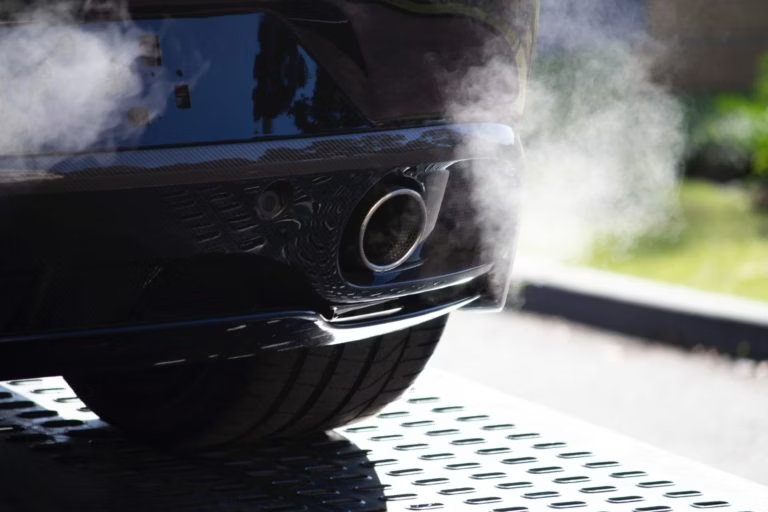
But on real roads, they emitted up to 40 times the legal limit of nitrogen oxides (NOx) a pollutant linked to asthma, heart disease, and premature deaths.
Volkswagen later admitted wrongdoing, paying over €32 billion (£27.8 billion) in fines and settlements worldwide, including £193 million to 91,000 UK motorists in 2022. The company’s “clean diesel” reputation collapsed overnight.
Now, five rival manufacturers - Mercedes-Benz, Ford, Nissan, Renault, and Stellantis (which owns Peugeot, Citroën, Vauxhall, and Fiat) are accused of using similar technology to pass emissions tests while emitting far higher pollutants in everyday driving.
Law firms including Leigh Day, Slater and Gordon, and Milberg London represent drivers in what they describe as a “once-in-a-generation” legal battle for environmental justice and consumer compensation.
The claimants allege that the five carmakers installed emissions defeat devices, software that could detect when a car was undergoing laboratory testing and temporarily reduce pollution output to comply with EU emissions standards.
Outside testing conditions, however, the cars allegedly reverted to normal performance mode, producing much higher levels of nitrogen dioxide (NO₂) and particulate matter than allowed by law.
“A decade after the Dieselgate scandal first came to light, 1.6 million UK motorists now get their chance to establish at trial whether their vehicles contained technology designed to cheat emissions tests.”
If the High Court rules in favor of motorists, the total payout could exceed £6 billion - potentially more than the Volkswagen settlement.
Each driver could receive compensation for misrepresentation, loss of value, and environmental damage, depending on the make and model of their vehicle.
Affected cars include diesel models produced between 2007 and 2020, covering popular brands like Peugeot 3008, Nissan Qashqai, Ford Focus, Renault Megane, and Mercedes C-Class.
This new trial could pave the way for additional claims against BMW, Jaguar Land Rover, Toyota, Volvo, Mazda, and other manufacturers under investigation.
All five defendants have denied using illegal software and insist they complied with emissions laws at the time.
Mercedes-Benz said its systems were “legally and technically justified.”
Renault and Stellantis claimed their vehicles met all European emissions regulations when sold.
Ford dismissed the lawsuit as “without merit.”
Nissan reiterated its “commitment to regulatory compliance in every market.”
The companies are expected to argue that the alleged software functions were designed to protect engines from damage, not to falsify test results - a technical distinction that could decide the outcome.
The High Court trial is expected to last three months, focusing on a sample group of vehicles from each carmaker. Judges will decide whether the software qualifies as a “defeat device” under EU Regulation 715/2007.
A judgment is expected in mid-2026, with a second phase on compensation possibly starting later that year.
If the drivers win, it could trigger the largest consumer compensation payout in UK history, dwarfing previous automotive or financial settlements.
The case isn’t just about money. It’s about accountability for a decade of polluted air, damaged consumer trust, and the gradual death of the diesel engine’s reputation.
“People across Britain were promised clean, fuel-efficient vehicles,” said one claimant. “Instead, they were breathing toxic fumes while corporations cashed in on false advertising.”
Legal experts say the Dieselgate 2025 UK trial could reshape future emissions regulations, accelerate the phase-out of diesel cars, and influence EU environmental law enforcement.
Even as electric vehicles dominate headlines, millions of diesel cars remain on UK roads — many potentially affected by similar technology.
The High Court’s decision will reverberate far beyond the UK.
A ruling against the five manufacturers could establish a landmark precedent for emissions-related litigation worldwide, paving the way for class actions across Europe, Australia, and North America.
Legal experts say it could also force governments and regulators to tighten vehicle testing standards, accelerate the phase-out of diesel engines, and reframe how automakers disclose environmental performance data to consumers.
For the global auto sector, the reputational stakes are enormous. Analysts warn that the fallout could surpass Volkswagen’s original Dieselgate crisis, especially for brands publicly committed to sustainability and “net zero” targets.
A judgment confirming widespread emissions deception would undermine years of green marketing and erode consumer confidence at a time when the industry is racing to electrify.
Investors are watching closely, too. The case underscores how environmental, social, and governance (ESG) failures can rapidly evolve into multibillion-pound liabilities, with share prices, brand equity, and long-term trust all on the line.
What is the UK Dieselgate trial about?
The 2025 Dieselgate trial involves claims that five major carmakers — Mercedes-Benz, Ford, Renault, Nissan, and Stellantis — used illegal defeat devices to cheat emissions tests and mislead consumers about pollution levels.
How do I join the diesel emissions claim in the UK?
UK drivers who owned or leased affected diesel vehicles built between 2007 and 2020 may still register through law firms such as Leigh Day or Slater and Gordon for potential compensation.
How much compensation could diesel car owners get?
Payouts could range from £1,000 to £10,000 per vehicle, depending on brand, age, and level of deception proven in court.
When will the Dieselgate UK judgment be announced?
The first ruling is expected in mid-2026, with a follow-up compensation phase likely in autumn 2026.
Which car brands are under investigation for emissions cheating?
Volkswagen, Audi, Mercedes-Benz, Ford, Renault, Nissan, Peugeot, Citroën, Vauxhall, BMW, Jaguar Land Rover, Toyota, Mazda, and Volvo have all faced emissions-related claims in various markets.