
Understand Your Rights. Solve Your Legal Problems
Whether you are involved in a car accident or experience a trip or fall at work, accidents are a part of life. If you are injured as a result of an accident, life can become very frustrating and inconvenient, especially if the accident was caused by another party's negligence. In such instances, it is worth filing a personal injury case to receive the compensation you deserve. While it is possible to file a personal injury lawsuit on your own, you'll find several benefits come from hiring a professional personal injury lawyer to represent your interests. If you are on the fence about seeking legal help, here are a few key reasons you should:
Recovering from an accident can take a toll on both your mental and physical health. Having to take on a legal case on top of dealing with the aftermath of a traumatic incident can feel overwhelming. This is why it makes sense to delegate the task to someone who is qualified to handle the matter efficiently. While a good lawyer will always keep you in the loop, they will do most of the groundwork so you can make your recovery a priority.
Legal experts accustomed to handling personal injury claims will likely have had a lot of experience with similar cases and will be able to give you a realistic idea of your chances of getting the settlement you desire. They'll assess the merits of your injury case and present the facts in a proper light to ensure success.
A reputable personal injury law firm will likely have represented hundreds of clients in similar personal injury cases. As such, they are likely adept at handling these cases and aware of some of the most common mistakes people make. They'll also have an intimate knowledge of the state's legal system they are practising in and will know what policies and procedures need to be adhered to.
Understandably, you won’t want to fork out a small fortune in legal fees unless there are some guarantees. Especially, since there are always lots of other expenses to deal with after an accident. For this reason, you’ll find that most personal injury lawyers work on a no-win, no-fee basis, so you won’t be expected to pay until they’ve helped you settle the case. Most reputable firms will arrange to take a certain percentage of your settlement as their fee, so it’s in their interest to help you receive the best possible settlement for the claim.
Being a victim of an injury can be stressful, and if the incident was not your fault, things can be all the more frustrating. In such instances, you must file a legal case against the negligent party to ensure you receive the compensation you deserve. Hiring a competent personal injury lawyer can make a huge difference when it comes to getting a good settlement. Allowing an expert to handle the case will also allow you to focus on your recovery's most important priority. Don't delay and find a good attorney today.
Google was fined amid increasing international pressure on online platforms to share more of the revenue they generate from using media outlets’ news.
Head of Google France, Sebastien Missoffe said: “We disagree with a number of legal elements, and believe that the fine is disproportionate to our efforts to reach an agreement and comply with the new law. We continue to work hard to resolve this case and put deals in place. This includes expanding offers to 1,200 publishers, clarifying aspects of our contracts, and sharing more data as requested by the French Competition Authority."
Google received its $591 million fine for failing to comply with the antitrust body’s orders on how to conduct talks with publishers. On Wednesday, the watchdog said that Google’s appeal, which will be ruled on by Paris’ court of appeal, would not hold up the fine. It remains unclear as to how the appeal process may take.
There are so many marketing channels that it can get a little confusing, especially if your expertise is not in advertising. When you are getting started with promoting your law firm you will be confronted with numerous strategies that you can employ to try and attract new clients, such as digital marketing, print marketing, SEO, blogs, or even old-fashioned billboard advertisements. However, there are two crucial elements that you have to consider as you develop your law firm’s marketing plan so you do not waste your time, your energy and – most importantly – your budget. The first point to remember is that you must always market for your customers and potential clients, and the second point is that you need to create a clear and concise plan which is tailored to your business.
Unequivocally, this would be a no. Like your customers, no two law firms are the same. Every law firm will be at a different point in their law marketing journey, so ensure that you plan for your firm and that you do not simply copy other law firms who may have different goals to you.
When marketing a law firm, you should make sure to consider:
To put this into an example, if your organisation is a brand new personal injury law firm, you will be at a different stage of your marketing journey compared to an established local family law firm. A well-known legal practice specialising in family law will likely already have a strong referral network, a website and a current marketing strategy that includes a social media presence and maybe a blog, but a new firm operating in a different market may not have a website or social media channels and is unlikely to have cemented a reputation yet. Planning where to spend the legal marketing budget for each of these firms will require a different and tailored approach, potentially using different channels.
There will also be different costs that will need to be considered depending on the practice area. Using the example above, personal injury law is traditionally more expensive and requires a much higher CPL (cost per lead) whether you are marketing online or offline. Family law is renowned for being a much lower cost area of law marketing, thus requiring less spend.
[ymal]
Right now there is, frankly, a huge amount of marketing channels available to law firms – some would say a daunting number for your consideration. Below are a few of the key channels that you should at least be considering as you map out your legal marketing strategy.
A recent study showed that, for a lot of law firms, email was the most-employed marketing channel, followed by organic social media (in contrast with paid social media advertising, which was much lower). Below you can see the full breakdown of where law firms are allocating their budget.
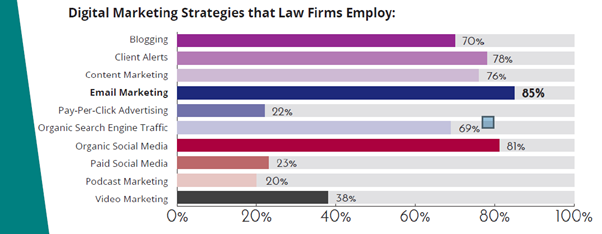
While the above may help to provide suggestions and give an insight into what others are doing, it remains vital that your law firm forge its own marketing path dependent on your goals. It should be added that the above chart may also be a little confusing in terms of what the difference is between organic and paid social media, for example. Legal marketing and its numerous channels can seem overwhelming, too. Marketing, much like the law, has a raft of its own terms and abbreviations which can be confusing. But do not be alarmed; a lot of them might not even be applicable to you at this time.
In simple terms, you need to market your law firm where your customers are.
When it comes to looking for a lawyer, consumers indicated that the following methods were what led them to selecting their law firm:
Looking at the above, it may be tempting to think that you can just sit back and rely on referrals, but this would be unwise. Why? Because these days, everything is connected. The majority of people who receive a referral from a friend or family will at the very least check that business online. If you have a multi-faceted approach, you will be more likely to bring in more traffic, more engagement and more leads. This does not mean that you have to spend money on every form of marketing – what it means is that you should prioritise your goals and match them to your customer intent.
A recent study showed that, for a lot of law firms, email was the most-employed marketing channel.
In order to match your goals to your customers, you will have to ensure you are marketing in the right place. Below are a few top tips to help you decide which avenues are best to spend your legal marketing budget.
First and foremost, if you are not online then we would strongly recommend getting a website. As mentioned, more and more clients are finding law firms through search engines – in fact, a combined 78% of consumers look for lawyers online. If you are not there, put simply, you will not be found. This is why you should make sure you have a good website. It should be clear, impactful and – most importantly – include all of the pertinent information that your clients will want to see.
With the rise of search engines, SEO (or search engine optimisation) has become more and more important. Simply put, SEO is the practice of improving web content to get it show as high up the search results pages (or SERPs) as possible. Once you have a good, working website, your next step would be to focus on some level of SEO so that your website is appearing as a result of what your customers are searching.
This is the next step in the website journey. If you add a blog to your website, you can begin to tap into your law firm’s wealth of knowledge to provide answers to client questions and place yourself in front of them as a source of authority, allowing you to build trust and showcase your law firm. One word of caution is to only use a blog if you have the time to write blogs. Nothing is quite so off-putting as heading to a website’s blog page only to find that it was last updated in 2017.
In order to match your goals to your customers, you will have to ensure you are marketing in the right place.
Internet traffic arriving to websites from PPC delivers 50% more leads than organic traffic, so this is an area that is not to be ignored. Unfortunately for a lot of legal practice areas, it also happens to be quite expensive! But do not be discouraged. PPC can be an excellent form of both exposure and customer acquisition.
Because the world is so connected these days, the temptation is to ‘go global’ straight away, but you may end up reaching consumers who are halfway around the world when your firm is not international. So, think local; some of the best campaigns can be the most locally targeted, whether that be a billboard or an advert on local radio. If you are looking to target potential clients in your area, then make sure you allocate some of your budget on local advertising. Do not forget that you can also target locally on global platforms, create a Google Business page and encourage clients to positively review your law firm. Facebook advertising can be targeted to within a mile of your office, and you can even write blogs specifically using topics and keywords that you know will be popular with local audiences.
Social media can be an excellent tool for your law firm, but it can also be time-consuming and confusing. A solid social media strategy that is tailored to your audience is therefore highly recommended – but getting your law firm an account on every social media channel and paying Instagram influencers and a full-time TikTok content creator when your potential clients aren’t on Instagram or TikTok is not. You might also benefit from including some paid social media adverts to increase client awareness of your law firm, but make sure you target them and do not just put adverts live without any consideration.
Some of the best campaigns can be the most locally targeted, whether that be a billboard or an advert on local radio.
In today’s digital age, the temptation to abandon traditional advertising options Is all too real. But for many law firms, some of the more established marketing channels are that for a reason: because they work. If your firm is new and looking for local clients, consider an advert in your local newspaper. If you are working for an international law firm opening a new office in New York, reach out to a PR firm to help get your news out there.
Almost all the advice these days is to follow a certain checklist of steps, but with an increase in channels (and enough time) you can afford to be a little more creative. Sponsoring a charity event or sports team, creating a YouTube channel for your firm or even creating your own legal podcast are now all viable ways to reach your marketing goals.
In short, there is no right or wrong way to spend your legal marketing budget as long as you create a strategy designed with your goals and your customers in mind. If you are still unsure about the best way forward, it is worth speaking to a legal marketing company who will be able to help you plan and execute a targeted legal marketing strategy.
Early this August, the Intergovernmental Panel on Climate Change (IPCC) released a report examining the physical impact of climate change on the world. The sixth such report yet released by the UN body and compiled from over 14,000 scientific papers, the report provided an up-to-date assessment of climate change as it is currently understood.
Its conclusions were bleak: human activity is “unequivocally” warming the planet, it warned, causing rapid and widespread damage to the biosphere. It also highlighted that weather extremes resulting from this warming have already been observed, and that initiatives to limit global temperature increases to 1.5°C above pre-industrial levels will fall short unless carbon emissions can be deeply reduced in the coming decades.
The release of the IPCC report coincided with a series of devastating floods in Europe that have been cited as lending credence to its claims regarding weather extremes. Both events also served to draw renewed attention to governmental efforts to combat the worst outcomes of climate change and the question of how effective they will be in the crucial years to come.
By 1990 there were only 35 laws related to climate change worldwide, owing to a lack of awareness of the issue at that time. Consequently, almost all climate change laws currently in effect have been passed within the last three decades.
The 1.5°C figure quoted above formed a key part of the negotiations of the 2015 Paris Agreement, wherein a number of nations – including several low-lying islands – successfully pushed for that temperature increase to be set as a target in the deal, arguing that allowing a greater increase would threaten their survival. The Agreement requires all supporting countries to set pledges to reduce their carbon emissions, with the aim of keeping the global average temperature from rising above 2°C and “pursuing efforts” to limit it to 1.5°C (temperatures having already risen above 1°C). Signatories are expected to assess their progress towards implementing these requirements through a “global stockade”, the first of which is planned for 2023.
By 1990 there were only 35 laws related to climate change worldwide, owing to a lack of awareness of the issue at that time.
The Paris Agreement followed on the heels of a marked acceleration in climate change legislation from the 1990s onwards, which reached a peak between 1999 and 2014 when more than 120 laws related to climate change were passed each year. Yet, as the findings of the IPCC report have demonstrated, the creation of these laws has not been sufficient to shift the global emissions trajectory towards a sustainable level.
A 2020 study of panel data on the legislative activity of 133 nations found that climate change laws enacted between 1996 and 2016 reduced global CO2 emissions by the equivalent of one year’s worth of carbon output. While impressive when taken alone, this rate of progress will not come close to reducing emissions to the level necessary to meet the Paris Agreement’s target of a 1.5°C total increase.
Climate experts also broadly agree that the Paris Agreement by itself is insufficient to achieve the climate change targets it has set. Though the Agreement was legally binding, its signatory nations set their own emissions reduction targets, and there is no enforcement mechanism to ensure their adherence. A tracker designed by German non-profits Climate Analytics and NewClimate Institute estimates that current climate change policies would result in a 2.9°C rise by 2100, or 2.6°C should all governments fully enact the pledges that they have made so far under the Agreement.
The progress made by individual nations in regards to climate change is predictably sporadic. In the US, the Supreme Court holds that the EPA has the authority and obligation to regulate greenhouse gas emissions pursuant to the Clean Air Act, yet the Supreme Court has also mostly struck down the greenhouse gas regulations that the EPA has attempted to implement in the past. The Clean Air Act itself was last amended in 1990 and is widely agreed to be unsuited to the regulation of greenhouse gases, though the current deadlock in Congress leaves either its updating or the acceptance of a more suitable bill a matter of speculation.
Meanwhile, member states of the EU officially adopted the European Green Deal project on 14 July, introducing a raft of policies aimed at reducing carbon emissions by 55% as of 2030 and achieving net-zero emissions by 2050 through the use of roughly €1 trillion of investments. The Green Deal focuses on encouraging businesses to adopt sustainability measures, but also includes a bundle of further initiatives such as the European Climate Law, enshrining the bloc’s 2050 net-zero emissions target among other anti-climate change measures. Though hailed as a landmark climate law, the deal has faced significant political opposition on the grounds that it was not ambitious enough to tackle the threat of climate change.
[ymal]
On the subject of emerging climate change legislation, Sylvie Gallage-Alwis, partner at the Paris office of Signature Litigation, suggested that to focus on the relative ambitiousness of the new laws would be to miss the point.
”In my view, it is not about whether this legislative progress is enough or not. The real issue is whether the enforcement ability of authorities and Courts is appropriate,” she commented. “Incentivising and having a global approach should be encouraged as scientists insist on the fact that human behaviour is the key to our future.”
Climate-related litigation has been on the rise, with landmark cases such as Urgenda Foundation v The State of the Netherlands, a class action that forced the Dutch government to raise its emissions reduction aims. There has also been a marked increase in so-called “greenwashing” accusations.
Notably, however, studies of climate-based rulings so far have shown that the judiciary is not predisposed towards supporting climate action. One study of 534 US cases leading up to 2016 found that judges ruled in favour of stronger climate action around 40% of the time, compared to around 50% of the time internationally.
World leaders will gather in Glasgow this November for COP26, a crucial UN climate summit that has been billed as the last major opportunity to strategise a method for keeping the global average temperature increase at 1.5°C. Like the IPCC report, it is expected to build pressure on governments to provide concrete action plans for how this will be achieved.
Studies of climate-based rulings so far have shown that the judiciary is not predisposed towards supporting climate action.
It is predicted that nine years remain before the window for averting the worst consequences of climate change will be closed. We at Lawyer Monthly will continue to cover the progress of legislation to this effect as COP26 approaches and beyond into 2022.
BAWAG Group acquired Hello Bank!, Austria’s largest online broker, from French financing group BNP Paribas. Fellner Wratzfeld & Partner (fwp) advised BAWAG, while Binder Grösswang advised the seller. The deal was signed on 22 July and is expected to be closed by the end of 2021.
Hello Bank! has been a leader in Austria’s online brokerage market for more than 25 years, with a base of around 80,000 customers and over €8 billion in assets under management. The bank handled more than 1.8 million securities transactions in Austria as per year-end 2020.
The fwp team was headed by partners Markus Fellner (Corporate/M&A, Banking) and Paul Luiki (Corporate/M&A) and comprised Roswitha Seekirchner (Corporate/M&A), Peter Stiegler (Corporate/M&A), Mario Burger (Corporate/M&A), Martin Navara (Corporate/M&A), Roman Schlemaier (Corporate/M&A), Julia Berger (Corporate), Elisabeth Fischer-Schwarz (Banking), Lukas Flener (Anti-Trust Law), Gregor Schett (Retail Consumer Law) and Veronika Seronova (Retail Consumer Law), who were once again able to demonstrate outstanding expertise in complex Corporate/M&A deals subject to banking regulation.
Carbonetti e Associati advised SIFI, an Italian ophthalmic pharmaceutical company that provides solutions for the treatment of eye diseases, on a loan granted by a pool of five banks (assisted by Simmons & Simmons) and backed by the Italian Guarantee issued by SACE. The aim of the measure was to provide support for the business as part of Italy’s post-pandemic recovery.
The transaction, which came to a total of €34.4 million, involved Banco BPM as agent bank, custodian bank and SACE Agent, as well as Intesa Sanpaolo, Banca del Mezzogiorno - Mediocredito Centrale, Creval, BPER and Banco BPM itself as arranger banks, bookrunners and lending banks.
Carbonetti e Associati assisted SIFI with a team led by managing partner Fabrizio Carbonetti and including associate Matteo Morselli. Simmons & Simmons assisted the pool of lenders with a team comprising partner Davide D’Affronto, managing associate Fabrizio Nebuloni and trainees Francesco Burla and Luigi Terenzio Trigona.
Fellner Wratzfeld & Partner (fwp) advised Soravia on its acquisition of the Immo-Contract companies from the Volksbanken Group. Binder Grösswang reportedly advised the seller. The closing took place on 21 June 2021 and details of the transaction were not disclosed.
fwp stated that the merger’s aim was to leverage existing synergies in a bid to merge Soravia and the Immo-Contract companies into “one single real estate network from which clients of Volksbanken Group will also be able to benefit.”
fwp’s team comprised Partners Markus Fellner (Corporate/M&A and Banking Law) and Lukas Flener (Antitrust Law), Lawyers Roswitha Seekirchner (Corporate/M&A) and Peter Stiegler (Corporate/M&A), and Associates Martin Navara (Corporate/M&A) and Roman Schlemaier (Corporate/M&A). Soravia, one of the leading real estate groups in Austria and Germany, is a long-standing client of fwp.
Irish solar PV developer Power Capital Renewable Energy (PCRE) acquired a majority interest in a 407 megawatt (MW) solar portfolio from Terra Solar, a Dublin-based solar energy company founded by two former private equity executives. Philip Lee advised the buyer, PCRE, and Beauchamps advised Terra Solar on the sale.
Over the next five years, PCRE intends to complete development of the solar farms located in counties Cork and Wexford in partnership with Terra Solar, with construction due to commence next year. The first plants are expected to be operational by the middle of 2023 and the project completed by 2027. The deal raises PCRE’s total portfolio to 840MW, and the company expects that roughly €200 million will be required to build out the entire portfolio. Equity will be provided by Omnes, with debt to be raised with Irish and international lenders.
The Philip Lee team was comprised of Eoghan Doyle, Síobhan McCabe, Hugo Grattirola, Maeve Delargy, and Elaine Whelan. The Beauchamps team comprised Ainsley Heffernan, Daire Russell, John Sweeney and Stuart Conaty.
Gore & Grimes Solicitors LLP assisted Park Developments on the sale of a portfolio of logistics units at Northwest Logistics Park in Dublin for €47.9 million.
The assets, which include four high-spec buildings extending to more than 242,000 square feet and let on long-term leases, have been bought by Savills Investment Management’s Commercial Fund. The fund is a pan-European multi-sector operation with a focus on office, retail and logistics assets. Its purchase of the logistics units is believed to represent a “significant investment” in the Irish market as the fund actively seeks further investment opportunities across the nation.
The sale of the units was undertaken by two lots. Lot 1 comprised of three completed units, the sale of which was completed within one month of exchange of contracts, while Lot 2 comprised of the fourth unit, which isunder construction and the sale of which will not be completed until March 2022.
Along with Gore & Grimes, Park Developments was represented by Savills and CBRE. The Gore & Grimes team was led by partner Keith McConnell. Savills IM was advised by A&L Goodbody.
Bremen-based investment company FMC secured the operational business of the Dradura Group, a manufacturer which went into self-administration in August 2020, putting around 1,100 jobs at risk. Dradura is known nationally for manufacturing industrially formed wire products such as dishwashers, refrigerators and equipment for medical technology companies.
Last summer, Dradura filed an application with the Ludwigshafen district court to open insolvency proceedings in self-administration. After the parties could not agree on a timely solution, insolvency proceedings followed in November over the assets of Dradura Beteiligungs GmbH, which held the foreign subsidiaries of the Dradura Group in France, Poland and the US.
The stake in Dradura France, which primarily supplies the automotive sector, was sold to a co-partner in spring 2021. The remaining operational business will now go to FMC Beteiligungs KG. In addition to the headquarters in Altleiningen, this will include the business in Poland and the US as well as locations in Germany and Italy. Dradura has been part of the portfolio of the private equity firm Emeram Capital since the end of 2016.
Reinhart Kober Großkinsky Braun (RKGB) advised Dradura on the transaction alongside Wallner Weiß and SZA Schilling, Zutt & Anschütz. FMC was advised by Lambrecht and RSM.
