
Understand Your Rights. Solve Your Legal Problems
A shooting at Wilmer-Hutchins High School in Dallas on Tuesday afternoon left four students injured and a community once again gripped by fear. The incident unfolded just after 1 p.m., when chaos erupted inside the school, prompting students and staff to run for cover as shots rang out.
Four male students, aged 15 to 18, were hospitalized following the attack. Three suffered gunshot wounds while the fourth sustained a musculoskeletal injury, according to Dallas Fire-Rescue. Their injuries range from serious to non-life-threatening.
Authorities quickly identified the suspect as 17-year-old Tracy Haynes, who later turned himself in to law enforcement.
He has since been charged with four counts of aggravated assault in a mass shooting and is currently being held on a $600,000 bond in the Dallas County Jail.
This marks the second shooting at Wilmer-Hutchins High School in just over a year, intensifying concerns about school safety and the presence of firearms on campus. Dallas ISD Superintendent Stephanie Elizalde voiced frustration and sadness during a press briefing, saying, “This is becoming way too familiar, and it should not be.”
WATCH: Press conference on the incident at Wilmer-Hutchins High School with Superintendent Stephanie S. Elizalde, Ed.D. pic.twitter.com/g9hsWDlPbr
— Dallas ISD (@dallasschools) April 15, 2025
School officials stated that the gun did not enter the building during the routine morning intake period, when all students are screened through metal detectors. How the weapon ultimately made it into the school remains under investigation.
In the aftermath of the shooting, Dallas ISD canceled classes for the remainder of the week and deployed crisis counselors to support students, staff, and families grappling with the traumatic event.
Law enforcement continues to investigate the circumstances that led to the violence, while community members demand answers and increased protections for students.
Governor Greg Abbott expressed condolences to those affected and emphasized the ongoing need to ensure school safety across Texas.
As Wilmer-Hutchins High School tries to recover from another act of violence, the pain is still raw and the questions are many. For the families affected, and for a community left shaken, one thing is certain - the conversation around gun violence is far from over.
DOJ Silent on Liz Oyer Blocking Mel Gibson's Gun Rights Plea
Terry Baralt Hospitalized After Menendez Courtroom Photo Clash
Coyote Pass is officially gone! Sister Wives stars Kody Brown, Robyn Brown, Meri Brown, and Janelle Brown have offloaded the plots of land originally envisioned for the formerly polygamous family’s dream residences.
The Brown family has officially sold off Coyote Pass, the 14-acre property that had, for years, been presented to viewers of Sister Wives as the physical and emotional centerpiece of their polygamous lifestyle.
The land, originally purchased in 2018 with high hopes of constructing multiple homes to accommodate Kody Brown and his four wives — Meri, Janelle, Christine, and Robyn — has now been parceled out and sold for a total of $1.5 million, a figure that not only represents a financial gain of $680,000 but also symbolizes the final unraveling of a plan that had already been crumbling in slow motion for years.

Sister Wives - Coyote Pass Drama Ruined The Brown Family
According to property records, the family divided and sold off the land in multiple transactions, with a 2.42-acre plot owned by Kody and Robyn selling for $305,000 on April 24, followed by a similarly sized parcel under Meri and Janelle’s names that was also sold for $305,000, while an additional 4.48 acres fetched $400,000 and the final, largest slice — a 5.19-acre lot — closed for $490,000, completing the dissolution of a once-ambitious project that never quite made it past the planning stages.
What makes the timing even more telling is that just a few weeks prior to the land being sold, Kody and Robyn quietly transferred a portion of their ownership to Meri and Janelle, adjusting the balance so that the four co-owners each held a clearly defined share, with Kody and Robyn retaining 50 percent and Meri and Janelle each holding 25 percent — a move that likely cleared the way for a smooth sale and, perhaps, settled lingering tensions over who was entitled to what.
Long before these transactions took place, however, Christine Woolley (formerly Brown) had already distanced herself from the land and the family dream attached to it; she officially sold her share back in July 2022 for the symbolic price of just $10, a gesture that seemed to speak volumes about where she stood emotionally following her separation from Kody in 2021, after nearly three decades in a spiritual marriage that, like the land itself, began with high hopes and ended in quiet surrender.
Kody’s original vision for Coyote Pass was ambitious — perhaps even idealistic — as he imagined a single, enormous home that would serve as a shared residence for himself, his four wives, and their children, creating what he believed could be a modern, functional expression of plural marriage, but it didn’t take long for that plan to fall apart, as the wives expressed strong opposition to living under the same roof, prompting a pivot toward the idea of five separate homes, one for each wife and a fifth for Kody that would serve as a gathering space for family events.
That revised vision never came to life either, largely because a string of real-world challenges slowed everything down — first the pandemic, which brought construction plans to a halt, then the drawn-out process of selling their homes in Las Vegas, and finally, the unraveling of the family itself, as Christine’s departure marked the beginning of a steady exodus that eventually included Janelle and, later, Meri, all of whom left the marriage as their personal relationships with Kody grew increasingly strained and emotionally untenable.
All of this unfolded in real time on national television, as fans of Sister Wives watched the drama play out episode by episode, including a series of increasingly tense discussions about property shares, ownership disputes, and who had contributed what to the Coyote Pass project, with Kody at one point insisting during a January broadcast that he had paid for “at least 92 percent” of the land himself and that the wives had only covered costs on the smaller sections, an assertion that added fuel to an already simmering fire of resentment and confusion.
Although Kody and Robyn had previously floated the idea of selling the property — a proposal that Meri and Janelle were openly against at the time — the deal eventually went through, leaving behind not just empty land but a symbolic void where a family dream once stood, and raising the question of whether Coyote Pass was ever truly destined to bring the Browns together or if it was simply a placeholder for a vision that never aligned with the emotional realities of the people involved.
Now that the sale is finalized, what remains is not the land or the blueprints that were never used, but a trail of broken relationships, televised arguments, and what-ifs, all anchored to a piece of property that began as a promise and ended as a footnote in a much larger story of family, faith, and fracture.
You Might Also Like:
🔹 Jim Bob Duggar’s Secret Walmart Land Deal Raises Eyebrows
The former 19 Kids and Counting star quietly flipped land near a Walmart — now questions are swirling about the legality of the deal.
🔹 Drake Faces Court Over Kendrick Diss Track — Trial Could Set New Industry Standard
What began as a rap battle might now become a precedent-setting courtroom drama over artistic rights and lyrical intent.
🔹 Tony Bennett’s Estate Battle Turns Ugly as Family Feuds Over Millions
The beloved crooner’s legacy is now entangled in a family inheritance dispute that’s making headlines for all the wrong reasons.
🔹 Karmelo Anthony’s Family Accused of “Blood Money” Spending After Teen’s Tragic Death
After receiving $430K in settlement funds, the family invested in home security — but critics say the money came at too high a cost.
Florida Becomes First State to Officially Recognize "Gulf of America"
Florida has made headlines as the first U.S. state to officially adopt the term "Gulf of America," replacing the historically recognized "Gulf of Mexico" in state statutes and educational materials.
The decision, signed into law by Governor Ron DeSantis, has sparked heated debate across legal, political, and international circles.
On April 14, 2025, Governor DeSantis signed two bills: HB 575 and HB 549 that require state agencies, schools, and even public maps to use the new name. Starting July 1, all official materials in Florida must swap "Gulf of Mexico" for "Gulf of America."
“This is about reclaiming our national identity and pride,” DeSantis said at a press conference in Panama City. “The Gulf of America belongs to Americans.”
Supporters say the change is about patriotism. Critics call it political theater. Either way, it’s now the law in Florida.
Florida's move didn’t come out of nowhere. It follows Executive Order 14172, signed by President Donald Trump on his first day back in office this January. The order tells federal agencies to use "Gulf of America" in all communications and documents.
But here’s the catch: executive orders apply only to federal agencies. They don’t change how private companies, states, or international bodies label the region.
“EO 14172 is largely symbolic,” said Professor Amelia Castro, a constitutional law expert at Georgetown. “It doesn’t carry legal weight outside the executive branch, but it signals a shift in messaging and that has consequences.”
Legally speaking, yes sort of.
Under the Tenth Amendment, states have the power to control how they label things like maps and textbooks. Florida can call it whatever it wants within its own borders. But that doesn’t mean the name holds any weight outside the state.
“Florida can update its signage and curriculum,” said maritime law expert Lisa Renard, “but internationally, it’s still the Gulf of Mexico. That name is recognized by global treaties, nautical maps, and the U.S. Board on Geographic Names.”
So while the state’s move is legal, its impact is more cultural than practical for now.
Not everyone is on board. Mexico quickly condemned the change, with President Claudia Sheinbaum calling it “provocative and ahistorical.” In a tongue-in-cheek reply, she suggested renaming North America to “Mexican America.”
The U.K. and European Union also pushed back, stating they will continue to recognize the traditional name in all international references.
Even within the U.S., many institutions are holding firm. Outlets like the Associated Press and National Geographic still use "Gulf of Mexico." Some federal agencies, including NOAA, have reportedly begun using "Gulf of America," deepening the confusion.
If this was meant to win hearts and minds, the early numbers don’t look great.
A Gallup poll from January 2025 found that 72% of American voters oppose the name change. Still, the rebrand is already being used in some Florida school districts and on tourism websites.
Supporters believe the name will eventually catch on. Others see it as a political distraction or a play for attention ahead of election season.
Legal experts say lawsuits could be coming. Some education advocates argue that forcing schools to adopt the new name could violate academic standards or place an unfair burden on public resources.
As the debate over Florida’s “Gulf of America” renaming continues to stir headlines and legal questions, it also highlights bigger issues shaping American law and identity today. For readers interested in the deeper implications, here are two key areas to explore:
🔹 Executive Orders and State Law
What happens when federal and state powers collide? Executive orders like EO 14172 may set federal policy, but they don’t always carry legal force at the state level. Dive into how constitutional boundaries shape the relationship between presidential authority and state autonomy—especially when symbolism turns into legislation.
🔹 Geographic Naming Disputes
Florida isn’t the first to ignite controversy over a name. From international spats like the Sea of Japan vs. East Sea, to the enduring debate over the Persian Gulf, naming disputes often reflect deeper tensions around nationalism, territory, and identity. Learn how these disputes are handled legally—both in the U.S. and around the world.
So far, no formal challenges have been filed but several groups are reportedly exploring their options. For now, expect to see both names in circulation. Just don’t expect everyone to agree on what to call it.
Defamation Law in the U.S. Explained
Understand how U.S. defamation laws protect reputations and where the legal boundaries lie.
Top U.S. Trial Lawyers of 2025 – Lawyer Monthly’s Expert Rankings
See who’s leading the courtroom across America in this exclusive annual roundup.
Alarming Trends in the CCF’s Questioning of Its Adversarial Procedure
Why legal scholars are raising red flags about shifts in courtroom fairness.
Atlanta Veteran Files VA Malpractice Lawsuit
A look at the legal challenges facing veterans in VA medical malpractice cases.
Nick Carter Faces New Sexual Assault & HPV Transmission Lawsuit
Exploring the legal fallout from a high-profile case involving the former Backstreet Boy.
Consolidated Burger Holdings, which runs 75 Burger King restaurants across Florida and Georgia, has filed for Chapter 11 bankruptcy. The filing landed in federal court in Florida, marking a dramatic turn for the once-thriving franchisee.
In court documents, the company revealed it owes tens of millions of dollars and has more than 200 unpaid creditors. This collapse adds to a growing trend of financial trouble sweeping through the fast-food world.
The road to bankruptcy has been anything but sudden. Consolidated had been in a drawn-out legal fight with Burger King Corporation over a franchise agreement that dates back to 2019. While both sides reached a settlement last fall, the damage had already been done.
Burger King is still owed more than $2.4 million in unpaid fees. Other debts include unpaid rent, vendor invoices, and operational costs that spiraled out of control.
Filing for Chapter 11 gives Consolidated a shot at turning things around without shutting down its restaurants. The company secured a $1.6 million emergency loan known as debtor-in-possession financing, which helps keep the lights on during the legal process.
That money will go toward payroll, rent, and daily expenses while the company figures out its next move.
Two related entities, Consolidated Burger A and B, are also part of the bankruptcy. A restructuring expert, Joseph J. Luzinski, is now leading the company through the process, with legal support from Berger Singerman LLP.
This situation raises real concerns for anyone working in franchise or insolvency law. The case offers a front-row look at what happens when a franchise breaks down under legal and financial pressure.
Some key takeaways:
Legal disputes with franchisors can linger for years and drain resources even after they’re “resolved.”
Emergency loans like DIP financing are often the only way to stay open during restructuring, but they come with conditions.
Franchisees with large footprints and staff face even bigger ripple effects when things go wrong.
If this all sounds familiar, it’s because the industry has seen it before. Back in the early 2000s, a massive Burger King franchisee called AmeriKing went bankrupt after operating nearly 400 locations.
Today, the issues are different, but just as intense. Labor costs are rising, prices are going up, and customers are shifting their spending habits. That’s putting more pressure on franchisees who are stuck in old contracts and outdated operating models.
Burger King has lost multiple franchisees to bankruptcy in the past decade, including TOMS King and Meridian Restaurants, both of which also cited rising costs and franchise disputes.
Chapter 11 isn’t uncommon in fast food. Competitors like Subway and Pizza Hut have also seen franchisees restructure or close hundreds of locations to cut losses and renegotiate leases.
AmeriKing, once Burger King's largest U.S. operator, filed for bankruptcy in 2002 with nearly 400 locations—foreshadowing the risks of rapid expansion without financial flexibility.
Debtor-in-possession (DIP) loans, like the $1.6 million secured by Consolidated, are becoming more common in franchise bankruptcies. They help businesses survive—but often come with tight oversight from lenders and the court.
Florida and Georgia, where Consolidated operated, are both top-ten states for franchise litigation volume, making them hotspots for legal disputes involving major QSR brands.
Burger King's modernization plan, announced in 2022, promised $400M in investment—but franchisees were required to co-invest or risk falling behind. Some couldn’t keep up, leading to closures or sell-offs.
🔹 Kirkland Advises Kodiak SPAC Deal in Autonomous Trucking Push
🔹 Harvard Faces Wall Street Pressure as Bailouts Freeze Research Funding
🔹 Backstreet Boy Nick Carter Hit with HPV Sexual Assault Lawsuit
🔹 Justice for Sara Millerey: Colombia’s Human Rights Reckoning
Kirkland & Ellis LLP has advised Ares Acquisition Corporation II (AACT) in a landmark business combination with Kodiak, a trailblazer in . The deal values Kodiak at a pre-money equity valuation of $2.5 billion and marks a major step in the company’AI-powered autonomous vehicle technologys journey toward reshaping the future of the trucking industry.
Upon closing, the combined company is expected to receive approximately $551 million in cash from AACT’s trust account, assuming no redemptions, based on the trust’s value as of December 31, 2024.
In addition, institutional investors including Soros Fund Management, ARK Investments, and Ares Management affiliates, have committed over $110 million in support of the transaction.
The Kirkland team guiding AACT includes corporate partners Monica Shilling and Walton Dumas, and capital markets partners Pippa Bond and Van Whiting.
“This is a remarkable milestone for the Kodiak team and reinforces our confidence in the significant value proposition we see in our differentiated driverless technology. We believe entering the public markets will accelerate our strategy to expand our existing partner relationships, provide our technology to a broader customer base, and deliver enhanced solutions across the commercial trucking and public sector industries.
Further, with Kodiak's disciplined approach to capital management, along with strategic and financial support from Ares, we believe we are well-positioned to execute on our long-term growth plans. On behalf of the entire Kodiak team, we are thrilled to be working with Ares and AACT as we continue to drive our mission to create a safer and more efficient future for the trucking industry.” said Don Burnette, Founder and CEO of Kodiak.
David Kaplan, CEO and Co-Chairman of AACT and Co-Founder of Ares, praised Kodiak’s innovation:
“As an early-mover in autonomous trucking and first to deliver a commercial driverless product to a customer, Kodiak has quickly set itself apart as an industry leader in a significant addressable market. We are excited to partner with Don and the Kodiak team as they seek to further capitalize on significant industry tailwinds and deliver value for their stakeholders."
Allyson Satin, COO of AACT and Partner at Ares, echoed the sentiment:
“We believe Kodiak's scalable technology, combined with its established network, position the Company to meet the evolving and growing demands of its customers and communities. We look forward to lending Ares' decades of experience investing and navigating through dynamic market environments in support of Kodiak's long-term goals."
Kodiak Robotics is a leading autonomous trucking company founded in 2018 by self-driving pioneer Don Burnette. Headquartered in Mountain View, California, with operations in Texas, Kodiak develops cutting-edge AI technology to make long-haul trucking safer and more efficient. Its core product, the Kodiak Driver, has completed millions of autonomous miles and thousands of commercial deliveries. The company also partners with the U.S. Department of Defense to adapt its tech for military use, underscoring its leadership in both commercial and government applications.
Ares Management Corporation is a leading global alternative investment manager, offering a broad range of investment solutions across credit, private equity, real estate, and infrastructure. Founded in 1997 and headquartered in Los Angeles, Ares operates in North America, Europe, Asia Pacific, and the Middle East, with over 3,200 employees worldwide. As of December 31, 2024, the firm managed approximately $477 billion in assets under management. Renowned for its disciplined investment approach and commitment to driving positive change, Ares integrates ESG, diversity, and philanthropy into its business practices, positioning itself as a trusted partner for institutional and private investors worldwide.
Kirkland & Ellis is a leading global law firm known for its excellence in M&A, corporate law, litigation, intellectual property, and private equity. With offices in key financial centers worldwide, the firm advises clients across a broad range of industries. Recognized for its work on high-stakes transactions and disputes, Kirkland delivers innovative legal strategies backed by deep industry knowledge. Its focus on complex deals and cutting-edge solutions positions it as a trusted advisor in the global legal market.
Harvey Weinstein has been wheeled into court as his sex crimes retrial kicks off with a new witness accusing him of assault.
The disgraced film mogul is returning to court five years after he was convicted of rape and sentenced to prison, where his health has reportedly been "rapidly declining."
Weinstein, 73, is facing a retrial on the same charges he was convicted of—along with additional new accusations—after his 2020 conviction was overturned in a stunning appeal decision last year.
He arrived in a wheelchair, dressed in a blue tie and holding a book, at the Manhattan courthouse on Tuesday as jury selection began for the retrial, where a fresh, unidentified witness is prepared to testify against Weinstein.
The former Hollywood mogul was sentenced to 23 years in prison after over 80 women accused him of sexual misconduct. Following five years at New York City's infamous Rikers Island, Weinstein is reportedly experiencing significant health issues, including rapid weight gain and severe tongue inflammation, as reported by TMZ. Just days prior to the retrial, Weinstein's representative, Juda Engelmayer, informed TMZ that the health of the former studio executive is 'deteriorating rapidly while in custody.'
Engelmayer noted that Weinstein has gained 25 pounds, with 19 of those pounds added in the last month alone, after being returned to prison following a brief hospitalization earlier this year. Last week, he was readmitted to Bellevue Hospital to address a tongue infection that has made swallowing difficult, raising concerns about the risk of choking. Additionally, Weinstein has diabetes and was diagnosed last year with chronic myeloid leukemia, a rare form of bone marrow cancer.
Engelmayer stated that her client’s medical situation is worsened by "persistent problems with missed and delayed medications, unaddressed chest palpitations, and insufficient support for his severe mobility challenges."
Despite his fragile health, as observed in court in September, Weinstein's new trial is scheduled to last over a month, with three accusers prepared to testify against him.
Jessica Mann and Mimi Haley, two of the women who accused Weinstein during his first trial, will once again take the stand to recount their experiences of sexual assault.
Prosecutors will argue that Weinstein exploited his power in Hollywood to prey on vulnerable women, offering career advancements in exchange for sexual favors.
In April 2024, New York's appeals court overturned his conviction for third-degree rape and criminal sexual assault, ruling that the trial judge had made a significant error by allowing testimony from three additional women.
The court, in a 4-3 decision, determined that then-Judge James Burke was unfair in permitting those women to testify, as Weinstein had not been charged with the allegations they brought forward.
Weinstein's lawyers have also insisted that media coverage tainted the first trial.
“Five years ago when you guys were here, there were protests, there were people chanting ‘fry Harvey,’ ‘Harvey’s a rapist,” his lawyer, Arthur Aidala, said last week, according to the New York Post.
“There was #MeToo, Oprah Winfrey, and then, you know, all these people were just so against him.
"The jurors had to be terrified if they would have acquitted him about pushback from their own families and their own communities,” Aidala continued.
“I think that overall has died down. We have bigger things to worry about with stock markets crashing and wars overseas, and I just think that it’s a different environment.”
Manhattan Supreme Court Justice Curtis Farber said last week the trial will be based "on the facts and on the allegations, and nothing else."
I am confident that there will be justice in this case. It is important for women everywhere and for people who are victims of sexual assault everywhere that others pave the way and show their dedication in this fight against sexual assault
Lindsay Goldbrum
The fresh allegation against Weinstein comes from an unidentified actress, who claims the former Miramax head forced oral sex on her at a Manhattan hotel in 2006.
The accuser, who did not take part in the original trial, has requested to remain anonymous.
Her attorney, Lindsay Goldbrum, informed reporters on Tuesday that her client's testimony has been "clear and consistent," according to the Associated Press.
“It is important for women everywhere and for people who are victims of sexual assault everywhere that others pave the way and show their dedication in this fight against sexual assault.”
Opening statements in the trial are expected to begin next week.
Harvard, Wall Street Bailouts & Funding Freeze
Harvard faces scrutiny over its financial strategy as Wall Street bailouts and funding freezes continue to stir debates. Explore how this could impact the future of higher education and financial institutions. Read More
Lego Boss Michael Halbye Dies in Skiing Accident
The world mourns the tragic passing of Lego's CEO, Michael Halbye, after a skiing accident at the age of 64. Learn more about his legacy and the impact he had on the global brand. Read More
Trump’s Record High Approval Amid Tariff Chaos
President Trump's approval ratings reach record highs, despite the ongoing turmoil surrounding his tariff policies. Dive into the political implications of this unexpected rise. Read More
Karmelo Anthony’s Family Invests in Security After Teen's Death
Following the tragic death of a teen, Karmelo Anthony's family invests $430k in home security measures. This article explores the rise of such security measures among high-profile families. Read More
Patriots Fan Death: Charges Dropped
The charges surrounding the death of a Patriots fan have been dropped. What does this decision mean for those involved and for legal precedents in similar cases? Read More
Cindy Lou Hill’s Jail Death: Legal Aftermath
NaphCare faces legal ramifications after the death of Cindy Lou Hill in jail. The case raises concerns over inmate healthcare and accountability. Read More
Tesla’s Defamation Loss in Court
Tesla faces a major legal defeat after losing a defamation case. This article covers the implications of the ruling and how it could affect the company’s reputation and future legal battles. Read More
Harvard University is resisting the Trump administration's freeze on over $2 billion in funding by seeking financial support from Wall Street. In a letter to the White House on Monday, the Ivy League institution declared its refusal to adhere to the administration's demands related to its anti-Semitism campaign. Shortly thereafter, the administration imposed a freeze on $2.26 billion in multi-year grants and $60 million in multi-year contracts for the university.
However, turning to Wall Street, Harvard has already issued $750 million in taxable bonds, a strategy aimed at softening the impact of potential federal funding cuts, The Wall Street Journal reported.
'The University will not surrender its independence or relinquish its constitutional rights,' Harvard President Alan Garber wrote in a letter to the community on Monday.
'No government - regardless of which party is in power - should dictate what private universities can teach, whom they can admit and hire, and which areas of study and inquiry they can pursue.'
President Trump has since reacted to Harvard in a post on Truth Social, asserting that the Ivy League is 'endorsing illness'.
'Perhaps Harvard should lose its Tax Exempt Status and be Taxed as a Political Entity if it keeps pushing political, ideological, and terrorist inspired/supporting “Sickness?” Remember, Tax Exempt Status is totally contingent on acting in the PUBLIC INTEREST!' he wrote.
Earlier this month, the Trump administration task force on antisemitism sent a letter to the renowned school, demanding it follow nine specific measures to continue receiving nearly $9 billion in grants and contracts.
'The United States has invested in Harvard University's operations because of the value to the school of scholarly discovery and academic excellence,' the administration wrote in the letter.
'But an investment is not an entitlement.'
Among the demands outlined were merit-based hiring and admissions, the cessation of DEI programs, external oversight of antisemitism, and protections for whistleblowers. Furthermore, the directives included a prohibition on face masks, seemingly aimed at pro-Palestinian demonstrators.
The government also advocated for intervention in educational settings, urging 'necessary modifications' to 'tackle bias, enhance viewpoint diversity, and eliminate ideological dominance'—elements the task force claimed contribute to anti-Semitic harassment. While acknowledging that some demands aim to address anti-Semitism on campus, President Garber emphasized that most represent a direct governmental intrusion into the institution's intellectual landscape. On Monday, Garber replied to the administration, ultimately declaring that Harvard would not adhere to the government's proposed agreement.
Harvard Will Fight Trump’s Demands _ News _ The Harvard Crimson
In the letter, Garber stated that the demands violated the university's First Amendment rights and 'exceeds the statutory limits of the government's authority under Title VI,' which prohibits discrimination against students based on their race, color, or national origin.
'These ends will not be achieved by assertions of power, unmoored from the law, to control teaching and learning at Harvard and to dictate how we operate,' he wrote.
'The work of addressing our shortcomings, fulfilling our commitments, and embodying our values is ours to define and undertake as a community.'
The Department of Education's Joint Task Force to Combat Anti-Semitism quickly moved to freeze billions in federal funding to the university, signaling a significant escalation in enforcement.
The frozen funds have supported the school’s 'ground-breaking' research in engineering, medical, and scientific fields for over three-quarters of a century.
'These innovations have made countless people in our country and throughout the world healthier and safer,' the letter said.
'New frontiers beckon us with the prospect of life-changing advances - from treatments for diseases such as Alzheimer’s, Parkinson’s, and diabetes, to breakthroughs in artificial intelligence, quantum science and engineering, and numerous other areas of possibility,' it continued.
'For the government to retreat from these partnerships now risks not only the health and well-being of millions of individuals but also the economic security and vitality of our nation.'
Massachusetts Governor Maura Healey recently stood up for Harvard University, praising the school for pushing back against what she called the Trump administration’s "brazen attempt to bully schools and weaponize the US Department of Justice under the false pretext of civil rights," as reported by The Harvard Crimson.
But the Department of Education (DOE) wasn’t exactly thrilled with Harvard’s stance. They wasted no time firing back, accusing the university of having a 'troubling entitlement mindset,' suggesting it had failed to meet 'intellectual and civil rights conditions.'
This clash between the administration and Harvard has ignited strong reactions across the board. A group of Harvard alumni, feeling the pressure, wrote to university leaders urging them to take a firm stand. They called on the university to "legally contest and refuse to comply with unlawful demands," arguing that these demands jeopardize the core values of academic freedom and university self-governance.
The tension didn’t stop at letters. Over the weekend, protests erupted not only from Harvard students and faculty but also from residents of Cambridge, all of whom were rallying against what they saw as an overreach by the government. The American Association of University Professors even filed a lawsuit on Friday, challenging the funding cuts. The lawsuit contends that the Trump administration didn’t follow the proper procedure under Title VI, which includes notifying both the university and Congress before making such drastic funding decisions.
The legal action also accuses the government of trying to impose its political views on Harvard and limit speech it doesn’t agree with. WSJ reported that the lawsuit paints the administration’s actions as an attempt to control what can and can’t be said on campus.
This moment of reckoning highlights a stark contrast with other Ivy League schools. Columbia, for instance, didn’t hesitate to give in to Trump’s demands weeks ago, aligning itself with the administration’s agenda.
Harvard isn’t alone in being targeted by this pressure campaign. The Trump administration has also frozen federal funds for other prestigious schools, including the University of Pennsylvania, Brown, and Princeton. The goal is clear: get these institutions to fall in line with the administration’s wishes.
The Department of Education has doubled down in its response to Garber, accusing Harvard of exhibiting an entitled mindset and failing to live up to its obligations on intellectual and civil rights. The stakes have never been higher, and it’s clear that the administration is digging its heels in.
Now, Harvard is turning to Wall Street for help. The university argues that if the government pulls back from its funding partnerships, the consequences will ripple far beyond just the school. Harvard warns that such a move would 'risk not only the health and well-being of millions of individuals but also the economic security and vitality of our nation.'
This fight comes on the heels of Harvard’s handling of the ongoing Gaza conflict, which has sparked widespread controversy. The violence, which has claimed over 50,000 Palestinian lives, according to Gaza's health ministry, has drawn accusations of war crimes and genocide, claims Israel denies. Harvard, like many other universities, faced mounting criticism for its position, particularly regarding campus discussions and protests.
This pressure led to the resignation of former President Claudine Gay, who faced calls for accountability over the university's response to antisemitism allegations tied to campus protests.
The Trump administration has seized on these issues, arguing that schools like Harvard failed to properly address antisemitism. However, Harvard has strongly rejected these accusations. In a letter sent to the task force on Monday, the university’s legal team emphasized that Harvard had made 'significant strides' over the past 15 months in addressing these concerns.
'Harvard is committed to fighting antisemitism and other forms of bigotry in its community,' the letter states. 'Antisemitism and discrimination of any kind not only are abhorrent and antithetical to Harvard’s values but also threaten its academic mission.'
The letter also pointed to specific steps Harvard has taken, such as implementing new disciplinary measures, launching programs aimed at combating bias, and improving safety and security. The university has also worked to foster civil discourse and encourage ideological diversity.
'As a result, Harvard is in a very different place today from where it was a year ago,' the letter reads.
In other words, Harvard is emphasizing that these efforts aren’t just about compliance—they’re about strengthening the community and ensuring a place where everyone can thrive. 'These efforts, and additional measures the university will be taking against antisemitism, not only are the right thing to do but also are critical to strengthening Harvard’s community as a place in which everyone can thrive,' the letter continues.
Historians have called the Trump administration’s actions an unprecedented intrusion into university rights. Universities, they argue, have long been viewed as extensions of the First Amendment, a belief the Supreme Court has upheld for decades. And now, this battle over funding and free speech is more than just a fight between Harvard and the government—it’s about setting a dangerous precedent for universities nationwide. What’s happening in Cambridge could impact campuses across the country, and the outcome could shape the future of academic freedom for years to come.
Charges Dropped in Patriots Fan Stadium Death
Prosecutors dismiss charges against two men after a deadly confrontation at Gillette Stadium, citing insufficient evidence and self-defense.
Rapper Tay-K47 Found Guilty in Chick-fil-A Murder Case
The controversial rapper faces another murder conviction, this time for a 2017 killing in a Chick-fil-A parking lot.
Jail Healthcare Provider NaphCare Held Liable in Inmate’s Death
A federal court finds NaphCare responsible for the death of Cindy Lou Hill, citing gross medical neglect in a Washington jail.
Tesla Loses Defamation Case Against Former Engineer
The electric car giant suffers a legal blow after a court tosses its win in a defamation suit due to jurisdictional missteps.
The investment firm behind Lego, Kirkbi, confirmed Halbye passed away on Saturday, April 12.
Michael Halbye, vice chairman at Lego’s parent company Kirkbi and a director of The Mary Foundation, has passed away. He was 64. Halbye was skiing in the Verbier area of Switzerland when he fell on the slope on Saturday, April 12, as stated by Kirkbi. He was promptly airlifted to the hospital for treatment of his injuries but unfortunately passed away shortly after due to internal bleeding.
"I have received with great sadness the news of Michael Halbye's sudden death,” Queen Mary of Denmark said in a tribute. “Michael Halbye was a man who possessed a rare positive energy, extensive knowledge and a strong commitment to making a difference for those outside the community. "He was also my friend, and he will be missed by many. My thoughts go out to his family and close friends,” she added.
Halbye had been a board member of The Mary Foundation since its inception in 2007, the tribute states. In this capacity, he collaborated closely with Queen Mary and the foundation's team.
As reported by Danish outlet Berlingske, Halbye also shared a friendship with King Frederik of Denmark, having worked together in business when the king was a young prince.
Charges Dropped in Patriots Fan Stadium Death
Prosecutors dismiss charges against two men after a deadly confrontation at Gillette Stadium, citing insufficient evidence and self-defense.
Rapper Tay-K47 Found Guilty in Chick-fil-A Murder Case
The controversial rapper faces another murder conviction, this time for a 2017 killing in a Chick-fil-A parking lot.
Jail Healthcare Provider NaphCare Held Liable in Inmate’s Death
A federal court finds NaphCare responsible for the death of Cindy Lou Hill, citing gross medical neglect in a Washington jail.
Tesla Loses Defamation Case Against Former Engineer
The electric car giant suffers a legal blow after a court tosses its win in a defamation suit due to jurisdictional missteps.
President Donald Trump's fluctuating tariff policy didn't send his poll numbers into decline.
A new survey from DailyMail.com/J.L. Partners revealed that the Republican president remains popular with over half of the nation. His current approval rating stands at 54 percent, the survey showed, tying his all-time high.
'For all the events of the past ten days, we find the President's approval rating unchanged and now at its joint highest ever,' said pollster James Johnson.
Over the course of 10 days, Trump initially intended to roll out broad tariffs and increase reciprocal tariffs on many nations. However, he had a change of heart, settling for just 10 percent tariffs and pausing the higher ones, except for those targeting China. This led to some fluctuations in the stock market, but polls indicated that most voters weren't really bothered by it.
'Among the noise and criticism, there does seem to be a simple truth: the more coverage there is of Trump's changes, the more voters reward him for what they see as the pace and purpose that many of them voted for,' Johnson explained.
The latest DailyMail.com/J.L. Partners poll was taken from April 10 to April 14, right after Trump changed his stance on tariffs last week.
An online survey was conducted with 1,002 registered voters, resulting in a margin of error of plus or minus 3.4 percent. Trump is still the favorite among younger voters, with those aged 18 to 29 giving him a 64 percent approval rating. Other age groups rated him in the 50s: 54 percent from voters aged 65 and older, 52 percent from those aged 30 to 49, and 51 percent from voters aged 50 to 64.
Additionally, Trump has a stronger approval rating among men at 61 percent compared to 47 percent among women, showing a 14-point gap. White voters also tend to rate Trump more favorably than black and Hispanic voters.
Hispanic voters are currently giving him a 46% approval rating, while black voters rate him at 43%. Trump has usually performed better with those lacking a college degree, but he's also gaining traction with college graduates now.
His approval among graduates has jumped to 56%, up from 47% in early April, and it's at 52% for those without degrees. Earlier this month, non-graduates had rated him at 57%. Right now, his approval rating among Republicans is a solid 94%, while independents rate him at 48%. Among Democrats, his approval is just 22%.
Further Reading:
Maxine Waters' Shocking Call to Deport Melania Trump Over Immigration Policies
Walmart Heir Christy Walton Takes a Bold Stand Against Trump in Full Page Ad
Can Trump Legally Ban Law Firms From Government Work? Experts Weigh In
Lindsay, who was detained and charged with allegedly conspiring to murder Robert in 2023, is currently awaiting trial.
Savannah Chrisley is opening up about her recent breakup with Robert Shriver. The couple broke up after almost two years, and there's a teaser from the April 15 episode of Savannah Chrisley's podcast, 'I Got Dumped.'
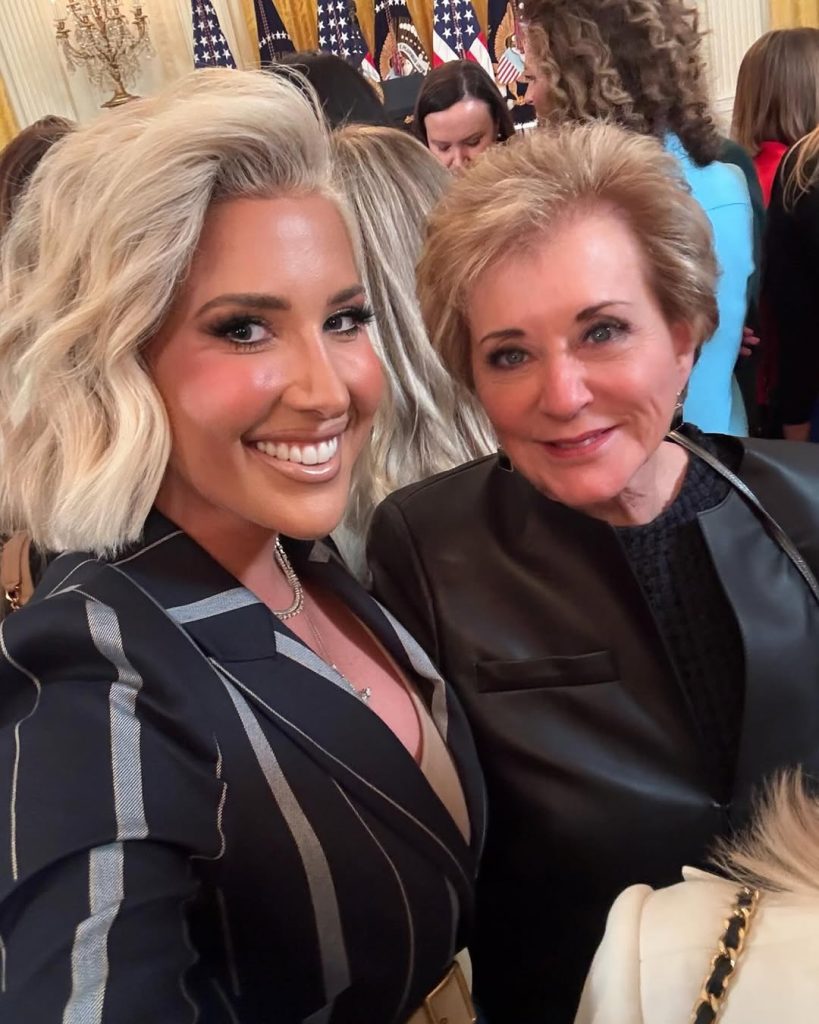
Savannah Chrisley was at the White House earlier this year.
"It's been about a month and a half since Robert and I broke up," the 27-year-old shared. "So there it is. Robert and I broke up on March 6. Not that I'm keeping track of dates or anything, but I have taken a lot of time to process things and truly grieve the loss of the relationship that I thought was gonna be where I was for the rest of my life."
In the recently aired episode, Chrisley delves deeper into the breakup, attributing part of the fault to Robert's estranged spouse, Lindsay Shriver, who is awaiting trial for allegedly conspiring to murder him.
“I don't wanna give her the notoriety that she has so badly been seeking, but I feel like that's the only way to go,” Chrisley said of Lindsay, a former beauty queen and mother of three. “I don't think I will ever forgive her for what she has put Robert and the boys through. I don't believe that Robert and I would be where we were at today if she wouldn't have caused so much mass destruction.”
“She absolutely destroyed a great man when it comes to his heart and his life, just all of it,” the reality star said of Lindsay. “She destroyed him and he should have done a lot of work on himself before he and I met. He deserved to get to work through all of that pain and trauma so that he could move on with his life in a healthy manner.”
Lindsay got arrested in the Bahamas back in July 2023 for allegedly getting her boyfriend, Terrance Bethel, and his buddy, Farron Newbold Jr., to take out ex-NFL player Robert. The cops hit her, Bethel, and Newbold with conspiracy to commit murder charges, but they all pleaded not guilty. Her trial is set to kick off in August.
Chrisley said that while Lindsay was arrested in the Bahamas, “life was great,” but when she returned, “the chaos came back with her.”
“It's like she wanted to destroy everything in his path, her path, everyone,” Chrisley claimed of Lindsay. “There was never any sense of care for another individual other than herself.”
“The chaos that she brought our way, it was too much for Robert to handle,” Chrisley said. “I know it was too much for him to handle. And so she got what she wanted. So you got what you wanted. It's that simple. You once again destroyed another thing in your life and other people's lives.”
Chrisley said that Robert, who has three sons with his estranged wife, found the conflict between his ex and Chrisley to be “too much.
Going forward, Chrisley promised to steer clear of men who aren't officially divorced. She mentioned that Robert filed for divorce back in April 2023, saying, 'He's not any closer to finalizing his divorce now than he was when I first met him, which is just crazy.' Chrisley intends to stay 'single for a bit' after her breakup, acknowledging that she still keeps in touch with Robert and his three kids.
“Fortunately, the conversations with the kids haven't stopped, which is such a weird place to be in, but when I got into a relationship with Robert, I also got into a relationship with his kids, and I vowed to always show up, always be there, and I was not gonna be another disappointment for them, because they've had a lot,” Chrisley explained. “And I'm going to keep that promise. When they call, I'm going to answer. If they need me to show up, I will be there.”
Charges Dropped in Patriots Fan Stadium Death
Prosecutors dismiss charges against two men after a deadly confrontation at Gillette Stadium, citing insufficient evidence and self-defense.
Rapper Tay-K47 Found Guilty in Chick-fil-A Murder Case
The controversial rapper faces another murder conviction, this time for a 2017 killing in a Chick-fil-A parking lot.
Jail Healthcare Provider NaphCare Held Liable in Inmate’s Death
A federal court finds NaphCare responsible for the death of Cindy Lou Hill, citing gross medical neglect in a Washington jail.
Tesla Loses Defamation Case Against Former Engineer
The electric car giant suffers a legal blow after a court tosses its win in a defamation suit due to jurisdictional missteps.
