Understand Your Rights. Solve Your Legal Problems
Suffering physically or mentally due to negligence on the part of a medical practitioner can be inconvenient and frustrating. The results of the injury could cost you thousands of dollars and lead to you being unable to work. Understandably, you may want to sue the person or institution responsible for some form of compensation.
However, filing a medical malpractice claim can be a gruelling and confusing process for someone without knowledge of local legal systems. This is why it is always advisable to hire the services of a medical malpractice attorney with a knowledge of state law. People make many common mistakes when filing a medical malpractice claim, and a reputable lawyer can help you avoid these. Here are some of the common pitfalls you should be aware of:
A common mistake that many medical malpractice plaintiffs make is failing to follow their doctor's orders. Even if a hospital or a doctor has made a mistake somewhere down the line, it is important to show you haven't made the situation worse by not complying or following up with the doctor as requested. Gaps in treatment are something that an insurance company regularly uses against the plaintiff.
Medical negligence cases are often difficult to pursue because the hospital's insurers are trained to fight to protect the institution's reputation. Most plaintiffs, especially those fighting a legal battle on their own steam, are intimidated by this adversarial approach. Novices often make the mistake of being too easygoing, trusting the other party to act honourably and not fighting back hard enough.
Many plaintiffs make the mistake of disclosing their intention to pursue a medical malpractice case to their medical professionals, which isn’t wise. This should only be done after consulting a lawyer. The other example of oversharing information is through social media. Any statements about the case that are made on public forums could be damaging to the claim, so it is best to exercise caution even when discussing matters with family and friends.
Naturally, people who have suffered as a result of medical malpractice may be more focused on dealing with their ailments or hoping that the issue will resolve itself. However, when it comes to legal matters, time is of the essence. Documenting your issues and keeping a record of all doctor's visits is imperative. It is wise to get a second opinion from an independent medical specialist right away.
In some instances, plaintiffs agree to settle too early in order to avoid court fees. In many cases, the plaintiff may not even have undergone a proper assessment to gauge the full nature of the damage and end up settling for much less than they deserve. While settling out of court is not necessarily a bad idea, you should always let the lawyer make that judgement regarding your specific situation.
Fighting a medical malpractice case will never be easy but being aware of some of the most common mistakes people make and having a good medical malpractice lawyer by your side can make all the difference when it comes to receiving the compensation you deserve. Be sure to follow these tips to avoid losing out.
With the penalty coming in at more than four times the €50 million the regulator had initially proposed, WhatsApp’s fine marks one of the largest ever fines relating to GDPR law. The messaging platform has called the fine “entirely disproportionate” and has said it will appeal against the decision.
Ireland’s Data Privacy Commissioner said that the fine was related to whether, in 2018, WhatsApp had followed EU data rules surrounding transparency.
A spokesperson for the messaging platform said: “WhatsApp is committed to providing a secure and private service. We have worked to ensure the information we provide is transparent and comprehensive and will continue to do so. We disagree with the decision today regarding the transparency we provided to people in 2018.”
WhatsApp’s fine follows the European Data Protection Board advising the Irish watchdog back in July to address criticism from peers that it had not been harsh enough on other tech giants in the past. At present, the Irish regulator has over two dozen investigations into big tech organisations open.
Thomson Geer recently advised superannuation fund Intrust Super on its merger with fellow super fund Hostplus.
Hostplus and InTrust Super signed a successor fund transfer deed, bringing the two industry-leading funds together to create a AUD70 billion national superannuation fund. A target date of 26 November 2021 has been set for the merger.
Intrust Super is heavily involved in the hospitality, clubs, tourism and retail sectors, counting over 90,000 members, 25,000 contributing employers and about $3 billion in assets under management.
Hostplus is based in the hospitality, tourism, recreation and sports sectors with 1.25 million members, 233,000 contributing employers and $66 billion in funds under management. Hostplus is one of the largest and best performing superannuation funds in Australia.
The Thomson Geer team was led by superannuation and wealth management partners Scott Charaneka and Stanley Drummond and assisted by lawyers Holly Marchant and Ashley Zhang.
Here Scott Charaneka, Head of Superannuation and Wealth Management at THOMSON GEER tells us more about the merger and the work undertaken.
Please tell us more about your involvement in this deal.
We have acted on over 60 larger fund mergers over the past decade, but the number of merger instructions has definitely increased over the past 12 months.
InTrust initially sought our advice on the steps involved in a fund merger, which then evolved into project planning and then drafting of the relevant transaction documents. We also worked closely with the board to ensure that their obligations were properly covered.
Another key dimension was to reduce the execution risk by ensuring that the transaction parties post-merger expectations were aligned.
Did any challenges arise along the way?
Super fund trustees (and their directors) are subject to a professional fiduciary standard of care, skill and diligence. Demonstrating how the trustee and its directors have met this standard requires considerable work, starting with the proper construction of the data rooms.
The two other key issues were regulator oversight (which historically has not been an issue in these types of transactions) and developing the post-merger organisational chart.
How did you navigate them with your team?
We do operate as a team, so everyone has a key area of focus - which eventually leads to the production of the board paper attaching to our sign-off letter.
Working with our regulators requires considerable experience; especially to ensure that the messaging remains clear.
Addressing the concerns of employees must be dealt with sensitivity and detailed planning.
What are clients’ main concerns when entering a significant merger like this?
That something may get missed! These are large corporate transactions. There are many moving parts and you need to cover them all. Matters such as equivalency of members’ rights, mandated and non-mandated member communications, life insurance contracts, unlisted investment valuations, direct and indirect taxes, staff employment offers, treatment of operational reserves, residual assets, post-transaction date expenses and litigation should require close attention.
Are there any potential issues unique to mergers between superannuation funds?
Our statutory framework imposes a very high standard of conduct for the client and its directors. The standard is higher than in other areas of corporate work. A failure to meet the standard can give rise to a statutory claim for damages.
How do you work with your clients to ensure these issues are handled and their concerns are addressed?
We start with a briefing to explain how they may be held accountable in the event of a due diligence “fail”. We then work with our client to construct a proper deal team and governance model. Usually we would have daily contact to make sure the project stays on track.
Chris, I believe that you and Josie have just been involved in a project on this topic in collaboration with London Business School. How did that come about?
Chris: Josie and I both run independent executive coaching practices and have worked very well together on coaching briefs like this in the past. I was invited as an alumnus of LBS and now I’m part of their Alumni Career Coaching team to co-create a pilot leadership webinar aimed at senior executive alumni. It felt natural to bring Josie into the mix on this topic because she is a great communication coach and complements my background in finance.
So, what did you learn from this exercise?
Josie: So many golden nuggets came out of it! I don’t think that any business would have signed up to mass hybrid working as an experiment unilaterally, however, we were all thrust into the pandemic regardless. Collaborating with other leaders in this webinar produced some great insights into the challenges of adapting business models to suit current circumstances. With so many factors and permutations to consider, it provided the leadership cohort that participated a real opportunity to a) air & debate the challenges and b) share best practices in finding possible solutions from their collective experiences.
Chris: It was indeed a fascinating session. Hybrid working is not exactly a new concept for leaders to handle, but since the pandemic employees have experienced, en masse, the flexibility that hybrid working offers and quite reasonably want it to continue in some form. Subsequently, how can leaders - globally - maintain business effectiveness and cohesion while at the same time allowing employees greater flexibility in how they work? It’s a huge question. Hybrid working isn’t going away, so the difference between winning and losing in this new world order will be measured by the speed at which leaders are able to adapt their business models effectively. The upside of course is that, for agile leaders who can embrace this coming of (the digital) age, there’s a huge opportunity to listen, learn, adapt, and grow in spite of the pandemic.
The primary challenges boil down to three Cs: Culture, Communication & Connection.
In this new hybrid culture of work, if you had to put the main challenges companies are facing into distinct categories, what would those be?
Josie: Chris and I spent a long time researching and soliciting feedback on this question in preparation for the webinar. Thankfully, as you might imagine, there is also some great empirical research that has been done on the pandemic’s impact as it unfolds. From our perspective in the context of team leadership, the primary challenges boil down to three Cs: Culture, Communication & Connection.
Chris: Yes, absolutely. It’s the combination of firm Culture also cast as vision & purpose; Connection, specifically in terms of active engagement; and effective Communication across the whole organisation from the top down which actively embraces the best of what technology can offer. The obvious challenge for leaders in a hybrid context is that the binds that tie individuals to the organisation are by definition loosened in a hybrid working world. So forward-thinking leaders are figuring out how best to better utilise digital tools to foster innovation & collaboration whilst retaining an acceptable degree of oversight over productivity & accountability.
Josie: And not just controlling productivity but increasing it by continuing to develop & upskill teams through formal and informal Learning & Development (L & D) activities. How can you best train your people when you’re not in the same room as them? What is truly going to work?
Chris: Exactly! One big conundrum across all professional services is how do we train our young talent in a hybrid context.
Really interesting. What are the implications of these findings for leaders going forward?
Josie: Great question, leaders are beginning to understand that, in moving forward, “one size fits none” and old styles of leadership are unlikely to fit the bill. Hopefully, they will adapt their style of leadership before they are forced to by the workforce voting with their feet. Currently, in investment banking (based on reports in the mainstream media), we’re seeing two types of leadership being played out in real-time. Some banking leaders believe it’s still optimal to “return” to a pre-pandemic business model. They’ve been upfront about requiring teams back in the office after Labor Day unless they are an active health risk. On the other hand, some other firms, notably in Europe, appear to be taking a more flexible & pragmatic approach about who might need to return to the office full-time or part-time and when. Which type of leadership will attract and retain the best talent? Only time will tell.
Chris: From our research, developments in the legal profession seem to be playing out differently from banking probably in part because the nature of legal work lends itself more easily to remote working than banking. From what we are seeing, the law firms are currently taking a more pragmatic view as long as productivity remains high and client needs are being met.
What have the leaders you have spoken to shared about this?
Josie: Well, that’s the beauty of hosting these webinars with senior leaders from a variety of locations and sectors; it invites a myriad of different perspectives and context is key. We are talking predominantly about knowledge workers who account for 1 in 5 workers globally but, for example, make up 60% of the workforce in the US. So, it’s a far bigger consideration today for corporate leaders in the world’s advanced economies than it is elsewhere.
Chris: In addition, the trends set by today’s Fortune 500 companies will be studied and in part incorporated into the global way of doing business in the coming years. This undoubtedly has wider ramifications for the planet and how we live and work. It’s a huge obligation and a massive opportunity at the same time for today’s leaders to embrace constructive change.
So, it seems like an almost insurmountable challenge to solve with so many considerations?
Josie: I think you’re right in so far that this challenge won’t get solved overnight - but let’s be optimistic! Good leaders stay curious, embrace calculated risk and set & articulate clear ‘SMART’ goals. They solicit advice & ideas. From these, they come up with creative solutions that fit their organisational purpose and then start implementing them. Of course, this may require some trial & error and you will need to embrace this risk positively from the outset.
Chris: A key factor going back to the three Cs is that the direction of travel within the organisation is clearly communicated, understood, and has collective broad-based buy-in from employees.
Josie: Absolutely. It’s not just what you say but how you say it, to whom and how often.
Chris: Yes. Communicating vision effectively is fundamental to a sense of shared purpose and leads to significantly higher engagement, whether office-based or hybrid. Picking up on Josie’s earlier point, knowledge workers are being paid to think for a living, so why not take into consideration more of their ideas. Since when did all good ideas emanate from the C-Suite?
You mentioned earlier that organisational context is important. Could you elaborate on this?
Josie: Sure, for example, we could contextualise knowledge work-tasks into predominant typologies; Information work, Evaluation work and Creative work as described by the team at Steelcase, a US real estate consultant. Informative & Evaluative work can be done far more easily remotely than Creative work which requires a higher degree of in-the-moment collaboration and collective energy which cannot be easily recreated in a digital (or asynchronous) setting. The benefit of bouncing ideas in a room together is, therefore, more likely to bring Creatives back to the office than Informative or Evaluative workers.
Chris: Equally you can divide the workforce demographically. Data from a 2020 Gensler study suggests that Millennials & Gen Z workers actually want to come back to the office (okay, maybe not 6 days a week!) because their remote working-set up may be less ideal. You could also contextualise the workforce by Learners, Provers and Leaders. Learners may want to be in the office more to gain experience from senior colleagues and actively seek advice and mentoring in order to develop their careers.
Josie: I would also argue that leaders need to increase their visibility and presence to engage with the wider workforce to model open communication and ease of access to their knowledge.
How can leaders score some quick wins in the process?
Josie: Being seen to engage with employees and be open to new ideas and dialogue between the levels. UBS for example seems to have modelled this well. They recently carried out an internal study of their 72,000 employees soliciting feedback on a range of topics. It concluded that two-thirds of its workforce were in positions that would allow for hybrid working. Merely by demonstrating a willingness to listen and adapt, I would be very surprised if that communique had not significantly increased employee engagement at a time when the battle for talent is white-hot. According to a study by Microsoft, a staggering 40% of knowledge workers are considering switching to a new employer in the next 12 months as a result of their pandemic experience and re-evaluating their goals & objectives in terms of work-life balance. Listen up, leaders!
Chris: I would also add that leaders and people managers at all levels of the organisation should assess their own relational skills and take some constructive feedback on development areas. This is a huge opportunity for L&D. It has been well-documented that Millennials and Gen-Z workers, in general, seek more feedback, guidance and encouragement from their leaders. Possibly more than current Gen-X leaders may have received as they were building their own careers.
Even in a hybrid world, there are some easy fixes for this. Praise direct reports in public & critique them more in private. Pick up the mobile phone more often to express gratitude for a job well done or for going the extra mile for a colleague and make a habit of doing so to build social capital with your employees. That personal touch can have a huge impact even though it may take a few minutes.
This all sounds great but what is the impact of getting it wrong?
Josie: You’re likely to lose your best people! The market for talent became global overnight with remote working. Now, if an employee is dissatisfied with the status quo or pace of change they will start to look elsewhere. Finding a better fit for their talent is now a more global opportunity, especially in hot growth areas like technology and healthcare.
How can leaders identify when things are going off-plan and what can they do?
Chris: By really listening to those reporting into them. For many leaders it will require a more open & responsive communication style and a willingness to engage rather than dictate, embracing the diversity of thinking and developing the necessary EQ skills to get the best from the team. Leaders at the top of their game have a multi-tier strategy in mind to set and communicate clear goals. They then ‘lead side-by-side’, trusting in and empowering teams & individuals to innovate and when they fail, to encourage them to try again without resorting to a blame game.
In your opinion, how is this all going to play out over the coming years?
Josie: I think fortune will favour the brave. New methodologies for working are being created, tried and developed as we speak. It won’t be a question of “Must we keep up with the changes happening all around us?” so much as “What will happen if we don’t?” The wizened, old-world behemoths may seem tough now, but what happens when the disruptive newbies of the tech world forge new paths without fear because they’re willing to fail and try again until they find a better path that works?
Chris: I would also say that there is plenty of scope for further disruption within established sectors such as banking, the law and consulting. We are seeing this already in FinTech where digital business platforms have been built from scratch in the 21st century by leaders who started them in their 20s. In my opinion, it is these kinds of sustainable, nimble, high-growth companies that will attract some of the best talent coming into the workforce over the coming years, especially if they can clearly demonstrate their raison d’être and offer the most attractive & flexible working environment for their employees.
What do you think we’ll be saying in ten years?
Josie: “Blimey, who knew where we were going to end up - AND aren’t we glad we took those risks?”
Chris: My hope is that the good guys win. Ultimately for the remainder of the century, leadership should be about responsibility rather than entitlement. It’s about sustainable profitability set within the parameters of environmental, social and governance excellence. Hybrid working is after all only one chapter in the unfolding story of doing business in a complex & challenging world.
Fascinating topic. Final question - how can leaders take this conversation further?
Josie: Firstly, I would say engage an outside expert to come in and listen, understand what you are trying to do and enable you to refine and effectively communicate your vision, goals and expectations to key stakeholders both inside and outside the business.
Chris: It’s the beauty of having someone unrelated to the business who can: 1. Keep you accountable to your ‘why' in a season of huge systemic change; 2. Challenge some assumptions and 3. Facilitate recovery and course correction as needed. This is what Josie and I love to do.
Chris has worked in financial & professional services for over 30 years and can be contacted at Chris@ BramleyAdvisors.com
Josie trained and has worked as an actor & master communicator in the UK & US for many years and can be reached at Contact@JosieGammell.com
But don’t worry! Choosing the right personal injury attorney for you shouldn’t be such a scary process. This article will help you learn the most important aspects to consider when selecting a lawyer and the right questions to ask during your consultation.
Many of your peers have likely already worked with an attorney for a personal injury case. Or, if they haven’t themselves, they probably know someone who did. Ask around you for lawyer referrals from people who can share with you their experiences with the lawyer.
Expert personal injury lawyers explain, “Referrals are always a reliable source of information when it comes to legal services. You’ll find out if the lawyer is helpful, empathic with their clients’ cases, has the right skills and knowledge, and did an impeccable job in court or settling the case.”
If you don’t know anyone who can give you a recommendation, you can go online and do your own research. You’ll likely find plenty of personal injury lawyers working in your area that you can choose from. But, before you make a choice, read online reviews from other people who have worked in the past with the attorney and see what reputation the prospective lawyer has.
After you have a list of names you can choose from, you should consider what matters to you in selecting a personal injury lawyer to narrow your choice options. More precisely, you may consider criteria such as:
There’s nothing better than a face-to-face meeting to determine whether or not you can work with a prospective personal injury lawyer. All attorneys may look perfect on the paper, with great referrals, a high success record, and a lot of experience. However, as a personal injury victim, you’re already in a difficult state, and you probably want to work with an attorney that you feel comfortable with. Meet all prospective attorneys and understand if you can efficiently communicate with the lawyer, if they are involved enough to help you the way you prefer, and if you feel comfortable opening up in front of them about your injury.
After going through all these steps, it is time to choose the personal injury attorney you think is right for you and move forward with your case.
Whether you are involved in a car accident or experience a trip or fall at work, accidents are a part of life. If you are injured as a result of an accident, life can become very frustrating and inconvenient, especially if the accident was caused by another party's negligence. In such instances, it is worth filing a personal injury case to receive the compensation you deserve. While it is possible to file a personal injury lawsuit on your own, you'll find several benefits come from hiring a professional personal injury lawyer to represent your interests. If you are on the fence about seeking legal help, here are a few key reasons you should:
Recovering from an accident can take a toll on both your mental and physical health. Having to take on a legal case on top of dealing with the aftermath of a traumatic incident can feel overwhelming. This is why it makes sense to delegate the task to someone who is qualified to handle the matter efficiently. While a good lawyer will always keep you in the loop, they will do most of the groundwork so you can make your recovery a priority.
Legal experts accustomed to handling personal injury claims will likely have had a lot of experience with similar cases and will be able to give you a realistic idea of your chances of getting the settlement you desire. They'll assess the merits of your injury case and present the facts in a proper light to ensure success.
A reputable personal injury law firm will likely have represented hundreds of clients in similar personal injury cases. As such, they are likely adept at handling these cases and aware of some of the most common mistakes people make. They'll also have an intimate knowledge of the state's legal system they are practising in and will know what policies and procedures need to be adhered to.
Understandably, you won’t want to fork out a small fortune in legal fees unless there are some guarantees. Especially, since there are always lots of other expenses to deal with after an accident. For this reason, you’ll find that most personal injury lawyers work on a no-win, no-fee basis, so you won’t be expected to pay until they’ve helped you settle the case. Most reputable firms will arrange to take a certain percentage of your settlement as their fee, so it’s in their interest to help you receive the best possible settlement for the claim.
Being a victim of an injury can be stressful, and if the incident was not your fault, things can be all the more frustrating. In such instances, you must file a legal case against the negligent party to ensure you receive the compensation you deserve. Hiring a competent personal injury lawyer can make a huge difference when it comes to getting a good settlement. Allowing an expert to handle the case will also allow you to focus on your recovery's most important priority. Don't delay and find a good attorney today.
Google was fined amid increasing international pressure on online platforms to share more of the revenue they generate from using media outlets’ news.
Head of Google France, Sebastien Missoffe said: “We disagree with a number of legal elements, and believe that the fine is disproportionate to our efforts to reach an agreement and comply with the new law. We continue to work hard to resolve this case and put deals in place. This includes expanding offers to 1,200 publishers, clarifying aspects of our contracts, and sharing more data as requested by the French Competition Authority."
Google received its $591 million fine for failing to comply with the antitrust body’s orders on how to conduct talks with publishers. On Wednesday, the watchdog said that Google’s appeal, which will be ruled on by Paris’ court of appeal, would not hold up the fine. It remains unclear as to how the appeal process may take.
There are so many marketing channels that it can get a little confusing, especially if your expertise is not in advertising. When you are getting started with promoting your law firm you will be confronted with numerous strategies that you can employ to try and attract new clients, such as digital marketing, print marketing, SEO, blogs, or even old-fashioned billboard advertisements. However, there are two crucial elements that you have to consider as you develop your law firm’s marketing plan so you do not waste your time, your energy and – most importantly – your budget. The first point to remember is that you must always market for your customers and potential clients, and the second point is that you need to create a clear and concise plan which is tailored to your business.
Unequivocally, this would be a no. Like your customers, no two law firms are the same. Every law firm will be at a different point in their law marketing journey, so ensure that you plan for your firm and that you do not simply copy other law firms who may have different goals to you.
When marketing a law firm, you should make sure to consider:
To put this into an example, if your organisation is a brand new personal injury law firm, you will be at a different stage of your marketing journey compared to an established local family law firm. A well-known legal practice specialising in family law will likely already have a strong referral network, a website and a current marketing strategy that includes a social media presence and maybe a blog, but a new firm operating in a different market may not have a website or social media channels and is unlikely to have cemented a reputation yet. Planning where to spend the legal marketing budget for each of these firms will require a different and tailored approach, potentially using different channels.
There will also be different costs that will need to be considered depending on the practice area. Using the example above, personal injury law is traditionally more expensive and requires a much higher CPL (cost per lead) whether you are marketing online or offline. Family law is renowned for being a much lower cost area of law marketing, thus requiring less spend.
[ymal]
Right now there is, frankly, a huge amount of marketing channels available to law firms – some would say a daunting number for your consideration. Below are a few of the key channels that you should at least be considering as you map out your legal marketing strategy.
A recent study showed that, for a lot of law firms, email was the most-employed marketing channel, followed by organic social media (in contrast with paid social media advertising, which was much lower). Below you can see the full breakdown of where law firms are allocating their budget.
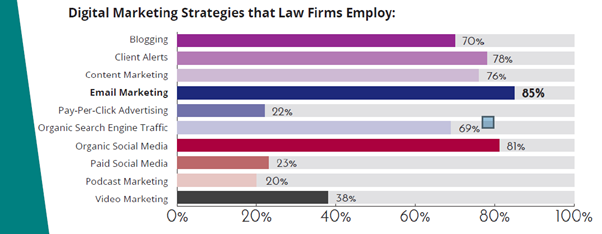
While the above may help to provide suggestions and give an insight into what others are doing, it remains vital that your law firm forge its own marketing path dependent on your goals. It should be added that the above chart may also be a little confusing in terms of what the difference is between organic and paid social media, for example. Legal marketing and its numerous channels can seem overwhelming, too. Marketing, much like the law, has a raft of its own terms and abbreviations which can be confusing. But do not be alarmed; a lot of them might not even be applicable to you at this time.
In simple terms, you need to market your law firm where your customers are.
When it comes to looking for a lawyer, consumers indicated that the following methods were what led them to selecting their law firm:
Looking at the above, it may be tempting to think that you can just sit back and rely on referrals, but this would be unwise. Why? Because these days, everything is connected. The majority of people who receive a referral from a friend or family will at the very least check that business online. If you have a multi-faceted approach, you will be more likely to bring in more traffic, more engagement and more leads. This does not mean that you have to spend money on every form of marketing – what it means is that you should prioritise your goals and match them to your customer intent.
A recent study showed that, for a lot of law firms, email was the most-employed marketing channel.
In order to match your goals to your customers, you will have to ensure you are marketing in the right place. Below are a few top tips to help you decide which avenues are best to spend your legal marketing budget.
First and foremost, if you are not online then we would strongly recommend getting a website. As mentioned, more and more clients are finding law firms through search engines – in fact, a combined 78% of consumers look for lawyers online. If you are not there, put simply, you will not be found. This is why you should make sure you have a good website. It should be clear, impactful and – most importantly – include all of the pertinent information that your clients will want to see.
With the rise of search engines, SEO (or search engine optimisation) has become more and more important. Simply put, SEO is the practice of improving web content to get it show as high up the search results pages (or SERPs) as possible. Once you have a good, working website, your next step would be to focus on some level of SEO so that your website is appearing as a result of what your customers are searching.
This is the next step in the website journey. If you add a blog to your website, you can begin to tap into your law firm’s wealth of knowledge to provide answers to client questions and place yourself in front of them as a source of authority, allowing you to build trust and showcase your law firm. One word of caution is to only use a blog if you have the time to write blogs. Nothing is quite so off-putting as heading to a website’s blog page only to find that it was last updated in 2017.
In order to match your goals to your customers, you will have to ensure you are marketing in the right place.
Internet traffic arriving to websites from PPC delivers 50% more leads than organic traffic, so this is an area that is not to be ignored. Unfortunately for a lot of legal practice areas, it also happens to be quite expensive! But do not be discouraged. PPC can be an excellent form of both exposure and customer acquisition.
Because the world is so connected these days, the temptation is to ‘go global’ straight away, but you may end up reaching consumers who are halfway around the world when your firm is not international. So, think local; some of the best campaigns can be the most locally targeted, whether that be a billboard or an advert on local radio. If you are looking to target potential clients in your area, then make sure you allocate some of your budget on local advertising. Do not forget that you can also target locally on global platforms, create a Google Business page and encourage clients to positively review your law firm. Facebook advertising can be targeted to within a mile of your office, and you can even write blogs specifically using topics and keywords that you know will be popular with local audiences.
Social media can be an excellent tool for your law firm, but it can also be time-consuming and confusing. A solid social media strategy that is tailored to your audience is therefore highly recommended – but getting your law firm an account on every social media channel and paying Instagram influencers and a full-time TikTok content creator when your potential clients aren’t on Instagram or TikTok is not. You might also benefit from including some paid social media adverts to increase client awareness of your law firm, but make sure you target them and do not just put adverts live without any consideration.
Some of the best campaigns can be the most locally targeted, whether that be a billboard or an advert on local radio.
In today’s digital age, the temptation to abandon traditional advertising options Is all too real. But for many law firms, some of the more established marketing channels are that for a reason: because they work. If your firm is new and looking for local clients, consider an advert in your local newspaper. If you are working for an international law firm opening a new office in New York, reach out to a PR firm to help get your news out there.
Almost all the advice these days is to follow a certain checklist of steps, but with an increase in channels (and enough time) you can afford to be a little more creative. Sponsoring a charity event or sports team, creating a YouTube channel for your firm or even creating your own legal podcast are now all viable ways to reach your marketing goals.
In short, there is no right or wrong way to spend your legal marketing budget as long as you create a strategy designed with your goals and your customers in mind. If you are still unsure about the best way forward, it is worth speaking to a legal marketing company who will be able to help you plan and execute a targeted legal marketing strategy.
Early this August, the Intergovernmental Panel on Climate Change (IPCC) released a report examining the physical impact of climate change on the world. The sixth such report yet released by the UN body and compiled from over 14,000 scientific papers, the report provided an up-to-date assessment of climate change as it is currently understood.
Its conclusions were bleak: human activity is “unequivocally” warming the planet, it warned, causing rapid and widespread damage to the biosphere. It also highlighted that weather extremes resulting from this warming have already been observed, and that initiatives to limit global temperature increases to 1.5°C above pre-industrial levels will fall short unless carbon emissions can be deeply reduced in the coming decades.
The release of the IPCC report coincided with a series of devastating floods in Europe that have been cited as lending credence to its claims regarding weather extremes. Both events also served to draw renewed attention to governmental efforts to combat the worst outcomes of climate change and the question of how effective they will be in the crucial years to come.
By 1990 there were only 35 laws related to climate change worldwide, owing to a lack of awareness of the issue at that time. Consequently, almost all climate change laws currently in effect have been passed within the last three decades.
The 1.5°C figure quoted above formed a key part of the negotiations of the 2015 Paris Agreement, wherein a number of nations – including several low-lying islands – successfully pushed for that temperature increase to be set as a target in the deal, arguing that allowing a greater increase would threaten their survival. The Agreement requires all supporting countries to set pledges to reduce their carbon emissions, with the aim of keeping the global average temperature from rising above 2°C and “pursuing efforts” to limit it to 1.5°C (temperatures having already risen above 1°C). Signatories are expected to assess their progress towards implementing these requirements through a “global stockade”, the first of which is planned for 2023.
By 1990 there were only 35 laws related to climate change worldwide, owing to a lack of awareness of the issue at that time.
The Paris Agreement followed on the heels of a marked acceleration in climate change legislation from the 1990s onwards, which reached a peak between 1999 and 2014 when more than 120 laws related to climate change were passed each year. Yet, as the findings of the IPCC report have demonstrated, the creation of these laws has not been sufficient to shift the global emissions trajectory towards a sustainable level.
A 2020 study of panel data on the legislative activity of 133 nations found that climate change laws enacted between 1996 and 2016 reduced global CO2 emissions by the equivalent of one year’s worth of carbon output. While impressive when taken alone, this rate of progress will not come close to reducing emissions to the level necessary to meet the Paris Agreement’s target of a 1.5°C total increase.
Climate experts also broadly agree that the Paris Agreement by itself is insufficient to achieve the climate change targets it has set. Though the Agreement was legally binding, its signatory nations set their own emissions reduction targets, and there is no enforcement mechanism to ensure their adherence. A tracker designed by German non-profits Climate Analytics and NewClimate Institute estimates that current climate change policies would result in a 2.9°C rise by 2100, or 2.6°C should all governments fully enact the pledges that they have made so far under the Agreement.
The progress made by individual nations in regards to climate change is predictably sporadic. In the US, the Supreme Court holds that the EPA has the authority and obligation to regulate greenhouse gas emissions pursuant to the Clean Air Act, yet the Supreme Court has also mostly struck down the greenhouse gas regulations that the EPA has attempted to implement in the past. The Clean Air Act itself was last amended in 1990 and is widely agreed to be unsuited to the regulation of greenhouse gases, though the current deadlock in Congress leaves either its updating or the acceptance of a more suitable bill a matter of speculation.
Meanwhile, member states of the EU officially adopted the European Green Deal project on 14 July, introducing a raft of policies aimed at reducing carbon emissions by 55% as of 2030 and achieving net-zero emissions by 2050 through the use of roughly €1 trillion of investments. The Green Deal focuses on encouraging businesses to adopt sustainability measures, but also includes a bundle of further initiatives such as the European Climate Law, enshrining the bloc’s 2050 net-zero emissions target among other anti-climate change measures. Though hailed as a landmark climate law, the deal has faced significant political opposition on the grounds that it was not ambitious enough to tackle the threat of climate change.
[ymal]
On the subject of emerging climate change legislation, Sylvie Gallage-Alwis, partner at the Paris office of Signature Litigation, suggested that to focus on the relative ambitiousness of the new laws would be to miss the point.
”In my view, it is not about whether this legislative progress is enough or not. The real issue is whether the enforcement ability of authorities and Courts is appropriate,” she commented. “Incentivising and having a global approach should be encouraged as scientists insist on the fact that human behaviour is the key to our future.”
Climate-related litigation has been on the rise, with landmark cases such as Urgenda Foundation v The State of the Netherlands, a class action that forced the Dutch government to raise its emissions reduction aims. There has also been a marked increase in so-called “greenwashing” accusations.
Notably, however, studies of climate-based rulings so far have shown that the judiciary is not predisposed towards supporting climate action. One study of 534 US cases leading up to 2016 found that judges ruled in favour of stronger climate action around 40% of the time, compared to around 50% of the time internationally.
World leaders will gather in Glasgow this November for COP26, a crucial UN climate summit that has been billed as the last major opportunity to strategise a method for keeping the global average temperature increase at 1.5°C. Like the IPCC report, it is expected to build pressure on governments to provide concrete action plans for how this will be achieved.
Studies of climate-based rulings so far have shown that the judiciary is not predisposed towards supporting climate action.
It is predicted that nine years remain before the window for averting the worst consequences of climate change will be closed. We at Lawyer Monthly will continue to cover the progress of legislation to this effect as COP26 approaches and beyond into 2022.
BAWAG Group acquired Hello Bank!, Austria’s largest online broker, from French financing group BNP Paribas. Fellner Wratzfeld & Partner (fwp) advised BAWAG, while Binder Grösswang advised the seller. The deal was signed on 22 July and is expected to be closed by the end of 2021.
Hello Bank! has been a leader in Austria’s online brokerage market for more than 25 years, with a base of around 80,000 customers and over €8 billion in assets under management. The bank handled more than 1.8 million securities transactions in Austria as per year-end 2020.
The fwp team was headed by partners Markus Fellner (Corporate/M&A, Banking) and Paul Luiki (Corporate/M&A) and comprised Roswitha Seekirchner (Corporate/M&A), Peter Stiegler (Corporate/M&A), Mario Burger (Corporate/M&A), Martin Navara (Corporate/M&A), Roman Schlemaier (Corporate/M&A), Julia Berger (Corporate), Elisabeth Fischer-Schwarz (Banking), Lukas Flener (Anti-Trust Law), Gregor Schett (Retail Consumer Law) and Veronika Seronova (Retail Consumer Law), who were once again able to demonstrate outstanding expertise in complex Corporate/M&A deals subject to banking regulation.

