
Understand Your Rights. Solve Your Legal Problems
A New York judge is expected to make a pivotal decision this week regarding Donald Trump's conviction over hush money payments made to adult film actress Stormy Daniels in 2016. At the heart of this decision is the issue of presidential immunity and whether it can shield former presidents from legal repercussions for actions taken during their time in office. The ruling could set a landmark precedent, defining the boundaries of presidential immunity and accountability. Here’s a comprehensive look at what’s at stake, the arguments in play, and how this decision could reverberate far beyond the courtroom.
The case dates back to 2016, when a $130,000 payment was made to Daniels to prevent her from disclosing an alleged affair with Trump. Trump’s former attorney, Michael Cohen, facilitated the payment and later pleaded guilty to charges connected to campaign finance violations. Cohen claimed the payment was intended to protect Trump’s campaign, making it a political transaction.
Fast forward to 2024, and Trump was convicted on 34 felony counts of falsifying business records related to the payment. The crux of these charges was that Trump and his associates manipulated business records to hide the payment's true purpose, concealing it under seemingly legitimate expenses. The court found this method amounted to falsifying records and attempting to evade campaign finance law. But the conviction is now under review due to a recent Supreme Court ruling on presidential immunity, which may potentially alter its course.
In July 2024, the Supreme Court ruled that former presidents are immune from prosecution for actions taken in their official capacity. Trump’s legal team argues that his conviction falls under this immunity since he was an acting president at the time of the payment. Their position rests on the notion that maintaining his public image, particularly during a tightly contested campaign, was intrinsically linked to his presidential role. Thus, they contend the payment falls within the scope of actions taken in his official capacity.
Legal experts are divided on whether the ruling should apply in this case. On one side, some argue that this immunity, when broadly interpreted, may shield Trump from legal repercussions tied to his time in office. On the other, many experts believe presidential immunity should only cover specific official duties, not actions intended to advance a political campaign or protect personal interests.
In this high-stakes legal arena, Trump's attorneys argue that shielding a public figure’s reputation from potentially damaging revelations is a core political act, closely tied to his presidential duties. They assert that protecting Trump’s public image was essential to his ongoing presidency, meaning the hush money payment was tied to his official actions.
Prosecutors, however, maintain that the payment was a personal matter, driven by individual motivations rather than presidential duty. They argue that arranging hush money deals is far removed from the typical responsibilities of the executive office. Furthermore, prosecutors emphasize that falsifying business records to mask the payment’s purpose constituted a violation of the law, unrelated to Trump’s presidential role. Their position is that this incident was a case of personal reputation management rather than a matter of state or national interest.
The presiding judge is tasked with assessing these arguments and determining whether the hush money case qualifies as an act of official conduct deserving immunity or as a private action that falls outside the Supreme Court’s ruling.
Should the judge rule in Trump’s favor, this decision could reshape our understanding of presidential immunity, extending its boundaries to cover actions with even indirect political implications. This outcome might strengthen former presidents' immunity, setting a precedent that shields them from specific legal repercussions long after leaving office. Such a precedent could influence the interpretation of immunity laws for future officeholders, potentially making it harder to prosecute former presidents.
For Trump personally, a favorable ruling would bolster his legal position as he contends with several other ongoing investigations, which include various civil and criminal cases. Moreover, an overturned conviction could provide a political boost as he campaigns for re-election, reinforcing his narrative that he is unfairly targeted by a “politically motivated” justice system.
Conversely, if the conviction stands, Trump may face more serious consequences. The conviction adds to a growing list of legal challenges, potentially complicating his re-election bid. A decision against Trump would imply that personal actions taken during a presidency are not exempt from scrutiny, even when they overlap with political campaigns. This outcome would reaffirm the importance of legal accountability for presidents, potentially narrowing the scope of immunity and reinforcing the notion that personal and official actions must be distinguishable in legal terms.
The Trump case brings a new layer of complexity to debates about the limits of presidential power and accountability. Historically, presidential immunity was established to protect the executive branch's independence and to prevent politically motivated lawsuits from interfering with governance. However, the boundaries of immunity have rarely been tested in cases involving alleged personal misconduct. This case could broaden or narrow those boundaries in ways that shape future legal and political landscapes.
If immunity is extended to include actions indirectly tied to political standing, future presidents might feel emboldened to stretch the limits of acceptable conduct. On the other hand, a ruling that upholds Trump’s conviction would act as a counterbalance, emphasizing that legal standards apply to presidents even after their term ends, especially concerning private or campaign-related actions.
This case’s potential to redefine the scope of immunity underscores the importance of distinguishing official duties from personal matters. Legal scholars suggest that a broad interpretation of immunity could weaken checks and balances, blurring lines between private interests and public office. Others believe this outcome could discourage presidents from taking any action that could later be construed as personal, placing a heavier burden on the executive office.
As the legal community and public wait for the judge's decision, the case has already underscored the need for clearer guidelines on presidential immunity. The decision could either offer Trump a pathway to overturn his conviction or reinforce accountability standards for former presidents, ensuring that private actions remain outside the shield of immunity.
Trump’s legal team faces an uphill battle, as they must prove that the hush money payment was essential to Trump’s role as president, not merely a personal maneuver to protect his image. For prosecutors, the challenge lies in convincing the judge that the falsification of records is sufficiently removed from official presidential actions to warrant conviction. Whichever way the ruling goes, it is likely to leave a lasting imprint on the evolving legal landscape surrounding presidential immunity.
This case serves as a reminder of the delicate balance between presidential privilege and accountability, a balance that becomes increasingly complex in cases that straddle the line between public duty and private interest. The judge’s ruling may well reshape how immunity is applied in future cases, influencing not only Trump’s legal trajectory but also the responsibilities and limitations that come with the highest office in the land.
As the decision looms, the case brings to light essential questions about accountability and immunity in U.S. politics. In the coming weeks, the legal landscape for former presidents may face a pivotal shift, one with implications for decades to come.
Trump declared victory after winning key states, including Pennsylvania.
Donald Trump is set to return to the White House following a remarkable victory over his opponent, Kamala Harris, as indicated by the data. He has made history as only the second president to achieve non-consecutive terms, having secured the necessary 270 electoral votes, according to information from our US partner network, NBC. Trump, who held the presidency from 2017 to 2021, was the first to claim a swing state, being declared the victor in North Carolina.
Related: Trump Files $10 Billion Lawsuit Against CBS Over "60 Minutes" Interview
Approximately one hour later, he was also announced as the winner in Georgia, marking the second significant swing state to be confirmed. Shortly thereafter, he was projected to win Pennsylvania, which is regarded as the most crucial among the seven battleground states. Following these announcements, Trump traveled to Palm Beach to address his supporters, while aides for Ms. Harris indicated that she would not make a statement that evening as her chances for victory diminished.
Related: What's next for the Menendez brothers?
The race initially appeared to be closely contested as Americans cast their votes, but Trump gained momentum as results began to emerge from traditionally Republican states such as Florida, Texas, and Alabama throughout the night.
Related: Donald Trump calls Elon Musk ‘Leon’
Trump Files $10 Billion Lawsuit Against CBS Over "60 Minutes" Interview
Former President Donald Trump has launched a $10 billion lawsuit against CBS News, accusing the network of manipulating a recent "60 Minutes" interview with Vice President Kamala Harris to present her in a favorable light. The suit, filed on Thursday in the U.S. District Court for the Northern District of Texas, claims CBS engaged in "partisan and unlawful acts of election and voter interference through malicious, deceptive, and substantial news distortion." Trump's legal team argues that CBS used its platform to obscure Harris's "word salad" responses and contends that the segment transitioned from "responsible reporting to deceitful manipulation."
In response, a CBS spokesperson told The Hill on Thursday evening that Trump's claims lack merit, stating, “The interview was not altered; 60 Minutes did not conceal any part of the Vice President’s response to the relevant question.” CBS emphasized that the segment was edited for clarity and accuracy, as is standard practice, and assured that it aimed to inform rather than mislead the audience. "Trump’s lawsuit against CBS is entirely without merit, and we will mount a vigorous defense," the spokesperson added.
Focus on the Harris Interview and Trump’s Response
The lawsuit centers on the October interview with Vice President Harris, particularly a response she gave regarding the conflict in Gaza, which aired online but was omitted from the televised broadcast. Trump's allies argue that this selective editing concealed Harris's “shortcomings” and compromised journalistic integrity. CBS clarified that prominent interviews are commonly edited to meet broadcast standards, balancing clarity, accuracy, and time limitations. Trump himself had initially agreed to an interview with "60 Minutes" but later withdrew, allegedly in response to the network’s intention to fact-check his statements.
For weeks, Trump and his supporters have been vocal about CBS’s alleged bias, claiming that “60 Minutes” unfairly manipulated Harris’s responses to present a favorable narrative. Trump recently hinted at legal action, going so far as to suggest that CBS “should lose their license and take '60 Minutes' off the air.”
Related: Donald Trump calls Elon Musk ‘Leon’
Strategic Venue and Judge Assignment
Trump’s legal team chose to file the case in federal court in Amarillo, Texas, where cases are assigned to U.S. District Judge Matthew Kacsmaryk, a Trump appointee. Judge Kacsmaryk, who has gained prominence as a preferred judge for Republican-led lawsuits, previously ruled to suspend federal approval of the abortion pill mifepristone—a decision later overturned by the Supreme Court—and reinstated Trump’s “Remain in Mexico” asylum policy in 2021. This strategic choice could benefit Trump as Kacsmaryk’s rulings have often aligned with conservative viewpoints.
CBS’s Legal Defense and Broader Implications
CBS’s legal defense strategy centers on the argument that broadcast editing practices are standard and lawful. Media experts note that broadcast networks routinely edit interviews for time constraints and content coherence, especially with high-profile figures. The Harris interview followed typical editing practices, with CBS releasing the full version online for transparency. This approach aligns with CBS’s assertion that the segment aimed to accurately inform, not mislead, the audience.
Trump’s lawsuit against CBS joins a series of legal threats he has directed at mainstream media outlets, often targeting them for coverage he views as biased. His relationship with the press has been consistently contentious, and this suit amplifies his frequent claims that media coverage unfairly influences public opinion and election outcomes.
Broader Political Context
Trump’s lawsuit comes at a politically sensitive time, as he prepares for a potential rematch against Vice President Kamala Harris, who remains a leading figure in the Biden administration. Accusations of media bias and manipulation have become a central theme in Trump’s campaign rhetoric. By pursuing legal action, he aims to cast further doubt on the credibility of traditional media, framing his lawsuit as part of a broader effort to combat perceived media biases.
The outcome of this lawsuit could have implications for media practices, particularly around how news outlets edit and present political interviews. As CBS prepares its defense, the case may set a precedent for how courts evaluate claims of news manipulation and the fine line between editing for clarity and alleged distortion. The case is filed as Trump v. CBS News in the U.S. District Court for the Northern District of Texas, case number yet to be assigned.
Trump Files $10 Billion Lawsuit Against CBS News Over Deceptive Editing in Harris’ ‘60 Minutes’ Interview.
Donald Trump's attorneys assert that the complaint stems from what they describe as "CBS's biased and unlawful actions regarding election and voter interference." They argue that the network's editing practices significantly distorted the content of the interview, intending to "confuse, mislead, and deceive the public." According to the lawsuit, such actions have caused "immense harm" to Trump, his campaign, and his supporters across the nation.
As the election draws closer, Donald Trump's legal team contends that the alterations in the interview were designed to favor the Democratic Party, particularly given Trump's current lead in the polls. The lawsuit emphasizes the importance of transparent media coverage, asserting that "media outlets have a duty to faithfully convey the truth of events" rather than manipulate content to misrepresent candidates.
Following the broadcast of the 60 Minutes interview, Trump's lawyers requested CBS to disclose the complete transcript, noting that the segment presented two differing responses from Kamala Harris to the same inquiry. They also asked CBS to retain all documents and communications related to the interview, anticipating a possible legal dispute. CBS, however, declined to release the full transcript, citing First Amendment protections, and maintained that the interview was not altered in a misleading manner.
The lawsuit specifically cites an exchange between Harris and 60 Minutes correspondent Bill Whitaker. In a preview clip that was broadcast on "Face the Nation," Kamala Harris was questioned regarding the apparent lack of attentiveness from Israeli Prime Minister Benjamin Netanyahu towards the United States.
"Well, Bill, the work that we have done has resulted in a number of movements in that region by Israel that were very much prompted by, or a result of, many things, including our advocacy for what needs to happen in the region."
Kamala Harris faced ridicule from conservatives for providing an extensive and convoluted response to Whitaker. However, when the same question was posed the next evening during the primetime election special, the vice president delivered a more concise and targeted answer. "We are not going to stop pursuing what is necessary for the United States to be clear about where we stand on the need for this war to end."
The lawsuit highlights broader concerns regarding media integrity and the portrayal of political figures. Donald Trump's legal team emphasizes that the editing of the interview led to public confusion about Kamala Harris's competence, suggesting that the manipulation of her responses creates an unfair narrative around her capabilities as a candidate.
The implications of this lawsuit extend beyond Trump and Harris, touching on the media's role in shaping public perception during a pivotal election. As Trump seeks a jury trial and a minimum of $10 billion in damages, the case raises critical questions about accountability in journalism and the responsibilities of news organizations to present truthful and unbiased coverage.
Trump seeks to move hush money case to federal court.
In their latest court filing, they stated, “On September 3, the district court issued a summary remand order that misinterpreted established precedent and the statutory removal process, overlooked crucial evidence supporting the Second Removal Notice, and misunderstood the duty of federal courts to ensure an impartial federal forum for the fair litigation of federal defenses under the federal-officer removal statute.”
Appeal
This appeal follows a ruling from US District Court Judge Alvin Hellerstein last month, who denied Trump’s request to present a new argument for moving the case after the Supreme Court's decision this summer regarding presidential immunity. Hellerstein concluded that Trump failed to demonstrate “good cause” for reconsideration, noting, “Nothing in the Supreme Court’s opinion alters my earlier determination that the hush money payments were private, unofficial actions, beyond the scope of executive authority.”
Hellerstein
Trump's legal team argues that Hellerstein wrongly concluded that the Supreme Court's ruling on presidential immunity does not influence the former president's hush money case. “The district court overlooked the importance and essential aspects of Trump v. United States and moved forward with a merits analysis of the presidential immunity defense, which was entirely inappropriate given the context of preliminary removal proceedings.
This led to the incorrect claim that ‘nothing’ in the Supreme Court’s post-trial ruling affected the district court’s earlier remand decision.” They are requesting the appeals court to instruct Hellerstein to consider their arguments for transferring the case to federal court. Trump's attorneys had previously appealed Hellerstein’s ruling and sought to pause his sentencing.
Federal Rejection
Last month, a federal appeals court panel rejected Trump’s request after the judge in the state case agreed to delay the GOP nominee’s sentencing until after Election Day. The filing on Monday represents the formal legal stance from Trump’s lawyers. The Manhattan district attorney’s office is expected to submit their brief in a few weeks, after which Trump will provide a response. The former president is scheduled for sentencing in late November following a Manhattan jury's verdict of guilty on all 34 counts of falsifying business records in his hush money trial earlier this year.
Trump could potentially face no jail time or up to four years for each count, with a legal maximum of 20 years. If the motion for removal remains unresolved by November 26, Judge Juan Merchan, who is managing the state case, will be unable to issue a final judgment or sentence Trump in that matter.
Accusations of Bias
The former president has accused Merchan of showing bias and is trying to have the case dismissed on those grounds. Merchan has already turned down several requests from Trump for his recusal. In a recent filing, Trump’s legal team argues that the case should be transferred to federal court to address the gag order imposed by Merchan, which they claim continues to limit the GOP nominee’s ability to campaign ahead of the election.
“The Second Removal Notice is justified as it aims to safeguard the integrity of the 2024 Presidential election by allowing President Trump a federal venue to seek immediate relief from an unconstitutional gag order that unfairly limits his campaign speech,” the filing states. Trump is currently waiting for Merchan to make a decision on his motion to overturn the conviction, arguing that certain evidence, including testimonies from White House officials and tweets made during his presidency, should be excluded based on a Supreme Court ruling. Merchan has indicated he will make a ruling on this motion by November 12.
Related: Trump Assassin Ryan Routh's Chilling Letter
A federal grand jury in Miami late this afternoon returned an indictment charging Ryan Wesley Routh, 58, of Hawaii, with attempting to kill former President Donald J. Trump at Trump International Golf Club in West Palm Beach, Florida, on Sept. 15.
“Violence targeting public officials endangers everything our country stands for, and the Department of Justice will use every available tool to hold Ryan Routh accountable for the attempted assassination of former President Trump charged in the indictment,” said Attorney General Merrick B. Garland. “The Justice Department will not tolerate violence that strikes at the heart of our democracy, and we will find and hold accountable those who perpetrate it. This must stop.”
“This alleged attempted assassination of the former President at his golf course was a direct attack on our democracy. Political violence has no place in this country — not then, not now, not ever,” said Deputy Attorney General Lisa Monaco. “The charges today reflect the Department’s continued resolve to deploy every available resource to ensure public officials remain safe and to hold accountable those who target public officials to the fullest extent of the law.”
“Routh is charged with attempted assassination of a presidential candidate, which strikes at the very heart of our democratic system,” said FBI Director Christopher Wray. “The FBI is continuing our investigation into this alleged plot and will use the full weight and resources of the FBI to uncover and provide as much information as possible about what led to the events in West Palm Beach. In our country, we have to hold accountable people who resort to violence.”
According to allegations in a complaint affidavit and a factual proffer filed with the court, former President Trump was golfing at Trump International on Sept. 15, and a Secret Service agent conducting a perimeter security sweep saw the partially obscured face of a man — later identified as Routh — in the brush along the fence line near the sixth hole. The agent observed the barrel of a rifle aimed directly at him. As the agent began backing away, he saw the rifle barrel move, and the agent fired at Routh.
A witness saw Routh running across the road from the golf course and getting into a black Nissan Xterra. Based on information provided by the witness, Routh was later apprehended heading northbound on I-95 by officers from the Martin County, Florida, Sheriff’s Office, in coordination with the Palm Beach County Sheriff’s Office.
Court documents allege that in the area where Routh had been hiding in the tree line, FBI agents located an SKS semiautomatic rifle with a scope attached and an extended magazine. The serial number on the rifle was obliterated and unreadable. Hanging from the fence was a backpack and a reusable shopping bag that each contained a plate capable of stopping small arms fire.
According to the allegations filed with the court, FBI agents found documents that contained a handwritten list of dates in August, September, and October and venues where the former President had appeared or was expected to be present. Cell records for two of the cell phones found in the Nissan Xterra showed that on multiple days and times from Aug. 18 to Sept. 15, Routh’s cell phone accessed cell towers located near Trump International and the former President’s residence at Mar-a-Lago.
According to the factual proffer filed with the court, a civilian witness contacted law enforcement stating that Routh had dropped off a box at his residence several months ago. Included in the box was a handwritten letter from Routh addressed “Dear World,” which stated, among other things, “This was an assassination attempt on Donald Trump but I am so sorry I failed you.”
Routh was charged with attempted assassination of a major presidential candidate, possessing a firearm in furtherance of a crime of violence, assaulting a federal officer (a Secret Service Agent), felon in possession of a firearm and ammunition, and possession of a firearm with an obliterated serial number. At a detention hearing on Sept. 23, Routh was ordered to remain in federal custody pending trial. If convicted, Routh faces a maximum penalty of life in prison.
According to court records, Routh was convicted of felonies in North Carolina in December 2002 and March 2010.
The FBI is investigating the case, with assistance from the Bureau of Alcohol, Tobacco, Firearms and Explosives and U.S. Secret Service.
The U.S. Attorney’s Office for the Southern District of Florida and National Security Division’s Counterterrorism Section are prosecuting the case.
An indictment is merely an allegation. All defendants are presumed innocent until proven guilty beyond a reasonable doubt in a court of law.
The man accused in assassination attempt wrote note indicating he intended to kill Trump. This disclosure was part of the DOJ argument for his continued detention as the case progresses.
The note, titled “Dear World,” was found in a box that was delivered to the residence of an unnamed individual, who subsequently alerted law enforcement following the arrest of Ryan Wesley Routh last Sunday. The box, which included ammunition, a metal pipe, and various other items, was not opened by the recipient until after Routh was apprehended.
The identity of the individual who received the box and reported it to authorities was not disclosed in the Justice Department's detention memorandum on Monday.
The note reportedly stated, “This was an assassination attempt on Donald Trump but I failed you. I tried my best and gave it all the gumption I could muster. It is up to you now to finish the job; and I will offer $150,000 to whomever can complete the job,” according to prosecutors. Routh's attorney did not provide an immediate response to an email requesting comment on Monday morning.
Ryan Wesley Routh, 58, supposedly posted the note — addressed “To the World” — off in a box at an unnamed person’s home in the months before the foiled assassination attempt at the West Palm Beach golf course on Sept. 15, federal prosecutors said in a court filing.
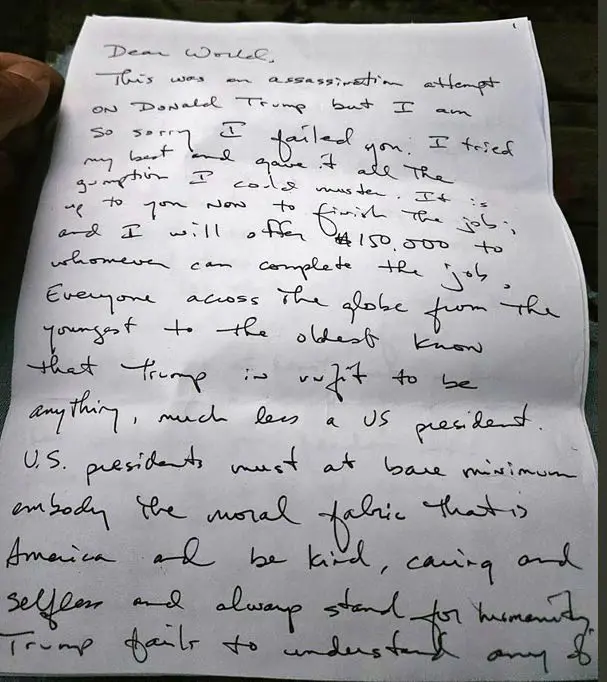
Ryan Wesley Routh's chilling letter offering $150,000 to anyone who could 'finish the job'
Wannabe Assassin Ryan Routh Indicted. Ryan Wesley Routh has today been Indicted for Attempted Assassination of Former President Trump...
Trump is one of 19 people charged with conspiring to overturn the results of the 2020 presidential election. He faces 13 felony charges, including racketeering, for allegedly pressuring Georgia election officials to change the results of the vote in that state.
The former president has repeatedly denied wrongdoing in the case, which he has described as politically motivated. In a document filed on 31 August, he formally asked a judge to sever his case from his co-defendants, who are pursuing a quick trial. Trump attorney Steven Sadow said he would not have "sufficient time" to prepare for trial by 23 October.
"Understanding my rights, I do hereby freely and voluntarily waive my right to be present at my arraignment on the indictment and my right to have it read to me in open court," the signed document stated.
After turning himself in at Fulton County Jail, Trump agreed to a $200,000 bail bond and other release conditions, including not using social media to target the co-defendants and witnesses in the case.
Related: The US Justice Dept sues Virginia for violating federal election law
Such charges are unprecedented. However, Trump is far from the first president to have been accused of a crime. Throughout its 200-year history, several presidents have become embroiled in legal troubles either during or before their tenure in office. From impeachment proceedings for lying to Congress to an arrest for speeding in a horse-drawn buggy, each has made a marked a ‘first’ in the country’s legal record books in one way or another.
Trump was impeached twice during his presidency, first over an apparent threat to withhold aid to Ukraine to secure advantages against then-presidential hopeful Joe Biden, and again over his actions in the lead-up to the January 6 attack on the US Capitol. However, Trump is only the second president to have been “impeached of high crimes and misdemeanours in office”. The first was 17th President of the United States Andrew Johnson, who inherited a political powder keg in the aftermath of the Civil War and the assassination of predecessor Abraham Lincoln.
Johnson frequently clashed with the so-called ‘radical Republicans’ of the era, who wanted to implement stringent conditions on seceded states’ readmission to the Union. Johnson’s policies were more lenient towards the South, and he repeatedly blocked the enforcement of the Reconstruction Acts, which had been passed to provide suffrage to freed slaves and prevent former Southern rebels from regaining control of their state governments. The clash came to a head in 1867 following the passage of the Tenure of Office Act, which made it impossible for the president to dismiss important government officials without Senatorial permission – and which Johnson defied in his subsequent dismissal of radical-sympathetic Secretary of War Edwin M Stanton in 1968.
When Congress reconvened, Stanton’s suspension was overruled and the House of Representatives formally impeached Johnson by a vote of 126 to 47. Johnson was charged with violation of the Tenure of Office Act and bringing into “disgrace, ridicule, hatred, contempt, and reproach the Congress of the United States”. However, the president’s political fortunes changed during the 11-week trial that followed, gaining enough credit among the senators that he escaped removal from office by one vote. Johnson passed the rest of his term unremarkably and was succeeded by radical-favoured candidate Ulysses S Grant later that year.
The last president who came close to facing criminal charges while in office, Clinton’s tenure was marred by a scandal originating before he took up residence in the West Wing. Receptionist Paula Jones claimed to have suffered emotional damage in May 1991 after Clinton, then-Governor of Arkansas, exposed himself to her in a hotel room, suing for sexual harassment.
The Clinton v Jones suit was influential in establishing a precedent that a sitting president might be sued for actions taken prior to being elected. Moreover, it brought to light other instances of improper behaviour by Clinton, including a two-year relationship with White House intern Monica Lewinsky. This would become the defining scandal of Clinton’s presidency, as his Clinton v Jones testimony denying the affair was used as grounds for his impeachment by the House, who accused him of lying under oath and obstruction of justice.
The Clinton v Jones suit was influential in establishing a precedent that a sitting president might be sued for actions taken prior to being elected.
Clinton eventually reached an out-of-court settlement with Jones in November 1998 which saw the president paying $850,000 in civil damages while admitting no wrongdoing. With neither article of impeachment gaining the required two-thirds majority, he was not convicted in his impeachment trial, yet the sex scandals would become an enduring legacy of his time in office.
To date, only two presidents (current or former) have been arrested. The most recent of them is Trump, but Andrew Johnson successor Ulysses S Grant had the dubious honour of becoming the very first. It is a matter of historical record that Grant faced at least two confrontations with the law, which occurred within months of each other in 1866 while he was a lieutenant general. The National Intelligencer reported that, while “exercising his fast gray nag” on 14th Street in Washington, DC, the general was detained by two MPD officers for speeding. Grant offered to pay the fine, but “expressed his doubts of their authority to arrest him" and drove away – before later acknowledging his warrant and paying in full. Later that year, Grant was arrested again on speeding charges and again paid his fine.
According to some historians, a third incident occurred in 1872 during Grant’s tenure as president, during which he was apprehended by African American MPD officer William H West for driving his horse-drawn buggy at speed. Then the 18th President of the United States, it is claimed that Grant not only encouraged West to arrest him, but insisted that he not face punishment for doing his duty. The incident was noteworthy not only for being the first arrest of a president, sitting or otherwise, but also for the arresting officer having been an African American – and occurring during the height of the Reconstruction era.
President Nixon is cited by many as the closest analogue to Trump in terms of the seriousness of his flagship scandal. In 1974, Nixon made history as the first president to resign the position, having been widely disgraced for his participation in the cover-up of the 1972 burglaries and wiretapping of a Democratic National Committee headquarters in the Watergate complex in a bid to boost his re-election odds. His resignation came under the imminent promise of impeachment and followed the indictment or jailing of 40 federal officials, including his own chief of staff, chief domestic advisor, White House attorney and attorney general.
[ymal]
Of particular note is the detail that Nixon was named an ‘unindicted co-conspirator’ by a federal grand jury – a term that will also be familiar to those who have followed the January 6 investigations. The decision to declare Nixon as such stemmed from an opinion from the Justice Department's Office of Legal Counsel in 1973, which held that a sitting president could not be indicted. Less clear was whether Nixon might be charged after leaving office – a matter that his successor, Gerald Ford, sidestepped by issuing him a presidential pardon.
To date, the question has never been tried in a court of law. But with Trump now polling as the most likely candidate to become Republican nominee for president in 2024, there is a non-zero chance that it may be revisited in the near future.
The indictment charges Trump with conspiracy to defraud the US, conspiracy to obstruct an official proceeding, obstruction of an official proceeding and conspiracy against the rights of citizens. The charges follow special counsel Jack Smith’s investigation of Trump’s actions following his election loss, culminating in his supporters’ attempted storming of the US Capitol on 6 January 2021.
“The Defendant lost the 2020 presidential election”, the indictment states on its first page. “Despite having lost, the Defendant was determined to remain in power. So for more than two months following election day on 3 November, 2020, the defendant spread lies … that he had actually won.”
The latest allegations mark the third time in four months that criminal charges have been brought against the former president. The new indictment names six co-conspirators, of whom one is believed to be former New York mayor Rudy Giuliani, who was Trump’s attorney following his election defeat.
Immediately following its announcement, Trump’s re-election campaign team denounced the indictment. “The lawlessness of these persecutions of President Trump and his supporters is reminiscent of Nazi Germany in the 1930s, the former Soviet Union, and other authoritarian, dictatorial regimes,” the campaign said in a post on Truth Social.
