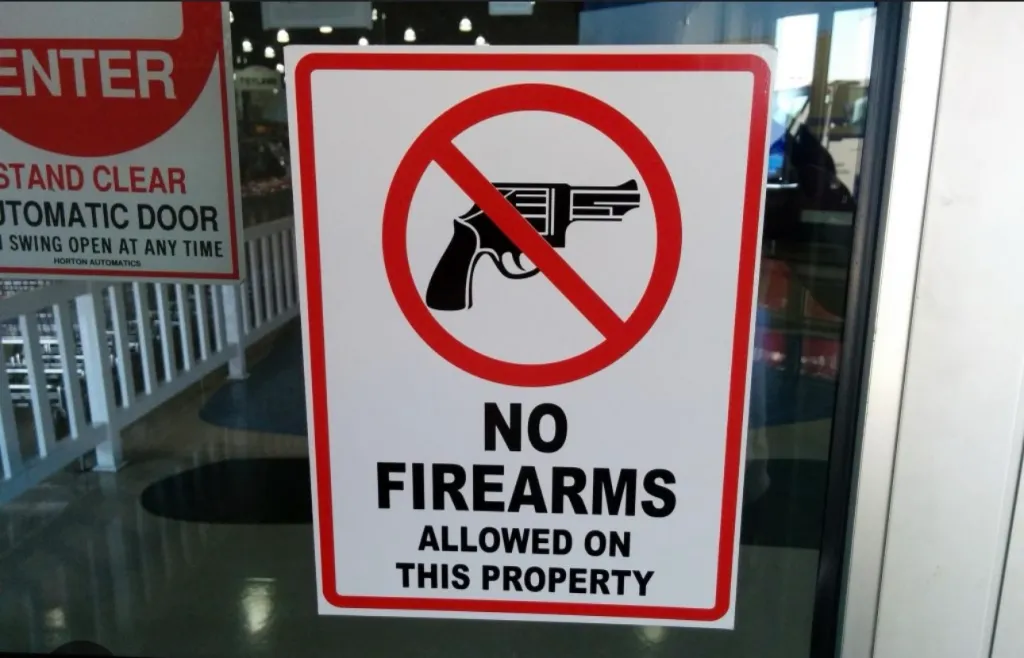
When someone walks into a café, shop, or office building that’s open to the public, most people assume the rules are simple. If the person has a valid permit, they can carry. If the owner doesn’t want guns inside, they can ask the person to leave.
What has drawn attention in recent years is that some states reverse that assumption entirely — making firearms illegal on private property open to the public unless the owner explicitly allows them. A challenge arising from Hawaii has brought that question before the U.S. Supreme Court, highlighting confusion about what actually happens when gun rights, property rights, and public access intersect.
This matters because similar rules exist in several states, and the process affects everyday spaces — restaurants, shops, offices, and shared buildings — not just courts or lawmakers.
What happens when a state changes the default rule
In states that adopt a restrictive default, the law does not start from “carry is allowed.” It starts from prohibition.
Firearms are barred from private property open to the public unless the owner takes a clear step to permit them. That permission usually must be explicit, such as a posted sign or direct verbal consent. Silence is treated as refusal.
Once the rule is in place, enforcement begins long before any courtroom review. It plays out through signage, routine encounters, and individual decisions about where a permit holder can legally go while carrying.
How this plays out in real life
Imagine a permit holder carrying a concealed firearm while running errands. They enter a small retail store that welcomes the public but displays no sign about firearms.
Under a permissive default system, nothing happens unless the owner objects. Under a restrictive default system, the same entry may already violate the law — even if no one notices and no confrontation occurs.
If police later become involved, the key question is not intent. It is whether permission existed at the moment of entry. That can turn on signage placement, verbal exchanges, or proof that may be unclear or contested after the fact.
Why resolution takes longer than people expect
Many people expect disputes like this to resolve immediately — either carrying was allowed or it wasn’t. In practice, enforcement unfolds slowly.
Officers must first determine whether the location qualifies as private property open to the public. They then assess whether permission was granted, implied, or absent, often relying on physical evidence or conflicting accounts.
Enforcement can also vary by location, agency, and context, meaning identical conduct may result in a warning in one setting and formal action in another, even under the same statute. If the matter is challenged, courts then examine how the rule was applied, not just what the rule says.
Where misunderstandings and failures usually occur
One common misunderstanding is assuming that a carry permit automatically applies everywhere that is not explicitly restricted. In restrictive-default states, the permit authorizes carrying only under certain conditions and does not override property-based rules.
Another frequent failure point involves signage. Property owners may believe they must post “no guns” notices to restrict firearms, when the law may already prohibit them by default. Permit holders may assume silence equals consent, when legally it may mean the opposite.
What often surprises people is where the burden sits. In restrictive systems, the individual carrying the firearm may need to show that permission existed, rather than the property owner needing to show it did not. That shift does not decide constitutional questions, but it shapes how encounters, investigations, and disputes unfold in real life.
Expectation vs reality
Many people expect gun laws to operate like speech or access rules — permitted unless clearly prohibited. In some states, firearms are treated differently.
In practice, the law may assume exclusion first, requiring affirmative permission rather than objection. That changes everyday behavior, places more responsibility on individuals to verify legality, and increases the chance of disputes rooted in procedure rather than intent.
The result is not clarity, but caution, uneven enforcement, and outcomes that hinge on small factual details.
How this is typically handled under existing law
Under existing legal frameworks, states generally have authority to regulate where firearms may be carried, but those rules operate within constitutional limits. Courts examine whether restrictions reflect historical practice, respect property rights, and avoid treating lawful carry as inherently disfavored.
Importantly, courts focus on application as much as language. How permission is defined, how enforcement works in practice, and whether lawful carry remains realistically possible all matter. Outcomes depend on structure, scope, and proof, not assumptions.
What remains unresolved
Courts have not reached a uniform conclusion on whether banning firearms by default on private property open to the public exceeds permissible regulation. Even where rules are upheld or limited, similar disputes continue to arise in everyday settings.
Understanding the process does not guarantee an outcome. It does, however, clarify where disputes are most likely, where delay enters the system, and what the law does not automatically do — which is often the part people misunderstand most.