
Understand Your Rights. Solve Your Legal Problems
Five months after General Data Protection Regulations (GDPR) officially came into effect, and as news breaks that Facebook has been fined the maximum data breach penalty for the Cambridge Analytica scandal, Barrister-at Law Quentin Hunt has been examining the implications of early test cases under the regulations – and reporting on what this might mean for organisations in the future.
Quentin looks at test cases against Facebook, Cambridge Analytica and the Child Sex Abuse Inquiry, and what organisations must learn from these cases when examining their GDPR policies going forward.
Although it adopts the same principle-based approach as the preceding Data Protection Act 1998, GDPR has significantly increased the ability of regulators to impose fines - with the maximum for some offences now set at 20 million EUR or 4% of global turnover, whichever is highest. GDPR has also rendered obligations on data controllers as more onerous they were before, with the consequences for non-compliance more severe and, crucially, less predictable. This renders GDPR a significant business risk that is difficult to assess and mitigate, as three of the early legal cases demonstrate, Hunt says.
The Case: The changing relationship between Facebook and marketing customers
In June 2018, the European Court of Justice considered whether the administrators of Facebook fan pages should also be considered as data controllers. In 2011, a company called Wirtschaftsakademie Schleswig-Holstein was ordered by its state data protection regulator to deactivate its fan page, on the grounds that neither the company nor Facebook had made users aware that their data was being collected via cookies. Wirtschaftsakademie objected, saying that, as a page administrator, it had not instructed Facebook to collect data and therefore was not responsible for the breach. The Court held that administrators of Facebook Pages are join data controllers and as such are jointly responsible with Facebook for the processing of visitors and users’ data anywhere within the European Union.
The Lesson: GDPR will change the shape of future contractual marketing relationships
This ruling will fundamentally change the relationship of platforms like Facebook with their marketing customers – so that the relationship is specified not as processor-controller, but as controller-controller with equal responsibility for data security. What’s more, with this case originally being brought in 2011 under the previous Data Protection Directive of 1995, the ruling demonstrates that the principles of older data protection effectively carry over to GDPR. In other words, just because there’s new regulation in force doesn’t mean that old data protection principles are no longer relevant or referenceable in a court of law.
The Case: Cambridge Analytica and criminal prosecutions
In July, the ICO published a progress report on its investigation into the Cambridge Analytica scandal. The report included the regulator’s intention to fine Facebook up to £500,000 for two breaches of the old law as laid out in the Data Protection Act 1998. Confirmation that this fine has been issued has been reported today (October 25th 2018). The report also confirmed that warning letters had been sent to eleven political parties. In terms of Cambridge Analytica’s parent company, the ICO announced a criminal prosecution for failure to comply with an earlier Enforcement Notice and a new Enforcement Notice compelling it to properly deal with an existing subject access request. Data Broker, Emma’s Diary and Cambridge University also face regulatory action. Alongside the report, the Information Commissioner called for a statutory code regulating the use of personal data in political campaigning.
The Lesson: GDPR is a tangible and significant risk for all organisations and sectors
The report represented a clear statement of intent from the regulator that it will make use of its powers to tackle data misuses for political purposes. The IC’s confirmation of maximum financial penalties for Facebook, confirmed today, reinforces that message. Clearly, GDPR is a regulatory change that will impact on organisations far beyond the marketing and technology arenas. Political organisations, not for profits, public and private companies and any other organisation handling data must all stay on top of GDPR to protect themselves.
The Case: A £200K fine for the Child Sex Abuse Inquiry
In July 2018, the Independent Inquiry into Child Sexual Abuse was hit with a £200,000 fine after a staffer to the inquiry emailed 90 individuals regarding a forthcoming hearing. The staff member in question accidentally inserted the recipients into the “TO” field rather than the “BCC” field. The ICO held that the Inquiry had failed to take appropriate organisational measures to avoid unauthorised processing of personal data by failing to make use of an email account which could send emails individually to each recipient and failing to provide staff with appropriate training.
The Lesson: GDPR is a leadership matter
This case demonstrates one of the trickiest elements of GDPR to negotiate. Because GDPR is principle-based regulation, subjective judgments come into play, both when it comes to who’s responsible and when it comes to predicting likely penalties. No doubt, the extremely sensitive subject matter of the inquiry and the emotional distress caused to the complainants in this case influenced the very high fine. As such, responsibility for GDPR must be taken seriously, start from the top and be effectively cascaded down the organisation.
Other Important GDPR Developments
The ICO annual report: In July, the ICO published their 2017/2018 annual report covering the twelve months ending 31 March 2018. The report detailed a 29% increase in the number of self-reported data breaches from 2,447 to 3,156. In 60% of cases, the ICO took no further action at all. Remarkably, only 0.3% of breaches attracted a monetary penalty. This underlines the ICO’s approach of reserving fines for only the most serious of breaches. Whether this approach will be sustainable following the introduction of the GDPR remains to be seen. However, the ICO’s Regulatory Action Consultation suggests that this approach will remain the status quo for the foreseeable future.
Director Liability: The Government has just consulted on whether the ICO should be given the power to fine directors, senior officers and partners personally. The Government’s concern is that the ICO currently only recovers 54% of the fines it imposes as fines can currently only be levied against corporations. The result being that if a company is dissolved or goes into liquidation, then the directors can create a new legal entity and continue their activity without payment of any fines. The consultation closed on the 20th August 2018. Its results could have a significant impact on director liability for breaches of the GDPR.
Legislation passed five years ago has failed to meet its aims and has created an unfair and inefficient justice system, says the Bar Council as new research shows the true impact of the Legal Aid, Sentencing and Punishment of Offenders Act (LASPO).
The Bar Council, which represents barristers in England & Wales, has said that five years after the Act came into force it has done the opposite of what the Government set out to achieve. Part 1 of LASPO and its subordinate legislation have produced a regime which impedes the public’s access to justice, jeopardises the efficient operation of the justice system, and damages the future of the publicly-funded legal professions.
In responding to calls from the Ministry of Justice for evidence ahead of its review of LASPO, the Bar Council released research which shows a worrying picture on the front line of the justice system five years after LASPO came into force.
Barristers were surveyed and interviewed by the Bar Council. The research found that:
Andrew Walker QC, Chair of the Bar, said: “LASPO has failed. Whilst savings have been made to the Ministry of Justice’s budget spreadsheets, the Government is still unable to show that those savings have not been diminished or extinguished, or even outweighed, by knock-on costs to other government departments, local authorities, the NHS and other publicly funded organisations.
“Nor do we accept that the reforms have discouraged unnecessary or adversarial litigation, or ensured that legal aid is targeted at those who need it, both of which the Act was billed as seeking to achieve. If anything, LASPO has had the opposite effect, and has denied access to the justice system for individuals and families with genuine claims, just when they need it the most.”
In its submission to the LASPO Review, the Bar Council questioned whether the Ministry of Justice was evaluating the true impact of the Act effectively.
The Bar Council said it had grave concerns over whether the Ministry had gathered the necessary evidence about the direct impact of LASPO on all aspects of the justice system; and whether the department had commissioned meaningful research about the consequential costs LASPO has caused to other government departments.
Andrew Walker QC added: “LASPO has not just failed: it has caused untold damage to our justice system and to access to justice. The Ministry and the Government cannot and must not hide from this. The review itself cannot and must not gloss over what barristers and other legal professionals, the judiciary and the public are seeing happening in our courts. The fact there are significant delays in the family and civil courts is a red flag. For those at the front-line, the results are clear: the true costs of LASPO, and the harm it has caused, are far greater than the Government has admitted. We need a significant change of direction to rectify five years of failure.”
In its response, the Bar Council has also called for the following, as steps that need to be taken urgently and as a priority:
(Source: The Bar Council)
As Halloween dawns on us and the trick or treaters come flocking, homeowners are being urged to think about claims that could be brought against them as a result of injuries or accidents that occur on their property. Victoria Stevenson, head of personal injury at Roythornes Solicitors, shares her top tips for avoiding liability this Halloween.
As children and their parents blow the cobwebs off their costumes this Halloween ready to threaten unimaginable horrors if not rewarded with chocolate and sweets, it is time to perhaps think about hidden booby traps.
Whether you see this tradition as fun and games or a feast of mass consumerism it is likely you will receive a visit on the evening of 31 October. Should the worst happen and one of the little monsters approaching your door injures themselves or they choke on the treat you provide, who is liable?
As a homeowner or occupier of a property you owe a duty of care to these visitors and you may find yourself liable if any accidents are caused by the dangerous condition of your property. This duty of care means you should ensure your property is reasonably safe. If you are aware of a specific danger you must take steps to highlight that danger even to those trespassing on your property without your permission.
Tips for avoiding liability….
The Law in this area is governed by the Occupier's Liability Act 1957 (Lawful Visitors) and Occupier's Liability Act 1984 (Persons other than Visitors). You do not have a duty to prevent all accidents but you are obliged to exercise reasonable care for the safety of visitors to your property.
Remember, children are generally less aware of the dangers around them than adults are. When looking at liability the Courts will take into account the age of the child and the level of understanding a child that age may be expected to have.
And what about the child who chokes on the treat you give them?
Much depends on the circumstances, but in order for you to be liable where a child chokes on a sweet you have given them or suffers an allergic reaction, it would have to be established you had been negligent; that you owed a duty of care to the child, you breached that duty and this caused the injury concerned and the risk of injury was foreseeable.
Halloween may have its roots in ancient times but in the modern day it is all about fun and games, spooks and sorcery. Take care to ensure your Halloween does not turn into a nightmare!
Yesterday UK Chancellor Phillip Hammond made a number of announcements and updates in the Autumn Budget 2018. You can see all things Autumn Budget and several summaries on the BBC website here.
In our most in depth Your Thoughts piece to date, Lawyer Monthly rounds up the country’s leading experts in a variety of sectors, from housing to banking, legal and professional, to provide their thoughts and reactions to this year’s Autumn Budget. Enjoy!
James Jones, Head of Consumer Affairs, Experian:
The proposal to pause interest, charges and enforcement for people struggling with problem debt is a positive move and should be welcomed, especially if it helps more people seek help sooner.
The no-interest loan proposal could also be a real help for people who have typically resorted to high-cost credit to cover unexpected expenses, or in some cases, essential household bills. It's important that everyone is able to access affordable finance.
Jeremy Raj, National Head of Residential Property, Irwin Mitchell:
The continued and deepened assistance for first time buyers via SDLT is to be welcome and given the delayed nature of most of the measure announced today, it is a pleasant surprise that this relief will be retrospective.
Additional funding for the housing infrastructure fund will need to be closely monitored as the supply site problems in the market are well documented and it is essential they are addressed in reality rather than just in theory.
Dr Zain Sikafi, CEO and Co-Founder, Mynurva:
The Chancellor’s confirmation that the Government will boost funding for the NHS – and especially mental health services – is a welcomed step in the right direction. However, in truth, £2 billion does not go far enough.
Just recently depression moved up to take second place on the GP list of common illnesses, overtaking obesity. It’s become clear that the mental health crisis warrants a significant commitment if we are to tackle the problem and improve services across the country. And yet still only a fraction of total NHS spending will be directed towards mental health, undermining the Government’s ambition to put mental health on equal footing with physical health.
With mental health having long taken the backseat, there is a lot of catching up to do if we are to improve the provision of these vital services. The overwhelming feeling from the Budget is that while there has been some positive progress, much more needs to be done. And regrettably, the Chancellor’s speech failed to disclose any new details about the policy reforms that will introduced in support of mental health services – merely reiterating what had already been announced in the lead up to the Budget.
Will Scargill, Senior Oil & Gas Analyst, GlobalData:
The UK has one of the most attractive fiscal regimes for oil and gas production globally, offering the lowest discounted state take out of the top 50 producing countries. Therefore, the most important thing for the industry now is a stable investment climate conducive to long-term planning, particularly given the uncertainties already present through the Brexit process.
Measures in the 2015 and 2016 budgets reduced the tax burden on the sector significantly. Headline tax rates were cut from 62% (or 81% for older fields) to 40% and a 62.5% investment allowance was introduced.
Although oil price rises in recent months have buoyed cash flows in the sector, the maturity of the area mean that oil and gas are more costly to extract and finds are generally smaller. Many major international oil companies have divested their UK assets. In this context an attractive fiscal regime with a stable investment climate is crucial for attracting the investment to achieve the government’s aims of maximizing economic recovery.
Paresh Raja, CEO, Market Financial Solutions:
At a time when demand for property is outpacing supply, there is limited time left for the Government to improve accessibility to housing. Unlike the Spring Statement earlier this year, some important announcements were made, including the commitment to build an additional 650,000 new homes. Unfortunately, there were no new reforms to creatively increase the amount of private investment into derelict homes that could be renovated and put back on the market. The country boasts some of the world’s most desirable real estate, which is why we should be encouraging both domestic and foreign investment into the property market. It is also questionable whether the Government will be able to deliver on its new-build targets given its past track record.
It is easy to see why the Government keeps missing new-build targets: Housing Ministers are appointed and replaced at far too great a frequency. Since the Spring Statement we’ve seen a new MP enter the role, but how long will Kit Malthouse last? The Government must ensure there is strong, consistent policy in the property industry because it remains hard to pinpoint their long-term strategy at present.
Theresa May confidently touted that austerity was over at the Conservative Party Conference. This was a bold statement to make and brought with it heightened expectations about the scope of reforms to be introduced by the 2018 Autumn Budget.
While there were some important announcements to take note of, the Chancellor fell short of delivering the ‘austerity-ending’ budget people were expecting. This shouldn’t come as much of a surprise – the official date of Brexit is now just five months away, and while Number 10 has suggested that the UK’s eventual deal with EU will not affect today’s Budget announcement, one cannot help but be suspect. Ultimately, as expected, there remains a sense that we are going to have to tread water for a little big longer as we await the final Brexit outcome and the Government can then begin making more meaningful, far-reaching reforms.
Angus Dent, CEO, ArchOver:
The Tory party’s promise to put an end to austerity has been revealed as simply words, not actions. Hammond’s plans for putting an end to a decade of under-funding do not go far enough – definitive action and continued investment is needed as a lifeline for struggling SMEs and savers.
The Chancellor’s reduction of business rates is music to the ears of SMEs around the country. This time last year, the Chancellor announced the expansion of the National Investment Fund for business – and if that doesn’t ring any bells, you aren’t alone. A definitive step forward like reducing business rates is long overdue – particularly for small retailers struggling on the British high street. But this isn’t enough to cure a decade of difficulty for UK SMEs.
While it could be seen as damaging for the Chancellor to offer businesses something that could derail negotiations with the EU, this doesn’t mean to say that he shouldn’t. Once Brexit negotiations are on the straight and narrow, the government needs to demonstrate that it believes in the future of British business.
The best way to prove this would be to announce a mini-budget focused on advancing SMEs in a still-struggling economy. The Chancellor desperately needs to convince the rest of the world that the UK is still a competitive place to do business – or he risks putting the future of UK businesses in jeopardy. The Chancellor’s corporation tax reduction is the first step in the right direction for British businesses. With the strong likelihood that tariff bearings will go up, a reduction in corporation tax will reduce unnecessary friction that disproportionately affects SME owners.
Without further concrete action from the government, SMEs are being left in the cold to fend for themselves. To battle the chill, businesses must turn to alternative finance options to give them the tools and funding they need to succeed – but nothing will reassure them more than support from their government in turbulent times.
Jason Hollands, Managing Director, Tilney:
After weeks of speculation around potential stealth taxes to cover the Government’s NHS spending pledge, the Budget saw a slew of new spending committments and a welcome acceleration of plans to raise both the personal allowance and higher rate tax threshold to April 2019. Overall this was a Budget that has outperfomed expectations.
Pleasingly a mooted raid on pension tax reliefs, did not happen. These have looked like they have been living on borrowed time since the Chancellor’s predecessor, George Osborne, came close to overhauling them in 2016. The current system of pension tax reliefs have proved as resilient as a cat with nine lives. That will undoubtedly be welcomed by many middle class professionals, but with a potential Labour government in the wings no one should take the long-term continuity of such generous reliefs for granted because of today’s stay of execution.
Luke Davis, CEO and Founder, IW Capital:
In what may either be the most crucial or the most redundant statement prior to Brexit, it cannot be denied that Chancellor Philip Hammond has provided due acknowledgment to a nation of entrepreneurs who will lead the charge for a buoyant private sector post-Brexit. The UK's alternative finance arena, albeit buoyant, will only flourish to its optimum capacity if fiscal and policy-led initiatives such as business rates, Entrepreneurs' Relief, VAT, and corporation tax are addressed head-on, particularly with Brexit around the corner.
A cookie-cutter approach for what is one of the most diverse spectrums of business to exist globally is destined to fail, but what Hammond has addressed in today's statement is the exact opposite. By clearly identifying superior support structures for start-ups, such as the Digital Services Tax and slashing business rates for retailers under the £51,000 cap highlights the Government's continuing support for growing businesses.
I am reassured by many of the measures announced in today's Budget - in particular, the feasibility study into DC pension funds directed to high-growth SMEs and new business investment measures. The UK's entrepreneurial economy is well equipped for a resilient post-Brexit future.
Nigel Morris, Employment Tax Director, MHA MacIntyre Hudson:
Reform of the IR35 rules is seen as a less politically controversial way to raise money for the Treasury, in the absence of Parliamentary support for an increase in National Insurance Contributions (NIC) from the self-employed.
What’s concerning is that the consultation this move is based on is too narrow in scope, ruling out some previous options that had real merits. The Government needs to be open minded in how it delivers continued IR35 reform, the public sector roll out has not gone smoothly and it’s important these lessons are taken on board .
We welcome the move to delay implementation until April 2020, and to limit it to large and medium sized businesses - we could never see that the private sector or HMRC would be ready to implement the changes next year. The change of plan also reduces what would have been an unnecessary burden on small businesses.
Jane Lucy, CEO and Founder, The Labrador:
The implementation of the Universal Credit has taken a substantial amount of time and money to roll out, with families across the UK suffering the brunt of what is at least a five year delay. This uncertainty is leaving household bills at the mercy of the Government, meaning that citizens are unable to adequately budget for the winter ahead. Last year - over 3000 people died as a result of not being able to heat their homes through the colder months.
Despite an extra £1 billion to assist the execution of Universal Credit that is intended to support 2.4 million families, the £630 per year, per family simply won't touch the sides for a staggering 14 million families living on the poverty line. With no formal announcement from Hammond addressing energy bills this winter, or the fact that 13 million homes still stagnate on SVTs, a void remains as to how the UK's broken and opaque energy sector will be remedied.
Rael Sarembock, Co-Founder and Partner, Capital Step:
The announcement of the revised Business rates relief is a welcomed initiative, the £900m relief will apply to small retailers who desperately require policy backed initiatives to benefit entities making a living out of the UK's big cities. Hammond has provided a much-needed nod to the small retailers and business owners who form the lifeblood of the UK's bricks and mortar economy. The Chancellor has gone further by announcing that fuel duty will be frozen for the ninth year running - key initiative for many small businesses who rely on cars and vans for their core operation to function. Small businesses in the entrepreneurial arena are battling for survival amid spiraling costs associated with running a business in the UK. They urgently need support, which has been catalysed by the slashing of business rates by a third for those who most desperately need it.
Disappointingly, what hasn’t been addressed today is the vital issue around VAT- the most time-consuming levy for small business owners to manage. A small registered firm loses six working days a year to VAT compliance on average, draining their productivity. The Chancellor needs to consider a smoothing mechanism as recommended by the Office for Tax Simplification - to address the issue of small firms bunching around the £80,000 turnover mark. Doing so would incentivise small business growth rather than the current trend for businesses in the regions, which is to cap trade to fall under the current threshold.
Stuart Law, CEO, Assetz Capital:
This was a budget for housebuilders and homebuyers. While we didn’t see a significant strategic shift from the government in this area, there were a number of tactical announcements which should at least result in a material improvement to the current situation.
The £1 billion of funding from the British Business Bank for small housebuilders is very welcome and goes hand-in-hand with our own lending efforts at Assetz Capital. We want to see these companies better compete with large national housebuilders, and this funding will support that.
We are very pleased to see the announcement of £8.5 million to empower local neighbourhood groups to create affordable housing for those in the community. This focus on housing needs at a local level is encouraging to see, and echoes many initiatives we’ve called for in the past.
We also support the retrospective stamp duty relief for shared ownership buyers, while the £500 million boost to the Housing Infrastructure Fund to unlock a further 650,000 homes is another welcome measure.
All in all, this budget won’t solve the housing crisis but it is certainly moving us in the right direction.
Jenny Tooth, CEO, UK Business Angels Association:
While this was a challenging period for the Government, it is great to know that Budget amendments have not come at the expense of a thriving entrepreneurial community. The Entrepreneurs’ Relief is an incentive for entrepreneurs to set up, grow, sell and re-invest into UK businesses and to contribute to the nations thriving economic environment.
Chancellor of the Exchequer, Phillip Hammond stated that entrepreneurs are at the heart of our dynamic society, this is very much the case and the UK's entrepreneurial spirit will continue to boost our thriving economy throughout Brexit negotiations. Resilience planning for Brexit now needs to be of the utmost importance across the UK’s business agenda to ensure a Brexit-proof economy.
Vincent Reboul, Managing Director, Hitachi Capital:
Today’s business rates announcement will provide a much needed shot in the arm for the High Street ahead of April’s £180 million business rate hike. However, while the news will be welcomed by 500,000 smaller businesses, it is unlikely to do much to relieve the pressure on our larger retailers across the UK.
The Chancellor must consider what the future high street retailer looks like, and provide a fair deal for all retailers whether they are online, bricks and mortar or a blend of the two. Our own study found that business rates are causing a concerning investment divide between online and high street retailers. While online retailers’ prioritise positive, revenue-generating investment opportunities such as new products (41% of respondents), bricks and mortar retailers are being forced into reactive approaches such as reducing operating costs (44%).
A digital tax is a good first step to modernise taxation of large tech giants, but there is some way to go to create a tax environment that treats all UK business fairly, frees up capital for investment and provides the right conditions to stimulate growth across the whole sector.
Ian Dyall, Head of Estate Planning, Tilney:
The Chancellor announced that from April 2020 the Government will reform lettings relief so that it will only apply where the owner of the property is in shared occupancy with the tenant and that the final period exemption will also be reduced from 18 months to 9 months.
Three years ago, George Osborne hit property investors hard by announcing an increase on stamp duty for second homes and limited mortgage interest tax relief. Today’s announcement is another nail in the coffin for buy-to-ley property investors.
Jay Boyce, Partner, MHA MacIntyre Hudson:
The increase in the annual investment allowance (AIA) is excellent news for SMEs and will encourage investment in new plant and machinery. However, as the increase doesn’t take effect until 1 January 2019, companies may want to defer expenditure until after this date if they’re spending in excess of £250,000.
We’ve yet to see the detail on the reform of entrepreneurs’ relief, but one likely outcome is an acceleration of business disposals in the coming months, particularly for those businesses that have incentivised senior staff with enterprise management incentive (EMI) options on the basis that the qualifying period is only twelve months.
The digital services tax of 2% is another laudable step, but it may have been a better idea to restrict the use of brought forward losses instead. Many of the technology companies Philip Hammond is targeting have significant tax allowable losses and by restricting their use he could increase tax payable in the UK.
Independent retail outlets can also take heart because of the announcement of business rate relief. However, given the challenges major landlords operating in the retail sector face, rate relief may not be enough to help them, especially if they are employing significant numbers of employees.
Rob Douglas, VP UK and Ireland, Adaptive Insights:
For many businesses across the country, today’s Budget may drive changes to companies’ plans at both the detailed and macro levels. Companies should evaluate specific financial opportunities offered by lowered business rates and announced tax reliefs for retailers. As important, at the macro level, companies should evaluate the interest rate trends, currency movements, and possible effects on raw materials. What is needed is an agile approach to planning that can be done with real-time data, quickly. For example, changing a few drivers such as exchange rates or when a key project starts, will allow businesses to evaluate financial plans on a continuous basis, and ensure they are maximising resources and managing expenses. This can be done in light of the most minor changes in economic outlook, without it becoming a costly and burdensome endeavour.
Modern forecasting and planning will not only help businesses capitalise on these new policy changes over the coming years, but also strengthen them for any unexpected changes that may occur in future budgets. With Brexit looming, and the Chancellor also opening up for a new budget announcement in the Spring, instead of a non-binding Spring statement as was presented earlier this year, businesses must ensure that the planning and forecasting processes they have in place are both nimble and robust, to successfully compete in today’s agile business environment.
Alex El-Nemer, Director, Nexus:
This budget was notable for the absence of any additional detail around how blockchain technology could help solve the Irish border issue - a policy suggested by the Chancellor himself just weeks ago. Whilst the proposals for extra investment in infrastructure and support for digital skills are welcome, the lack of imaginative thinking around how technology can smooth the Brexit transition was both striking and disappointing.
Businesses are already braced for market uncertainty next year, and the ongoing and increasing fraught negotiations, particularly around how to avoid a hard border have only added to this problem. Moving forward, the government must recognise the vital role technology like blockchain and cryptocurrencies can plan in promoting transparency and opportunity, as well as making organisations more accountable to the public.
Mark Taylor, Tax Director, Duncan & Toplis:
Despite several of his announcements having been revealed before the Budget speech, the Chancellor offered a few surprises for businesses and individuals across the country.
As had been hinted, the Chancellor announced that austerity is coming to an end and he seems to be content with abandoning the principle of a balanced budget and continuing to have a £20bn annual deficit.
Many expected the Chancellor to increase income tax, but, contrary to expectations, the government is to achieve its manifesto commitment of increasing the personal allowance to £12,500 a year earlier while also raising the higher rate threshold to £50,000. This is perhaps the biggest surprise, paid for, as he explained, from the lower than expected borrowing figures for the year. This raising of the personal allowance will put an extra £130 in the pocket of a basic rate tax payer.
Again, while many predicted that Capital Gains Tax would also increase, that hasn’t materialised either. Currently, Capital Gains Tax is very low and seems set to stay that way. Even Entrepreneurs’ Relief, which allows business owners to claim a 10% tax rate on up to £10m of gains they make on their business is set to go continue, albeit the qualifying period was increase to two years.
The Chancellor offered a lot of support for small businesses, particularly those operating in the high street. The government will provide councils with £675m of co-funding for the Future High Streets Fund to improve the retail environment in villages, towns and cities. High streets will also benefit from a one-third cut to business rates for retailers with properties which have a rateable value below a £51,000 threshold. This, combined with a UK Digital Services tax which directly targets the online giants which are competing with high streets for customers could help to create a more even playing field, without penalising smaller digital services and which focuses on helping retailers to adapt rather than be propped up.
Overall the budget has not provided any major shocks to taxation, the income tax savings will be welcomed by many and it is hoped that the benefit of measures to assist the high street will be felt soon.
Richard Morley, Tax Dispute Resolution Partner, BDO:
Following the Chancellor’s statement, HMRC have a lot of work to do. Allegedly, they will raise a further £2 billion from tax evasion and avoidance, (something that rings bells from the 2016 and 2017 budgets).
To help ensure the right tax is paid at the right time, the Government is now announcing a further package of measures. Essentially, they will be looking to clamp down on VAT and by directly taxing offshore entities that realise intangible property income in low-tax jurisdictions.
They are also looking to raise £35 million by making directors liable for business taxes owed, which is a piece consulted on earlier this year. This is particularly interesting given how widely avoidance has been defined in legislation and it remains to be seen how this works in practice.
The extension of IR35 to the private sector is something many would have seen coming, following the introduction to the public sector last year. The Chancellor’s announcement is merely an advanced warning.
Rather interestingly, the budget notes state “the reform is not retrospective – just as it was in the public sector. HMRC will focus its efforts on ensuring businesses comply with the reform rather than focusing on historic cases.
This means that seemingly, those who are now potentially subject to IR35, will not be liable for past years when the ruling is introduced in April 2020. Businesses have 18 months to prepare for this, which is somewhat of a welcome relief given many expected these changes to become effective from next April.
It will be interesting to see how Hammond’s IR35 strategy plays out. Though easy to approach this budget with a sceptical eye, it will certainly be something to admire if it yields success.
Paul Falvey, Tax Partner, BDO:
From a tax perspective, there will be sense of relief that things could have been worse, but there’s not much to cheer. The slightly better than expected economic indicators offered the chancellor some minor giveaways, and there were some further welcome revenue-raising measures. However, none of this will allay Brexit fears - the Chancellor barely mentioned it in his speech – and limited investment reliefs will only go a small way towards stimulating investment in this uncertain environment.
Mr Hammond’s has bowed to pressure to unilaterally introduce a new Digital Services Tax to combat multinational tech businesses which create revenue from the UK but pay low levels of tax here. He has become impatient at the slow pace of progress with the OECD to create a global tax framework.
It is significant that a UK Digital Services Tax will come not come into play until April 2020 – and only if no breakthrough with the OECD takes place in the meantime - it is apparent that the Chancellor still favours a multinational response. This is likely to be a very popular initiative with the public. However, it should be noted that it will be very narrowly focussed and is only expected to raise approximately £400m a year.
Mr Hammond confirmed a widely-leaked cut to business rates. This will likely receive wide support as retailers in particular have struggled with the level of business rates in an increasingly challenging marketplace. The cut - which will result in a saving of £8,000 for up to 90% of all independent shops, pubs, restaurants and cafes - is a significant change and it’s hard to imagine any dissenting voices about this.
There was additional support for business investment in plant and machinery. The Annual Investment Allowance is being increased from £200,000 to £1m for two years. This fivefold increase is aimed at benefitting small to medium sized businesses. This should hopefully kick-start business spending on fixed assets, with Brexit causing a high level of caution for business investment.”
The proposal to extend the off payroll workers tax to larger private sector companies in April 2020 is not a huge surprise given the revenue raised from the public sector measure introduced in April 2017. It is likely to create an additional tax and compliance burden for larger businesses, not least because the definition of employed and self-employed in still unclear.”
Hammond’s pledge to retain entrepreneurs’ relief is very welcome, albeit with some further restrictions and will be a reassuring to wealth creators who feared that this could have been abolished.
Most notably of all, it is clear there is little appetite for any significant new tax measures until Brexit negotiations are complete. This was evidenced by BDO’s pre Budget poll, which found that a significant majority (59%) of respondents thought finalising Brexit negotiations quickly is the single most important action that the chancellor should take to boost the British economy.
Hammond talked of a “double deal dividend” for the economy if an agreement with the EU is reached, but also promised to be watchful, hence the idea of the spring statement becoming a “full fiscal event” if necessary. This is code for an emergency budget in the event of a no deal.
Alastair Wilson, Tax Partner, Tait Walker:
BRITAIN IS OPEN FOR BUSINESS… A key theme for this year’s announcement and not an unrealistic title given some of the more positive announcements from the Chancellor yesterday. However, we do of course have to remember he might have to take it all away again in the Spring if we end up in No Deal territory!
Some tax measures to encourage investment were very welcome, including the increase in the Annual Investment Allowance from £200,000 to £1million for two years from January 2019. Whilst this will encourage investment, we’ve had similar rules before and the AIA can be more complex to administer and utilise than businesses often realise, so care with timing investment is needed to maximise the impact.
The big headline for an overall ‘tax boost’ for businesses came from the Structures and Buildings Allowance, a 2% reduction per annum for construction, land alteration and improvement cost of new non-residential structures and buildings will come as a welcome relief. This is partially reintroducing the benefit we used to have from Industrial Buildings Allowances – but potentially with a wider scope. This is however being paid for by a reduction in capital allowances elsewhere, so may be cost neutral (or just a cost) for more businesses than the new reliefs assist.
But if you were, for example, building a new automotive park on the A19, it should be very good news!
The theme of saving our high streets was clear with extensive Government investment and a temporary reduction in business rates until the next revaluation. A reduction of business rates by a third for occupied retail properties (with a rateable value of less than £51,000) will make a real difference to North East “high street” businesses and comes as a real positive, it’s worth noting that retail does include restaurants etc (the Treasury even highlighted hairdressers) so this will impact a broad range of business.
The cost of the positive changes have largely been funded by anti-avoidance measures which have been consulted upon and so will impact areas of the tax system which are not working as the general public would expect. The Chancellor may not however be high up the Christmas card list for the shareholders of the large US owned social media companies!
Richard Godmon, Tax Partner, Menzies LLP:
We weren’t expecting big decisions about funding for business in this Budget, due to the high level of Brexit uncertainty. However, there is some positive news for small and growing businesses, with the prospect of more to come, if the right Brexit deal is struck.
The Chancellor announced plans to increase the tax-free amount that businesses can spend on building and machinery from £200,000 to £1m, for two years.
This is a sizeable increase in the tax-free allowance and will benefit businesses with plans to invest now and over the next two years. However, businesses may have hoped for the increase to be spread over a longer timescale.
The Chancellor has announced a £695m initiative to help small firms hire apprentices. This includes plans to cut the small business co-investment level for apprenticeships from 10% to 5%.
This could be beneficial to many small and medium-sized businesses who are concerned about the impact of Brexit on their access to skills in the future and could create an important opportunity to introduce and grow their own talent.
The Chancellor’s decision to retain Entrepreneur’s Relief is a clear indication that the Government recognises the importance of entrepreneurial investment in driving economic growth. However, the decision to tighten up on eligibility is going to force entrepreneurs to take a more considered and planned approach.
Specifically, the measures will encourage longer term investment in businesses. If investors don’t think they will qualify by the implementation date, they may need to either bring forward or delay sales. Either way, they will need to get their timing right.
The changes could also have a knock-on impact on EMI schemes – may need to adjust date at which issue share options to employees - a minimum 24 months in advance of any business sale.
The Chancellor announced plans to increase the National Productivity Investment Fund to over £38bn by 2023-24. The fund was established in 2016 to add £23bn in investment from 2017 to 2022.
Businesses recognise the need to invest in technology to drive growth and keep the UK at the forefront of the digital revolution, but this needs to be underpinned by wider infrastructure and productivity support to enable transport and logistics, manufacturing and technology sectors to achieve their potential. The announcement of this fund is a positive step forward.
The Chancellor has announced plans to roll out IR35 to the private sector with effect from April 2020.
Contractors who have only been taking work from businesses in the private sector since April 2017, when IR35 changes first hit the public sector, must now think again. Some may even look overseas for employment, in territories where tax conditions are more favourable.
The changes, due to take effect in April 2020, mean contractors will no longer be responsible for deciding if IR35 applies to them and this responsibility will shift from their personal service company (PSC) to the end user of their services.
Deciding whether IR35 applies or not is not an exact science however, so it is important to take care. If businesses want to continue to have access to contractors because of the flexible terms they offer, they will have to make sure their working arrangements are fully consistent with the fact that they are self-employed.
For contractors, there is also a risk that a change of their IR35 status could trigger HMRC enquiries into their previous arrangements.
The Chancellor announced a £500m housing infrastructure budget to fund the build of 650,000 new homes and a further £1bn British Business Bank Guarantees to support the revival of SME housebuilders.
Good news for SME housebuilders, because been overlooked and this is a specific measure for them – difficult to compete with large scale and secure the upfront finance needed to get schemes underway. More opportunities potentially are more development opportunities due to easier change of use.
Richard Powell, Partner, MHA MacIntyre Hudson:
The Budget has delivered some positive news for manufacturers, a vital sector of the UK economy, but we want to see more policies that focus on this sector in particular.
Good news includes the £1.6bn to support the Industrial Strategy, increased incentives to invest and improvements in the apprenticeship scheme. Increased investment in research & development (R&D) has been promised, but like many reliefs, the scheme remains far too scattergun in their approach as it’s open to any business, regardless of their importance to the UK economy. There’s also nothing to suggest the scheme doesn’t simply give relief to those who would be investing in R&D or plant anyway – we need to see evidence on how these new packages incentivise new investment, rather than support investment that would have been made regardless.
A boost in public sector spending was announced – but the Government needs to encourage projects to buy from UK manufacturers wherever possible to truly benefit the UK economy. Hopefully with greater clarity over the direction of Brexit during the next five months, a Spring Budget will allow the Chancellor to focus on this key sector, which will inevitably be significantly impacted whatever the final deal looks like.
Brian Berry, Chief Executive, FMB:
It is important that the Chancellor has recognised the importance of investing in our high streets. He has announced a £675 million Future High Streets Fund to allow councils to rejuvenate town centres. It is estimated that as many as 300,000 to 400,000 new homes alone could be created by making use of empty spaces above shops on our high streets. This is space just waiting to be turned into residential accommodation. There is a pressing need to re-invent many of our town centres in light of changing patterns of retail and leisure. The Government should be applauded for its ambition to safeguard the life of our high streets.
We would urge councils to take this opportunity to look again at how they can work with local builders and developers to make better use of existing town centre building, and facilitate the development of wasted space above shops. A recent report titled Homes on our High Streets from the FMB puts councils at the heart of the solution and suggests some practical ways for them to facilitate the development of wasted space above shops. Retail will always be an important element of vibrant high streets, but there is plenty we can do on a small scale to help convert unused and under-used space in to attractive residential units. This will both boost the supply of new homes and help breathe new life back into our high streets. What we must avoid is perfectly good space lying empty and achieving nothing in terms of boosting the local economy or housing individuals.
We are also pleased that the Chancellor has today announced £1bn to guarantee capacity to support lending to the SME housebuilding sector. This will be implemented by the British Business Bank, working with Homes England. Many small-scale house builders continue to experience real difficulty in accessing the finance they need to build homes, and it is often the smallest scale builders that experience the greatest problems. This new funding will help to speed up the delivery of homes and lead to a more diverse and resilient housing supply.
Jordan Morrow, Global Head of Data Literacy, Qlik:
The uncertainties surrounding Brexit and the country’s weak productivity growth are a black cloud looming above British businesses. In recent Budgets, the Government announced investments in a number of technologies to drive productivity and growth in the UK: Osborne highlighted the power of big data, while Hammond announced billions of pounds of investment in AI.
Today is no different, with the Chancellor proclaiming that we can solve the productivity challenge if we embrace the future, announcing a further £1.6bn in new investments for the modern industrial strategy and £150m for fellowships to attract the brightest talent from around the world.
However, to truly reap the benefits of the Fourth Industrial Revolution, the Government must ensure that it not only attracts the best technical expertise and invests in technological development, but empowers the entire nation to feel more comfortable with data and the technologies that will underpin the future of work and ensure that the UK is a thriving technology innovator. With just one in five UK workers confident in their ability to read, understand and communicate with data, British businesses aren’t currently in a position to harness the opportunity presented by these new technology investments.
But the opportunity is massive. According to the Data Literacy Index, organisations with a strong corporate Data Literacy have a 3-5% higher enterprise value - a potential increase for large enterprises of between $320 and $534 million. And it improves all metrics of corporate performance, including productivity and revenue growth.
Investing in new technologies and highly-technical skills aren’t enough for the UK to take advantage of the Fourth Industrial Revolution. Data will be its universal language, so a firm commitment is needed from the Government to support the upskilling all UK workers in data literacy so they can harness existing investments by better interpreting, analysing and interrogating data for more robust business outcomes.
Furthermore, as technologies such as AI take hold of every aspect of our lives, having the data skills to be able to ask questions of data without the restrictions dictated by machines will be key to future-proofing the UK’s workforce across every industry.
Mark Homer, Co-Founder, Progressive Property:
The biggest news is the government’s reported intention to introduce permitted development rights for conversion of retail spaces into residential. Thus, meaning that shops can be converted into apartments and houses free of requiring consent under the vagaries of the planning system. Nor should Section 106, Community infrastructure Levy or punitive affordable housing contributions be sought. Clearly the devil will be in the detail as is usually the case; We got the sizzle today, let’s hope it won’t turn out to be undercooked Tofu as has too often been dispatched on housing matters in May’s era of gesture politics.
Hammond also indicated that he would reform lettings relief so that 0% CGT on your own home only applies in circumstances where the owner of the property is in shared occupancy with the tenant rather than a HMO setup. In addition the final period exemption where a property can be let out free of CGT after the owner moves out will also be reduced from 18 months to nine months. Not that I know anyone that took advantage of this relief anyway....
However, where was the repealing of section 24?
I couldn’t see much original thinking to help fix the housing crisis. More tinkering, lots of gestures but nothing that is going to help homeowners much and especially not encourage landlords to provide better properties for tenants…
How about reform of the draconian stamp duty system which is now collecting around £700M LESS than it was prior to the stamp duty hikes in 2015 due to much reduced transaction volumes?
Tim Cook, Chief executive of the biggest company in the world: Apple, has called for stricter US data protection laws during a speech in Europe.
During his speech, he admired Europe’s latest data protection law: the infamous GDPR.
Cook stated, “We shouldn’t sugar-coat the consequences … this is surveillance”, adding that data is currently being “weaponized against us with military efficiency”.
Tim Cook had spoken his views at the 40th International Conference of Data Protection and Privacy Commissioners, which was held in Brussels earlier this week.
Cook called it the “data industrial complex” in which people’s “likes and dislikes…wishes and fears…hopes and dreams” are the basis and foundation of where billions of dollars are traded on by tech firms and advertisers. He then added this situation “should make us very uncomfortable, it should unsettle us”.
He then went on to say, "This year, you've shown the world that good policy and political will can come together to protect the rights of everyone… It is time for the rest of the world, including my home country, to follow your lead.”
"We at Apple are in full support of a comprehensive federal privacy law in the United States."
He then went on to add that the only people benefiting in trading in their data is the companies that are storing it, not the public.
The Global Chair of one of the biggest law firms in the world, Baker McKenzie, has recently stepped down, due to medical issues that stemmed from exhaustion.
Paul Rawlinson was appointed as Global Chair only three years ago in 2016 and has sadly announced he will temporarily be stepping down. The firm has not yet revealed how long for.
Rawlinson’s doctor said, “Paul has decided to take a step back from firm leadership and client responsibilities to make his health and recovery his immediate priority”.
Baker McKenzie added, “Everyone at Baker McKenzie sends best wishes to Paul and his family for a quick and full recovery, and we look forward to welcoming him back soon. Out of respect for Paul and his family, we are unable to provide any additional details at this time”.
Jaime Trujillo - who is currently acting Latin America chair - is to replace Rawlinson whilst he is on leave..
This news is one of the several headlines which has featured Baker McKenzie in the media recently, with one reporting how they had handled a sexual assault within their firm several years ago. They began a review into the situation which identified a ‘number of shortcomings’.
The alleged incident took place after a business event, where a partner at the company assaulted a female associate. The associate then left the firm, after receiving a pay out and signing a non-disclosure agreement. The accused partner continued in his role, but has left since.
Baker McKenzie stated they treated the above allegations as ‘very seriously’ at the time, including conducting a thorough investigation and sanctioning the partner.
In other news, the firm have also announced a full review into their business support team to ensure ‘sustainable profitability’. There has been speculation that around 350 jobs could be at risk following the review, but they have declined to confirm this.
Given the recent headlines, Baker McKenzie has had a few bumps in the road which could cause future detriment.
Authored by Fraser MacLean, Executive Legal Search & Management Consultant at MacLean Legal Search, the piece below shines a light on the actual revenue and profits of the London offices of some of the leading US Law Firms.
Profits remain the main indicator of a company’s health and success. Here in the UK, we can check how well a business is doing because they have to, by law, publish a set of independently audited accounts to Companies House.
However, US law firms, usually registered as a LLC in states like Delaware, or as a LLP, have no legal requirement to publically report their annual profits to any government or public body.
So how do we know how well a US Law Firm is doing financially?
The American Lawyer annually publishes and ranks Firms by their own profitability metric called average profit per partner (PPP). These figures, or the data from which they are calculated, are self-reported by most Firms and cannot be independently verified, unlike those published by their UK competitors. They also rarely reflect what the majority of partners are earning at each Firm. So why do most of the media fixate on these numbers? And why have they become so reliant on them?
Because they’re the only source in town!
So, if we can't rely on this data, what can we rely on?
The overall success of any organisation is clearly a function of the quality and success of its individual parts. We all know what happens if there’s a weak link in the chain.
For a Law Firm, this can be broken down to the quality and success of lateral partner hires. Further, there’s no value in hiring a high billing, profit-generating partner if he leaves within three years without making any meaningful contribution to the bottom line. So retaining quality lawyers is just as important as hiring them.
Of course, there are plenty of other indicators such as increased deal activity, headcount, associate to partner promotions and office space which point to a Firm’s wellbeing.
Lawyer Monthly has already published a piece I have written on partner churn and retention at some of the largest US law firms. In it, by comparing the number of partner hires and exits between Firms over four years, you can clearly see which Firms have been successful in growing their partner numbers.
Natural partner churn, excluding retirements, is a fact of life. It’s when a Firm suffers multiple losses that the alarm bells start to ring. The double whammy is when many of those leaving do so within three to five years of joining. These will mostly all be loss-making lateral hires.
Market commentators will view these as bad hires and it’s usually the Firm which gets the blame for making them, be it through inadequate due diligence and scrutiny of the individual or for lack of support once onside.
One of the many other excuses, given to explain why lateral hires don’t work out, is over selling. This usually refers to candidates overstating the strength of their practice and not delivering on their financials. This is a lame excuse as the fault in these scenarios lies almost entirely with the Law Firm. An inability to test the business case, to carry out insufficient due diligence or scrutiny is a failure of the Firm, not the candidate.
However, law firms can also oversell an opportunity to candidates. Every business needs salesmen, but if what they’re selling is neither achievable nor deliverable, usually discovered after the event and once an offer has been accepted, this will inevitably lead to partner frustration and, depending on the scale of the porkie pies, ultimately partner departures.
Whoever is to blame, losing a series of partners in quick succession is far from ideal, especially if they’ve only recently joined. It leaves a Firm with less fee earners and in some cases, less clients. It also generates bad publicity which creates negative perceptions which can make filling the gaps more difficult. The domino effect.
Revenues & profits of UK LLPs
Some US Firms do submit accounts to Companies House for their European operations. They generally show what their London offices are generating in revenue. They also show us the group operating profits for a specific number of equity partners, so an independently verified PPP figure can be calculated. See the tables below.
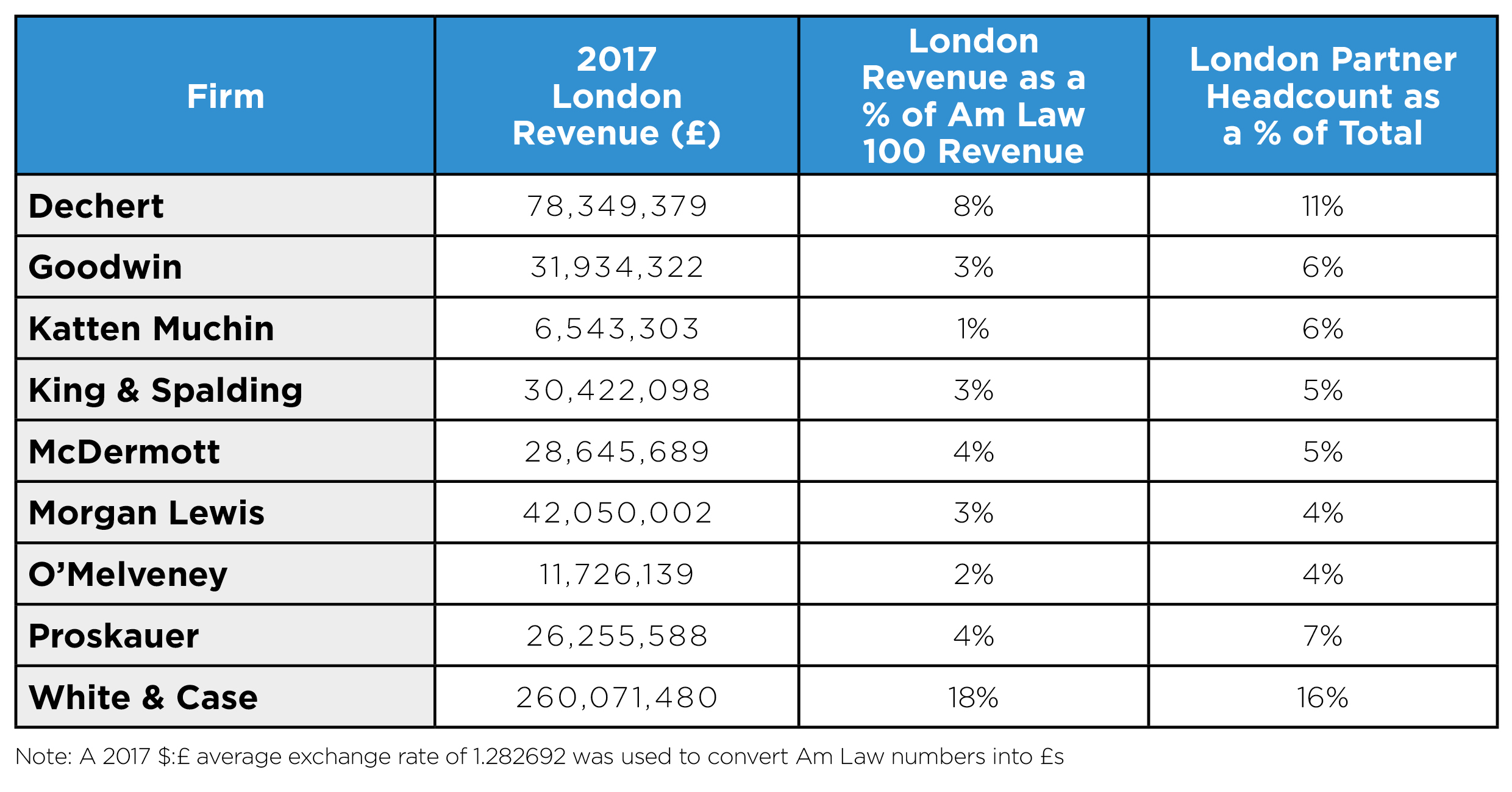 The above table shows the varying importance that London has financially to the largest US law firms. For White & Case, London is clearly very important, with almost one fifth of their total revenue generated here and almost one fifth of their total partners based here. Apart from Dechert, for all the other Firms listed, London only contributes between 1% and 4% of total revenue.
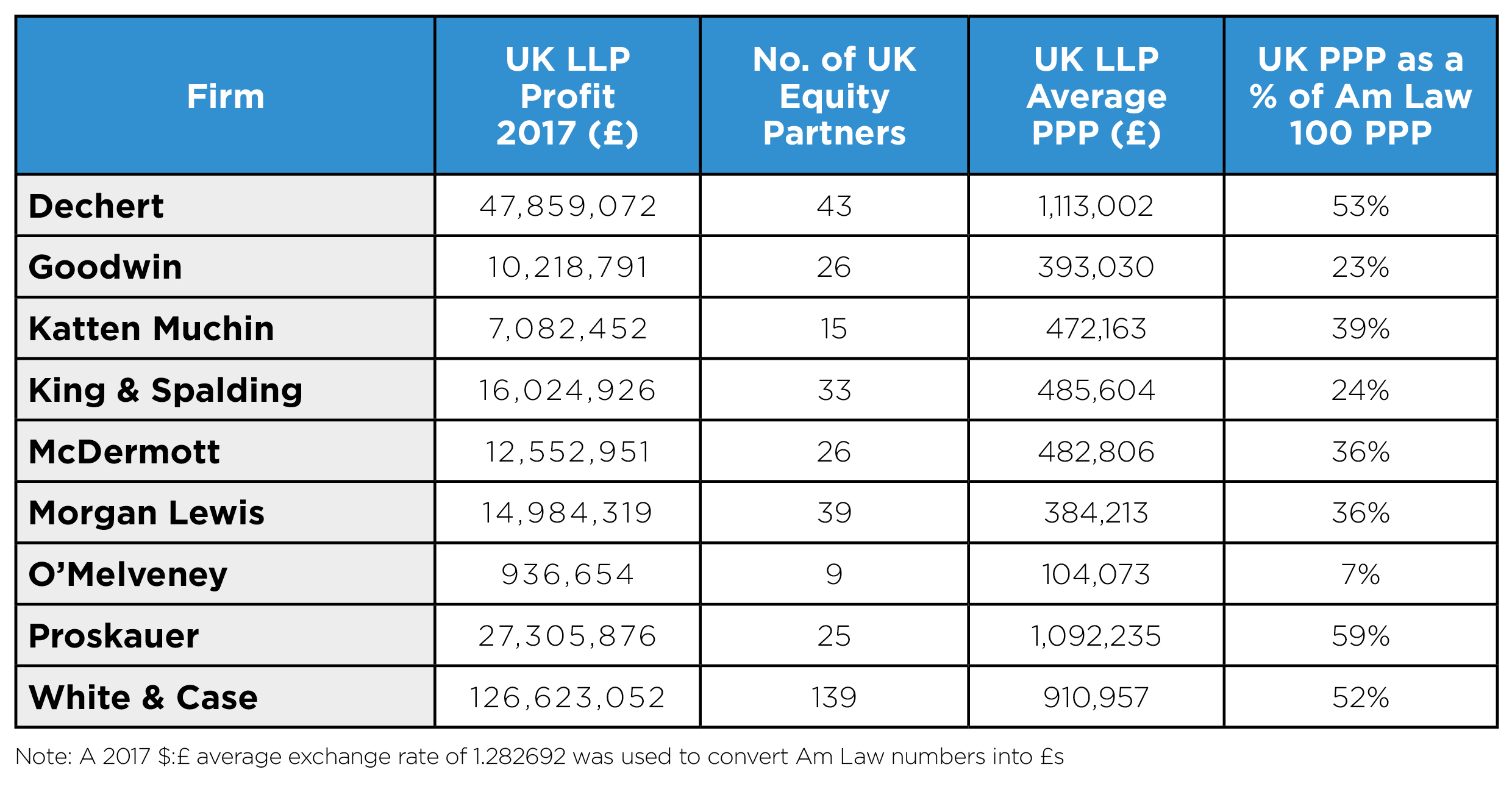
Clearly the actual PPP for these offices is far smaller than the published data. Proskauer gets the closest with an average of just over £1m. Assuming that the Am Law data is close to being accurate, it’s a reminder that international offices/partners are not as profitable as those back home.
National Pro Bono Week started in 2001 to recognise the pro bono contribution made by the legal profession. Building on its success, an exciting new initiative launches on 29 October: Justice Week sponsored by the Law Society, the Bar Council and the Chartered Institute of Legal Executives (CILEx). It unites the legal profession to raise the profile of the issue of access to justice and the rule of law. Below Francine Ryan, lecturer in law and member of the Open Justice Centre at The Open University, talks Lawyer Monthly through its purpose and goals.
Justice Week is not only a fantastic opportunity to highlight the incredible contribution made by law students and legal professionals in their communities but it also aims to galvanise public support for campaigns on access to justice and the rule of law. Members of the public are often unaware of the implications government policy has on the justice system. Justice Week will create opportunities for discussion and debate to highlight the importance of a justice system that is truly open to all.
A spokesperson for Justice Week said:
"With so many parts of the justice system at breaking point, now is the time to make a strong and clear case for why it is so fundamental to our society, economy and democracy. Business groups, members of the public and front-line service providers should all be part of the conversation. This week aims to take the subject of justice to new audiences and underline the commitments of legal professionals and organisations to improving access to justice and strengthening the rule of law both in England and Wales and internationally."
What is pro bono?
Pro bono public means ‘for the public good’ and for lawyers it is the provision of free legal services to those who cannot afford to pay. There are a number of ways lawyers are involved in pro bono from volunteering in Law Centres, supervising law students in law clinics, or providing free representation in court.
How can you get involved?
Legal professionals and law students can all take part in Justice Week there is a programme of events happening throughout the week. A great way to engage would be to blog and tweet about your pro bono activities and how you are supporting your community. The University of Law is running a workshop for students on how to approach pro bono activities in Birmingham on Thursday 1st November, for more information, email: Jennifer.wright@law.ac.uk
There is more information on Justice Week on the Law Society, Bar Council and CILEx websites with details of the events that are running during the week.
There will be lots of media coverage in Justice Week about the importance of the rule of law, it provides an opportunity to raise awareness of the access to justice crisis and the plight of many vulnerable individuals who are without legal representation because of the significant reduction in the availability of legal aid. Justice Week is about bringing into focus the implications for the justice system of the human cost of the cuts and telling the stories behind the numbers.
Law students should relish the chance to get involved in pro bono and make a difference in their community. Law schools offer a variety of ways students can support individuals, charities and community groups by providing free legal advice in clinics, delivering Street law presentations or working on innocence projects. The Open University encourages its law students to engage in pro bono activities through the Open Justice Centre. Cuts to legal aid have had a devastating impact on vulnerable individuals and although pro bono should never be a substitute for legal aid, law students have an increasingly important role to play in the provision of legal advice and public legal education to ensure access to justice.
Pro bono offers a great opportunity for law students to support and give a voice to their local community but also to develop professional skills that will be invaluable in their legal career. Participation in pro bono will hopefully ensure law students continue to communicate the importance of access to justice.
So, this week, reflect on how you can get involved in Justice Week. Don’t forget to tweet about what you’re doing or what is going on in your local area #JUSTICEWEEK18
New independent research commissioned by Sky has identified a huge gap in the way that different generations see equal opportunities and inclusion in the workplace, with the bosses of tomorrow set to challenge workplace discrimination and put businesses on the path to inclusion.
Gen Z are almost twice as likely as Boomers to believe a glass ceiling exists and they’re twice as likely to question the status quo on equal opportunities too.
Debbie Klein, Group Chief Marketing and Corporate Affairs Officer – Sky, said: “There's a new glass ceiling and it has remained unseen, but it seems Gen-Z have better eye-sight – they can see it, and they want to smash it.”
Employers have a duty to ensure their workplace fosters total inclusion, so it’s positive to find the newest members of today’s workforce are challenging barriers and committed to holding employers accountable.
Debbie Klein added: “These results are shocking. It is time to take a hammer to the glass ceiling.”
(Source: Sky)
With ongoing discussions around the Cypriot failure to tackle money laundering and economic crime, global banking expert Robert Lyddon discusses US efforts to force the island to improve its policies.
On June 14th 2018 the Central Bank of Cyprus (CBC) sent a circular to all Cyprus’ banks enjoining them to better and more complete Due Diligence on so-called shell companies, otherwise known as brass-plate companies, as part of Cyprus’ wider campaign to improve its image in the area of countering money laundering and combatting the financing of terrorism – otherwise known as AML/CFT.
Shell companies, as residents of the country where they are incorporated, benefit from the protections embedded in Double Taxation Treaties “DTA” that the respective country has signed with the governments of other countries. The owner of the shell company, though, being normally a non-resident of the country, does not. Cyprus has built up a wide network of DTAs and has signed the most favourable and aggressive DTA with Russia. The usage of Cyprus shell companies has featured historically in cases like the infamous one involving the Serbian president Slobodan Milosevic where they were used as vehicles for the purchase of armaments that were used in the Balkan Civil War.
The run-up to CBC’s circular demonstrates increased and renewed US focus on shell companies, on Cyprus, and on reaching out to locations such as Cyprus to ensure that US writ runs there.
Cyprus repeatedly featured in cases like the Panama Papers and the Paradise Papers which post-dated Cyprus’ undertaking – made in connection with its financial bail-out in 2013 – to eliminate its status as a haven for money laundering and tax avoidance. Most recently formal US sanctions were extended to include an individual who is the largest single shareholder in Bank of Cyprus, Viktor Vekselberg.
These sanctions, announced on April 6th, included Mr Vekselberg, six further Russian ‘oligarchs,’ 17 senior government officials, Vekselberg’s Renova Group and 11 other companies, according to the website of the US Treasury’s Office of Foreign Assets Control (OFAC): 36 entities in all.
The Cyprus business press reported that US anti-financial crime units in private went much further than the OFAC list of sanctioned entities: FinCen - the Financial Crimes Enforcement Network of the US Department of the Treasury - sent the Cyprus authorities another roster of 114 names, such that the FinCen and OFAC lists together totalled 150 Russian businessmen and companies under suspicion of actively operating through financial institutions in Cyprus.
These submissions caused the Cyprus authorities to mandate a thorough review of all possible connections between Cyprus’ banks and this list of individuals and companies. A number of Russian tycoons with deposits or trade-related monies at seven financial institutions were identified. CBC then froze the bank accounts of these Russian businessmen in the context of the US sanctions, an action which the banks involved should have done themselves, had they been operating an adequate AML/CFT function.
On May 4th, US Department of the Treasury Assistant Secretary for Terrorist Financing Marshall Billingslea visited Cyprus and stated that the island was no longer open for illicit financing. The Cyprus authorities have been cagey about the content of the discussions with Mr Billingslea, but they must simply have been a report to him of what Cyprus had done about the OFAC and FinCen lists, and a justification as to why the banks involved should not be cut off from the US$ payments system. In other words the visit was the culmination of previous communications and aimed from the US side at ensuring that the Cyprus authorities had received the message, and from the Cyprus side to assure Mr Billingslea that this was the case.
On May 8th – as if to underpin contentions made to Mr Billingslea the previous week - an article was placed in the Cyprus press with impressive-sounding statistics of 55,000 accounts closed, and large volumes of business turned away by Cyprus’ banks voluntarily. Closing 55,000 accounts that were open and which had passed the banks’ onboarding tests prior to opening is a truly astonishing figure for a banking environment that had represented, after the 2013 bailout, that it had cleaned up its act on AML/CFT. In addition, as the account fees for servicing a shell company will run into the thousands of euro per annum, the Cyprus banking system is effectively giving up on upwards of EUR300 million of fees per annum – a true measure of the degree of threat from the US side to cut Cyprus off from the US$ payment system.
On May 11th, FinCen issued new rules on the checks that financial institutions will have to make to detect shell companies, with a view to not banking them. We predicted then that these rules would be used as the yardstick by which the US measures the practices in other countries, particularly countries that are of money laundering concern like Cyprus.
At a European level the European Council, in its meeting on May 14th , adopted the 5th EU Anti-Money Laundering Directive. The new elements compared to the 4th Directive include greater transparency of the beneficial ownership of companies and trusts, a measure that will directly impinge upon the viability of the Cyprus business model.
This model has been a key feature of its economy since EU membership, and involves “introducers” based in Cyprus developing contacts with and business propositions for potential customers outside Cyprus, and then establishing legal entities domiciled in Cyprus who obtain their banking facilities with indigenous banks.
Close connections have been shown to exist between these introducers – in the form of law offices, accountants and company formation agents - and senior politicians and bankers. Indeed, the president’s own law firm is a prominent introducer.
The impression of Cyprus’ authorities dancing to the US’ tune and coming willingly into compliance is contradicted by other evidence however. The Cyprus authorities have hired a PR firm in the USA to project a more positive view of Cyprus towards those organisations charged with AML/CFT matters, like Financial Action Taskforce and Moneyval.
CBC’s circular does not proscribe shell companies as customers, contrary to the strong inference of FinCen’s new rules. CBC simply requires that banks review their existing client base to identify customers which can be described as shell companies, inform the supervisor of the outcome of the review before July 31, 2018, and “assess the future of their future relationship with them”. They must justify their decision to continue banking that customer against a series of criteria, and note the analysis and decision on the customer’s file.
The evidence points to Cyprus’ overtures being a ceremonial exercise to placate US regulators as no directives were put in place forbidding banks from opening accounts for companies who have no physical presence on the island and who take advantage of the Cyprus business model for tax evasion and money laundering. A clear example of this is the current Cyprus passport scheme, which requires that a foreign investor bring EUR2 million into Cyprus and invest it in real estate, and the investor is then issued with a Cypriot passport and provided unfettered access to the EU.
The scheme has come under the scrutiny of EU and US regulators as it has yet again emerged that both Cyprus regulators and local banks were turning a blind eye to the bone fides of funds coming into the country for the purchase of luxury residential properties in order to utilise the scheme. When the EU and US again asked difficult questions, the Cypriot authorities pledged to improve their AML/CTF efforts. Too little and too late: 3,300 passports have been issued to foreign investors and their family members under the scheme since the 2008 financial crisis, according to Cyprus media sources - for a stated profit of EUR 4.5 billion.
Cyprus’ response to this and other matters follows their established pattern: to eschew going the whole nine yards, in favour of going about seven and a half of them.
No bank has been shut down in relation to AML/CFT concerns, that is apart from Cyprus branch of a small foreign bank called FBME. In July 2014 FBME was resolved by CBC immediately after FBME had been served by FinCen with a Notice of Finding citing FBME as an institution of “primary money laundering concern”, in connection with allegations surrounding about a dozen of the 8,000 FBME had active at the time.
If the Cyprus banks as a whole actually closed 55,000 accounts when FinCen had raised concerns about a dozen of FBME’s 8,000 accounts in total, this comparison shows that the scale of the problem is much larger and that its fulcrum is the large domestic banks, who so far have remained untouched - even following scandals including Liberty Reserve and the Bank of Cyprus’ involvement in the Manafort case.
Indeed, according to Pavlos Angelides, a private-practice lawyer, CBC’s approach to introducers has been similar to its approach to the banks. Pavlos has been quoted as saying: “Look, the central bank already knows who is doing what, they’ve got lists. This business of turning the heat on shell corporations began some five or six months ago. But they aren’t touching the big guns, the major law firms with political connections, who between them ‘own’ the lion’s share of these shell or nominee entities. Instead, they’re going after the little guy.”
On shell companies as on AML/CFT generally, the approach is to find a scapegoat, hold that scapegoat up as the fulcrum of the problem, engage in a PR campaign about Cyprus’ supposed efforts to clean up its act, and to let the big players carry on business as usual. As if to prove this, the number of new company registrations in June 2018 was 1,123, an annual increase of 17%.
It may prove to be rather less easy to get Mr Billingslea off their back than it was for CBC to annul the investment of FBME’s shareholders.
Sources & Weblinks:

https://www.stockwatch.com.cy/el/article/diethni-trapezes/se-amerikaniko-epoptiko-kloio-oi-trapezes

Milosevic and Cyprus…

https://www.washingtonpost.com/archive/politics/1992/06/07/serbian-money-trail-leads-to-cyprus/3f92c601-bbf3-4236-9394-1f54d687c4c7/?noredirect=on&utm_term=.8bf2c5384ed5

Report on shell companies crackdown…

https://cyprus-mail.com/2018/06/30/under-the-us-cosh-the-crackdown-on-money-laundering/

Yet another EU AML/CFT directive...

https://www.int-comp.org/insight/2018/may/07/eu-fifth-anti-money-laundering-directive-5mld/

Essence of 5AMLD…

https://financialinstitutionsnews.com/2018/05/14/eu-adopts-mld5/

New FinCen rules on Customer Due Diligence go live...

https://www.fincen.gov/news/news-releases/fincen-reminds-financial-institutions-cdd-rule-becomes-effective-today
