Supreme Court Reviews Trump’s Authority Over Independent Regulators
The case could redefine how federal regulators operate by deciding whether presidents may dismiss members of independent agencies at will.
Justices Hear Case On Trump’s Dismissal Of FTC Commissioner
The U.S. Supreme Court heard arguments Monday in a dispute over President Donald Trump’s removal of Federal Trade Commission member Rebecca Slaughter before the end of her statutory seven-year term.
The case, arising after Slaughter’s dismissal earlier this year, centers on a federal law that restricts removal of FTC commissioners to instances of inefficiency, neglect of duty, or malfeasance.
It comes as similar challenges involving the National Labor Relations Board and the Merit Systems Protection Board move through lower courts.
The issue carries national implications because independent agencies regulate areas such as consumer privacy, antitrust enforcement, workplace protections, securities markets, and telecommunications access.
These agencies were designed by Congress to maintain continuity across administrations.
The dispute arrives at a time when rulings such as Seila Law v. CFPB (2020) have already limited certain forms of agency independence, prompting closer scrutiny of how removal protections function across federal commissions.
How The Design Of Independent Commissions Entered The Constitutional Spotlight
Congress established fixed terms and for-cause removal limits for the FTC in 1914 to ensure expertise and reduce political pressure on competition enforcement.
Similar structures govern more than 30 federal bodies, including the Federal Communications Commission and the Securities and Exchange Commission, according to the Congressional Research Service.
These agencies rely on bipartisan membership rules that prevent any single party from holding more than a statutory majority.
Lower courts held that Slaughter’s removal violated 15 U.S.C. §41, which outlines the conditions for dismissing commissioners.
The administration argues that Article II’s vesting of executive power allows the president to remove officials he appoints, citing decisions such as Free Enterprise Fund v. PCAOB (2010).
The Supreme Court’s 1935 ruling in Humphrey’s Executor is the central precedent limiting that authority and remains binding unless the justices narrow or overturn it.
How Institutions And The Public Are Reacting
The administration maintains that broad removal authority enhances electoral accountability by ensuring regulators follow the president’s policy agenda.
Several independent agency leaders and former officials counter that bipartisan, fixed-term structures guard against sudden shifts in enforcement.
National labor groups and consumer organizations have filed public statements emphasizing that leadership interruptions can delay investigations or rulemaking, pointing to past backlogs at the Merit Systems Protection Board when it lacked a quorum before 2022.
Observers note that Slaughter’s request to remain on the FTC during litigation was denied in September in a 6–3 Supreme Court order, leaving the commission without any Democratic members.
That outcome has drawn attention from stakeholders who rely on multi-member panels to reflect diverse policy viewpoints, particularly in areas such as merger review and consumer fraud enforcement.
How The Ruling Could Affect Consumers And Regulated Industries
A decision allowing at-will removal of commissioners could lead to more rapid changes in regulatory priorities.
For households, this could influence the timing or direction of actions related to privacy protections, false advertising cases, or antitrust scrutiny of digital platforms.
For businesses, reduced stability in enforcement approaches may complicate multi-year planning, especially in sectors where agencies issue interpretive guidance or consent orders that structure market expectations.
Past transitions illustrate the stakes.
For example, after the 2008 financial crisis, the SEC’s enforcement posture shifted incrementally rather than abruptly because of its bipartisan commission structure.
A system with direct presidential control could compress such transitions, affecting how quickly firms and consumers must adjust.
Evidence From Past Rulings And Federal Oversight Data
Analyses by the Congressional Research Service show that independent agencies with for-cause removal protections supervise markets touching nearly every U.S. household, including labor rights, transportation safety, and financial disclosures.
Recent Supreme Court rulings—Seila Law in 2020 and Collins v. Yellen in 2021 curbed removal limits for certain single-director agencies, signaling an openness to reviewing long-standing independence models.
Federal staffing data published by the Office of Personnel Management indicates that multi-member boards oversee significant adjudicatory functions, such as federal labor disputes and civil service appeals.
These responsibilities depend on predictable leadership, since panel vacancies can delay case resolution or impose procedural bottlenecks.
What Comes Next As The Court Moves Toward A Decision
A ruling is expected before the Supreme Court term ends in June 2026.
Related cases involving the NLRB and MSPB will resume once the Court clarifies the governing standard for removal.
The upcoming case on Federal Reserve Governor Lisa Cook’s dismissal will provide an additional opportunity for the Court to address whether the Fed’s structure warrants a different constitutional approach.
Implications For Federal Governance
This dispute addresses how the United States defines the balance between presidential oversight and the long-standing independence of federal regulators.
Independent agencies supervise consumer protection, market competition, financial integrity, and workplace standards, making their stability central to daily economic and legal systems.
Changes to removal protections could alter how reliably these bodies function through shifts in administration.
The Court’s decision will guide expectations for regulatory continuity and clarify the limits of presidential authority in managing these institutions.
President Trump has now signed the Epstein Files Transparency Act, a law requiring the Department of Justice to release all of its Jeffrey Epstein–related files within 30 days. The legislation passed Congress with overwhelming bipartisan support and sparked public hopes that long-sealed documents will finally see daylight.
But the real question isn’t whether the files will be released — it’s what the government is actually allowed to release, and what the law quietly permits the DOJ to withhold. This analysis explores those fault lines.
The Transparency Question Everyone Is Asking — But No One Has Answered
For years, the Epstein case has lived in a strange space between criminal justice, intelligence rumor, sealed litigation, and institutional embarrassment. Anytime a public official says “release the documents,” people instantly imagine full transparency — names, travel logs, intelligence briefings, bank trails, everything.
But the U.S. government doesn't work that way. Even when Congress directs disclosure, other laws still set the boundaries. Grand jury materials are protected. Active prosecutions can’t be jeopardized. Victim privacy rules override political messaging. And classified intelligence — if any exists in the Epstein file set — is governed by entirely separate statutes.
So the public is asking the most rational question: Does this new law blow open the vault, or will it ultimately produce a heavily redacted, legally constrained release?
That gap between public expectation and legal reality is exactly where this analysis sits.
The Critical Details Missing From the Initial Reporting
The initial reporting focused on the bill’s passage, political reactions, and Trump’s celebratory framing. What was not explained — and what matters far more — is the legal terrain the DOJ must navigate.
Specifically:
-
What categories of information legally cannot be disclosed, even under congressional mandate?
-
What counts as “Epstein-related” files? Internal memos? Email chains? Witness lists? Foreign intelligence referrals?
-
What happens to grand jury documents governed by Rule 6(e) of the Federal Rules of Criminal Procedure?
-
Are intelligence agency materials included, or are they exempt because they aren't held by the DOJ?
-
How are victim names, medical details, and sealed civil case records handled?
-
What about ongoing investigations triggered by the House Oversight subpoenas of J.P. Morgan and Deutsche Bank?
These omissions are not small. They shape the entire meaning of the law. Without them, the public has only half a story — and the half that remains unspoken is where the complexity lies.
The Legal Firewall Around the Epstein Files: What the DOJ Must Protect
Understanding what can and cannot be released requires an honest look at the laws that govern federal disclosure. Several are non-negotiable in their current form.
1. Grand Jury Protections (Rule 6(e))
Rule 6(e) strictly restricts disclosure of grand jury testimony, witness identities, exhibits, or internal deliberations unless a federal judge authorizes it. Courts, not politicians, enforce these limits.
Congress can mandate disclosure of DOJ-controlled records, but as a practical matter, material covered by Rule 6(e) typically remains sealed even in landmark releases unless a court explicitly orders otherwise.
2. Victim Privacy Statutes
The Crime Victims’ Rights Act, along with longstanding privacy doctrines and related statutes, helps prevent disclosure of:
-
Names of minors
-
Identifying information
-
Medical or psychological records
-
Addresses, phone numbers, and personal history
Any file touching on Epstein’s decades-long pattern of abuse inherently contains such information. These elements will almost certainly be redacted or anonymized.
3. Ongoing Investigations and Law Enforcement Privilege
The DOJ is allowed to withhold information if disclosure would:
-
Interfere with active investigations or prosecutions
-
Reveal confidential techniques
-
Expose cooperating witnesses
The House Oversight Committee’s active financial investigation — including subpoenas to J.P. Morgan and Deutsche Bank — suggests that some materials may remain protected until those inquiries close or reach a different procedural stage.
4. Classified Intelligence and Foreign Government Referrals
If any portion of the Epstein files involved intelligence-sharing from allies (for example, the UK, France, or Israel) or internal counterintelligence assessments, those materials fall under:
In practice, such materials cannot be made public without going through a formal declassification or review process, even if Congress has passed a disclosure-focused statute.
5. The Precedent of Large-Scale Disclosures
Historical comparisons help set expectations:
-
The JFK Records Act took decades to fully implement, with repeated waves of releases and redactions.
-
The 9/11 Commission materials were published in stages, with sensitive sections withheld or heavily edited.
-
The Church Committee files are still partially redacted nearly half a century later.
These examples show that while Congress can demand transparency, the executive branch retains significant control over timing, redactions, and the scope of what is actually put in the public domain.
👉 Related: Who Is Clay Higgins, the Lone Republican Who Voted Against Releasing the Epstein Files? 👈
Why Experts Expect a Redacted Release, Not a Data Dump
Legal and policy experts tend to converge on a few broad themes when it comes to large, politically charged document releases:
-
Analysts generally note that disclosure laws still operate within the boundaries of other federal statutes, which often limit how far any “release everything” promise can actually go.
-
National security specialists often point out that classified materials undergo multi-agency review, not unilateral release by a single official.
-
Victims’ rights advocates routinely emphasize that privacy protections are not optional, even in high-profile cases where public curiosity is intense.
-
Former DOJ officials frequently observe that “related files” can be interpreted narrowly or broadly, depending on how aggressively department leadership wants to lean into transparency.
In short: broad political language meets narrow legal reality. And those tensions determine what the public will actually see.
What a 30-Day Deadline Really Means Inside the DOJ
Here is the forward-looking landscape, clearly separating facts from analysis.
What Is Factual and Confirmed
-
The DOJ has 30 days under the new law to release the files.
-
The department must still comply with federal privacy rules, grand jury secrecy, and classification laws.
-
Attorney General Pam Bondi has said the DOJ will continue to follow the law.
-
Lawmakers in both parties have signaled they will use oversight tools if they believe the law is being ignored or undermined.
What Is Likely (Analysis, Based on Precedent and Statutory Limits)
Based on how previous large disclosures have unfolded:
-
A partial release with extensive redactions is the most realistic near-term outcome.
-
Internal DOJ memos, communications, and investigative notes are likely to remain withheld under longstanding deliberative and law enforcement privileges.
-
Financial records obtained under subpoena may be released in limited or summarized form, especially if they intersect with ongoing investigations into banks or third parties.
-
Any intelligence-related materials will undergo separate classification review, which typically slows and narrows disclosure.
Scenarios
Best-case transparency scenario (analysis):
A broad release of unclassified DOJ case files, including correspondence, investigative summaries, financial tracing, and internal communications that do not violate Rule 6(e), victim privacy protections, or classification rules.
Most probable scenario (analysis):
A heavily redacted document dump resembling previous high-profile releases (for example, parts of the JFK files or portions of the Mueller materials), with strong victim privacy protections and limited exposure of privileged internal records.
Political conflict scenario (analysis):
If lawmakers conclude the DOJ interpreted “Epstein-related” too narrowly, Congress may escalate through hearings, subpoenas, and potential litigation. Federal courts could eventually be drawn into defining the scope of the law and the boundaries of permissible redactions.
The Agencies, Courts, and Committees That Could Shape the Outcome
-
DOJ Leadership: Controls the redaction process and defines what is “related” for practical purposes.
-
Federal Courts: May be asked to resolve disputes over grand jury secrecy, classification, and withheld records.
-
House Oversight Committee: Already pursuing Epstein-related financial records and likely to test DOJ’s compliance with the new law.
-
The Intelligence Community: If its equities are involved, expect multiple layers of review and resistance to broad disclosure.
-
Survivors and Victims’ Advocates: Will scrutinize how well privacy is protected and whether institutions face meaningful accountability.
Epstein Files Release: Key Questions Answered
1. Will the Epstein files include the names of public figures?
Possibly — but only where doing so does not violate grand jury secrecy, victim privacy protections, or restrictions tied to ongoing investigations. Even then, names may appear in redacted or limited form rather than as a comprehensive “list.”
2. Can Congress force the DOJ to release everything?
Congress can require disclosure by statute, but it cannot easily sweep aside grand jury secrecy, classification rules, or victim protection laws without changing the underlying legal framework and likely facing judicial review. Courts have the final say in many of those areas.
3. Will victim or survivor identities be exposed?
That is highly unlikely. Federal law and long-standing practice protect victim identities, especially minors, and those protections typically take precedence over disclosure mandates in cases like this.
4. Are intelligence files about Epstein included?
The law directs the DOJ to release the files it holds. If intelligence agencies possess their own Epstein-related materials, those would be governed by separate classification rules and are not automatically swept into this statute unless explicitly included.
5. Could the DOJ delay the release beyond 30 days?
Legally, the DOJ is required to comply with the deadline. In practice, extensive redaction review, classification review, or litigation over specific categories of records could create practical delays, even if the department claims to be acting in good faith.
In a dramatic early-morning move from Washington, President Donald Trump has signed a bill forcing the US Justice Department to release its long-guarded files on Jeffrey Epstein within 30 days. The law compels disclosure of investigative records, prosecution and custody files, flight logs, internal DOJ communications, and documentation surrounding Epstein’s detention and death.
The decision caps days of feverish political pressure, near-unanimous votes in Congress, and growing unrest inside Trump’s own Make America Great Again movement. Survivors of Epstein’s abuse and their families are hailing the signing as a breakthrough moment, while attorneys and former officials are already bracing for a wave of questions about who is named in the documents and how much will be blacked out.
At the center of it all: Trump, the Justice Department, and a countdown clock now ticking toward a disclosure battle unlike anything seen in the Epstein saga so far.
Why Trump Signed the Epstein Files Bill After Calling It a ‘Hoax’
For months, Trump publicly dismissed demands to open the Epstein archive as a partisan stunt aimed at damaging him and other Republicans. That stance clashed with promises he made on the campaign trail to “release the Epstein files in full,” and created visible tension within his base.
Over the past week, that pressure exploded into the open. The House of Representatives voted 427–1 to force disclosure, a rare show of unity that drew applause on the floor. The Senate quickly followed, sending the bill to Trump’s desk with overwhelming bipartisan support.
Trump then flipped his position and announced online that he had signed the measure, using the moment to argue that Democrats, not Republicans, would be most exposed by a full release. His allies have leaned heavily on Epstein’s past connections to prominent Democratic figures, even as Trump’s own relationship with Epstein remains a focus of public scrutiny.
What the Law Forces the Justice Department to Release
The new law is unusually sweeping in what it demands from the Justice Department. Within 30 days, officials must begin releasing:
-
Investigative and prosecution files tied to Epstein’s criminal cases
-
Custody and detention records, including material related to his death in jail
-
All files referencing Ghislaine Maxwell
-
Flight logs and travel records for aircraft, vessels, or vehicles owned, operated, or used by Epstein or related entities
-
Documents naming individuals or entities linked to Epstein’s criminal activities, civil settlements, immunity or plea agreements, or investigations
-
Records of immunity deals, non-prosecution agreements, plea bargains, and sealed settlements involving Epstein or his associates
-
Internal DOJ communications about decisions to charge, not charge, investigate, or decline to investigate Epstein or his circle
-
Communications about missing, destroyed, altered, or concealed Epstein records
-
Documentation surrounding Epstein’s detention and death, including witness interviews and autopsy materials
This goes far beyond a simple document dump. It reaches inside the Justice Department’s decision-making process over many years, putting prosecutorial choices and internal debates under the microscope in a way that is rarely seen in public.
How Redactions and Releases Really Work in a Case Like This
As the 30-day deadline approaches, one legal question dominates: how much of this will the American public actually be allowed to read?
Under US law, agencies can release records while still redacting limited categories of information. In practical terms, that usually means:
Protecting Ongoing Investigations
If a document would expose active investigative steps or reveal tactics that could compromise a live case, specific passages can be withheld. This is one reason prosecutors almost never release full, live case files while investigations are still open.
Shielding Certain Private Individuals
Courts may permit redactions to protect the privacy of people who are not accused of crimes, even if their names appear in investigative files. This is especially sensitive in a case like Epstein’s, where documents may mention dozens of people who never faced charges.
Limiting Sensitive Security and Medical Details
Material such as detailed autopsy photographs, security camera locations, or internal prison protocols can be redacted to protect safety and institutional security, while still releasing the broader narrative and timelines.
Public Record, Even with Black Bars
Once released, even partially redacted documents generally remain part of the public record. Future legal challenges can sometimes force additional details to be unsealed, but that process can take months or years.
The core tension now is simple: the law demands maximum disclosure, but existing rules still allow targeted redactions. That collision between transparency and privacy is exactly where the next legal fights are likely to erupt.
Survivors, Political Fallout, and Global Names in the Spotlight
Epstein survivors and their families reacted with emotion and relief, framing the bill’s passage as a long-overdue step towards real accountability. The family of Virginia Giuffre, one of Epstein’s most prominent accusers, praised the signing as a historic moment and urged that “every name” tied to his operation be revealed, regardless of wealth or political power.
The political landscape around the scandal is deeply fractured. Within the MAGA movement, there has been open anger over any delay or hesitation in releasing the files. Republican congresswoman Marjorie Taylor Greene, a longtime Trump supporter who has recently clashed with him, appeared with survivors on the steps of the Capitol, praising their persistence and insisting their voices be heard.
Meanwhile, documents already released by a House committee have referenced Trump, former President Bill Clinton, the UK’s former US ambassador Lord Mandelson, and Andrew Mountbatten-Windsor, the former Prince Andrew. None of those figures have been charged with crimes in relation to the Epstein case, and all have denied wrongdoing while expressing regret over their association with Epstein.
👉 Latest: Andrew Mountbatten-Windsor Faces Congress Deadline Over Epstein Ties Amid New UK Pressure 👈
Former US treasury secretary Larry Summers, whose name also appeared in released materials, announced he would withdraw from public life and said he was deeply ashamed of his past connection to Epstein.
What Happens Next Legally: The 30-Day Deadline and Potential Court Battles
The key legal clock now running is the 30-day window given to the Justice Department. During that period, officials must review, organize, and release large volumes of Epstein-related material in a way that complies with the new law and existing privacy and criminal procedure rules.
In previous high-profile document releases involving government records, disputes over what can be redacted have sometimes ended up in court. Judges may be asked to decide whether certain blacked-out sections are truly justified or whether more detail must be made public. That kind of legal fight is entirely possible here, given the intense public interest and the number of powerful people whose names appear in the files.
For now, the immediate focus is on how quickly the DOJ moves, how heavily the documents are redacted, and whether Congress or outside groups challenge any decisions to keep material hidden. Whatever happens next, the department’s handling of the Epstein archive is already under a spotlight that will only grow brighter as the deadline approaches.
👉 Related: The Real Question Behind Trump’s Epstein Files Order: What Will Actually Be Released — and What Can Still Stay Hidden? 👈
FAQs: What People Are Asking About the Epstein Files Release
When will the Epstein documents be released?
The Justice Department has 30 days from the moment President Trump signed the bill to release the Epstein files. That timeline is written directly into the law, putting firm pressure on the DOJ to move quickly.
Will all of the Epstein files be fully public?
No. The law requires broad disclosure, but existing rules still allow limited redactions to protect ongoing investigations, certain privacy interests, and sensitive security or medical information. The public should expect to see some blacked-out sections in the first wave of documents.
Can the DOJ refuse to release specific records?
The Justice Department must follow the law and release the categories of documents listed in the bill. It can withhold or redact only where other legal protections apply, such as active investigations or court orders. Any decision to withhold information could be challenged and reviewed by a court.
Could the release of these files lead to new legal action?
Releasing records does not automatically create new criminal charges. Prosecutors can only bring cases if the evidence meets legal standards for proving crimes in court. Whether further action is taken will depend entirely on what the documents show and how investigators and courts interpret that evidence.
Gunmen Attack Kwara Church During Evening Service
Gunmen stormed a Christ Apostolic Church in Eruku, Kwara State, during an evening worship service on Tuesday, shooting congregants and kidnapping the pastor along with several worshippers. The attack, which struck shortly after 6 p.m. local time, left at least two people dead and others injured, according to early police findings.
The church, located in a rural border community between Kwara and Kogi states in central Nigeria, was holding a regular service when the armed men forced their way in. The assault comes less than 48 hours after 25 schoolgirls were abducted from a government boarding school in Kebbi State and at a time when U.S. President Donald Trump has publicly warned Nigeria over repeated attacks on Christian communities. The incident has sharpened questions about how the government is handling bandit violence and what protection ordinary worshippers can expect.

Map showing Kwara State in central Nigeria and the border town of Eruku, where gunmen attacked a church during an evening service.
Witness Accounts: How the Kwara Church Attack Unfolded
Worshippers had been mid-service when the sound of distant gunfire began to filter into the building. Moments later, the shots grew louder and panic spread, with people rushing for doors and diving for cover as several armed men forced their way inside.
Video from a church livestream, shared locally after the attack, shows the sudden disruption of the service as gunshots ring out and the camera shakes before cutting off. Residents say the attackers were heavily armed and moved quickly through the church, seizing bags, phones, and other belongings.
Police later confirmed that at least two victims were found fatally shot—one inside the church and another in nearby bushland—while several others, including a local vigilante, were taken to hospital with gunshot wounds. The pastor and an unconfirmed number of congregants were forced from the building and marched into the surrounding bush, with families still waiting for news of their whereabouts.
Eruku, Kwara: Border Community Living Under Threat
Eruku sits on a key rural route near the Kwara–Kogi border, an area where residents say bandit activity has intensified in recent weeks. Local leaders report that attempted kidnappings, roadside ambushes, and raids on small settlements have increased, leaving many people afraid to travel after dark or attend evening events.
Community figures have repeatedly appealed for more security patrols, arguing that the town’s position near a state border makes it vulnerable to gangs that can slip across jurisdictions. Tuesday’s church attack has deepened those fears, with residents pointing to the Kebbi schoolgirl abduction and other recent incidents as signs of a wider pattern of insecurity stretching across northern and central Nigeria.
On the international stage, the Eruku assault lands at a sensitive moment. Trump’s recent comments on the treatment of Christians in Nigeria have drawn global attention back to the country’s security record, adding diplomatic pressure to the domestic outrage already building over repeated attacks on schools, villages, and places of worship.
How Nigerian Law Handles Deadly Church Attacks
When an armed group attacks a church, kills worshippers, and kidnaps congregants, several serious offences are typically involved under Nigerian criminal law. These can include kidnapping, armed robbery, unlawful possession of firearms, and culpable homicide. The exact charges depend on the evidence gathered, the number of victims, and whether links to organised criminal or terrorist groups are established.
The process usually begins with a formal investigation by the state police command. Officers collect physical evidence from the scene, record statements from survivors and witnesses, and work to establish how the attackers arrived, how they escaped, and who may have supported them. If the incident crosses state lines or is linked to recognised terrorist organisations, federal agencies can become involved.
Evidence is central. Items such as recovered shell casings, the church livestream footage, medical reports, and any communications or ransom demands may later be presented in court. Maintaining a clear chain of custody—how each piece of evidence is collected, stored, and logged—is crucial so that it can be used in a prosecution if suspects are arrested.
This is a general explanation of how the system works in cases like this. Individual investigations can differ depending on the facts and the agencies involved.
FAQs: Kwara Church Attack and Kidnappings
How many people were killed in the Kwara church attack?
Police have confirmed at least two fatalities so far, with investigations continuing to establish the full number of victims and injuries.
How many worshippers were kidnapped from the church?
The exact figure has not yet been made public. Authorities have confirmed that the pastor and several congregants were taken into the bush, and efforts are ongoing to compile a complete list.
Is this attack linked to the Kebbi schoolgirl abduction?
There is no official confirmation of a direct link between the two incidents. However, they occurred within a short time frame and have contributed to growing concern about the spread of bandit attacks across multiple states.
Why is the United States commenting on attacks like this?
Trump has recently criticised Nigeria’s handling of violence against Christian communities, putting additional international attention on how the government responds to church attacks, mass kidnappings, and other religiously sensitive incidents.
What Happens Next in the Kwara Church Kidnapping Case?
In the coming days, investigators are expected to focus on three main tracks: locating the hostages, identifying the gunmen, and securing evidence strong enough to support future prosecutions. Search operations in the bush around Eruku are likely to continue, with police and local vigilante groups trying to trace the kidnappers’ routes and possible hideouts.
If suspects are arrested, they can face a combination of kidnapping and homicide charges, alongside other offences such as armed robbery or unlawful possession of weapons. Any future court case will depend on whether investigators can connect individuals to the attack through witness testimony, forensic evidence, digital records, or ransom communications.
For residents of Eruku and other rural communities, the key question now is whether this case leads to tangible change—stronger security on the ground, better protection for churches and schools, and visible progress in holding armed groups to account. The way authorities handle the investigation and any eventual trials will shape public trust in the justice system long after the gunfire has faded.
👉 Latest: The Real Question Behind Trump’s Epstein Files Order: What Will Actually Be Released — and What Can Still Stay Hidden? 👈
Speaking in the Oval Office on Monday, President Donald Trump said that moderate-income Americans may receive $2,000 tariff dividend checks by mid-2026.
The message landed like a lightning bolt: a fresh promise, a new date, and millions wondering whether a windfall might actually be coming.
The surprise update immediately rippled through financial circles, political groups, and online betting markets. Supporters cheered at the possibility of a cash boost during a stubbornly expensive economic climate.
Critics, meanwhile, questioned both the math and the law behind the plan, especially after Treasury Secretary Scott Bessent publicly cautioned that the administration would “need legislation” before anything could move forward.
And with tariff revenue still far below what analysts say would be required to issue checks of this size nationwide, the debate has only intensified.
What Trump Says Will Happen and Why the Math Still Falls Short
The president has repeatedly floated the idea of using tariff revenue to fund payments for low- and middle-income households.
The pitch is simple: tariffs generate cash, and part of that money would be returned to working Americans.
But tariff revenue remains nowhere near the level such a program would require.
Budget analysts say current collections total around $100 billion, far below the roughly $600 billion needed to cover $2,000 payments to eligible households.
Some economists argue that the proposal highlights a broader reality often missed in political messaging: tariffs are ultimately paid by American consumers and businesses through higher prices.
For that reason, a rebate tied to tariff revenue is essentially returning money people already paid indirectly.
That concern has helped fuel skepticism not just among economists, but also across online prediction markets closely watched by traders and policy watchers.
Betting Markets Don’t Expect the Checks to Materialize
Two of the most active forecasting platforms, Polymarket and Kalshi, show strong pessimism about whether the checks will ever be issued.
Polymarket traders assign only a slim chance that tariff revenue will reach the levels needed in 2025.
On Kalshi, users are also questioning whether the Supreme Court will uphold the administration’s tariff authority, with odds of a favorable ruling dropping sharply after recent oral arguments.
That decline mirrors the atmosphere inside the Supreme Court chamber earlier this month, where several justices voiced concerns over whether the executive branch can impose broad tariffs without clear approval from Congress.
A ruling against the administration would significantly affect the revenue base the proposal relies on.
What Must Happen Before Any Payments Can Go Out
1. Congress Must Approve Any Payment Program
Federal agencies cannot distribute new cash benefits unless Congress passes a law authorizing them.
This includes setting the size of the payments, who qualifies, how the money will be delivered, and how it will be funded.
Until Congress votes on a specific bill, the Treasury Department has no authority to issue checks, even if the administration supports the idea.
2. Tariff Legality Is Under Review
The Supreme Court is currently reviewing whether the administration used its tariff powers appropriately.
The justices are looking at whether the government followed the limits set by existing trade laws.
If the Court narrows or overturns any of those powers, tariff revenue could decline, which would directly affect the funds available for a dividend-style program.
3. Treasury Must Confirm a Stable Funding Source
If Congress signs off, the Treasury Department must ensure that the money is actually there.
That means verifying how much tariff revenue is coming in, how consistent the revenue is, and whether using it for payments would conflict with existing obligations like debt repayment.
Treasury also has to confirm it can manage the distribution process—either through IRS systems, direct deposits, or mailed checks—without creating financial risk.
4. Timelines Are Controlled by Law, Not Announcements
Even after approval, federal payments take time to implement.
Agencies must build eligibility systems, coordinate with the IRS, set up fraud protections, notify the public, and test payment channels before anything goes out.
This means any estimated date depends entirely on the government completing those steps under the law, not on public comments or projections.
Why the Announcement Still Hit a Nerve Amid Cost-of-Living Pressure
Americans are still dealing with high grocery costs, elevated rent, and stubborn price pressures. The idea of a $2,000 relief payment — even one tied to tariffs — resonates strongly with families feeling the strain.
Supporters view the proposal as overdue recognition for households absorbing the higher prices that follow tariff increases. Opponents question both the feasibility and the legal foundation of the plan.
Either way, the future of the proposal depends on decisions from Congress, Treasury, and the Supreme Court — not on public comments alone.
👉 Trump Orders Nationwide SNAP Benefits Reapplication Review 👈
$20 Billion War Machine Arrives in Caribbean—Trump Unleashes Naval Power Against Cartels
In a stunning display of military muscle, President Donald Trump has deployed the world’s largest and most expensive aircraft carrier, the USS Gerald R. Ford, to the Caribbean, marking a dramatic escalation in his administration’s newly declared "war on cartels." The nearly $20 billion, 1,090-foot behemoth, which can carry over 75 warplanes, is now operating under U.S. Southern Command (USSOUTHCOM), significantly enhancing operations to counter narco-terrorism and disrupt the flow of deadly drugs, including fentanyl, into the United States.
This massive naval declaration signals a profound shift from law enforcement to open military confrontation in the hemisphere. The Ford leads a formidable strike group, including cruisers and destroyers, a concentration of naval power not seen in the region since the Cold War. This extraordinary move comes amid a series of increasingly lethal strikes against suspected drug vessels, bringing the total death toll of alleged smugglers to over 40 since September. The stakes are immense, fusing national security with a fierce domestic battle against the opioid crisis.
🚢 Trump Sends a $20 Billion Weapon South: The Ford's Mission
The administration is not hiding the purpose of the USS Gerald R. Ford deployment. Chief Pentagon spokesman Sean Parnell confirmed the carrier's mission is explicitly to “enhance and augment existing capabilities to disrupt narcotics trafficking and degrade and dismantle the cartels.” This $20 billion killing machine is a clear, unambiguous message: the maritime routes for drug smuggling are now considered a war zone.
The show of force involves not just the carrier, but also nuclear submarines, cutting-edge F-35 fighter jets, and MQ-9 Reaper drones, all converging on a theatre focused on transnational criminal organizations like the Venezuelan Tren de Aragua cartel, blamed for distributing massive amounts of fentanyl. This military strategy seeks to cut off the cartels’ lifeline on the sea, forcing them into a desperate corner.
🚨 'We Will Treat You Like Al-Qaeda': The Shocking New Doctrine
The rhetoric from the White House has moved far beyond traditional counter-narcotics language, firmly framing the cartels as an existential threat. Secretary of War Pete Hegseth delivered one of the administration's most aggressive threats yet, effectively declaring a new counter-terrorism standard for the hemisphere:
“If you are a narco-terrorist smuggling drugs in our hemisphere, we will treat you like we treat Al-Qaeda. Day or NIGHT, we will map your networks, track your people, hunt you down, and kill you.”
This declaration is already being enforced. The Pentagon has released striking footage of what it calls a “lethal kinetic strike” against a vessel linked to the Tren de Aragua, demonstrating a willingness to use overwhelming force. The administration’s determination to hunt down and eliminate these groups is central to its promise to secure the homeland from narco-terrorist threats that fuel the U.S. opioid epidemic.
Legal Context: The $20 Billion Question—Is a Drug Cartel a Terrorist Army?
The deployment of a $20 billion aircraft carrier group to fight drug cartels is backed by a quiet but radical legal change: President Donald Trump's administration has officially declared an "armed conflict" with these criminal groups, essentially treating them like ISIS or Al-Qaeda.
For you, the consumer, this single legal move is the engine that shifts the fight from a regular policing action to a military kill-operation.
🔪 The Loophole That Strips Your Rights
When the President uses the words "armed conflict," he is swapping the rules of a courtroom for the rules of war.
- Before: A suspected drug smuggler would be arrested and guaranteed a court trial (known as due process).
- Now: By designating cartel members as "unlawful combatants," the U.S. military claims the right to target and kill them without warning, jury, or judge.
Legal experts warn that this is a dangerous erosion of the line between law enforcement and warfare. If the President can declare war on a criminal group, what stops him from doing the same to other domestic or foreign groups? This legal theory replaces justice with lethal force, setting a precedent for unchecked executive power.
💸 The Hidden Cost: Adding War Debt to Your Wallet
This new legal war is not free—and you are already paying for it. Historically, the U.S. funds undeclared, perpetual wars (like the War on Terror) by debt, not taxes. These "ghost budgets" have cost taxpayers over $5 trillion in the past two decades alone.
By classifying the cartel fight as a new "armed conflict," the administration gains a loophole to fund the massive naval deployment—including the $20 billion carrier—as "emergency spending." This bypasses normal budget oversight, guaranteeing that the true cost of this campaign will be added to the national debt, passed directly to your children and grandchildren.
The administration cites the 2001 Authorization for Use of Military Force (AUMF) and the Maritime Drug Law Enforcement Act, but many top legal experts vehemently disagree. “There is currently no explicit legal authority that the President has that directly approves military operations against drug cartels in Mexico or elsewhere,” stated Javed Ali, a former National Security Council official and professor at the University of Michigan, speaking to CNN.
Legal scholars, including those at the U.S. Naval War College, have warned that attacking drug smugglers in international waters does not meet the Article 51 threshold of an "armed attack" that justifies national self-defense under international law.
According to analysis reviewed by Lawyer Monthly, the legal consensus is skeptical: “Treating criminal organizations as enemy combatants could unravel the international consensus on when force is lawful.”
🇻🇪 Regional Fallout: Maduro's Defiance and Covert Operations
The deployment has predictably inflamed regional tensions. Venezuelan President Nicolás Maduro, who has a $50 million U.S. bounty on his head, has condemned the operation as an act of naked aggression, calling Trump a “bloodthirsty fascist” intent on regime change.
Maduro’s televised response, vowing that the Venezuelan people are “ready for battle,” highlights the risk of a wider international incident. This friction is amplified by the presence of covert assets, including the MV Ocean Trader, a U.S. Special Forces "ghost ship" used for clandestine missions. The Pentagon confirmed the vessel's presence but has refused to disclose its mission, further fueling concerns about transparency and the administration's true intentions in Venezuela.
The sudden, high-profile resignation of Admiral Alvin Holsey as head of USSOUTHCOM only "deepens my concern," according to Senator Jack Reed, suggesting deep internal disagreements over the legality and strategy of this high-risk operation.
The arrival of the USS Gerald R. Ford dramatically raises the stakes, transforming the battle against narco-trafficking into a volatile new chapter of military engagement in the Western Hemisphere.
You can watch a deep dive into the legal and geopolitical questions surrounding the strikes here: Why Trump is blowing up boats off Venezuela. This video provides further background and analysis on the rationale behind the U.S. military strikes on vessels off Venezuela's coast, which is the immediate context for the deployment of the USS Gerald R. Ford.
Trump Cancels Federal Troop Surge to San Francisco After Urgent Calls from Tech CEOs and Mayor Lurie
Following widespread condemnation, President Donald Trump has called off the planned deployment of federal agents and the National Guard to San Francisco. The decision came after a key call with Mayor Daniel Lurie, who presented new data showing overall citywide crime is down nearly 30% in 2025. This summary confirms that the threatened federal surge will not proceed, concluding a high-stakes standoff with state and local leaders.
The Billionaire Blockade: How Silicon Valley’s Private Lobbying Overturned a Presidential Order
In a stunning turn of events that played out just hours ago, President Donald Trump reversed his plan to send a massive surge of federal agents and National Guard troops into San Francisco. The extraordinary decision, which came as federal agents were reportedly already staging nearby, was directly influenced by a flurry of urgent, last-minute calls from the Bay Area’s most powerful tech CEOs.
The President announced the sudden halt on social media, claiming that "friends of mine who live in the area called last night to ask me not to go forward with the surge." He explicitly named technology giants, including Jensen Huang of Nvidia and Marc Benioff of Salesforce, as key influencers in the cancellation, highlighting the unprecedented political sway of Silicon Valley. Trump wrote that these "Great people... want to give it a ‘shot.’ Therefore, we will not surge San Francisco on Saturday." This dramatic intervention shifts the focus from a purely political battle to a private power play, giving this story a compelling new angle.
Mayor Daniel Lurie confirmed the intense discussion, stressing that he provided the President with hard data and a firm stance against military intervention. “I told him the same thing I told our residents: San Francisco is on the rise,” Lurie stated, emphasizing that the city is already achieving significant results on its own terms.

San Francisco’s skyline stands at the center of a national debate after President Trump halted plans to deploy federal troops to the city following an eleventh-hour call with Mayor Daniel Lurie and leading tech CEOs.
Mayor Lurie's Statement on Federal Government Calling Off Potential Federal Deployment in San Francisco
“Yesterday, I spoke to San Franciscans about a potential federal deployment in our city. I said then what I have said since taking office, that keeping San Franciscans safe is my top priority.
“Late last night, I received a phone call from the President of the United States. I told him the same thing I told our residents: San Francisco is on the rise. Visitors are coming back, buildings are getting leased and purchased, and workers are coming back to the office. We have work to do, and we would welcome continued partnerships with the FBI, DEA, ATF, and U.S. Attorney to get drugs and drug dealers off our streets, but having the military and militarized immigration enforcement in our city will hinder our recovery. We appreciate that the president understands that we are the global hub for technology, and when San Francisco is strong, our country is strong.
“In that conversation, the president told me clearly that he was calling off any plans for a federal deployment in San Francisco. Secretary of Homeland Security Kristi Noem reaffirmed that direction in our conversation this morning.
“My team will continue to monitor the situation closely, and our city remains prepared for any scenario.
“I am profoundly grateful to all the San Franciscans who came together over the last several days. Our city leaders have been united behind the goal of public safety. And our values have been on full display—this is the best of our city.”
Local Leaders Cite Massive Crime Drop as Key to Victory
The Mayor’s pushback was backed by undeniable figures showing the city’s successful public safety efforts. Local law enforcement data reveals that overall crime is down nearly 30% citywide in 2025, reaching its lowest point in decades. Specifically, homicides are on track for a 70-year low, and car break-ins have hit 22-year lows.
This strong statistical rebuttal dismantled the administration's main argument that San Francisco was a "mess" and required emergency federal intervention. Mayor Lurie acknowledged the need for targeted, professional assistance, but made it clear that military action would be detrimental.
He warned: “We would welcome continued partnerships with the FBI, DEA, ATF, and U.S. Attorney to get drugs and drug dealers off our streets, but having the military and militarized immigration enforcement in our city will hinder our recovery.”
Salesforce CEO Marc Benioff, who previously drew massive backlash for suggesting he would welcome troops, was among the loudest voices opposing the surge this week. The CEO, who recently apologized for his earlier comment, reinforced his commitment to local solutions by announcing a $1 million donation to support larger hiring bonuses for new police officers in San Francisco.
Legal Analysts: Cancellation Avoids Guaranteed Court Loss Over Insurrection Act
The decision to back off was not just a political concession; it was a tactical retreat from what legal experts called a guaranteed court defeat. The controversy centers on the Posse Comitatus Act, which strictly prohibits using active-duty military for civilian law enforcement, and the Insurrection Act, which provides the President’s only statutory exception to this rule.
According to analysis reviewed by Lawyer Monthly, legal scholars were prepared to argue that the administration could not legally invoke the Insurrection Act because San Francisco did not meet the rigorous legal threshold. The law requires conditions that amount to an actual rebellion, insurrection, or an obstruction of federal law so severe that it makes ordinary judicial proceedings impossible.
California’s Attorney General Rob Bonta and Governor Gavin Newsom had already prepared a lawsuit, vowing to challenge the deployment “within nanoseconds.” This threat was potent, especially given a recent ruling by a federal judge in Los Angeles that found a similar deployment of federalized troops in that city violated the Posse Comitatus Act.
The certainty of immediate legal scrutiny over the President’s assertion of “unquestioned power” to send troops was likely the final, decisive factor. District Attorney Brooke Jenkins emphasized the local authority: “When San Francisco needs help from state or federal agencies, we have no problem asking for it — but the key word is asking. Resources imposed upon our communities are fundamentally different.” The withdrawal confirms that the administration was unwilling to risk setting a new, unfavorable legal precedent.
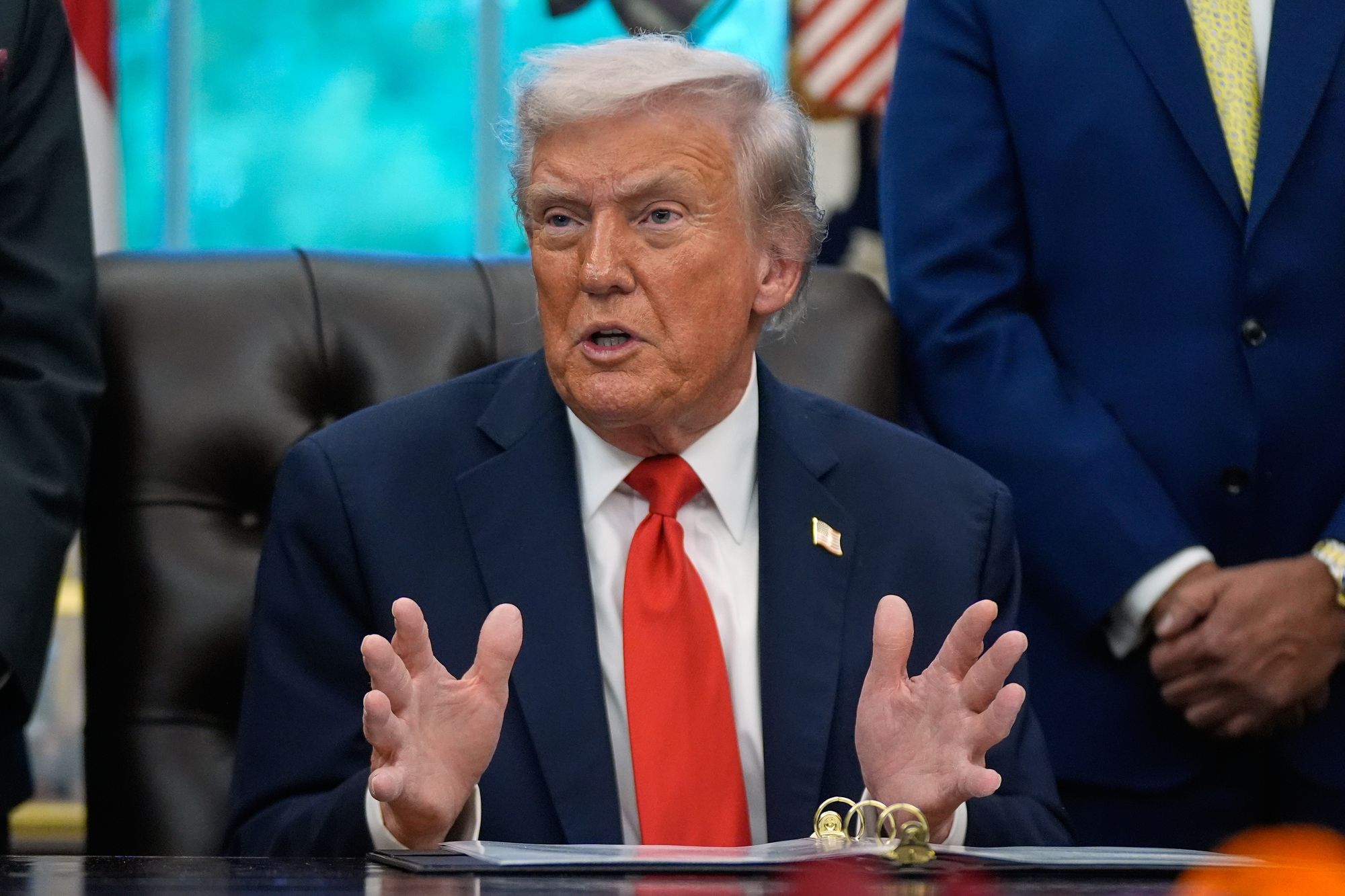
President Donald Trump speaks from the Oval Office after reversing plans to deploy federal troops to San Francisco, following a late-night call with Mayor Daniel Lurie and several prominent tech CEOs.
MAYOR DANIEL LURIE: The Levi Strauss Heir Who Took On Trump
Mayor Daniel Lurie, the man whose eleventh-hour conversation with President Trump—reportedly brokered by top Tech CEOs—resulted in the SF troop surge reversal, is a political newcomer with a history rooted in both immense wealth and large-scale philanthropy. His unique background provides essential context for his unprecedented victory in the standoff.
The Private Power Behind the Public Office
Lurie is an heir to the Levi Strauss fortune, a key fact that establishes his deep ties to the Bay Area's elite business and tech communities—the same influential group that privately lobbied the White House. This connection allowed him to leverage political and economic influence in a way few other mayors could.
Prior to entering public service, Lurie was best known for founding the Tipping Point Community, a successful anti-poverty non-profit that raised over half a billion dollars for Bay Area initiatives. This prior experience is critical because it underpins his credibility on data and local effectiveness:
- Data-Driven Focus: His success at Tipping Point was defined by clear metrics, and he brought this methodology to City Hall. He provided the President with the exact figures—“Overall crime is down nearly 30% in 2025”—to argue that San Francisco’s local, data-backed strategy is already working.
- The Unconventional Outsider: As the first San Francisco mayor since 1911 to win the office without ever holding one, Lurie is the ultimate political newcomer. This outsider status, bolstered by his self-funded campaign, became his shield, allowing him to push back against the President where a traditional "City Hall insider" might have capitulated.
In short, Lurie's distinct blend of private-sector resources, measurable philanthropic success, and a stubborn refusal to conform gave him the leverage needed to negotiate a halt to the federal deployment and declare a victory for local control.
Your Questions Answered: The SF Troop Reversal Breakdown
Q: Who were the top tech CEOs that persuaded President Trump? A: The two prominent tech executives confirmed by the President to have called for the reversal were Marc Benioff, CEO of Salesforce, and Jensen Huang, CEO of Nvidia.
Q: Why did Trump agree to halt the federal troop surge to San Francisco? A: President Trump cited a "late-night call" from Mayor Daniel Lurie, who "very nicely" asked for a chance to demonstrate the city's ability to handle the situation. The calls from tech CEOs also assured the President that "the future of San Francisco is great."
Q: Is the federal deployment to San Francisco permanently canceled? A: No, the deployment is temporarily suspended or on hold. The President explicitly stated he was giving the Mayor a "chance to turn it around," and ended his announcement with the phrase: "Stay tuned!"
Q: What was the federal surge intended to do in San Francisco? A: The federal surge was reportedly planned to address crime and homelessness, but was primarily framed by the administration as a stepped-up immigration enforcement operation, which San Francisco leaders widely opposed.
Trump's F-Word at Maduro: 'Doesn't Want to F**k Around' Amid Deadly Sub Strike
In a tense White House meeting, President Donald Trump stunned reporters by aiming an F-word at Venezuela’s Nicolás Maduro. "He has offered everything,” Trump said of the Venezuelan strongman. “You know why? Because he doesn’t want to f**k around with the United States.”
Trump's explosive comment landed minutes after officials confirmed the latest details of a deadly U.S. military strike in the Caribbean: two survivors from a suspected drug-running semi-submersible are now being held aboard a Navy warship. U.S. sources indicated that the same strike killed two other individuals.

Venezuela's Maduro: Trump has given the CIA the greenlight to conduct operations inside Venezuela
What is a 'Narco-Sub' and Where Did the U.S. Strike?
U.S. forces hit the suspected trafficking vessel, which officials describe as a semi-submersible/submarine-like craft designed to evade detection and smuggle narcotics through the southern Caribbean. This is the first operation in which survivors have been reported since the campaign began in early September.
The strike is the latest escalation in a series of attacks. Earlier this week (Oct 14), Trump said a separate strike killed six men aboard another suspected boat. Roughly 27 deaths have been reported across recent operations.

Narco Submarine Is Almost Impossible To Intercept: Over the last two months, the US military has struck five Venezuelan boats carrying illegal narcotics in the Caribbean sea
Why is the U.S. Attacking These Vessels?
Plain-English PAA answer: The U.S. says traffickers are using Venezuelan-linked boats to move cocaine through the Caribbean. Washington argues these networks are "narcoterrorists," meaning the U.S. military can strike them in international waters to stop shipments. In short: the U.S. frames the strikes as counter-terrorism against drug cartels at sea, justifying lethal force.
The CIA Authority and Military Escalation
The President has also authorized the CIA to conduct covert missions inside Venezuela, a sharp escalation that has triggered legal and diplomatic pushback. At sea and in nearby airspace, the U.S. has surged forces; Special Operations helicopters were observed operating near Trinidad, roughly 90 miles from Venezuela, during training tied to the expanded missions.
The Legal Question: Can the U.S. Call Them 'POWs'?
Legal scholars question whether the U.S. can treat survivors as prisoners of war (POWs) or conduct lethal strikes without explicit congressional authorization. Suspects are not traditional combatants, and the U.S. is not in a declared war with Venezuela. The administration cites counter-terrorism authority and the "narcoterrorist" designation, but critics argue international and domestic law require stricter thresholds for the use of lethal force.
Maduro Pushes Back
Maduro has blasted the CIA authorization and maritime strikes as illegal aggression, urging international condemnation. Caracas has appealed to the U.N. and warned of a heightened military readiness in response to the U.S. buildup.
Inside the Zelensky Meeting
Trump’s profanity landed during a high-visibility meeting with Ukrainian President Volodymyr Zelensky at the White House. During the discussion, Trump also discussed limits on sending Tomahawk missiles to Ukraine and teased an upcoming summit with Russian President Vladimir Putin, further highlighting the tense geopolitical backdrop of his comments.
This video discusses the military buildup between the US and Venezuela, providing crucial context for the "narco-sub" strike mentioned in the article: Maduro VS Trump Peaks: 3rd 'Drug Boat' Bombed| US F-35 Jets In Puerto Rico Amid Venezuela Tensions.
Ørsted Sues Trump Administration Over $5 Billion Offshore Wind Project Halt.
Danish energy company Ørsted has filed suit in federal court after the Trump administration abruptly ordered a halt to construction of the Revolution Wind project off Rhode Island, despite the offshore wind farm being nearly 80% complete.
Ørsted and its partner Skyborn Renewables argue the Bureau of Ocean Energy Management (BOEM) acted unlawfully and in violation of the Administrative Procedure Act when it issued an August stop-work order citing national security concerns. The companies have asked the U.S. District Court in Washington, D.C. for a preliminary injunction to allow work to resume.
Separately, the attorneys general of Rhode Island and Connecticut have sued in Rhode Island federal court, warning the suspension threatens more than 2,500 jobs, grid reliability, and state-level climate goals.
President Trump has repeatedly criticized wind energy and has issued several executive orders blocking new projects since returning to office. His administration has also launched a national security investigation into turbine imports, raising the prospect of tariffs.
Ørsted has already invested $5 billion in Revolution Wind and warns delays could add another $1 billion in costs. The company is pursuing a $9.4 billion rights issue to stabilize its finances, backed partly by shareholder Equinor.
The litigation centers on whether BOEM exceeded its authority, whether the stop-work order was arbitrary, and how far federal agencies can go in overriding state-backed energy projects. The outcome could have lasting implications for U.S. renewable energy investment and executive power.
Courts in Washington and Rhode Island will decide if the suspension can stand. Appeals are expected, with the possibility that the case could eventually reach the Supreme Court.
Ørsted A/S is a Danish renewable energy leader specializing in offshore wind, onshore wind, solar, and green hydrogen. Headquartered in Fredericia, Denmark, the company employs about 8,500 people worldwide and is committed to net-zero emissions across its supply chain by 2040.
More Articles from Lawyer Monthly
How Trump’s Health Secretary Has Put Personal-Injury Lawyers Back in Play.
The strange case of vaccine-injury courts, six months later
President Donald Trump has long mocked personal-injury attorneys, deriding them as “ambulance chasers” and dismissing them as the “lawyer lobby.” Yet in February 2025, he elevated one of their own. When Robert F. Kennedy Jr. took the oath of office as the 26th U.S. Secretary of Health and Human Services on February 13, standing beside Trump and his deputy Jim O’Neill, it marked a stunning turn in Washington politics.
Kennedy, a former personal-injury and environmental lawyer who has spent years questioning vaccine safety, is now in charge of the very agencies that regulate vaccines and public health. For most Americans, this appointment was startling enough. But for trial lawyers who specialize in personal injury, it looked like an unexpected gift.
The reason: a little-known but hugely consequential legal system known as the vaccine-injury court.
The Origins of Vaccine-Injury Courts
Vaccine-injury courts were born out of crisis. In the 1970s and 1980s, vaccine manufacturers faced a growing wave of lawsuits from families who said their children had been injured by routine immunizations. Juries handed down multimillion-dollar verdicts. Manufacturers warned that if litigation continued unchecked, they might abandon the vaccine market altogether [HHS History Office].
Congress stepped in. The National Childhood Vaccine Injury Act of 1986 created the National Vaccine Injury Compensation Program (VICP) — a unique “no-fault” tribunal within the U.S. Court of Federal Claims.
How it works:
-
Instead of suing vaccine makers in civil court, injured individuals file claims with the VICP.
-
Special masters — judges appointed to these cases — hear petitions.
-
Payouts come from a federal trust fund financed by a small tax on every vaccine dose administered.
-
Families can be compensated for medical costs, lost income, and pain and suffering (capped at $250,000 in death cases).
Since its creation, the VICP has paid out more than $5 billion to claimants [HRSA]. But while the system was designed to protect vaccine supply and provide swift compensation, critics — especially trial lawyers — argue it insulates drug companies from true accountability.
Myths and Realities About Vaccine Courts
Vaccine-injury courts are surrounded by misinformation. Some myths come from vaccine skeptics, others from lawyers or activists frustrated by the program’s limits.
Myth: Vaccine courts deny almost all claims.
Reality: While standards are strict, thousands of families have won compensation. Roughly 70% of payouts result from settlements [HRSA].
Myth: Families can’t sue vaccine makers at all.
Reality: The 1986 law largely shields manufacturers, but claimants can pursue limited civil action if their petition fails. However, in Bruesewitz v. Wyeth (2011), the Supreme Court held that design-defect claims are preempted, meaning most lawsuits outside the program face steep barriers [DOJ].
Myth: Vaccine court payouts are generous.
Reality: Awards are often modest compared to jury verdicts in injury cases. Pain and suffering caps have not been adjusted for inflation in nearly 40 years, frustrating many families and lawyers.
Myth: The program covers all vaccine injuries.
Reality: Only certain conditions on the “vaccine injury table” qualify automatically. Families with other claims face a higher burden of proof.
By design, the system is a compromise. It prevents a flood of lawsuits that could cripple vaccine supply while still acknowledging that injuries, though rare, do occur.
Why Trial Lawyers See Opportunity in Kennedy
With Robert F. Kennedy Jr. now leading HHS, trial lawyers see a chance to revisit — and possibly expand — the vaccine-injury system. Kennedy has long argued that vaccine safety data is incomplete and that injured families deserve more transparency [source].
Areas where lawyers expect openings:
-
Broadening the Vaccine Injury Table
HHS, through HRSA, has the power to revise the vaccine injury table. Expanding recognized conditions would make it easier for families to win cases without protracted legal fights. Kennedy could directly influence this process through regulatory action.
-
Raising Compensation Caps
The current $250,000 death benefit cap has not been updated since 1987. Trial lawyers argue it should be closer to $650,000 today, adjusted for inflation — more in line with awards commonly seen in medical malpractice cases. Changing that cap would require an act of Congress, though Kennedy could push for reforms or lobby lawmakers to revisit it
-
Weakening Liability Protections
The most controversial possibility, and one trial lawyers dream about, is reopening the door to direct lawsuits against vaccine makers. That would require Congress to amend the 1986 law, but Kennedy’s influence could help put the issue back on the political agenda.
For personal-injury attorneys, that prospect is tantalizing. Vaccine litigation could become as lucrative as asbestos or tobacco cases once were, with the added weight of sympathetic plaintiffs and powerful corporate defendants.
The Risks to Public Health
What excites trial lawyers alarms many doctors and public health officials. The creation of vaccine courts in 1986 was a response to an existential problem: companies threatened to stop producing vaccines altogether under the weight of lawsuits. If Kennedy pushes too far, history could repeat itself.
Key risks:
-
Reduced Supply: Drugmakers could raise prices or exit the vaccine market if liability expands.
-
Eroded Trust: Expanding litigation could validate anti-vaccine narratives, undermining confidence in routine immunization.
-
Public Health Threats: Even small drops in vaccination rates can fuel outbreaks of diseases like measles and polio [CDC].
Kennedy argues that justice for injured families does not conflict with strong public health policy. But most scientists warn that signaling greater legal risk around vaccines could accelerate skepticism already fueled by social media and political polarization [Pew Research].
Pros and Cons of Reform
Vaccine courts carry real trade-offs.
Advantages of Reform:
-
Families could receive fairer, updated compensation.
-
Greater transparency could rebuild trust among skeptics.
-
Trial lawyers argue accountability pressures manufacturers to maintain safety standards.
Drawbacks:
-
Expanded litigation could destabilize vaccine supply.
-
Jury trials risk huge, inconsistent verdicts based more on emotion than science.
-
Public confidence could erode, making outbreaks more likely.
In short, vaccine courts are designed to balance individual justice with collective safety. Kennedy’s tenure may tip the scales.
Trump, Politics, and the Lawyer Lobby
For Trump, the Kennedy appointment was a political masterstroke. By installing a high-profile vaccine skeptic and personal-injury lawyer at HHS, he appealed to multiple constituencies: anti-establishment voters wary of vaccines, trial lawyers typically aligned with Democrats, and conservatives frustrated with “big pharma.”
It also reflects Trump’s transactional approach. Though he has long vilified personal-injury lawyers, he sees in Kennedy a useful ally. And Kennedy, by embracing a powerful cabinet role, gains the platform to reshape a system he has criticized for decades.
Whether this alliance endures will depend on what reforms Kennedy actually pursues. Congress and the courts will almost certainly push back if he tries to dismantle the 1986 framework. But even modest adjustments — higher payouts, more qualifying conditions — could mean billions in new claims and a windfall for trial lawyers.
The Bottom Line
Donald Trump once mocked trial lawyers as parasites. Now, his own Health Secretary may hand them the opportunity of a generation. Vaccine courts, long a niche legal system, suddenly sit at the center of America’s battles over law, science, and trust.
The question is whether reforms will deliver overdue justice to families — or destabilize a system that has safeguarded vaccines, and public health, for nearly forty years.
FAQ / People Also Ask
What is the Vaccine Injury Compensation Program (VICP)?
A federal program created in 1986 to provide compensation for rare vaccine injuries. It operates as a no-fault tribunal, with payouts funded by a tax on vaccine doses.
Can families sue vaccine manufacturers directly?
Not usually. Most claims must go through the VICP. Civil suits are limited, and in Bruesewitz v. Wyeth (2011), the Supreme Court ruled that design-defect claims are preempted, sharply limiting liability.
How much money has been awarded through vaccine courts?
Over $5 billion since 1986 [HRSA].
Why are personal-injury lawyers interested?
Because loosening restrictions could reopen lucrative jury trials against pharmaceutical companies.
What risks come with reform?
Expanded litigation could raise vaccine prices, reduce supply, and erode public trust in immunization.


