
Understand Your Rights. Solve Your Legal Problems
TikTok filed an emergency injunction late on Wednesday to halt the Trump administration’s executive order set to ban downloads of its app in the US over national security concerns.
In its filing with the US District Court for the District of Columbia, the social media company said that it could suffer irreparable damage if the administration’s plans to have its app banned from the iOS and Google App Stores while it continues to fight the executive order in court. TikTok alleged that “an American company that employs thousands of individuals will suffer devastating harm to its business, from which it cannot recover even if this court concludes the government's conduct was unlawful.”
"There is simply no genuine emergency here that would justify the government's precipitous actions," the company continued. "And there is no plausible reason to insist the prohibitions be enforced immediately."
This marks the second lawsuit filed by TikTok against the US government over its plans to ban the app. In its previous suit, it accused the government of violating its right to due process under the Fifth Amendment.
The Trump administration originally sought to have Tiktok’s app banned from US app stores on 20 September, but the Commerce Department moved the deadline back to 27 September after President Trump gave preliminary approval of a deal that would see Oracle purchasing TikTok from parent company ByteDance.
[ymal]
A parallel ban on WeChat, an app owned by Chinese tech conglomerate Tencent, was also to go into effect on Sunday, but a judge issued a temporary stay of the order on First Amendment grounds.
TikTok said that it had "made extraordinary efforts to try to satisfy the government's ever-shifting demands and purported national security concerns."
The legal sector is a natural fit for aspiring politicians. Lawyers must know how to persuade an audience, interact with people from all walks of life and, of course, understand legislation. Public speaking and critical analysis skills developed by training in law are just as important for a successful public servant.
Below are just a few of the influential world leaders whose careers stemmed from a legal background.
After majoring in political science in 1983, Barack Obama moved to Chicago and accepted a job as a community leader, which led to his lobbying for better conditions in the Altgeld Gardens housing project and subsequent clashes with the bureaucracy of city hall. “I just can't get things done here without a law degree,” he later recalled thinking at the time. The drive to make a difference pushed him to enrol at Harvard Law School, where he graduated magna cum laude, thereafter beginning his career as a civil rights attorney. Obama’s career trajectory also saw him become a professor at the University of Chicago Law School, where he was highly regarded by his students.
Obama is far from the first lawyer to become POTUS, however. A full 25 other presidents were previously lawyers – the profession is in fact the second most likely professional experience for a president to receive prior to taking office, beaten only by military service. Bill Clinton is licenced to practice law in Arkansas; Franklin D Roosevelt worked in admiralty law before acting on his political ambitions. Even Abraham Lincoln was a self-taught lawyer who appeared before the Illinois Supreme Court on at least 300 separate occasions.
“I just can't get things done here without a law degree.”
Putin’s ex-KGB status is well known, but less widely talked about is his background in law. Though he did not go on to join the legal profession, he graduated from Saint Petersburg State University with a degree in international law and wrote his thesis on “The Most Favoured Nation Trading Principle in International Law”.
Putin also completed a course on economic law, but these accomplishments are now widely overshadowed by his career in the KGB, which he joined upon graduating in 1975, and his subsequent political rise – though he was often called to apply his legal knowledge in both roles. Today, he will still occasionally raise his legal qualifications. “I could, in principle, work as a lawyer or attorney,” he remarked during a 2018 interview on Chinese state television.
Before he became an internationally recognised advocate of nonviolent resistance, Gandhi spent almost 25 years as a lawyer. Then known as Mohandas Karamchand Gandhi, he risked the scorn of his elders by dropping out of Bombay’s Bhavnagar College – the cheapest college he could find – and choosing to study in London. Over the course of his career he would become a barrister in England, an advocate in India and finally an attorney in South Africa, all while developing a taste for social justice that would become his legacy.
Perhaps unsurprisingly, Gandhi was highly principled in his legal work. “The duty of a lawyer is always to place before the judges, and to help them to arrive at, the truth, never to prove the guilty as innocent,” he once said. The profession also developed Gandhi as a person. When he first attempted to set up a practice in Bombay in 1891, he was forced to give it up after realising he was too shy to cross-examine witnesses in court. By the time he gave up the practice of law and devoted himself to public service, however, his rhetorical skill had grown to the point where he was able to deliver public speeches that lasted for several hours.
[ymal]
Much of Castro’s political ideology was formed during his early adulthood while studying law at the University of Havana. He took to student activism shortly after his admission in 1945 and made headlines in several newspapers for a speech condemning the corruption of the then-president of Cuba, Ramón Grau. His prominence in anti-government movements grew throughout his university career and persisted until his certification as a Doctor of Law in 1950.
Upon graduating, Castro co-founded a legal partnership primarily concerned with providing aid to poor Cubans. The venture was not profitable, however, and Castro subsequently joined the Cuban People’s Party and began a foray into politics. In 1953 he began a guerrilla war against the Batista regime, and by 1959 had become the effective head of state in Cuba.
After studying Arts at the University of Fort Hare and University of South Africa, Nelson Mandela went on to study law at the University of Witwatersrand in 1943, where he was the only native African student. Though he worked as a clerk in several law firms during his studies at Witwatersrand, he would later describe himself as a poor student; he failed his final year exam three times before finally leaving the university without a degree.
Mandela eventually qualified as a lawyer in 1952 by obtaining an Attorney’s Diploma. That year, he and his friend Oliver Tambo founded South Africa’s first black law firm, Mandela & Tambo. The two focused on providing legal representation to black Africans who would otherwise have been charged exorbitantly by blue-chip firms. The legal advice Mandela and Tambo offered was affordable, and often free, and their firm became highly sought after as a means for black Africans to access justice.
Though his eventual election as President of South Africa in 1994 would eclipse his work as a lawyer, Mandela’s incisive mind served him well as a statesman, allowing him to build upon the political and legal ideas he formed as a leader of the African National Congress in crafting a post-apartheid nation.
Last week, he showed his displeasure with the direction of the government by crossing the floor of the house to join the Lib Dems while Boris Johnson was speaking in the Commons.
Damian Green is staying put with the Conservatives but has written to the Prime Minister as the head of the centre ground 'One Nation' group of MPs - objecting to the purge of 21 Tories thrown out of the party last week for voting against no deal.
We met in a shut down House of Commons in Phillip Lee's parliamentary office.
Research* from AXA – Global Healthcare has revealed that a third (31%) of expats living in the UK are concerned about domestic politics. It proved to be such a concern, that expats currently living and working in the UK reported feeling more worried by domestic politics than those in any other country surveyed; France (22%), Canada (11%), the UAE (10%) and Hong Kong (7%).
By comparison, with just a fifth (18%) claiming to feel worried about global politics, UK-based expats seemed to be considerably more concerned about domestic politics than those on the world stage. They were also more worried by domestic politics than terrorism (18%).
Those expats who were most concerned by the local political landscape were aged 41-50 (36%), with residents aged 24-30 (29%) and 31-40 (28%) much less worried.
Tom Wilkinson, CEO, AXA – Global Healthcare commented: “There’s no denying that, with Brexit looming, we are in the midst of an incredibly turbulent political period. For months now, it has felt almost impossible to read or listen to the news without the UK’s political situation making the headlines. It’s understandable, therefore, that the impact of the local political landscape on their daily lives would worry expats who have made their home in the UK more than those in other parts of the world.”
Looking to the future, the research also found that expats living in the UK are more likely than any other surveyed to consider returning to their home countries for political reasons. The research revealed that 14% would consider leaving, compared with 12% in France, 6% in Hong Kong, 5% in the UAE and 3% in Canada.
Despite the current political uncertainty, it seems expats have more reason to come to the UK than they do to leave. While 14% would consider leaving for political reasons, a third (32%) of expats have moved to the UK for career opportunities and a fifth (20%) did so for better pay and benefits.
Tom Wilkinson concluded: “Speculation is rife over how Brexit will affect both British citizens who are living abroad and expats who have chosen to make their home here, in the UK. Whatever the future holds though, the skills, experience and investment that expats from all corners of the globe bring to the UK cannot be underestimated. It’s hugely encouraging, therefore, to see that large numbers of expats are still choosing to make their home here, in the UK. Likewise, it’s reassuring that the number of expats who would consider returning to their home country for political reasons remains relatively low.”
With Nigel Farage also waiting in the wings with his new Brexit Party should Article 50 be further extended, it could all get a bit more uncertain yet, so Yomdel has looked at which party is the best for house p6rice growth to at least settle one debate.
On top of the lack of suitable housing being built by the government, the UK housing market has been hit fairly hard by political uncertainty, with transactions suffering whilst house price growth is falling. So Yomdel looked at historic house price growth across the reign of each political party to see which has been best for UK homeowners.
Since the Conservative landslide victory in 1979, house prices have increased by 256% across the UK, but who has been behind this?
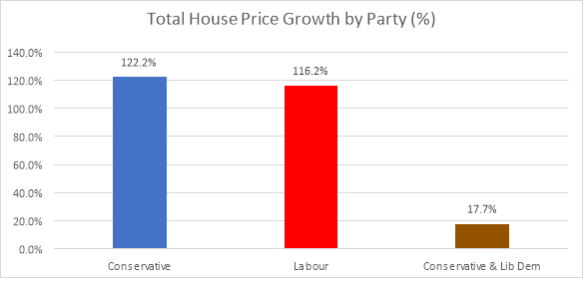
When looking at total growth seen under each government, the Conservatives come out on top with prices increasing 122.3% during their two terms between 1979-96 and 2015 until now. Labour saw house prices increase 116.2% while they were in power between 1997 and 2009, with a Conservative and Lib Dem government seeing growth of just 17.7% between 2010 and 2014.
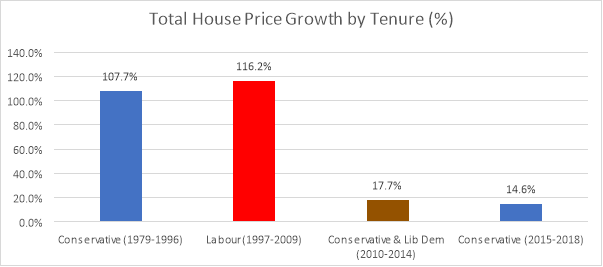
Unfortunately for the Conservative Party, looking at house price growth by tenure tells a different story. Between 1979 and 1996, the Conservative’s presided over a housing market that saw prices increase by 107.7%. The market then went on to see prices rise by 116.2% between 1997 and 2009 under Labour. The Conservative/Lib Dem coalition saw prices rise by just 17.7% during their four years in power, with prices increasing by just 14.6% during the last three years under a Conservative government.
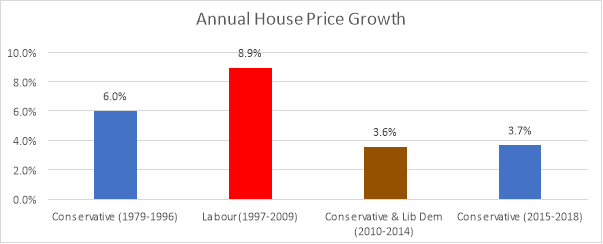
When looking at the average annual house price growth under each party, Labour once again comes out on top with an increase of 8.9%, with the Conservatives seeing an annual rate of growth of 6% in their first term and just 3.7% in their latest, or 5.8% when considered as a whole.
Property expert and Yomdel CEO, Andy Soloman, commented: “Perhaps unexpectedly, it’s Labour that takes the crown as Britain’s best house party for homeowners with prices having increased at a greater rate during their tenure. With the current market suffering at the hands of a very drawn out Brexit process, it’s unlikely that the Conservatives will be able to reverse this property market trend any time soon and they could well become the party behind a stagnant housing market for years to come.
"Of course, strong house price growth isn’t necessarily a good thing if you don’t own a home and with both parties currently unsure whether they’re coming or going on a number of issues, maybe we should all wipe the slate clean and vote Conservative if we don’t own a home and Labour if we do.
"This would bring some simplicity to the otherwise shambolic political landscape we currently find ourselves in.”
| Period | Party in Government | House Price | Growth (%) |
| 1979 | Conservative | £19,830 | - |
| 1980 | Conservative | £23,288 | 17.4 |
| 1981 | Conservative | £24,010 | 3.1 |
| 1982 | Conservative | £24,851 | 3.5 |
| 1983 | Conservative | £27,623 | 11.2 |
| 1984 | Conservative | £31,076 | 12.5 |
| 1985 | Conservative | £34,378 | 10.6 |
| 1986 | Conservative | £37,627 | 9.5 |
| 1987 | Conservative | £43,164 | 14.7 |
| 1988 | Conservative | £51,405 | 19.1 |
| 1989 | Conservative | £61,514 | 19.7 |
| 1990 | Conservative | £57,683 | -6.2 |
| 1991 | Conservative | £54,626 | -5.3 |
| 1992 | Conservative | £51,815 | -5.2 |
| 1993 | Conservative | £51,211 | -1.2 |
| 1994 | Conservative | £51,633 | 0.8 |
| 1995 | Conservative | £51,245 | -0.8 |
| 1996 | Conservative | £53,394 | 4.2 |
| Total Increase | 107.7 | ||
| Increase per annum | 6.0 | ||
| 1997 | Labour | £59,199 | 10.9 |
| 1998 | Labour | £65,201 | 10.1 |
| 1999 | Labour | £71,122 | 9.1 |
| 2000 | Labour | £80,366 | 13.0 |
| 2001 | Labour | £88,799 | 10.5 |
| 2002 | Labour | £106,407 | 19.8 |
| 2003 | Labour | £127,246 | 19.6 |
| 2004 | Labour | £148,359 | 16.6 |
| 2005 | Labour | £156,325 | 5.4 |
| 2006 | Labour | £166,470 | 6.5 |
| 2007 | Labour | £181,364 | 9.0 |
| 2008 | Labour | £168,973 | -6.8 |
| 2009 | Labour | £156,512 | -7.4 |
| Total Increase | 116.2 | ||
| Increase per annum | 8.9 | ||
| 2010 | Conservative/Lib Dem | £165,483 | 5.7 |
| 2011 | Conservative/Lib Dem | £165,131 | -0.2 |
| 2012 | Conservative/Lib Dem | £163,628 | -0.9 |
| 2013 | Conservative/Lib Dem | £168,928 | 3.2 |
| 2014 | Conservative/Lib Dem | £185,620 | 9.9 |
| Total Increase | 17.7 | ||
| Increase per annum | 3.6 | ||
| 2015 | Conservative | £193,900 | 4.5 |
| 2016 | Conservative | £203,771 | 5.1 |
| 2017 | Conservative* | £209,935 | 3.0 |
| 2018 | Conservative* | £214,163 | 2.0 |
| Total Increase | 14.6 | ||
| Increase per annum | 3.7 | ||
| * No overall control | |||
| House Price Data: Nationwide House Price Index | |||
As is often the case and due to the unique nature of the mid-market, it [the M&A market] behaves differently than publicly traded bonds, currency or stock markets. Sentiment is very important and public markets are sometimes critical influencers. However, most of the transactions in this market are private, cover a very broad range of opportunities and happen for a wide variety of reasons, strategic or otherwise.
The number of deals completed in the UK with a transaction value of under £500m has reduced by around 12% in the year-to-date 2018, when compared to the same period in the prior year, however the cumulative value of these deals is only down by around 2%.1 In contrast, the Office for National Statistics (ONS) reported that there were no transactions with a value of more than £1bn completed between July and September of 20182.
In addition to top line numbers, there are always winners and losers in any of the mid-market sectors.
While statistics will never tell the whole story, our experiences of 2018 in the mid-market have seen many happy sellers, buyers paying full prices, strong transaction multiples sand international buyers remaining very interested in UK businesses. Brexit, and the political and economic uncertainty it brings, has been one of the biggest macro diligence issues of 2018, but buyers and sellers alike seem to be more focused on the micro impacts, investigating the components of the potential Brexit threat on a business-by-business basis.
In addition to top line numbers, there are always winners and losers in any of the mid-market sectors. For example, the divergence of success in retail between those in bricks-and-mortar, those that have moved to ‘clicks-and-mortar’ and e-commerce retailers is much more pronounced than some of the general gloom around consumer sentiment. Equally, in the industrial and business services sectors, the gap between winners and losers is widening, with technology often at the centre of some part of the manufacturing, supply or distribution chain process.
So, will 2019 be better or worse than 2018? Much may depend on what happens in Westminster between the time of writing this article and publication, but from an adviser’s perspective, it feels like it will likely be a tougher environment, but equally interesting. We sense there may be a widening of the gap between buyer and seller expectations, which means adviser’s may need to be smarter about how transactions are structed and executed. There may also be a tightening in the debt markets, although the flexibility of approach from the increasingly varied lender community continues to grow. The private equity investor community may become more conservative in deploying capital, but given there is more dry powder in the UK private equity community than ever before, there is a pressure to invest.
While 2018 cannot necessarily be any guide for 2019, the themes of Brexit, business investment confidence and consumer confidence will continue to dominate the minds of buyers and sellers, and the mid-market in 2019 could be a good place to be, while all around looks uncertain.
Sources: 1. Capital IQ data, deals that include a UK target and transaction value < £500M, between January 1, 2017 and December 13, 2017 and 2018.
2: ONS data – https://www.telegraph.co.uk/business/2018/12/04/overseas-firms-making-fewer-ma-deals-uk-british-firms-still/
Written by Henry Wells, Managing Director and Head of UK Mergers and Acquisitions at Duff & Phelps
Canada agreed late to sign on to a trade deal between the United States and Mexico, revamping the three-country North American Free Trade Agreement after more than a year of tortuous negotiations.
In this insightful article, Laura Tainsh, Lead Partner in the Environmental & Waste Team at Davidson Chalmers LLP, Globalaw, and Sean G. Herman, Environmental Attorney, Hanson Bridgett LLP, Globalaw, speak on what laws need to change in order for people to seriously address environmental concerns.
There has been a perceptible shift in the way that environmental issues generally are considered by the wider public over the last year, mostly as a result of the increased attention by mainstream media on issues such as plastic pollution in the marine environment. That shift has brought existing environmental law into sharp focus and may now become a force for change in the way that environmental issues are regulated, at least in the developed world. Whilst meaningful change takes time to bring about and implement, recent events have provided evidence of movement in both the political and regulatory spheres in both the UK and United States. In this article, we examine the forces behind these changes that will impact businesses operating in these jurisdictions.
Many feel that the white paper does not go far enough and leaves too many matters requiring clarification post-Brexit. This likely would include amending or creating new environmental legislation, a big task to wait until post-Brexit to address.
Brexit Remains Evergreen in the UK
From a UK perspective, the most obvious, topical and current example of both the need and the opportunity for change are the ongoing negotiations relating to Brexit which will, to some extent, determine how environmental concerns are regulated in the immediate future.
In early July, the UK Government published its highly anticipated white paper stating its negotiation position on Brexit[1]. After fairly considerable pressure from a number of those in the private, political and public sectors, the white paper includes a commitment to strong environmental protections, starting with the retention of all existing environmental standards imposed under EU law. However, many feel that the white paper does not go far enough and leaves too many matters requiring clarification post-Brexit. This likely would include amending or creating new environmental legislation, a big task to wait until post-Brexit to address. In order to ensure that various existing environmental concerns are properly addressed, all of the following points will need to be further considered and clarified in due course:
EU targets
The UK is currently breaching a number of targets set by the EU in areas such as waste, water and air quality. Whether these breaches will be resolved or effectively dismissed has not yet been clarified.
EU case law
The extent to which the UK will have regard to the remit and decisions of the European Court of Justice going forward is unclear. Environmentalists argue that these decisions are essential to the continuing development of environmental law in the UK.
Energy and Climate Change
How the UK will participate in the energy market post-Brexit has yet to be clarified. This includes whether the UK will leave the Internal Energy Market and how the UK’s technical rules for trading will compare to the EU Emissions Trading System (if indeed different). However, it is worth noting that the UK’s domestic legislative targets on climate change are more ambitious than required under EU law, meaning they are unlikely to change post-Brexit.
In both the UK and US, there is a fundamental need for legal clarity to provide the common ground needed to bring both the regulated community and environmentalists together to allow change.
Circular Economy
The EU officially published its circular economy package, with changes to directives on waste, packaging, landfill and WEEE, in June this year. Despite its impending exit from the EU, the UK has indicated that the measures required under the package will be adopted under domestic law, as there is substantial support across a number of sectors throughout the UK for closed loop and circular procedures to be utilised in relation to the management of natural resources.
Trade
In order to facilitate a continued trading relationship, the UK will need to ensure that with respect to certain goods - such as those which are heavily regulated, including chemicals, electronic equipment and agri-food products -, common environmental rules applicable in the EU are adhered to.
Notwithstanding the important interaction between the UK and the EU on environmental matters post-Brexit, the UK has expressed its commitment to upholding the obligations imposed under the many international agreements to which it is a party. That perhaps does go some way towards satisfying the wider global environmental concerns of domestic citizens, but it is arguable that more specific regulatory action, including both taxes and incentives, as appropriate, will be needed to make government bodies, business and individuals alike directly responsible for their actions.
From the US' perspective, two of the main environmental statutes, the Clean Water and Clean Air Acts, are nearly 50 years out of date.
Shifting Ground in the US
From the US' perspective, two of the main environmental statutes, the Clean Water and Clean Air Acts, are nearly 50 years out of date. Scientific progress since their enactment has widened gaps between our understanding of the environment and the statutes' original textual meaning. Until now, executive agencies have filled these gaps by relying upon regulations. However, as recent failures in water quality and greenhouse gas regulations demonstrate, this approach has shortcomings that demand Congressional action.
The Clean Water Rule
Since 1972, executive agencies have relied upon developments in hydrology to expand the scope of how they enforce the Clean Water Act. This came to a head at the Supreme Court in the 2006 case Rapanos v. United States in which a developer challenged a regulation of certain wetlands. Supreme Court Justice Anthony Kennedy argued that the Clean Water Act may be expanded to regulate waters with a proven "significant nexus" to navigable waters. However, the four conservative justices criticised this approach, forcefully arguing that the original textual meaning of the Act provided no basis for such an expansive interpretation.
The Obama Administration seized upon Justice Kennedy's "significant nexus" test and proposed the Clean Water Rule: a regulation that clarified and expanded the scope of federally regulated waters. The regulated community immediately challenged the regulation by arguing, in part, that it exceeded the Clean Water Act's textual authority. Once in office, President Trump's Administration began repealing the Clean Water Rule under the rationale that regulations must be confined to the statutory text.
The Clean Power Plan
Similarly, executive agencies have relied upon recent developments in climate science to identify and regulate pollutants like greenhouse gases. This came to a head at the Supreme Court in the 2007 case Massachusetts v. Environmental Protection Agency. There, a majority of the Court held that these scientific developments compel the EPA to take steps under the Clean Air Act to regulate greenhouse gases. Justice Kennedy joined the majority opinion, the lone conservative justice to do so. In dissent, the remaining conservative justices again argued that, regardless of the practical need to regulate greenhouse gases, the Clean Air Act's text does not provide the authority to force the EPA to do so.
Following the Massachusetts decision, the Obama Administration adopted regulations like the Clean Power Plan to address greenhouse gas emissions. Again, the regulated community challenged the regulation on the basis that it lacked textual authority and, again, the Trump Administration began repealing the Clean Power Plan under that same rationale.
Justice Kennedy's Retirement
The Trump Administration's efforts to limit the reach of federal regulations over businesses took a leap forward when Justice Kennedy recently announced his retirement from the Supreme Court. President Trump nominated Judge Brett Kavanaugh as his replacement, which at the time of this article is still pending confirmation. Judge Kavanaugh is a textualist with demonstrable concern for the growth of executive agencies. Had Judge Kavanaugh been on the Supreme Court instead of Justice Kennedy, the Supreme Court would likely have decided the Rapanos and Massachusetts cases differently. Therefore, the legal bases for environmental regulations like the Clean Water Rule and Clean Power Plan appear lost.
Oscillating between diametrically opposed regulatory approaches breeds uncertainty that is neither good for the environment nor businesses, for whom uncertainty often proves to be very costly.
Proposed Solution: Amend the Environmental Statutes
It seems the US cannot rely upon major regulations to alter the prioritisation of environmental issues. President Trump's election was not only a setback for progressive environmental regulation efforts, but it has now changed the Supreme Court such that it may be decades before we next see major regulations like the Clean Water Rule and Clean Power Plan.
Instead of new regulations, Congress needs to update its ambiguous, half-century old environmental statutes to adequately address modern environmental concerns. If textualism will define judicial review in the coming decades, environmental regulations must then be better grounded in Congressionally-sanctioned statutes.
Importantly, updating environmental statutes will benefit the regulated community. Ambiguous environmental laws allow for paradigm shifts depending on who is president as demonstrated by the elections of Obama and Trump. Oscillating between diametrically opposed regulatory approaches breeds uncertainty that is neither good for the environment nor businesses, for whom uncertainty often proves to be very costly.
The Need for Clarity
In both the UK and US, there is a fundamental need for legal clarity to provide the common ground needed to bring both the regulated community and environmentalists together to allow change. The role of environmental lawyers in both jurisdictions is at pivotal point. With change of this significance on the horizon, it is vital that lawyers in this field are ahead of the game and aware of political and policy drivers as well as those which are directly based in regulation.
[1] https://www.gov.uk/government/publications/the-future-relationship-between-the-united-kingdom-and-the-european-union
Laura Tainsh
Lead Partner in the Environmental & Waste Team
Davidson Chalmers LLP, Globalaw
Laura Tainsh is the Lead Partner in the Environmental & Waste Team at Davidson Chalmers LLP, a full-service commercial law firm based in Edinburgh, Scotland. Laura is a Chartered Waste Manager with the Chartered Institution of Wastes Management, the only solicitor in Scotland to have obtained this accolade.
Sean G. Herman
Environmental Attorney
Hanson Bridgett LLP, Globalaw.
Sean is an Environmental Attorney with Hanson Bridgett LLP, a full service law firm based in San Francisco, California. Sean represents private and public clients alike, including manufacturers, retailers, farmers, and governmental entities such as counties, water districts, and waste management authorities.
In his role as an attorney, Karsten Hagel-Sørensen benefits greatly from the special understanding of the interaction between law and politics that he gained from working in the central administration. He speaks on his experience standing in the EU Court of Justice and as adviser to the Danish Government.
With years of experience behind you, what do you think had been the most prominent part of your legal career?
Definitely working in the interface between law and politics, especially in relation to EU law and international law. It is becoming more and more common that attorneys are working in this sphere. The reason is that human rights appeal to the authorities' values and empathy. The European Convention on Human Rights is a balancing of conflicting considerations: On one hand the states' central responsibility for the public policy objectives, and on the other hand the consideration for the individual citizen. As an attorney I have to articulate the consideration for the freedom of action of the government elected by a public vote. I have helped pave the way for human rights to play a more important role in the everyday life of the Danish people as I was the chairman of the committee that prepared the implementation of the European Convention on Human Rights into Danish law.
How do you prepare for cases when standing in the EU Court of Justice?
The emphasis is on the written presentation in the proceedings before the EU Court of Justice contrary to the situation in Denmark where the oral presentation is more important. An attorney must be prepared to accept this basic condition. Only 30 minutes are set aside for stating the case before the EU Court of Justice. It means that you have to be very specific and extremely well-prepared. The primary objective of the oral statement is also to give the judges the opportunity to ask questions. This is why you have to be able to answer all conceivable questions.
Five judges sit on the bench of the EU Court of Justice in most cases. More important cases are heard by the Grand Chamber. I have conducted several of such cases that have been landmark cases. One example is the Centros case from 1999, case C-212/97, where the Court established that a company with a registered office in one EU Member State cannot be refused the registration of a branch in another EU Member State, even if the company does not conduct any business in the home country. The Danish authorities considered this to be illegal as a circumvention of the requirements of the country in which the branch is situated of paying up a minimum share capital. All the Court's 15 judges sat on the bench in that case. Another important case was when the Danish Government was an intervener in the T-Mobile Austria/Hutchison case about an auction of 3G mobile telecommunications licences (cases C-284/04 and C-369/04). The case was about whether the tender price included VAT, which the Court ruled was not the case.
Are there any changes you would like to witness in the EU which will help Denmark?
The Danish opt-outs mean that Denmark is not part of EU cooperation on defence, the euro and parts of EU legal policy. Brexit and consequently Great Britain's break with EU means that Denmark will stand more alone with these opt-outs. As a nation we contribute greatly to the economic cooperation and peacekeeping measures and we fulfil our obligations.
The politicians must decide on the further development, but as an attorney I hope that the cooperation in the EU which has made economic progress possible and removed barriers can continue and develop.
What would you state are the more restrictive EU laws? How does this affect your clients?
The rules on state aid. They can affect the implementation of big and important infrastructure investments. One example from Denmark is the fixed road and railway link between Germany and Denmark, the Fehmarn Belt Fixed Link, where the question was whether government guarantees for loans were in conflict with the rules on state aid. The European Commission ruled that the Danish model for the public funding of the link was not in conflict with the EU rules on state aid. The same applied to the establishment of the bridge between Denmark and Sweden, the Øresund Bridge, where the Danish and Swedish governments gave government guarantees to the company behind the Øresund Bridge. Also in this matter the European Commission rejected a complaint by a shipping company about illegal state aid. But that does not mean that the case is settled.
An example of the effect of the rules on a completely different area can be found in the ten-year long case about the Danish television channel TV2. It turned out that the Danish state aid to the channel was compatible with the rules on state aid. But the case had serious consequences for the television channel as the EU Court of Justice ruled that the rules of procedure for the payment of aid had not been observed. The consequence is that the television station risks having to make large illegality interest payments. The case has also prevented the television channel from being privatised and affected all the other EU Member States' ability to support the production of public service broadcasting.
You take an active interest in EU and human rights; what do you think is the most pressing issue the EU should currently address?
The protection of personal data in a human rights perspective. The EU Court of Justice has already made the much talked about ruling on data security where the Court found that the US cannot be considered to be a safe harbour in connection with the transfer of personal data. The judgment has had serious consequences for many companies transferring data from Europe to servers in the US.
Digitalisation is also a crucial issue nowadays. The Danish Government has decided that all new Danish legislation must be ready for digitalisation, meaning that it must be possible to automate the case handling and the administrative tasks. The target is that legislation ready for digitalisation will generate administrative gains which instead can be used to create welfare. But it is important that the EU has the same target of rationalising as national law. If not, EU law will become a foreign element in national law. The EU should consequently give greater priority to the wish to not just create legislation but also to run legislation, so that the legislation will be easier to understand and be digitalisable.
At Kammeradvokaten (Legal Adviser to the Danish Government)/Poul Schmith we have decided to take the digital agenda quite literally. It means that we are the front runner on the Danish market for legal services when it comes to the development of digital platforms. In recent years we have invested in and developed digital tools that facilitate the legal processes in a number of different areas.
Karsten Hagel-Sørensen
Partner, Attorney
M: +45 25 10 05 23
T: +45 72 30 72 43
I have a solid background of many years as a senior official focusing on international law and EU law with the Danish Ministry of Justice. In 1991, I joined Kammeradvokaten (Legal Adviser to the Danish Government)/Poul Schmith as a Partner and Co-Owner. As the legal adviser to the Danish State we are directly involved in many of the cases that go down in Danish history and we provide a special synergy across authorities. This is why we always include the broad perspective in our advice and we generally have an innovative approach when working with the law.
In 2006, I had the rare honour of being appointed an adjunct professor at the Department of Law at the University of Aarhus. It was only the second time in the history of the Department that a practising lawyer was appointed a professor. One of the reasons was that I co-authored the text-book on EU law that was used by Danish law students for 20 years and the editor of the leading work containing commentaries on EU law.
Kammeradvokaten (Legal Adviser to the Danish Government)/Poul Schmith is currently the biggest full-service law firm in Denmark and we assist both public authorities and private businesses. The firm is the Danish State's primary law firm and we have an agreement with the Government to provide legal assistance in all areas of the law. The firm is also Denmark's leading litigation firm with extensive experience from all courts, including the Danish Supreme Court and the EU Court of Justice. The firm's long-standing relationship with the Danish State has had a profound influence on the entire firm's values and access to cases and advice to both private and public clients. We do not only safeguard our clients' interests. We also think of how the law affects the developments of society as such.
Dick Costolo, who served as Twitter's CEO from 2010 to 2015, joins "CBS This Morning" to discuss the challenges Silicon Valley faces, including election meddling on social media platforms and regulation.
