
Understand Your Rights. Solve Your Legal Problems
The coronavirus pandemic is posing huge challenges to every family. However, families based across more than one country will be facing particular difficulties. Hetty Gleave, Partner at Hunters Law LLP, explains to Lawyer Monthly the challenges that these families face.
Whilst the government has confirmed that transporting children between homes is permitted essential travel during the lockdown, this will not help international families, where children or parents regularly fly to or from the UK for contact.
And whilst the UK has not yet closed its borders, many other countries have done so, and there are now far fewer transport options with most international flights cancelled. Wealthy families with access to private jets may have more options, depending on where else they have bases. However, if the UK closes its borders they too will be affected. Even without a border closure, the government is advising against all but essential international travel, and families will choose to avoid international travel to reduce their risk of infection.
Where families are based across a number of jurisdictions, this may mean children being separated from parents, and potentially from siblings, for many months. In such cases, parents will need to make remote contact work. International families used to spending time abroad may be at an advantage here, with experience of staying in touch with family and friends remotely. Beyond video calls, online gaming, learning and watch parties can make remote contact a lot more fun for children.
Where families are based across a number of jurisdictions, this may mean children being separated from parents, and potentially from siblings, for many months.
In addition to remote contact, families should consider additional face-to-face contact once restrictions are eased, for example, additional time during the summer holidays.
Unfortunately some parents are likely to use the coronavirus as pretext for disrupting contact unnecessarily. For international families, where it's likely that face-to-face contact will not be possible, this is likely to take the form of frustrating remote contact – whether by not making the children available for agreed times, by refusing to agree times, or by distracting children when they're due to be spending virtual time with the other parent.
The judiciary has been clear that maintaining relationships between children and parents is particularly important at this uncertain time. For international families, this will almost certainly be through extensive and meaningful remote contact. If one parent is obstructing such contact from taking place, then this can be challenged through a court application, and the courts are continuing to operate, albeit remotely. It will be important to ascertain which country's courts have jurisdiction; the English courts will generally have jurisdiction if the child is habitually resident here.
[ymal]
Whilst the court is extremely unlikely to mandate contact that would require international travel, if one parent is preventing remote contact, a court order is likely to be appropriate. In practice, however, it is likely be difficult to get an early hearing date, where the courts are facing staff shortages and will need to prioritise the most serious welfare cases, such as where children are being abused. Whether a hearing can be obtained may depend on which region the children are based in, as different court regions have different capacities. Additionally, enforcement will in reality be challenging at this time.
Issues may also arise where applications and orders need to be served across borders, though courts are in any event increasingly permitting service by email or even social media, and would be expected to do so if the pandemic has made paper service abroad unrealistic.
The disruption of parent-child relationships during this emotionally challenging period poses a real risk of damaging that relationship, and where the court has capacity to accommodate a remote hearing, obtaining a judgment that one parent has been behaving unreasonably, and a Child Arrangements Order tailored to the current circumstances, requiring remote contact, may be powerful in sending a clear message to the other parent that unreasonably refusing to facilitate remote contact is never acceptable, and will be harmful to the child.
The disruption of parent-child relationships during this emotionally challenging period poses a real risk of damaging that relationship[...]
In some circumstances, arbitration is likely to be a pragmatic and helpful tool for parents unable to agree on the best arrangements for their children, and can, like court, hearings, it can take place remotely. Unlike court proceedings, however, it does, require both parties' agreement to the process, so may not assist where one party is being deliberately obstructive.
Whether an application is to be made or not, where one parent is unreasonably frustrating remote contact, it would be sensible to keep contemporaneous notes, supported by copies of relevant emails, texts, WhatsApp or other messages as evidence of what has taken place, in case a review of what happened to contact during the pandemic is required in future proceedings.
Any parent who abuses the pandemic to damage their child’s relationship with their other parent is likely to have a hard time in future persuading a court that they prioritise their child’s best interests, and this could limit the amount of time they are able to spend with their children going forward, or even result in a change of the child’s residence. The family judiciary have made their views clear in their guidance, and parents should think of the long term impact of ignoring that on both them and their children.
The upcoming legal events in the US for 2020 will call for presenters and attendees who are not only lawyers but also other members of the international community who are willing to share topics from their research and findings.
Here are some the best upcoming legal events in the US:
This conference is organized by the Research Association for Interdisciplinary Studies or RAIS. This event promotes collaboration of different professionals from the academe and researchers from various professions. It promotes the study of diverse subjects from the perspective and approach of different disciplines. This conference will give lawyers the opportunity to work with professionals from other fields.
This event is attended by leading academic scientists, researchers, and scholars to discuss all aspects of the law. It provides a platform for other professionals to learn and share recent innovations, trends and concerns. This is also where lawyers share practical challenges they experience in the field and the solutions they have adopted.
This is a federated organization that draws together scholarly events for presentation valuable for students, academics and industry researchers. It focuses on all aspects of Constitutional Law and Political Science. It also calls professionals from different fields in different countries to come together and discuss Law and Political Science. If you are traveling from a country under The Visa Waiver Program (VWP), you should be able to prepare this requirement to be able to attend and present for this conference. If you have to buy or renew your visa, submit your 3-steps ESTA application form now and have it ready in no time. If your requirements are complete and your visa is processed, you can now attend more conferences and other events in the USA using the same visa for two years.

This international conference focuses mainly on all aspects of Health Politics, Policy and Law. Here, topics would include health policy management, systems and technologies used for healthcare and others that would also be beneficial for medical practitioners and allied health workers.
This conference focuses on all aspects of the Internet, Law and Politics. The start of the new millennium has brought the age of the Internet and the discussion about the E-world would be beneficial for anyone. Important topics that would be discussed here are about data protection, taxations and ICTs, intellectual property, and the most pressing one is electronic voting.
Ensuring that you are amenable to travel means that you would be able to attend various upcoming law events in the US. You do not want to miss out on these because of lost documents or missed visa. Process your ESTA now and book the flights to the conference you've been wanting to attend.
For couples with residences in several countries, the choice of where to issue proceedings is usually constrained by circumstance: different jurisdictions can produce dramatically different outcomes.
Below Lawyer Monthly discusses international divorces with Alex Carruthers, Partner expert family lawyers Hughes Fowler Carruthers, who provides some insight into the different complexities divorcing couples may face.
Much may depend upon who files where, and when. First mover advantage matters: starting the divorce race at a sprint means that hours, even minutes and seconds can make a significant difference to the outcome, especially in high value cases. Multi-jurisdictional divorces can be particularly complex. Because contrasting rules may apply, a central organiser is advisable to co-ordinate between jurisdictions.
Brexit creates further uncertainty. Currently, all EU member states except Denmark are signatories to the revised Brussels II, which governs jurisdictional disputes on divorce. To commence proceedings in the UK, or in an EU jurisdiction, one of several criteria must apply: spouses must currently be, or were last habitually resident in, that country - insofar as one of them still resides there; the respondent is habitually resident in that country; or in a joint application, either spouse is habitually resident there.
[ymal]
Further criteria include: the applicant is habitually resident in that country if he or she resided there for at least a year immediately before the application was made; or if one of them resided there for at least six months immediately before the application was made and is either a national of the relevant member state - or in the case of the United Kingdom and Ireland, has their domicile there.
Disputes can arise as to whether a condition is met. Provided that one of them is, a strict ‘first in time’ rule applies: divorce will proceed in the country where the papers were filed first. This may necessitate urgent advice.
When one parent wants to move to another jurisdiction with their child/children, they must apply to the court for permission if the other parent disagrees. Removing children from the country in which they habitually reside without the other parent’s consent, or an order of the court, constitutes child abduction which is a criminal offence. An application can be made for a temporary period or a permanent relocation.
Such cases can be hard-fought and distressing. The parent wanting to move, often to the country of his/her birth, will feel that they can make the best life for their children there. The other parent will feel just as strongly that the children’s relationship with them will be deeply affected if they no longer have involvement in their daily lives. The key consideration for an English court is the children’s best interests: examining the motivations of the parent who wants to move, as well as plans for housing, schooling and proposals for contact with the other parent.
The key consideration for an English court is the children’s best interests: examining the motivations of the parent who wants to move, as well as plans for housing, schooling and proposals for contact with the other parent.
An independent official, such as a social worker, will be appointed to interview both parents and children (if they are old enough) and to provide a report recommending whether the application should be allowed and what arrangements apply for the children to see the other parent. The judge at the final hearing invariably gives considerable weight to that report.
For those who divorce in another jurisdiction and are unhappy with the outcome, there may be a second bite of the cherry: the Matrimonial and Family Proceedings Act 1984 (the Act) can facilitate having another go through the English courts. Potentially, this enables such parties to get more money where a marriage has been dissolved or annulled in another country. Many people succeed in doing this through the English courts, often receiving a significant additional award in their favour.
The Act can allow a second look at the financial settlement, even if the parties were divorced elsewhere. Although not an automatic right, it can afford an additional opportunity provided certain criteria are met. The court’s permission is, however, required via an application without the other side being there. Once permission is granted, it is difficult to overturn, stacking the odds in favour of applicants.
Divorce can be especially difficult when it has an international dimension. Sound advice and the wisdom of experience from expert divorce lawyers can help overcome the challenges and achieve a successful divorce that delivers peace of mind and a good long-term financial settlement.
Below Zoya Burbeza, a specialist international litigation and arbitration lawyer with Zaiwalla & Co., explains the situation, providing her take on how the issue will resolve and move forward.
The Nord Stream 2 Pipeline will export natural gas under the Baltic Sea from Russia into the European Union. This will enable Russia to its increase gas exports to Germany, while providing significant strategic and economic value to Germany and the surrounding countries in Western Europe.
However, the view from the East is different. Ukraine, Poland and other East European countries consider the pipeline to be a threat since it will bypass them. As a result, Russia will further increase its leverage over those countries and potentially allow it to reduce, or even halt gas supplies to Eastern Europe completely, without impeding Russia’s capacity to deliver gas to its key customers in Western Europe.
Price is another factor. Nord Stream 2 will provide Western European countries with relatively cheap Russian gas at a lower cost than the Liquified Natural Gas (LNG) alternative. Currently, Russia supplies roughly 40% of the EU's total gas demand - just ahead of Norway, the second largest supplier. In aggregate, the new pipeline will boost the total amount of gas supplied under the Baltic to 55bn cubic metres a year.
In December 2019, the US Government imposed sanctions targeting firms building Nord Stream 2. The US considers the project a security risk to Europe. Both Russia and the EU have strongly condemned the US sanctions. Congress voted through the measures as part of a defence bill in December 2019 and the legislation, which described the pipeline as a "tool of coercion", was signed into law by President Trump immediately after its passing.
The US Government and Congress are concerned that the pipeline will tighten Russia's grip over Europe's energy supply and reduce US own share of the European market for American liquefied natural gas. President Trump went as far as saying that the pipeline would turn Germany into “a hostage of Russia”.
The US Government and Congress are concerned that the pipeline will tighten Russia's grip over Europe's energy supply and reduce US own share of the European market for American liquefied natural gas.
Even before the sanctions went into effect, leading US senators, Ted Cruz and Ron Johnson, sent a letter directly to the Director General of the Swiss shipping company Allseas Group SA Edward Heerema, son of the late Pieter Schelte Heerema who founded the company. In this letter, the Senators promised devastating consequences for the company if it continues its work on the Nord Stream 2 project:
"We understand that Russia is paying Allseas a very considerable amount of money to complete the Nord Stream 2 pipeline. However, the consequences of your company continuing to do work – for every single day after the President signs the sanctions legislation – would expose your company to crushing and potentially fatal legal and economic sanctions.”
Senator Ted Cruz posted this letter on his Facebook page.
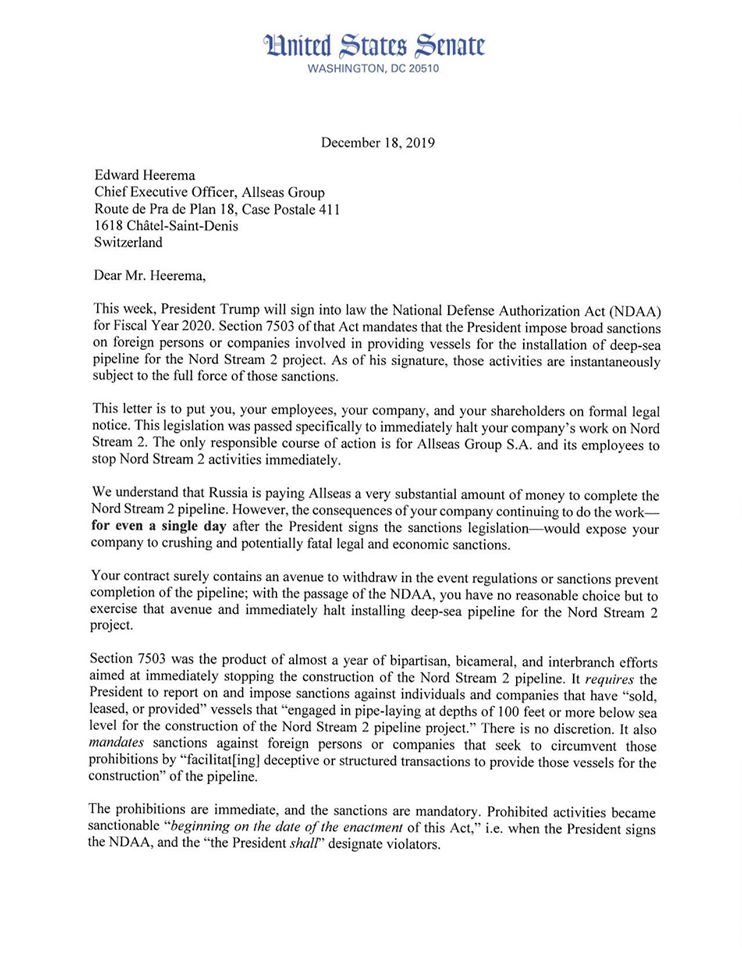
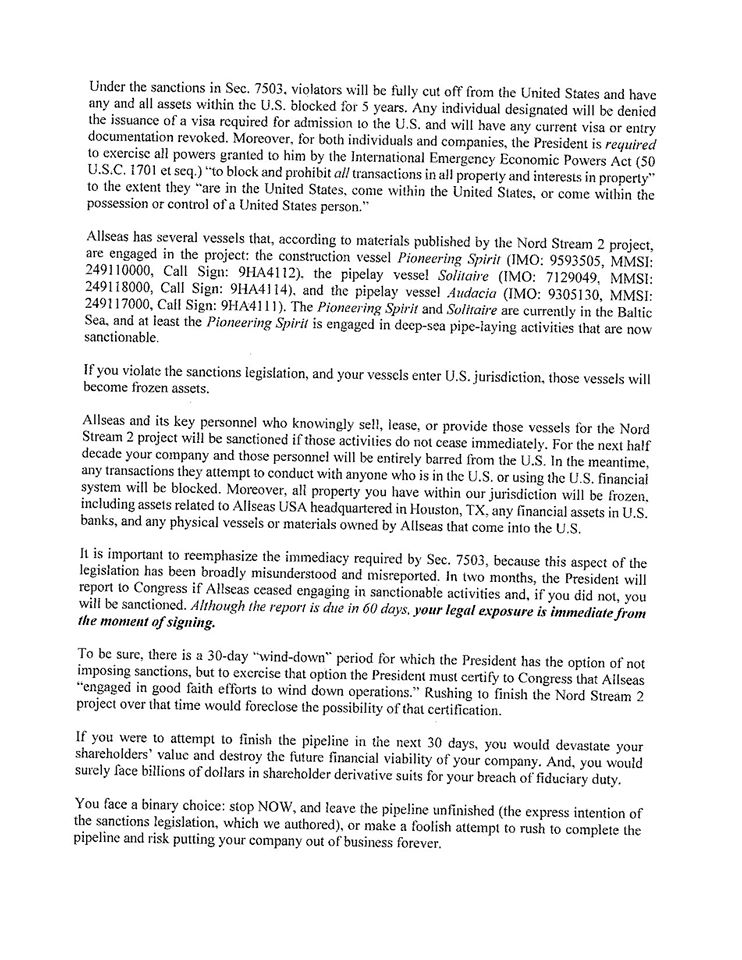
As a result, Allseas, a Swiss-Dutch company involved in the project, stated that it suspended its pipe-laying activities in anticipation of the sanctions.
Although this development is unlikely to prevent completion of the pipeline, this will delay its completion. Neither Gazprom, a Russian gas company behind the project, nor any other Russian company has their own capabilities to lay pipelines under the surface of the sea. It will take Gazprom some time to develop its own rudimentary capabilities in undersea pipeline laying or source another company (most likely to be a Russian company) to do so which would not be concerned about the consequences of the sanctions.
It will take Gazprom some time to develop its own rudimentary capabilities in undersea pipeline laying or source another company (most likely to be a Russian company) to do so which would not be concerned about the consequences of the sanctions.
President Putin stated that the project, which was expected to start in the first half of 2020, would be delayed "several months" and would be completed in the first quarter of 2021.
German Chancellor Merkel reacted angrily to the imposition of the sanctions stating that she was "opposed to extraterritorial sanctions" against the Nord Stream 2 project. German foreign minister Heiko Maas went even further stating that the sanctions amounted to "interference in autonomous decisions taken in Europe”.
In reality, though, Germany has limited resources to retaliate against the US by, for example, imposing its own sanctions on US companies. The US is a significant export market for the export-driven German economy and the current US administration is well known for not being shy to escalate trade disputes by imposing additional sanctions on its main trading partners. Therefore, the German Chancellor has made a well thought through statement that Germany does not intend to retaliate.
However, Germany has other leverage on the sanctions front. For example, effectiveness of a range of US sanctions on Russia depends to a very large extent on the cooperation and mirror sanctions imposed by the EU on Russia. Germany and the EU are a much more significant trading partner for Russia than the US German and EU companies can easily replace US firms and US technology (especially in the energy sector) in Russia should Germany decide to advocate relaxation of EU sanctions imposed on Russia.
Currently, the WTO finalises decisions on trade matters, which can then be appealed in a separate ‘appeal’ court. This consists of three judges, each of which has to hear the case. An appeal decision is then made. All in all, this constitutes one of the primary functions of the WTO.
As of December 10 however, there will be a single final arbiter, instead of three, as the remaining two judges’ terms have come to an end, despite no replacements being recruited.
According to the BBC, there are currently no plans to replace the two judges, leaving the single judge to confront all appeal cases in the court. This is because the US has allegedly refused to allow the recruitment of further judges.
Other countries within the WTO have repeatedly proposed a start to the recruitment of other judges. In fact, by the end of November over 100 countries had requested the other two judges have replacements found and established, but the US alone has prevented this, mostly due to the way the WTO makes decisions and essentially stipulates new laws as cases come and go.
A statement was recently made by the US delegation at a WTO meeting: "For more than 16 years and across multiple US administrations, the United States has been raising serious concerns with the Appellate Body's overreaching and disregard for the rules set by WTO members."
The WTO has previously been described as "probably the busiest international dispute settlement system in the world.” Finding a solution to the lack of an appropriate Appellate Body will be difficult and may hinder the function of the WTO in the long term.
India has now vowed to diplomatically and economically isolate Pakistan. Could India assemble a coalition to impose effective economic sanctions on Pakistan? Kartik Mittal, a Senior Solicitor at Zaiwalla & Co, explains for Lawyer Monthly.
The latest escalation in tensions came on 14 February 2019, when a terrorist suicide attack killed 46 Indian security personnel in Kashmir. India squarely held Pakistan responsible. It is alleged by India that the Pulwama attack was carried out by a local suicide bomber, who claimed allegiance to Pakistan-based terror group Jaish-e-Mohammed (JeM). India says that JeM has links to the Pakistani intelligence services.
Frustrated at a lack of action by Pakistan against JeM, on 26 February 2019 India launched an air attack inside Pakistani territory on JeM training camps (which Pakistan denies). Two days later, Pakistan announced that it had shot down one Indian fighter plane over Kashmir, prompting fears of an escalation to all-out war.
India is not alone in accusing Pakistan of taking a soft line on terror groups. The Paris-based watchdog the Financial Action Task Force, suggested that Pakistan could shortly be placed on its blacklist if specific steps to clamp down on the financing of JeM and other groups were not taken by May.
India is unfortunately no stranger to terror attacks on its soil. The 2008 Mumbai attacks left 166 dead. That attack was also widely blamed on Pakistani militants. The former Pakistani Prime Minister Nawaz Sharif was recently reported as saying, “Militant organisations are active. Call them non-state actors, should we allow them to cross the border and kill 150 people in Mumbai? Explain it to me. Why can't we complete the trial?"
India has promised to isolate Pakistan as a result of the Pulwama attack. Yet Nawaz Sharif recently said that Pakistan’s failure to contain terror groups means that, “we have isolated ourselves”. Osama Bin Laden, famously, was also found in Pakistan in 2011, having lived there for five years, in a conspicuous compound.
It seems Pakistan is belatedly feeling the weight of international disapproval at how terror groups have been able to use the country as a safe haven. It has recently promised to do more to disrupt such groups. On 5 March 2019, it said it had arrested key figures responsible for the Pulwama attack. However, many in India will fear that this is merely window dressing, and that little of substance will change.
Against this complex and murky background, India must decide how to best combat terrorism. In the wake of the latest attack, India again called for the UN Security Council to impose sanctions against Masood Azhar, the JeM chief. However, these efforts were blocked by China.
Sanctions regimes imposed on named terrorist organisations have often had a minimal impact, especially where they operate in a country that shelters their activities. A well-crafted sanctions regime against Pakistan may be the best approach to stop it sheltering terror groups.
India has confirmed that it will go it alone on economic sanctions. It has revoked Pakistan’s “most favoured nation” trading status. However, Pakistan-India trade only amounts to around US2 billion. The balance of trade is also titled heavily in favour of Pakistan. For sanctions to have a significant effect, India will need to persuade powerful economic actors to join such an effort.
Sanctions are most effective when a number of countries work collectively. The ideal scenario would be for sanctions to be imposed through a resolution passed by the United Nations Security Council. This seems unlikely, given China’s evident unwillingness to act. It is most likely that a group of willing countries will have to collectively impose sanctions.
The US has declared its “strong support” for India in the wake of the Pulwama attack. It has repeatedly shown frustration at Pakistan’s harbouring of terror groups. President Trump even began 2018 with a tweet saying that the US "has foolishly given Pakistan more than 33 billion dollars in aid over the last 15 years, and they have given us nothing but lies & deceit, thinking of our leaders as fools. They give safe haven to the terrorists we hunt in Afghanistan, with little help. No more!" Last year, the US cut $300 million in military aid to Pakistan, and $1.66 billion in security assistance.
The EU is Pakistan's biggest trading partner, purchasing 23.7% of Pakistan's total exports in 2015. Even the threat of EU sanctions could persuade Pakistan to act. The EU recently called for Pakistan to implement “clear and sustained actions targeting not only all UN-listed transnational terrorist groups but also individuals claiming responsibility for such attacks.”
India has a long and noble tradition of non-violent action. If India can muster an international coalition in favour of economic sanctions, it could peacefully persuade Pakistan to - at long last - clamp down on the terror groups operating on its soil.
This week Lawyer Monthly hears from David Vaughan, international dispute resolution partner, and Sneha Nainwal, international dispute resolution associate at Shakespeare Martineau, on the prospects of a ‘no deal’ Brexit on the litigation process cross-border.
On 18 January 2019, the European Commission circulated a note to the 27 European Union Member States, urging them to take advantage of “the opportunities of Brexit” and undermine the UK’s predominance in international civil litigation within Europe.
This appears to have been somewhat of a threat to the UK courts, with the Commission instructing the EU countries involved in Brexit negotiations to refrain from progressing any further with pending judicial cooperation procedures involving the UK, and to halt the launch of any new judicial cooperation procedures involving the UK.
This follows the UK Government’s technical guidance note on handling civil legal cases that involve EU countries if there is no Brexit deal, which attempted to outline how the rules for cases involving EU countries would change in the event of the UK exiting the EU with no deal.
If the UK were to leave in March 2019 with no deal, the justice system would no longer be part of the EU’s civil judicial cooperation framework. This would, therefore, affect choice of law and jurisdiction clauses involving parties based in the EU, or where the losing parties’ assets, for the purposes of enforcement of judgments, are in the EU.
Any international litigation involves the determination of issues such as, which country’s courts will hear the case (jurisdiction), which country’s law will apply to determine merits (applicable law), which country’s law will determine the procedure governing the legal proceedings (procedural law) and how judgments obtained in one country will be recognised and enforced in other countries (recognition and enforcement of judgments).
Currently, these issues are determined in accordance with the rules set out in various International Conventions and EU Regulations, which apply to the UK either because it is a signatory or by virtue of its EU membership.
However, in the event of a ‘no-deal’ Brexit, the EU Regulations that operate strictly on the basis of reciprocity will cease to apply to the UK. Furthermore, the International Conventions, which currently only apply to the UK because of its EU membership, will cease until the UK becomes a signatory in its own right and re-joins the Convention.
In this scenario, the key Conventions and Regulations and the relevant consequences of a ‘no deal’ Brexit, are:
There is also a suggestion that the bilateral enforcement treaties, concluded between the UK and various EU member states including France, Germany, Austria, Italy and Netherlands during the period of 1934 to 1969, could potentially be revived to provide an alternative mechanism for recognition and enforcement.
Parties are advised to include clearly structured choice of law and choice of jurisdiction clauses in their contracts to provide more certainty. Where possible, parties should opt for exclusive jurisdiction clauses, as the 2005 Hague Convention does not apply to jurisdiction agreements that are non-exclusive or asymmetric.
The EU rules on recognition and enforcement of judgments under the Recast Brussels Regulation do not extend to arbitration. Arbitration, therefore, is likely to emerge as a preferred choice for many, as the New York Convention 1958, to which over 150 countries - including the EU member states - are signatories, will continue to apply to the UK even following a ‘no-deal’ Brexit. Parties should, where possible, consider this option for resolving disputes and include arbitration clauses in contracts.
If, however, contracts do not allow for arbitration, then parties are advised to commence proceedings before 29 March 2019.
Meanwhile, parties with existing or imminent litigation against EU parties may also wish to accelerate any litigation or enforcement of any interim remedies or final judgments, in order to take advantage of the automatic recognition and enforcement mechanism currently available under the Recast Brussels Regulation.
It is possible that the current uncertainty regarding the position with respect to recognition and enforcement of judgments could make England a less desirable forum for litigation in the short term.
However, Brexit is unlikely to detract from the primary reasons commercial parties choose the English courts. London has been a favoured centre for a number of years and ultimately, the reputation of its High Courts for quality, consistency, honesty, transparency and technical knowledge, as well as its status as a global financial centre, ensure that London will continue to stand head and shoulders above other European countries despite the uncertainty ahead.
The process of electing INTERPOL’s new President at the end of last year attracted the attention of the world’s press and forced INTERPOL’s governance and political neutrality into the spotlight once more. The need for a change in leadership was brought about following the sudden disappearance and apparent detention of former President Meng Hongwei in China.
Emerging as the frontrunner for the unexpectedly vacant position was Alexander Prokopchuk, a Russian general with close ties to Vladimir Putin, who had formerly occupied a role within Russia’s Ministry of the Interior. His candidacy reignited a longstanding and unresolved debate surrounding Russia’s abuse of the INTERPOL system. Concerns raised by critics of the Kremlin (notably Bill Browder and Mikhail Khodorkovsky) centred on allegations that Prokopchuk had made routine use of red notices to target political opponents of Putin whilst in government. These allegations were afforded further weight by direct correspondence from Fair Trials to the Secretary General of INTERPOL, which stated that “it would not be appropriate for a country with a record of violations of INTERPOL’s rules (for example by frequently seeking to use its systems to disseminate politically motivated alerts) to be given a leadership role in a key oversight institution.”
INTERPOL’s 194 members ultimately voted to award the presidency to South Korean Kim Jong-yang. Nevertheless, the widespread outcry about Prokopchuk and the question of Russia’s abuse of the red notice system continues to call into question whether the existing safeguards of INTERPOL’s political neutrality are effective. After all, Prokopchuk may not hold the title of President but he remains a Vice President of INTERPOL and sits on the Executive Committee. His compatriot, Petr Gorodov, sits in the Request Chamber of the Commission for the Control of INTERPOL’s files (CCIF), which is responsible for the processing of requests relating to red notices, and importantly makes recommendations for the removal of such notices to the General Secretariat, which nearly always follows the recommendation given.
These concerns about the political neutrality of the INTERPOL bodies which are entrusted to take life-changing decisions about when red notices should be issued and deleted are particularly important when an individual affected by the red notice claims that it is tainted by political motives.
If an individual seeks removal of a red notice because it is so tainted, he or she can only apply to the CCIF by reference to an extremely limited and narrow set of legal rules, including INTERPOL’s own Constitution.
If an individual seeks removal of a red notice because it is so tainted, he or she can only apply to the CCIF by reference to an extremely limited and narrow set of legal rules, including INTERPOL’s own Constitution.
The most important rule in this context is Article 3 of INTERPOL’s Constitution which states that “It is strictly forbidden for the Organization to undertake any intervention or activities of a political, military, religious or racial character.” Article 3 reflects one of the founding resolutions of INTERPOL’s General Assembly, Resolution AGN/20/RES/11, which provides that: “…no request for information, notice of persons wanted and, above all, no request for provisional arrest for offences of a predominantly political, racial or religious character, is ever sent to the International Bureau or the NCBs, even if – in the requesting country – the facts amount to an offence against the ordinary law.”
To assist the practitioner in the application of Article 3, INTERPOL published a ‘Repository of Practice’ in February 2013. This drew a distinction between pure offences (i.e. acts criminalised solely due to their political nature, e.g. espionage) and relative offences (i.e. acts comprising elements of ordinary law crimes but which nonetheless have a political dimension). In relation to the latter, INTERPOL adopts a so-called “predominance test”. In relation to both pure and relative offences, Article 34(3) of INTERPOL’s Rules for the Processing of Data provides that the “main pertinent factors” to be considered in the context of an Article 3 claim include:
When analysing the nature of the offence, the CCIF will consider information beyond that provided in the Red Notice application form, such as information concerning the background to the request or how it relates to other requests. For example, it may be relevant to assess a red notice request together with similar requests concerning other individuals wanted by the same country, or to consider the fact that such similar requests may have been denied in the past.
The Repository of Practice sets out various scenarios arising from the Article 3 case law. It is striking that all of these scenarios concern what could be labelled as overtly political offences such as treason, military crimes, election crimes, free speech violations by human rights activists or crimes committed by politicians during seizures of power. None of the scenarios describes a paradigm “relative offence”, such as a non-politician who alleges he is being persecuted by a State on account of his economic success in a strategically important sector. Of course, this is precisely the type of conduct which Propopchuk’s detractors allege he was instrumental in prosecuting at the Kremlin’s behest. The failure of the Repository of Practice to provide meaningful guidance on relative offences – and how the predominance test should be applied to relative offences – demonstrates the challenge faced by those in challenging red notices on Article 3 grounds where the underlying conduct is not criminalised solely due to its political nature.
The Repository of Practice states that one of the primary objectives of Article 3 is to reflect international extradition law. However, when read with Repository of Practice, Article 3 adopts a definition of “political” which is arguably narrower than the test currently applied in many extradition laws or indeed the Refugee Convention. In the UK, the Extradition Act 2003 bars a person’s extradition (whether to an EU Member State or to a State outside of the EU) if (and only if) it appears that:
Historically, UK extradition law adopted a definition of “political opinion” that was wider than that contemplated by INTERPOL. Taking their cue from immigration case law, the UK’s extradition courts recognised that, in order to show persecution on account of political opinions, it was not necessary to show political action or activity; that political opinions could be imputed to the person whose extradition was sought; and that it was inappropriate to maintain a rigid distinction between political and economic opinions. None of these factors – which highlight the flexibility of the concept of “political” – are explicitly recognised in INTERPOL’s Repository of Practice on Article 3.
Historically, UK extradition law adopted a definition of “political opinion” that was wider than that contemplated by INTERPOL.
In light of this divergence, an individual faced with a red notice may (at present) be in a better position contesting extradition and/or claiming asylum, and using success obtained in those proceedings as a basis to persuade INTERPOL to remove the red notice. This comes with two precautionary caveats. The first is that INTERPOL’s own policy on asylum, published in 2014, recognises a limitation on the grant of asylum on political grounds (whereas no such limitation is recognised if asylum is granted on all other grounds under the Refugee Convention, e.g. religion, race, sexuality etc.) A person granted refugee status on the basis of political persecution does not therefore have a cast iron guarantee that his status will result in the red notice being removed. The second caveat is that if caught up in active extradition proceedings in the UK, practitioners will need to consider an asylum claim at the earliest possibility. This is because, in a shift away from the historic position, extradition courts have, over the past four years, increasingly embraced a restrictive interpretation of ‘political opinions’, which has detached itself from the principles derived from immigration case law summarised above. This shift appears to have been motivated by the narrow interpretation adopted by the then Senior District Judge Riddle in the case of the Russian Federation v Kononko, as opposed to the wider interpretation adopted by his predecessor, Senior District Judge Workman, in the case of the Russian Federation v Makhlay and Makarov. With this narrowing of the interpretation of political opinion, it is clear, in an extradition context, that a mere political interest in a case will be insufficient to establish the bar of extraneous considerations.
In addition, unlike extradition cases, proceedings for asylum allow for the provision of anonymous witness and expert evidence, which cannot be shared or challenged by the requesting state. The client himself can also give evidence without being the subject of hostile cross-examination in open court. Therefore, in some cases, and depending always on the facts, asylum may be easier to claim than a discharge from an extradition request if the client asserts that he is the victim of a political persecution. A successful grant of asylum will result in the client’s automatic discharge from the extradition proceedings.
Unlike extradition cases, proceedings for asylum allow for the provision of anonymous witness and expert evidence, which cannot be shared or challenged by the requesting state.
Just as it is virtually impossible to claim asylum in the UK in respect of alleged persecution in another EU member state, so too there are no recorded cases where an individual has been discharged from an extradition request issued by another Member State on the basis of his political opinions. It remains to be seen whether this may change post Brexit, when mutual trust and recognition could well be further eroded between the UK and the remaining EU27 States.
In summary, whilst it is preferable to have a successful extradition or asylum decision upon which to base representations to INTERPOL, the absence of such a decision is not fatal to an individual’s chances of securing the removal of a red notice. We have had success in removing red notices on political grounds in the absence of an extradition or asylum decision, but it is an extremely difficult task, made no easier by the restrictive interpretation of “political” in INTERPOL’s Repository of Practice on Article 3. Despite the sigh of relief exhaled at the election of Kim Jong-yang over Alexander Prokopchuk, INTERPOL still has much to do by way of further reform to ensure that the organisation becomes the model of political neutrality which it clearly seeks to be – both in terms of its perception by Member States and in the independence of the decision-making it applies to the issuing and removal of red notices which are tainted by political motives.
The plight of the Rohingya in Myanmar is said to be a “human rights catastrophe”, with extensive violations of both humanitarian and international law. According to Eleri Griffiths, a Barrister at One Pump Court chambers, these violations have not gone unnoticed by the international community. Below, Eleri talks to Lawyer Monthly, shining a spotlight on the constrained role of the International Criminal Court in punishing grave human rights violations.
In September, the UN human rights council (UNHRC) presented its full account on the independent fact-finding mission on Myanmar. Formed to establish the facts and circumstances of alleged recent human rights violations by the military (‘Tatmadaw”) and security forces, the Mission concludes that systematic targeting and clearance operations have occurred in Myanmar and that the human rights violations committed are of such gravity that a referral to the International Criminal Court (ICC) should be made.
However, as Myanmar does not recognise the ICC and is not a State Party to the Statute of Rome, the case once again raises questions on the role and limitations of the ICC as arbitrator of the most serious human rights offences.
The situation in Myanmar
Amongst its conclusions, the Mission found that military forces in Myanmar use Rakhine men, women and children for forced or compulsory labour, soldiers having subjected women to sexual violence, forced evictions through land confiscation, arbitrary arrest and detention, and violations of the rights to life, to physical and mental integrity, and to property.
Systematic “targeted and terrorising attacks” on the entire Rohingya population was termed a “clearance operation” by the authorities, but a “human rights catastrophe” by the mission. This included mass killing, abductions and rape and other sexual violence perpetrated on a “massive scale”, including gang rape of women and girls (sometimes up to 40 raped together and in front of families and the community) and people burnt to death in their homes. Rape victims were “often marked by deep bites”. Many children were shot, stabbed or burned by military forces acting with complete impunity and absence of accountability. Ethnic armed organisations have also violated human rights, though not generally systemically.
Oppression of Rohingya was considered severe, systemic and institutionalised from birth to death. violence and human rights violations fuelled by the silencing of critical voices by the Myanmar authorities. This and other violations has led to a mass exodus of Rohingya into nearby Bangladesh.
In light of its findings, the Mission called for both diplomatic and humanitarian action by the international community to protect Myanmar’s people from genocide. In particular, it concluded that there is sufficient information for the ICC to determine liability for genocide, crimes against humanity (including murder; imprisonment; enforced disappearance; torture; rape, sexual slavery and other forms of sexual violence; persecution; and enslavement (with additional crimes in Rakhine State)), and possible finding of apartheid or war crimes.
Can the ICC intervene?
The ICC was established to deal with incidents of genocide, crimes against humanity, war crimes, or the crime of aggression. Its involvement is considered necessary in Myanmar due to deeply entrenched impunity in Myanmar’s political and legal system and the government being demonstrably unwilling and unable to investigate and prosecute the crime, the latter being a precondition to prosecution at the ICC.
A clear jurisdictional issue is raised by Myanmar not being a State Party to the Statute of Rome; the ICC can only exercise powers relating to crimes occurring on the territory (or by nationals) of a State Party by special agreement with the state or by the UN Security Council referral.vii Absent a Security Council referral, crimes which took place in Myanmar would not usually fall within the Court’s jurisdiction unless Myanmar accepted it, which seems unlikely given the government’s lack of co-operation with the Mission.
The key in this case is the allegation of forcible deportation of nearly 700,000 Rohingya from Myanmar to Bangladesh, which is a state party to the statute. “Deportation or forcible transfer of population” (through expulsion or other coercive acts) is explicitly identified as a crime against humanity. By preliminary ruling sought for the first time by the Officer of the Prosecutor, the Court determined that it does have jurisdiction over deportation initiated within a non-party state (in this case Myanmar), but completed in a state party (Bangladesh). It also ruled that the same rationale may apply to persecution connected with the deportation or other inhumane acts intentionally causing great suffering, or serious injury to body or to mental or physical health, such as the refusal to readmit Rohingya to Myanmar.
What happens next?
The Officer of the Prosecutor has opened a preliminary examination of the events in Myanmar to decide whether there is a reasonable basis to proceed with an investigation. This included the questions of admissibility and the interest of justice. If a prosecution is intended, a warrant must be obtained for the accused’s arrest.
Getting further than that is more problematic. Enforcing an arrest warrant issued by the Court is a requirement imposed upon on State Parties, which Myanmar again is not. Non-party states can be invited to co-operate, but are not obliged to do so under the statute and Myanmar has already disputed the Court’s jurisdiction making that, again, unlikely. Whilst charges can be confirmed in the accused’s absence in some circumstances, he/she must be present during the trial. Therefore, without a voluntary surrender or movement to a State Party where they can then be arrested, it is difficult to see how, realistically, the Court will secure the presence of alleged perpetrators from Myanmar, stifling any prosecution.
Even if perpetrators do travel into a state party, arrest will not necessarily follow. For example, Omar Al Bashir, President of Sudan, is subject to two arrest warrants from 2009 and 2010 for crimes committed in Darfur. He remains at large has allegedly travelled unhindered to state and non-state parties without being surrendered to the Court, despite the Court Registry’s advance reminder of the state’s obligations. A further 15 Defendants remain at large, some over 13 years after arrests warrants were issued.
In its recent ruling, the Court drew attention to the duty of a UN member states to co-operate with the ICC where the Security Council so requires, that being a duty deriving from its UN membership as opposed to acceptance of the statute. Whether this will impact on Myanmar’s co-operation will remain to be seen. In the meantime, fact finding missions, investigations and arrest warrants may all serve to show the world that crimes of the nature seen in Myanmar are not acceptable. But if moving the case beyond the pre-trial stages is stifled by the accused’ non-attendance, a clear question mark remains over whether justice for the Rohingya will ever be delivered.
As nations focus upon the ongoing issue of illegal human immigrants, such as the Trump administration’s focus upon the Mexican border, is the real issue at hand the ongoing unmeasurable cross-border pollution which effects nations worldwide? Below experts at Hudson McKenzie discuss with Lawyer Monthly.
Air pollution is a serious issue. Recent studies show that more than 95% of the Earth’s population is “breathing dangerously polluted air”, with annual deaths from poor air increasing by 20% since 1990.
This is despite several measures taken by multi-national platforms such as the EU to tackle the crisis, by implementing environmentally conscious legislation such as the EU ‘Air Quality Directive’ and the ‘Pollution Prevention and Control Act’ (1999).
Furthermore, these protective measures coincide with Article 2 of the Human Rights Act (HRA), in which every nation worldwide must comply with the securing of every citizens “right to life”. This means that every government should take “appropriate measures to safeguard life”, so that the average life expectancy of each citizen is not affected, as it may be by air pollution and climate change.
However, although each individual nation may take protective measures such as to reduce its carbon footprint through the decreasing use of plastic, or to make its major cities “car-free” so to decrease its air pollution, how effective is this protection whilst citizens are still burdened with the unmanageable cross-border pollution from neighboring nations?
Unlike the physical borders placed upon citizens between nations, air pollution knows no boundaries when it comes to travelling between one nation and another. Therefore, should there be an increase in global governance, so to tackle the ongoing crisis of air pollution and climate change?
By doing so, not only will nations become more unified in their co-operation against the issue of global air pollution and climate change, but the implementation of their own citizens Human Rights would be greatly exemplified, specifically the application of the human ‘right to life’.
In addition, the potentially increased global governance of the management of global pollution and the ongoing war against climate change could also see alternative future trade deals arising between nations, as the need for more ‘environmentally friendly’ commodities arise – such as demonstrated by highly polluted countries like China increasing their demand for ‘fresh air’ and related products from other countries.
Thus, due to the ongoing rise of air pollution and the serious impacts of unpredictable climate change upon every nation worldwide, a need for an enhanced global governance between all nations may be the only solution to tackling not only the management of cross-border pollution, but also the implementation of Human Rights law globally.
