
Understand Your Rights. Solve Your Legal Problems
Judge Andrew Napolitano, Fox News senior judicial analyst, on the legal fallout over Google's firing of an employee who wrote a memo about the tech company's diversity policy.
A male software engineer at Google has sparked quite a row from within the corporation. He allegedly sent an internal memo clarifying that gender pay gaps are not to be assumed as sexism. He has reportedly now been fired by Google for breaking the Code if Conduct.
According to the Sun, he blames biological differences between sexes for the low number of female workers in leadership positions. He said: “We need to stop assuming that gender gaps imply sexism.”
This of course flipped a switch so to speak and staff quickly shared the 30,000-word memo making it go viral. The US Department of Labor is currently investigating Google under the suspicion that it is discriminating against women based on its recent pay reports.
Reports claim he wrote that women generally “prefer jobs in social or artistic areas” while “more men may like coding.”
The document, titled ‘Google’s Ideological Echo Chamber’, was first reported to have caught the wind on Motherboard.
Danielle Brown, VP for diversity, integrity and governance at Google, says the document “advanced incorrect assumptions about gender.”
“Part of building an open, inclusive environment means fostering a culture in which those with alternative views, including different political views, feel safe sharing their opinions. But that discourse needs to work alongside the principles of equal employment found in our Code of Conduct, policies, and anti-discrimination laws,” she adds.
Google hasn't confirmed the name of the fired employee, but US media reports name him as James Damore.
When a huge company like this allows such claims to get out of the internal comms, rows are bound to be sparked. Do you think Google is rightfully being investigated?
UK Prime Minister Theresa May plans to fine companies like Google and Facebook for lack of efforts, or all together allowing the hosting of extremist material online. Even her very own counter-terrorism watchdog has said this is anti-democratic.
In past months May’s government pointed the finger at Google and other social media platforms and websites like YouTube, saying they were not doing enough to remove extremist content quickly enough.
It comes down to online terrorist radicalisation and recruitment, where the internet is being used as a buggy for extremist infantry arming. To this end the PM wants to take firms to court on the basis that they are aren’t doing enough to eliminate this issue.
According to the Daily Mail, but Max Hill QC, the UK Independent Reviewer of Terrorism Legislation, said: “What is the appropriate sanction? We do not live in China, where the internet simply goes dark for millions when government so decides. Our democratic society cannot be treated that way.”
The idea behind the bizarreness of the plan is that regardless of removing extremist material on social platforms, Jihadist and extremist content can still easily be found by actively searching for it. Such as for example, the material reportedly found and used as a guide by Manchester bomber Salman Abedi.
Max Hill QC says he struggles to see how criminalising tech bosses who 'don't do enough' would work, given it would be a feat to measure what ‘enough’ is. How would that actually work in court?
However, on a legal basis, the idea of pushing the responsibility onto online hosting firms is widespread more and more. The UK Pm and France’s President have been in talks about a ‘legal liability’ that could be imposed on firms, and in Germany, it is already the case that if a company persistently fails to remove content, it can be fined up to €50 million.
The Daily Mail claims that Lord Carlile of Berriew QC agrees that penalising tech firms should be a last resort. What do you think?
Privacy Policies, whether a small or large firm can often play a crucial role in retaining customers, but when your privacy policy doesn’t meet the standard required by its platform, sector or market, for example on an app store, then you may be in for losing a lot more business. Here Cleland Thom, principal of the College of Media and Publishing and author of Online Law for Journalists, discusses Google’s recent policy terms, illustrating just how important privacy policies can be.
App developers who have ignored two recent changes in Google’s terms and conditions now face having their apps removed from Play Store.
The internet search giant recently updated its Play Store policies to give purchasers greater protection, and to clamp down on app placement manipulation.
Developers who fail to comply now face sanctions, including having their apps restricted or removed from Play Store.
In May, Google introduced a new policy to curb activities such as offering users incentives to review an app; repeatedly submitting ratings to influence an app’s position; and encouraging users to submit reviews containing affiliates, coupons, game codes, email addresses, or links.
The policy also gives Google the power to include other items in its list of banned practices, by using the phrase "Including, but not limited to’.
A Google spokesman said: ‘Ratings and reviews are benchmarks of app quality. Users depend on them to be authentic and relevant.’
In addition, Google warned developers earlier this year that they had until March 31st to comply with its stricter privacy policy.
It sent letters, headed: ‘Warning of Google Play Developer policy violation: Action Required’, to app developers whose privacy policies did not comply, or who did not have a policy at all.
Now, every app must have a link to privacy policy in its store listing, and developers must also remove requests for sensitive information or user data within the app.
The new restrictions are on top of existing rules banning inappropriate adverts, and user safeguards against bullying, threats and harassment for apps that allow user generated content.
The privacy policy generator Iubenda has a guide for developers on how to upgrade their policies.
Taken together, these policy changes show that Google is gradually clamping down on rogue developers, and we can expect other changes as it tries to keep up with illegitimate activities.
Consumer Watchdog recently called on tech companies including Google, Facebook, Twitter, Facebook, Amazon and Microsoft, to support amending a key Internet law so websites like Backpage.com that facilitate child sex trafficking can be held accountable by victims and state attorneys general.
Consumer Watchdog's call came at the start of what Congress has called "Combatting Trafficking and Child Protection Week." Rep. Ann Wagner's (R-Mo.) has introduced H.R. 1865, Allow States and Victims to Fight Online Sex Trafficking Act of 2017 that would amend Section 230 of the Communications Decency Act – the law that shields Backpage from accountability for its ongoing abuses. Other bills focusing on the trafficking issue are expected to come to the floor Tuesday.
Consumer Watchdog's call came after a news conference last week with anti-trafficking groups where a mother of a victim of Backpage-facilitated child sex trafficking, Nacole S., called on Facebook CEO Mark Zuckerberg, who is engaged in a "listening tour," to meet with her family so she could explain the harm his support of Section 230 causes.
Section 230 of the CDA provides that a website can't be held liable for what's posted on its site by third parties. Tech companies and other defenders of CDA Section 230 claim it promotes and protects free expression on the Internet.
"Internet freedom must not come at the expense of children who are sex trafficked," said John M. Simpson, Consumer Watchdog Privacy Project Director. "Just as the First Amendment does not allow you to shout fire in a crowded movie house, or to assist hit men and drug dealers in their criminal activity, CDA Section 230 must not be allowed to protect an exploitative business that is built on child sex trafficking. It's past time for tech companies to step up and act to narrowly amend this law."
Backpage's victims have filed multiple lawsuits and brought legal actions against Backpage, which has also been the target of government investigations. Among victims bringing suit are a 13-year-old girl in Miami whose pimp tattooed his name on her eyelids and a 15-year-old in Seattle who was sold for sex more than 150 times. A new documentary film I Am Jane Doe, which chronicles the struggles of child sex victims, is now available on iTunes, Google Play, and Amazon, and will be available on Netflix beginning May 26th.
Last week a coalition of anti-child sex trafficking and public interest groups and the mother of a trafficking victim released a report detailing Backpage's abuses. It documented how Google has funded efforts to defend Sec. 230.
"For years, one company—Backpage.com—has dominated online trafficking in minors for sex. The advertising giant's reach is vast, with sites catering to 437 locations in the U.S. and 506 overseas. So is its impact: By one count, 73% of all suspected child trafficking reports in the U.S. involve Backpage," the report said.
In letters to the tech companies Consumer Watchdog's Simpson wrote: "We call on you to support a narrow amendment to Section 230 of the Communications Decency Act -- H.R. 1865, the 'Allow States and Victims to Fight Online Sex Trafficking Act' could be the vehicle -- that would allow Backpage to be held accountable for its ongoing facilitating of child sex trafficking."
(Source: Consumer Watchdog)
Google Inc. and a proposed class of AdWords advertisers, represented by the law firm of Schubert Jonckheer & Kolbe LLP, recently announced that they have reached a proposed $22.5 million settlement of claims related to Google's placement of their ads on parked domains and error pages.
Plaintiffs alleged that from July 11th 2004 through March 31st 2008, Google failed to disclose to its AdWords customers that it placed their ads on websites known as parked domains and error pages. Parked domains are websites with little or no content, and error pages are websites that users visit when they enter an unregistered address into their web browser. Google denied these allegations.
"We are gratified by this excellent result for millions of AdWords advertisers," said Noah Schubert of Schubert Jonckheer & Kolbe, Lead Counsel for the Class, "It has been a hard-fought nine-year case including an important victory in the Ninth Circuit."
On March 9, 2017, U.S. District Court Judge Edward J. Davila granted preliminary approval of the proposed settlement. If the settlement is finally approved, Google will pay $22.5 million into a settlement fund. Under its terms, class members who submit claims will receive payment in proportion to the amount they spent on ads on parked domains and error pages during the class period.
If, during the period from July 11th 2004 through March 31st 2008, you were a United States resident who had a Google AdWords account and were charged for clicks on advertisements appearing on parked domains or error pages, you are a class member and may be entitled to a settlement payment.
(Source: Schubert Jonckheer & Kolbe LLP)
An increasing number of commercial and business-related disputes are being heard by the European Court of Justice (ECJ) up 20% in the last year to 423, compared to 352 in 2014, according to research from the Legal Business of Thomson Reuters, the world’s leading source of intelligent information for businesses and professionals.
However, the Brexit vote has brought into question the access of UK businesses and individuals to the ECJ to resolve legal disputes, pursue damages or challenge government decisions that might impact their profitability.
Thomson Reuters says that the significant increase in usage by businesses of the ECJ is being driven by businesses being more willing to make use of the European Courts as a tool to achieve commercial aims, particularly if they fail to get matters satisfactorily resolved at national level.
Thomson Reuters adds that the strengthening economic recovery has brought more financial firepower to many businesses to pursue claims all the way to the ECJ, which can be extremely expensive and time-consuming to do.
Areas which have seen significant increases in the number of cases heard by the ECJ include:
Examples of businesses involved in recent cases in the European Court include:
“The European Commission has been going through a more active period in terms of competition investigations, creating more cases for the ECJ.” says Professor Laurence Gormley, Professor of European Law at the University of Groningen and a member of the editorial board for the European Law Review, published by Thomson Reuters.
“One area of particular attention is the internet sector where there is a strong tendency for markets to develop into monopolies. Google and Amazon are just two players on which the EC has set its sights.”
As technological innovation gathers pace, the scope for IP-related disputes increases as firms seek to exploit intellectual property assets, and ground-breaking developments encourage more me-too competitors looking to seize market share.
Public procurement claims emerge as a growing area for litigation
Public procurement cases have also emerged as a growing area for litigation - with 26 cases in 2015 compared to zero in 2010. The cases are brought by businesses who believe they have unfairly missed out in a tender process run by a local government or public sector body.
Thomson Reuters says that this suggests that private companies are becoming more aggressive over litigating over public sector contracts.
It adds that despite some EU member states beginning to ease austerity measures, resulting in more public procurement projects coming on stream, competition for project tenders remains tough. This could increase the potential for disputes over the way contracts are awarded and handled.
It points out that despite the public purse strings loosening slightly as critical infrastructure projects get the go-ahead after years on hold, budgets remain very tight and governments and local authorities want to see real value for money.
Number of commercial cases heard by the ECJ continues to rise
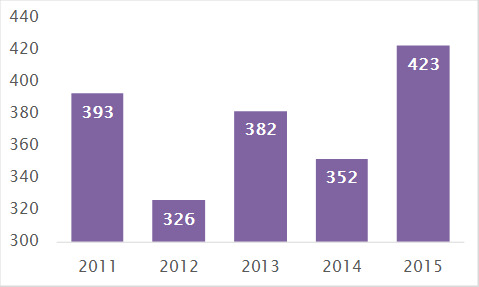
*Data from European Court of Justice – year 1 January to 31 December
(Source: Thomson Reuters)
