
Understand Your Rights. Solve Your Legal Problems
As a business owner, understanding chargebacks is vital to maintaining your revenue flow and keeping your operation afloat.
These unwelcome occurrences aren't just about reimbursed transactions; they can also saddle you with administrative costs and even jeopardize your relationship with credit card companies.
This guide will arm you with critical knowledge about chargebacks, ways to dispute them, and strategies for prevention. Read these tips to become a master of reducing chargebacks.
#1 - Understanding Chargebacks
Chargebacks are when a customer disputes a charge from your business on their credit card. They can be caused by things like fraudulent transactions or unauthorized purchases. When this happens, the charge is reversed, and the money is returned to the customer.
#2 - The Process
When customers report a disputed transaction to their credit card company, you will receive a notice. You must respond within a set timeframe detailing your side of the dispute. If you don’t respond in time, you could lose the dispute, and the customer could get their money back.
#3 - Fraud Is One of The Main Causes
One primary reason behind chargebacks is fraud, either true fraud (stolen credit card information) or friendly fraud (where customers dispute legitimate charges). Both situations are challenging for businesses and usually require strict security measures to prevent.
#4 - They Can Be Disputed
If a customer claims an unjust chargeback, you can make your case known to the credit card company. This involves providing evidence like receipts or delivery confirmations that disputes the claim. Winning a dispute can save you from loss and safeguard your business reputation.
#5 - How to Dispute Chargebacks
To dispute a chargeback, gather all pertinent transaction information. Next, compose an articulate rebuttal letter explaining why you believe the chargeback is unjust. Then, submit your dispute. You can learn more about the chargeback dispute process at Chargebacks911.
#6 - Impact on Businesses
Chargebacks can create significant issues for businesses. It's not just about the financial loss from reimbursed transactions, but there are also admin costs involved in disputing chargebacks. A high level of chargebacks could damage your relationship with credit card companies.
#7 - Prevention Is Key
Being proactive in preventing chargebacks is crucial. This means clear communication about products or services, providing excellent customer service, and implementing secure transaction procedures. Monitoring all transactions vigilantly can also help you identify fraudulent activities.
#8 - Total Prevention Isn’t Possible
It's critical to note that total chargeback prevention isn't attainable. Even with strict security measures and transparent business practices, some chargebacks can still happen. Fraudulent activities or customers who maliciously dispute valid transactions cannot always be prevented.
#9 - Strictly Follow Card Network Rules
Each network has unique regulations for managing disputes, so it's crucial to familiarize yourself with them. Plus, responding promptly and following the suggested process may increase your chances of successfully contesting illegitimate chargeback claims filed by customers.
#10 - Monitor Your Chargeback Levels
Keeping a close eye on your chargeback levels is crucial. If the amount of chargebacks is too high relative to total transactions, it could potentially harm your relationship with credit card companies. This leads to revenue loss and may result in penalties or even account suspension.
#11 - Implement Fraud Prevention Tools
These systems, such as Address Verification System (AVS) and Card Verification Value (CVV) checks, can help identify suspicious transactions early. Tech like two-factor authentication also adds another layer of security, helping to deter potential fraudsters and consistent chargebacks.
#12 - Seek Professional Help If Needed
If managing credit card disputes becomes too complex or overwhelming, don't hesitate to seek professional help. Expert services can streamline the process, handling tedious tasks and intricate details on your behalf. This will reduce your stress when dealing with chargebacks.
Now that you're armed with this knowledge about chargebacks, it's time to put it into action. Keep close tabs on your chargeback levels, dispute when necessary, and never hesitate to ask for professional help when the going gets tough. Remember that prevention is important.
The Financial Action Task Force, an inter-governmental organisation set up to combat money laundering, has described lawyers as the potential gatekeepers to money laundering.
Today, governments around the world are cracking down on money laundering and the legal sector is facing tougher regulations as a result.
Anti-money laundering checks are a necessary tool in the fight against money laundering and allow lawyers to remain compliant with regulations, whilst also protecting themselves from exploitation by criminals.
In this article, we will look at the legal sector’s anti-money laundering responsibilities, the threat posed by money laundering to the legal sector, methods that can be used to exploit, and how Anti Money Laundering helps prevent financial crime.
Anti-money laundering regulations place the bulk of responsibility on the private sector and, in some cases, are vague in their instructions. Whilst these regulations are spread across multiple Acts, there are two which are most significant. First, the Proceeds of Crime Act 2002 (POCA), amongst other things, dictates that the legal sector is subject to AML regulations. Second, the Money Laundering, Terrorist Financing, and Transfer of Funds (Information on the Payer) Regulations 2017 (MLR 2017) define the responsibilities of those who are bound by AML regulations.
Chief amongst these is adopting a risk-based approach. This means that a company must assess and understand the money laundering and terrorism financing threats that they face and take the appropriate actions to mitigate that danger.
Not only does this place responsibility onto the private sector but requires a huge amount of knowledge and expertise on the theory and practice of money laundering to enact and maintain successfully.
Until recently, the extent that money laundering pervaded economies was not widely known; therefore, appropriate regulations to counter it were not in place. Under these conditions, the money laundering industry thrived. It is now estimated that roughly £1.67 trillion of dirty money is laundered globally every year, generally flowing towards the more stable and established Western economies.
In the UK, £88 billion is laundered every year, which the National Crime Agency estimates costs the economy £100 billion in the same amount of time. This puts the UK as the second most exploited economy in the world, second only to the USA. But after years of lax regulations and incentives to attract international money, London is widely considered to be the preeminent city worldwide for money laundering.
This has led the UK government to implement a slew of legislation aimed at curtailing money laundering, including harsh punishments on those companies found to be non-compliant. Whilst these laws are designed to frustrate and prevent money laundering and help companies identify when they are being targeted, they do not currently reduce the threat of being exploited that companies face.
This is because regulations, in and of themselves, do nothing to reduce the need for criminals to ‘wash’ dirty money. Don't forget, money launderers are professional criminals who are sophisticated in how they enact laundering schemes and deceive the professionals that they exploit.
The Financial Action Task Force stated that; "lawyers are vulnerable to complex money laundering schemes due to their ability to easily switch between advising on financial and fiscal matters, establishing trusts and corporate entities and completing property and other financial transactions, such as investments". Money launders also employ the services of lawyers to add a veneer of legitimacy when carrying out laundering schemes.
Whilst money laundering schemes are diverse and ever-changing, they are all made of the three same steps:
Lawyers are usually exploited as part of the layering step, with conveyancers and trust and company services providers (TCSPs) being disproportionately targeted.
TCSPs can provide money launderers with a range of services. Two of the most frequently used are the creation of complicated corporate structures, that are used to transfer illicit funds and hide both their source and the ultimate beneficial owner, and to purchase investments on their behalf. Services such as mail forwarding and virtual offices also help money launders add the appearance of legitimacy to their schemes.
Conveyancers are exploited as the purchase and sale of property is a popular method of laundering money. Frequently money laundering schemes will involve the purchase and quick sale of property, usually between corporate entities, where the buyer and seller are the same person. Property is also a popular method of storing wealth once cleaned and thus can be part of the placement stage of money laundering.
Money launderers also seek to abuse legal practices and client accounts wherever possible, as by transferring money into and out of them the audit chain is broken.
It is important to note that professional money launderers are good at what they do and will appear as legitimate businesspeople or upstanding citizens and can exploit any number of services offered by the legal profession.
As we have seen, being exploited by a money laundering scheme is a pervasive and constant threat to the legal profession. Being found to have aided money laundering, even unknowingly, comes with harsh sanctions in the UK, including fines, professional disqualification, and jail time. Unfortunately, spotting these money laundering schemes is difficult. The law assumes and requires that staff have sufficient training, equipment, and expertise to do so.
By performing AML checks, via AML check software, lawyers can run detailed background checks on any potential business partners which can form the basis of an individual risk assessment.
In an AML check, the subject will submit a copy of an ID document (usually a passport) and their address The AML check software will then:
This allows a practitioner to quickly confirm both the identity of an individual and if that person has any conviction or link to criminal activity anywhere in the world. This process would be impossible to do manually and by including a step in your risk assessment that has the human element removed it severely impedes money launderer’s ability to con.
AML checking software is also able to run an individual against the list of domestic and international sanctions and confirm if a person is politically exposed. This ability has become extremely important to legal professionals since the Ukraine invasion as the international appetite to use sanctions against individuals as a political punitive measure has increased. Being found to have dealings with such an individual would at the very least cause severe reputational damage.
It is important to note that human intuition, training, and professional knowledge form the foundation of a risk-based approach. But by performing AML checks, lawyers are not only greatly empowered in identifying criminal individuals seeking to exploit their services, but also are protecting themselves against potential prosecution for being in breach of AML regulations.
In a landmark ruling concluding one of South Carolina’s most dramatic legal sagas, disgraced attorney Alex Murdaugh was found guilty of the 2021 murders of his wife and son. According to the court, Murdaugh committed the double homicide to conceal a multi-million-dollar web of financial fraud and theft. He was sentenced to two consecutive life sentences without parole for the horrific crime.
WALTERBORO, SC—A sensational six-week murder trial culminated in a stunning guilty verdict as a jury convicted former South Carolina lawyer Alex Murdaugh of killing his wife, Maggie, and younger son, Paul, at their rural estate in 2021. The swift verdict, delivered after less than three hours of deliberation, instantly shuttered a legal dynasty that had wielded immense power in the state's Lowcountry for nearly a century. Murdaugh, once a titan of the legal community, was sentenced to two consecutive life terms in prison without the possibility of parole, marking a final, crushing blow to his high-profile double life.
Prosecutors successfully argued the shocking homicides were the desperate act of a man facing the imminent exposure of years of elaborate financial crimes and a crippling opioid addiction. The state contended that Murdaugh, 54, murdered his family to generate sympathy, hoping to divert scrutiny from his vast financial empire as it rapidly crumbled. Evidence showed he had stolen over $12 million from his law firm and vulnerable clients, including funds intended for the family of a former housekeeper who died in a suspicious accident.
Prosecutor Creighton Waters encapsulated the state's case during closing arguments, emphasizing the calculated selfishness of the crime: "He had a torrent of his secret life coming out. He knew his days as a wealthy, powerful attorney were over. He killed them to buy time."
The case hinged primarily on circumstantial evidence, most notably a short Snapchat video recorded by Paul Murdaugh just minutes before he and his mother were shot to death near the dog kennels on the Moselle property on June 7, 2021.
For over a year, Alex Murdaugh insisted he was nowhere near the kennels that night, claiming he was napping at the main house. However, friends testified that Murdaugh’s distinctive voice was clearly audible on Paul’s video, placing him at the murder scene at 8:44 p.m.—mere moments before the victims' phones went silent forever.
Confronted with this undeniable evidence on the witness stand, Murdaugh finally cracked his years-long lie. While maintaining his "innocence" in the murders, he blamed the deception on his paranoid addiction to prescription painkillers, an admission that severely damaged his credibility with the jury.
Despite the conviction, the legal battle is far from over. Murdaugh’s defense team immediately signaled their intent to appeal the double-murder conviction, citing, among other issues, that the judge improperly allowed extensive testimony about the financial crimes, unfairly prejudicing the jury.
Furthermore, recent events have revived the sensational drama surrounding the case:
This story of murder, betrayal, and institutional power is far more than a local South Carolina tragedy; it’s a modern American crime saga that continues to unfold in real-time. According to analysis reviewed by Lawyer Monthly, the sheer depth of financial and familial corruption uncovered during the trial ensures this case will remain a critical touchstone in legal history for years to come.
The true legal depth of the Alex Murdaugh saga extends far beyond the criminal conviction; it powerfully reinforces a foundational principle of civil law known as the Slayer Rule. For the average consumer, this rule is a crucial piece of protection that ensures a killer can never financially benefit from their heinous act, shielding the victims' estates and insurance payouts from the perpetrator.
The Slayer Rule is a statute or common law doctrine adopted in every U.S. state that prevents an individual who intentionally and unlawfully kills another person from inheriting money, property, or life insurance proceeds from the victim. It’s rooted in the public policy principle that no one should profit from their own wrongdoing.
In the Murdaugh case, this means that even if Alex Murdaugh was legally named as a beneficiary on his wife Maggie’s life insurance policy or stood to inherit part of their substantial estate, his murder conviction automatically forfeits any right to those assets. This is why the Murdaugh conviction is so critical in the ongoing civil lawsuits: it removes any claim he could have had, clearing the path for the assets to go to the next legal heir—in this case, his surviving son, Buster, or other contingent beneficiaries.
The origin of this protection lies in centuries of legal tradition, often cited through the maxim, "equity will not suffer a wrong to be without a remedy." The practical consequence is a safety net for your estate. When drafting a Will or designating beneficiaries, you should know that if a worst-case scenario occurs, the legal system will prevent a killer from draining the estate.
The Slayer Rule essentially treats the killer as having "predeceased" the victim for inheritance purposes. This is vitally important for consumers because it shifts the focus to the contingent or backup beneficiaries you named in your documents. If you have no Will, or if your primary and contingent beneficiaries are all victims or ineligible (as happened here), the assets flow according to state intestacy laws, often to the next nearest blood relative.
While the Slayer Rule provides a solid baseline of protection, consumers need to take a proactive step to ensure their money goes exactly where they intend.
Your Action Item is to check the contingent beneficiaries on every financial and insurance document you own.
Life insurance, 401(k) plans, IRAs, and even bank accounts often allow you to name contingent beneficiaries—people who receive the funds if the primary beneficiary cannot. If you haven't updated these in years, or if you simply left the section blank, the assets could end up tied up in court or distributed to distant relatives. Making sure you have a clear line of succession beyond the primary beneficiary is the most effective way to protect your financial legacy from unforeseen legal complications, including those stemming from the tragedy of the Slayer Rule.
You can learn more about the evidence that led to the conviction of the former attorney by watching a video detailing the State's Best Evidence in the Murdaugh Trial.
Yes, Alex Murdaugh has filed an appeal of his double murder conviction, which is currently before the South Carolina Supreme Court. His primary arguments center on two points:
The family's property and Alex Murdaugh's known assets have been liquidated, with the proceeds distributed to satisfy his numerous victims and creditors.
Murdaugh was sentenced to two concurrent 40-year federal prison sentences and a concurrent 27-year state sentence for a vast scheme of financial fraud, conspiracy, and money laundering. As part of these sentences, he was ordered to pay:
While Murdaugh's liquidated assets (Moselle and others) contributed to these payments, the vast amount of restitution means that many victims will receive only a partial recovery.
The video below covers the sentencing for Alex Murdaugh's financial crimes, which includes the restitution orders.
With the rapid development and adoption of new technologies, companies that don’t plug all of the gaps or provide sufficient protections in time often get caught out by savvy fraudsters. We see a myriad of fraud stories reported at Lawyer Monthly, clearly showcasing how prevalent these crimes are and that there isn’t a single sector that’s guaranteed safety from the scams. Yet, nobody ever thinks that they’ll fall for the next scam.
The truth is, though, that scam artists are intelligent and form organised crime setups that strategically target, take, and disappear without a route for recourse for the victims. In 2021, it was reported that online fraud increased by one-third in the UK – accounting for £2.3 billion lost – and that fraud attempts had increased by one-quarter in the US that same year. Those are just the cases that can be quantified, and there are plenty of cases where customers either don’t realise that a scam has taken place or that they’re perhaps too embarrassed to admit that they fell for the tricks.
Easily the most prominent case of widespread fraud in the US right now concerns the peer-to-peer payment platform Zelle. Backed by major US banks that American customers trust, many believe that even if they do fall for a scam, the colossal multi-bank support would give them a safety net. Unfortunately, those losing hundreds and thousands of dollars apiece are quickly finding that there isn’t a path to a refund, making it more important than ever for everyone to shore up their tech and web security options and protocols.
To identify its users, Zelle only requires a phone number and an email address, with most banks also sending one-time authentification codes for transaction verifications. All of these are low-tier security measures that can, with relative ease in the space of digital scamming, be found, spoofed, or revealed to a scammer as neither none of them is billed as a coveted password – which most known to never reveal over communications.
So, access to an account or log-in information can be relatively easy, but the way that Zelle works also puts users at a particular disadvantage when it comes to scams. Zelle prides itself on its quick, easy, and secure payments, using the Automated Clearing House to fire money between two US bank accounts in mere minutes. This is also its downfall, for when anyone falls for a scam and sends money to one of these criminals’ accounts, it’s gone in an instant. There isn’t another segment to the platform that holds cash or verifies the other side.
With such fast transactions and nothing to stop the cash flow once the user confirms the payment, Zelle has become an easy target for fraudsters. Its 1.8 billion transactions to the tune of $490 billion in 2021 only make it more enticing. While Zelle is seemingly hack-proof and secure against attacks, people can be lured into scams because the platform is so trusted. Most of the time, those being scammed aren’t Zelle users, to begin with, find it to be backed by their banks when requested to use it for payment, and then find that the banks won’t help them when their money gets gobbled up and the scammer’s website or listing proves false.
One of the most important things for anyone reading this article is how to avoid such scams happening to them, as it’s all well and good being aware of scammers, but it’s another thing altogether to not fall into a trap. The key is to become active rather than passive when it comes to your fraud security measures and not simply trust your email’s security spam protocols, that only people you need to talk to have your phone number, or that every website that your browser lets you on can be trusted.
Go out of your way to check authenticity and double-check with trusted services. An active way to go about this, particularly if you’re being asked to make a payment to a website via Zelle, is to utilise online services such as the acclaimed IP lookup tools. These tools let you learn more about users based on their IP address by essentially gathering a lot of extra information that helps you to make an informed decision as to whether or not the users are authentic. Not just for private use, the IP lookup tool is especially useful for small businesses and start-ups because it can help employers to increase their awareness of false or disingenuous web traffic, and bad actors, and see the real numbers that matter. Some of these tools allow you to identify bot traffic, see connections between users, and gauge how risky a transaction is, which is ideal for use at the checkout stage.
Other than getting as much information about a website as possible, the other way to attempt to avoid these scams is to stick to the tenets preached about avoiding old internet scams. You should always create unique, strong, multi-symbol passwords that you keep a hardcopy version of safe in your home. Never trust an unsolicited call or text that concerns finances, and always call up your bank after you receive such communications to check the validity and inform them of the issue. Never give away one-time verification codes, as they are as good as modern passwords. Finally, as is suggested in this Zelle scams piece by Vox, the best thing to do is to not engage in any way. Even picking up the phone to waste their time informs them that you’re real.
Zelle’s fraud issues have been reported on and are well-known for many years. Back in 2018, the rampant fraud cases were reported by the New York Times, only for them to have to follow up in 2022. Legal liability is one of the main issues here. While the banks backing Zelle will reportedly help customers who directly use their payment options, such as credit cards, with cases of fraud, Zelle seems to be out of bounds. This comes down to the authorisation within the platform that customers have to agree to send payments – regardless of if they end up being swindled and never receiving what was paid for.
This has led to senators Elizabeth Warren and Robert Menendez accusing Zelle’s owners, Early Warning Services LLC, of not performing enough fraud prevention while also blaming the feet of its owner banks. At the same time, customers have assembled to target these financial institutions. Concerning cases of fraud on Zelle: Bank of America is accused of failing to disclose the risks of the platform; Capital One is accused of failing to reimburse; Navy Federal is accused of not keeping to its promise of reimbursement, and Wells Fargo is accused of failing to protect its customers.
Zelle has been a long-time target for scammers and swindlers as there simply isn’t a route for recourse for afflicted customers. To avoid such an incident, it’s always best to stick to what you know and use active security protocols to deflect any scam attempts that you come across.
The plea marked Bankman-Fried's first court appearance since his release on a record $250 million pretrial bail.
Following the collapse of the $21 billion cryptocurrency exchange in November 2021, the 30-year-old mogul has been accused of having looted customer funds to prop up his Alameda Research hedge fund.
The US Securities and Exchange Commission opened a parallel complaint against Bankman-Fried, alleging that he used FTX customer deposits as a "personal piggy bank" for investments, political donations and real estate purchases. Should he be found guilty of charges of fraud and vioating campaign finance laws, he may face a sentence of up to 115 years in prison.
Two of the FTX founder's senior co-workers, FTX co-founder Gary Wang and Alameda CEO Carolyn Ellison, pleaded guilty to criminal and civil charges of fraud and securities violations. News of these pleas was only announced once Bankman-Fried was in transit to the US from the Bahamas after agreeing to voluntary extradition.
In media appearances since FTX's filing for bankruptcy, Bankman-Fried admitted to having made mistakes in his running of the exchange but denied criminal liability.
Judge Lewis Kaplan set a trial date for 2 October.
The company was accused of illegally reducing the tax it paid on executive paid by awarding executives 'off-the-books' benefits such as boats and luxury cars in what prosecutors described as a multi-decade scheme. A New York jury found the Trump Organissation guilty of all 17 charges on 6 December.
"The foremr president's companies now stand convicted of crimes," Manhattan district attorney Alvin Bragg said in a statement to the media after the verdict was delivered. "That is consequential. It underscores that in Manhattan we have a standard of justice for all."
The conviction marks a victory for Manhattan prosecutors in the only extant criminal case against the Trump Organisation and marks the latest in a string of recent defeats for the former president, with the Supreme Court having recently ordered that his tax returns be handed over to a congressional committee.
New York attorney general Letitia James, whose office assisted the district attorney's case, also lauded the result. "This verdict sends a clear message that no one, and no organisation, is above our laws," she said.
James Tebbs and Kassem Younes, Senior Managing Directors at Ankura, take an in-depth look at fraud prevention in this article, presenting an intuitive ‘cycle’ that any organisation can use to drive change in its resilience against fraud.
“Fraud – it’s a hot topic.” Not a very inspiring or original headline.
At any time, and in almost any place, the anti-fraud agenda can be heard linked to global crises, national agendas, corporate imperatives or simply personal security – yes, it affects us all. The COVID-19 pandemic: fraud is on the rise. Increased use of digital tools: fraud is on the rise. Working from home: fraud is on the rise.
What are we to make of this in reality? Surely there is some ‘numbing’ effect here. We become so used to hearing that there is a problem that the risk becomes a background consideration, or worse, the cost of fraud becomes an operational hazard rather than something we can really get our teeth into.
This poses the obvious question: for all the technological development, advancement of systems, training programs, fraud awareness weeks, regulatory fines and the clear costs of these activities, how much fraud has actually been prevented, detected, or prosecuted above what might otherwise have been the case? How do you calculate the true ‘value’ of these activities to the individual, organisation, state or global agenda?
This is a question that has plagued anti-fraud and indeed anti-financial crime[1] practitioners and risk professionals for years. Consider also the same question of the prevention of money laundering, terrorism financing or proliferation financing often levied of financial institutions. The ever-repeated phrase ‘cost of compliance’ is balanced with the calculation of any reduction in actual criminal activity arising specifically from these preventive and detective activities. Whilst we cannot provide a quantified answer, we firmly believe that anti-fraud is a significant value-adding activity, and it starts at the organisational level.
We become so used to hearing that there is a problem that the risk becomes a background consideration
In a previous article in this publication, our colleague Peter Glanville provided clarity on the new landscape of fraud investigation[2] and the collaborative efforts of legal professionals and investigators. Investigation is a fundamental – and highly effective – tool in the prevention of fraud. It actively demonstrates zero tolerance for incidents of fraud, both internal and external, and is the ‘teeth’ of any anti-fraud program. It sends a clear message that if wrongdoing is suspected, it will be followed up thoroughly and professionally and dealt with accordingly.
In this article we explore the practical steps organisations should take to prevent fraud from happening. Our experience is that any organisation, of any size and budget, can find a solution through these steps and can recognise that there really is a benefit to this, and it might be greater than you think.
The cycle below attempts to show how this continuous loop could be viewed in practice:
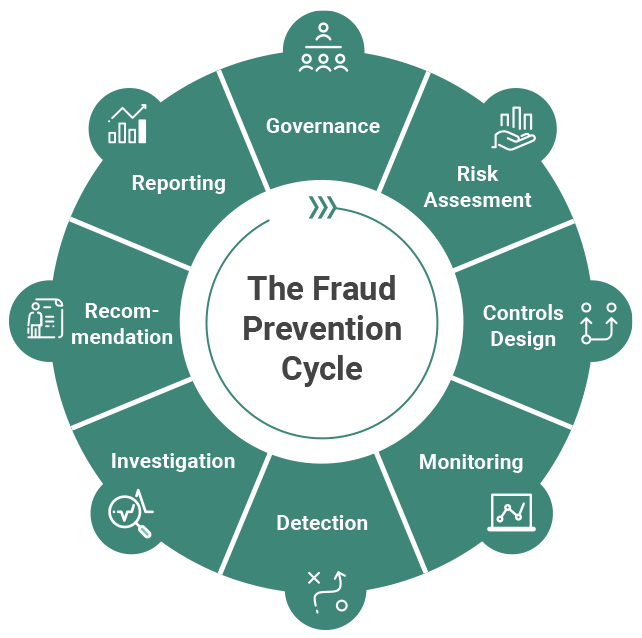
The first point of note is that fraud prevention is a cycle. It should not be viewed as a series of independent activities. To highlight this, refer to the ACFE and COSO work on Fraud Risk Management, including the Anti-Fraud Playbook[3], which provide valuable insights linked to the COSO framework, a founding basis for internal controls.
In recent years, the tendency to focus on compliance activities through the lens of a regulatory imperative (including mitigating the risk of a fine) has created ‘pools’ of activity which are not always well synchronised. For example, consider the ‘Governance’ component as ‘tone of the top’ – in our experience there is often a disconnect between the senior executives/Board Directors involved or informed at this stage, and the monitoring (including MI) and reporting that follows later. Ownership at the top is essential.
Ensuring the link between anti-fraud steps not only provides a better view of overall risk but facilitates more efficient and effective use of resources.
Each step of the cycle is an inherent component of the overall strategy, and the strategy fails without each step playing its part.
Setting the anti-fraud agenda at the outset is key. The Board is responsible for determining corporate strategy and risk appetite, and the anti-fraud agenda stems from these commercial imperatives. Once the risk appetite is set, a risk assessment is fundamental in determining how to build effective controls. After all, how can any system of control be well-designed if it is not informed of the risks it is supposed to mitigate?
To conduct an effective risk assessment, engage the business directly and avoid undertaking the process as an academic compliance exercise. Try to put yourself in the shoes of a would-be criminal, or even consider engaging some of the new breed of consultants who have themselves previously been fraudsters, for real insight.
We often see cases of organisation controls developed ‘after the fact’ – that is without any proper assessment of risk. The risk assessment does not have to be expensive and overly time-consuming, but it drives well-designed and properly targeted controls which bring much-needed efficiency and effectiveness.
Each step of the cycle is an inherent component of the overall strategy, and the strategy fails without each step playing its part.
A large volume of literature is publicly available to support this[4], but remember there is no such thing as a fraud control, only controls. Segregation of duties, effective passwords, authority limits, approvals, independent reviews and other control groups prevent errors and keep activities on budget and on target, and they also happen to prevent fraud. Do not allow this exercise to overshadow broader operational controls.
These represent the activities of the controls in practice. Proper KPIs and reporting data should be generated to help those charged with governance to determine whether the controls are effective and to identify early when a potential fraud or other anomaly may be taking place so that these can be immediately followed up.
If designed correctly, this information should be fully aligned with commercial objectives and provide more than fraud monitoring alone.
Normally managed by an independent team within either Internal Audit or another risk function, and in many cases with support from external investigators and legal counsel, thorough investigation provides a wealth of information on individual cases and the crystallisation of perceived risks, often allowing senior leaders to see their organisations from a new perspective.
No investigation can be complete without detailed and clear reporting and clear recommendations. Always consider two key outputs: what controls have failed (or been circumvented) in allowing this fraud to happen, and where else in the organisation the same scheme might be possible. Actively answering both of these questions can then complete the ‘cycle’ and feed back into enhanced controls design and monitoring.
The above steps really do apply to any business, of any size. The cycle is designed not to demand more resources, but to ensure that resources are efficiently allocated and focused on the most relevant activities. As highlighted, whilst this is presented through an anti-fraud lens, the results should provide far more commercial value.
As a wise colleague once pointed out, there has been no ‘outbreak of honesty’. The human psychology of fraud is well documented and will likely not change. Our advice therefore is clear – focus on your risk assessment and focus on the cycle.
There are, however, developments in anti-fraud which are bearing fruit. Perhaps the most effective of these, outside of individual organisations, is the growing tendency for cooperation amongst public and private sector organisations. Examples of this include:
These examples demonstrate the willingness and ability of government bodies to engage with the private sector to combat fraud. Whilst further cooperation is undoubtedly needed, these initiatives demonstrate a state- and global-level commitment to working together to combat fraud.
[ymal]
What should we take from this? Whilst fraud does continue, and new attack vectors develop every day, anti-fraud activities can be efficient and effective and achieve more than just anti-fraud at the organisational level. With the right collaboration at an organisation and state-level, moving the needle on fraud might not be so far from our grasp.
© Copyright 2022. The views expressed herein are those of the author(s) and not necessarily the views of Ankura Consulting Group, LLC., its management, its subsidiaries, its affiliates, or its other professionals. Ankura is not a law firm and cannot provide legal advice.
James Tebbs
Senior Managing Partner, Dubai
T: +971 (0) 4 381 9000 Main
Kassem Younes
Senior Managing Director, Riyadh
T: +966 11 261 1522
James Tebbs is a Senior Managing Director at Ankura and leads the firm’s risk, forensics and compliance team in the Middle East. He has over 20 years’ experience in fraud prevention, detection and investigation, including 10 years in the Middle East.
Kassem Younes is a Senior Managing Director at Ankura in Riyadh. Kassem’s experience covers a variety of cases including corruption, money laundering and asset misappropriation and he has appeared on several occasions as an expert witness.
Ankura is an independent global expert services and advisory firm that delivers services and end-to-end solutions to help clients at critical inflection points related to conflict, crisis, performance, risk, strategy and transformation.
[1] For the purposes of this article, we refer to anti-financial crime as a narrower concept related to AML, CFT, Sanctions compliance and the financing of proliferation.
[2] What is the Reshaped Landscape of Fraud Investigation? (lawyer-monthly.com)
[3] https://www.acfe.com/fraud-resources/fraud-risk-tools---coso
[4] Including the ACFE/COSO anti-fraud framework referenced above
[5] Saudi Central Bank governor launches operations center to combat financial fraud (arabnews.com)
In this feature we hear from Robert Wynn Jones, partner in Mishcon de Reya’s Fraud Group, who expands on this process and how he and his colleagues bring their expertise to bear in obtaining and keeping freezing injunctions.
Mishcon Fraud Group is a sub-group of Mishcon's wider Litigation Department. It has approximately 60 practitioners, including 12 partners. What distinguishes our group from many others is that the vast majority of the work that we undertake is in fact civil fraud, injunctive and asset tracing type work as opposed to the inverse, where many practitioners undertake general commercial litigation and a small percentage of fraud and injunctive work. We also undertake both claimant and defendant work, which allows both skillsets and know-how to feed off each other.
We have traditionally been instructed in large cross-jurisdictional matters involving large UK-based corporations, overseas-based large corporations or high net worth individuals in control of such corporations. Within those client groupings, we have been and continue to be instructed in classic ‘fraud matters’ where there has been obvious dishonest conduct in commercial dealings, which invariably require injunctive measures – often in multiple jurisdictions – in the form of search orders, freezing injunctions and third-party disclosure orders.
In the last five years or so, the department has been instructed on numerous non-performing loan (NPL) matters on behalf of various international banks, essentially using the same injunctive toolkit to obtain meaningful recoveries for the clients.
Another significant area of work in the last few years has been in the crypto space, where there have been substantial losses on the part of the claimant or the claimant group. In these cases we utilise our injunctive expertise, combining with our investigation colleagues both inside and outside of the firm to identify the wrongdoing, the wrongdoers and the misappropriated crypto or assets obtained utilising those proceeds. Again, we are seeing a real upturn in these types of instructions.
Finally, over the last 15 years or so, we have been instructed on countless misappropriation of confidential information cases, which remain a central pillar of our offering. Again, in these we use our injunctive expertise and in particular search orders and freezing injunctions to secure the misappropriated information and, invariably, the evidence of wrongdoing. The most recent and high-profile example of one of these cases is the widely reported Ocado Group Plc v Project Today Holdings Limited & Others.
In all of the above categories of work, we are also doing work on behalf of defendants.
What distinguishes our group from many others is that the vast majority of the work that we undertake is in fact civil fraud, injunctive and asset tracing type work as opposed to the inverse
Mishcon is predominantly a London-based law firm with offices in Hong Kong and Singapore. The vast majority of the matters on which we are instructed, however, have a multijurisdictional element. From the description of our work above, this is somewhat inevitable. We routinely act on matters involving common law jurisdiction such as Cayman, BVI, Hong Kong, Cyprus and Singapore, among others. In terms of non-common law judications that often feature in our cases, our clients' cases regularly have a footprint in the United States, Switzerland and Luxembourg – again, among others.
To operate and project manage these types of multijurisdictional cases, we have the benefit of the International Fraud Group (IFG), which our department set up approximately 25 years ago and now has 43 firms worldwide. These firms are all experts in the fraud injunctive and asset tracing space in each of those jurisdictions and allow us to operate at the highest level in pursuing these matters. I should note that we do not only use IFG members, but it does form the backbone of our international fraud litigation operation.
In terms of worldwide freezing injunctions (and the vast majority of the freezers we obtain are worldwide freezers due to the nature of the disputes), the two most obvious things they provide are, firstly, the freezing of a respondent's assets – generally up to an amount or above the amount claimed.
While they are called worldwide freezing injunctions, in fact they only freeze up to that amount or have effect up to that amount in the jurisdiction in which they are ordered. It is therefore necessary to obtain further supporting freezing injunctions in the other jurisdictions in which the respondent's assets are identified. In those circumstances we routinely obtain, for example, four, five or six freezing injunctions in other jurisdictions in support of the base worldwide freezing injunction. These are then generally served simultaneously on the respondents in order to lock down the target assets globally as tightly as possible.
The second benefit is worldwide asset disclosure. That provision of the Order, as opposed to the freezing provisions, is not dependent on the jurisdiction in which the Order is actually made. In other words, it does not matter if the worldwide freezing order is made in, for example, England or the Cayman Islands; the worldwide asset disclosure order is exactly that and the respondent has to disclose its assets worldwide.
While they are called worldwide freezing injunctions, in fact they only freeze up to that amount or have effect up to that amount in the jurisdiction in which they are ordered.
There is, of course, a risk of partial non-compliance with the freezing or the asset disclosure provisions. However, in our experience, the Orders provide an extremely powerful launchpad from which to conduct the litigation whereby the majority of the key assets are generally secured and those that may not have been previously known about have been disclosed under the asset disclosure provisions. Substantive breaches of these provisions which are discovered can be – and in our department routinely are – punished by contempt proceedings, often resulting in fines or imprisonment.
A search order is another immensely powerful tool that is hugely beneficial to the client. They can also be obtained in a multijurisdictional context in support of the same proceedings and executed simultaneously for maximum utility (time zones permitting).
It is hard to overstate the litigation advantage in obtaining the client's opponent’s key documents relevant to the proceedings held in hard copy and on computers, phones, cloud networks and any other electronic devices held at the relevant premises by the respondents. On many occasions (but certainly not all) the litigation can be all but over within the first days, weeks, or months after review of the key hard copy and electronic material obtained as a result of executing search orders. This, combined with key assets being simultaneously frozen, is an extremely potent combination in any litigation – and particularly any fraud litigation where the client's opponents have invariably been caught up in dishonest conduct.
Third-party disclosure orders, such as Norwich Pharmacal Orders and similar discovery type orders in the United States under the 1782 regime, can also be extremely beneficial in identifying assets, wrongdoing and further parties involved in the misconduct.
As you can see, the potential benefits to clients of properly obtaining, executing and (equally importantly) keeping these orders cannot be overstated.
The primary risk in obtaining these sorts of injunctions is having your opponent's client's discharge the injunction in its entirety or substantially amend its scope. If the injunction is discharged, that may trigger the cross-undertaking in damages. This cross-undertaking has to be given by the client/applicant when obtaining all of the types of injunctions. Therefore, if the injunction has been made in error and damages have flowed to the respondents, the applicant will generally be liable for those losses – and a review of the case law in this area will show that some of those losses can be extremely large indeed.
The potential benefits to clients of properly obtaining, executing and (equally importantly) keeping these orders cannot be overstated.
It also should be said that, even if the losses are not particularly high and the injunction is substantively discharged, the costs of that discharge will generally be paid by the applicant. So there is clearly a significant risk and, rightly, a very high bar in obtaining these injunctions.
The most common reason for discharge of an injunction ultimately relates to the obligation of full and frank disclosure. This is an extremely high burden placed on the applicant which essentially requires that applicant to explain to the judge all of the good and bad parts of that client's case, and all the good and bad parts (as far as they can know them) of the respondent's case.
These applications are nearly always made ex-parte, or without notice, to the respondent and therefore by definition without the respondent in the Court while the application is being made. Hence the obligation of full and frank disclosure and why the Court requires that rule to be complied with in a very meaningful way. If it is not, the Court could make an order that it would otherwise not have made had it been provided with the full information reasonably available.
The obligation of full and frank disclosure means that the practitioner is in the unusual position of having to undertake what are sometimes extremely challenging and often uncomfortable conversations with the client virtually at the outset of the matter and in preparation of the evidence and application. Understandably, the client/applicant is usually reluctant to explain in significant detail some of the more difficult aspects of its case and past conduct in its commercial dealings with the target/respondent. Equally, the applicant is, particularly in the context of feeling significantly aggrieved by the opponent's conduct, extremely reluctant to highlight the most promising aspects of its opponent's defence.
However, it is precisely these conversations that must be had to allow instructions to be drafted into in the affidavit supporting the injunction applications. Needless to say, extracting these instructions can sometimes cause very uncomfortable moments between lawyer and client. But it is this process that usually provides the best way of ensuring that the injunctions are retained once they are under significant attack by the opponent at the return date and beyond during the inter-partes period of the litigation. Without pushing hard in such conversations, it is unlikely that the client will pass over information that is (partially) detrimental to its position – which can, in turn, put retaining the injunctions at significant risk.
[ymal]
When making the application, all of the written evidence, draft orders, written submissions and oral submissions must be pitched appropriately so as not to overstate the factual position and the legal position, or what is being asked for in the injunctions themselves. This is a constant and complex battle that the applicant team must have with itself so as to not overreach, and again allow the client/applicant to be successful when under attack in inter-partes hearings. By the same token, we must be equally careful not to underreach in conclusions and inferences that can be drawn on the evidence and in the reach of Orders to allow for their maximum utility in all possible circumstances.
The experience of preparing numerous injunctions and going through the processes described above also allows for our department to strenuously test opposing applicants and their legal teams when working on the defence team in these injunctive matters.
In conclusion, it is a highly complex, extremely challenging, but ultimately enjoyable area of law in which to operate.
Robert Wynn Jones, Partner
Mishcon de Reya LLP, Africa House, 70 Kingsway, London WC2B 6AH, UK
Tel: +44 02033 217443 | Mob: +44 07525 392169
Fax: +44 02037 611856
E: robert.wynnjones@mishcon.com
Robert Wynn Jones is a partner in Mishcon de Reya’s Litigation Department and co-head of its Investigations Group. As a specialist in civil fraud, asset tracing and injunctive work, he has acted for both claimants and defendants, obtaining and opposing multiple search orders, asset freezing orders and disclosure orders in large cross-jurisdictional commercial disputes.
Mishcon de Reya is one of the UK’s leading law firms, employing over 1,200 people – including 600 lawyers – across its offices in London and Singapore. Mishcon’s team acts in accordance with the firm’s socially conscious values to affect profound and far-reaching change for their clients across all areas of law.
We always expect fraud to peak during a crisis, and the pandemic was no exception. According to a 2021 benchmarking survey published by the Association of Certified Fraud Examiners (ACFE), 51% of organisations had uncovered more fraud since the onset of the pandemic. The report, ‘The Next Normal: Preparing for a Post-Pandemic Fraud Landscape’, also found 71% of entities expecting fraud to rise over the next 12 months.
For fraud investigators, the digital acceleration and remote work precipitated by the crisis not only made employee fraud more likely – it made securing and identifying evidence of fraud all that much harder.
Employee fraud was the most significant fraud risk during the pandemic. About one-third of employee fraud is caused by lack of internal controls, which was exacerbated by the global move to working from home. In the rush to respond to lockdowns, the priority was to provide staff with the necessary digital tools and hardware to do their jobs remotely. A business’s internal controls were a secondary thought.
However, the lack or weakening of controls, and the fact that internal audit was also grounded, left the door open for unethical behaviour to grow. Some of this unethical behaviour has already been exposed, but the rest is still to be found. Key risk factors leading to heightened fraud risk during the pandemic included people becoming disengaged from work and culture, a lack of face-to-face compliance activities and increased financial stress.
This is not to suggest that companies should avoid hybrid and remote work. The Talent Tech Outlook 2022 study by job site SCIKEY shows that remote working has now become the new normal, with 82% of employees preferring to work from home or other places rather than returning to the office. Notably, almost two-thirds (64%) of employees said they are more productive working from home and feel less stressed.
For fraud investigators, the digital acceleration and remote work precipitated by the crisis not only made employee fraud more likely – it made securing and identifying evidence of fraud all that much harder.
However, it is also true that employees working from home feel they are less observed and may be aware that controls have weakened, and are therefore increasingly likely to believe they will get away with unethical behaviour. As cultural connection fades, disengaged employees are more likely to be blasé about a job they are not even sure they want. We also see cases where the situational reality of working from home, including any perceived lack of support, can help disgruntled employees to rationalise fraudulent behaviour.
Given that hybrid working is here to stay, businesses and organisations need to be aware of the increased fraud risk this poses. The latest ACFE Report to the Nations – Occupational Fraud 2022 asked participants which pandemic-related factors, such as internal control changes or operational process changes, led to the frauds that they investigated. The factor most commonly cited as significant was the shift to remote work.
The digitisation of work is challenging in that it has created a huge volume of structured and unstructured data for investigators to trawl through. In particular, remote work triggered the ubiquitous use of unified collaboration and communication tools. In 2021, Gartner’s Digital Worker Experience Survey found nearly 80% of workers using collaboration tools, up from just over 50% in 2019.
Today, businesses communicate internally and externally across an ever-expanding range of communications vectors, including dozens of team chat apps depending on the region. Take Hong Kong as an example: the region is quite diverse in its chat preferences, so investigators need to deal with many different chat applications with regional nuances around favourite platforms, such as Telegram in Hong Kong, WeChat in China, WhatsApp in Singapore, Line in Japan and KakaoTalk in Korea.
The widespread use of personal devices via Bring Your Own Device policies also means personal and business communications have become intermingled with an employee’s personal data. Today, investigators frequently come up against cases where employees are using non-enterprise versions of chat applications and personal accounts for business use. We must also assume that people have more than one phone – and their other one is likely a ‘burner’ used for communications they want to hide from their employer.
Given that hybrid working is here to stay, businesses and organisations need to be aware of the increased fraud risk this poses.
To meet the new demands of fraud investigation, we have had to uplift our capabilities in remote mobile data collection, including chat images and audio files. Right now, we cover 98.6% of mobile devices, including various Chinese brands, using specific local software. We also offer a full forensic analysis of mobile devices to extract hidden and deleted files and uncover insights in relation to call logs, geolocation, deletion analysis and internet search history.
To handle the oceans of data uncovered in an investigation, we use eDiscovery and investigations platforms. These technologies enable capabilities like image conversion, auto-redaction, text indexes for keyword searches and unified metadata fields, where electronic files can be tagged with information such as document date, custodian, or evidence ID. In addition, mobile chat data can be pulled into our document review platforms, and we use machine learning tools to grasp communication topics and timelines.
When working with legal teams, our job has always been to answer: ‘Who?’ ‘What?’ ‘How?’ ‘When?’ ‘Why?’ and ‘How much?’ To get to the bottom of these answers, fraud investigation teams broadly need three distinct disciplines, which can work closely with subject matter (industry) experts:
It is an iterative process. The forensic technologist may identify a person of interest. The forensic accountant may not initially find any evidence linking them to the allegation. But the BI analyst may uncover the person of interest is the director of a company that received fraudulent payments. Now the forensic accountant can go to work on those company records identifying payments of interest. The best teams work collaboratively, using their disparate skills to run down lines of enquiry and secure robust evidence.
[ymal]
© Copyright 2022. The views expressed herein are those of the author(s) and not necessarily the views of Ankura Consulting Group, LLC., its management, its subsidiaries, its affiliates, or its other professionals. Ankura is not a law firm and cannot provide legal advice.
Peter Glanville, Senior Managing Director
Suite 2206, Level 22, Central Plaza, 18 Harbour Road, Wan Chai, Hong Kong SAR, China
Tel: +852 2233-2500 (Main) | +852 5596-2080 (Mobile) | +852 3002-2011 (Direct)
Peter Glanville is a senior managing director at Ankura as well as a chartered accountant with over 20 years’ worth of experience. He has assisted a range of clients across Australia, the UK, Europe and Asia with complex investigations and forensic accounting matters. His wealth of expertise enables him to assist organisations in navigating key risks, investigating allegations of bribery and fraud and responding to regulatory issues.
Ankura is an independent global expert services and advisory firm that delivers services and end-to-end solutions to help clients at critical inflection points related to conflict, crisis, performance, risk, strategy and transformation.
New York attorney general Letitia James has filed a lawsuit against Donald Trump and three of his children to prevent them from doing business in the state, alleging “years of bank, tax and insurance fraud”.
The 220-page civil suit, filed in State Supreme Court in Manhattan, details allegations that the Trumps lied about the value of their real estate assets “by billions of dollars” in order to inflate their personal net worth. Through this fraud, Trump was able to secure favourable loans and, in cases where he undervalued his property, tax benefits.
Trump, Donald Jr, Ivanka Trump and Eric Trump were each named as defendants, along with Trump Organisation executives Allen Weisselberg and Jeffrey McConney. On top of an order preventing the Trump family from leading any company or purchasing any property in New York, the lawsuit also seeks a $250 million judgement.
James stated in a social media post that the suit alleged more than 200 cases of fraud over a period of 10 years. If enacted, she said, the penalties called for in the suit would be a “death penalty” for the Trump Organisation.
The Trump Organisation denied any wrongdoing. In a social media post, Trump described the legal action as “another witch-hunt”.
[ymal]
The news comes on the heels of further legal troubles for the former president as a three-judge appeals panel ruled that the criminal investigation into classified documents seized from his Mar-a-Lago estate could proceed.
