
Understand Your Rights. Solve Your Legal Problems
The President of the UK Supreme Court, Lord Reed of Allermuir, has confirmed he will retire from office on 10 January 2027, ending one of the most influential and stabilising judicial tenures in modern British history.
The announcement, made on Friday 16 January 2026, brings clarity to months of quiet speculation and sets in motion a formal succession process that will shape the future direction of the UK’s highest court. Lord Reed will leave after seven years as President, 15 years as a Supreme Court Justice, and 28 years in the senior judiciary.
While judicial retirements are often procedural affairs, this one carries far wider significance — not just for the legal profession, but for the balance of power between courts, Parliament, and government.
Lord Reed has led the UK Supreme Court through one of the most politically sensitive periods in its history. His presidency spanned the constitutional aftershocks of Brexit, intensifying debates over judicial independence, and rising public scrutiny of how courts interact with elected power.
Unlike more confrontational judicial figures, Lord Reed became known for institutional restraint, legal precision, and a refusal to personalise the Court’s authority. Supporters credit him with safeguarding public confidence in the judiciary. Critics argue his cautious style sometimes limited the Court’s willingness to push back forcefully against executive power.
Either way, his influence has been decisive — and his departure opens the door to a potentially very different judicial era.
Lord Reed succeeded Lady Hale of Richmond as President of the Supreme Court in January 2020 and became a life peer upon taking office.
Educated at the University of Edinburgh and the University of Oxford, he qualified as both an advocate in Scotland and a barrister in England — a dual foundation that shaped his authority across UK jurisdictions. Before joining the Supreme Court, he practised extensively at the Scottish Bar, handling complex civil litigation and prosecuting serious criminal cases.
He later served 13 years as a senior judge in Scotland, including:
Membership of the Outer House of the Court of Session (1998–2008), where he was Principal Commercial Judge
Appointment to the Inner House of the Court of Session (2008–2012)
Since joining the Supreme Court in 2012, Lord Reed has also sat on the Judicial Committee of the Privy Council, served as an ad hoc judge of the European Court of Human Rights, and acted as High Steward of Oxford University.
Under Lord Reed’s leadership, the Supreme Court became known less for headline-grabbing interventions and more for carefully reasoned judgments and administrative reform.
His presidency oversaw:
Stronger ties with foreign supreme courts
The Court sitting outside London, expanding public access
The revival of Privy Council judges from overseas jurisdictions sitting on appeals
This approach helped position the Court as an internationally respected institution — but also leaves open the question of whether future leadership will maintain that restraint or embrace a more visibly assertive judicial role.
1998–2008 – Judge, Outer House of the Court of Session (Principal Commercial Judge)
2008–2012 – Judge, Inner House of the Court of Session
2012 – Appointed Justice of the UK Supreme Court
2018 – Becomes Deputy President
2020 – Appointed President of the Supreme Court
2027 – Retirement takes effect
This timeline underscores the scale of his influence — and why replacing him will not be a routine appointment.
Lord Reed’s retirement will trigger the creation of an independent selection commission, convened by the Lord Chancellor under rules set by Parliament. The process is designed to safeguard judicial independence while ensuring transparency and merit-based selection.
No successor has yet been identified publicly. The appointment process is expected to unfold throughout 2026, with legal and political observers watching closely for signals about the future philosophy of the Court.
The eventual choice will quietly answer a bigger question: does the UK want continuity — or change — at the top of its judiciary?
Announcing his decision, Lord Reed said:
“I have decided that I will retire from the office of President of the Supreme Court on 10 January 2027… It has been a privilege to serve the citizens of the United Kingdom, and the people of the Privy Council jurisdictions round the world.”
The statement reflects a judicial career defined by service rather than self-promotion — a trait that has come to characterise his leadership.
Lord Reed’s departure comes as debates over judicial power, constitutional reform, and executive accountability continue to intensify. His successor will inherit a Court that is stable, respected, and under growing public attention.
Whether that stability holds — or gives way to a more interventionist judicial era — may depend less on individual cases and more on the leadership style chosen next.
When is Lord Reed retiring from the Supreme Court?
Lord Reed will retire on 10 January 2027.
Who appoints the President of the UK Supreme Court?
An independent selection commission is convened by the Lord Chancellor under parliamentary rules.
How long has Lord Reed served on the Supreme Court?
He has served since 2012 and has been President since 2020.
Who replaced Lady Hale as Supreme Court President?
Lord Reed succeeded Lady Hale of Richmond in January 2020.
Lord Reed’s retirement marks the end of a defining chapter for the UK Supreme Court. The real story now is not just his legacy — but how the next appointment could reshape the balance of judicial power in Britain.
This article will be updated as the selection process for Lord Reed’s successor progresses.
On January 15, President Donald Trump issued a formal commutation of sentence in a federal drug distribution case involving James Phillip Womack, reducing the custodial portion of his prison term but leaving the underlying conviction and post-release supervision requirements unchanged.
The commutation was formally recorded through the Office of the Pardon Attorney, which administers presidential clemency actions on behalf of the U.S. Department of Justice.
A commutation shortens or ends a sentence already imposed by a federal court. It does not vacate the conviction, reverse the judgment, or expunge the criminal record.

President Trump grants clemency to Arkansas congressman's son
The executive action immediately ends the prison term imposed on Womack but does not disturb:
The federal felony conviction
Any fines already imposed
The five-year term of supervised release, which remains enforceable
Prior state convictions or sentences
Unlike a pardon, which forgives the offense, a commutation is limited to punishment. The federal judgment remains legally valid.
Womack was sentenced in May 2024 in federal court to eight years’ imprisonment and a $1,900 fine after pleading guilty to distributing more than five grams of methamphetamine.
Federal prosecutors had also charged him with possession of a firearm as a convicted felon, according to court filings related to the indictment returned in April 2023.
The sentence reflected mandatory federal drug-weight thresholds and prior criminal history considered during sentencing.
With the prison term commuted:
Womack transitions from Bureau of Prisons custody to federal supervised release
A probation officer will oversee compliance with court-ordered conditions
Any violations of release conditions can result in reincarceration, regardless of the commutation
The sentencing court retains jurisdiction over supervision enforcement.
Republican Rep. Steve Womack from Arkansas
Representative Steve Womack publicly acknowledged the commutation and thanked the president for the action. There is no indication in public records that the congressman participated in the clemency decision-making process.
Presidential clemency authority is constitutionally vested and does not require judicial review or congressional approval.
James Phillip Womack is a repeat federal and state offender from Arkansas whose criminal record spans more than fifteen years and includes multiple drug and firearms convictions. He is the adult son of Representative Steve Womack, though his cases were prosecuted through standard state and federal criminal processes.
Public court records indicate Womack was 31 years old at the time of a major 2018 arrest, placing his birth year in the late 1980s. There is no publicly reported record of post-secondary education or sustained lawful employment in available court filings or contemporaneous reporting.
Womack’s interactions with the criminal justice system date back to at least 2007, according to Arkansas court records cited in local reporting.
In September 2018, he was arrested on more than ten state charges, including drug-related offenses and firearms violations. At the time, authorities cited possession of controlled substances and weapons despite prior felony status. He later entered a plea agreement and, in 2019, received a nine-year state prison sentence on multiple felony counts.
He was released from state custody early in 2020, but that release did not end his legal exposure.
In April 2023, federal prosecutors indicted Womack on charges arising from methamphetamine distribution and unlawful firearm possession by a convicted felon.
The case centered on the distribution of more than five grams of methamphetamine, a quantity that triggers enhanced penalties under federal law. Prosecutors also alleged firearm possession, which carried independent exposure due to his felony record.
In May 2024, a federal court sentenced Womack to:
Eight years (96 months) in federal prison
A $1,900 criminal fine
Five years of supervised release following incarceration
The sentence reflected federal drug-weight thresholds, prior convictions, and statutory sentencing guidelines.
Following sentencing, Womack was committed to the Bureau of Prisons, where he began serving his federal sentence. Public records do not detail his specific facility assignments or institutional conduct, and there is no public indication that prison conditions or health issues formed the basis of the clemency decision.
On January 15, President Donald Trump issued a commutation of sentence, ending the custodial portion of Womack’s federal punishment.
Critically, the commutation did not erase the conviction. Womack remains legally bound to complete the five-year term of supervised release, during which violations can result in reincarceration.
In earlier proceedings, Representative Womack publicly acknowledged his son’s struggle with addiction, describing it as a long-term issue affecting the family. Those statements were made during prior state proceedings and did not form part of the federal court’s legal findings.
From a legal standpoint, addiction history may be considered during sentencing or supervision but does not negate criminal liability or alter the validity of convictions.
From a legal standpoint, the case highlights:
The breadth of presidential clemency power
The distinction between sentence relief and conviction relief
The continuing authority of federal courts over supervised release
The non-reviewable nature of executive commutations
It also underscores how clemency can alter incarceration outcomes without rewriting the legal record.
The January 15 commutation changed where and how the sentence is served — not whether the crime occurred or how federal law applies going forward.
For defendants, counsel, and compliance professionals, the case is a clear example of executive discretion operating alongside, not instead of, the federal judicial system.
The High Court of Justice has confirmed that the Payment Systems Regulator (PSR) holds the legal authority to cap cross-border card fees. In a judgment delivered on 15 January 2026, Mr Justice Cavanagh dismissed a coordinated judicial review brought by Visa, Mastercard, and Revolut. The ruling provides the regulator with a "green light" to intervene in fee structures that have surged fivefold since Brexit.
The claimants’ primary legal theory relied on a narrow reading of Section 54 of the Financial Services (Banking Reform) Act 2013 (FSBRA). They argued the PSR’s power to issue "general directions" was limited to technical or operational "plumbing" of payment systems. Under this view, price-setting would be an unauthorized economic intrusion.
Mr Justice Cavanagh rejected this distinction as a "false dichotomy." The court held that pricing is inherently operational. The ruling clarifies that the PSR’s statutory objectives—promoting competition and protecting service users—grant it the flexibility to cap fees directly. This avoids the need for a multi-year Competition and Markets Authority (CMA) investigation.
Mastercard and Revolut advanced a secondary challenge under Section 108 of the FSBRA. They contended the PSR was barred from acting because the fees were already subject to separate payment regulations. The court found this argument "overly broad."
The judgment established that regulatory purpose is the deciding factor. Because the PSR’s "motivating objective" was to address competition failure rather than "access to the system," Section 108 was not engaged. This high-bar ruling prevents firms from using existing regulations as a shield against new, targeted interventions.
The PSR estimates that the jump in "outbound" fees—where EU consumers buy from UK shops—costs British businesses between £150 million and £200 million annually. With the legal "vires" challenge resolved, the regulator is shifting focus to the financial mechanics of the cap.
The Methodology: The PSR is currently finalizing the Merchant Indifference Test (MIT). This formula identifies the price point where a merchant would be indifferent between accepting a card or a bank transfer.
The Stage 2 Cap: Having scrapped an earlier interim plan, the regulator will now move directly to a long-term cap. This will likely bring the current 1.15%–1.5% rates back toward pre-Brexit levels of 0.2%–0.3%.
Issuer Impact: Banks and fintechs like Revolut warn that a "one-size-fits-all" cap may force them to process certain international transactions at a loss.
This ruling cements the PSR’s role as a proactive price regulator. It signals a shift away from the "red tape" reduction seen in other sectors, prioritizing the bottom line of UK merchants over the revenue streams of global payment networks.
Last updated: 19 January 2026 | 16:45 GMT
As Prince Harry’s nine-week High Court trial against the Daily Mail begins, his long-running legal battle with the British press can now be measured in outcomes, costs, and courtroom risk. This is the full record of what he has won, lost, settled — and what is now at stake.
On 19 January 2026, Prince Harry is due to return to the High Court to face his final and most formidable opponent: the Daily Mail. This is not just another hearing. It marks the opening of a nine-week trial that Harry has described as his “mission.”
Unlike earlier settlements, this trial is expected to place the Duke in the witness box to face gruelling cross-examination. He has said he is willing to risk everything on a belief that judicial scrutiny can hold powerful institutions to account. He is not alone in this fight.
The Daily Mail case is the culmination of a seven-year campaign that his father, King Charles, once referred to as a “suicide mission.” Harry views this litigation as a way to protect his family. He has repeatedly linked his hostility toward the tabloids to the circumstances surrounding his mother’s death and to what he describes as sustained press intrusion into his own adult life.
These cases now allow his record to be assessed through hard figures, formal apologies, and judicial outcomes. Supporters argue that the narrative has shifted from “troubled Prince” to a figure seeking structural accountability within the media.
Status | Outcome
Mirror Group
Partial victory — unlawful phone hacking established; first royal to give court evidence in more than 130 years.
News Group Newspapers
Settled (January 2025) — historic apology from The Sun; reported eight-figure payout.
Associated Newspapers (privacy claim)
Outright loss — a reminder that royal status does not guarantee success in court.
Associated Newspapers (Daily Mail case)
Live trial — the final and most expensive confrontation; Harry expected to give evidence on 22 January 2026.
The claim against The Sun’s publisher reached a dramatic conclusion in January 2025. This was the moment the litigation campaign took on far greater legal and financial significance.
The Duke accepted an eight-figure settlement widely reported to exceed £10 million ($12.3 million). The payment covered damages relating to alleged intrusion over a fifteen-year period. Crucially, the publisher issued what it described as a “full and unequivocal apology” for unlawful information-gathering activities connected to The Sun.
For Harry, the financial element was publicly framed as secondary to the admission itself. News Group Newspapers had not previously acknowledged unlawful conduct at The Sun, and the settlement was widely seen as an inflection point in the broader phone-hacking litigation landscape.
In late 2023, the High Court ruled that Prince Harry’s phone had been hacked “to a modest extent” between 2003 and 2009. He was awarded £140,600 in damages — a sum that represented only a fraction of the overall litigation cost.
He succeeded in establishing unlawful phone hacking, with the court criticising aspects of the publisher’s disclosure and record-keeping during the proceedings. The judgment nevertheless rejected large portions of the claim, finding that many alleged incidents were unsupported by sufficient evidence.
While financially limited, the ruling was legally significant. It marked the first time a senior member of the Royal Family had succeeded in proving phone hacking at trial and reinforced the courts’ willingness to interrogate historic newsroom practices.
Not every case has ended in success. In 2019, Prince Harry brought a privacy claim against Associated Newspapers relating to reporting on his security arrangements.
The claim was struck out, with the court holding that the articles did not meet the threshold for misuse of private information and that the publisher’s right to freedom of expression prevailed. An appeal was later dismissed.
This remains the Duke’s clearest defeat in press litigation and left him exposed to substantial unrecoverable legal costs. The outcome underscored that the High Court is not a rubber stamp for royal grievances and that privacy claims face exacting legal tests.
Across his press litigation, Prince Harry has been represented by David Sherborne, one of the UK’s most high-profile media barristers, known for leading complex and confrontational cross-examinations. Sherborne has been central to the legal strategy behind a series of cases that have placed sustained pressure on major British newspaper groups.
Litigation on this scale is rarely accessible to ordinary claimants. In the current Daily Mail case, the combined legal budget was originally estimated at approximately £38.8 million ($48 million).
However, the High Court later intervened, describing the projected costs as “manifestly excessive” and imposing a recoverable costs cap of around £4.1 million for Harry’s legal team. While this cap limits the amount he could recover if successful, it does not prevent a claimant from funding additional legal work privately.
The nine-week trial features a claimant group more commonly associated with award ceremonies than courtrooms. Prince Harry is expected to give evidence on Thursday, 22 January 2026. He will be followed by:
Sir Elton John and David Furnish, alleging covert surveillance and misuse of private information
Elizabeth Hurley, claiming systemic intrusion during periods of intense media scrutiny
Baroness Doreen Lawrence, whose participation carries significant symbolic weight given her public history with the paper
One of the most anticipated moments for media observers is the expected testimony of Paul Dacre. As editor-in-chief of DMG Media for decades, Dacre’s evidence will place historic editorial practices under direct judicial scrutiny.
Alongside the press litigation, Prince Harry has also pursued a judicial review against the UK Home Office over decisions relating to his police protection when visiting the UK.
While a 2025 appeal was rejected, a further review process by Ravec has been requested and remains subject to ongoing administrative consideration. This public-law challenge operates under a different legal framework from the press cases and does not involve damages.
For Harry, it remains one of the most personal legal disputes, as it determines the conditions under which his family can safely spend time in the UK.
As of January 2026, Prince Harry’s press litigation record stands at one partial trial win, one major settlement, and one outright loss. The Daily Mail case represents the final and most consequential test of that record.
A claimant victory in this final case could carry implications for newsroom practices, particularly in relation to historic information-gathering methods. If he loses, the financial consequences and reputational impact could be significant.
Regardless of the outcome, the litigation has already reshaped the public and legal conversation around press conduct, cost risk, and the limits of privacy law in modern Britain.
Day 4 - 22 January 2026: Emotional Cross-Examination as Prince Harry Tells Court Meghan’s Life Was “Absolute Misery”
Prince Harry became visibly emotional at the end of a dramatic day of evidence at the High Court, as he concluded nearly two hours of cross-examination in his case against the publisher of the Daily Mail. The Duke of Sussex told the court that relentless press scrutiny had made his wife Meghan’s life “an absolute misery,” his voice faltering as he addressed the judge.
The 41-year-old is bringing legal action against Associated Newspapers Limited, alleging unlawful information-gathering practices between 1993 and 2011. The publisher strongly denies the claims and argues the case has been brought too late. Prince Harry is one of several high-profile claimants, alongside Baroness Doreen Lawrence, Sir Simon Hughes, actresses Liz Hurley and Sadie Frost, and Elton John with his husband David Furnish.
During cross-examination by ANL’s lawyer, Anthony White, the Duke appeared increasingly frustrated, rejecting suggestions that stories could have originated from his own social circle and insisting his private life had been “commercialised” since his teenage years. He told the court the notion that he has no right to privacy was “disgusting,” adding that the couple had only ever sought “an apology and accountability.”
At several points, Mr Justice Nicklin reminded the Duke that he was not required to argue the case, only to answer questions. Harry responded that he had previously had a “bad experience” in court and felt compelled to explain his position fully.
In his evidence, Harry described a deeply strained relationship with the press following the death of his mother, Princess Diana, and said he felt unable to challenge intrusive reporting while an active member of the Royal Family. Complaining, he said, only encouraged further attacks.
ANL maintains journalists sourced material lawfully and denies any unlawful activity, including phone hacking. The trial continues, with Liz Hurley expected to give evidence next.
Day 3 — 21 January 2026: Emotional Exchanges as Prince Harry Faces the Court for a Possible Final Time
Day three of the High Court trial may mark the final time Prince Harry appears in the witness box after years of legal battles with the British press. If so, it was an exit charged with frustration, emotion, and visible fatigue.
Giving evidence in his latest case against Associated Newspapers, Harry described the proceedings as a “horrible experience,” recounting what he sees as a lifetime of intrusive media coverage that has taken a profound emotional toll on him and his family. His testimony was often tense and deeply personal, reflecting how strongly he feels about allegations that journalists unlawfully gathered private information.
At one point, his voice cracked as he accused the press of making his wife’s life “an absolute misery,” a moment that underscored the rawness of his anger and distress. He spoke of paranoia, distrust, and constant anxiety over leaks, painting a picture of a private life lived under siege. His answers were frequently terse, sometimes defensive, and occasionally edged with sarcasm.
The judge, Mr Justice Nicklin, intervened to remind Harry to answer questions directly rather than argue his case from the witness box. Despite remaining outwardly polite, Harry appeared visibly strained, the effort to stay composed evident throughout his testimony.
In contrast, Associated Newspapers’ barrister Antony White maintained a calm, forensic approach, suggesting alternative, lawful explanations for how stories were sourced. The clash of styles was stark: Harry delivering moral outrage, the defence focused on technical detail.
The courtroom itself felt modern and subdued, a far cry from the dramatic setting often imagined, as decades-old tabloid stories were dissected in meticulous detail.
As the case continues for weeks to come, neither side has landed a decisive blow. But for Harry, simply enduring this appearance — and voicing his sense of injustice — may feel like a chapter nearing its end.
Day 2 — 20 January 2026: Prince Harry Alleges Targeted Reporting and Unlawful Media Practices
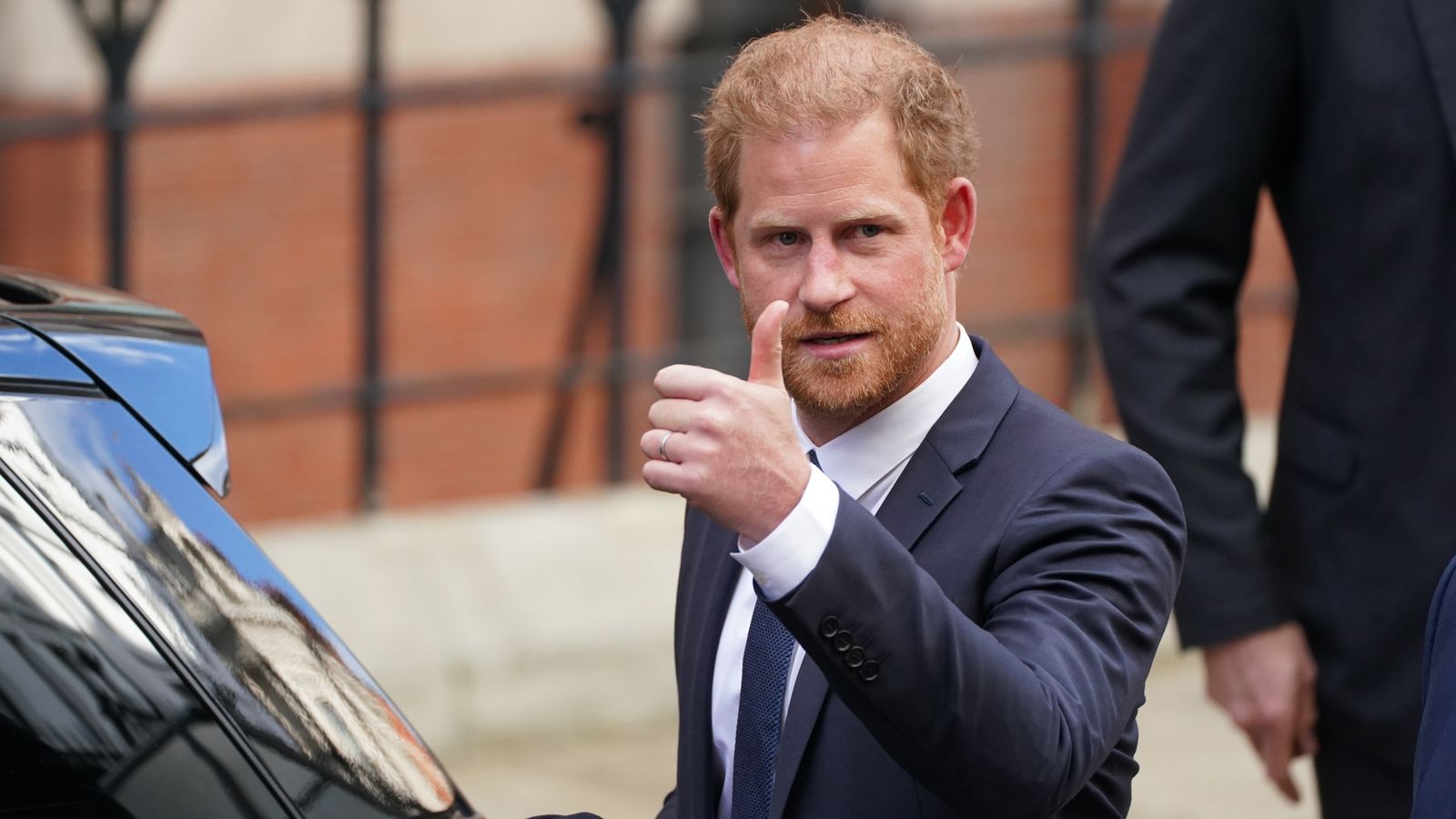
Prince Harry arrives at the Royal Courts of Justice in London on Tuesday for the second day of his High Court case against Associated Newspapers.
Day two of the High Court trial saw lawyers for Prince Harry dramatically escalate their case, arguing that the duke was subjected to a “sustained campaign of attacks” after daring to challenge the publisher of the Daily Mail and Mail on Sunday.
Addressing the court in London, Harry’s barrister David Sherborne told the judge that the duke believes he was repeatedly targeted by Associated Newspapers for “having the temerity to stand up” to the media group.
Sherborne said Harry’s witness statement describes the “distress, paranoia and other feelings” caused by what he alleges was years of unlawful information-gathering. He asked the court to consider whether such reactions were unsurprising given what he described as a pattern of intrusive reporting with serious implications for Harry’s personal safety.
The duke sat in court throughout the hearing and is due to give evidence later this week.
The court heard that Harry is relying on 14 articles published between 2001 and 2013, most carrying bylines from royal journalists Katie Nicholl and Rebecca English. Sherborne said the stories bore the “hallmarks of unlawful information gathering” — including details that could not reasonably have come from legitimate sources.
Among the examples highlighted:
Security-sensitive flight details, allegedly obtained through a private investigator
Intimate details of Harry’s private life, including where he preferred to stay overnight
A report revealing that Harry had been chosen as godfather to the child of his former nanny, Tiggy Legge-Bourke, before even senior members of the royal family were aware
Sherborne told the court that even King Charles had not been informed of the godparent decision at the time of publication.
One key allegation centred on claims that journalist Rebecca English paid private investigator Mike Behr £200 in cash for information about Harry’s then-girlfriend Chelsy Davy, including precise flight details. Sherborne said such information posed clear security risks and could not have been lawfully obtained.
He also attacked explanations given for other sourcing claims, describing one account — that details about Davy came indirectly from a long-retired journalist living alone on the Isle of Wight — as “stretching plausibility” and deserving to be dismissed.
Associated’s defence team rejected the allegations in forceful terms. Lead counsel Antony White said all the articles were sourced “entirely legitimately” from a wide range of contacts — including people in Harry’s own social circle, press officers, publicists, freelance journalists and previously published reports.
White told the court that Harry’s circle was “known to be a good source of leaks” and argued that the articles did not appear in isolation but built on widespread prior coverage.
He also stressed that Associated had a “full roster” of journalists prepared to give evidence — including former Daily Mail editor Paul Dacre — which he said “speaks volumes” about the publisher’s culture and confidence in its defence.
Associated denies any systemic use of unlawful methods and says an effective ban on private investigators was imposed in 2007.
White argued that the claimants had produced “very little evidence” directly linking private investigator payments to specific stories, describing much of the case as “guesswork” and improperly reliant on evidence from earlier phone-hacking cases involving other newspapers.
Sherborne, responding, rejected claims that the lawsuit was brought too late or that the legal team had engineered key moments to revive expired claims. He called those allegations “offensive, misconceived and untrue.”
With opening arguments now complete, attention turns to Prince Harry’s own testimony, expected later this week. His evidence is likely to be one of the most closely watched moments of the trial, particularly given the security-focused allegations and his longstanding public criticism of the British tabloid press.
The trial continues.
Day 1 — 19 January 2026: Opening Statements and the Shape of the Case
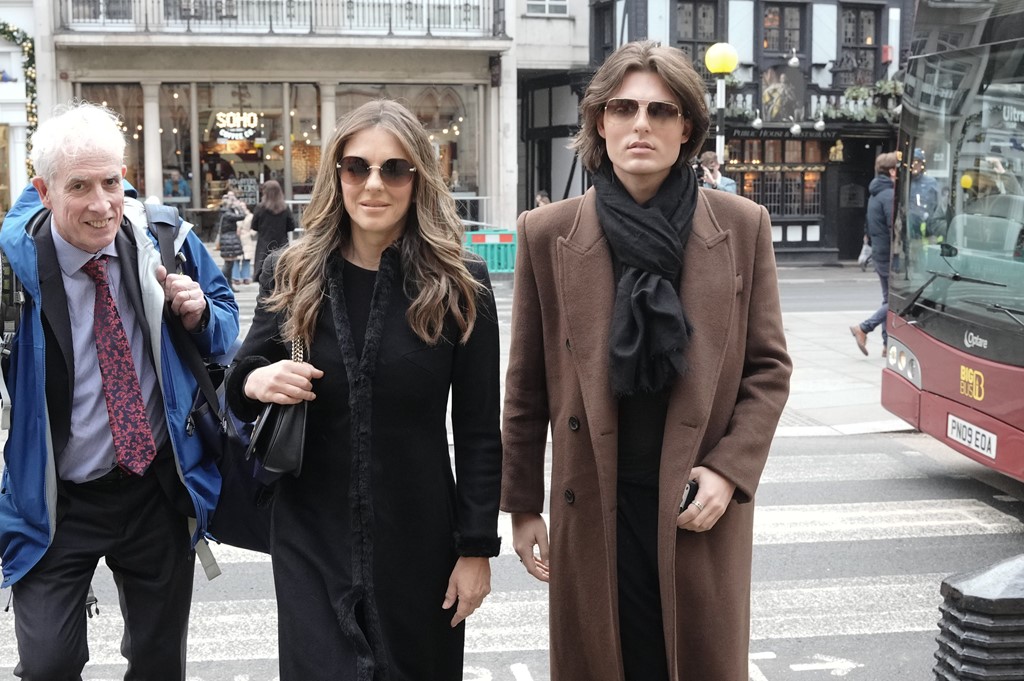
Elizabeth Hurley arriving in court this morning with her son Damian
The opening day of the nine-week High Court trial between Prince Harry and the publisher of the Daily Mail set the tone for what promises to be one of the most closely watched media law cases in modern British history.
Proceedings began shortly after 10:30 a.m. at the High Court, with the court hearing exclusively from the claimants. Defence submissions from Associated Newspapers are expected later in the week.
At the centre of the day’s hearing was a lengthy opening statement from media barrister David Sherborne, who represents Prince Harry and six other high-profile claimants. Sherborne accused the publisher of operating what he described as a “systematic and sustained” culture of unlawful information-gathering across multiple decades, alleging that senior figures within the organisation were aware of — and complicit in — the use of private investigators to obtain confidential information.
Sherborne told the court that Associated Newspapers’ historic denials of wrongdoing amounted to a “hear no evil, see no evil, speak no evil” defence, arguing that internal records, missing invoices and cash payments painted a very different picture from the publisher’s public stance. He said the claimants would seek to demonstrate that unlawful practices were not isolated incidents but part of a broader newsroom culture extending from the 1990s through to at least 2011.
Although Prince Harry was present in court throughout the day, today’s proceedings were not focused on his individual allegations. Instead, Sherborne structured the opening around the claims of other members of the group, including Elizabeth Hurley, Elton John and his husband David Furnish, actress Sadie Frost, and Baroness Doreen Lawrence.
The court heard detailed submissions relating to alleged invasions of privacy, including claims that private medical information, family communications and confidential legal discussions could only have been obtained through unlawful means. Particular emphasis was placed on the alleged repeated use of private investigators, some of whom were said to have been paid in cash, with incomplete or missing billing records.
In Baroness Lawrence’s case, Sherborne described the alleged impact of media intrusion as “hard to fathom”, given her long-running public campaign for justice following the murder of her son, Stephen Lawrence. He argued that while the Daily Mail publicly positioned itself as an ally of the Lawrence family, private information relating to sensitive legal negotiations had nevertheless appeared in print.
Associated Newspapers has categorically denied all allegations of unlawful information-gathering. In written submissions referenced in court, the publisher described the claims as “preposterous smears” and insisted that all reporting relied on legitimate journalistic sources, including public records, prior reporting and information provided by contacts within claimants’ social or professional circles.
The defence has indicated that a central plank of its case will be a limitation argument — namely, that the claims have been brought too late and should be struck out regardless of their factual basis. That issue, while flagged on Day 1, has not yet been argued in full.
Despite his central role in the wider litigation, Prince Harry’s personal claim was not examined in detail on the opening day. Sherborne confirmed that submissions relating specifically to the Duke of Sussex will begin when proceedings resume, ahead of Harry entering the witness box later this week.
Court observers noted that Harry appeared attentive throughout the hearing, though he did not address the court. His evidence is expected to be one of the most scrutinised moments of the trial, particularly given earlier judicial findings in his previous press cases.
The trial resumes tomorrow at 10:30 a.m., with Sherborne expected to continue outlining the claimants’ case — including the specific allegations made by Prince Harry. Associated Newspapers is expected to open its defence later in the week.
While no factual findings were made on Day 1, the opening submissions made clear that this case will hinge not only on individual articles, but on whether the court accepts that unlawful information-gathering formed part of a wider, institutional practice within one of Britain’s most powerful newspaper groups.
Further updates will be added as evidence is heard.
A workplace disclosure occurred during a live BBC production when Wayne Rooney stated he is deaf in his left ear and asked production staff to place his talkback earpiece in his right ear. While no court filing or regulatory action followed, the disclosure triggers defined legal duties under UK employment and equality law that attach immediately once an employer is on notice of a disability affecting work.
This is not a health announcement in the abstract. It is a workplace-relevant disclosure made in the course of contracted broadcasting work with BBC.
Under the Equality Act 2010, hearing loss can qualify as a disability where it has a substantial and long-term adverse effect on normal day-to-day activities, including communication in noisy environments. Once an employer has actual or constructive knowledge of such a condition, statutory duties are engaged regardless of whether the individual has previously sought adjustments.
The key legal consequence is the employer’s duty to make reasonable adjustments to prevent the individual being placed at a disadvantage compared to non-disabled colleagues.
The duty is anticipatory but becomes operational once the issue is known. In a broadcasting context, this can include:
Adjusting earpiece placement or audio feeds
Managing background noise levels during live analysis
Providing alternative communication methods during studio discussions
Modifying production protocols where noise interference affects performance
The legal test is reasonableness, assessed against factors such as cost, practicality, effectiveness, and the employer’s resources.
There is no requirement for the individual to prove fault, injury, or negligence. The obligation arises from the existence of disadvantage and employer knowledge alone.
Where on-air talent is engaged under a services contract rather than a traditional employment contract, the Equality Act still applies if the individual is a worker or contractor providing personal services.
Broadcasting agreements commonly include fitness-to-perform and compliance clauses. However, such clauses cannot be enforced in a way that circumvents statutory equality protections. Any contractual response must therefore be compatible with the reasonable adjustments framework.
No formal process is required to begin compliance. The employer is expected to:
Acknowledge the disclosed condition
Consider whether it meets the statutory disability threshold
Assess workplace disadvantages caused by the condition
Implement reasonable adjustments where identified
Failure to do so can expose the organisation to discrimination claims, even where the individual continues performing at a high level.
Whether the hearing impairment meets the “long-term” threshold under the Act
Whether any existing production arrangements already constitute reasonable adjustments
Whether further adjustments would be required if working conditions change
Absent a dispute, no tribunal involvement is necessary. The legal mechanism operates preventatively, not reactively.
The significance lies in the automatic operation of equality law once a disability is disclosed in the workplace. The legal position does not depend on publicity, performance quality, or intent—only on knowledge and consequence.
For employers in media, sport, and live production environments, this is a reminder that on-air disclosures can carry immediate legal effect.
The UK government has formally rejected any attempt to link trade measures to the future status of Greenland, following the announcement by Donald Trump of proposed tariffs affecting several European states.
Speaking on behalf of the government, Lisa Nandy confirmed that the UK regards the legal position on Greenland as settled and not open to negotiation. The statement clarifies that the UK will not participate in discussions in which economic pressure is used as leverage to influence territorial or governance outcomes concerning Greenland.
While the dispute has been framed politically, the government’s position is rooted in established international legal principles rather than diplomatic preference.
Greenland is an autonomous territory within the Kingdom of Denmark, with extensive self-governing powers. Any change to its constitutional position would require the consent of Greenland’s population and the Danish state.
From a legal perspective, third-party states have no authority to influence that process through economic or trade measures. The UK’s position reflects the principle of self-determination, which limits the ability of external actors to impose outcomes indirectly where direct legal authority does not exist.
By describing the issue as “non-negotiable”, the government is signalling that it will not treat trade discussions as an acceptable forum for resolving questions of territorial governance.
Tariffs are imposed under domestic trade powers, but their use is not unlimited. While states retain discretion over trade policy, the application of tariffs for purposes unrelated to trade — particularly where they are used to compel political or territorial concessions — raises legal and treaty-based concerns.
In practice, tariffs of this nature increase import costs and create commercial pressure on targeted states. However, when deployed in connection with sovereignty or territorial demands, they risk breaching international trade commitments and undermining the legal distinction between economic regulation and coercive diplomacy.
The UK’s response makes clear that it views this distinction as legally significant.
At present, the dispute remains at a pre-litigation stage. No formal trade challenge has been launched, and the UK has not indicated that retaliatory measures are imminent.
The next steps are likely to involve continued diplomatic engagement, including discussions through bilateral and multilateral channels. Coordination with European partners may also follow if the tariff proposals move closer to implementation.
US House Speaker Mike Johnson has indicated that diplomatic channels remain the preferred mechanism for addressing Greenland-related tensions, suggesting that formal trade disputes or legal proceedings are not yet the default outcome.
Key issues remain unresolved, including whether the proposed tariffs will be formally enacted and whether they will be challenged under international trade frameworks if implemented. It is also unclear how far the US administration intends to push the linkage between trade measures and strategic or territorial interests.
What is now clear is the UK’s legal boundary. Trade negotiations will proceed on trade terms alone, and questions of Greenland’s future will remain governed by consent, autonomy, and established international law rather than economic leverage.
A DUI charge has been formally filed against Lamar Odom following his arrest by Las Vegas authorities in the early hours of January 17, 2026, according to Nevada court records. The filing initiates a criminal misdemeanor case under state traffic and impaired driving laws and places the matter under the jurisdiction of the local justice court.
In addition to the DUI allegation, the court docket lists two traffic-related violations arising from the same incident, including excessive speeding and an alleged lane control infraction.
The DUI charge represents the state’s allegation that Odom operated a motor vehicle while impaired under Nevada law. At this stage, the filing does not resolve guilt or impose penalties. Instead, it triggers the criminal process, requiring the defendant to appear in court and respond to the charges.
Because the matter is proceeding in Nevada, the applicable legal standards, sentencing ranges, and procedural rules are governed by Nevada statutes rather than prior cases in other states.
Court records indicate that Odom was taken into custody at the time of arrest. DUI arrests typically involve administrative steps separate from the criminal case, including temporary license suspension proceedings and evidentiary testing issues, which may proceed on a parallel timeline.
Those administrative consequences are handled independently of the criminal court and can move forward even before the case is adjudicated.
The filing notes no sentencing outcome at this stage. While Odom has a prior DUI conviction from California in 2013, any consideration of past offenses would only become relevant later in the process, such as during plea discussions or sentencing, and only to the extent permitted under Nevada law.
Prior convictions from other jurisdictions do not automatically enhance charges but may be evaluated by the court if the case advances beyond preliminary proceedings.
Odom is scheduled to appear in Nevada court on March 17. That appearance is expected to involve an initial hearing or arraignment, where the charges are formally presented and the defendant may enter a plea.
At this stage, the court typically addresses scheduling, bail or release conditions if applicable, and the next procedural steps.
Following the initial court appearance, the case may proceed through several possible paths:
Pretrial motions addressing evidence or procedural issues
Negotiated resolution discussions between the parties
Further hearings or a trial setting if no resolution is reached
The legal standard the prosecution must ultimately meet is proof beyond a reasonable doubt that the DUI offense occurred as charged.
No determination has yet been made regarding liability, admissibility of evidence, or potential penalties. The court has not issued any rulings beyond acknowledging the charges and setting the matter for a future appearance.
Until those steps occur, the case remains in its earliest procedural phase, with the legal consequences dependent on how the process unfolds in court.
Shannen Doherty’s divorce settlement has been formally challenged after her ex-husband filed new legal papers on January 14, 2026 arguing the court lacks authority to enforce the agreement signed shortly before her death.
Court records show that Kurt Iswarienko filed documents in Los Angeles Superior Court on January 14, seeking to block enforcement of the divorce settlement he and the late actress Shannen Doherty signed in July 2024.
The filing represents a procedural challenge rather than a reopening of the divorce itself and centers on whether the court has jurisdiction to enforce the agreement following Doherty’s death.
In his court filing, Iswarienko argues that the divorce settlement was brought in the wrong court and that, as a result, the court does not have legal authority to enforce its terms. He further contends that the divorce proceedings should have ended automatically upon Doherty’s death and that the settlement should not have been filed or enforced afterward.
Doherty signed the settlement on July 12, 2024, with Iswarienko signing the following day. She died in July 2024 after a long battle with cancer, just after the agreement was finalized.
Jurisdiction determines whether a court has the legal power to hear a dispute or enforce an agreement. If a court lacks jurisdiction, it cannot compel compliance with settlement terms, even if both parties previously signed the agreement.
Iswarienko’s filing does not dispute that a settlement exists. Instead, it challenges whether the court overseeing the case has the authority to act on it at all.
The new filing follows an earlier court submission from Doherty’s estate, which claimed Iswarienko failed to comply with several financial and property-related obligations set out in the settlement.
Those obligations include the sale of a Texas property valued at approximately $1.5 million, with net proceeds to be divided equally between Iswarienko and Doherty’s estate. The estate has alleged that the home has not been listed for sale. The filing also states that Iswarienko was required to buy out Doherty’s interest in a Mooney M-20 aircraft for $100,000, but that a portion of those funds was withheld after the plane’s sale.
The estate further alleges that certain items of personal property belonging to Doherty have not been returned, contrary to the settlement terms.
Iswarienko’s January filing also questions whether the trustee of the Shannen Doherty Family Trust had the legal authority to bring enforcement motions on behalf of the estate. That issue is separate from the financial disputes and focuses on who is legally permitted to act for Doherty’s estate in court.
This dispute is not about fault or the validity of the marriage and does not involve a new divorce action. The court is being asked to decide a narrow procedural question: whether it has jurisdiction to enforce the settlement and whether the estate has standing to seek enforcement.
If the court finds that jurisdiction exists and the proper party brought the motion, it may proceed to address whether the settlement terms were breached. If the court agrees with Iswarienko’s jurisdictional argument, enforcement efforts could be halted or redirected to another legal forum.
The ruling will determine whether Doherty’s estate can compel payment and property transfers under the settlement or whether those disputes must be resolved through a different legal process. The outcome will affect how and where the remaining financial and property issues from the divorce are resolved, but it does not reopen the divorce itself.
How much it would cost Tottenham to sack Thomas Frank moved sharply into focus on Saturday night after Spurs suffered a damaging 2–1 home defeat to West Ham, deepening a crisis shaped as much by employment law and finance as results on the pitch.
Tottenham Hotspur’s season hit a new low as they were beaten late by West Ham United, leaving Spurs 14th in the Premier League and prompting fresh chants of “you’re getting sacked in the morning” directed at head coach Thomas Frank.
The loss came just days after renewed scrutiny of the club’s finances following a £90 million loan agreement — a deal that complicates any decision to change manager midway through the season.
Tottenham started brightly but fell behind early before captain Cristian Romero headed Spurs level. Despite pushing for a winner in the second half, Spurs switched off late, conceding a last-minute goal to hand West Ham their first league win in 11 matches.
Boos rang out at full time inside the Tottenham Hotspur Stadium, with fan frustration now boiling over during a run that has seen Spurs exit both domestic cup competitions.
Speaking after the match, Frank acknowledged the familiar pattern of Spurs’ defeats this season.
On conceding late, he said Spurs were “on top of the game” but “switching off in the last moment,” adding that while his side created chances, they failed to finish the match out.
Frank said halftime tweaks helped Spurs control the second half, but admitted the team’s defending at set pieces against West Ham was “probably our worst game” in that area this season.
Asked directly about the chants calling for his dismissal, Frank said he understood the frustration but insisted he still feels “the absolute backing from everyone here at the club,” adding: “We just don’t get the results, which is super crucial and important, so we just keep going.”
Spurs captain Cristian Romero did not hide the scale of the problem after another home defeat.
“This moment is disastrous for us,” Romero said. “We need to stay together, silence in this moment, work harder and go again.”
Frank earns an estimated £8 million per year and has around two-and-a-half years left on his contract, putting its total remaining value close to £20 million.
However, under UK football employment contracts, clubs almost never pay the full remaining value of a manager’s deal.
Instead, contracts usually include liquidated damages clauses, which set a fixed compensation amount if the club terminates early without misconduct.
In practical terms:
Spurs would not owe Frank his full remaining salary
A pre-agreed termination fee would apply
That figure is commonly equivalent to six to twelve months’ pay
Based on Premier League norms, Tottenham’s likely exposure to sack Frank now is estimated at around £8 million, though the exact figure would remain confidential.
The legal calculation is sharpened by Tottenham’s recent £90 million loan from Macquarie Bank.
While the loan does not prevent Spurs from dismissing their manager, compensation payments are immediate cash liabilities. Spurs are already managing:
Significant transfer-related debt
Annual interest payments estimated at £20–30 million
High operating and wage costs
Adding a multi-million-pound termination payment so soon after securing external financing makes timing critical.
This is not a misconduct dismissal and would not automatically give rise to an employment tribunal claim. From a legal perspective, Tottenham’s decision would be treated as a contractual termination without cause, governed entirely by the terms written into Thomas Frank’s employment agreement.
If the club chooses to remove Frank, it would formally terminate his contract early and rely on the agreed termination provisions, most commonly a liquidated damages clause. That clause sets out a fixed compensation amount payable by the club in exchange for ending the contract before its natural expiry, avoiding any dispute over future salary, bonuses, or lost earnings.
In practice, this means Frank would receive a pre-agreed payment, typically made as a lump sum or in short instalments, rather than continuing to be paid for the remaining term of his deal. Because the compensation figure is contractually defined, there is usually no requirement for court or tribunal involvement.
The only circumstances in which legal proceedings would arise is if one party alleged that the termination provisions were not correctly followed or that the clause itself was breached. Otherwise, the legal test is narrow and procedural: whether Tottenham complied with the termination mechanism set out in the contract.
Each Premier League place is worth millions in prize money, and European qualification can quickly offset the cost of managerial compensation. But continued poor results risk a far greater financial hit than a single termination payment.
After another late collapse, mounting fan unrest, and growing financial scrutiny, Tottenham’s decision on Thomas Frank is no longer theoretical. It is a live employment-law and cash-flow question unfolding week by week — and results like this only accelerate the countdown.
👉👉 Related: What happens to Ruben Amorim now after Manchester United sacking?
Manhunt launched for Ashton Anderson after a man in his 20s was killed by a car on a petrol station forecourt in Seaham, police confirmed Friday.
Officers said they are actively searching for 19-year-old Ashton Anderson, who is believed to hold vital information about the fatal incident at the Esso garage on Stockton Road.
Seven people are now in police custody as part of a murder investigation into the Seaham petrol station death.
The incident happened at around 4.50pm on January 15, when a man in his 20s was struck by a vehicle on the forecourt. He was pronounced dead at the scene.
Police have arrested seven people in connection with the investigation. Three male teenagers and a man in his 50s were arrested on suspicion of murder. Three women — including one teenager and two in their 40s — were arrested on suspicion of assisting an offender. All seven remain in custody.
A police cordon remains in place at the petrol station, and Durham Constabulary said there will be an increased police presence in and around Seaham while enquiries continue.
Detective Chief Inspector Chris Woollett said officers have no information to suggest any wider risk to the public and thanked the local community for its support. He added that anyone found to be assisting or concealing suspects would face “robust action.”
Under UK law, arrests at this stage do not mean charges have been filed.
What legally changed today: Police formally confirmed an active manhunt for Ashton Anderson and confirmed all seven arrested suspects remain in custody.
What happens next: Investigators must decide whether there is sufficient evidence to seek charges, release suspects, or apply for further detention. Any charging decision must be authorised by the Crown Prosecution Service.
Legal standard: To bring a murder charge, prosecutors must assess whether the evidence shows an unlawful killing with intent or reckless disregard for life.
If charges are approved, suspects would first appear before a magistrates’ court before any case proceeds to the Crown Court.
Police continue to appeal for information as the investigation remains active, with officers maintaining a visible presence across County Durham while key legal decisions are pending and the victim’s family is supported.
