
Understand Your Rights. Solve Your Legal Problems
In a shocking turn of events that has rocked the cybersecurity community, two former IT professionals — once trusted to protect major U.S. companies from hackers — have been charged with using their insider knowledge to carry out cyberattacks worth millions.
Federal prosecutors allege that Kevin Tyler Martin, 34, of Roanoke, Texas, and Ryan Clifford Goldberg, 32, of Watkinsville, Georgia, joined forces to hack multiple American businesses and extort them for money using a notorious ransomware strain called ALPHV.
Both men previously worked for well-known cybersecurity firms before allegedly exploiting the same skills they were paid to use for protection.
According to an indictment filed in the Southern District of Florida, Martin and Goldberg carried out a string of ransomware attacks in 2023, targeting a medical device company in Florida, a pharmaceutical firm in Maryland, and a drone manufacturer in Virginia.
Prosecutors say the pair demanded around $10 million from the Florida-based medical company to release its encrypted files, ultimately receiving $1.27 million in ransom payments before the FBI intervened.
Martin and Goldberg each face federal charges of extortion and intentional damage to a protected computer. Their attorneys have declined to comment on the ongoing investigation.
“It’s deeply disturbing to see professionals who were once part of the defense industry crossing the line,” said Allan Liska, a veteran threat analyst at Recorded Future. “These incidents erode the public’s trust and make an already difficult cybersecurity landscape even harder to manage.”
Authorities allege that Martin and Goldberg used ALPHV—also known as BlackCat—a sophisticated form of ransomware that operates as a “service model,” where developers sell the malware code to affiliates in exchange for a share of their profits.
ALPHV has been linked to numerous large-scale attacks, including the 2024 Change Healthcare breach that crippled hospital billing systems across the country and disrupted prescription services. Investigators have clarified that Martin and Goldberg were not involved in that particular incident.
DigitalMint, Martin’s former employer, said he acted “completely outside the scope of his employment” and that the company had “no knowledge or involvement” in any illegal activity. Sygnia Cybersecurity Services, where Goldberg worked, stated it immediately terminated his employment after learning of the investigation and has been cooperating with federal authorities.
The charges highlight a growing concern in the cybersecurity world: insider threats. Unlike typical hackers, insiders already possess the credentials and knowledge to bypass complex defenses. For companies that rely heavily on their IT teams, this form of betrayal can be devastating.
Josephine Wolff, Associate Professor of Cybersecurity Policy at Tufts University Fletcher School, said cases like this underscore the risk that comes when trust and access intersect. “When a professional with legitimate access abuses that privilege, it’s more than a crime — it’s a breach of trust that undermines the foundation of cybersecurity itself,” she said.
Under U.S. federal law, specifically the Computer Fraud and Abuse Act, anyone who intentionally accesses a protected computer system without authorization can face significant prison time and financial penalties. For cybersecurity professionals, the standards are even higher.
The law, first passed in the 1980s, was originally designed to stop hackers from targeting government networks. Today, it also applies to employees who misuse authorized access for personal gain or sabotage.
For businesses, this case serves as a warning to strengthen internal monitoring systems, perform regular security audits, and include specific insider misuse clauses in employee contracts. The FBI estimates that insider attacks cost American companies more than $4.6 billion in 2024 alone — a figure that continues to rise as cybercriminals grow bolder.
Both DigitalMint and Sygnia have reiterated their cooperation with law enforcement, stressing that no client systems were compromised through their infrastructure. However, the scandal has raised questions about the vetting and monitoring of cybersecurity employees who hold privileged access to sensitive corporate data.
“This isn’t just about one or two bad actors,” said one industry source familiar with the investigation. “It’s about the growing need for accountability in an industry that wields enormous power behind the scenes.”
The Department of Justice has described the case as one of the most significant insider cybercrime indictments of recent years, potentially setting new legal precedents for how insider attacks are prosecuted in the future.
Martin and Goldberg are expected to appear in federal court later this year. If convicted, they could face decades in prison and millions in fines.
For companies and consumers alike, the case serves as a sobering reminder: in the digital age, sometimes the biggest threats don’t come from strangers in the shadows — but from the people already inside the system.
Texas travelers are running out of patience. As the federal government shutdown stretches into its fifth week, airports across the state are buckling under the pressure.
From Dallas-Fort Worth International Airport (DFW) to Houston’s Bush Intercontinental (IAH) and Austin-Bergstrom International (AUS), passengers are facing hours-long delays, mile-long TSA lines, and last-minute flight cancellations that have left thousands stranded.
According to flight tracking data from FlightAware, Dallas-Fort Worth recorded more flight delays Monday than any other U.S. airport except one, while Houston saw nearly a third of its departures disrupted.
“The system is stretched thin,” a Southwest Airlines pilot told local reporters. “Controllers are exhausted, TSA lines are out the door, and everyone’s just trying to hold it together.”
The crisis stems from a federal funding lapse that began October 1, when Congress failed to agree on a spending bill to keep agencies running. The shutdown has left thousands of air traffic controllers and TSA agents working without pay.
Many of them are now calling in sick or seeking second jobs to stay afloat, forcing the Federal Aviation Administration (FAA) to issue ground delays and reduce the number of active flights.
At Austin-Bergstrom, the FAA briefly halted departures Monday afternoon due to “critical staffing shortages.” In Houston, passengers waited more than three hours just to clear security, according to airport officials.
“The shutdown must end so that these controllers receive the pay they’ve earned,” the FAA said in a Friday statement. “Travelers deserve safe, efficient air travel — not chaos caused by political stalemate.”
The shutdown began after Republicans and Democrats deadlocked over whether to extend Affordable Care Act premium tax credits that expire at the end of 2025.
Republicans pushed for a “clean” temporary funding bill through mid-November, while Democrats demanded that the bill include an extension of the health insurance subsidies — which millions of Americans rely on.
As negotiations collapsed, the government shuttered, affecting every sector from national parks to airport security.
Transportation Secretary Sean Duffy warned in an interview with CBS that “air travel delays are only going to get worse as long as the shutdown continues and federal employees keep calling in sick.”
“We will slow traffic down, we’ll have flights canceled if needed,” Duffy said. “Safety comes first — even if that means longer lines.”
At DFW, frustrated travelers described scenes reminiscent of early pandemic travel days: passengers sleeping on benches, missed connections, and overflowing customer service counters.
Families missed weddings and business travelers missed client meetings as airlines scrambled to reschedule flights amid thinning air traffic control coverage.
“The federal shutdown has impacted TSA staffing and operations nationwide,” said Jim Szczesniak, director of aviation for Houston Airports. “We ask that passengers continue to arrive early and expect extended wait times until this is resolved.”
In Dallas Love Field, airport staff launched a donation drive to support unpaid federal workers, collecting groceries, diapers, and gas cards. Other airports — including Corpus Christi and El Paso — have followed suit.
If your flight is delayed or canceled because of the shutdown, what legal rights or protections do you actually have as a traveler?
When the federal government shuts down, agencies like the FAA and TSA remain partially operational under the Antideficiency Act, which allows only “essential personnel” to work — and without pay. That’s why controllers and agents are still showing up, even as their paychecks stop.
But here’s the catch: U.S. law doesn’t guarantee compensation for travelers affected by government shutdown delays.
The federal government cannot be sued for damages caused by the shutdown, and airlines aren’t automatically required to compensate passengers when delays result from factors outside their control — including federal staffing shortages.
Aviation attorney Arthur Alan Wolk, founding partner of The Wolk Law Firm in Philadelphia, explained in an interview on airline passenger rights:
“While severe disruptions may deeply inconvenience passengers, the carrier-contract and regulatory framework — not a government shutdown — is where most compensation rights lie.”
No automatic refunds: Airlines are only legally obligated to refund passengers if they cancel a flight altogether — not for delays caused by government issues.
TSA and FAA immunity: These agencies are shielded by sovereign immunity, meaning you can’t sue them for delays or missed connections caused by the shutdown.
Insurance may cover you: Travel insurance or certain credit cards may compensate you for hotel stays or rebooked flights due to “unforeseen disruptions.”
Check your airline’s “Contract of Carriage.” It spells out when refunds or rebookings are offered.
Document the delay: Keep screenshots, boarding passes, and airline messages. These are vital if you file a claim.
Use travel insurance wisely: Policies that cover “travel delay” or “trip interruption” can save you hundreds.
Know your state and international rights: If your flight is international, EU regulations may entitle you to compensation even when the U.S. shutdown is to blame.
While the government shutdown has caused unprecedented disruption across Texas airports, your rights as a passenger depend largely on airline policy — not federal law. Protect yourself by understanding your airline’s rules, carrying travel insurance, and planning for potential chaos until Washington breaks the stalemate.
If Congress doesn’t reach a deal soon, the shutdown could stretch into Thanksgiving — the busiest air travel week of the year.
For many families, that means canceled reunions, lost wages, and expensive rebookings.
Industry analysts warn that a prolonged shutdown could also hurt Texas tourism and local economies, particularly in Austin and Dallas, where hospitality businesses rely heavily on air travelers.
“The longer this goes on, the more it damages public confidence in air travel,” said one airline executive who asked not to be named. “People start avoiding flights altogether — and that hurts everyone.”
Arrive early: Airlines recommend arriving at least three hours before domestic flights during the shutdown.
Stay flexible: Consider booking flights with refundable or flexible fare options.
Track your flight in real time: Use apps like FlightAware or FlightRadar24 to monitor possible ground delays before heading to the airport.
Follow updates: Check official statements from the FAA and your airport’s social media accounts for the latest developments.
The Texas air travel meltdown is more than just an inconvenience — it’s a glimpse into how political gridlock can ripple through the lives of ordinary Americans.
With federal workers stretched thin, airlines struggling to maintain schedules, and passengers caught in the middle, the shutdown’s true cost extends far beyond Washington.
Until Congress reaches a deal, Texans should prepare for continued disruption — and remember that while patience may not be a legal right, it’s the only thing keeping the country’s airways from grinding to a halt.
Armed police stormed LNER service after multiple passengers were stabbed on Doncaster to London King’s Cross route
A 32-year-old man from Peterborough has been charged with 10 counts of attempted murder following a horrific knife attack aboard a London North Eastern Railway (LNER) train traveling from Doncaster to London King’s Cross on Saturday, November 1, 2025.
Police identified the suspect as Anthony Williams, who was arrested by armed officers at Huntingdon Station within minutes of the first 999 call. Witnesses described scenes of chaos as terrified passengers fled down the carriages to escape the attacker. At least 11 people were taken to hospital, including a railway employee now in critical condition after reportedly stepping in to protect others.
British Transport Police (BTP) confirmed that Williams also faces charges of actual bodily harm and possession of a bladed article. A second man detained at the scene was later released without charge. Deputy Chief Constable Stuart Cundy praised the “heroic and selfless actions” of the train staff and driver, adding that their response “undoubtedly saved lives.”
British Transport Police (BTP) confirmed that Williams, of Langford Road, Peterborough, faces serious charges including:
Ten counts of attempted murder — linked to a stabbing attack on a train in Cambridgeshire on Saturday.
Actual bodily harm (ABH) — relating to an alleged assault on a police officer in a custody suite following the train incident.
One count of possession of a bladed article — in connection with the Cambridgeshire train attack.
One further count of attempted murder — connected to a separate incident at Pontoon Dock DLR station in London in the early hours of Saturday.
One additional count of possession of a bladed article — relating to the Pontoon Dock DLR station incident.
Latest: Anthony Williams: Profile of the Huntingdon Train Knife Attacker Charged with 10 Murders
Witnesses said the violence began suddenly in one of the middle carriages, triggering panic as passengers scrambled to reach safety.
“It was absolute chaos — people were screaming and pressing the emergency buttons,” one passenger said. “We didn’t know if there were more attackers.”
The Doncaster–London high-speed service was placed under Operation Plato — the UK’s emergency protocol for potential terror incidents — but police later confirmed it is not being treated as terrorism-related.
Investigators are now reviewing CCTV and eyewitness accounts to determine motive and sequence of events.
One LNER staff member remains in a life-threatening condition after reportedly confronting the suspect.
“Having viewed the CCTV, the actions of the rail staff were nothing short of heroic,” said Deputy Chief Constable Cundy. “They placed themselves directly in harm’s way to protect passengers.”
Train driver Andrew Johnson was also commended for stopping the train at the platform and assisting police communications — a move officials say prevented further casualties.
LNER said it is offering full counselling and support to passengers and employees, calling the event “an unthinkable tragedy for everyone on board.”
Anthony Williams, 32, from Peterborough, has been charged with 10 counts of attempted murder after the knife attack on an LNER service from Doncaster to London King’s Cross. Arrested at Huntingdon Station within minutes, he appeared before Peterborough Magistrates’ Court and was remanded in custody.
Police have also linked him to earlier knife incidents the same day in both London and Peterborough. Sources indicate that Williams has a history of mental health issues and was known to authorities.
BTP has confirmed that while Counter Terrorism Policing assisted initially, the case is not being treated as terror-related. Investigators are examining CCTV, phone data, and social media to establish motive and background.
If you’re hurt in a train or bus attack, the key legal question is simple: who is responsible, and can you claim compensation?
Under UK negligence law, transport operators such as LNER owe passengers a duty of care — maintaining trained staff, CCTV, emergency systems, and effective responses. When that duty fails, victims may sue for negligence.
Additionally, passengers may qualify for a Criminal Injuries Compensation Authority (CICA) award — a government-backed scheme for victims of violent crime, even when the operator isn’t directly at fault.
Victims may be eligible for compensation covering:
Hospital and medical treatment
Therapy or counselling costs
Lost income or trauma-related leave
Long-term psychological injuries
Severe cases have seen awards exceeding £200,000, depending on injury and lasting impact.
Report immediately to police and the rail operator.
Preserve medical reports, witness details, and photos.
Contact a solicitor experienced in CICA or transport negligence.
File your CICA claim within two years.
Keep records of all losses and expenses.
Train operators often argue such attacks are “unforeseeable,” but UK courts increasingly view passenger security as part of operational duty, especially on intercity routes.
If investigations reveal failures in staffing, alarms, or response time, victims’ claims may be significantly strengthened.
Victims of violent public transport incidents have clear legal rights. Whether through civil negligence claims or CICA compensation, the law recognizes your right to justice and recovery.
Anthony Williams, 32, from Langford Road, Peterborough, has been charged with 10 counts of attempted murder after a violent knife attack aboard a Doncaster to London King’s Cross LNER train on November 1, 2025.
British Transport Police (BTP) also confirmed he faces one count of assault occasioning actual bodily harm (ABH) and one count of possession of a bladed article linked to the train attack. In a related development, Williams has been charged with an additional attempted murder and bladed article possession connected to a separate incident at Pontoon Dock DLR station earlier that same day.
The stabbing spree lasted around 10 to 15 minutes. The first 999 call came in at 7:42 p.m., and within eight minutes, armed officers had intercepted the train, which made an emergency stop at Huntingdon Station.
Passengers described the terrifying moments as “pure chaos,” with people fleeing carriages and locking themselves in toilets for safety. Police subdued Williams using a Taser after witnesses reported him shouting “kill me, kill me.” The driver, Andrew Johnson, has been praised for his quick thinking, ensuring the train stopped at the platform for immediate police and paramedic access.
Yes. Passengers and staff injured during the attack may be eligible for compensation through the Criminal Injuries Compensation Authority (CICA) — a government program supporting victims of violent crime in public places.
In addition, they may pursue civil claims against LNER if investigations find that the rail operator failed in its duty of care, such as insufficient staffing, emergency response delays, or lack of adequate safety measures. Victims should gather evidence, contact the British Transport Police, and seek advice from a personal injury solicitor specializing in railway negligence and criminal injury claims.
Few experiences shape a lawyer’s purpose as powerfully as seeing injustice up close. For Indianapolis criminal defense attorney Denise Laureen Turner from DTurner Legal, LLC, that moment came as a teenager watching her younger brother walk into juvenile court in handcuffs — a memory that still drives her every day.
Since earning her J.D. from George Washington University Law School in 2010, Turner has built her career around advocating for those who feel unheard within Indiana’s criminal justice system. From her early years as a Marion County Public Defender to her current work handling major felonies and federal death penalty cases, Turner has become known for her compassion, direct communication, and tireless defense of clients facing the most serious charges imaginable.
In this candid conversation with Lawyer Monthly, Turner reflects on how personal experience shaped her empathy for clients and their families, the realities of public versus private defense in Indiana, and what true justice means in a system often misunderstood by those outside the courtroom.
Denise Turner: Being on the other side of the desk has had a profound impact on how I connect and communicate with clients and their families. Having been the big sister in the gallery, or the one who vets and pays for the lawyer, or the one whose calls go unanswered, gives me a unique perspective on what clients and their families go through.
I share my experience with clients and their families all the time, so they can feel comfortable knowing I’ve been where they’re at. I make it a point to keep lines of communication very open — that means paying for calls from the jail, meeting families in person, answering texts when true emergencies arise.
As many of my clients are young African-American men, I often see my little brother in each of them. It makes me work that much harder to get the best possible outcome for them and to reassure their families that their loved one is a priority.
Denise Turner: In theory, there should be no difference in the representation, but the reality is that there are not enough lawyers doing public defense work. That leads to higher caseloads and less time to spend with clients and work on cases.
A private attorney, by contrast, can choose what and how many cases to take. Oftentimes, those represented by appointed counsel feel rushed — like they’re not being heard or that their lawyer is too busy for them. Private attorneys generally have more time to investigate their cases, to talk with the families, and to keep them updated.
However, public defense lawyers often have access to more resources without being limited by a client’s income. Most public defense offices have in-house investigators, social workers, and court reporters on staff. Funding for experts is also easier to obtain. The difference in having access to these resources can have a profound impact on the outcome of a case. Clients represented by private attorneys may get more of their lawyer’s time, but they can be limited in obtaining the resources needed to fully defend themselves.
Denise Turner: Hands down, the most misunderstood aspect of criminal defense work is the assumption that everyone accused is guilty. I can’t tell you how many times I’ve been asked, “How do you do it?” or “How do you represent those people?”
What people don’t realize is that everyone who’s accused isn’t always guilty. Another misconception is that our only goal is to “get people off.” Truly, the goal of any criminal defense attorney is to protect the client’s rights and hold the government accountable.
It’s our job to make sure that police and prosecutors are doing their work according to the law and not taking shortcuts or cheating to get the outcome they want. Defense attorneys care just as much about the community, safety, and justice as anyone else — we simply express that commitment in a different, but equally vital, way.
“Winning” doesn’t always mean a not-guilty verdict. It’s defined by the client — for some, that means a shorter sentence; for others, it may mean treatment or simply having their voice heard in court.
Denise Turner: First, I’d like to see bail and case data made fully transparent statewide. The process involving bail and whether someone qualifies for appointed counsel is extremely subjective and varies widely between counties. Transparency in data would make it easier to expose bias and develop fairer solutions.
Each county in Indiana has its own bail schedule, so there’s no statewide standard. Second, I’d like to see a statewide program to help those who are partially indigent find private attorneys willing to take their cases at reduced rates.
Currently, the IndyBar Modest Means Program in Marion County helps people who can’t afford full private representation connect with attorneys who charge reduced fees. Judges must refer eligible clients, and it currently only covers misdemeanors and low-level felonies. Expanding this program statewide and including higher-level felonies could help relieve public defender caseloads and improve access to justice.
Denise Turner: Being open and honest with my clients and their families from day one is pivotal to building trust. Only when a client has all the information can they make the right decisions for themselves and their loved ones.
I make sure my clients know as much as possible about their case and my advice — that always includes telling the truth, no matter how hard it may be to hear. I often tell clients, “There’s too much at stake. It’s not fair for me to blow smoke.”
I’ve found that clients respect and appreciate honesty more than empty promises. Many families come to me after hearing false assurances from other lawyers, and they can tell when someone isn’t being truthful. Strangely enough, being the bearer of bad news often builds more trust — it shows the client that their lawyer is serious, invested, and not just collecting a paycheck.
Denise Turner: Federal and capital cases are more complex and take longer to resolve. They demand more investment — not just in legal work but in understanding the client and their family on a deeper level.
Because these cases are so detailed, organization and time management are critical. Staying focused, knowing when to ask for help, and maintaining structure are key.
The emotional toll is another challenge. In federal and death penalty cases, the stakes are so high that humanizing the client is essential but difficult. I make a point to learn my client’s full story — the good, the bad, and especially the ugly. I meet their family and friends to understand who they are beyond the charges.
Managing that emotional load requires discipline. I stay centered by keeping my end goals clear, staying organized, and knowing when to pause and reset.
Denise Turner: My advice is to find something to relate to in your clients. The case and the client have to mean something to you.
For me, it’s seeing my little brother in my clients that fuels my drive. For others, it might be standing up for the underdog because you once were one. Finding that personal connection gives your work purpose and drive.
But it’s equally important to protect your own well-being. Emotional fatigue is real in this field. Practice self-care — schedule a massage, go to the gym, take a vacation. Taking care of yourself helps you better take care of your clients.
Turner’s commitment to criminal defense is rooted in humanity — a belief that everyone deserves to be seen, heard, and defended with integrity. Whether she’s answering a late-night text from a worried mother or preparing for a complex federal trial, her focus remains on giving clients the same respect and attention she once wished for her own family.
Her advice to the next generation of lawyers is as personal as her mission: “Find something that resonates with you,” she says. “When your work means something to you, that’s where purpose and resilience begin.”
From the gallery of a juvenile courtroom to the forefront of Indiana’s defense bar, Denise Laureen Turner has never lost sight of what first inspired her — the belief that justice must begin with understanding.
The quiet streets of Uxbridge were shattered late on 27 October 2025 when 49-year-old Wayne Broadhurst, a well-loved waste services worker and dog-walker, was killed in what police have called a “brutal” triple stabbing. Mr. Broadhurst, a man described by his family as a "devoted and hardworking man" with a "gentle heart," became the central, tragic figure in a debate that quickly transcended local crime.
His murder immediately exposed a national fault line when the suspect, 22-year-old Safi Dawood, was identified as an asylum recipient from Afghanistan. This connection transformed a local horror into a political crisis, forcing the government to navigate a perilous ethical tightrope between legal caution and public compassion.
Yet, in the days following the brutal attack and the revelation of the asylum link, the government chose a path of stark formality. The Home Office issued only a brief, bureaucratic response, and no senior minister made a public statement, appearance, or parliamentary mention. This deliberate silence—a calculated strategy to avoid prejudicing the active criminal case or inflaming the already polarized national debate—has been widely interpreted as a profound failure of leadership and empathy, leaving the Uxbridge community to grieve alone.
A Home Office spokesperson said:
“Our thoughts are with the family and friends of those impacted by this horrific incident. We are receiving regular updates from the Metropolitan Police, who are leading the investigation. The priority must now be for the police to investigate so those responsible can be brought to justice.”
That’s the only official Home Office comment made so far — no minister (including the Home Secretary or Immigration Minister) has issued a personal or parliamentary statement, and no press release appears on gov.uk.
The family's tribute effectively established the human cost of the tragedy. Wayne Broadhurst, who died at the scene, was described as a man who "never shied away from helping his community," known for his ever-present broom, high-vis jacket, and loyalty to Liverpool FC. Two others were injured: a 45-year-old man with life-changing injuries and a 14-year-old boy. The community's deep wound is compounded by the growing unease over knife violence in the capital, making the loss feel like a broader failure of safety.
The suspect, Safi Dawood, who was granted asylum two years after arriving in the UK in 2020, was charged with murder and attempted murder. Crucially, the analytical article noted there is "no indication" his immigration status was connected to the crime's motive.
However, the fact of his status was enough to inevitably draw attention to the government’s vetting and integration systems. This immediately created a polarizing debate: some commentators warned against stoking xenophobia, while others argued that the case demanded immediate scrutiny of the asylum process itself.
The government’s silence is rooted in a difficult choice between caution and compassion:
1.The Caution Imperative (Legal Safety):Ministers must avoid violating the Contempt of Court Act 1981... This risk was confirmed when the Chief Crown Prosecutor, in announcing the charges on October 29, issued a formal warning that "It is vital that there should be no reporting, commentary or sharing of information online which could in any way prejudice these proceedings."
2. The Compassion Imperative (Public Leadership): The article strongly argues that this legal caution came at a high cost. A measured statement from a senior figure would have offered public reassurance, signaled awareness of the community's pain, and prevented the perception of indifference. Instead, the bureaucratic response, lacking "human warmth," failed to calm public anger and allowed misinformation to take hold.
The government's choice to prioritize avoiding controversy over the asylum link, coupled with the need to protect the criminal trial, was deemed by many observers to be misplaced caution—a strategic silence that deepened public frustration.
As Uxbridge residents leave flowers near Midhurst Gardens, the sense of disbelief persists. The tragedy of Wayne Broadhurst's life ending so violently has become a mirror reflecting the broader national anxiety: the erosion of safety, the failure of political empathy, and the human cost of policy silence.
In the coming months, the trial of Safi Dawood will determine the facts of what happened that evening. Yet the moral question of whether the government should have spoken sooner, more openly, and more compassionately will likely linger long after the courtroom doors close.
When British adult performer Bonnie Blue sat down opposite Australian journalist Allison Langdon on A Current Affair, few expected the conversation to spiral into one of the year’s most controversial immigration stories. But within minutes, the 26-year-old OnlyFans creator had revealed her audacious plan: to fly back to Australia in time for Schoolies Week — and to “offer free sex” to newly-turned 18-year-old men on the Gold Coast, filming the encounters for her subscribers.
Within days, the public outrage was deafening.
Parents called for bans. Lawmakers demanded answers. And by December 2024, Australia’s Department of Home Affairs had revoked Blue’s 12-month visitor visa, citing breaches of visa conditions and a clear intent to perform paid work while in the country.
For many Australians, Schoolies Week is a rite of passage — a week-long celebration for young adults who’ve just graduated high school. But Bonnie Blue saw it differently: as a marketing event.
In interviews and social-media posts, the London-born creator boasted that she would be on her knees “ready to pleasure” freshly 18-year-old school leavers, as long as they signed consent forms and allowed her to film it.
Those videos, she said, would later be uploaded to her OnlyFans page — a subscription platform known for adult content.
It didn’t take long for backlash to ignite. A petition to ban her entry to Australia gathered tens of thousands of signatures within days. Critics argued that the stunt was exploitative, calling it a dangerous precedent that blurred the line between adult entertainment and predation.
Child-safety advocate Kristi McVee summed up the public sentiment: “If this were a male content creator targeting barely-legal girls, the outcry would be ten times louder.”
Australia’s immigration rules are strict for a reason. Under the Migration Act 1958 (Cth), a visitor visa is issued strictly for tourism, family visits, or short-term leisure — not for paid or promotional work.
Once Bonnie Blue publicly stated her plans to film and monetise sexual content during her trip, she effectively invalidated the purpose of her visa.
Home Affairs Minister Tony Burke confirmed the cancellation, stating,
“The Australian visa system has rules. If you don’t intend to obey those rules, don’t apply.”
From a legal perspective, the case was almost textbook. Even though she claimed the encounters would be consensual and unpaid, the moment filming and online publication entered the equation, commercial gain became clear.
Tourist visas prohibit any work that involves earning money — even indirectly through digital platforms like OnlyFans, Patreon, or YouTube.
Beyond the immigration issue, the incident triggered a broader debate over ethics, consent, and digital responsibility in the influencer era.
Parents expressed fears over social-media glamorization of adult content targeting teenagers.
Advocates pointed to the double standard of how female sex workers are vilified while male creators often face less scrutiny.
Lawyers saw a new legal frontier: where the intersection of digital sex work, visa law, and consent is colliding in public view.
Bonnie Blue herself claimed the outrage was driven by “society’s shame around sex work.” She told viewers:
“Sex work has always been disgusting in most people’s eyes. Porn has always been shamed. People are intimidated because I talk about it proudly.”
Yet for many Australians, the issue wasn’t moral — it was legal. Schoolies Week is heavily regulated, with strict safety and alcohol laws designed to protect young adults during their first taste of freedom. The idea of a foreign content creator turning that event into an adult film set was never going to pass quietly.
“Can someone on a visitor visa legally film or promote content for money in Australia — even if no direct cash changes hands?”
Expert Explanation:
No. Under Australian law, “work” includes any activity for which a person receives payment or other reward — including digital monetisation, sponsorships, or subscriber-based income. That means if a creator films content on a tourist visa and later sells or streams it online, they’ve breached their visa conditions, even if no money changes hands at the time.
The relevant legal basis lies in the Migration Regulations 1994, which allow the Department of Home Affairs to cancel or refuse visas if the holder “engages in activities inconsistent with the purpose of the visa.” In Bonnie Blue’s case, announcing commercial filming before even arriving made the breach undeniable.
Social media counts as evidence. Publicly declaring that you intend to “work” or “collaborate” abroad can flag you for visa review.
Digital creators are under new scrutiny. Immigration systems worldwide are adapting to the gig-economy and online monetisation — a tweet, TikTok, or OnlyFans post can be enough to trigger enforcement.
A cancelled visa can lead to long-term bans. Australia can impose exclusion periods lasting up to ten years for serious misrepresentations.
If you’re a freelancer, content creator, or influencer, your next sponsored trip could land you in legal trouble if your visa doesn’t match your intent. Immigration officials increasingly cross-reference digital footprints — making online transparency both a blessing and a risk.
Always apply for the correct visa subclass (e.g., a temporary work or media visa) when traveling for promotional or commercial activity.
Avoid public statements suggesting paid work while visiting under a tourist visa — even jokes can be taken literally.
Consult an immigration lawyer if you’re unsure about work eligibility abroad. The cost of a short consultation is nothing compared to a four-year re-entry ban.
Bottom line:
The law is clear — and public. Bonnie Blue’s case shows how quickly a single viral post can evolve from a publicity stunt to a legal cautionary tale.
“Visitor visas do not permit you to work, provide services or sell goods to the public whilst in Australia — if you announce you are filming for commercial gain, the visa purpose is undone.”
— Hannan Tew, Partner at Melbourne-based immigration law firm Hannan Tew Lawyers
Blue’s defenders argue her punishment exposes deep-seated hypocrisy. Sex work is legal in parts of Australia, and OnlyFans is a legitimate, regulated business. Yet, critics counter that her Schoolies stunt was never about sex work — it was about public decency and protecting vulnerable demographics.
The situation reignited questions about digital consent, age verification, and how governments regulate sexually explicit material filmed within their borders.
Even some sex-positive campaigners admitted that targeting an event synonymous with teenagers made her actions “irresponsible, if not predatory.”
Since her ban, Bonnie Blue has teased a possible return, claiming she has “good lawyers” and is “working behind the scenes” to challenge the decision. Whether she succeeds remains uncertain — but her case has already changed how Australia monitors influencer and adult-content visas.
Meanwhile, the Department of Home Affairs has reportedly tightened its review protocols for high-risk entrants whose online presence suggests commercial activity — a move that could soon impact global creators across TikTok, YouTube, and subscription sites alike.
Bonnie Blue’s story isn’t just tabloid fodder. It’s a snapshot of our times — where digital fame collides with real-world law, and where social-media freedom meets national border control.
For travellers, creators, and influencers, the message is simple but vital:
Tourist visas are not business licences.
Understanding your legal limits before posting, filming, or selling content abroad isn’t just smart — it could save your freedom, your income, and your right to ever come back.
Australia’s Department of Home Affairs revoked Bonnie Blue’s 12-month visitor visa after determining she intended to perform paid or promotional work during her stay — specifically filming and monetising sexual content at Schoolies Week. Under the Migration Act 1958, visitor visas strictly prohibit any form of employment or commercial activity. Even if she claimed the encounters were “free,” the intent to film and profit from the content through OnlyFans constituted a clear breach of visa conditions.
No. Anyone entering Australia on a visitor visa is barred from performing paid work or producing monetised content. Immigration authorities interpret “work” broadly — it includes earning income from digital media, brand partnerships, or adult content subscriptions. If you plan to create or sell content during your stay, you must apply for an appropriate Temporary Work (Subclass 400) or Entertainment Visa (Subclass 408) instead. Violating this rule can lead to visa cancellation, deportation, or long-term re-entry bans.
Bonnie Blue’s case marks a turning point for online creators and influencers who travel internationally for content creation. Immigration agencies are increasingly reviewing social-media activity to detect undeclared work, sponsorships, or collaborations that breach visa conditions. If a creator’s posts suggest commercial intent — even jokingly — it may trigger an investigation. The takeaway is clear: transparency matters, and creators must ensure their visa status aligns with their activities to avoid legal or reputational fallout.
Anthony Williams, a 32-year-old man from Peterborough, has been formally charged in connection with the mass stabbing that occurred on an LNER train travelling from Doncaster to London King’s Cross on Saturday evening, November 1, 2025. Although terrorism has been ruled out, sources have confirmed that the suspect has a history of mental health issues and was already known to authorities.
After a brief appearance before Peterborough Magistrates’ Court on Monday 3 November, 2025, Anthony Williams has been remanded in custody pending further proceedings. Williams is facing a series of serious charges connected to violent incidents in both Cambridgeshire and London over the weekend.
British Transport Police (BTP) confirmed that Williams, of Langford Road, Peterborough, faces serious charges including:
Ten counts of attempted murder — linked to a stabbing attack on a train in Cambridgeshire on Saturday.
Actual bodily harm (ABH) — relating to an alleged assault on a police officer in a custody suite following the train incident.
One count of possession of a bladed article — in connection with the Cambridgeshire train attack.
One further count of attempted murder — connected to a separate incident at Pontoon Dock DLR station in London in the early hours of Saturday.
One additional count of possession of a bladed article — relating to the Pontoon Dock DLR station incident.
In a significant and separate development, BTP announced that Williams has also been charged with an additional count of attempted murder and possession of a bladed article connected to an incident at Pontoon Dock DLR station earlier on the same day (November 1). Police are also Police are investigating the stabbing of a 14-year-old boy in Peterborough as one of three knife-related incidents in the city that are believed to be connected to the suspect in the Huntingdon train stabbings.
In court earlier, prosecutors stated that Anthony Williams is also accused of assaulting a police officer following the stabbing attack on a train in Cambridgeshire on Saturday. The alleged assault took place inside a custody suite shortly after Williams’ arrest and is said to have left the officer with a broken nose, the court heard.
Chilling CCTV footage reportedly shows Anthony Williams, 32, pacing outside a barbershop on Friday night, shortly after he allegedly stabbed a 14-year-old boy, according to The Sun.
The chaotic incident began shortly after the 6:25 pm LNER service departed Peterborough station around 7:30 pm. The entire episode, from the start of the stabbings to the suspect's arrest, unfolded in approximately 10 to 15 minutes.

A total of eleven people, including passengers and staff, were treated in hospital following the attack.
While Counter Terrorism Policing initially assisted the probe, the incident has officially been ruled not terror-related.
The royal family, including the Prince and Princess of Wales, expressed their shock and sympathy for those impacted by the "horrific events."
Anthony Williams, 32, from Langford Road, Peterborough, has been charged with 10 counts of attempted murder after a violent knife attack aboard a Doncaster to London King’s Cross LNER train on November 1, 2025.
British Transport Police (BTP) also confirmed he faces one count of assault occasioning actual bodily harm (ABH) and one count of possession of a bladed article linked to the train attack. In a related development, Williams has been charged with an additional attempted murder and bladed article possession connected to a separate incident at Pontoon Dock DLR station earlier that same day.
The stabbing spree lasted around 10 to 15 minutes. The first 999 call came in at 7:42 p.m., and within eight minutes, armed officers had intercepted the train, which made an emergency stop at Huntingdon Station.
Passengers described the terrifying moments as “pure chaos,” with people fleeing carriages and locking themselves in toilets for safety. Police subdued Williams using a Taser after witnesses reported him shouting “kill me, kill me.” The driver, Andrew Johnson, has been praised for his quick thinking, ensuring the train stopped at the platform for immediate police and paramedic access.
Yes. Passengers and staff injured during the attack may be eligible for compensation through the Criminal Injuries Compensation Authority (CICA) — a government program supporting victims of violent crime in public places.
In addition, they may pursue civil claims against LNER if investigations find that the rail operator failed in its duty of care, such as insufficient staffing, emergency response delays, or lack of adequate safety measures. Victims should gather evidence, contact the British Transport Police, and seek advice from a personal injury solicitor specializing in railway negligence and criminal injury claims.
U.S. President Donald Trump has ordered the Pentagon to prepare for “possible action” in Nigeria, accusing the government of failing to protect Christians from what he called “mass killings.” His post on Truth Social over the weekend — warning that he may send U.S. forces “guns-a-blazing” and cut all aid to Nigeria — instantly went viral and reignited global debate over whether Nigeria is facing a Christian genocide.
“If we attack, it will be fast, vicious, and sweet — just like the terrorist thugs attack our cherished Christians,” Trump wrote.
The claim has divided opinion across diplomatic, religious, and human rights circles — with Nigerian officials strongly rejecting the “genocide” label and urging caution.

Trump Threatens Military Action in Nigeria Over Protections for Christians
Nigerian President Bola Tinubu said that while his government welcomes international cooperation, “Nigeria is a sovereign nation” and any foreign military intervention must respect its territorial integrity. Officials acknowledged widespread insecurity but denied it is religiously targeted.
“The killings are not restricted to Christians alone,” said Kimiebi Imomotimi Ebienfa, a spokesman for the Ministry of Foreign Affairs. “Muslims are being killed. Traditional worshippers are being killed… The majority is not the Christian population.”
Tinubu added that the characterization of Nigeria as “religiously intolerant” does not reflect the country’s national reality — pointing instead to years of attacks from Boko Haram, Islamic State West Africa Province (ISWAP), and Fulani extremist militias, which have targeted civilians of all faiths.
While analysts agree the violence is multifaceted and not purely sectarian, the scale of Christian persecution in northern and central Nigeria is undeniably staggering.
According to the International Society for Civil Liberties and Rule of Law (Intersociety), an April 2023 report found that at least 52,250 Nigerian Christians have been killed for their faith since 2009, when Boko Haram began its deadly insurgency. In addition, the report estimated over 18,000 churches and Christian schools have been destroyed or burned, with four million people displaced, most of them Christian farmers fleeing jihadist and Fulani militia attacks.
“Nigeria has tragically become the world’s center of Christian martyrs,” the Intersociety report concluded, noting that in a typical year, the number of Christians killed in Nigeria “is rarely less than 4,000 — often more than the rest of the world combined.”
Violence has increasingly spread beyond the 12 northern states that adopted Sharia law in 1999, pushing into the Middle Belt — especially Benue, Plateau, Nasarawa, and Taraba States — where Fulani militants have targeted Christian farming villages in raids described by witnesses as “ethnic cleansing.”
Groups such as ACLED (Armed Conflict Location & Event Data Project) and Christian Solidarity Worldwide agree that Nigeria’s violence is driven by multiple overlapping crises — religious extremism, ethnic rivalry, land scarcity, and government weakness.
ACLED data shows that between 2020 and 2025, over 1,900 civilian attacks occurred nationwide, many indiscriminate. Analysts caution that while Christian communities are disproportionately affected in some regions, the term “genocide” oversimplifies what is a nationwide security collapse.
Nevertheless, the Christian Association of Nigeria (CAN) insists that the pain of Christian families “torn apart by violence must never be treated as mere statistics,” calling for urgent government protection and international support.
The central issue is one of sovereignty and law:
Can the United States legally send troops or launch strikes inside Nigeria without its government’s consent?
Under Article 2(4) of the United Nations Charter, nations are prohibited from using force against another state’s territorial integrity except in three narrow situations:
With the host nation’s consent.
With United Nations Security Council authorization.
In self-defense following an armed attack.
Because none of these apply to Nigeria, unilateral U.S. military action would be illegal under international law — and could be condemned as aggression.
Domestically, Trump cannot legally deploy troops to Nigeria without Congressional approval under the War Powers Resolution of 1973. The President may order short-term strikes only if the U.S. is under imminent threat — a condition clearly absent here.
Furthermore, the International Religious Freedom Act of 1998, which allows the U.S. to designate a nation as a “Country of Particular Concern,” permits sanctions, not armed intervention.
Humanitarian risk: Airstrikes or ground operations would likely kill civilians and worsen the refugee crisis, which already exceeds 4 million displaced Nigerians, mostly Christians.
Economic fallout: Escalation could disrupt oil production, trade, and regional markets — affecting global prices and U.S. economic interests.
Legal precedent: Acting outside UN or Congressional approval would weaken international law and set a dangerous example for other world powers.
Dr. Bulama Bukarti, a Nigerian human rights lawyer, told Al Jazeera:
“All the data reveals there is no organized Christian genocide. The violence is real and devastating — but the narrative that one faith is exclusively targeted is dangerously simplistic.”
Legal scholars add that even if persecution is proven, the U.S. must act through the UN or by invitation, not unilateral force. Otherwise, any intervention risks violating the same human rights norms it claims to defend.
Stay informed with credible data from ACLED, Intersociety, and CAN — not viral social posts.
Contact legislators (if in the U.S.) to demand Congressional oversight before any overseas military action.
Support verified NGOs offering aid to Nigerian Christian refugees — humanitarian relief remains the only legal and moral intervention path today.
Watch for key signals: If Nigeria formally invites U.S. support or the UN Security Council votes on a peacekeeping mission, that could change the legal landscape.
The persecution of Nigerian Christians is real and severe — with over 50,000 lives lost, millions displaced, and entire communities living in fear. But Trump’s threat of unilateral U.S. military action crosses clear legal red lines under both international and domestic law.
For now, the lawful path forward is through sanctions, diplomacy, and humanitarian support, not invasion.
How many Christians have been killed in Nigeria?
According to the International Society for Civil Liberties and Rule of Law (Intersociety, April 2023), over 52,250 Christians have been killed since 2009, and more than 18,000 churches have been destroyed.
Why are Christians targeted in Nigeria?
Extremist groups like Boko Haram and ISWAP aim to eradicate Christianity in the north and Middle Belt, where Sharia law and ethnic land conflicts fuel religious tension.
Can Trump legally intervene militarily?
No. Without Nigeria’s consent, U.N. approval, or Congressional authorization, such an action would be illegal under the U.N. Charter and U.S. law.
Is Nigeria’s government complicit?
There’s no evidence of direct state complicity, but critics say successive governments have failed to act decisively, allowing extremist networks to spread.
Nigeria is fighting for its soul — against extremists, disinformation, and political posturing from abroad. The suffering of its Christian population is undeniable, but the solution lies in law, truth, and accountability, not unilateral military threats.
When a night out took a terrifying turn for a young woman in Jersey City Heights, it was Law & Order actor George Pogatsia who stepped into the real-life role of a hero.
What began as an ordinary Saturday dinner ended in a dramatic rescue that could have come straight from one of television’s most intense crime scenes.
According to reports first published by TMZ, Pogatsia and his wife were driving home around 10:30 PM when they spotted a man approaching a 19-year-old woman who appeared intoxicated and disoriented.
Witnesses said the woman rejected the man’s advances, insisting she didn’t know him. Moments later, things escalated.
When the woman tried to run, the man allegedly grabbed her and threw her over his shoulder.
That’s when Pogatsia stepped in. The actor shouted at the suspect to put her down. Startled, the man dropped the woman and fled the scene before police arrived.
“I just hope she’s okay,” Pogatsia told reporters afterward. “I’m glad I was there to stop it.”
Police confirmed Pogatsia stayed behind to give a full statement and waited with the victim until medical help arrived.
Fans of Law & Order might recognize Pogatsia from his role as court officer Mikey in the long-running NBC series, or from appearances in The Sopranos, Luke Cage, and Manhattan Night.
But off-camera, this was a moment of pure instinct — a stranger intervening when someone was in danger.
In an era when most bystanders reach for their phones, Pogatsia did the opposite. He acted.
This story exploded online for reasons that go beyond celebrity headlines:
It reflects real-world fears — how easily nightlife can turn dangerous.
It taps into collective anxiety about public safety and women walking alone.
It shows human decency still exists — and that acting fast can make all the difference.
As one viral commenter put it: “He didn’t just play a hero. He was one.”
Everyday heroism like Pogatsia’s raises an important question:
👉 If you step in to stop an assault or abduction — what are your legal rights? Could you be held liable if something goes wrong?
Here’s what the law actually says.
In most U.S. states, you’re legally allowed to intervene to protect another person from imminent harm.
This is known as the “defense of others” doctrine — part of self-defense law.
However, your actions must be reasonable and proportionate.
That means:
You must have a genuine belief the person is in danger.
You can only use the minimum force necessary to stop the threat.
If you tackle someone trying to drag a woman into a car, your actions are likely justified. But if you continue attacking them after the danger has passed, that protection weakens.
Some states extend Good Samaritan laws to people who intervene in emergencies — not just those providing medical aid.
These laws are meant to encourage bystanders to help without fear of being sued, so long as their actions are made in good faith and not recklessly harmful.
However, coverage varies widely. For example:
New York and New Jersey protect medical responders more than physical interveners.
California and Texas have broader laws covering emergency assistance and crime prevention.
If you use unnecessary force, misidentify the aggressor, or cause harm while intervening, you could face civil or even criminal liability.
For instance, if two people are arguing and you mistakenly attack one, thinking they’re the threat, you could be sued for assault — even if your intentions were noble.
Call 911 first — that’s your legal and safest move.
Make your presence known — sometimes shouting “Police are on the way!” is enough to deter an attacker.
Document what you see if it’s safe to do so.
Avoid escalation — act only if someone is clearly being assaulted or abducted.
Cooperate fully with law enforcement afterward.
The law recognizes that stepping in can save lives — but it also sets limits to prevent chaos.
If you act reasonably and in good faith, you’re likely protected.
But knowing where the legal line is could make the difference between being hailed as a hero and being questioned as a suspect.
George Pogatsia’s quick action highlights both the power and complexity of public heroism.
He didn’t hesitate, and because of that, a young woman is safe today.
Still, the story underscores a larger truth: when danger appears, the law expects courage tempered by caution.
Whether you’re a TV actor or an ordinary passerby, that balance — between instinct and legality — can change everything.
After two decades of heartbreak, hope, and painful IVF treatments, Atomic Kitten star Liz McClarnon has finally welcomed her first child — a baby boy — with her husband Peter Cho.
The 44-year-old singer shared the emotional news on Instagram, posting a radiant selfie from her hospital bed and writing:
“Little man arrived early. It started out a bit scary, but all went well in the end.”
It was the moment fans had prayed for. For years, Liz had been open about her fertility journey, describing the “dark times” she faced through repeated IVF cycles, miscarriages, and the constant fear that motherhood might never happen.
Her story — one of grit, love, and quiet faith — has now touched millions across the UK and beyond.
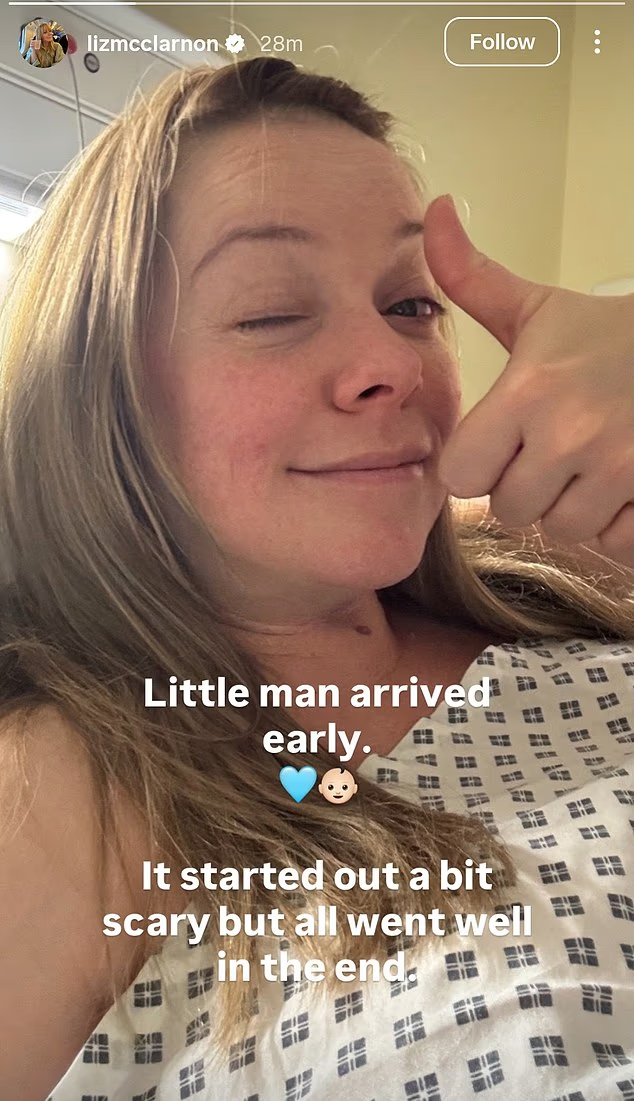
Liz McClarnon has joyfully welcomed her first child — a baby boy — with her husband, Peter Cho, following years of emotional highs and lows on their painful IVF journey.
Liz first revealed her pregnancy in May after what she called “painful IVF and endless hope.” She and Peter, who met four years ago, faced three failed embryo transfers in 2023 and two miscarriages before finally receiving the positive test that changed everything.
“We feel like we’ve been given the world,” she said in an emotional Instagram video, filmed in a quiet park where she revealed her growing bump.
Fans flooded the comments with messages of joy, including well wishes from celebrity friends Natasha Hamilton, Michelle Heaton, and Jo O’Meara.
Liz married Peter in 2023 but kept his identity private until their first wedding anniversary. When she finally revealed his face, followers noted the pure happiness radiating from the pair — a couple who had endured and triumphed together.

Liz McClarnon and Partner Peter Cho
Speaking on Loose Women earlier this year, Liz admitted that hearing her story played back on screen made her emotional:
“It’s strange — when you hear someone else tell it, it almost feels like it happened to another person.”
She revealed she was five months pregnant at the time and had just learned she was expecting a boy.
The road to motherhood wasn’t simple. Liz began IVF treatments after learning that, at over 40, her chances of conceiving naturally were slim. Doctors found fluid around her ovaries but encouraged her to try assisted conception.
Despite setbacks, she persevered — and her story has inspired thousands of women who face similar challenges.
The emotional and legal realities of IVF are deeply intertwined with biology. Fertility expert Professor Geeta Nargund, a leading consultant at St George’s Hospital in London, once urged policymakers to help women better understand their biological clock.
“Ideally, if a woman is ready for a child, she should start trying by the time she is 30… because as a woman gets older, her fertility declines sharply,” she told Sky News.
Her words highlight why fertility law isn’t just a set of regulations — it’s about ensuring access, education, and empowerment. For women like Liz McClarnon, those hard-won rights made the dream of motherhood possible later in life.
For many couples like Liz and Peter, IVF isn’t just a medical journey — it’s a legal one too. What most people don’t realize is that fertility law in the UK governs everything from embryo ownership to age limits and parental rights once treatment begins.
Under the Human Fertilisation and Embryology Act 1990 (as amended in 2008), embryos created during IVF belong jointly to both partners who provided the eggs and sperm. This means no embryo can be used, stored, or destroyed without the written consent of both parties.
If a couple separates, this rule can have life-changing consequences — as seen in past cases where one partner withdrew consent, forcing clinics to legally destroy embryos despite the other’s wishes.
Takeaway: Always review and update your IVF consent forms before every cycle. It protects both your reproductive rights and emotional well-being.
The UK doesn’t have a strict legal age limit, but the NHS typically funds IVF only up to age 42, depending on local clinical commissioning policies. Private clinics can offer treatment later, but must ensure medical safety and informed consent.
The Human Fertilisation and Embryology Authority (HFEA) regulates all UK fertility clinics, ensuring ethical practice and patient protection. Clinics must clearly explain risks, success rates, and legal rights before treatment begins.
By law, donor-conceived children have the right to learn the donor’s identity at age 18. The donor, however, has no parental rights or responsibilities. This legal clarity helps families plan for the future and avoids complex disputes later in life.
Fertility law in 2025 continues to evolve — especially around egg-freezing time limits, single-parent IVF, and same-sex couple rights. New proposals in Parliament could soon extend embryo storage from 10 years to 55 years, giving families more flexibility in building their future.
Practical advice: Before starting IVF, ask your clinic about your legal consent forms, storage rights, and what happens to your embryos in worst-case scenarios. Consider consulting a fertility lawyer — even a one-hour session can prevent years of emotional and legal uncertainty.
Reader takeaway: IVF is not only about science and hope — it’s about legal empowerment. Knowing your rights ensures you stay in control of your body, your family, and your future.
Now home with her newborn, Liz is focusing on recovery and gratitude. “After years of heartbreak,” she wrote, “we finally have our miracle.”
The singer’s story is already sparking renewed conversations about women’s health, fertility access, and the emotional cost of IVF — a reminder that behind every baby photo lies a story of resilience, love, and legal rights that protect that dream.
1. Can women over 40 get IVF treatment on the NHS in the UK?
Yes, but access is limited. Most NHS trusts offer funded IVF up to age 42, though some stop at 40 depending on local policy. After that age, women can still pursue IVF privately if medically suitable. Always check your local NHS Integrated Care Board (ICB) rules before starting treatment.
2. Who legally owns embryos created during IVF in the UK?
Under the Human Fertilisation and Embryology Act, embryos belong jointly to the people who provided the egg and sperm. No clinic can use, store, or destroy them without written consent from both partners — even if they separate. It’s vital to review consent forms before each cycle to avoid future legal complications.
3. What legal rights do IVF parents and donor-conceived children have?
In the UK, donors have no parental rights or financial obligations. Children conceived through donation have the right to request identifying information about their donor when they turn 18. This law helps ensure transparency and protects the rights of all parties involved in assisted reproduction.

