
Understand Your Rights. Solve Your Legal Problems
The Toxic Battle for Ragley Hall: Inside the Earl of Yarmouth’s £1.3 Million Legal Defeat and What It Teaches About Inheritance Law
It’s the price of losing a savage, dynastic war against his own parents, the Marquess and Marchioness of Hertford, over the £85 million family seat, Ragley Hall. But this isn't just a squabble over money; it's a Greek tragedy of betrayal, allegedly sparked by one choice: the 32-year-old heir daring to marry Kelsey Wells—the "Goldman Sachs outsider" his family reportedly couldn't bear.
William Seymour, Lord Yarmouth, dragged his parents to the High Court in a desperate, failed bid to seize control of the 6,000-acre estate. Now, facing ruinous legal costs after the judge slammed the door on his claim, the disgraced Earl is raging against the system. It raises a timeless question: can wealth ever mend a family divided by love and legacy?

The High Court in London has ruled against the Honourable William Francis Seymour, Earl of Yarmouth, in his claim to take control of his family’s £85 million Ragley Hall estate in Warwickshire.
The heir, who married former Goldman Sachs banker Kelsey Wells in 2018, must now pay an estimated £1.3 million in legal costs after the judge dismissed his bid to remove the trustees managing the centuries-old family trust.
According to court filings, the Earl argued that the trustees acted under the influence of his parents, the Marquess and Marchioness of Hertford. But the judge disagreed, concluding that their conduct was proper and that family hostility alone was insufficient to justify removing trustees.
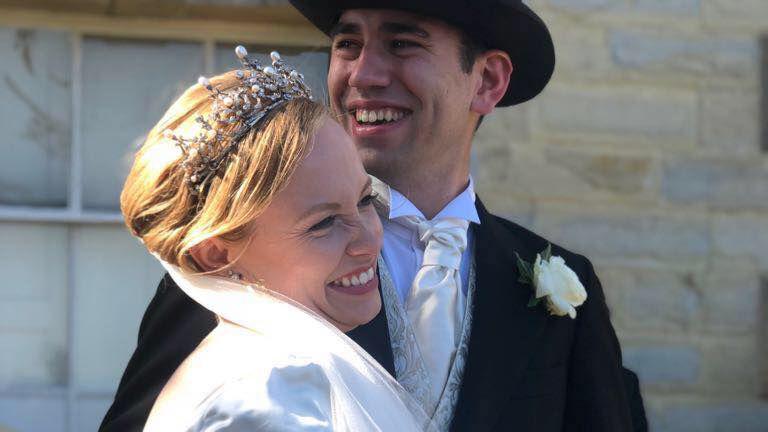
Ragley Hall, a 6,000-acre Palladian mansion long associated with the Seymour lineage and even Henry VIII’s third wife Jane Seymour, has become the epicentre of one of Britain’s most toxic aristocratic feuds.
William Seymour, once viewed as the natural heir to the estate, says his life changed after falling in love with Kelsey Wells—a woman his family reportedly regarded as an “outsider.”
The couple’s 2018 wedding marked not a new beginning, but the start of a deepening divide. In interviews and correspondence shared during the proceedings, Lady Yarmouth described the hurt of being rejected by her in-laws. “It should have been one of the happiest times of my life,” she said. “Instead, it was the most stressful.” The family’s internal disagreements—about inheritance, expectations, and social boundaries—spilled into public view, making Ragley Hall a symbol of how privilege and pain can coexist.
The Earl’s claim—The Honourable William Francis Seymour v Ragley Trust Company Ltd & Ors (2025 EWHC 1099 (Ch))—alleged that the trustees were acting in lockstep with his parents and mismanaging family assets.
He sought their removal and replacement with independent trustees. Master Brightwell of the High Court rejected that argument. In his judgment, he wrote that while the family’s relationship had “broken down irretrievably,” that alone was “not grounds for judicial interference.”
He further criticised Lord Yarmouth’s decision to secretly record conversations with family members, noting that the tapes appeared “to be seeking ammunition for a dispute.” The Earl maintained that he had only wanted fairness and to protect the interests of his children. But the decision leaves him with the enormous costs of litigation and a family still fractured by distrust.
Though it may read like a period-drama, the Ragley Hall dispute highlights a very modern legal question: what happens when family expectations collide with the rigid realities of trust law? Many families—wealthy or not—use trusts to manage property and business assets.
When relationships sour, those trusts can become battlefields. This case underscores a vital lesson: an heir’s belief or “understanding” of inheritance does not override the legal duties written into a trust deed. For ordinary readers, that means if your family holds property or business assets in trust, clarity and documentation matter far more than promises or tradition.
The removal of trustees in England & Wales falls under both the court’s inherent jurisdiction and section 41 of the Trustee Act 1925. Courts will intervene only if:
As London attorney David P. Ring, partner at Taylor & Ring LLP, told Law.com in 2024:
“When family relationships fracture inside a trust, the court’s concern is functionality. Unless the hostility prevents trustees from carrying out their duties, judges are reluctant to step in.” Lessons for Families and Trustees
“In any family trust dispute, emotion often clouds judgment,” notes Tatiana Svetlova, a London-based solicitor. “Courts will always prioritize legal structure over sentiment.”
At the heart of this dispute is not just law, but emotion: a son feeling betrayed, parents fearing loss of control, a wife left feeling unwelcome.
Their story has resonated precisely because it mirrors universal themes—love, inheritance, and belonging. Lady Yarmouth, reflecting on her struggle, once said: “I’m not from their world, and I’m afraid I haven’t found much there to aspire to.” Those words capture the pain of class divides that money cannot mend.
Lord and Lady Yarmouth have indicated they may appeal the ruling. For now, the High Court’s decision cements the trustees’ authority and leaves the couple footing a £1.3 million legal bill.
For the wider public, the case serves as a warning: inheritance disputes rarely have winners. They leave scars that outlast the judgments. As one legal commentator wrote in Wealth Briefing:
“The Ragley Hall case proves that wealth may build walls, but trust law enforces boundaries.”
1. Why did the Earl of Yarmouth lose his £85M inheritance case?
The High Court ruled that Lord Yarmouth’s parents and the trustees managing Ragley Hall had acted lawfully and in the best interests of all beneficiaries. His claim—based mainly on family hostility and alleged bias—was rejected because UK trust law requires clear proof of misconduct or mismanagement, not emotional conflict.
2. What does the Ragley Hall case teach about UK trust law?
The judgment highlights that family promises and expectations have no legal weight unless formally written into the trust deed. Under the Trustee Act 1925, courts remove trustees only when their actions harm the trust or breach fiduciary duties. Hostility, hurt feelings, or perceived unfairness are not enough.
3. Could the Earl appeal or regain any control of Ragley Hall?
Lord and Lady Yarmouth have indicated they may appeal the ruling, but legal experts say overturning a trustee decision is difficult without new evidence of wrongdoing. For now, the trustees retain control of Ragley Hall, and the Earl faces a £1.3 million legal bill—proof that inheritance battles can cost more than they’re worth.
The men who faced down the IRA at Loughgall are now facing a new enemy: their own government.
Forty years after the most decisive SAS victory of the Troubles—an ambush that wiped out an IRA bomb squad—veterans say they have been betrayed by the UK's new legacy reforms. The Labour government’s move, announced by Northern Ireland Secretary Hilary Benn this week, marks a direct reversal of the Conservatives’ 2023 Northern Ireland Troubles (Legacy and Reconciliation) Act, which had promised veterans closure by halting such inquests.
For many of the 300,000 veterans who served under Operation Banner, this feels like a double-blow: they were promised that years of investigations were over, only to face new scrutiny and potential prosecution nearly four decades later. As the disgusted veterans point out, this decision flies in the face of recent assurances from Defence Minister Al Carns that no such inquest would take place.
It is clear that the Northern Ireland Office is calling the shots, leaving the Ministry of Defence—which purports to look after our veterans—powerless or simply uncaring.

A devastating scene unfolded outside the Loughgall police station in 1987 — the aftermath of what became the IRA’s most crushing defeat of The Troubles, brought about by the swift and decisive action of the Special Air Service.
The Loughgall attack remains one of the most dramatic and significant episodes of the Troubles. The plan was one of audacious, murderous intent, hatched by Jim ‘The Executioner’ Lynagh and Padraig McKearney, two of the most psychotic figures within the IRA of the late 80s.
Their orders were clear: the three duty policemen inside the tiny country police station in Loughgall were to be blown to pieces at their desks by a digger carrying a 400lb bomb—a mix of fertiliser and diesel with a high explosive booster. Any officer attempting to escape was to be shot dead.
But the police had received intelligence, and the men of the Special Air Service (SAS) were waiting.
The SAS had secreted 24 men in and around the station, including five in plain clothes hidden inside an upstairs room. When the van carrying the gunmen screeched to a halt and the digger crashed through the gates on the evening of May 8, 1987, the IRA unit, expecting a massacre, instead met a heavily armed force.
One of those SAS men—speaking for the first time, exclusively to the Daily Mail—recalls crawling out of the wreckage alive while still under fire: “It was like Rorke’s Drift with diggers.”
When the noise subsided, the bodies strewn around the wreckage were not the police officers earmarked for slaughter, but eight terrorists, including the two maniacs in charge. The IRA certainly did not win that day; they suffered their gravest defeat in the history of The Troubles.
Forensic tests on the captured weapons showed they had been used to murder more than 50 people. Lynagh, alone, had been linked to more than 30 deaths. The SAS saved many more lives than just the three policemen who survived that evening.

For the soldiers involved, the legal reopening is not about evidence—it's about endurance.
John X, a long-serving SAS veteran in the thick of the action, has never breathed a word to anyone outside ‘the Regiment’ about the events of that evening. Now in his mid-70s, Mr Benn’s decision has goaded this brave old soldier beyond endurance.
He recounts the terror when five IRA guys deployed from the van and opened fire: “There was no chance of saying ‘hands up’... It was heavy fire raking the whole station.” He recalls his comrade, ‘Barry,’ falling back, his face covered in blood after a bullet fragment hit the steel window frames. Then, they were just “blown back against the back wall” when the 400lb bomb detonated, obliterating one half of the building.
After running through the wreckage and neutralizing the remaining gunmen, John and his team returned to barracks for the mandatory debrief. His only reward? Being snubbed by the general commanding British Land Forces, who mistook him for a cleaner.
Back then, John and his mates received free beer in the mess for six months for ridding Northern Ireland of two homicidal monsters. All soldiers complied with a full investigation, and in 1988, the Director of Public Prosecutions ruled there was no evidence to warrant a prosecution. Now, he faces being charged if the coroner decides the deaths were unlawful.
“I’ve lived that night a thousand times,” he reportedly told colleagues. “Now they want to make me relive it in court.”
The decision to hound veterans is made all the more outrageous by the existence of ‘comfort’ letters—secret get-out-of-jail cards issued by the Blair government during the Northern Ireland peace talks to protect around 200 terror suspects from prosecution.
For the veterans, there is still only one set of combatants from The Troubles who can wave these letters: the terrorists.
In a profound ethical failing, the UK government is proceeding with an inquest that threatens soldiers who stopped a massacre, while the Labour government’s new 'Legacy Framework' is being jointly consulted with the Irish government. It did not go unnoticed that while Hilary Benn pledged vague ‘new protections for veterans,’ the Irish deputy PM assured Irish voters there would be ‘no new protections for veterans.’ The old soldiers smell betrayal because the scales of justice are not merely imbalanced; they are broken.
The current fight is not military, but legal. The reopening of the inquest is driven by human-rights law, specifically Article 2 of the European Convention on Human Rights (ECHR), which demands an "effective investigation" into state-involved deaths.
The problem for veterans is that the judge in the inquest will apply human rights law that did not exist at the time of the shooting to an event more than 30 years before.
This creates what critics call the “cosy legal La-La Land” of judges. John X emits an exasperated guffaw when asked why British troops didn't just ask the terrorists to put their hands up: “They’d already opened up first. If I’d tried to say, ‘You’re under arrest’, I’d be dead.”
We know how these new inquests will operate thanks to the recent inquiries into the deaths of IRA terrorists caught red-handed at Coagh in 1991 and Clonoe in 1992.
In both cases, High Court judge Michael Humphreys applied the retrospective law and criticised the SAS operations because they did not “minimise to the greatest extent possible” the need for “lethal force.” He even referred the Clonoe case to prosecutors.
The message is clear: according to this legal standard, the only correct response on being confronted with a man in a balaclava blasting a machine gun in a public place is to risk your life by saying, ‘Halt. You are under arrest.’ This is the impossible standard Loughgall veterans will now face.
For the IRA and their sympathizers, Loughgall remains a stinging humiliation that simply has to be recast as a moral victory. Hence, the endless songs and murals about the ‘Loughgall Martyrs.’
The IRA’s lawyers kept pushing every new interpretation of the Human Rights Act until, in 2015, an Advocate General caved in to demands for a fresh inquest. Even though the European Court of Human Rights ruled in 2001 that the killings were not unlawful (despite procedural flaws in the original investigation), the campaign never stopped.
The current inquest is not about evidence—the soldiers complied with a full investigation in 1987 and there is nothing new. It is about politics and propaganda: repainting the IRA's murderous incompetence as some sort of martyrdom while demonizing the SAS as the bad guys.
On previous form, we can be reasonably sure of a few predictions:
As the Belfast courtroom prepares to hear the echoes of 1987, the question remains: Can a nation truly honor both truth and those who once fought in its name, or will it allow its heroes to be hunted while their enemy walks free with a 'comfort' letter?
Millie Bobby Brown stepped onto the London red carpet for the final Stranger Things premiere, tearful and stunning. But her emotional farewell was shadowed by the very controversy Netflix hoped had been silenced: persistent reports of bullying and a "toxic" environment that plagued the blockbuster show's set.
On November 7, 2025, the 20-year-old star (and new mother) was met with adoration from fans chanting "Thank you, Eleven!" Yet, the warmth of the moment couldn't fully melt the tension. Industry sources confirmed to us that Netflix conducted a "quiet internal review" earlier this year into claims of "unprofessional conduct."
Joined by husband Jake Bongiovi and embraced by co-star David Harbour, Brown's public appearance was a poignant goodbye to a decade-defining role. But as the images went viral, the real story became clear: This isn't just about a TV show ending. It's a sudden, urgent spotlight on the power imbalances and duty of care Hollywood owes its young actors. The controversy has reignited the critical question: Has the industry truly changed, or is the dark side of fame still lurking just out of frame?

For audiences, Stranger Things is nostalgia. For those inside the business, it’s a workplace subject to employment and safety laws. Allegations of bullying or harassment can expose studios to reputational damage and legal risk, forcing them to show proof of action, training, and support systems.
As one of Netflix’s biggest franchises, the series has become a real-world case study in how fame, responsibility, and corporate ethics collide. The handling of this situation could influence how future productions manage accountability in a post-#MeToo industry.
The emotional goodbye between Millie Bobby Brown and David Harbour beneath the flashbulbs was symbolic, but it occurred in a very real workplace. The internal review reportedly conducted by Netflix into allegations of "unprofessional conduct" on the Stranger Things set places the massive production directly under the legal and ethical spotlight.

What the Law Says about the Workplace
Like any other employer, Netflix and the show's producers must navigate complex labor laws. Since much of the filming took place in the US and involved a US-based streaming giant, the production is bound by US state labor and harassment laws, alongside strict SAG-AFTRA union contracts. Had the alleged incidents occurred in the UK (where the final premiere was held), the Equality Act 2010 would protect workers from harassment.
For a show that cast Brown as its lead at the age of twelve, the compliance is even stricter, involving child-performance regulations and a duty to provide a safe environment for minors.
The Industry Reality: A BECTU Warning
The controversy surrounding the alleged set issues echoes warnings from industry leaders like Philippa Childs, head of the broadcasting union BECTU, who cautioned that the creative industries have a “dark under-belly which is driving skilled workers out of the sector and leading to untold misery and exploitation.”
For Brown, who spent her formative years on this set, and for Netflix, which championed the show globally, this means regulators and production companies are facing rising pressure to treat creative sets with the same standards expected in corporate workplaces.
The Stakeholders' Duty of Care
This isn't just internal studio drama. The public nature of the allegations involving one of the world's biggest franchises turns the issue into a case study.
The fate of Eleven may be fantasy, but the responsibility to ensure a safe set for Millie Bobby Brown and her co-stars is real-world accountability.
For Millie Bobby Brown, the final Stranger Things premiere wasn't just a goodbye; it was a tightrope walk. She showcased her transformation from child star to mother—even revealing co-star Noah Schnapp as her baby's godfather—a desperate attempt to prove the cast's bond was stronger than the whispers.
But the sentimental headlines are a smokescreen.
Netflix is frantically promoting the upcoming fifth season as "a defining moment in global television," trying to protect its crown jewel from reputational poison. The series has generated billions in revenue, yet the final chapter arrives amid the ugliest kind of Hollywood scrutiny: not just about the fantasy on screen, but the alleged cruelty behind the camera.
The question isn't whether Stranger Things will be a hit. The real question is: Can Netflix afford the fallout? The studio is now forced to confront a brutal truth—every hug, every viral photo, is instantly scrutinized against reports of toxic conduct. In this post-#MeToo era, fame comes with a price tag of accountability, and the scandal surrounding their biggest franchise may be the most powerful, and damaging, story of all.
Was there an official investigation into bullying claims?
Yes, reports suggest Netflix reviewed internal complaints, though no formal action or lawsuit has been announced.
Can bullying on a film set be unlawful?
Yes. In the UK, serious or discriminatory bullying may breach the Equality Act 2010 or justify constructive-dismissal claims.
How are young actors protected?
Through union rules, licensed chaperones, and strict working-hours limits under child-performance regulations.
What should you do if you face harassment at work?
Record details, raise a formal grievance, and seek confidential advice from an employment-law solicitor or union rep.
When Millie Bobby Brown hugged David Harbour beneath the flashbulbs of Leicester Square, it wasn’t just a photo op — it was the symbolic end of a global story. Behind the supernatural fantasy of Hawkins lies a universal truth: every workplace, even one wrapped in lights and cameras, depends on respect and responsibility.
As the final season of Stranger Things approaches, Brown’s journey — from child star to mother and advocate — mirrors the shift happening across Hollywood. Fame, like any job, now comes with accountability. And for the industry, that may be the most powerful story of all.
Sarah Jessica Parker has long been synonymous with glamour — but her newest venture may put her name in the middle of a very modern legal minefield.
According to Astrea London, the Sex and the City icon has joined the luxury jewellery brand as Global Creative Director and Founding Partner, with her first 12-piece lab-grown diamond collection launching in Dubai this December. It’s a partnership celebrated in HELLO! Magazine’s exclusive feature — a story of elegance, sustainability, and craftsmanship.
Yet behind the soft lighting and sequined optimism lies an overlooked question: can luxury truly be “conflict-free” when global trade laws around synthetic diamonds are tightening by the month?
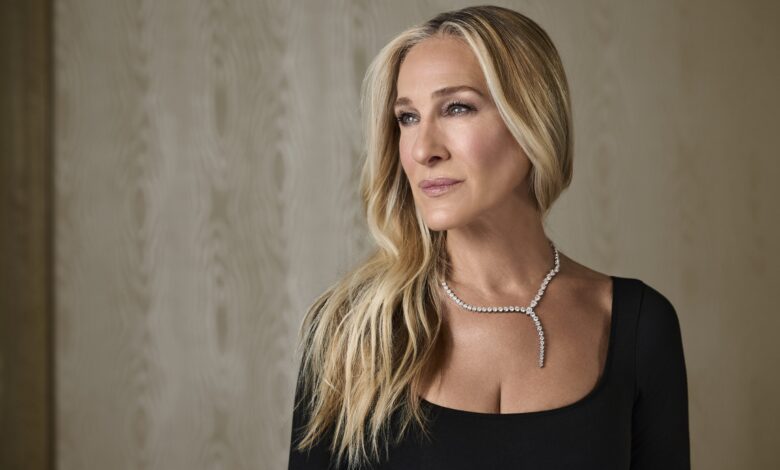
Sarah Jessica Parker joins Astrea London as creative director
The HELLO! interview painted Parker’s new chapter in shimmering tones — her love of imperfection, her passion for sustainability, her quiet generosity. But beneath the surface of that narrative lies a growing legal tension in the jewellery world: the rise of sanctions, origin-tracking obligations, and green-washing enforcement targeting the very sector she’s now joined.
Lab-grown diamonds have been hailed as the ethical alternative to mined stones. They’re identical in composition, cut, and clarity — yet made in a controlled environment rather than extracted from the earth.
But there’s a catch. In 2025, the UK government quietly expanded sanctions to cover synthetic diamonds of Russian origin — even those processed in third countries like India or China. Under the April 24 amendment to the Russia (Sanctions) (EU Exit) Regulations 2019, any stone weighing 0.5 carats or more and traced to Russian inputs can be barred from import into the UK unless its non-Russian provenance is fully documented.
(UK Government Notice to Importers 2953)
That’s where the risk begins — and not just for jewellers.
As a high-profile partner, Parker’s name and reputation are directly tied to the brand’s global compliance. If a single stone within her debut collection were found to have unclear origins, the fallout could extend beyond Astrea London’s showroom — into court filings and headlines.
“Failure to properly screen suppliers and vendors used by a company could lead to repeated dealings with a Specially Designated National (‘SDN’), for example. … This risk underscores the need for companies and their compliance teams to consider frequent screening of suppliers and vendors to mitigate such risks.” — Baker McKenzie
That reputational risk has made “celebrity-as-partner” deals more complex. Contracts now include entire annexes dedicated to origin-tracking warranties, vendor certifications, and force majeure clauses tied to sanctions or ESG breaches.
For Parker — whose brand persona depends on authenticity — the stakes couldn’t be higher.
Industry insiders say the majority of lab-grown diamonds are produced in Asia using energy-intensive methods. According to the Natural Diamond Council, over 70% of synthetic stones come from factories in India and China — both markets deeply intertwined with Russian raw carbon and machinery exports.
So while lab-grown diamonds avoid the traditional mining controversies, they introduce new complications:
Energy sourcing — many factories rely on coal-based grids.
Raw material traceability — the “seed” carbon may come from sanctioned suppliers.
Cross-border certification — stones often pass through multiple jurisdictions before hitting luxury markets.
A failure to document each stage could make “conflict-free” claims misleading — and potentially actionable.
Under UK law, jewellery brands must comply with both sanctions regulations and advertising standards. The Advertising Standards Authority (ASA) ruled in 2024 that Skydiamond’s slogan “diamonds made entirely from the sky” was misleading because it didn’t clearly disclose that the stones were synthetic.
In the United States, the Federal Trade Commission (FTC) enforces similar rules: marketers must describe stones as “lab-grown” or “laboratory-created” and avoid implying that they are mined. (16 CFR Part 23)
Here’s where luxury turns tricky. If a brand markets its lab-grown diamonds as “sustainable” or “carbon-neutral” without quantifiable data, that can be classified as green-washing. According to Bloomberg Law, jewellery houses are now facing heightened FTC scrutiny over “eco-luxury” claims that can’t be scientifically verified.
According to Norton Rose Fulbright “Businesses must also process and absorb dramatically increased corporate transparency from suppliers and be nimble enough to adapt to the constantly changing requirements of cross-border sanctions that can impact global supply chains at any time.”
For consumers, this means simple curiosity isn’t enough. Before buying, ask:
Where was this diamond created and processed?
Is it certified by the Gemological Institute of America (GIA) or International Gemological Institute (IGI)?
Does the brand disclose its energy use or carbon offset documentation?
For brands, these aren’t marketing niceties — they’re legal shields.
Because the global jewellery market is shifting from romance to regulation. The sparkle that once symbolized freedom now requires documentation, data trails, and declarations.
And in a world where sanctions can reach across oceans, even the most dazzling partnership can stumble on the fine print of compliance.
Parker’s collaboration with Astrea London may well succeed — she’s a savvy businesswoman with a reputation for diligence — but the venture illustrates a broader truth about modern luxury: glamour is now audited.
To her credit, Parker isn’t naive about responsibility. During her HELLO! interview, she spoke movingly about Astrea’s decision to reinvest profits into educational programs for children in Africa. “Fashion doesn’t have to be perfect to be beautiful,” she said.
It’s a sentiment that doubles as a warning. In the age of transparency, imperfection must be honest.
Behind every diamond — natural or lab-grown — lies a story of provenance, power, and policy. For consumers, that means buying more consciously; for brands, it means every carat must carry a certificate of truth.
Are lab-grown diamonds affected by sanctions?
Yes — under UK law since April 2025, synthetic diamonds of Russian origin, even when processed elsewhere, can be prohibited from import.
Can a celebrity partner be held liable for supply-chain misrepresentation?
Legally, liability typically rests with the brand, but reputational and contractual damages can extend to partners depending on endorsement agreements.
Is “lab-grown” always sustainable?
Not necessarily. Many factories rely on fossil fuels, meaning sustainability claims must be verified through independent audits.
Could a brand face penalties for misleading eco-claims?
Yes. The ASA and FTC can issue fines, warnings, or public rulings for false or unsubstantiated environmental claims.
Sarah Jessica Parker’s diamond story began as an ode to beauty and reinvention — but it’s fast becoming a case study in how glamour collides with global law.
Her partnership with Astrea London embodies both opportunity and risk: a bold step into sustainable luxury, shadowed by the realities of sanctions, transparency, and compliance.
And perhaps that’s the paradox of modern celebrity enterprise — the brighter the sparkle, the clearer the spotlight. Carrie Bradshaw sought a diamond that meant forever. For Sarah Jessica Parker the businesswoman, her diamonds must now mean compliance.
The cause of death for Charlie Kirk, 31, founder of the conservative youth movement Turning Point USA, has been officially confirmed by Utah authorities. According to state investigators, Kirk died from a gunshot wound to the neck on September 10, 2025, during a campus appearance at Utah Valley University.
He was mid-sentence in front of thousands when a single bullet ended his life. Within hours, the suspect was identified as Tyler Robinson, a 22-year-old former student. And within days, the nation was asking a harder question: Can Erika Kirk—his widow—hold anyone else accountable?
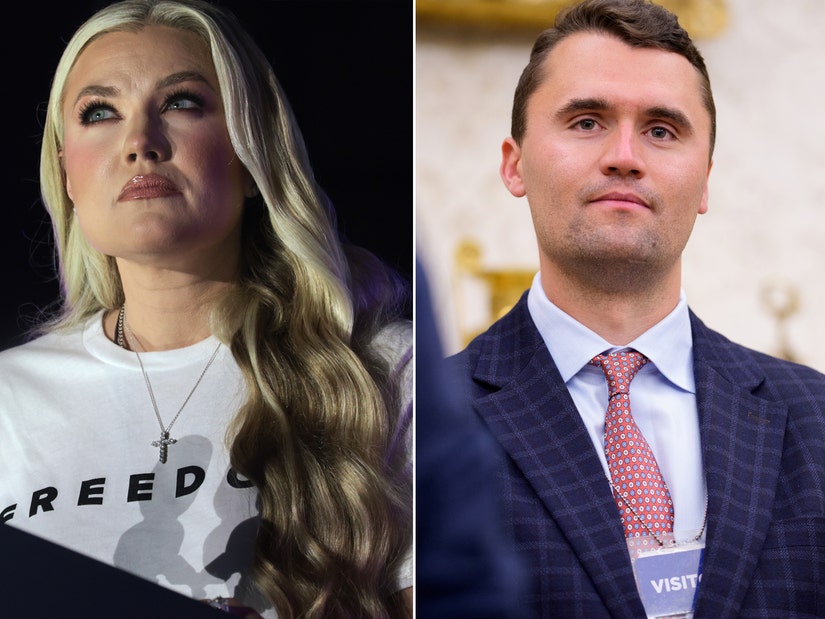
Nearly two months later, Erika Frantzve Kirk spoke publicly for the first time. Appearing on Fox News with Jesse Watters, she described walking into the hospital room and seeing her husband’s still face.
“He had this smirk,” she said through tears. “That smirk said, You thought you could stop what I built. You got my body; you didn’t get my soul.”
The moment became a symbol of defiance for supporters—and the beginning of Erika’s own legal and moral reckoning.
Federal agents soon located the rifle used in the shooting: a German-made Mauser 98, a military bolt-action weapon dating back to the World Wars. Law-enforcement officials told NBC News the gun likely entered the U.S. before 1960s serialization laws—making it effectively untraceable.
Investigators later confirmed the rifle belonged to Robinson’s grandfather and had been re-barreled to fire modern .30-06 rounds. Former ATF official Scott Sweetow called it a chilling precedent:
“Short of presidential-level protection, there’s no way to defend against the threat posed by these rifles.”
For prosecutors, that heirloom opened a crucial question: if a family passes down a deadly weapon, can they be held civilly liable when it’s used in a crime?
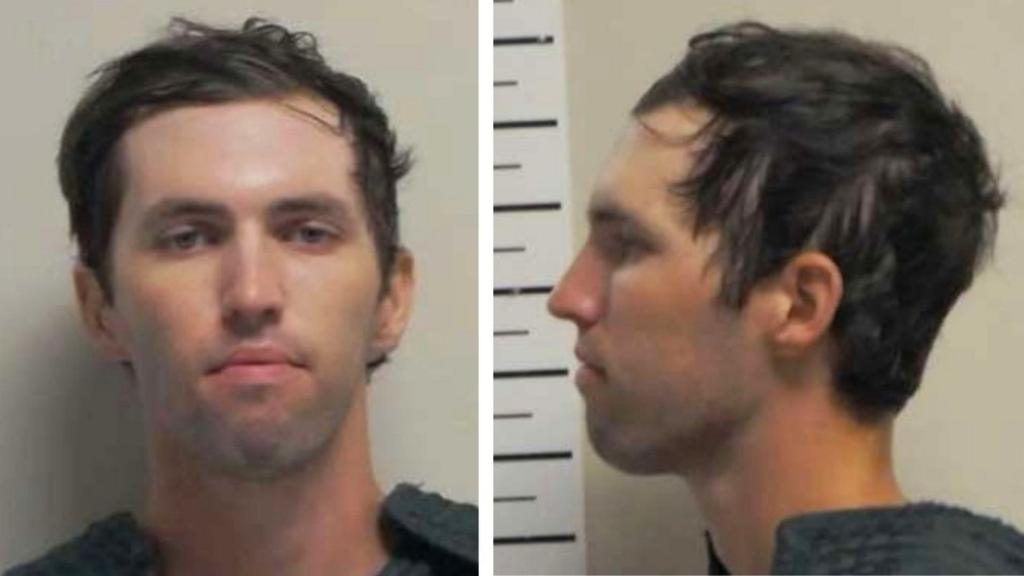
Suspected killer Tyler Robinson remains in custody following a 33-hour manhunt that ended when his father convinced him to surrender
Robinson’s parents recognized him in FBI surveillance footage and persuaded him to surrender on September 11. The father, Matt Robinson, drove his son to authorities—an act that may have prevented further violence but also drew attention to how that same household stored a century-old firearm.
At 18, Charlie Kirk co-founded Turning Point USA; by 2023 the nonprofit was valued at more than $80 million and employed nearly 500 people. His personal fortune—estimated at $12 million by PennLive—included:
A $4.75 million desert estate near Phoenix
A Florida Gulf Coast condominium
A secondary Arizona apartment used for podcast recording
Those assets now pass to Erika Kirk and the couple’s two young children, ages 3 and 1. But wealth has not shielded the widow from grief—or the possibility of a prolonged civil battle.
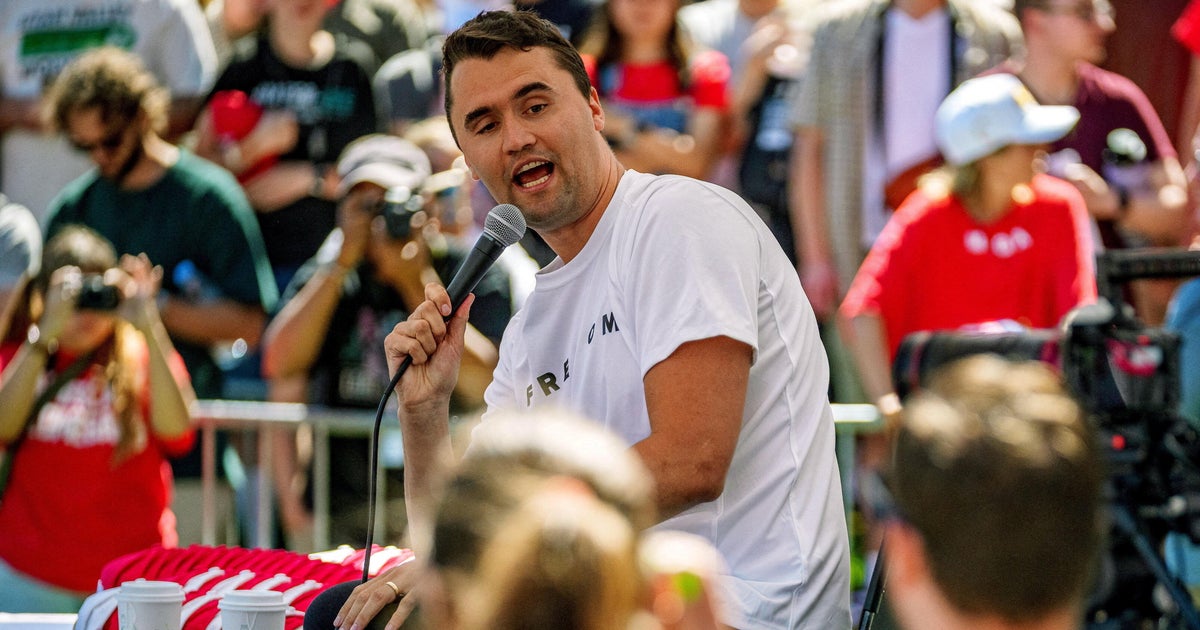
Charlie Kirk, a conservative activist and co-founder of Turning Point USA, died Wednesday 10 September 2025 after he was shot at an event at Utah Valley University.
Yes. Under Utah’s wrongful-death statute, a surviving spouse may sue anyone whose intentional or negligent act causes a death. A civil action is separate from criminal prosecution, meaning Erika can pursue damages while the criminal case proceeds.
“In Utah, when a person’s death results from the wrongful act or neglect of another, the Wrongful Death Act allows a surviving spouse, children or parents to bring a civil claim independently of any criminal proceedings.”
— Kenneth L. Christensen, Founding Partner at Christensen & Hymas, a Salt Lake City personal-injury law firm.
Such a lawsuit would allow the Kirk family to recover losses for income, companionship, and punitive damages. Even if the shooter lacks assets, the verdict itself would become a lasting legal acknowledgment of harm.
If Tyler Robinson possessed property or dies in custody, Erika could file a claim against his estate. But the more complex—and consequential—question involves his relatives.
Civil attorneys point to negligent entrustment, a doctrine holding gun owners liable if they knowingly allow access to a dangerous weapon. If investigators prove the Mauser rifle was left unsecured or that relatives ignored warning signs, the family could face a lawsuit.
Recent precedents strengthen this path:
In 2024, the parents of Michigan school shooter Ethan Crumbley were convicted of involuntary manslaughter for failing to secure a firearm.
Families from Parkland and Sandy Hook obtained multimillion-dollar settlements from manufacturers and guardians for ignoring clear risks.
“Victims’ families often underestimate how powerful a civil claim can be,” notes Erin Murphy, partner at Cahill Gordon & Reindel LLP, in a 2024 Reuters interview on wrongful-death suits. “Even when the defendant is in prison, the judgment itself restores agency to the survivors.”
(Sources: Reuters 2024; Law.com 2024)
Filing the Complaint – The plaintiff (Erika Kirk) submits a civil claim in Utah state court within two years of the death.
Discovery Phase – Both sides exchange evidence: police reports, gun-storage records, digital communications.
Liability Theories – Intentional act (murder), negligent entrustment (unsafe firearm), or vicarious negligence (family inaction).
Damages – Lost income, emotional suffering, punitive awards for reckless disregard.
Enforcement – Judgments can attach to property, trust funds, or even future wages.
For readers, this framework mirrors how any family could seek justice after a violent crime—illustrating that civil court often becomes the final arena for moral accountability.
Within hours of the killing, donors including Bill Ackman, Robby Starbuck, and Alex Bruesewitz pooled over $1.15 million in reward money for information leading to the suspect’s arrest.
When news broke that the tip came from Robinson’s own father, the public asked: Should he get paid for turning in his son?
Under the U.S. State Department’s Rewards for Justice program, an individual cannot nominate themselves; the FBI must do so, and the Secretary of State has complete discretion to approve or deny payment.
Ackman wrote on social media that he would honor the pledge “if it is earned,” but warned:
“If the father was involved or acted negligently, civil litigation or criminal prosecution will reverse any unjust compensation.”
Commentators urged the Robinson family to decline the money and direct it to the Kirk family fund instead. If Erika later files a civil suit, any reward paid to the shooter’s relatives could be frozen or seized to satisfy a judgment.
Each year, roughly 15,000 Americans file wrongful-death or negligence suits after violent crimes, according to the ABA Journal. Most recover little financially—but many describe the process as an essential form of closure.
For widows like Erika Kirk, the choice to sue isn’t only about damages. It’s about writing the legal final chapter of a story that began with violence. In civil court, she can force testimony, expose negligence, and establish accountability that outlives the criminal sentence.
Charlie Kirk’s assassination lies at the crossroads of two national crises—political polarization and unregulated vintage firearms. Millions of pre-1960s rifles, never serialized or registered, remain in private homes.
If the Kirk case triggers even one new precedent on negligent gun storage, it could redefine how courts balance heritage with responsibility. As one Reuters firearms analyst noted, “When a family heirloom becomes an assassin’s weapon, the law must decide where tradition ends and duty begins.”
Since her husband’s death, Erika Kirk has leaned on faith and activism.
“There is no linear blueprint for grief,” she wrote on Instagram. “Love doesn’t ask to be healed—it asks to be remembered.”
She now leads Turning Point USA as CEO, raising two children while navigating national attention. Legal insiders expect any civil action to follow the shooter’s criminal trial in 2026. If evidence confirms that the rifle’s storage violated safety norms, a wrongful-death suit against the Robinson family appears likely.
“They got my husband’s body,” Erika said in her first public address, “but they didn’t get his soul.”
Charlie Kirk’s death began with a single heirloom rifle and has evolved into a debate about justice, family responsibility, and the meaning of faith under fire.
For Erika Kirk, the path forward may weave through both courtroom and conscience. Whether she sues or forgives, her decision will echo beyond one family—testing how far the law can reach when tragedy begins at home.
Can Erika Kirk sue the shooter while he is already facing a criminal trial?
Answer: Yes. A civil wrongful-death lawsuit (seeking financial damages and acknowledgment of harm) is completely separate from the criminal prosecution (focused on punishment). She can pursue a claim regardless of the criminal trial outcome or the shooter's current status.
What is the legal basis for suing the shooter's family over the gun?
Answer: The primary legal theory is negligent entrustment. This doctrine holds a gun owner liable if they failed to secure the weapon, or knowingly allowed a potentially dangerous person access to it. If the century-old Mauser rifle was left unsecured, the family could face a lawsuit.
Will the shooter's father receive the $1 million reward money for turning in his son?
Answer: The decision rests with the FBI and State Department. While the father provided the tip, donors have warned that if the family receives the money, it could be subject to legal challenge or seizure if Erika Kirk wins a future civil judgment against them.
On Wednesday, prosecutors told jurors to “buckle up for a wild ride” before unveiling one of the most disturbing murder cases Nevada has seen in years — the alleged beheading of a father by his ex-porn star girlfriend.
According to prosecutors, 47-year-old Devyn Michaels, a former adult-film actress once known as Nikki Fairchild and Tracee Taverz, beat and decapitated 46-year-old Johnathan Willette, the father of her two children — all so she could build a “future” with his adult son from another relationship.
The murder trial of Devyn Michaels began this week in Clark County District Court, where jurors were told they’d be hearing a “lurid, twisted, and deeply personal” story of obsession, betrayal, and brutality inside Willette’s Henderson home in August 2023.
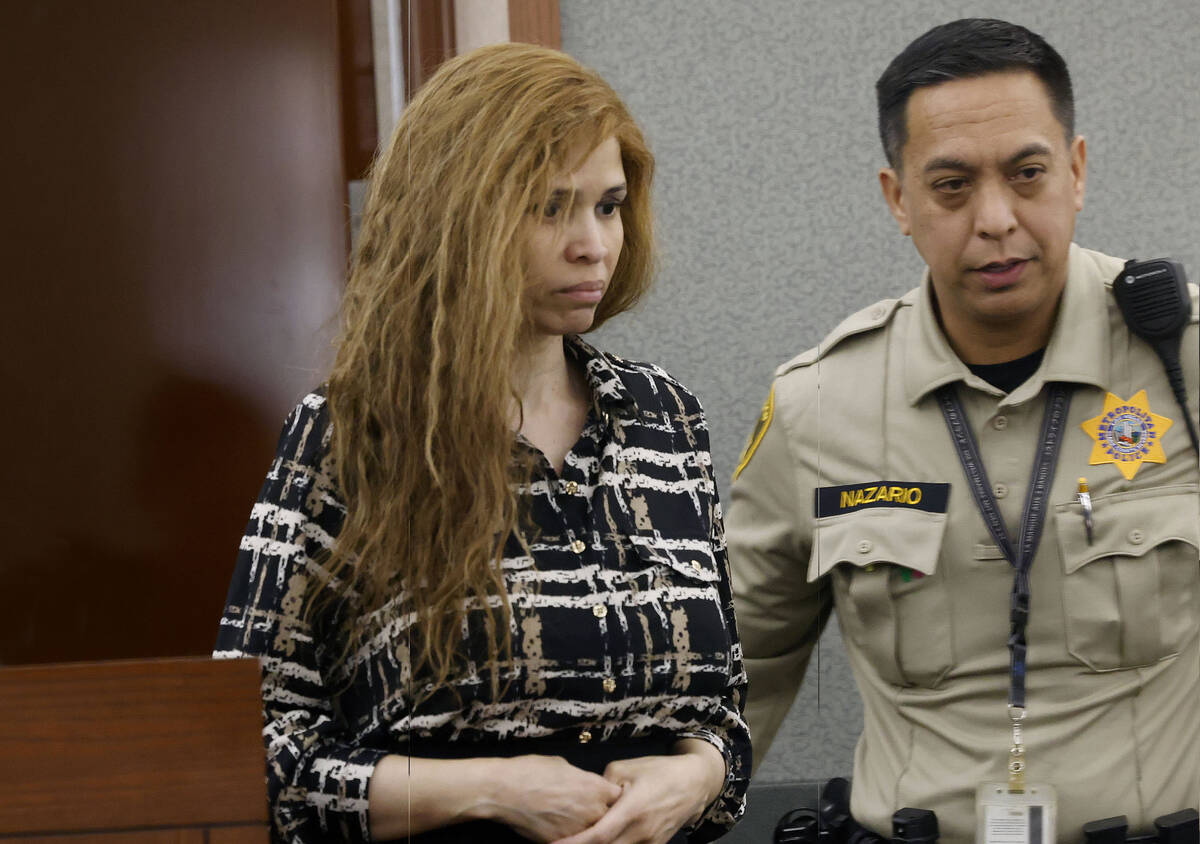
Chief Deputy District Attorney John Giordani painted a chilling picture of motive and manipulation, warning jurors that the evidence would expose “a nightmare that began as a love story.” He said Michaels wanted a life with Willette’s 29-year-old son, Deviere, whom she had secretly married — and that the only obstacle was Johnathan himself.
“This is the future that she saw and that she wanted,” Giordani told the jury. “And the only way to have that future was with John out of the picture.”
For investigators, the motive — tangled between lust, jealousy, and family betrayal — pushed this from a domestic dispute into a psychological labyrinth. Prosecutors allege Michaels plotted the killing after learning that Willette planned to reconcile with her but move his son out of their shared home.
On August 7, 2023, police responding to a welfare call in Henderson, Nevada, made a horrifying discovery. Willette’s headless body lay wrapped in a sheet on his bed. His head and the suspected murder weapon were missing. Investigators say chemicals had been poured over his body in an apparent attempt to destroy evidence.
Detectives later concluded that Michaels likely took the severed head to her home in Las Vegas and disposed of it in a trash bin later collected by a waste service. The head and weapon were never found.
According to testimony reported by KLAS-TV, the scene showed no signs of forced entry — suggesting Willette may have let his killer inside. “This wasn’t random,” Giordani told the court. “It was personal.”
Michaels initially pleaded guilty to second-degree murder in a 2024 plea deal that would have given her 15 years in prison with parole eligibility. But she abruptly withdrew the plea last July, claiming she could prove her innocence — a move that now leaves her facing first-degree murder and a possible life sentence.
Defense attorney Robert Draskovich told jurors the wrong person was on trial, claiming Deviere Willette had motive and opportunity. He alleged the son “hated his father,” was about to lose his home, and had the technical know-how — as a home-security installer — to avoid leaving digital traces.
Deviere, testifying on Thursday, denied any involvement. When asked directly by prosecutors if he killed his father, he responded firmly: “No, sir.”
The trial is expected to continue for several weeks, with jurors hearing forensic evidence, cellphone data, and testimony from family members. Prosecutors are expected to present graphic photos of the crime scene and chemical traces linking Michaels to the killing.
If convicted of first-degree murder, Michaels faces life imprisonment without the possibility of parole. If found not guilty, prosecutors could still pursue related charges, and Willette’s family may seek civil damages.
What the law says:
Under Nevada Revised Statutes §200.030, first-degree murder applies to intentional, premeditated killings or those committed during certain felonies. Second-degree covers intentional killings without premeditation.
Why this matters:
By withdrawing her plea, Michaels forfeited the protection of her 15-year sentence. Now she faces a potential life term. Judges only allow plea withdrawals if the defendant can show good cause — typically coercion, misunderstanding, or ineffective legal counsel.
Expert insight:
“When a defendant withdraws a plea in a murder case, it’s a gamble,” said Michael Pariente, managing partner of Pariente Law Firm in Las Vegas, in an interview with the Las Vegas Review-Journal. “You regain the chance to prove innocence, but prosecutors can seek life without parole.”
Plain-English takeaway:
A plea withdrawal reopens the full range of original charges.
Missing physical evidence (like the head or weapon) doesn’t prevent conviction if circumstantial evidence — DNA, messages, motive — is overwhelming.
In Nevada, first-degree murder carries a mandatory life sentence if the act is proven premeditated.
Behind the gruesome headlines is a shattered family: a father dead, two young daughters traumatized, and a son forever linked to both victim and accused.
For prosecutors, the case tests the limits of proving murder without key physical evidence. For the public, it’s a chilling reminder of how love, jealousy, and control can twist into something deadly. As the jury weighs its verdict, the story of Devyn Michaels stands as one of the most disturbing — and legally consequential — murder trials Nevada has seen in years.
A Massachusetts man has been sentenced to life in prison without parole for the brutal murder of his ex-girlfriend.
Bruce Maiben, 48, was convicted of first-degree murder on November 3, 2025, for killing 40-year-old Sherell Pringle, a mother from Woburn who was found dead in Rumney Marsh Reservation in Saugus two days after she went missing on December 19, 2021.
:max_bytes(150000):strip_icc():focal(749x0:751x2):format(webp)/sherell-pringle-1-110725-9cb88ce4857a4ae19d7ec5b24dab0ec6.jpg)
Sherell Pringle - Woburn Police Department
“She had been stabbed more than 217 times,” Boston 25 News reported — a level of violence prosecutors said showed extreme atrocity or cruelty under Massachusetts law.
“This verdict and sentence ensure the defendant will be held accountable for his senseless and atrocious conduct,” said Essex County District Attorney Paul F. Tucker. “We hope the family and friends of Sherell Pringle can find some comfort in this outcome.”
Court records show Pringle texted a friend shortly before her death, saying she was “done with [Maiben]” after he had illegally entered her home and threatened her with a knife, according to Boston.com.
:max_bytes(150000):strip_icc():focal(497x0:499x2):format(webp)/Bruce-Maiben-110725-43fae599b9364887bab3ab33bc381fad.jpg)
Bruce Maiben - Woburn Police Department
Those who knew Sherell described her as ambitious, joyful, and devoted to her teenage son. She loved traveling, shopping, and photography — and had just placed an offer on a new home that was approved days after her death.
At sentencing, her mother, Pearl Garner, faced Maiben in court. “You’re scum,” she said. “I hope you rot in hell for what you did. You don’t deserve to be walking here.”
Garner said her daughter’s funeral had to be closed-casket because of the brutality of the attack — an image no mother should ever have to endure.
Under Massachusetts law, first-degree murder carries an automatic life sentence without the possibility of parole. The charge applies to killings that are premeditated or committed with extreme atrocity or cruelty (Mass. Gen. Laws c. 265, § 1).
Criminal attorney Brad Bailey, a former federal prosecutor, explains:
“In Massachusetts, first-degree murder involves deliberate intent or extreme cruelty. A conviction guarantees life in prison with no chance of parole.”
— Brad Bailey Law, 2024
For Pringle’s family, the sentence represents accountability — but not closure. Her teenage son must now grow up without his mother, while loved ones continue to speak out about the warning signs of intimate-partner violence.
Advocates warn that the moment a victim decides to leave an abuser is often the most dangerous time. Pringle’s final text — “done with him” — tragically echoed that pattern.
If you or someone you know is experiencing threats or violence, call the National Domestic Violence Hotline at 1-800-799-SAFE (7233) or Massachusetts SafeLink at 1-877-785-2020 for confidential support.
Domestic violence experts say early intervention — reporting stalking, threats, or unlawful entry — can be the difference between safety and tragedy.
Sherell Pringle’s murder is more than a court case — it’s the violent silencing of a woman trying to reclaim her life. Justice may have been served, but peace remains elusive for those she left behind.
Her story stands as a warning about how control can turn to rage and as a plea for awareness. Before the law steps in, there’s a chance to stop the next tragedy — to listen, to believe, and to act.
Mark Sanchez has been fired by Fox Sports following his arrest over a stabbing incident in Indianapolis. The network confirmed his departure on November 7, 2025, telling The New York Post, “Mark Sanchez is no longer with the network. There will be no further comment at this time.”
The former New York Jets quarterback, 38, was hospitalized and later charged with felony battery and three misdemeanors after an altercation outside a downtown Indianapolis hotel in early October. According to police, Sanchez—who was in town to cover a Raiders-Colts game—was allegedly the aggressor in a fight with Perry Tole, a 69-year-old truck driver who ended up stabbing Sanchez in self-defence.
Court records show that on October 4, Sanchez confronted Tole, who had parked his truck in an alley near the hotel. Witnesses told police that Sanchez appeared intoxicated and “was acting erratically.” Tole claimed he was frightened for his life and used pepper spray before Sanchez allegedly lunged at him, leading the driver to stab the former NFL star several times.
Both men were hospitalized. Weeks later, prosecutors upgraded Sanchez’s charges to Level 5 felony battery, citing the seriousness of Tole’s injuries. In a statement, Marion County Prosecutor Ryan Mears called the confrontation “an avoidable tragedy,” saying, “What began as a disagreement should never have escalated into violence.”
Tole has since filed a civil lawsuit against Sanchez, claiming permanent disfigurement.
REATED STORIES: Marshawn Kneeland Texted Family Goodbye, Dispatch Audio Reveals
Once celebrated for leading the Jets to consecutive AFC Championship appearances, Sanchez transitioned smoothly into broadcasting after his playing career, joining Fox Sports in 2021. The news of his firing shocked colleagues and fans who had come to see him as a rising on-air talent.
“It’s been a long month for Mark as he continues to recover from serious injuries while grieving the loss of a close friend,” his brother, Nick Sanchez, said in a family statement. “While the recent news—and its timing—is understandably disappointing, our priority remains his continued healing and recovery.”
For many who followed Sanchez’s career, this moment feels like a dramatic fall from grace—a reminder that fame can unravel overnight.
Under Indiana Code § 35-42-2-1, a Level 5 felony battery applies when someone “knowingly or intentionally causes serious bodily injury” to another. It carries a potential one-to-six-year prison sentence and up to a $10,000 fine.
Attorney David P. Ring, partner at Taylor & Ring LLP, explained in Law.com that, “When multiple people are hurt in a violent altercation, investigators focus less on who suffered the worst injury and more on who initiated the threat. The initial aggressor can still face felony liability even if they were later harmed.”
That distinction will likely define the Sanchez case. Prosecutors argue that his actions instigated the confrontation, meaning self-defence may not apply—while Tole’s claim hinges on whether his response was proportionate to the threat.
For everyday readers, the takeaway is simple: being injured doesn’t automatically make you the victim. Indiana law emphasizes intent, initiation, and proportional response. If you start a fight and someone gets seriously hurt, felony charges can still follow—even if you’re the one hospitalized.
Sanchez’s preliminary hearing is scheduled for later this month. If convicted, he could face prison time, probation, or mandatory counseling. Meanwhile, Perry Tole’s civil suit seeks damages for medical costs and emotional trauma.
Regardless of the outcome, the incident underscores a broader truth: in moments of anger, even brief lapses in judgment can lead to irreversible consequences—legal, professional, and deeply personal.
“Under Indiana’s battery statutes, causing ‘serious bodily injury’ can escalate a case into a Level 5 felony – meaning the mere fact of being wounded doesn’t negate potential criminal liability if you instigated the altercation,” says Sean Hessler, founding partner of Hessler Law LLP, an Indianapolis-based criminal defence firm.
Q: Can someone face felony charges if they were also injured?
A: Yes. Indiana law focuses on intent and initiation, not who ended up hurt.
Q: What penalties apply to a Level 5 battery conviction?
A: One to six years in prison and fines up to $10,000.
Q: Does self-defence protect the truck driver?
A: Possibly. If prosecutors find Tole acted reasonably to prevent harm, his actions may be justified.
For Mark Sanchez, the consequences extend far beyond the courtroom. A once-bright broadcasting career has been cut short, leaving a cautionary tale about impulse, accountability, and the cost of a single volatile encounter. As his case moves forward, it will test not only Indiana’s self-defence laws but also public forgiveness in an era where personal conduct and professional reputation are more intertwined than ever.
A Los Angeles judge has officially granted actress Denise Richards a five-year restraining order against her ex-husband, Aaron Phypers, following months of disturbing domestic violence allegations.
The ruling, issued on November 7, 2025, prohibits Phypers, 53, from contacting or harassing Richards, 54, and from possessing firearms. The order will remain in effect until November 7, 2030 and includes provisions preventing him from sharing private images or speaking publicly about his ex-wife.
Richards, known for her roles in Wild Things and The Real Housewives of Beverly Hills, first sought a temporary restraining order in July, just days after Phypers filed for divorce. In court testimony, she described a series of violent incidents spanning several years of their six-year marriage — including claims that Phypers had “caused me at least three concussions.”
She recalled one alleged attack in January 2022 that left her with a black eye and another at his California wellness center, where he “slammed me up against the concrete wall.” The most recent alleged assault took place in April 2025 at a Chicago hotel, when, according to Richards, Phypers “was squeezing my head so hard, it felt like he was crushing my skull.”
“He’s almost killed me so many damn times,” Richards told the court, visibly emotional as she detailed the repeated violence and control she says she endured.
Phypers has denied every allegation, calling Richards’ testimony “made up” and claiming that she exaggerated events. He has not been charged with a crime, but the civil restraining order severely limits his actions and contact with her.
Under the court’s decision, Phypers must return Richards’ laptop, delete videos of her medical procedures from all devices, and refrain from releasing any private photos or information to the media. The order also explicitly allows Richards to record any communications between them — a measure designed to ensure her safety.
For Richards, the ruling represents a legal and emotional turning point after years of silence. For many readers, it’s a stark reminder that domestic violence can affect anyone, regardless of fame or fortune.
In California, a Domestic Violence Restraining Order (DVRO) allows victims to seek protection from a spouse, partner, or former partner who has threatened, harassed, or abused them. It can prohibit contact, mandate the surrender of firearms, and even grant temporary control of shared property or custody.
According to the California Courts Self-Help Center, “abuse” doesn’t just mean physical harm — it can include verbal, emotional, or digital harassment that “disturbs the peace” of another person. A judge can grant a temporary order within days and, after a hearing, extend it for up to five years.
Violating a DVRO is a criminal offense in California and can lead to arrest or jail time.
How long can a restraining order last in California?
Up to five years — and it can be renewed before it expires.
Does a restraining order mean someone is guilty of a crime?
No. It’s a civil protection measure, but violating it can lead to criminal charges.
Can restraining orders include digital privacy clauses?
Yes. Courts can restrict sharing of private images or data, as seen in Richards’ case.
The body of Marshawn Kneeland, 24, was discovered early Thursday, November 6, 2025, in Frisco, Texas, from what authorities described as a self-inflicted gunshot wound. Just hours earlier, the Dallas Cowboys defensive end had led police on a late-night chase through North Texas — fleeing into darkness after reportedly sending his family a haunting final message: “goodbye.”
According to the Texas Department of Public Safety, the pursuit ended in tragedy, but the question lingers: what pushed a young athlete, fresh off the biggest moment of his career, to the edge? Police dispatch recordings obtained by PEOPLE reveal that Kneeland’s girlfriend warned officers he was armed, distraught, and “may end it all.” Only days before, the Michigan-born player had celebrated his first NFL touchdown — a dream realized, now forever shadowed by its devastating aftermath.
At approximately 10:33 p.m. on November 5, Texas DPS troopers attempted to pull Kneeland over for a traffic violation in Addison, north of Dallas. Instead, he fled, prompting a pursuit that was later called off when troopers lost sight of his vehicle.
At 1:31 a.m. Thursday, his car was found crashed on the Dallas Parkway, just minutes from the Cowboys’ headquarters in Frisco. His body was discovered nearby, along with a firearm.
Dispatch audio later revealed the chilling timeline:
“They just received a text from him, a group text from him saying goodbye,” an officer said. “They’re concerned for his welfare.”
Within minutes, the NFL, Cowboys staff, and local police agencies were in communication, aware that one of their players was in crisis — but by the time they arrived, it was too late.
Kneeland’s story resonates far beyond football. It highlights the silent epidemic of mental health crises in professional sports, where players are celebrated for strength but often unsupported in vulnerability.
His teammates, including quarterback Dak Prescott, shared messages of grief and disbelief online. “I hurt for his family,” Prescott wrote, adding that the locker room felt “broken.”
For many readers, this moment lands personally. It reminds us that even visible success can conceal invisible suffering. Behind the highlight reels are human beings — sons, partners, teammates — whose struggles often go unseen until they become irreversible.
Born in Grand Rapids, Michigan, in 2001, Kneeland’s path from Western Michigan University to the Dallas Cowboys was the culmination of a childhood dream. His mother, Wendy Kneeland, had nurtured that dream until her sudden death in February 2024 — less than two years before his own.
“She helped me a lot in my younger years getting into football,” he told The Dallas Morning News last year. “I always told her, ‘I’m going to the NFL,’ and I made it.” After her passing, he wore her ashes in a necklace during every game.
The emotional weight of grief, fame, and pressure to perform now appears to have collided in his final days. The contrast is haunting: a national television touchdown on Monday Night Football, followed by a frantic police chase and a desperate text to his loved ones by Wednesday night.
Under U.S. employment law, a “duty of care” means organizations must take reasonable steps to prevent foreseeable harm. In sports, that now includes mental health support, not just physical safety.
Police follow state pursuit and wellness-check rules. In Texas, officers can end a chase if risks outweigh benefits or issue an emergency detention order when someone is suicidal or armed.
When mental health crises cross into law enforcement, the fallout can be deadly. Families can request wellness checks, but response quality varies — and employers risk negligence claims if they ignore warning signs.
Investigations by the Frisco Police Department and Texas DPS are ongoing. The Cowboys are expected to conduct an internal review, while the NFL faces renewed scrutiny over mental health programs for players under 30.
More broadly, Kneeland’s death underscores the urgent need for mental health literacy within high-pressure industries. It also raises questions about firearm access, confidentiality between agents and teams, and how crisis communication unfolds when fame magnifies the stakes.
In the end, Marshawn Kneeland’s life is not just a story of lost potential — it’s a legal and human mirror reflecting how fragile success can be.
His legacy, short as it was, might help shift how teams, police, and society respond to those silent cries for help that too often go unanswered.
Marshawn Kneeland (July 8, 2001 – November 5, 2025) was a Dallas Cowboys defensive end whose rapid rise in the NFL ended in heartbreaking tragedy.
Born in Grand Rapids, Michigan, he built his reputation at Western Michigan University, earning Second-Team All-MAC honors before being drafted 56th overall by the Cowboys in 2024. Teammates described him as focused, humble, and relentless — a player who turned quiet determination into impact on the field.
Kneeland’s first season was cut short by injury, but he fought back to become a breakout prospect in 2025. His defining moment came just two days before his death, when he recovered a blocked punt for his first NFL touchdown, celebrating a dream realized.
Behind that triumph, however, was the silent weight of loss and pressure. Following the death of his mother in 2024, he carried her ashes in a necklace during every game — a small act that spoke volumes about loyalty, faith, and grief.
Kneeland’s brief career spanned 18 games, but his story endures as a reminder that even the strongest athletes can struggle beneath the expectations of fame and the absence of support.
What legal responsibility do sports teams have for players’ mental health?
Under employment law, teams must provide reasonable support and safe working conditions, which now increasingly include access to mental health resources and counseling.
Can law enforcement stop a chase if the suspect is suicidal?
Yes. Most U.S. states, including Texas, allow officers to terminate pursuits if risks to life outweigh the objective. They can instead initiate a wellness check or emergency detention.
What rights do families have when someone is in a mental health crisis?
Families may request police wellness checks, emergency protective orders, or firearm removal under state mental health statutes.
Could the Cowboys or NFL face liability?
Unlikely unless evidence shows clear negligence. However, this case may prompt policy reviews and reforms across professional sports leagues.
