
Understand Your Rights. Solve Your Legal Problems
Ed Sheeran has detonated a storm in one of Britain’s most tightly protected coastal villages after quietly snapping up two 19th-century seaside cottages and moving to fuse them into a single mega-home—an upgrade that residents warn could permanently alter the character of the Suffolk conservation zone he has now set his sights on.
The 34-year-old singer purchased the adjoining three-bedroom cottages for £1.95 million, adding them to a coastline that has become one of the UK’s fastest-rising property hotspots. The street, lined with Victorian cottages and narrow lanes, sits inside the Suffolk Coastal Conservation Area, where heritage rules restrict almost every visible change.

The father-of-two also owns a substantial Suffolk estate, often referred to locally as “Sheeranville,” equipped with a private pub, treehouse, swimming pool, underground music room and a 35ft by 20ft cinema screen.
East Suffolk Council confirmed that Sheeran applied for a certificate of lawful development rather than full planning permission, allowing him to remove the party wall between the two cottages and create a larger four-bedroom coastal home. Because the buildings are unlisted and the renovation focuses on the interior, officials ruled the work was legally permitted.
Local reactions were immediate and sharp. One resident described the move as “a loss the village can’t afford,” while another said that in a community with fewer than 340 households, “every small home matters.” Several argued the Suffolk coast has already reached a tipping point, where celebrity-driven redevelopment is pushing traditional families out.
Sheeran’s plans sit in a narrow pocket of UK planning law where conservation rules and permitted development rights overlap. Because the cottages’ exterior appearance remains untouched—and the properties are not listed—East Suffolk Council had limited scope to refuse the internal reconfiguration.
To explain the wider pattern, former RIBA President Ben Derbyshire commented earlier this year when discussing similar disputes along Britain’s coastlines:
“We need more homes of all types in the right places, and that means being honest about what local communities can support without losing their character.”
Council officers leaned heavily on national housing guidance, noting the borough is currently exceeding its housing-delivery targets. In their report, they argued the loss of one dwelling “does not materially affect overall supply.”

Sheeran’s planning submission outlines his intention to remove the wall between the two cottages, effectively combining them into a single, larger four-bedroom home.
The parish council initially objected, raising concerns about lost privacy for neighbouring homes once the new interior design and window angles are in place. Councillors pushed for frosted or obscured glazing on specific elevations—conditions ultimately included when the approval was granted.
In a conservation village where homes sit side-by-side, residents say even subtle changes can affect light, noise and sightlines.
👉 Inside the Celebrity Property Feuds Reshaping Britain’s Planning Laws 👈
Beyond Sheeran’s application, villagers say the larger problem is the gradual erosion of modest coastal homes. One resident pointed to another nearby three-bedroom house currently being replaced with a five-bedroom property, describing the trend as “death by a thousand extensions.”
More than 60% of locals say they want to protect and increase the stock of smaller family homes. Many fear that rising celebrity interest—and the oversized coastal homes that follow—will eventually push younger residents and local families out.
The Suffolk-born musician already owns a sprawling rural estate known informally as “Sheeranville,” featuring a pub, swimming pool, underground music room, treehouse and a 35-foot private cinema.
Across the UK, Sheeran now owns around 27 properties worth roughly £70 million, including several homes in Chiswick, flats in Covent Garden and a fisherman’s cottage in Dungeness, Kent.
Earlier this year, he bought a £9 million home in New York, though he and wife Cherry Seaborn continue to spend most of their time in Suffolk with daughters Lyra and Jupiter. His Suffolk estate has been involved in multiple planning disputes in recent years—ponds, boundary lines and access issues among them—though all were resolved lawfully.
| Location | Approx. Value | Brief Description |
|---|---|---|
| Covent Garden (London) | £7.36m | Modern flats in the West End forming one of his core London holdings. |
| Holland Park (London) | £31.05m | Multiple luxury properties in one of the capital’s most exclusive postcodes. |
| Portobello Road, Notting Hill (London) | £2.64m | Colourful terraced homes in a high-demand, high-rent neighbourhood. |
| Chiswick (London) | £3.68m | Several family houses in a popular, affluent West London suburb. |
| Whitechapel (London) | £3.9m | City-fringe flats positioned for strong long-term rental and growth. |
| Battersea (London) | £1.72m | Apartments in a rapidly redeveloped riverside district. |
| Hammersmith (London) | £1.76m | Residential property in a well-connected West London area. |
| Suffolk Estate (Non-London) | £3.7m | His main countryside base, often referred to as “Sheeranville”. |
Property analysts say the Suffolk coast is beginning to mirror the “Cornwall effect,” where celebrity investment gradually reshapes small coastal communities. Once a high-profile buyer arrives in a conservation village, demand increases, prices rise and modest homes are renovated into luxury retreats.
Agents working across the Suffolk Coast & Heaths AONB say they are seeing a consistent pattern:
• historic cottages purchased by affluent buyers
• expanded under permitted development rules
• resold at price points beyond local families’ reach
To long-time residents, Sheeran’s plans are another sign that a quiet cultural shift is already underway.
East Suffolk Council defended its ruling, stating the renovation complied with planning law and fit within the district’s development plan. Building work is expected to begin in early 2026 following structural assessments and conservation checks.
Ed Sheeran’s cottage merger is legally straightforward yet symbolically powerful. It exposes the widening divide between national planning policy and village-level reality—a divide that increasingly decides who gets to stay in coastal communities and who is priced out.
Sheeran is fully within his rights. But if permitted development continues to favour larger, luxury conversions in conservation villages, England’s seaside communities may find themselves transformed more by the rules than by the celebrities who follow them.
A Certificate of Lawful Development confirms that a proposed change meets planning rules and can go ahead without a full planning application. In Sheeran’s case, the cottages are not listed and the work is mainly internal, so the council could approve the merger legally without requiring a full planning process.
Generally, neighbours can raise concerns, but councils have limited power to block internal work unless it changes the building’s external appearance or affects protections linked to the conservation area. Privacy issues can sometimes be addressed through conditions—such as obscured glazing—if window placement or sightlines are affected.
Not usually. Even if residents object, councils base decisions on national planning rules and local housing delivery targets. If a council is meeting or exceeding its housing quota—as East Suffolk currently is—the loss of a single dwelling is often considered too minor to justify refusal under planning law.
A major safeguarding review released today has detailed a series of missed opportunities by multiple agencies in the years before the death of 10-year-old Sara Sharif, who was found dead at her home in Woking, Surrey, in August 2023. Her father, Urfan Sharif, was jailed for life in December 2024 for her murder, along with her stepmother Beinash Batool. Her uncle, Faisal Malik, was convicted of causing or allowing her death.
The independent review, commissioned by the Surrey Safeguarding Children Partnership, found that professionals in education, health, policing and social care each held information indicating potential risk, but key details were not shared, escalated or connected in time to prevent the fatal outcome.

Urfan Sharif was jailed for life for murder
According to the report, professionals observed changes in Sara’s presentation after she was placed in the care of her father in 2019. School staff documented unexplained injuries, periods of absence and sudden behavioural changes. She also began wearing a hijab, a garment she had not previously worn. The review states that although staff noted concerns, some were not escalated due to uncertainty about procedures and information-sharing rules.
Health professionals raised similar observations, but these were not linked to concerns already held by other agencies. Police records showed a history of domestic abuse involving Sharif, but this information was not consistently shared with social care or family court professionals later responsible for decisions about Sara’s welfare.
Social workers managing Sara’s case were dealing with significant workloads, and several early contacts were closed without comprehensive follow-up. One key family court assessment was produced under tight deadlines by an inexperienced practitioner, and crucial historical information about Sharif’s violent behaviour did not reach the judge overseeing the private law proceedings.
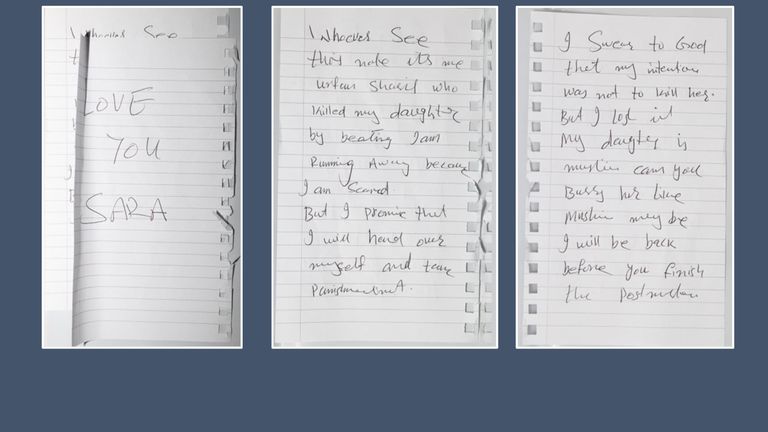
A handwritten note left by Sara’s father before he fled the UK. Image: Surrey Police
In early 2023, Sharif withdrew Sara from school, stating that she was being bullied. Under current UK legislation, home-educated children do not automatically need to be seen by local authorities unless an active safeguarding concern is open. A scheduled home-education visit — the primary opportunity to verify Sara’s wellbeing — was delayed and then sent to an incorrect address. Two days later, Sara was found dead.
A post-mortem examination recorded more than 100 injuries, including fractures, burns and signs consistent with prolonged assault. Sharif and Batool left the UK shortly before the discovery and were later extradited from Pakistan to stand trial.

Urfan Sharif and Beinash Batool were both convicted of murdering Sara, and her uncle, Faisal Malik, was convicted of causing or allowing her death.
The review highlights several systemic gaps in child-protection law and inter-agency communication:
The report recommends:
a mandatory national register for home-educated children
a statutory requirement for authorities to see a child within a set timeframe
clearer guidance on information sharing between schools and local authorities
Earlier admissions by Sharif during a domestic abuse intervention programme did not reach the Family Court during later private law proceedings. Reviewers recommend automatic disclosure of domestic abuse histories in all relevant cases.
Sara’s mother, who speaks limited English, did not receive full interpreter support during key court hearings. The review states that language needs must be clearly identified and consistently met to ensure full participation in future cases.
Sir Peter Wanless, chief executive of the NSPCC, previously stated that the case demonstrates the importance of clear communication and coordinated action when professionals encounter evidence of potential domestic violence or risk to a child.
Surrey County Council chief executive Terence Herbert issued an apology following today’s publication, confirming that the council would implement all recommendations in full. The Surrey Safeguarding Children Partnership said the findings would inform national discussions on strengthening safeguarding practice across health, education, policing and family justice.

Sara Sharif died in August 2023 with over 100 injuries — a horrifying catalogue of the abuse she had suffered.
The review concludes that Sara’s death was the result of criminal actions by her father and stepmother, but identifies significant areas where earlier intervention may have been possible. National policymakers are expected to examine the report’s recommendations in ongoing work to improve safeguarding processes, information sharing and oversight of home-educated children.
The Surrey Safeguarding Children Partnership will oversee the implementation of reforms locally and will publish progress updates over the coming year.
👉 UNSAFE BRITAIN: The Failures That FREED a Killer. Why Officials Get PROMOTED When Innocents Die 👈
LONDON — Allies of Prime Minister Keir Starmer scrambled late on Thursday to contain what one senior figure called a “full-blown mutiny in slow motion,” warning Labour MPs that forcing him out could plunge the country into a snap general election at the very moment the party’s support is collapsing.
Senior officials close to Starmer said any replacement leader would be “immediately hounded” to seek a fresh mandate, with voters unlikely to tolerate a mid-term power grab “stitched up behind closed doors.” With Labour sinking below 20% in multiple polls — its lowest standing since last year’s landslide — MPs privately admit an election now would be “electoral suicide,” costing the party hundreds of seats and potentially detonating Labour’s fragile grip on power.
The warning came after a chaotic 24 hours inside No. 10, where an apparent attempt to undermine Health Secretary Wes Streeting — widely seen as a future leadership contender — spiralled into a public briefing war and fuelled claims that Labour had slipped into its own version of the “civil war” it once mocked the Conservatives for.
Opposition leader Kemi Badenoch accused the Government of imploding, saying it had “descended into civil war.” Reform UK leader Nigel Farage described Labour as “a government at sea, without a rudder,” adding that the public deserved an election even if he doubted Starmer would allow one.
Much of the anger was directed at Starmer’s chief of staff, Morgan McSweeney, who MPs believe authorised late-night briefings labelling colleagues “feral” and suggesting Streeting was coordinating a mass resignation of frontbenchers after the Budget. One ally confirmed McSweeney was “100% behind” the operation before conceding: “He’s toast.”
Streeting, caught mid-way through a scheduled media round, dismissed the claims as “bizarre,” saying whoever briefed them “has been watching too much Celebrity Traitors.” He denied plotting to topple Starmer and ridiculed suggestions he planned to demand the PM’s resignation. “Yes — and nor did I shoot JFK,” he told broadcasters.
No. 10 insisted Starmer did not authorise any attacks on his own Cabinet and confirmed he had privately apologised to Streeting. But MPs say the fallout is far larger than one misjudged briefing. It has exposed deeper unease inside Labour about its direction, its messaging, and Starmer’s ability to navigate a fraught Budget moment that could define his premiership.
Political historian and elections expert Professor John Curtice has repeatedly warned that perceptions of legitimacy can shape political outcomes during periods of instability. “The electorate is not just divided between ‘left’ and ‘right’, but also between ‘liberals’ and ‘authoritarians’,” he said, adding that many voters now “sit in the middle and are not especially interested in politics.”
Constitutionally, a change in Labour leadership would not force an election. A new Prime Minister simply needs to command confidence in the House of Commons.
But politically, recent precedent tells a different story. Gordon Brown in 2007, Theresa May in 2016 and Rishi Sunak in 2022 all faced immediate demands to seek their own mandate. Legal analysts say that expectation is now so entrenched that any mid-term Labour successor would face irresistible pressure to “go to the country” — creating a political, not legal, trigger for a snap vote.
Starmer’s allies are using that dynamic to warn MPs: remove him now, and you may be walking the party into an election it is almost certain to lose.
Starmer offered only restrained support for McSweeney in the Commons, saying he remained “focused” on delivering government priorities. Downing Street later clarified that the Prime Minister still had confidence in him, though several Cabinet ministers privately question how long that position is sustainable.
Some Labour MPs accused No. 10 of deliberately provoking the crisis to expose potential rebels — a strategy they say has backfired spectacularly. “They’ve lost control of their own operation,” one backbencher said. Others fear the fallout has exposed old ideological fractures between Labour’s left, centre-left and technocratic wings.
With the Budget days away, senior MPs warn the government cannot afford another misstep.
What unfolded inside Labour this week looks less like a coup and more like an accidental detonation. A clumsy attempt to contain internal dissent instead revealed how thin the ice beneath Starmer has become.
Labour won a historic mandate last year, but the political mood has shifted faster than anyone expected. Economic frustration, slow-moving reforms and months of grim polling have eroded the goodwill Starmer once enjoyed. In that climate, even careless briefings can mutate into existential threats.
If Labour’s discipline continues to crumble, Starmer’s greatest danger will not be a challenger with a plan — it will be the party’s own growing belief that the problem is him. For now, there is no organised rebellion. But this week has shown how easily one could be created.
TV presenter Kirsty Gallacher has accused a district judge of showing “no empathy” after she was banned from driving for six months for travelling 35mph in a 30mph zone. The 49-year-old admitted the offence but said she depends on her car for work, parenting duties and medical appointments linked to a benign brain tumour.
The speeding incident, recorded near her home in Maidens Green, Berkshire, triggered a mandatory “totting-up” ban because she already had nine points from three earlier offences in 2023 and 2024. Under UK law, reaching 12 points in three years automatically leads to a six-month disqualification unless the driver proves exceptional hardship.
In court, Gallacher said infrequent rural buses made it difficult to get her youngest son to school or activities, and she needed to travel to Oxford for radiotherapy for an acoustic neuroma, which has left her deaf in one ear. She also said she could not afford daily taxis, despite earning around £150,000 a year with £80,000 in savings.
District Judge Arvind Sharma said her circumstances did not meet the legal threshold. “Things will be harder for you,” he said, “but those are manageable.” She was also fined £1,044.
Gallacher said the ruling left her shocked. “I’m just an ordinary mum with plates spinning… It’s going to be very difficult.” Her barrister, Sophia Dower, called her “a one-woman band” juggling work, children and treatment.
The court also heard she was recently assaulted in central London, telling police she was “kicked… like a football” by a man who may have targeted her. She said the attack worsened her anxiety and made walking alone harder while undergoing treatment for her fast-growing tumour.
She previously received a two-year driving ban in 2017 after a drink-drive offence, though it did not influence the court’s decision this time.
Under section 35 of the Road Traffic Offenders Act 1988, magistrates must impose a six-month disqualification when a driver reaches 12 points unless the defendant proves exceptional hardship — a narrowly defined test. The law distinguishes between hardship, which is common, and exceptional hardship, which must show severe, unusual consequences that could not reasonably be avoided.
Motoring lawyer Nick Freeman, known for representing high-profile drivers, has repeatedly warned that hardship arguments often fail. In a previous interview about similar cases, he said: “Exceptional hardship has to be truly exceptional. Serious inconvenience, or even significant difficulty, is rarely enough.” His interpretation aligns with the approach many magistrates now take when assessing income, savings and the availability of alternative travel.
In Gallacher’s case, the court found that while her circumstances were demanding, her access to taxis or private hire transport — though expensive — meant the consequences did not reach the exceptional threshold. The presence of savings, regular income and available alternatives weighed heavily in the decision.
• 1 April 2025 – Gallacher recorded at 35mph in a 30mph zone near her home
• 2023–2024 – Three previous speeding offences bring her to nine active points
• October 2025 – Reports assault in central London; police investigate
• November 2025 – Appears at High Wycombe Magistrates’ Court, pleads guilty
• Same day – Judge imposes six-month ban and £1,044 fine
Gallacher told the court she feels “broken” by the combined impact of her illness, single-parent responsibilities and the recent assault. She said she worries about attending radiotherapy appointments without the security of driving and remains concerned about her son’s transport needs. Despite her financial stability, she argued that daily transport costs would strain her household while she undergoes treatment.
She left the courthouse covering her head and did not confirm whether she intends to appeal the ruling.
The ruling highlights the strict approach UK magistrates take when applying exceptional-hardship rules. The test is not whether a driving ban will be disruptive — it almost always is — but whether its consequences are so severe and unavoidable that they surpass ordinary difficulty. For drivers facing totting-up disqualifications, income, savings and available transport alternatives often determine whether the defence succeeds. Gallacher’s case shows that even complex personal and medical pressures may not meet the threshold if workable alternatives remain available.
If you receive a driving ban in the UK, you must stop driving immediately for the length of the disqualification. Your licence is either surrendered or automatically invalidated, and you may need to reapply for a new licence at the end of the ban. In more serious cases, you may also need to retake your driving test.
There is no fixed maximum. Courts can issue bans ranging from a few weeks to life, depending on the severity of the offence. Lifetime bans are rare and typically reserved for the most serious or repeated dangerous driving offences.
You can check your driving record instantly on the DVLA website using your driving licence number, National Insurance number and postcode. If you’re banned, the disqualification dates will be shown on your record.
There is no single speed that automatically leads to a ban. However, very high speeds — usually more than 30mph over the limit — can result in an instant disqualification. For example, driving at 100mph on a motorway or 60mph in a 30mph zone often leads to a ban.
It usually results in three points and a fine, but depending on circumstances and previous points, magistrates can issue a short driving ban. Repeat offenders or those with existing points are more likely to face disqualification.
It depends on your weight, metabolism and drink size. Even two beers can put some people over the legal limit. The safest and legally sound advice is that there is no safe amount of alcohol to drive after. If you’re unsure, don’t drive.
Former NFL standout Antonio Brown has pleaded not guilty to a charge of second-degree attempted murder, telling the court through his attorney that he acted in self-defense during a May shooting at a celebrity boxing event in Miami.
Brown, 37, was arrested by U.S. Marshals in Dubai and extradited to the United States to face charges connected to a chaotic May 16 altercation outside a boxing event hosted by streamer Adin Ross. According to a warrant, Brown allegedly retrieved a handgun from a security guard and fired two shots, one of which grazed the neck of the alleged victim, Zul-Qarnain Kwame Nantambu.
After his arrest overseas, Brown was held in Essex County, New Jersey, before being transferred to Miami-Dade. At a virtual hearing on November 12, a judge set bond at $25,000, ordered him to wear a GPS ankle monitor, surrender his passport, and remain under house arrest.
Attorney Mark Eiglarsh filed a written plea and said Brown’s actions were “solely in self-defense.”
“Brown was attacked that night and acted within his legal right to protect himself,” Eiglarsh told the AP.
Brown later claimed he has symptoms consistent with CTE (chronic traumatic encephalopathy), a degenerative brain disease linked to repeated head trauma among football players.
“I got CTE, I blacked out… I don’t know what happened,” he said on a livestream with Adin Ross.
Clips circulating online show Brown in a scuffle with several people outside the venue. Moments later, he appears to lunge forward holding an object before two gunshots are heard.
Police later confirmed that Brown was identified as the shooter following interviews with eyewitnesses and a review of footage.
Brown claimed on social media he was “jumped by multiple individuals” attempting to rob him and that he “didn’t come there looking for violence.”
Under Florida law, second-degree attempted murder carries up to 15 years in prison and a $10,000 fine.
Legal analyst and former Miami prosecutor David Weinstein told Local 10 News:
“Self-defense claims hinge on whether the threat was imminent and unavoidable. The video evidence will play a major role in determining that.”
Brown’s previous release on the night of the incident and his subsequent travel abroad may also influence how the court views his “reasonable fear” argument.
The shooting has thrown a harsh light on the fast-growing world of celebrity-boxing events, where social-media personalities and ex-athletes share the ring. The May event, livestreamed by Adin Ross, reportedly lacked formal crowd-control and security screening procedures.
Event-liability expert Daniel Yates said the case could be “a wake-up call” for promoters:
“When entertainers bring entourages and firearms into public venues, the legal exposure isn’t limited to the fighter — it extends to the organisers, the streamers, and the venue itself.”
Legal analysts suggest that if negligence in event management contributed to the chaos, Brown’s attorneys could argue that poor oversight created a “dangerous environment,” bolstering his self-defense narrative.
A seven-time Pro Bowler, Brown spent 12 seasons in the league — primarily with the Pittsburgh Steelers, later joining the New England Patriots and Tampa Bay Buccaneers.
Off the field, his career was marked by controversies: battery allegations, domestic-violence investigations, and the infamous 2021 game walk-off that effectively ended his NFL tenure.
The latest charge adds another chapter to an already turbulent post-career saga that continues to blur the line between sports celebrity and criminal accountability.
Prosecutors will present witness statements and forensic reports in the coming weeks. The defence is expected to request suppression of certain social-media footage and could pursue a plea deal if evidence becomes overwhelming.
The case’s next court date is scheduled for December 5 in Miami-Dade Circuit Court.
Observers say the trial could set precedent for how celebrity-event shootings are prosecuted, especially when the accused invokes both self-defense and neurological impairment.
Before his latest legal battle, Brown was already no stranger to off-field headlines. In October 2022, videos surfaced appearing to show the former wide receiver exposing himself to guests at a Dubai hotel swimming pool.

According to reports from The U.S. Sun and New York Post, Brown was filmed thrusting near a woman and pulling himself out of the water naked at the Armani Hotel Dubai on May 14, 2022. Witnesses said the woman appeared upset and later complained to hotel staff, after which Brown was allegedly asked to leave the property.
The clip, which went viral on social media, sparked outrage and another wave of controversy for the ex-NFL star. Brown, however, rejected the claims as “disinformation,” insisting that the woman “ran off with [his] swim trunks” and that coverage of the incident was racially biased.
“Every chance they get to sway the heat off themselves they use me,” Brown wrote in a since-deleted Twitter post. “In the video you can clearly see she runs off with my swim trunks.”
At the time, Brown had been in the United Arab Emirates to watch Floyd Mayweather Jr. compete in an exhibition match in Abu Dhabi. The episode deepened concerns about Brown’s conduct abroad and added to a string of prior controversies — from his mid-game walk-off with the Tampa Bay Buccaneers in 2021 to earlier assault and battery charges in Florida.
Legal observers later noted that the Dubai incident, though never prosecuted, amplified public scrutiny of Brown’s behavior and could influence jury perception in his current attempted-murder case.
Updated 14 November, 2025
Akon spent six hours behind bars in DeKalb County, Georgia, last week after police arrested him on an outstanding warrant — a situation his team says stemmed from a clerical mistake rather than criminal wrongdoing.
The 52-year-old singer, best known for his 2004 breakout hit “Locked Up,” was taken into custody by the Chamblee Police Department on Friday morning. Jail records show he was booked, photographed in a black hoodie, and later released that same afternoon.
Police were alerted to Akon’s location after Flock security cameras flagged a vehicle connected to an individual with an out-of-county warrant. The alert pinged while his car was parked at Tint World, an auto styling shop where Akon had reportedly dropped off the vehicle.
According to the arrest report obtained by The Independent, Akon remained calm and cooperative throughout the encounter, telling officers he already knew about the outstanding warrant tied to a previous incident in Roswell, Georgia.

A Tesla Cybertruck similar to the one Akon was driving when police discovered his suspended license in Roswell, Georgia.
Roswell Police say the warrant traces back to an episode in September 2025, when Akon became stranded roadside after the battery in his Tesla Cybertruck died. Officers who responded arranged to tow the vehicle — but soon discovered the singer was driving with a suspended license.
According to the incident report:
His license had been suspended for a failure to appear in January 2023
Officers issued a citation and confiscated his license
Police also seized an illegal vape found in the glove compartment
The warrant was later issued when the suspended-license violation remained unresolved in the system.
A representative for Akon told The Independent that the arrest “should have never happened.”
In the statement, the spokesperson explained that Akon had already taken care of the original suspension:
“Due to a clerical issue the suspended license should have never been escalated — it was paid but not properly entered into the system. This will be soon rectified in the courts in early December.”
Akon himself has not publicly addressed the arrest. Instead, he has continued posting as usual on social media — including a video shared Wednesday morning with the caption “It’s a beautiful day.”
Despite spending part of his Friday in jail, Akon has not paused his current schedule.
He is currently on tour in India, performing at several large-scale music festivals and arena shows.
The quick release and administrative nature of the warrant mean the incident is unlikely to affect his touring commitments, though it will require a court appearance next month.
Akon’s early career was shaped — and at times overshadowed — by a self-crafted narrative about his criminal past. For years, the Grammy-nominated artist claimed he had done significant prison time and even ran a car-theft ring before becoming famous.
But in 2008, The Smoking Gun published a detailed investigation showing that much of that story had been exaggerated or fabricated. According to the site, Akon had indeed been arrested multiple times, but the only felony conviction on record was a 1998 gun-possession case in New Jersey, for which he received three years’ probation.
The renewed headlines about his arrest have resurfaced those earlier controversies — though this most recent detention appears grounded in administrative errors rather than criminal behaviour.
The arrest comes during a turbulent period in Akon’s personal life.
In September 2025, his wife Tomeka Thiam filed for divorce after 28 years of marriage.
Court filings show:
Akon is seeking joint legal custody
He wants sole physical custody of their 17-year-old daughter
He is requesting spousal support
The father of nine has not spoken publicly about the divorce proceedings, which remain ongoing.
Akon became one of the defining voices of the early 2000s with chart-topping hits including:
“Locked Up”
“Smack That”
“Lonely”
“I Wanna Love You”
His influence expanded beyond music with philanthropic and entrepreneurial work, including:
Akon Lighting Africa, a solar-energy initiative across the continent
The launch of his cryptocurrency Akoin
Early plans for Akon City, a proposed smart city in Senegal (still in slow development)
His supporters online have largely expressed frustration with the arrest — calling it a “bureaucratic mess,” “embarrassing error,” or “waste of resources.”
He was detained because of an outstanding warrant issued in Roswell, Georgia, related to a suspended-license incident in September.
Around six hours before being released the same afternoon.
Flock security cameras flagged his vehicle at an auto shop, alerting police to the warrant.
He was stranded with a dead battery in his Tesla Cybertruck. During the stop, officers found he was driving with a suspended license and confiscated an illegal vape.
They call it a clerical mistake, claiming the underlying suspension had been resolved but not updated in the system.
Unlikely — he is currently touring in India and continues posting publicly without addressing the arrest.
Wednesday 12 November 2025, 11:28 UK
A major independent review into the UK’s counter-terrorism and repatriation policy has made a radical recommendation: British nationals and former nationals detained in camps in northeast Syria — including high-profile case Shamima Begum — should be brought back home. The report warns, however, that Britain’s current policy of leaving such individuals in limbo is “unsustainable” and risks creating “Britain’s Guantanamo.”
The Independent Commission on UK Counterterrorism found that conditions at camps such as Al Hol camp and Al Roj camp amount to “inhuman and degrading treatment”, putting the UK in breach of its international human rights obligations.

Shamima Begum Lost Initial Appeal Over Stripped British Citizenship
The commission estimates between 50 and 70 British-linked people remain stranded in Syria, mostly women, and 12–30 children, around half of whom are under age 10. The review emphasises that Britain has a special obligation to protect minors.
Unlike the US, Canada, France, Germany and other European countries which have repatriated nationals who joined or supported IS, the UK follows a “strategic distance” policy: citizenship revocations, restricted consular support and outsourcing detention to Kurdish-run facilities. This approach, the review says, erodes allied trust and weakens UK counter-terrorism credibility.
Legally, the UK government can use the British Nationality Act 1981 (Section 40) to deprive citizenship where it is “conducive to the public good”, provided the person is not made stateless. This was applied in the case of Shamima Begum.
At the same time, Britain remains bound by the Human Rights Act 1998 and the European Convention on Human Rights (ECHR), which prohibits sending someone to a place where they face inhuman or degrading treatment (Article 3).
Legal scholar Professor Clive Walker explains:
“The UK must strike a delicate balance between safeguarding national security and upholding its obligations under international human-rights law.”
In short: the UK does not have an absolute duty to repatriate every citizen who joined a terrorist organisation—but it cannot wholly outsource or ignore the responsibility either.
While precise figures for repatriating individuals from Syria are not public, comparable programmes give a sense of scale. For example, the UK’s Syrian Vulnerable Persons Resettlement Programme estimated lifetime costs of up to £1.7 billion for resettling refugees.
Repatriating former IS members is far more complex — involving secure transport, prosecution, monitoring, rehabilitation, potential incarceration and long-term surveillance. Conservative estimates place £200,000 to £500,000 per individual at the lower end. At 50-70 individuals, that translates into £10–£35 million or more. And that is before including indefinite monitoring or possible prison costs.
Who pays? The taxpayer. Who monitors them? Agencies like MI5, the Home Office, probation services — all under pressure already.
Experts say leaving British nationals indefinitely in Syrian camps may intensify security risks rather than mitigate them. The commission states:
“As escapes from camps are likely to lead to some returns to the UK, an organised programme of return, rehabilitation and integration is the best long-term option for managing risk.”
But the report warns: if the UK delays, these camps become propaganda incubators, breeding grounds for the next wave of extremists. The risk of escape, radicalisation, and terrorism returns is not hypothetical.
Shamima Begum, now 26, travelled from East London in 2015 aged 15 with two school friends to Syria and joined Islamic State (IS). She lost her appeal last year against the revocation of her British citizenship. Her three children died in infancy. Her case encapsulates the tension between national security and state responsibility.
Let’s be painfully honest: those who travelled to Syria to join or support IS made a choice. They took sides against the UK, the West, and democracy. That choice withdrew many of the protections citizenship affords.
Yes, human rights matter. Yes, children are vulnerable and deserve protection. But the blanket assumption that the UK should pay for their return, monitor them indefinitely, rehabilitate them and assume the risk is increasingly untenable.
Every returnee costs hundreds of thousands of pounds. Every one requires lifelong monitoring. Every one carries the risk of re-offending and committing terror acts. Who picks up the tab? The British taxpayer. Who bears the danger? The British public.
If they come back, it must be on our terms: strict legal consequences, lifetime surveillance, transparent costs, strong rehabilitation but zero tolerance for relapse. Without that, repatriation becomes irresponsible.
My firm view: for those who voluntarily joined a terrorist organisation, repatriation should not be the default. You went there, you joined, you chose. Stay where you are — and let the state set the price, the monitor and the terms. Because if we bring them home on anything less, we are implicitly underwriting terrorism with public money.
Shamima Begum — once a schoolgirl from East London — has lost multiple legal appeals to overturn the UK government’s decision to strip her of British citizenship. Now 24, she remains barred from returning to the UK and continues to live in a guarded camp in northern Syria.
Who is Shamima Begum?
Begum was born in 1999 in London to parents of Bangladeshi heritage. At 15, she travelled to Syria in 2015 with two classmates to join the Islamic State (IS). She married an IS fighter and had three children, none of whom survived. Her British citizenship was revoked in 2019 on national security grounds.
What does citizenship mean?
Citizenship gives a person the legal right to live in the UK and access key services such as healthcare, education, and voting. It also forms part of a person’s identity and legal belonging to the state. Some non-citizens have “settled status” or “leave to remain,” granting similar rights without full citizenship.
When can the UK remove citizenship?
Under the British Nationality Act 1981, the government can revoke citizenship if it is deemed “for the public good,” as long as the person is not rendered stateless. Grounds include:
Membership or support of a banned organisation such as ISIS or al-Qaeda.
Fraudulent acquisition of citizenship.
Actions deemed harmful to UK interests.
The Nationality and Borders Act 2022 further expanded powers, allowing citizenship removal without prior notice in some national security cases.
What happened in Begum’s case?
A tribunal ruled in 2020 that Begum was technically a citizen of Bangladesh by descent, so removing her British nationality did not make her stateless — though Bangladesh later said she would not be allowed entry. In 2021, the Supreme Court decided she could not return to the UK to appeal.
In 2023, the Special Immigration Appeals Commission (SIAC) acknowledged a “credible suspicion” that Begum was a victim of trafficking and sexual exploitation but maintained that the Home Secretary’s decision was lawful.
The Court of Appeal upheld that ruling in February 2024, saying she “may have been influenced and manipulated but still made a calculated decision to join Islamic State.” On 25 March 2024, Begum lost her bid to take the case to the Supreme Court.
How many people have lost UK citizenship?
According to the Home Office, 220 people were stripped of British citizenship for the public good between 2010 and 2022, mostly on national security grounds. The peak was in 2017, when 104 people lost citizenship; in 2022, only three did.
How do other countries handle this?
United States: Birthright citizenship cannot be revoked. Naturalised citizens may lose it if obtained by fraud or for joining proscribed groups.
Australia: Dual citizens can lose citizenship for terrorism-related offences or threats to national security.
EU states: Around 14 EU countries, including France, Greece, and Romania, allow citizenship removal on national security grounds. The Netherlands can do so without prior notice.
Q1: Can Shamima Begum legally return to the UK?
A: Her citizenship was legally revoked under the British Nationality Act 1981; unless reversed, she lacks entitlement to a British passport and must address her legal status abroad.
Q2: What laws govern the UK’s power to deprive citizenship for terrorism?
A: Section 40 of the British Nationality Act 1981 allows deprivation if “conducive to the public good” and non-statelessness is maintained. The ECHR (Article 3) continues to bind the UK regarding rights against inhuman treatment.
Q3: How many British nationals are still held in Syrian camps?
A: The review estimates roughly 50-70 British-linked individuals and 12-30 children remain in northeast Syrian camps.
Q4: How much might repatriation cost UK taxpayers per person?
A: Conservative estimates start at £200,000–£500,000 per individual, with total costs of £10-35 million+ depending on numbers and monitoring needs.
Q5: Who monitors returnees and what happens if they commit terrorism again?
A: Returnees would fall under MI5, the Home Office, probation and criminal justice systems. If they commit further offences, the state is exposed to public safety risk and fiscal liability—and the taxpayer bears follow-up costs and consequences.
Exclusive Read: UNSAFE BRITAIN: The Failures That FREED a Killer. Why Officials Get PROMOTED When Innocents Die
Three Oklahoma oil and gas producers have agreed to pay a combined $555,000 to settle allegations that their wastewater disposal wells triggered earthquakes that caused widespread property damage across the state.
The Oklahoma earthquake damages class action settlement benefits homeowners, municipal bodies, county governments, and tribal governments that owned or had an interest in real property between January 19, 2019, and February 2, 2024, and whose properties were damaged by earthquakes, foreshocks, or aftershocks.
The settlement stems from the case Salzman et al. v. Freedom et al., Case No. CJ-2024-0043, filed in the District Court of Lincoln County. Plaintiffs alleged that Spess Oil Co., Circle 9 Resources, and Culbreath Oil & Gas Co. Inc. were responsible for induced seismic activity through deep-well injection of wastewater — including the magnitude 5.1 quake that struck near Prague, Oklahoma, on February 2, 2024.
While the defendants denied liability, they agreed to the payout to avoid prolonged litigation and the costs of trial.
Eligible claimants will receive cash payments based on the extent of verified property damage. Funds are divided geographically:
Zone A: Lincoln, Payne, Logan, Oklahoma, Cleveland, Pottawatomie, Seminole, Okfuskee and Creek Counties
Zone B: All other counties in Oklahoma
90% of the fund is reserved for Zone A, with 10% allocated to Zone B. If the total claims exceed the fund, payments will be distributed on a pro-rata basis.
Key deadlines:
Opt-out deadline: September 27, 2025
Objection deadline: October 10, 2025
Final approval hearing: October 20, 2025
Claim submission deadline: January 25, 2026
This case underscores the legal risks facing the oil and gas industry amid growing scientific evidence that disposal wells can trigger seismic events. Oklahoma’s rate of earthquakes has soared in the past decade, forcing regulators to acknowledge man-made, or “induced,” causes.
According to William Leith, Senior Science Advisor for the U.S. Geological Survey,
“The link between wastewater injection and earthquakes in Oklahoma is well established — in theory, in the lab, and in the field.”
That scientific consensus has opened the door to successful lawsuits. Previously, plaintiffs struggled to prove causation; now, seismic mapping and injection-well data have changed the legal landscape, making industry accountability more achievable.
Homeowners who experienced quake-related damage now have a clearer path to recovery. Here’s what this settlement means from a consumer-law perspective:
Compensation for verified damage: Claimants may recover funds for structural cracks, foundation shifts, or other earthquake-related harm backed by repair estimates or engineering reports.
Future property disclosure: Oklahoma sellers in affected counties must disclose prior earthquake damage or claims. This requirement may influence resale value and insurance eligibility.
Insurance implications: Standard homeowners’ policies often exclude earthquake damage. Filing a valid claim under this settlement could help offset uncovered losses — but residents should also consider separate earthquake riders going forward.
Regulatory trend: The Oklahoma Corporation Commission (OCC) continues to monitor and restrict high-volume injection wells under its “traffic-light” system. Properties near red- or yellow-classified wells may face new safety advisories or inspection requirements.
Legal analysts say the settlement is small in dollar terms but symbolically powerful, signaling that courts are increasingly receptive to property-owner claims tied to environmental or industrial negligence.
Class members include individuals, municipal or tribal governments who:
Owned or had an interest in real property within Oklahoma between January 19, 2019, and the settlement’s effective date.
Experienced physical property damage from earthquakes, foreshocks, or aftershocks during that period.
Proof Required:
Documentation of ownership (e.g., deed or property tax record).
Evidence of earthquake-related damage (repair estimates, invoices, photos).
Links to seismic events such as the February 2, 2024, Prague quake or others recognized by the U.S. Geological Survey.
Eligible claimants can submit a claim online or by mail:
Website: OklahomaEarthquakesLawsuits2024.com
Email: admin@OklahomaEarthquakesLawsuits2024.com
Mailing Address:
Salzman Class Action Settlement
Attn: Settlement Administrator
P.O. Box 301132
Los Angeles, CA 90030-1132
Phone: 888-777-6403
Claims must be submitted or postmarked by January 25, 2026. Fraudulent claims are subject to penalty of perjury.
Class Counsel: Scott Poynter — Poynter Law Group
Defense Counsel:
E. Edd Pritchett — Durbin Larimore & Bialick
Charles D. Neal — Steidley & Neal
Alvin R. Wright — Law Office of Alvin R. Wright
This is one of the first post-2020 induced-seismicity settlements to move from scientific debate to direct consumer compensation. Experts believe similar claims could follow in Texas, Kansas, and Arkansas, where injection-well activity mirrors Oklahoma’s patterns.
For property owners, the message is clear: document everything — damage, repairs, and communication — to preserve future claim rights. For energy companies, the case is a reminder that environmental accountability is no longer optional.
Settlement Website: OklahomaEarthquakesLawsuits2024.com
Claim Deadline: January 25, 2026
Case: Salzman et al. v. Freedom et al., Case No. CJ-2024-0043 (District Court of Lincoln County, OK)
Anyone who owned or had an interest in real property in Oklahoma between January 19, 2019, and February 2, 2024, and suffered earthquake-related damage may qualify. That includes individuals, homeowners, businesses, municipalities, and tribal governments whose buildings or land were affected by seismic events linked to wastewater injection wells.
Payments will vary based on the extent of verified property damage and the claimant’s location.
Under the settlement, Zone A counties — including Lincoln, Payne, Logan, Oklahoma, and Cleveland — receive 90% of the total fund, while Zone B (the rest of the state) receives 10%.
If total claims exceed the fund, payments will be distributed proportionally (pro rata) among approved claimants.
Eligible residents must submit a claim form — along with proof of ownership, damage documentation, and repair estimates — by January 25, 2026.
Claims can be filed at OklahomaEarthquakesLawsuits2024.com or mailed to:
Salzman Class Action Settlement, P.O. Box 301132, Los Angeles, CA 90030-1132.
Millions of AT&T customers have only a few days left to file for a share of the company’s $177 million data-breach settlement. The payout follows two 2024 cyberattacks that leaked sensitive customer details across the dark web — and those affected could receive as much as $7,500 if they act before November 18, 2025.
In early 2024, hackers accessed AT&T’s systems in two major incidents:
March 30, 2024: Names, addresses, birth dates, account passcodes, and Social Security numbers were exposed.
July 12, 2024: A second breach revealed call and text logs, phone numbers, and limited location data linked to user accounts.
Together, the leaks impacted more than 70 million current and former customers. AT&T denied wrongdoing but agreed to a nationwide settlement to close the case.
If you were an AT&T customer during 2024, you might qualify to file a claim. You’re eligible if:
Your data appeared in either the March or July breach.
You received a settlement notice or claim ID by email or mail.
You can verify your information on TelecomDataSettlement.com.
Customers unsure of their status can call the Kroll Settlement Administrator at 833-890-4930 for assistance.
Note: Filing a claim means you’ll give up the right to sue AT&T separately over these same data breaches.
Payouts depend on the type of data exposed and proof of financial loss.
Tier 1: Up to $5,000 if your SSN was leaked (and you can show losses).
Tier 2: Standard payment if your personal data—but not SSN—was exposed.
Tier 3: Up to $2,500 if affected by the July breach.
Those caught in both breaches could see combined payments reaching $7,500. Actual amounts depend on how many people file before the deadline.
Filing takes just a few minutes:
Visit TelecomDataSettlement.com.
Click “Submit Claim.”
Enter your class-member ID, AT&T account number, or full name and email.
Choose whether to claim for documented loss (requires proof) or a flat-rate tier payment.
Submit online or mail the printed form — it must be postmarked by November 18, 2025.
Claim filing deadline: November 18, 2025
Final approval hearing: December 3, 2025 (U.S. District Court, Northern District of Texas)
Payments expected: After final approval and any appeals
The settlement has simple consumer protections but a few legal strings attached:
No double-dipping: Once you accept payment, you can’t file a separate lawsuit over the same breaches.
Opt-out rights: If you’d rather sue independently, you must opt out before the official court date.
Arbitration note: AT&T’s standard contracts use arbitration clauses, but this class action isn’t bound by them—so filing a claim won’t affect your ability to challenge future, unrelated disputes.
Proof of loss: Only documented costs directly tied to identity theft or credit-monitoring expenses will qualify for higher-tier compensation.
It’s a straightforward process, but experts recommend reading the fine print before you submit your claim.
This is one of the largest consumer data-privacy settlements in U.S. history. Even if you didn’t suffer major losses, you could still receive a smaller automatic payout simply by filing before the deadline.
Consumers who miss the window will lose eligibility permanently once the court finalizes the agreement.
Bottom Line:
If you were an AT&T customer whose personal or account data was exposed in 2024, you could qualify for up to $7,500 — but only if you file your claim by November 18, 2025. Head to TelecomDataSettlement.com to check eligibility or call the administrator before the window closes.
Understanding how the UK immigration system works can feel overwhelming at first glance. The rules are detailed, the categories are many, and the expectations differ depending on whether someone is arriving to study, work, join family, or take on seasonal employment. Yet beneath the complexity, the UK’s approach follows a clear philosophy: the country welcomes global talent and family connections, but it expects applicants to be prepared — financially stable, proficient in English, and transparent about their background.
This guide breaks down the core principles behind the UK’s immigration rules. It explains how the system is organised, why certain requirements exist, and what applicants can generally expect across the main routes. Rather than focusing on day-to-day updates or short-term policy shifts, the aim here is to give a practical, evergreen understanding of how the system functions and why it is structured the way it is.
One of the first things many applicants notice is that English requirements are taken seriously. For certain work and skilled-worker visas, applicants must prove English ability at a level roughly comparable to A-level standard. This isn’t just a box-ticking exercise — it’s a foundational expectation.
The UK government and the Migration Advisory Committee have consistently highlighted research showing that strong English skills improve long-term outcomes for migrants. Better language ability tends to lead to:
smoother workplace integration
more stable employment
easier navigation of public services
improved social participation
To make testing consistent and secure, the UK uses the Secure English Language Test (SELT). Results are verified digitally, which reduces the risk of fraudulent certificates — an issue examined in past Parliamentary committee reviews after earlier test-centre abuse cases.
For applicants, strong English skills can feel like a demanding expectation, but they often end up being an advantage once someone begins working or studying in the UK.
International students are one of the largest groups entering the UK under the points-based system. They bring economic value to universities, cities, and the wider economy. But the UK also requires them to show they can support themselves financially for several weeks before applying.
The required maintenance funds differ depending on whether the student plans to live in London or elsewhere. The capital’s living costs are higher, and the rules reflect that reality.
While financial requirements can feel strict, they are designed to prevent problems that universities and government reviews have highlighted in the past — such as students running into hardship, relying on undeclared work, or becoming vulnerable to exploitative housing. By ensuring financial stability at the outset, the system aims to protect both the student and the integrity of the student route.
Every immigration system in the world draws a line around conduct and eligibility, and the UK is no different. Under the suitability criteria, applicants may be refused if they have serious criminal convictions, a pattern of repeated offences, or a history of significant immigration breaches.
These rules sit within the broader legal framework of the Immigration Act 1971 and subsequent updates, which require the Home Office to consider public safety, character, and compliance. Suitability decisions are not made casually — they must be justified under the law — but they follow clear principles:
protecting public safety
preventing repeated misuse of the immigration system
ensuring transparency in decision-making
For general applicants, this usually means having clean, consistent documentation and following visa conditions carefully. For those who disagree with a decision, administrative reviews and appeal routes remain available, especially where human rights issues arise.
Agriculture and horticulture have always relied heavily on seasonal labour. Crops need picking at specific times, and the demand for workers rises and falls in natural cycles. Recognising this, the UK’s Seasonal Worker route allows workers to take on short-term roles within a defined seasonal window, with enough flexibility for multiple periods of entry.
This approach is shaped by practical considerations. Industry reports and government impact assessments have repeatedly shown that without seasonal workers, key crops risk being left unharvested. The scheme provides:
a lawful route for overseas workers
predictable staffing for farmers
structure and safeguards that prevent overstaying
For workers, the scheme creates a clear path for short-term employment without long-term immigration commitments. For employers, it supports food security and operational planning.
Family reunion remains a central pillar of the UK immigration system. Partners, parents, and children can apply to live together in the UK, provided they meet the eligibility requirements. But safeguarding is now built more firmly into the process.
Caseworkers must refuse applications where a parent, partner, or guardian could pose a risk to a dependent. This reflects the UK’s wider legal duties under the Children Act 1989 and safeguarding best practices established in social-care guidance.
Importantly, safeguarding checks are not designed to complicate normal applications — the vast majority raise no issues. They are intended to protect dependents in rare but serious cases where risk factors exist.
Although each visa category has its own criteria, the immigration system is built around a few overarching principles:
This includes language skills, financial evidence, correct documentation, and genuine intentions.
English proficiency, financial stability, and clear sponsorship all contribute to better outcomes.
Consistent standards help maintain confidence in the system.
Sponsors must meet compliance duties to keep their licences and support applicants properly.
Seasonal labour, global talent routes, and student mobility all rely on balanced requirements.
One of the biggest long-term shifts in UK immigration is digitalisation. The transition from physical documents (like BRPs) to digital status records mirrors global trends toward biometric systems and electronic verification.
Digital immigration status aims to:
reduce fraud
simplify border checks
create faster processing
improve record accuracy
For applicants, this means that future visa routes will depend heavily on digital evidence — bank statements, employer confirmation, university enrollment data — rather than the paper documents that were used for decades.
Most skilled-worker applicants must take a Secure English Language Test (SELT) from a Home Office-approved provider. The score needs to show English ability at roughly A-level standard across reading, writing, speaking and listening.
Students must prove they can cover their living costs for several consecutive weeks before applying. The amount varies depending on whether the student will live in London or elsewhere.
Yes. Serious criminal convictions, repeat offending, or major immigration breaches can trigger an automatic refusal under suitability rules. Applicants may still have access to review or appeal routes depending on their circumstances.
It allows overseas workers to take on short-term agricultural or horticultural roles within a structured seasonal window. The scheme is more flexible than earlier versions, giving employers a reliable workforce during peak periods.
Family applications can be refused if there is evidence that a parent, partner or guardian poses a risk to a dependent. This requirement aligns with the UK’s child-protection laws.
