
Understand Your Rights. Solve Your Legal Problems
Air Force One descended into turbulence of a different kind on Friday as President Donald Trump lashed out at Bloomberg reporter Catherine Lucey, calling her “quiet, piggy” after she asked about the looming release of the Jeffrey Epstein files — a political storm that’s now threatening his own party.
The confrontation unfolded mid-flight when Lucey questioned Trump on bipartisan demands for the Department of Justice to release all remaining Epstein investigative documents. Trump reportedly waved a finger inches from her face before snapping:
“Quiet, quiet piggy!”
The moment was caught off-camera but heard clearly by surrounding press — and it wasn’t the last clash of the weekend.
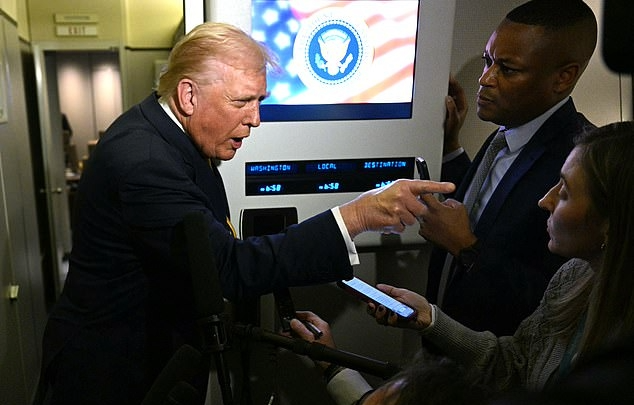
Donald Trump erupts at a reporter aboard Air Force One after being pressed on the Epstein files.
By Sunday, tensions were even higher. Speaking outside Air Force One, Trump began addressing Lucey’s question about Tucker Carlson’s interview with Nick Fuentes. When she attempted to clarify, Trump erupted again:
“Will you let me finish my statement? You are the worst! You’re with Bloomberg, right? You are the worst! I don’t know why they even have you.”
The outburst comes as Trump faces intense bipartisan pressure to support the release of all unclassified Epstein files — a political fight that has spiraled far beyond the press cabin.
For months, the White House has resisted Congressional efforts to force full declassification of Epstein documents. Trump has repeatedly claimed that Democrats are using the issue as a “distraction” and blasted fellow Republicans for supporting the push, saying:
“Only a very bad, or stupid, Republican would fall into that trap.”
Even his allies weren’t spared. Trump reportedly labeled Georgia Rep. Marjorie Taylor Greene a “traitor” over her pressure to release the files.
But as GOP votes began lining up with Democrats, Trump reversed course on Truth Social:
“We have nothing to hide… it’s time to move on from this Democrat Hoax.”
He has now vowed to sign any legislation requiring full file release — or issue an executive order himself.
A House vote is scheduled for Tuesday.
👉 Related: Epstein Files Bill Explained: How Congress Can Force the DOJ to Release Federal Records
Congress can force the release of unclassified Epstein-related documents from federal agencies. Classified material would require separate review or presidential action.
The President can, at any time, sign an executive order to declassify federal files connected to Epstein. That authority is broad but must still comply with federal privacy and national security laws.
Documents typically go to:
The House Oversight Committee
The Senate
Public online release through agency portals
Names of private individuals may be redacted if disclosure violates privacy or ongoing investigation standards.
Possibly — but most related criminal matters ended when Epstein died in 2019. Civil cases could still be influenced if new emails or communications reveal misconduct.
Last week, House Republicans released more than 23,000 subpoenaed records from Epstein’s estate, including emails sent in the months leading up to his 2019 death in a New York jail.
Trump now says he supports full government transparency:
“We’ll give them everything… Let anybody look at it.”
Still, he insisted the scandal belongs to Democrats:
“It’s really a Democrat problem… and it’s a hoax.”
With tempers flaring, cameras rolling, and votes approaching, the political fight over the Epstein files is only intensifying — and Friday’s “quiet, piggy” moment may be remembered as the spark that lit the weekend’s firestorm.
Understanding assault in the United States can be surprisingly confusing. The word gets tossed around in everyday conversation — often incorrectly — and each state defines it a little differently. But there is a core legal idea that runs through every state’s laws, and understanding it helps people know their rights, their risks, and what to do if a situation escalates.
This guide breaks it all down in plain English. No jargon. No dense law-school explanations. Just a clear, forever-relevant explainer you can rely on.
Across the U.S., assault is generally defined as intentionally causing another person to fear imminent physical harm.
A crucial point:
If someone’s actions (and sometimes words) make a reasonable person think they’re about to be hurt right now, that’s usually assault.
Intent: The person meant to act in a threatening or harmful way.
Reasonable fear: The victim actually and reasonably believed harm was about to occur.
Imminence: The threat must feel immediate, not a future “someday.”
Raising a fist as if about to punch
Pointing a weapon at someone — even if it's not fired
Lunging or rushing aggressively at another person
Threatening physical harm while moving toward someone
Assault is about the fear created, not the injury caused.
People often mix them up, but they are not the same thing.
= Threat of harm, causing fear.
= Actual physical contact that is harmful or offensive.
Think of it this way:
Assault is the swing.
Battery is the punch landing.
Some states still use the traditional distinction. Others fold both into a single “assault” statute that includes physical contact. But the idea behind them stays consistent.
Here’s where things get tricky — and where people misunderstand the law most often.
However…
Under many state laws, spoken threats may become a crime if they:
threaten serious harm, injury, or death
are specific and believable
create real, reasonable fear
suggest the threat could happen immediately
involve weapons or implied weapons
are part of a pattern (stalking, harassment, domestic abuse)
Examples of criminal threats:
“I’m going to kill you tonight.”
“I’m coming over now to beat you.”
“If you take another step, I’m going to shoot you.”
Examples that usually are not criminal:
Insults
Name-calling
Yelling
Rude comments without any immediate threat
Vague statements like “You’ll be sorry one day”
Verbal threats alone are usually not assault unless they create a genuine, immediate fear of harm.
Courts often draw on long-standing legal principles when deciding assault cases. Even though states write their own statutes, two core ideas are almost universal:
If their behavior caused fear, that may be enough.
A threat isn’t assault if a reasonable person wouldn’t take it seriously.
It’s the combination of actions, words, tone, body language, distance, and context that matters.
Assault and battery can lead to both criminal charges and civil lawsuits.
Arrest
Fines
Probation
Protective orders
Jail or (in very serious cases) prison
A victim can sue for:
medical costs
lost income
therapy
emotional distress
Civil courts use a lower standard of proof, meaning a lawsuit can succeed even if a criminal case fails.
Two people argue in a parking lot. One raises his fist and steps forward, shouting “I’m about to smash you.”
There is no contact.
This is assault.
The fist connects.
This is battery.
Someone shouts, “You’re stupid. Get lost.”
Rude? Yes. Criminal? No.
This is not assault.
Someone screams threats from across a busy street but cannot reach the other person.
Usually not assault, because there is no imminent harm.
Depending on the situation, prosecutors may add more serious charges, such as:
Domestic violence
Child abuse
Sexual assault
Stalking or harassment
Homicide, if injuries cause death
Aggravated assault, often involving weapons or severe injury
These charges carry significantly higher penalties.
Every case is unique, but the most recognized defenses include:
The defendant reasonably feared imminent harm and used proportionate force.
Same rules as self-defense, but applied to protect someone else.
Common in sports or activities where physical contact is expected.
Accidental contact or misunderstandings generally do not qualify.
Especially relevant when witnesses are confused or visibility is poor.
Because assault laws vary by state and small details matter, anyone facing:
accusations
charges
threats involving weapons
domestic or workplace situations
online threats
misunderstandings that escalated
should speak to a lawyer before talking to police.
This isn’t about evading justice — it’s about protecting the right to a fair process.
Assault = causing fear of immediate harm (no contact needed).
Battery = harmful or offensive physical contact.
Verbal threats can be illegal, but “verbal assault” is not typically a crime on its own.
States define assault differently, but the core ideas remain consistent nationwide.
Both criminal penalties and civil lawsuits are possible.
Context, intent, and immediacy matter more than exact wording.
This understanding helps people know when a situation crosses the line from rude or tense to potentially criminal — and what rights they have if it does.
👉👉 Further Reading: How Criminal Law Really Works: Inside the Principles That Shape Justice in America
Porsha Williams’ trip home from BravoCon took a disturbing turn at 30,000 feet — and now the Real Housewives of Atlanta star has become the central figure in an active federal investigation.
What began as a routine Delta flight erupted into a confrontation so heated that the FBI is now combing through witness statements, airline reports, and passenger accusations to determine whether federal charges should be filed. Williams, who was escorted off the plane by officers upon landing, says she was the victim, not the aggressor — and she’s ready for the truth to come out.

Her attorney, Joe Habachy, tells TMZ that Porsha was blindsided by an unruly passenger:
"Ms. Williams was verbally assaulted by an irate and unhinged passenger without provocation. The passenger then proceeded to make false allegations that were in direct conflict with observations from several eyewitnesses."
The confrontation, described by witnesses as “chaotic but brief,” ended with law enforcement meeting the aircraft at the gate — a standard protocol when the crew flags a disturbance as serious enough for federal attention.
Habachy added:
"As with any incident occurring aboard an aircraft, federal authorities are required to conduct an investigation involving all parties to determine what, if any, offenses occurred. Ms. Williams has every intention of cooperating with law enforcement to whatever extent necessary, and remains confident that the passenger will be charged."
A spokesperson for FBI Atlanta confirmed agents are now reviewing whether any federal statutes were violated during the altercation involving Williams and another passenger. Federal involvement is not optional — any onboard disturbance involving safety, crew interference, or allegations of threats triggers an automatic FBI response.
No charges have been filed, but investigators are already gathering:
Witness interviews
Written reports from flight attendants
Passenger statements
Any potential video captured on board
At this stage, federal prosecutors will determine:
If a crime occurred
Whether charges should be filed
Which party, if any, could be held criminally responsible
This process typically takes days to weeks.
Delta Airlines confirmed the incident but kept its statement brief:
After the incident, the flight continued to its destination without issue."
The airline did not disclose whether anyone else was detained, nor did it confirm the nature of the allegations made against Porsha.
👉 Explainer: What Is Assault and Verbal Assault in the USA?
Federal agents aren’t just “looking around.”
They are analyzing whether the behavior of either passenger meets the threshold for federal air-crime prosecution.
Here are the statutes most likely under review:
The most common — and most serious — charge from mid-air incidents.
Covers any behavior that intimidates, threatens, or obstructs flight attendants or anyone performing safety duties.
Penalty: Up to 20 years in federal prison.
Investigators will analyze whether the accused passenger’s behavior disrupted crew operations or created a safety issue.
Includes:
Verbal threats
Harassment
Aggression
Behavior that creates panic or disrupts cabin order
This can lead to federal misdemeanors — or civil fines from the FAA.
If someone knowingly lies to the FBI about what happened, that alone is a federal crime.
Given Porsha’s attorney referenced false allegations, this statute is directly relevant.
Even without criminal charges, the FAA can issue substantial fines for behavior that interferes with safety.
These penalties can reach $10,000–$30,000 per violation.
Going forward, the FBI will follow a familiar federal playbook: agents first interview everyone involved — including the flight crew, nearby passengers who witnessed the confrontation, and both individuals at the center of the dispute — before moving on to reviewing whatever evidence is available, from cabin video to written crew reports to the precise timeline of what unfolded in the air.
Once investigators assemble the full picture, federal prosecutors decide whether the conduct rises to the level of a chargeable offense, which could mean pursuing a case against the other passenger, bringing charges against both parties, or concluding that the incident does not meet the legal threshold for prosecution. For now, Porsha’s team remains confident that the evidence will point squarely at the other passenger as the one who should face consequences.
👉👉 Further Reading: How Criminal Law Really Works: Inside the Principles That Shape Justice in America
This incident touches on several high-interest legal and cultural pressure points:
Airlines have seen a surge in unruly passenger cases.
The FAA has issued record-breaking fines since 2021.
Any incident involving a celebrity immediately amplifies scrutiny.
Porsha Williams remains one of Bravo’s most high-profile stars.
Fans have already begun rallying behind her online, demanding Delta release further details.
Kate Rogers’ lawsuit against Lt. Gov. Dan Patrick, Land Commissioner Dawn Buckingham, and members of the Alamo Trust board places a routine employment dispute squarely into the realm of constitutional law, raising questions about how First Amendment retaliation claims function when public officials interact with institutions operating in a public-facing role.
From that point forward, the issues turn on legal standards rather than political disagreements, particularly how courts determine whether protected speech and government influence intersect.
First Amendment retaliation cases focus on two core elements: whether the speech involved a matter of public concern and whether government officials used their authority in a way that materially affected the plaintiff’s employment situation. The law does not hinge on whether the original speech was provocative or widely debated, but whether the government’s response crossed the line between criticism and coercive involvement.
Courts also examine whether the individual was speaking in a personal or professional capacity, because constitutional protection applies more clearly when the speech is independent of official job duties. That distinction often shapes the entire case.
Federal cases blending constitutional claims with employment issues move through predictable procedural steps. Defendants frequently begin by challenging whether the court has jurisdiction or whether their conduct qualifies as “state action,” a threshold requirement in any First Amendment lawsuit.
Discovery then becomes central. Documents, communication patterns, and decision-making records help clarify whether government officials influenced an employment outcome or whether the employer acted independently. Each legal claim is evaluated under its own standard—constitutional, contractual, or statutory—rather than being treated as one large dispute.
Public understanding often blurs the difference between political pressure and legally actionable retaliation. Criticism from elected officials is allowed; coercive conduct is not. Liability depends on a clear connection between government authority and an adverse employment impact.
In contractual disputes—such as disagreements over severance—courts focus on the written terms, whether the conditions for payment were met, and whether any change in status was consistent with those terms. These contractual questions remain separate from any constitutional analysis.
A frequent misunderstanding is the assumption that public commentary by elected officials automatically triggers constitutional consequences. Courts instead look for evidence of power being used to influence or punish. Purely political speech, even if pointed, does not meet that threshold.
Another misconception is the idea that any organization closely associated with a public site becomes part of the government. In reality, courts apply specific tests to determine whether an employer should be treated as a state actor, especially in hybrid arrangements involving nonprofits or historical institutions.
In disputes involving nonprofits, courts use established factors to determine whether the government effectively caused an employment decision. These include:
whether public officials had formal authority over the role
whether funding, approvals, or official powers were invoked
whether communications could reasonably be interpreted as directives
whether internal records show that governmental influence played a role
This analysis is fact-specific and can vary significantly from one institution to another. It is not enough for a plaintiff to show that officials expressed disagreement; they must demonstrate that governmental power was connected to the outcome.
The next steps typically involve motions to dismiss, the exchange of documents, and depositions to determine whether the alleged conduct meets the legal definition of state action and retaliation. Many cases resolve after the facts become clearer, either through settlement or summary judgment, depending on how the evidence aligns with the established legal standards.
👉 What Is the First Amendment? A Plain-English Guide (Why It Still Shapes Everything We Say)
Does criticism from elected officials usually violate the First Amendment?
No. Only actions tied to governmental authority—not commentary alone—create potential liability.
Can a nonprofit be treated like a government employer in court?
Sometimes. Courts look at the level of government control and the nature of the organization’s functions.
Does filing a First Amendment lawsuit guarantee reinstatement?
No. Remedies depend on the specific claims and the evidence, and courts often focus on damages or declaratory relief.
What determines whether speech is protected in a workplace dispute?
Courts consider whether the speech addressed a public issue and whether it occurred outside the employee’s official duties.
Danny Masterson has filed a petition challenging his rape conviction, arguing that investigative bias and attorney errors deprived him of a fair trial. From this point forward, the discussion shifts to how post-conviction challenges actually work—and what courts look for when a defendant claims the justice system broke down.
A habeas corpus petition is a narrow form of post-conviction review. It does not relitigate the facts of the case or repeat the trial. Instead, courts examine whether constitutional violations may have affected the integrity of the verdict.
Common grounds include:
ineffective assistance of counsel
due process violations
improper restriction or admission of evidence
violations of constitutional rights during investigation or trial
However, courts require more than allegations of unfairness. Petitioners must show that the error had a meaningful impact on the outcome. This is a demanding standard rooted in federal and state precedent.
Claims centered on attorney performance face a particularly steep burden. Courts apply a two-part test:
Was counsel’s performance objectively unreasonable?
Judges do not second-guess ordinary trial strategy. They look for specific actions that fall outside professional norms.
Did the alleged error likely change the result?
This “prejudice” requirement is the most challenging part. Even when an attorney’s performance appears imperfect, the conviction stands unless the petitioner can show a probable effect on the verdict.
Courts typically assess whether:
the attorney investigated and prepared adequately
omitted witnesses would have offered admissible and material evidence
key decisions reflected strategy rather than oversight
Most petitions fail because the threshold is intentionally high.
Bias claims—including those involving religious communities, advocacy groups, or public figures—are analyzed through due process principles. The question is not whether investigators held particular views, but whether those views translated into actions that violated constitutional protections.
Courts look for issues such as:
suppression of material evidence
conduct that influences witness reliability
investigative steps that depart from standard practice in a way that harms the defendant’s rights
Allegations must be tied to identifiable constitutional violations, not general concerns about perception or contentious relationships between investigators and associated groups.
Once a habeas petition is filed, the case enters a structured sequence:
Judicial Screening
A judge determines whether the claims meet statutory requirements and are supported by the record.
Government Response
Prosecutors file written arguments addressing each claim and defending the original conviction.
Possible Evidentiary Hearing
Hearings occur only when factual disputes cannot be resolved from the existing record. Many petitions are decided on written submissions alone.
Final Ruling
The court may deny the petition, order a new trial, overturn parts of the judgment, or direct other corrective action.
Even after denial, petitioners may pursue further review, though each stage becomes more restricted.
Cases that touch on religious practice—whether the issue is a victim’s reluctance to report, a defendant’s affiliation, or the relevance of religious rules—require careful judicial balancing.
Courts typically consider:
whether testimony about religious norms helps explain conduct or reporting timelines
whether the probative value outweighs any risk of unfair prejudice
how to avoid assessing the truth or validity of religious doctrine, which courts cannot do under the First Amendment
The goal is to ensure the jury receives necessary context without compromising constitutional protections related to religion.
It is not. Courts address constitutional questions, not factual disputes already settled at trial.
Relief is granted only if the new evidence is credible, admissible, and likely to have altered the verdict.
Claims must show a direct link to a constitutional violation affecting the trial’s fairness.
The law presumes counsel acted reasonably unless the record strongly indicates otherwise.
👉 How Criminal Law Really Works: Inside the Principles That Shape Justice in America 👈
The court will review the petition, evaluate the legal standards raised, and determine whether any claim merits further examination or an evidentiary hearing. The next developments will be procedural, not factual—focused strictly on whether any identified constitutional issue is significant enough to call the original judgment into question.
Is a habeas petition the same as an appeal?
No. Appeals review trial-record errors. Habeas petitions examine alleged constitutional violations that may extend beyond the trial transcript.
Can a court overturn a conviction without granting a new trial?
Yes. Courts may vacate a conviction and leave it to prosecutors to decide whether to retry the case.
How long do habeas proceedings typically take?
They often extend from several months to more than a year, depending on the complexity of the claims and whether hearings are required.
Can new evidence be introduced?
Sometimes, but only if it meets strict rules on credibility, relevance, and potential impact on the verdict.
The Law Commission’s recommendation to expand what police may publish about a suspect at the moment of arrest marks a notable shift in how early-stage criminal information could be handled in England and Wales.
The development highlights why the point at which proceedings become “active” carries real legal consequences for reporting, how contempt safeguards operate in practice, and what the change would mean for transparency and fair trial rights.
The Commission’s suggestion to shift “active” status from arrest to charge clarifies when the strict liability rule begins to apply. Before charge, factual information—such as age or nationality—generally presents low risk because a jury has not yet been formed and proceedings are not underway.
Once a charge is filed, the long-standing legal test continues to govern: a publication may be contempt if it creates a substantial risk that a future trial will be seriously impeded or prejudiced. That threshold is high, but it is designed to protect the integrity of evidence and the independence of the jury.
The adjustment does not loosen the law; it clarifies when obligations start and aims to create more consistent practice among police, courts and the media.
Contempt law is concerned with preventing real-world interference with justice. Three core risks guide enforcement:
Impact on jurors
Prejudicial reporting—especially content framed as guilt—can compromise impartiality.
Influence on witnesses
Public commentary may unintentionally shape memory or perception of events.
Interference with legal processes
Publishing restricted details or breaching court orders can undermine investigations or ongoing proceedings.
The law does not prohibit reporting about criminal cases. It restricts content that could materially affect fairness, and only at specific procedural stages.
Once a suspect is charged, the court process moves through a predictable sequence:
The point where proceedings become active and contempt restrictions tighten.
A procedural hearing dealing mainly with identity, representation, and bail. Reporting must remain factual.
Courts address disclosure, admissibility and case preparation. Commentary about evidence carries greater risk during this stage.
Jury selection and evidence presentation begin. This is the period when prejudicial publication is most likely to draw contempt action.
Understanding these stages helps explain why risk increases over time and why clarity at the point of arrest can reduce misinformation early on.
Four principles underpin the balance between information-sharing and fair trial protections:
Defendants are treated as not guilty until the prosecution proves otherwise.
Court processes remain transparent unless a lawful restriction applies.
Reporting is permitted, subject to limits that protect the justice process.
Courts must safeguard the impartiality of juries and the reliability of evidence.
Releasing general, non-prejudicial details at arrest sits within these principles when managed responsibly.
The law allows factual, non-prejudicial details if they do not pose a substantial risk.
It is not. Public posts are treated as publications for the purposes of contempt.
The law focuses on real and substantial risk, not on criticism alone.
The risk of prejudice is closely tied to when information is published. Courts assessing contempt consistently consider timing as a key factor:
Before charge, jurors do not exist and proceedings have not begun, reducing the likelihood of serious prejudice.
A brief factual statement is rarely problematic, but widespread emotive content shared repeatedly can elevate risk.
Once a trial date is set and jurors are on the horizon, safeguards must be stronger to preserve integrity.
This emphasis on timing explains why the Commission proposes clearer boundaries for the pre-charge stage and why public authorities have called for consistency.
If the government adopts these recommendations, police forces, public bodies and journalists will operate within a clearer legal framework that defines what can safely be released at arrest. The overarching goal remains the same: ensuring trials are fair, transparent, and protected from undue external influence while supporting accurate public information.
Does the proposal allow naming suspects before charge?
It clarifies that naming is not automatically contempt, but any decision still requires a context-based assessment of risk.
Can ordinary social media users be liable for contempt?
Yes. Public posts fall within the scope of contempt law.
Do these recommendations change trial procedure?
No. They address publication risk—not the structure of criminal proceedings.
Is nationality or age always safe to release?
These are usually low-risk details, but the assessment always depends on the circumstances of a specific case.
A new UK study highlighting widespread strangulation among sexually active young people has renewed attention on how the law treats non-fatal strangulation and what protections apply when the behaviour occurs in intimate settings. Legally, this points toward a different discussion — one grounded in consent rules, harm thresholds, and the implications of the stand-alone offence introduced in 2021.
Non-fatal strangulation is defined in law as intentionally applying pressure to the neck or otherwise restricting breathing or blood flow. The offence does not depend on visible injury. What many do not realise is that consent cannot legally negate liability once conduct crosses into the realm of serious harm or creates a substantial risk of it — a principle drawn from long-established criminal law.
This framework was strengthened when Parliament recognised the need to treat strangulation as a distinct offence because of the risk it poses, particularly where a person’s ability to breathe is restricted even briefly.
When police receive a report of strangulation, it is treated as a high-risk incident. Officers typically complete risk assessments, record physical or verbal symptoms, and obtain medical evidence where appropriate. Forensic clinicians may be involved because internal effects can occur without external marks.
If the threshold for the offence is met, a case may be charged and sent to the Crown Court due to the seriousness of the potential penalties. Prosecutors rely on a combination of eyewitness accounts, recorded symptoms, context, and any available digital evidence to establish intent and impact.
To secure a conviction, prosecutors must prove:
intentional application of pressure to the neck or obstruction of breathing
impairment of breathing or blood flow
absence of a lawful basis for the conduct
Because injuries may not be visible, the Crown often relies on symptoms such as difficulty breathing, changes in voice, memory disruption, or indications of fear at the time. Expert evidence is sometimes used to explain why these physiological markers matter in assessing harm.
A number of misunderstandings frequently arise around this offence:
“If both partners agreed beforehand, it isn’t a crime.”
Consent cannot override the law’s prohibition on serious harm. The offence focuses on the act and its effects, not solely on any prior discussion.
“No bruising means no offence.”
The law recognises that strangulation often leaves minimal or no external injury, which is why symptoms and clinical findings play an important role.
“It only matters if someone loses consciousness.”
The statute does not require loss of consciousness. Any interference with breathing or circulation may be sufficient to meet the legal threshold.
The maximum penalty is five years’ imprisonment, and sentencing depends on intent, level of harm, context, and previous behaviour. Courts consider both physical and psychological effects. Restraining orders may also be imposed where there is ongoing risk. The offence is treated with gravity due to well-documented links between strangulation and risk of future serious harm in domestic and intimate settings.
Anyone reporting strangulation has the right to have the allegation taken seriously even in the absence of visible marks. Individuals can seek medical assessment, and police must preserve relevant evidence. Complainants in cases with a sexual element are also entitled to statutory anonymity. Safeguarding processes may be triggered where there are concerns about coercion or repeated behaviour.
👉 Inside the World of False Accusations: An Exclusive Interview with UK Criminal Defence Lawyer Marcus Johnstone
The renewed public focus on this issue is likely to increase awareness of the legal standards governing non-fatal strangulation. As more cases come before the courts, the legal framework remains clear: any act that restricts breathing or circulation carries serious legal consequences, regardless of how socially normalised the behaviour may seem.
Yes. Since 2021, it has been a stand-alone offence with a maximum sentence of five years.
No. The law recognises that significant internal effects can occur without external bruising.
Consent cannot negate liability where conduct involves or risks serious harm.
Police rely on recorded symptoms, witness statements, contextual information, digital evidence where available, and medical assessments.
Former Deputy Police Commissioner Jevon McSkimming’s criminal charges for accessing illegal sexual images on police devices illustrate how misconduct at senior levels can trigger broader questions about internal safeguards and the legal standards that apply when law enforcement personnel are accused of criminal wrongdoing. Once allegations reach this rank, the law shifts from focusing solely on individual behaviour to evaluating the mechanisms designed to ensure accountability.
Charges involving the possession or viewing of child sexual abuse material fall under some of the most serious provisions in New Zealand’s Crimes Act. These offences are assessed through factors such as the type of material, the frequency of access, and the use of government systems. Courts typically consider:
the quantity and nature of the material
the context in which the images were accessed
whether workplace systems were involved
the defendant’s position of responsibility
For any law enforcement officer, and especially for one in a senior role, breach of trust can be viewed as an aggravating feature during sentencing.
Misconduct processes in policing rely on structured reporting channels. When allegations involve senior officials, those processes must account for conflicts of interest. A standard pathway includes:
Receipt and recording of the complaint
Initial assessment for independence concerns
Preservation and examination of digital evidence
Parallel administrative and criminal reviews, each with different evidentiary thresholds
Where the accused holds authority over those conducting the inquiry, oversight bodies such as the Independent Police Conduct Authority (IPCA) often play a role to reinforce process integrity.
When an accused individual holds institutional authority, public confusion often centres on what “abuse of power” means under the law. New Zealand law does not treat power imbalance as a standalone criminal offence. Instead, it influences several downstream assessments, including:
how investigators weigh the circumstances of a complaint
whether any workplace dynamics affect credibility evaluations
whether impartiality in the process needs extra scrutiny
These considerations guide the process, not the determination of criminal guilt itself, and they help ensure assessments are grounded in verifiable evidence.
Investigations involving illegal images typically rely on detailed forensic analysis of digital devices. Examiners review:
search history and timestamps
cached or temporary files
login and access logs
metadata linking content to specific accounts
chain-of-custody documentation for seized devices
A common misconception is that streaming imagery avoids liability. In New Zealand, knowingly accessing illegal sexual images can be an offence regardless of whether the material is stored or downloaded, provided investigators can show intentional viewing.
Read: 👉 Curious About Forensics? Here’s What Experts Want You to Know Before You Dive In 👈
Oversight bodies intervene when allegations involve people with significant organisational influence. Their involvement centres on whether:
standard procedures were followed
investigators had the independence required for impartial analysis
any deviations from protocol require review or correction
This external scrutiny is intended to reinforce public confidence and ensure that seniority does not affect investigative decisions.
Following a guilty plea to offences involving illegal sexual images, the case moves directly toward sentencing. Judges consider statutory maximums, the specifics of the offending, and recognised mitigating or aggravating factors.
Separate from the criminal process, law enforcement officers typically face employment consequences, removal of access privileges, and restrictions resulting from internal policy requirements. These administrative outcomes proceed under their own rules and are independent of the court’s decision.
Myth 1: A complaint must be “proven” before police can investigate.
Investigations begin when credible information is provided; proof applies later, under courtroom standards.
Myth 2: If certain allegations are not prosecuted, they were dismissed as unfounded.
Prosecution decisions turn on available evidence and the ability to meet the “beyond reasonable doubt” standard for each charge.
Myth 3: Police always investigate misconduct internally.
Serious allegations—especially involving senior roles—are often reviewed or overseen by independent bodies to maintain impartiality.
As the case moves toward sentencing, the legal system’s attention shifts to the structural safeguards surrounding high-ranking officials. Cases involving senior police figures often prompt renewed discussion about oversight, internal controls, and the practical steps institutions must take to ensure that investigative processes operate independently of hierarchy.
The Crimes Act permits penalties of up to 10 years’ imprisonment, depending on the circumstances and severity of the material.
Yes. Activity on government devices is routinely logged and can be preserved for forensic analysis.
The Independent Police Conduct Authority (IPCA) reviews or oversees cases involving potential conflicts of interest or serious allegations.
They can. Internal employment processes follow separate standards and timelines and do not depend on the outcome of criminal proceedings.
When Congress pushes for the release of sensitive federal records—such as the recent debate around Jeffrey Epstein–related files—it inevitably raises a bigger, evergreen question: what limits does federal law place on the government’s handling and disclosure of personal information?
That question leads straight to one of the most important but least understood laws in the United States: the Privacy Act of 1974, a statute designed to keep federal agencies from misusing the data they collect about people.
The Act’s purpose is simple on the surface, yet incredibly detailed in practice. It sets out how federal agencies may gather, store, use, and share the personal information they keep in their “systems of records,” offering individuals meaningful rights and building a framework for government accountability.
The Privacy Act didn’t emerge out of thin air. It was written in a moment of national distrust.
In the early 1970s, congressional investigations revealed that several federal agencies had quietly built vast databases filled with personal details about private citizens. The Watergate era exposed just how easily surveillance powers could be misused. Lawmakers also saw the rise of early computing systems and worried about what could happen if a single identifier—like a Social Security number—gave the government the ability to link records across different agencies.
The Privacy Act of 1974 was Congress’s answer: a law meant to curb intrusive data practices, stop secret surveillance programs, and give individuals a measure of control over the information the government holds about them.
While the statute is lengthy, its fundamental aims can be understood through four guiding principles. These continue to shape federal data practices today.
Agencies cannot freely share personal information about someone unless a specific legal condition is met. Without an exception—such as a law-enforcement request or a routine-use disclosure—those records stay sealed.
If a federal agency maintains a record about you in a “system of records” retrievable by your name or identifier, you generally have the right to see it. It’s one of the earliest expressions of modern data-access rights.
You can ask the agency to correct information that is inaccurate, irrelevant, outdated, or incomplete. The agency must respond promptly and explain its decision if it refuses to amend the record.
The Act requires federal agencies to follow strict standards when collecting and storing data. Agencies must tell people why the data is being collected, ensure it is necessary for a legitimate purpose, gather it directly from the individual when possible, and take steps to protect accuracy.
These rules form the backbone of federal privacy protections—long before “digital privacy” became a global headline issue.
A key term in the Privacy Act is “system of records.”
This is not any random file or email. It refers to a group of records an agency retrieves using a name or personal identifier, such as:
Social Security number
date of birth
fingerprints
case number
other unique identifiers
If an agency can pull up the data by your name or identifying detail, the Privacy Act likely applies.
The Act is protective, but not absolute. Certain disclosures are allowed because they serve essential government functions. These include:
the Census Bureau, which relies on data confidentiality rules outside the Act
the Bureau of Labor Statistics
archival disclosures for historically valuable materials
routine uses, which allow sharing for agency-defined purposes published in the Federal Register
law-enforcement exceptions
congressional inquiries
certain administrative functions
The law also requires agencies to log when they disclose someone’s information, unless the disclosure falls into a few narrow categories—such as internal administrative uses or FOIA-related releases.
By the late 1980s, technology had evolved rapidly. Agencies began using automated systems to “match” data across programs—for example, comparing benefit records with employment files to detect fraud. This raised new due-process concerns.
Congress amended the Privacy Act through the Computer Matching and Privacy Protection Act of 1988 and follow-up amendments in 1990. These laws introduced additional safeguards:
agencies must follow specific procedures before running automated matching programs
individuals must be notified and given a chance to contest errors before benefits are stopped
each agency must create a Data Integrity Board to oversee matching activities
Congress and the Office of Management and Budget must receive advance notice before new systems of records or matching programs are established
These amendments helped close the gap between traditional paper-based privacy expectations and the emerging era of computer-driven government systems.
Most people rarely think about how often federal agencies collect personal data—whether from passport applications, Social Security filings, benefit claims, employment records, student loans, or federal background checks. The Privacy Act governs all of it.
The law ensures:
you can see what information the government keeps about you
that information can’t be shared without a legally recognized reason
you can challenge inaccuracies
agencies must limit collection to what is necessary
government databases cannot expand in secret
It’s a quiet law, but a powerful one. It shapes how federal data systems operate, how agencies treat citizens, and how sensitive records are released during congressional investigations or FOIA litigation.
The more society evolves toward digital identities, the more important this 50-year-old law becomes.
It influences modern disputes about:
federal data-sharing with law enforcement
congressional investigations into high-profile cases
federal background checks and security clearances
digital benefit systems
cybersecurity obligations
government use of advanced data analytics
As agencies modernize their systems, the Privacy Act continues to force a simple question: does the government truly need this piece of personal information, and is it handling it responsibly?
The Privacy Act of 1974 was born out of a moment when Americans worried the federal government was watching too closely. Those concerns haven’t vanished; they’ve simply taken new forms.
What remains constant is the Act’s role as a safeguard—ensuring that even as federal systems evolve, the rights of individuals stay firmly protected.
It’s a law designed to restore trust. And nearly five decades later, that mission has never felt more relevant.
Read Next: 👉 Why Most People Misunderstand Defamation — And What the Law Actually Protects 👈
No. FOIA governs public access to government records. The Privacy Act governs an individual’s rights over records about themselves held by federal agencies.
You can access records stored in a “system of records” retrievable by your name or identifier, unless a specific exemption applies.
No. It only applies to federal agencies and federal systems of records.
Only under the exceptions listed in the Act—such as law enforcement needs, congressional requests, or routine uses published by the agency.
Yes. You can request an amendment, and the agency must respond promptly under 5 U.S.C. § 552a(d).
House lawmakers moved toward passing a bill requiring the Justice Department to release its Jeffrey Epstein records, and the development brings the focus squarely onto how federal agencies handle legally mandated transparency. The more significant issue now is how a congressional disclosure order interacts with victim-privacy rules, investigative protections, and long-standing federal record-release laws.
Congress can direct the Executive Branch to release non-classified federal records, but the process operates within a defined legal framework. A mandate like this typically intersects with:
the Freedom of Information Act (FOIA)
the Privacy Act
federal victim-confidentiality protections
restrictions involving ongoing investigations
Rule 6(e) limits on grand-jury material
Congress may expand transparency, but statutory protections—especially around victims and sealed judicial material—continue to apply unless explicitly overridden through clear legislation.
The bill’s requirement for a “searchable and downloadable” format has practical legal effect as well. It ensures that agencies cannot satisfy the mandate with unusable documents and must produce records in a form that the public can meaningfully review.
Read: 👉 The Privacy Act of 1974: How Federal Law Protects Your Personal Information 👈
A legally mandated release of historical investigative material triggers a multi-step review inside the Justice Department:
Locating all responsive files
Records may exist across FBI field offices, DOJ divisions, and long-term archival storage.
Confirming classification status
Even “unclassified” records must be checked for law-enforcement sensitivities or other protected information.
Redaction analysis
Victim identities, confidential investigative methods, and materials tied to active matters fall under specific statutory protections.
Preparing the required format
When Congress specifies the format, agencies must comply—turning this step into a genuine legal obligation rather than an administrative preference.
These steps are administrative processes governed by federal disclosure law, not political discretion.
Mandatory-release legislation rests on several legal foundations:
Congress must be acting within its constitutional oversight authority, such as examining how federal agencies handled a major criminal matter.
A disclosure mandate cannot override due-process protections, privacy rights, or statutory victim-protection requirements unless Congress expressly legislates around them.
The request must focus on government records connected to the matter at issue. This avoids sweeping disclosure obligations unrelated to the federal investigation itself.
This framework keeps mandatory-release bills within constitutional boundaries while still enabling robust oversight.
Many people imagine a single centralized archive, but in law-enforcement practice, “files” refer to categories of federal records, including:
FBI interview summaries
search-warrant applications (some sealed)
internal agency emails
investigative lead sheets
evidence logs and chain-of-custody materials
A congressional mandate does not expand what exists. It simply governs what may be released, subject to long-standing confidentiality laws. Grand-jury materials remain protected unless Congress explicitly authorizes their disclosure—which is uncommon under Rule 6(e).
Even with a transparency mandate, victim-protection statutes apply automatically. In cases involving exploitation of minors, several laws operate simultaneously:
the Crime Victims’ Rights Act (CVRA)
18 U.S.C. § 3509(d) confidentiality rules
any applicable state-origin privacy protections embedded in shared investigative files
These statutes require redactions of identifying information, medical records, and sensitive personal details unless a victim has independently chosen to waive privacy protections.
This creates a predictable tension in high-profile cases: transparency on government conduct must coexist with strict legal safeguards for victims.
If the bill becomes law, the DOJ will begin its standard document-review process: locating records, consulting other agencies where needed, applying statutory redactions, and producing material in stages. The next legal question will center on the scope and pace of disclosure and how the Justice Department balances transparency with its obligations under federal privacy and investigative-secrecy rules.
👉 Latest: Felipe Massa’s £64m 2008 F1 Title Lawsuit Cleared for High Court Trial in Major Legal Twist 👈
Does a congressional disclosure mandate override all privacy laws?
No. Victim-protection statutes and Rule 6(e) restrictions remain in force unless Congress explicitly legislates otherwise.
Are civil-litigation materials the same as federal investigative files?
No. Civil-case documents come from lawsuits. Federal investigative records originate within DOJ and the FBI.
Will foreign-partner records be included?
Disclosure of foreign-origin investigative material generally depends on the terms of cooperation agreements and may require additional permissions.
Does a disclosure mandate reopen a closed investigation?
No. It governs transparency, not investigative action, though released records can lead to renewed public or congressional scrutiny.
