
Understand Your Rights. Solve Your Legal Problems
Slot says neither summer signing is ready for three full matches, raising key selection questions for Liverpool’s busiest week of the season.
Liverpool manager Arne Slot has admitted that Alexander Isak and Florian Wirtz are not yet capable of completing three full matches in a week — a reality that could shape team selection during one of the club’s most demanding stretches of the Premier League season.
Speaking ahead of Wednesday’s trip to Sunderland, Slot confirmed that both big-money summer signings are still being managed carefully after recent fitness setbacks. Wirtz, who impressed with 75 minutes in the win over West Ham, is still building sharpness after missing two games, while Isak reported cramp after scoring his first league goal for the club since his £125m arrival.
With three Premier League fixtures in seven days, Slot faces a balancing act that could determine how Liverpool navigate a period that may prove pivotal to their campaign.
Slot made it clear that neither player is at the stage where they can play “three times 90 minutes”, calling the fixture schedule “almost impossible” to manage with so many players returning from injury.
Wirtz: missed nearly two weeks of training; still being eased back
Isak: experiencing early-stage cramp; minutes to be monitored
Gomez: played first full league match in 11 months and still under observation
“They are not able to play three times 90, that is for sure,” Slot said. “Now I have to wait and see how they feel today, if they are able to play from the start again.”
The comments suggest that Liverpool may need to rotate more aggressively than anticipated, especially with back-to-back games at Anfield and Elland Road.
This week’s fixtures — Sunderland (A) and Leeds (A) — arrive at a difficult moment for Liverpool’s squad depth.
Neither Isak nor Wirtz will start all three games
Slot could deploy one from the bench in midweek
Joe Gomez may not complete another 90 minutes
Ben Doak or Cody Gakpo could see increased roles
Wataru Endo may be rotated due to workload
Slot suggested that all three players could be involved “if they don’t get an injury”, but “involved” may not mean starting.
In a boost, Slot confirmed that Conor Bradley has rejoined team training, although he warned fans not to expect an immediate return.
“Conor got into a training session yesterday for the first time,” Slot said. “He’s not everything 100% so we have to manage that.”
Bradley could be available for Leeds on Saturday if he responds well to sessions in the coming days.
Meanwhile, Jeremie Frimpong — out since October with a hamstring problem — is expected back in training next week but will miss at least three more games.
The club enters a decisive stretch where:
Each point is critical in the title race
Squad rotation could dictate January transfer priorities
Fan scrutiny of Slot’s decisions will intensify
Performance levels may expose gaps in fitness planning
This period also represents the first time Slot’s Liverpool has faced an authentic “three-games-in-seven-days” test with multiple returning players.
How he distributes minutes across Isak, Wirtz, Gomez, and Szoboszlai may influence the rest of the season.
Predicted Liverpool XI (4-3-3): Alisson; Kerkez, Van Dijk, Konate, Szoboszlai; Mac Allister, Gravenberch, Jones; Gakpo, Ekitike, Salah
Injured: Bradley, Frimpong, Leoni
Time and date: 8.15pm GMT on Wednesday December 3, 2025
Venue: Anfield
How to watch: Sky Sports
Wirtz and Isak likely to feature from the bench unless they come through training at full intensity.
| Player | Status | Expected Return |
|---|---|---|
| Florian Wirtz | Managing load | Available, limited minutes |
| Alexander Isak | Minor cramp | Available, limited minutes |
| Joe Gomez | Returning from long layoff | Available with monitoring |
| Conor Bradley | Back in training | Could return vs Leeds |
| Jeremie Frimpong | Hamstring injury | Back in training next week |
| Andy Robertson | Fit | Available |
| Trent Alexander-Arnold | Fit | Available |
Not yet. Isak is available but is not considered ready to complete three full matches in a week.
Slot has not confirmed, but his comments suggest Wirtz may be rotated or given reduced minutes.
Bradley has rejoined team training and could return for the Leeds match if his recovery continues smoothly.
At least three more, according to Slot.
Liverpool’s week now hinges on Slot’s rotation. Managing Isak’s and Wirtz’s workloads while protecting Gomez may determine how many points Liverpool emerge with — and how stable their squad looks heading into the year-end stretch.
Liverpool face Sunderland on Wednesday, 3 December 2025, with kick-off scheduled for 20:15 (UK time).
The match will be broadcast live on Sky Sports Premier League and Sky Sports Main Event, with coverage beginning around an hour before kick-off.
A live stream will also be available via Sky Go for subscribers.
Fans outside the UK can watch through the Premier League’s international broadcast partners, which vary by region. Common platforms include:
NBC Sports / Peacock (USA)
DAZN (Canada, some European territories)
Optus Sport (Australia)
SuperSport (Africa)
Star+ / ESPN (South America)
Supporters can check the Premier League’s official website for full regional listings.
👉 Further Reading: Sky Sports – Liverpool vs Sunderland Match Centre 👈
Newly filed Los Angeles court documents reveal the exact pension split between Channing Tatum and Jenna Dewan, confirming each will receive 50% of the other’s SAG-Producers Pension Plan credits earned during their 2009–2018 marriage. The filings also clarify the long-debated financial dispute over Magic Mike profits, officially closing one of Hollywood’s most scrutinised divorce battles.
It took six years, thousands of pages of filings, and one franchise-sized money dispute — but the financial core of Channing Tatum and Jenna Dewan’s divorce has finally been exposed.
New documents filed in Los Angeles on Nov. 26 lay out, in precise legal terms, how the former Step Up co-stars divided retirement benefits after a bitter, years-long fight over what counted as marital property. The filings confirm that both actors — who married in 2009, built careers together, and separated in 2018 — will receive 50 percent of the other’s pension credits earned during their marriage under the Screen Actors Guild-Producers Pension Plan.
The revelation lands after Dewan argued that Tatum’s 2012 hit Magic Mike, which exploded into a global franchise, was developed using marital funds and should have been shared. Tatum’s team rejected the claim, insisting nothing was ever withheld. It was one of the most talked-about Hollywood divorce clashes of the decade, and the emotional weight of that fight lingers over today’s disclosures.
Why does this matter now? Because this filing quietly resolves the last major financial question in a divorce that shaped headlines, defined arguments about marital labour in Hollywood, and determined the future financial security of two high-earning stars co-parenting a child. And after years of tension, the case has finally reached its endgame.

Channing Tatum and Jenna Dewan at a red carpet event years before new court documents detailed the final terms of their divorce settlement.
The newly filed documents confirm that the September 2024 divorce settlement includes a strict 50/50 division of pension credits earned during the marriage. This calculation applies only to the 2009–2018 period, mirroring California’s community property rules.
This follows Dewan’s long-standing claim that Magic Mike, and its later sequels, shows, and spin-offs, were partly funded by marital resources. Her legal team argued she was entitled to a share of franchise profits. Tatum maintained full financial transparency and denied any wrongdoing.
The couple continues to share joint custody of their daughter Everly, born in 2013, and both remain active producers across film and television projects.
This case hinges on how California courts divide community property — including union pensions. When two spouses earn retirement benefits during marriage, the law applies a “time rule” formula to determine the marital share. Only the pension credit earned during the marriage is divisible.
The SAG-Producers Pension Plan distributes payments according to Qualified Domestic Relations Orders (QDROs). Once the court issues a QDRO, administrators divide future payments accordingly. No damages, penalties, or retroactive claims are attached.
In this settlement, the pension split becomes the definitive legal resolution, rather than reopening the dispute over Magic Mike profits.
No. The settlement is procedural, not punitive. It finalises asset division; it does not impose penalties or findings of wrongdoing.
The new filings don’t change the past arguments. They simply confirm the pension division. The franchise-profit dispute resolved privately as part of the 2024 settlement.
Not based on current facts. Once a court-approved marital settlement is executed, reversals are rare unless evidence of fraud or nondisclosure emerges.
No. Their joint custody agreement remains intact.
From Dewan’s 2018 filing to the 2024 settlement — an unusually long timeline even for a high-asset Hollywood divorce.
This case highlights how retirement benefits are treated in divorce: pensions earned during a marriage are often split, even if only one spouse earned them. The key rule is marital timing — not total career value. It also shows how creative or intellectual property developed during marriage can trigger complex legal questions about contribution, investment, and marital benefit.
For many divorce cases, pensions end up being one of the largest assets, and their division can take years to calculate and finalise.
Best-case scenario:
Both stars’ pension divisions proceed smoothly through SAG’s administrators, with no delays or disputes.
Worst-case scenario:
Administrative timing issues arise, slowing payouts — a rare but possible bureaucratic hurdle.
Most common outcome in similar cases:
The QDRO is processed, and each spouse automatically receives their share upon eligibility, with no further court involvement.
The filings address pension credits, not franchise profits. There is no new ruling on Magic Mike income.
No. The documents suggest all financial matters are now resolved.
Yes. In community property states, this is the standard calculation when pension credits overlap with the marriage.
No. Pension division does not affect ongoing earnings or new production revenue.
The newly revealed pension split marks the true legal end of Channing Tatum and Jenna Dewan’s divorce, closing the door on years of financial negotiations and public scrutiny.
It confirms how California law treats retirement benefits, clarifies the final chapter of the Magic Mike dispute, and cements the framework of their post-marriage financial future. With joint custody in place and all major issues resolved, this case now stands as one of Hollywood’s clearest examples of how long, complex, and emotionally charged high-asset divorces can be — and how they finally conclude.
👉 What Is Domestic Violence in California? The 2025 Guide to Understanding the Law, Your Rights, and the Real Consequences 👈
There’s a moment that hits almost everyone who finishes Netflix’s Amy Bradley Is Missing: that unsettling pause when you realise the documentary ended, but the mystery itself never came close to being solved.
Three episodes, dozens of interviews, twenty-seven years of clues — and you’re left with more questions than you started with. Did Amy fall? Was she taken? Was she trafficked off the ship before sunrise? Or — the most sensitive question of all, avoided entirely by Netflix — is it possible she chose to disappear?
It’s a question the series doesn’t even acknowledge, even though the documentary quietly reveals things about Amy that complicate the narrative. She was 23, exploring her identity, including a same-sex relationship she hadn’t discussed widely. She was uncomfortable with parts of her life path. She was struggling with expectations. Yet the documentary lets those details float by without ever connecting them to the larger psychological picture.
What Netflix also avoids, deliberately or not, are the structural failures that shaped the case: the gaps in 1990s maritime law, the lack of enforced missing-person procedures, the contradictory witness timeline, the unregulated security environment, the parents’ desperate reliance on outside help, and the devastating Navy SEAL scam that swallowed hundreds of thousands of dollars and poisoned the early investigation.
What follows isn’t a recap of the documentary; it’s a deeper look at the parts it brushed past — the legal gaps, psychological factors, investigative missteps, and structural failures that shape the case far more powerfully than any single interview or piece of footage ever could.
This isn’t a retelling of the documentary.
It’s the deeper analysis people have been searching for since the day Amy vanished.

Amy Bradley was 23 when she vanished from a family cruise in 1998 — a disappearance still unresolved nearly three decades later.
Some disappearances fade. This one doesn’t — and it’s not because of the documentary.
It’s because Amy’s story hits a rare combination of emotional relatability and investigative impossibility. She wasn’t hitchhiking across a desert or backpacking through unregulated wilderness. She was on a family vacation, sleeping on a cabin balcony, surrounded by thousands of people, with crew members working around the clock and CCTV cameras pointed at nearly every public space.
And still — she vanished.
To understand why the mystery refuses to settle, you have to look squarely at the pressures that pulled the case off course from the start.
Cruise ships in the late 1990s operated as floating jurisdictions where rules were flexible, accountability was uneven, and missing passengers could be treated as misunderstandings rather than emergencies. Amy stepped into that vacuum at the worst possible time.
Compounding that problem was a witness timeline that bends under scrutiny. The performer known as “Yellow” recalls events differently from his roommate. Crew statements drift over the years. Passengers remember pieces of conversations without context. With almost no CCTV to anchor those recollections, the truth became a moving target before investigators even arrived.
And layered over all of this was an investigation shaped — and sometimes distorted — by forces outside official channels. The FBI’s hands were tied by jurisdiction, the islands had limited resources, and the family was forced into the role of investigator long before they understood how vulnerable that position made them.
The documentary is careful and emotional, but it avoids critical context that completely changes how the case should be understood.

Amy disappeared from the Rhapsody of the Seas, a ship operating under 1990s maritime rules that lacked modern security requirements.
This question frustrates viewers more than any other — and Netflix’s explanation barely scratches the surface.
Back in 1998, cruise ships were under no legal obligation to secure exits, lock gangways, make public announcements, or preserve potential forensic scenes when a passenger was reported missing. There were no standardised protocols. No mandated lockdown. No requirement to alert other passengers or delay disembarkation.
Everything depended entirely on the captain’s discretion.
When the Bradleys begged the crew to keep passengers onboard and issue an announcement, they were told it would “cause panic.” So the ship continued operating as though nothing had happened. People disembarked freely. Crew members walked off. Luggage rolled down conveyor belts. Critical windows for locating a missing person — or preventing the removal of a kidnapped one — closed minute by minute.
If Amy was taken, or if she wandered off the ship in a disoriented or drugged state, that unregulated stretch of time between sunrise and docking was the moment she vanished into a jurisdictional abyss.
Netflix shows the chaos, but it never explains the structural failure behind it — the maritime laws that allowed a missing woman to slip through the cracks without a single mandatory safeguard in place.
Many viewers finish the documentary wondering why Amy’s family didn’t simply remain on Curaçao and search until they found her. The reality is far more complicated than Netflix suggests.
The Bradleys tried — at least in those early days — but the island was not legally, culturally, or practically accessible to a private American family with no jurisdictional authority.
They couldn’t knock on doors or search private property. They couldn’t interrogate crew members or suspected traffickers. They couldn’t walk into businesses, bars, or brothels demanding information. They had no legal right to access ports, marinas, or immigration records, and no ability to compel local authorities to share evidence. Even basic investigative steps — following a lead into a remote area, engaging with criminal networks, or tracing alleged sightings — required permissions they did not have, and would have put them at personal risk.
The FBI, operating under its own constraints, told the family early on that Amy was unlikely to still be on the island. Curaçao’s police were sympathetic but chronically understaffed, and the Bradleys quickly learned that moving through Caribbean jurisdictions without local political backing can close more doors than it opens. Several private investigators warned them explicitly that probing too aggressively into trafficking circles without official protection could escalate danger, not reduce it.
Staying indefinitely on the island would not have expanded their investigative reach. It would have left them isolated, vulnerable, and no closer to accessing the information they needed. The choice wasn’t between staying and “finding Amy,” but between staying and becoming powerless spectators in a foreign jurisdiction.
Netflix presented the emotional weight of the Bradleys’ search — but not the legal and territorial barriers that shaped it. That silence leaves viewers with a question that feels simple, when the truth was anything but.

Curaçao became the centre of the Bradley family’s search, but jurisdictional limits and limited local resources quickly complicated the investigation.
There is one chapter in the Amy Bradley investigation that alters the entire logic of the case, and yet the Netflix series glanced past it so lightly that most viewers never grasp its significance.
Shortly after Amy vanished, the Bradleys were approached by a man named Frank Jones, who presented himself as a former Navy SEAL turned elite private security specialist. He told the family exactly what desperate parents fear and hope in equal measure: that he had a surveillance team on Curaçao, that his operatives had eyes on a compound used by traffickers, and that Amy was alive inside it.
Jones spoke in the language of authority. He described “safe houses,” “extraction windows,” “intercepts,” and “mission timing” with the kind of technical confidence that erases doubt. He sent photos. He forwarded detailed reports, complete with GPS coordinates and sketches of buildings. He claimed his team had seen a young woman with tattoos matching Amy’s. He drew maps, annotated surveillance routes, and promised that a rescue operation was already taking shape — but needed funding to move forward.
The Bradleys wired the money. Then more. Then more.
More than $200,000 of personal savings and nonprofit donations went into this supposed mission. For months, Jones fed the family a perfectly crafted illusion: operatives who didn’t exist, surveillance that never happened, intelligence reports fabricated from scratch. The “compound” he claimed to be watching was simply a house he had seen from a distance. The photos were staged. The entire story was theater.
Jones was eventually charged and convicted of mail fraud. He went to prison. But the true damage wasn’t the financial loss — it was the contamination of the case itself.
His deception didn’t simply mislead the Bradleys; it reinforced the trafficking narrative with false certainty. It created emotional truth without factual grounding. And it pushed investigators, journalists, and even the family into a tunnel where every new detail was interpreted through the lens of a story Jones had manufactured.
Netflix’s decision to gloss over this episode creates a profound distortion. Viewers finish the series assuming that the trafficking theory rests on untainted evidence and consistent witness accounts. In reality, the early investigation was clouded by one of the most manipulative scams ever inflicted on a missing-person case.
Understanding this matters.
Grasping this early contamination isn’t just helpful — it’s essential. It reshapes how every later sighting, rumour, and theory should be interpreted.
To understand what happened to Amy Bradley, you have to understand the legal vacuum she disappeared into.
In 1998, the protections people now assume exist on cruise ships simply didn’t.
There was no Cruise Vessel Security and Safety Act. Cruise lines were not legally required to report serious crimes or missing persons to the FBI. Crew members weren’t subject to independent vetting or background checks. CCTV was patchy at best — often functioning more as a customer-service tool than a forensic one as documented in a Government Accountability Office report on cruise crime, cruise lines routinely underreported incidents…
And when a passenger vanished, cruise corporations typically handled matters internally, sometimes framing disappearances as misunderstandings or intoxication rather than potential crimes.
International law added another layer of instability. Jurisdiction bounced between the ship’s flag state, the corporation’s home country, and the next port of call. That meant no one agency held clear authority in the first critical hours — a structural problem that legal scholars have long described as a “floating corporate jurisdiction,” where schedules and profits routinely outweighed transparency.
It wasn’t until years after Amy vanished — through congressional hearings, lobbying by families of missing passengers, and a wave of similar cases — that the U.S. began reshaping maritime security.
Between 2006 and 2010, her case became part of the public record used to justify reforms: mandatory reporting of disappearances, improved CCTV retention, greater cooperation with federal agencies, and eventually the requirement for independent security officers on U.S.-connected vessels.
Netflix hints at this background, but never explains that Amy’s disappearance occurred before any of these safeguards existed, and that her case directly helped build the laws meant to prevent it from happening again.
Without this context, viewers are left to interpret her fate as an isolated mystery, when in reality she vanished inside a system designed — intentionally or not — to give families like hers almost no power, no clarity, and no meaningful recourse.

Jurisdiction on cruise ships is notoriously fragmented — one reason the first 24 hours of Amy’s disappearance were so chaotic.
Experts in missing-person investigations, maritime law, psychology, and trafficking often evaluate cases like Amy’s through four core questions:
Most data shows adults who voluntarily disappear:
have a history of planning,
leave financial or digital breadcrumbs,
face pressures they want to escape,
or exhibit behaviours in the days or weeks prior.
Amy’s life had normal stresses — identity exploration, relationship uncertainty — but nothing pointing to long-term disappearance planning. Still, the documentary fails to examine this angle at all, despite including a quiet but revealing detail: a former girlfriend describing an hour-long kiss in her car. Netflix adds it, then drops it — even though identity, autonomy, and emotional complexity are common factors in adult disappearances.
Cruise ships in the 1990s were extremely vulnerable:
dark decks
open railings
alcohol
predatory staff interactions
limited CCTV
unregulated staff access to passenger cabins
Amy stood out. She was athletic, outgoing, photographed repeatedly.
Criminologists often say:
Visibility is vulnerability.
Nearly every recollection shifts over time.
That’s normal — but it complicates everything.
The bartender’s account.
Yellow’s account.
His roommate’s account.
The dancer’s account.
The “Señorita kidnapped” bar server account.
Experts highlight that contradictory timelines aren’t a sign of conspiracy — they’re a sign of chaos.
Yes.
Trafficking in port cities happens in hours, not days.
Especially when crew members are involved.
But proof? Still missing.
👉👉 Related: Inside the Search for Amy Bradley How Trafficking Investigations Work When the Victim May Still Be Alive
Netflix should have included more context about long-term adult disappearances. Not because these cases resemble Amy’s exactly, but because they broaden what seems possible.
Long-term disappearances involving adults are rare, but when they do occur, their stories reveal patterns that feel disturbingly relevant to Amy’s case. The following survivors show how a young adult can vanish, remain unseen for years, and re-emerge under circumstances no one could have predicted.
When people talk about the possibility of Amy Bradley surviving past the first critical hours, they often dismiss it as unrealistic. But history has repeatedly shown that adults — especially young women with complicated emotional lives, fractured identities, or sudden trauma — can disappear for years and resurface alive under circumstances no one predicted. And some of those cases involve women very close to Amy’s age.
One of the closest parallels is Colleen Stan, who was twenty years old when she disappeared in 1977. For seven years, she lived under the control of a married couple in California who kept her locked inside a wooden box for most of each day.
Yet she also had periods of relative freedom: she visited her family, she performed chores outside, she interacted with strangers. People who later admitted they had seen her never once recognised that anything was wrong.
Her captivity ended only when her captor’s wife — after years of manipulation — finally helped her escape. Stan’s story matters here because she vanished abruptly, at the same age as Amy, and remained hidden for nearly a decade even though she was repeatedly visible to the public.
Another deeply relevant case is Michelle Knight, who was twenty-one when she went missing in 2002. For eleven years she lived inside the Cleveland home of Ariel Castro, only a few miles from where she was last seen. Neighbours barbecued in the garden while she remained inside. Visitors came and went.
Police responded to unrelated calls next door. No one realised an adult woman was being held captive for more than a decade. Knight later described how trauma, isolation, and psychological domination made resistance feel impossible — even on the rare days when she had the physical opportunity to escape. Her case demonstrates something the public often misunderstands: captivity doesn’t always look like chains and cages. Sometimes it looks like paralysis, fear, and an internalised belief that escape will make things worse.
The third case that echoes the complexities of Amy’s disappearance is Amanda Berry, who vanished the year after Knight.
Berry wasn’t a minor for long — she turned eighteen while in captivity — and her eventual escape at twenty-six remains one of the most studied adult-survival disappearances in modern U.S. criminal history. She was seen by neighbours, heard by visitors, even watched through windows.
Yet no one intervened. When she finally broke free and called 911, she did it during a tiny, unpredictable window when her captor left a door unlocked. Berry later explained that escape was never simply a matter of walking out — it was a matter of surviving long enough to find a moment where risk and opportunity briefly converged.
Taken together, these cases show something essential for evaluating the Bradley case honestly: adults can vanish for years, even decades, and remain alive in circumstances far stranger and more complex than most people imagine. They can be controlled without handcuffs, silenced without prisons, and hidden without ever being locked away.
And critically, these survivors were not found because investigators followed a clean trail of evidence. They were found because of luck, timing, confession, human error, or a single moment of opportunity — the kind that might come once in ten years.
None of these cases prove what happened to Amy Bradley. But they do dismantle the easy assumptions — the ones that say, “She would have escaped,” or “Someone would have seen her,” or “She couldn’t survive this long.”
History shows that adults have disappeared under pressure, under threat, or by choice, and resurfaced only when their circumstances finally shifted enough to let them be seen.
1:00 a.m. — Amy dances with “Yellow” in the ship’s lounge.
~3:30 a.m. — She returns to her cabin. Brad sees her on the balcony.
~5:15 a.m. — Ron believes he sees her asleep on the balcony.
6:00–7:00 a.m. — She is gone. Shoes left behind. No CCTV trace.
7:00–9:00 a.m. — Passengers disembark. No lockdown.
Later that day — Island searches begin, limited in scope and time.
There are only three credible theories.
This remains the most plausible scenario (roughly 55%).
Not because of dramatic witness accounts — many are questionable — but because:
the ship didn’t lock down,
crew interactions with Amy were suspicious,
port cities have documented trafficking corridors,
and the environment allowed for fast removal.
Possible (roughly 25%).
Adults sometimes walk away from their lives.
Amy was exploring her identity and could have been overwhelmed.
But there is no evidence of planning. She left behind money, documents, ID, shoes, jewellery.
Voluntary disappearances almost always involve preparation.
Hers did not.
Still possible (roughly 20%).
But accidents typically leave evidence — clothing, blood smears, items drifting.
None were found.
And strong swimmers rarely fall from balconies without climbing.
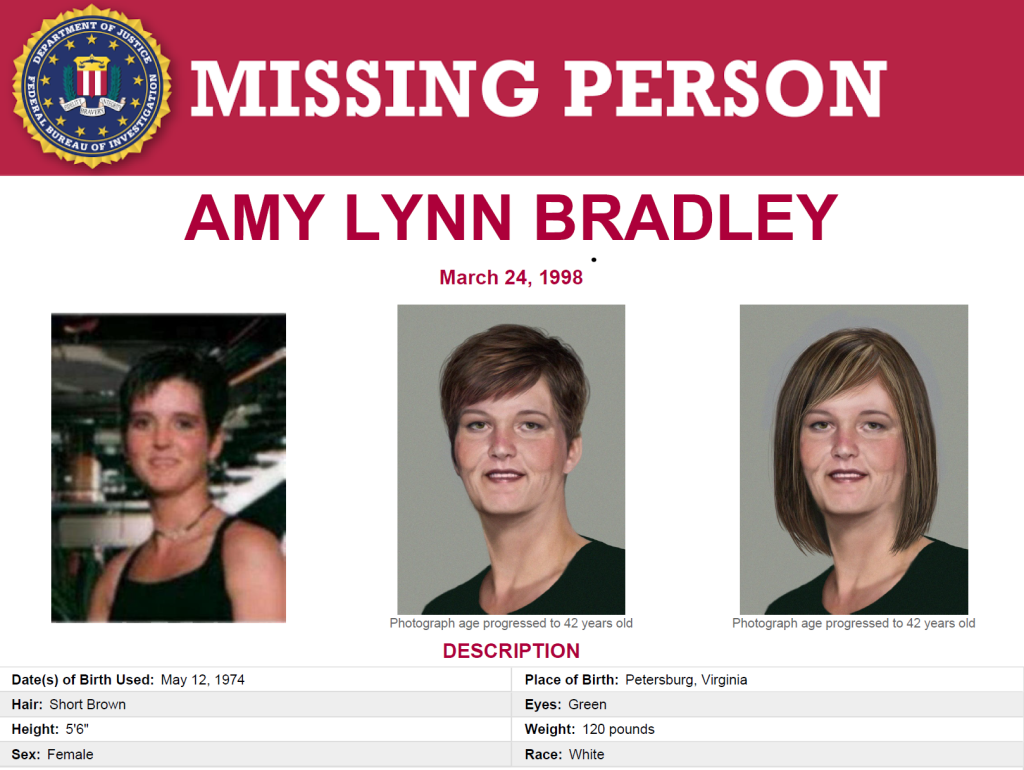
Age-progressed images released by federal investigators keep the search active — even decades later.
The case remains officially open. But open cases often sit in a quiet limbo unless:
a trafficker or associate talks,
someone recognises her from age-progressed images,
DNA intersects with a new database,
or Amy herself accesses a monitored digital space.
The “website activity” angle — where visits spike around family dates — is promising in theory, but difficult in practice. IP addresses traced to Caribbean waters could mean anything: tourists, criminals, traffickers, victims, or random coincidence. Modern OSINT firms could do more, but only with legal backing.
The FBI is still limited by jurisdiction. Private investigators are limited by access. And the Bradleys are limited by time and hope.
The question remains painfully open.
Did investigators ever prove that Amy Bradley was trafficked?
No. Trafficking remains a possible explanation, but no agency — including the FBI — has ever confirmed it. The theory gained traction because of unverified sightings, the Caribbean brothel claim, the staged Navy SEAL scam, and the shipboard witness who said she heard “Señorita kidnapped.” None of this proves trafficking occurred. It simply shows how quickly speculation can fill the gaps left by weak early evidence and unclear jurisdiction.
Why didn’t Amy Bradley try to escape if she was being held?
Survivors of long-term captivity consistently describe a mix of fear, psychological control, shame, and dependency that can feel stronger than physical barriers. Adults like Colleen Stan, Michelle Knight, and Amanda Berry had moments where escape looked possible — yet trauma and coercion made action nearly impossible. If Amy were alive in a controlled environment, the same psychological dynamics could suppress escape far longer than many assume.
If Amy accessed her family’s website, why couldn’t investigators trace the IP address?
They did trace certain hits — including one to a vessel near Barbados — but identifying a specific person behind an IP is rarely straightforward. Boats move between jurisdictions, onboard devices may use shared networks, and VPNs or satellite relays complicate geolocation. Even today, tracing a single website visitor doesn’t automatically reveal identity, motive, or proximity to a missing person.
Why didn’t the FBI or the Bradleys stay in Curaçao longer?
The family had no legal authority to search private property, interrogate suspects, or enter brothels. The FBI’s reach was also limited because the ship flew a foreign flag and the disappearance occurred in international waters. Remaining indefinitely on the island would have created emotional presence, but not investigative power. Without jurisdiction, resources, or institutional backing, staying permanently was not a realistic or effective strategy.
Could Amy have disappeared voluntarily?
It’s possible, and the psychological context matters. College friends have noted she was exploring her identity, navigating a same-sex relationship, and feeling the pressure of major life changes. Some adults do choose to disappear when faced with emotional turmoil, family expectations, or identity conflict. That doesn’t make it the most likely theory — only one that cannot be dismissed simply because it feels uncomfortable.
Why did so many people report seeing her if none were confirmed?
Eyewitness testimony in missing-person cases is notoriously unreliable, especially across languages and cultures. People often genuinely believe they’ve seen someone familiar, even when they haven’t. Confirmation bias, hope, guilt, and media exposure amplify this effect. In Amy’s case, the Navy officer, the brothel photo, and various island sightings all fueled speculation — but none reached evidentiary thresholds that investigators rely on.
Is there any realistic chance Amy Bradley is alive today?
There is no confirmed evidence either way. Historically, some adults have resurfaced after a decade or more. Others remain missing forever. The lack of remains, the unverified sightings, the psychological factors, the maritime failures, and the unique vulnerabilities of cruise-ship disappearances all keep multiple theories open. The most honest answer is that several scenarios remain plausible — and none can be ruled out with certainty.
For readers seeking verified information or wishing to view the Bradley family’s official updates, you can visit Amy’s dedicated missing-person website at: 👉 https://amybradleyismissing.com/
(This site is maintained by her family and provides official case details, images, and contact information.)
People often learn Amy Bradley’s name from a missing-person poster: the green eyes, the distinctive tattoos, the smile her family hasn’t seen in years.
But many only begin to understand the emotional reality of her disappearance when hearing her brother describe life lived in uncertainty. He has spoken about nights when sleep didn’t come easily, about thousands of messages that arrive through tip lines and inboxes, and about the strange mixture of grief and hope that settles in when a case refuses to close.
His reflections echo something experts in long-term missing-person cases often note: families don’t live in the past — they live in a constant present, waiting for information that might change everything.
When someone vanishes without explanation, especially in a setting as transient and complex as a cruise ship, the search takes on a life of its own. Families field tips from around the world, some useful, some confusing, some simply cruel.
They sift through photos strangers send them, compare handwritten notes, and navigate online speculation that grows more intense as technology makes misinformation easier to produce.
They turn to law enforcement for answers, only to find that the official process can move slowly — not because the case is forgotten, but because international disappearances bring layers of legal and diplomatic barriers that few outsiders ever see.
Amy Bradley’s case sits in the rare category that investigators approach differently: disappearances where the victim may still be alive. This doesn’t rest on hope alone.
It rests on decades of observations documented by the U.S. Department of State, the National Center for Missing & Exploited Children (NCMEC), and federal task forces that specialise in transnational crime.
These institutions recognise that trafficking victims often move between countries without leaving a traditional forensic trail. In such cases, law enforcement must consider survival as an active possibility.
This feature isn’t about retelling Amy’s disappearance. Instead, it uses her case — and the human experience surrounding it — to explain how trafficking investigations actually work, why they unfold slowly, and what it means when a case stays open for decades.
Most missing-person cases begin with simple questions: Did the person walk away voluntarily? Did they have reason to leave? Was an accident involved? But trafficking cases complicate every assumption investigators might otherwise rely on.
According to the United Nations Office on Drugs and Crime (UNODC) and the U.S. Department of Homeland Security (DHS), trafficking victims often:
move between several countries
appear in locations with transient populations
lack the ability to reach out safely
live under coercion that prevents self-identification
rely on others to speak on their behalf
These patterns change the entire investigative approach. Law enforcement agencies must look beyond immediate geography and consider the possibility of forced movement, offshore activity, and organized criminal networks that operate discreetly.
That’s why cases like Amy Bradley’s — involving a disappearance at sea and the possibility of trafficking — remain open for so long. The absence of a body isn’t a gap. It’s a signal that the search must continue.
For the public, late-arriving sightings may seem unlikely or unhelpful. Investigators disagree. They know that survivors of trafficking are often seen fleetingly, in controlled environments, or by travelers who don't realise the importance of what they witnessed until years later.
Agencies evaluate these accounts based on:
Consistency of physical description
Features that rarely change — scars, tattoos, gait, posture — hold more value than age or hairstyle.
Geographic patterns
Many Caribbean and coastal trafficking routes have been documented for years by agencies like INTERPOL and the International Maritime Organization.
Environmental context
Credible sightings often occur in airports, bars, or port-adjacent areas where traffickers operate with mobility.
Independence of witnesses
Unrelated individuals recalling similar details is more significant than volume alone.
A single sighting rarely shifts an investigation. But several, clustered in regions known for transient trafficking activity, can prompt renewed reviews or targeted outreach.
This is why law enforcement encourages the public to share information even long after a disappearance has occurred. Time does not erase clues. Sometimes it clarifies them.
People imagine trafficking cases unfolding in physical spaces — ports, vessels, tourist hubs. But in modern investigations, digital footprints carry extraordinary weight.
Agencies may review:
unusual traffic to dedicated missing-person websites
IP locations connected to sudden spikes in searches
uploads that require forensic imaging analysis
metadata on photos or videos sent anonymously
patterns of online interest that correlate with particular regions
Digital forensics units, whether within the FBI or specialised state task forces, treat these data points as puzzle pieces. One piece rarely solves anything alone. But when paired with geographic information, behavioural patterns, or witness memories, digital anomalies can narrow focus.
Families notice these patterns too. They see suspicious messages, unexpected visits to memorial pages, and AI-generated videos that mimic credibility but offer nothing of value. Sorting through this noise requires emotional resilience, technical guidance, and a willingness to embrace uncertainty.
For cases like Amy Bradley’s, the online world is not merely background chatter — it is an evolving investigative landscape.
Late-arriving witnesses are a hallmark of trafficking investigations. The reasons vary:
fear of retaliation
shame for not speaking earlier
misunderstanding what they saw
language barriers
misplaced confidence that someone else reported it
social pressure from bystanders or employers
Law enforcement recognises that delayed testimony is not inherently unreliable. In fact, a study published by the U.S. Office for Victims of Crime notes that trauma, shame, or coercion often delay disclosure in trafficking and maritime crimes.
When new witnesses emerge, investigators assess:
whether the sensory details align with established facts
whether the timing and location match known movement patterns
whether descriptions of uniforms, accents, or behaviour reflect authentic shipboard or port environments
whether the account reinforces earlier, independent testimonies
People often underestimate how much they remember. One detail — a piece of clothing, a phrase in another language, a location inside a ship — can help investigators anchor a timeline or rule out false leads.
👉👉 If you missed the full investigation, you can read it here:
Fact-Checking Amy Bradley Is Missing: What’s Real, What’s Missing, and What Still Doesn’t Add Up
Families navigating long-term disappearances carry a kind of pressure the public rarely sees. They act as unofficial investigators, archivists, researchers, communicators, and advocates — roles they never asked for but cannot step away from.
Amy Bradley’s family has spoken about the emotional weight of sorting through thousands of messages, of trying to identify what is meaningful and what is harmful. They have described the frustration of misinformation, including AI-generated claims that spread quickly before they can respond. They’ve also expressed the exhaustion of trying to understand where official investigations stand when federal files remain sealed in open cases.
This tension — wanting clarity, receiving little — is common. The FBI, like most federal agencies, restricts ongoing case files to protect witnesses, investigative methods, and potential prosecutions. Families understand the reasoning, even when the silence hurts.
Experts at the National Center for Missing & Exploited Children note that families in long-term cases often become the memory keepers of the investigation. Without access to official files, they shoulder the responsibility of tracking what has already been ruled out — an emotional and logistical burden few people outside this world can comprehend.
Yet families continue, because the alternative is to stop looking. And in cases without conclusive evidence of death, giving up is a choice they cannot make.
Disappearances on cruise ships introduce one of the most complicated legal challenges in international law.
Jurisdiction depends on:
the nationality of the victim
the nationality of the suspect (if any)
the ship’s flag state
where the ship was sailing
the country receiving the report
maritime treaties and bilateral agreements
A cruise ship may be U.S.-owned but registered in another country. It may sail between jurisdictions in a single day. It may employ staff from multiple nations. And while U.S. agencies can participate in investigations involving American citizens, they cannot conduct arrests or searches in foreign waters without cooperation from the relevant government.
The United Nations Convention on the Law of the Sea (UNCLOS) maintains that ships fall primarily under the responsibility of their flag state. This means that even when a disappearance affects an American citizen, U.S. authorities often work at the pace — and discretion — of another country’s legal system.
Understanding these constraints helps the public recognise why international missing-person cases move slowly. The pace isn’t personal. It’s structural.
Cases like Amy Bradley’s highlight gaps in safety and reporting procedures aboard cruise ships. Families in similar situations have advocated for reforms that feel intuitive to the public, such as:
alerts sent to all passengers when someone goes missing
independent, non-cruise-line security on ships
mandated reporting of crimes at sea
clear communication pathways between cruise lines and investigators
uniform safety procedures that apply across international waters
These discussions are not tied to any single case. They reflect broader questions about accountability in an industry that operates across borders with minimal oversight.
Experts in maritime law have long pointed to the need for consistent global standards. Without them, disappearances at sea remain vulnerable to jurisdictional gaps and uneven enforcement.
Long-term trafficking cases stay open for a reason. Federal agencies — including the FBI, DHS Homeland Security Investigations, and NCMEC — maintain that without conclusive evidence of death, a disappearance remains unresolved. Advances in digital forensics, international cooperation, and victim identification techniques continue to revive cases once thought dormant.
Families cling to this reality not because hope is easier than grief, but because evidence shapes the search. And in cases like Amy Bradley’s, the evidence has never provided a definitive endpoint.
What endures is a family still searching, a brother who speaks candidly about emotional exhaustion and determination, and the sense that in an interconnected world, one person’s memory or one overlooked detail could alter everything.
Trafficking investigations involving long-term disappearances are slow, intricate, and emotionally punishing — yet they are not without purpose. Every tip reviewed, every sighting considered, every anomaly examined reflects a foundational truth:
When a case still has unanswered questions, the search remains an act of justice, not hope alone.
When a disappearance happens in international waters, the legal rules shift in ways most families never discover until it’s too late. If you want to understand why cruise ships operate under a different set of laws — and what that means when violence occurs at sea — this in-depth guide breaks it down clearly:
👉 When Tragedy Strikes at Sea: Why Cruise Ship Homicides Follow a Completely Different Legal Playbook
Federal agencies keep these cases open because victims may still be alive under coercion. Trafficking networks often move people across borders, and long-term recovery is documented in many international cases. Without conclusive evidence of death, the investigation remains active.
Yes. Investigators analyse patterns across independent accounts, focusing on physical traits that rarely change, geographic overlap with known trafficking routes, and environmental consistency. A lone sighting may not mean much, but repeated details can.
Modern cases rely heavily on digital forensics. Unusual traffic to missing-person websites, IP anomalies, image metadata, and unexpected online searches can all prompt further review, especially when aligned with geographic or behavioural patterns.
Ongoing case files remain sealed to protect investigative methods, witnesses, and potential prosecutions. This is standard across federal law enforcement and applies even when cases are decades old.
They can. Increased visibility often leads to new tips, renewed witness interest, and international awareness. However, they also generate misinformation, which investigators must carefully sort through. The value lies in the quality — not the volume — of new information.
Simon Cowell has revealed he undergoes a wellness-clinic procedure where his blood is “rinsed” and “filtered,” prompting questions about the legality, regulation and medical safety of celebrity-driven anti-aging trends. His comments arrive just weeks before his new Netflix series launches, drawing fresh public scrutiny to unregulated biohacking practices.
Simon Cowell has ignited a fresh wave of controversy after admitting he regularly visits a wellness clinic where clinicians “rinse” and “filter” his blood — a claim he made in a new interview that immediately raised eyebrows among medical professionals and regulators.
The 66-year-old television mogul discussed the procedure during an interview with The Sun, describing how his blood is removed, cleaned and returned to his body, leaving him convinced he has “actually aged backwards.”
The revelation, delivered from Los Angeles ahead of the December 10 release of his new Netflix series Simon Cowell: The Next Act, sparked intense public reaction because the underlying treatment resembles apheresis, a medical procedure tightly controlled in hospitals but increasingly marketed by private longevity clinics.
Cowell’s remarks arrive at a moment when wellness-industry oversight is already under pressure, and when celebrity endorsement of unproven treatments can influence millions.
The legal stakes are significant: questions about regulatory compliance, medical claims, informed consent, and the limits of consumer protection laws.
Emotionally, Cowell’s confession also touches on his long-documented struggle with aging, cosmetic procedures and the pressures of life lived on-camera. And the hook is unmistakable — one of Britain’s most famous entertainment figures now finds himself at the centre of a growing debate about whether extreme anti-aging practices risk stepping beyond recognised medical safeguards.
Simon Cowell told The Sun that he undergoes a procedure in which blood is “taken out, rinsed, filtered and put back” into his body. He credited the treatment — combined with exercise, reduced stress and supplements — for allegedly lowering his “biological age.”
He did not name the clinic or the exact procedure, but his description resembles apheresis, a process used in medical settings to filter specific components of blood. Although increasingly promoted by high-end wellness centres, The Times has reported there are “no meaningful studies” showing anti-aging benefits.
Cowell also shared that he once considered cryogenic preservation but abandoned the idea after learning that some forms involve separating the head from the body. The disclosure follows earlier public discussions about cosmetic fillers and Botox, which he has since stopped after recognising the impact on his appearance and family.
The key legal question is whether extreme anti-aging treatments — especially those invoking medical terminology — are being marketed or performed within the bounds of health-care regulation. Procedures resembling apheresis fall under medical law, meaning providers must meet safety, licensing and clinical-standards requirements.
In plain English:
Clinics must use approved equipment, follow accredited protocols and ensure that qualified medical staff perform the procedure.
Claims about reversing aging, detoxifying blood or improving health must comply with advertising and consumer-protection rules.
Patients must provide informed consent and understand that benefits have not been scientifically validated.
Regulators typically examine safety, data transparency, and whether a clinic crosses into unlicensed medical practice.
What comes next procedurally depends on whether regulators receive complaints or questions from the public, medical associations or watchdog bodies. Investigations, if opened, tend to review clinical records, staff qualifications and marketing language.
No. Cowell’s comments describe what he personally underwent; the legal scrutiny, if any, would centre on the clinic providing the treatment rather than the celebrity receiving it.
His description aligns with apheresis, a medical procedure used to filter specific blood components. While medically legitimate in hospitals, its anti-aging use remains unproven and commercially controversial.
The Times has reported that no meaningful studies support claims of anti-aging or detoxification benefits. The scientific community generally views such wellness-clinic versions as unproven.
Potentially, yes — if regulators believed there were misleading medical claims, improper licensing or safety concerns. Any review would focus on clinical standards, advertising, and compliance.
Regulatory reviews vary widely. Some conclude quickly if documentation is in order; others take months if evidence or marketing claims require deeper analysis.
Cowell’s comments highlight a growing legal and medical gray zone where wellness marketing overlaps with regulated medical practice. For everyday consumers, the key principle is that procedures involving blood removal and reinfusion are not spa treatments — they fall under health-care law and must meet clinical standards.
Many people don’t realise that:
Medical-grade procedures require licensed professionals.
Claims about reversing aging or improving longevity must be supported by evidence.
Consumer-protection rules prevent clinics from overstating benefits or downplaying risks.
This case underscores why due diligence, evidence-based medicine, and regulatory oversight matter, especially in an industry where celebrity endorsements can blur boundaries.
Best-case scenario:
The clinic offering Cowell’s treatment is fully licensed, compliant and transparent, meaning no regulatory concerns arise and the matter remains one of public debate, not legal action.
Worst-case scenario:
If regulators find misleading claims, improper licensing or substandard practices, they could issue warnings, fines, or require operational changes. These actions would target the provider, not Cowell.
Most common outcome in similar cases:
Authorities typically monitor but take no action unless there are specific complaints or evidence of wrongdoing. Public scrutiny alone often prompts clinics to update disclaimers or marketing language.
Is Simon Cowell promoting the procedure medically?
He described his personal experience but did not make clinical claims. The medical validity remains unproven.
Is apheresis legal?
Yes, when performed by licensed professionals for approved purposes. Its use as an anti-aging therapy is legal only if clinics comply with health-care regulations.
Can wellness clinics legally offer blood-filtering treatments?
They may, but only under strict medical oversight and with accurate, non-misleading advertising. Regulations vary by jurisdiction.
Is cryogenic freezing legal?
Cryogenic preservation is legal in several countries but remains scientifically unproven and heavily debated, with no guarantee of future reanimation.
👉 Latest Legal Deep Dive: Could Kurt Iswarienko Face Consequences for Ignoring Shannen Doherty’s Divorce Settlement? 👈
Simon Cowell’s viral admission throws a spotlight on the fast-expanding — and lightly regulated — world of high-end anti-aging clinics. Legally, the focus falls not on Cowell but on the providers who perform blood-based treatments and the advertising claims they attach to them.
At this stage, there is no suggestion of wrongdoing, but the episode highlights how quickly celebrity wellness trends can collide with medical-regulatory boundaries. As public interest surges, the next developments will depend on whether medical bodies or regulators move to examine the safety and marketing surrounding these procedures.
Shannen Doherty’s estate has accused her ex-husband, Kurt Iswarienko, of failing to follow several financial and property-related obligations set out in their divorce settlement—an agreement both parties signed at the very end of her life. The public headline is clear, but the real question beneath the surface is far more complicated: What actually happens when someone refuses to comply with a court-approved marital settlement, especially after one spouse has passed away?
This deep dive examines the legal pathways, enforcement tools, and risks someone in Iswarienko’s position may face if the allegations are accurate.
Readers don’t just want the latest development—they want to know what it means. When a story involves a missed payment here or an unreturned item there, it’s easy to shrug it off. But when it touches on a $1.5 million property, withheld proceeds, and legally mandated asset transfers, the stakes shift sharply.
The case also raises a highly relatable question: If a court says you must do something in a divorce—sell a home, return property, pay money—what happens if you simply don’t? Most people never witness what enforcement looks like, and celebrity divorces add layers of complexity that news blurbs never unpack.
That’s why this is the central unresolved issue: Iswarienko’s alleged noncompliance isn’t just a personal dispute—it’s a matter of enforceable law.
:max_bytes(150000):strip_icc():focal(749x0:751x2):format(webp)/shannen-doherty-kurt-iswarienko-112825-267b1e06724f45c4b6e1f949e971a932.jpg)
Shannen Doherty's Ex Husband kurt iswarienko Ordered to Pay Her Estate
Most reports describe the missed obligations but stop short of explaining consequences. They don’t clarify:
What legal mechanisms the estate can use to force compliance
Whether ignoring a marital settlement can lead to contempt of court
How the trustee of Doherty’s estate can pursue enforcement
Whether failure to sell a property or return personal effects exposes someone to additional civil penalties
What a judge can do when one party refuses to participate or even be located
Without this context, readers are left with an incomplete picture. The missing piece is the enforcement structure that governs divorce settlements after they are approved by a court.
A marital settlement agreement (MSA) is not a loose arrangement—it is a binding contract that becomes a court order once a judge approves it. Under California law, which governed Doherty’s divorce, MSAs are enforceable through multiple avenues:
If a party willfully violates a court order, the judge can find them in contempt. This is one of the strongest enforcement tools because it carries penalties ranging from fines to, in extreme cases, jail time. Courts rarely take it that far, but they do use contempt to compel action.
If someone fails to pay a required sum, the owed amount can be converted into a money judgment. Under California law, unpaid judgments accrue 10% annual interest, which becomes especially significant with six-figure obligations.
If the dispute involves real property—like a $1.5 million home—courts can authorize liens or even appoint a third-party receiver to take control of the asset and carry out the sale.
The law is clear: the death of one spouse does not dissolve the obligations of an MSA that has already been signed and approved. Instead, those obligations pass to the estate. California’s Probate Code allows the executor or trustee to:
Enforce unpaid obligations
Demand the return of property
Seek court intervention
Recover additional damages for noncompliance
This means Doherty’s estate has the same legal standing she would have had while alive.
While no experts were interviewed for this piece, legal scholars who write about divorce enforcement tend to emphasize several recurring points:
Analysts generally note that once a marital settlement becomes a court order, ignoring it is not treated lightly. Courts prioritize finality in divorce cases and are typically unwilling to let one party unilaterally rewrite the terms.
Family law attorneys often point out that failing to cooperate with the sale of a home or the return of property is one of the most common forms of post-divorce conflict—and courts routinely intervene by appointing neutral parties to carry out the required actions.
Legal scholars also emphasize that estates have broad authority to enforce obligations because the alternative would allow parties to avoid financial responsibilities through delay or strategic inaction.
Financial analysts sometimes observe that disputes involving shared assets (like airplanes, business interests, or intellectual property) often escalate quickly because delay can affect valuation, tax obligations, and estate accounting duties.
Taken together, the general expert consensus is that noncompliance triggers escalating legal consequences rather than quietly fading away.
This section is interpretation, not fact. The precise moves depend on filings, court schedules, evidence, and judicial discretion. That said, several likely scenarios emerge based on how California courts typically handle cases like this:
A judge could order Iswarienko to:
List the Texas property for sale
Turn over all remaining personal items
Produce and/or return any photographs or IP
Pay any outstanding financial obligations with interest
Courts often give strict deadlines once they intervene.
Any unpaid amounts could be reduced to a judgment that accrues interest. If the estate proves willful noncompliance, the court may also order attorney’s fees to be paid.
If Iswarienko continues to refuse to sell the home, the court can appoint a receiver—a neutral third party empowered to list, market, and sell the property without his cooperation.
If the court believes orders were intentionally ignored, it can initiate contempt proceedings. That is rare but not unheard of in contentious or high-value cases.
If Iswarienko cannot be located, or if he contests aspects of the settlement, the case could stretch out significantly. Estates are legally required to pursue assets owed to them, so inaction is unlikely.
👉 Confused about what actually qualifies as harassment under U.S. law?
Yes. Once the agreement is approved by a court, failing to comply can lead to monetary judgments, interest, liens, and in some cases contempt of court.
If both parties signed and the court finalized it, the obligations survive the death of a spouse. The estate becomes the party entitled to receive assets or payments.
Courts can compel the sale of jointly owned property, appoint a receiver, or issue liens if a party blocks the required sale.
The court can order its return, impose sanctions, or award the value of the property plus additional damages if it was withheld in violation of the settlement.
Family law noncompliance is generally handled civilly, not criminally. However, contempt of court—if ordered—carries penalties that can include fines and, in rare cases, jail.
Judgments can be enforceable for many years. California allows renewals of money judgments, meaning estates can continue enforcement until obligations are satisfied.
Dutch prosecutors have charged two brothers with the honour-related killing of their 18-year-old sister, prompting questions over safeguarding decisions and the inability to return a primary suspect now believed to be in Syria.
Dutch authorities have launched an honour-killing trial in the Netherlands involving the death of 18-year-old Ryan Al Najjar, with prosecutors alleging that her brothers Mohamed and Muhanad Al Najjar participated in the killing after she was restrained, gagged, and left in a swamp area in Lelystad.
Prosecutors say the case centres on actions linked to perceived “shame,” leading investigators to classify the incident as an honour-related crime. The investigation escalated on 28 May 2024, when Ryan’s body was recovered six days after she was reported missing from her family home in Joure.
The father, Khaled Al Najjar, is being tried in absentia after leaving the country for Syria. The central legal issues concern potential coordinated involvement, the adequacy of earlier police-protection decisions, and the limitations of cross-border criminal cooperation. The Public Prosecution Service and the Ministry of Justice and Security are the main authorities overseeing the case due to its implications for public safety and honour-based-violence prevention.

A court sketch of suspects Mohammed, right, and Muhanad Al Najjar, accused of helping their father kill their sister. The men have insisted their father acted alone
Prosecutors have classified the killing as honour-related, raising legal questions around alleged premeditation, complicity, and whether safeguarding measures discontinuing her police protection met national standards.
The Public Prosecution Service is leading the case, with the Ministry of Justice and Security responsible for oversight and international-cooperation issues. The matter carries public-safety significance because it highlights risks in honour-based violence prevention, the adequacy of protection measures, and the constraints on pursuing suspects across borders.
Prosecutors state that Ryan Al Najjar was reported missing on 22 May 2024 and was found deceased on 28 May in a swamp area in Lelystad. Forensic examination documented her hands restrained behind her back, her ankles taped, and a gag present, with drowning identified as the cause of death. Investigators also recorded her father’s DNA under her fingernails.
Authorities allege that the father instructed his sons to transport her to an isolated location and place her in the water while she was unable to free herself. Prosecutors have classified the incident as an honour killing based on evidence that relatives viewed her behaviour as bringing “shame” on the household.
The brothers were arrested shortly after the recovery of the body and remain in custody. Their father left the Netherlands before his arrest and is believed by Dutch broadcasters to be in northern Syria.
The Ministry of Justice and Security has said that criminal-cooperation mechanisms with Syria are not operational, while Syrian officials have publicly disputed this and stated that no request from the Netherlands has been received.
Under Dutch criminal law, courts assess whether the alleged conduct meets thresholds for premeditated murder, participation, or aiding and abetting. Participation may cover transporting a victim, restraining them, or carrying out actions knowing they are likely to result in death.
Safeguarding decisions are also in focus. The ending of protective measures is typically subject to documented risk assessments under the Dutch Duty of Care principles and EU standards on protection of persons at risk of gender-based violence.
International-cooperation constraints influence whether suspects abroad can be returned. Extradition requires the existence of functioning bilateral or multilateral frameworks, which Dutch authorities state are absent in relation to Syria.
👉 Further Reading: Understanding Duty of Care: The Hidden Legal Principle That Protects You Every Day 🇬🇧🟨 👈
According to Dutch police and specialist intervention units — data compiled in the Dutch government–supported Honour-Based Violence Factsheet published by HuiselijkGeweld.nl — the scale of suspected honour-related violence in the Netherlands is significantly larger than the small number of cases that ultimately reach a courtroom. Each year, authorities register an estimated 2,500 to 3,000 suspected “family honour” offences, ranging from threats and coercion to forced marriage, assault, and severe domestic control. Of these, approximately 460 cases are considered serious enough to be referred to the country’s national expert centre on honour-related violence (LEC Eergerelateerd Geweld).
Within that group, investigators identify between 7 and 17 fatal incidents annually, including murders, attempted murders, manslaughter, and cases where extreme coercion contributes to suicides. These figures highlight a critical point in the national discussion: while honour-based killings represent only a fraction of the total caseload, they emerge from a much wider system of family-imposed control, escalating abuse, and community pressure that frequently remains hidden or under-reported.
Honour-related killings fall within gender-based violence frameworks recognised by the United Nations and the Council of Europe. States have obligations under the European Convention on Human Rights to safeguard life and to take reasonable steps to protect individuals at credible risk.
UNODC and OSCE guidance emphasise detection of coercion, family-based threats, and escalating patterns of control. Where protective measures are withdrawn, oversight bodies often review whether the decision met minimum risk-assessment standards.
Community safety considerations include the ability of systems to identify and respond to honour-based threats, the need for specialised police capability, and ensuring that vulnerable individuals receive consistent protection regardless of cultural or familial context.
Dutch police are responsible for gathering the evidence that underpins a case like this, from recovering the body and documenting restraints to analysing digital data and prior reports involving the family. In honour-related killings, officers may be expected to review earlier safeguarding files and assess whether warnings or threats were recorded before the victim’s death.
Prosecutors then decide which charges to bring and whether the available evidence supports trying a suspect who has left the country in absentia. When a suspect is believed to be abroad, police and prosecutors can issue international alerts or legal-assistance requests, but any follow-up depends on whether a real cooperation channel exists with the state concerned.
Regulators and oversight bodies can later look at how protection decisions were made, including why any police safeguarding measures were downgraded or ended. Their role is to assess whether Dutch duty-of-care and risk-assessment standards were properly applied and to identify where guidance or practice may need to change.
Honour-based killings carry a deeper public impact than a single criminal case. They raise immediate questions about whether vulnerable people are being seen, heard, and protected when warning signs appear. When someone known to be at risk ends up dead, trust in safeguarding systems takes a hit—not in an abstract way, but in a way that families and communities feel personally.
The limits of cross-border cooperation add another layer of tension. If a key suspect can leave the country and remain outside reach because cooperation channels are stalled or disputed, it creates a clear gap in accountability. That gap isn’t theoretical; it shapes how future victims understand their own safety and whether the system can respond when danger comes from within a family.
This case is already influencing how authorities think about honour-based violence: who is flagged, how risk is understood, and whether protective measures last long enough to make a difference. It underscores how easily coercion, family pressure, or hidden threats can escalate—and why the public expects clearer, faster, more reliable intervention.
Prosecutors classify a killing as honour-related when evidence indicates the motive involved perceived violations of family expectations or reputational concerns. The designation is based on motive, not cultural or religious attribution.
Authorities have not disclosed the specific reasoning. In general, protection may be discontinued following risk assessments, which may later be reviewed to determine whether procedures complied with duty-of-care standards.
Dutch law permits trials in absentia when a defendant cannot be returned through recognised international-cooperation mechanisms. The accused retains rights if later apprehended.
Dutch authorities state that legal-cooperation structures with Syria are not currently operational. Extradition requires mutual legal-assistance frameworks and functioning justice institutions recognised by both parties.
DNA forms part of a wider evidentiary record. Courts assess context, transfer possibilities, and corroborating material before drawing conclusions.
Police investigators are working through the forensic record, location data, and communications to build a clear picture of what happened in the days before and after Ryan disappeared. In cases linked to honour-based motives, officers also review earlier reports, family conflicts, and any documented warnings to understand whether the threat escalated.
Prosecutors move forward once they believe the evidence meets Dutch charging standards, combining forensic findings with interviews and digital records. When a suspect leaves the country, authorities can issue notifications internationally, but meaningful action depends on whether cooperation with the other state is operational.
Oversight bodies may later look at how earlier safeguarding decisions were made — whether risk indicators were recognised, whether information was passed between agencies, and whether protective measures followed national guidelines. Those reviews often determine whether systems worked as intended or if changes are needed.
The case centres on allegations of coordinated involvement in an honour-related killing and the limitations of Dutch authorities in securing the return of a suspect abroad. It raises structural questions about safeguarding processes, evidence thresholds, and international-cooperation capacity. The proceedings will influence wider discussions on the state’s duty to protect individuals at risk of honour-based violence and the mechanisms available for cross-border accountability.
👉 Further Reading: Extradition Limits and Cross-Border Justice in Europe 👈
A leaked Ministry of Justice memo has revealed plans to shift most criminal cases carrying potential sentences of up to five years from jury trials to judge-only hearings. The proposal—now reportedly being scaled back following intense political and legal backlash—aims to reduce the severe Crown Court backlog but has drawn scrutiny because it would significantly curtail the long-standing role of juries in England and Wales.
The Government was thrown into chaos this week after a confidential Ministry of Justice briefing revealed that Justice Secretary David Lammy had approved proposals to remove jury trials from the overwhelming majority of Crown Court cases. The plan, which surfaced only 48 hours ago, outlined a major structural reform: criminal cases with a possible sentence of up to five years would be decided by a judge sitting alone, with juries reserved only for the most serious offences.
The leak triggered immediate uproar across Parliament, the judiciary and the criminal bar. Senior MPs accused the Government of “constitutional vandalism,” while legal commentators warned that shifting up to 95% of trials to judge-only hearings would fundamentally alter the balance of public participation in justice.
Amid the backlash, new reports now suggest ministers are preparing to scale back the reforms, signalling uncertainty at the heart of government policy. For lawyers, defendants, victims and court administrators, the stakes are high: the proposals are designed to tackle a backlog exceeding 78,000 Crown Court cases, yet may reshape centuries of jury tradition.
The leaked policy document proposes:
A new Crown Court Bench Division (CCBD) to hear cases usually attracting sentences of up to five years.
Judge-only trials for the majority of non-fatal, non-sexual offences currently tried before juries.
Retention of juries for murder, rape, manslaughter and a narrow set of “public interest” cases.
A new allocation system, under which judges would triage incoming cases and determine whether jury trial is necessary.
If implemented, this would mean:
Most Crown Court cases currently waiting for trial would no longer be sent to juries.
Only the most serious cases would remain in the traditional Crown Court structure.
Enforcement would fall under new procedural rules and potentially a primary Act of Parliament.
The reforms represent a significant departure from current law, where juries hear serious indictable offences unless a defendant elects otherwise or the case is transferred downward.
The Government argues the proposals are a response to:
A record Crown Court backlog, with tens of thousands of cases delayed for years.
Victims withdrawing, particularly in sexual offence cases where long delays lead to emotional and evidential collapse.
Concerns about system capacity, following years of courtroom closures, judicial shortages and underfunded legal aid.
A belief that judge-only trials could deliver faster, more predictable outcomes.
Officials also referenced earlier recommendations from senior judicial figures calling for structural reform to prevent the criminal courts from reaching crisis point.
However, critics argue the reforms address symptoms, not causes — and that jury trials are not the reason delays exist.
The proposal fits within the realm of criminal procedure and administrative law, where Parliament is free to determine how serious offences are tried, provided fair-trial rights remain intact.
Key points:
Jury trials are not constitutionally guaranteed in the UK, though they hold deep historical weight.
Article 6 of the ECHR allows judge-only trials if they are fair, independent and proportionate.
Courts typically examine whether a defendant retains:
access to evidence,
the right to challenge witnesses,
an impartial tribunal,
and appeal rights.
Similar judge-only models exist internationally, especially for fraud and technical cases.
If passed, the reforms would create a dual-tier system requiring new compliance protocols, judicial training and clear allocation rules to avoid arbitrary decision-making.
For law firms, insurers and litigation-support companies, the reforms would reshape:
Case strategy — less emphasis on narrative persuasion, more on legal and evidential precision.
Workflows — earlier document review, tighter case preparation and increased reliance on expert evidence.
Budgets — potentially shorter hearings but heavier front-loading of work.
Corporate defendants in fraud or regulatory matters may face faster trial dates, altering settlement and risk-management strategies.
A new judge-only system would also increase scrutiny on judicial decision-making, with appeal routes expected to become more active and more closely monitored.
For the public, the consequences are far-reaching:
Fewer opportunities for jury service, reducing direct civic engagement in criminal justice.
Faster case resolution, which could help victims gain closure sooner.
Concerns about fairness, particularly for defendants from under-represented communities who may trust juries more than judicial decision-makers.
Debate over discrimination, given research suggesting juries tend to show less racial bias than other parts of the system.
For victims, defendants and witnesses, the question is whether speed should prevail over tradition and perceived legitimacy.
Under the leaked proposals, the default for mid-level offences would be judge-only. Only the most serious cases would retain automatic juries unless Parliament inserts a right to request one.
The UK does not have a constitutional right to a jury, but jury trials are a long-standing safeguard. Any reform must still satisfy fair-trial standards and be proportionate to the crisis it aims to solve.
Yes. Technical cases such as complex fraud are among those likely to move to judge-only hearings, a change some judges have previously supported for efficiency.
Possibly. Concentrating decision-making in a single judge may produce more appeal challenges, especially on findings of fact.
No. The proposals apply only to England and Wales, not Scotland or Northern Ireland.
The Ministry of Justice says no final decision has been taken. The expected next steps include:
internal Whitehall negotiations,
potential announcement of a scaled-down proposal,
publication of a policy paper or draft Bill,
committee scrutiny in both Houses,
formal Parliamentary debate and possible amendments,
development of procedures for judicial allocation and appeals,
phased implementation if legislation passes.
Given the political backlash, significant revisions are likely before any Bill is introduced.
Is this an emergency measure?
No. Any reform would require legislation, meaning it would become a permanent structural change unless later repealed.
Are juries being abolished?
No, but their role would be sharply reduced. Jury service would remain only for the most serious offences.
What prompted the backlash?
Lawyers, judges and MPs argue that removing juries risks miscarriages of justice and undermines public trust in criminal verdicts.
Does this reduce discrimination?
Some MPs argue the opposite, noting that juries have historically shown lower levels of racial bias than other justice processes.
David Lammy’s leaked jury-trial reforms mark one of the most consequential modern debates on how criminal justice should function in England and Wales. They aim to solve a severe backlog but raise fundamental questions about fairness, tradition and public legitimacy. The proposals affect defendants, victims, legal practitioners and the wider public, and any enacted version would permanently reshape criminal procedure.
The Government is already reconsidering the scope of its plan, but the direction of travel is clear: the balance between efficiency and public participation is being renegotiated. What Parliament decides next will determine whether the UK’s 800-year-old jury tradition remains central to justice or evolves into a narrower, more symbolic role.
👉 When Countries Say No: The Legal Grounds That Let Nations Reject Extradition Requests 👈
Cat Deeley was left visibly stunned on This Morning when Peter Kay paused mid-interview to call out her habit of repeatedly responding during guest segments, a moment that immediately thrilled viewers online. The exchange happened as Kay discussed donating all profits from his Better Late Than Never tour to 12 cancer charities, sparking a wave of social media reaction. Under Ofcom’s Broadcasting Code, presenter conduct and treatment of guests are closely watched, which is why moments like this can quickly draw public scrutiny.
Cat Deeley’s morning took an unexpected turn on Thursday when a light-hearted chat on ITV’s This Morning suddenly shifted into an uncomfortable live-TV moment. Peter Kay, appearing to promote the final run of his Better Late Than Never charity tour, stopped mid-sentence as he listed the 12 cancer charities receiving the tour’s profits.
Sitting alongside Ben Shephard in the London studio, the comedian paused, glanced over, and told viewers he wasn’t laughing at “bowel cancer” — but at Deeley’s repeated “yeah” responses after every charity name.
It happened just after 10 a.m., and the reaction was instant. Social media lit up with viewers saying a guest had “finally called her out,” reigniting months of criticism about Deeley speaking over contributors.
What matters now is that this clip has become a flashpoint in the ongoing conversation about presenter responsibility, tone, and respect on daytime television. While there is no complaint or investigation, this is the kind of moment that often snowballs into broader scrutiny of broadcasting standards — especially when health-related charities are involved and emotional sensitivity is expected on air.

The presenter, who co-hosts the ITV daytime series alongside Ben Shephard, was joined by comedian Peter Kay to discuss his Better Late Than Never tour.
Peter Kay, 52, appeared live on ITV to discuss the expansion of his charity-focused comedy tour. As he read from a list of cancer charities set to receive the profits, Cat Deeley responded “yes” after each name.
Kay briefly stopped, smiled, and clarified to viewers that he wasn’t laughing at any of the causes but at Deeley’s interjections. Deeley blushed and looked away as Ben Shephard stepped in, calling the habit “active listening.”
Viewers quickly posted the clip online, many arguing that Deeley has a pattern of interrupting guests. Past criticism has centred on interviews and cooking demonstrations where she has spoken over contributors.
No Ofcom complaint has been filed, and ITV has not issued a statement. The incident remains one of public debate, not regulatory action.
This is not a legal dispute, but it does sit squarely within the framework of UK broadcasting regulation. Under Ofcom’s Broadcasting Code, presenters must ensure guests are treated fairly and with due respect, particularly when discussing sensitive subjects such as cancer charities. Tone and conduct matter because viewers expect composure, accuracy, and calm handling of emotional content.
Regulators look at intention, impact, and context. Live TV naturally includes unpredictable moments, but broadcasters must still maintain editorial control. If viewer concerns escalate, Ofcom may review whether the programme upheld standards of fairness and audience expectation.
The process is straightforward: Ofcom reviews clips, evaluates audience harm or concern, and determines whether the code was breached. No such process has begun here.
No. There is no evidence of misconduct rising to a regulatory threshold, and no complaint has been lodged with Ofcom. Online commentary does not trigger official action on its own.
Ofcom requires presenters to treat interviewees respectfully and ensure sensitive topics are handled with care. The rules focus on fairness, accuracy, and preventing unjustified offence.
Based on available facts, it is unlikely. Kay’s comment was humorous, and the conversation continued without disruption. No audience harm has been identified.
There is none. Viewer frustration relates to Deeley’s style rather than any failure of compliance or procedure.
Only if significant numbers of viewers file formal complaints. Without that, the matter remains a public-opinion moment rather than a regulatory concern.
Incidents like this help clarify how broadcasting oversight actually works. A viral clip does not automatically lead to legal or regulatory action; what matters is whether the content causes harm, misleads viewers, or treats guests unfairly.
Anyone appearing on live television — whether a public figure or a member of the public — benefits from Ofcom’s protections. The code ensures people are treated with dignity, that sensitive subjects are handled responsibly, and that broadcasters maintain standards even during moments of unscripted tension.
This also demonstrates how audience trust plays a major role. Public perception can influence whether complaints emerge, shaping how broadcasters respond and how regulators prioritise reviews.
Best-case scenario:
The moment remains a viral clip, Deeley takes it in stride, and Kay’s charity message stays in focus. The incident passes without further attention.
Worst-case scenario:
If a wave of viewer complaints arrives, Ofcom could conduct a standards review into tone and presenter conduct. Even then, this would be a process-based assessment, not punitive.
Most common outcome in similar cases:
The moment becomes part of the show’s ongoing social-media conversation, receives no regulatory intervention, and fades as news cycles move on.
👉 Has Your Reputation Been Attacked? UK Defamation Law Explained for the Public 👈
Did Peter Kay intend to embarrass her?
Nothing indicates malice. His remark appeared spontaneous and humorous, and the segment continued smoothly.
Has Ofcom said anything?
No. There has been no comment or involvement from the regulator.
Does this affect Peter Kay’s charity tour?
Not at all. His announcement about donating profits to 12 cancer charities remains unchanged.
Has Cat Deeley been criticised before?
Yes. UK media reports say viewers have previously expressed frustration about interruptions, but this has never led to regulatory action.
President Trump has now signed the Epstein Files Transparency Act, a law requiring the Department of Justice to release all of its Jeffrey Epstein–related files within 30 days. The legislation passed Congress with overwhelming bipartisan support and sparked public hopes that long-sealed documents will finally see daylight.
But the real question isn’t whether the files will be released — it’s what the government is actually allowed to release, and what the law quietly permits the DOJ to withhold. This analysis explores those fault lines.
For years, the Epstein case has lived in a strange space between criminal justice, intelligence rumor, sealed litigation, and institutional embarrassment. Anytime a public official says “release the documents,” people instantly imagine full transparency — names, travel logs, intelligence briefings, bank trails, everything.
But the U.S. government doesn't work that way. Even when Congress directs disclosure, other laws still set the boundaries. Grand jury materials are protected. Active prosecutions can’t be jeopardized. Victim privacy rules override political messaging. And classified intelligence — if any exists in the Epstein file set — is governed by entirely separate statutes.
So the public is asking the most rational question: Does this new law blow open the vault, or will it ultimately produce a heavily redacted, legally constrained release?
That gap between public expectation and legal reality is exactly where this analysis sits.
The initial reporting focused on the bill’s passage, political reactions, and Trump’s celebratory framing. What was not explained — and what matters far more — is the legal terrain the DOJ must navigate.
Specifically:
What categories of information legally cannot be disclosed, even under congressional mandate?
What counts as “Epstein-related” files? Internal memos? Email chains? Witness lists? Foreign intelligence referrals?
What happens to grand jury documents governed by Rule 6(e) of the Federal Rules of Criminal Procedure?
Are intelligence agency materials included, or are they exempt because they aren't held by the DOJ?
How are victim names, medical details, and sealed civil case records handled?
What about ongoing investigations triggered by the House Oversight subpoenas of J.P. Morgan and Deutsche Bank?
These omissions are not small. They shape the entire meaning of the law. Without them, the public has only half a story — and the half that remains unspoken is where the complexity lies.
Understanding what can and cannot be released requires an honest look at the laws that govern federal disclosure. Several are non-negotiable in their current form.
Rule 6(e) strictly restricts disclosure of grand jury testimony, witness identities, exhibits, or internal deliberations unless a federal judge authorizes it. Courts, not politicians, enforce these limits.
Congress can mandate disclosure of DOJ-controlled records, but as a practical matter, material covered by Rule 6(e) typically remains sealed even in landmark releases unless a court explicitly orders otherwise.
The Crime Victims’ Rights Act, along with longstanding privacy doctrines and related statutes, helps prevent disclosure of:
Names of minors
Identifying information
Medical or psychological records
Addresses, phone numbers, and personal history
Any file touching on Epstein’s decades-long pattern of abuse inherently contains such information. These elements will almost certainly be redacted or anonymized.
The DOJ is allowed to withhold information if disclosure would:
Interfere with active investigations or prosecutions
Reveal confidential techniques
Expose cooperating witnesses
The House Oversight Committee’s active financial investigation — including subpoenas to J.P. Morgan and Deutsche Bank — suggests that some materials may remain protected until those inquiries close or reach a different procedural stage.
If any portion of the Epstein files involved intelligence-sharing from allies (for example, the UK, France, or Israel) or internal counterintelligence assessments, those materials fall under:
The Classified Information Procedures Act (CIPA)
Executive Order 13526
Foreign government information protection obligations
In practice, such materials cannot be made public without going through a formal declassification or review process, even if Congress has passed a disclosure-focused statute.
Historical comparisons help set expectations:
The JFK Records Act took decades to fully implement, with repeated waves of releases and redactions.
The 9/11 Commission materials were published in stages, with sensitive sections withheld or heavily edited.
The Church Committee files are still partially redacted nearly half a century later.
These examples show that while Congress can demand transparency, the executive branch retains significant control over timing, redactions, and the scope of what is actually put in the public domain.
👉 Related: Who Is Clay Higgins, the Lone Republican Who Voted Against Releasing the Epstein Files? 👈
Legal and policy experts tend to converge on a few broad themes when it comes to large, politically charged document releases:
Analysts generally note that disclosure laws still operate within the boundaries of other federal statutes, which often limit how far any “release everything” promise can actually go.
National security specialists often point out that classified materials undergo multi-agency review, not unilateral release by a single official.
Victims’ rights advocates routinely emphasize that privacy protections are not optional, even in high-profile cases where public curiosity is intense.
Former DOJ officials frequently observe that “related files” can be interpreted narrowly or broadly, depending on how aggressively department leadership wants to lean into transparency.
In short: broad political language meets narrow legal reality. And those tensions determine what the public will actually see.
Here is the forward-looking landscape, clearly separating facts from analysis.
The DOJ has 30 days under the new law to release the files.
The department must still comply with federal privacy rules, grand jury secrecy, and classification laws.
Attorney General Pam Bondi has said the DOJ will continue to follow the law.
Lawmakers in both parties have signaled they will use oversight tools if they believe the law is being ignored or undermined.
Based on how previous large disclosures have unfolded:
A partial release with extensive redactions is the most realistic near-term outcome.
Internal DOJ memos, communications, and investigative notes are likely to remain withheld under longstanding deliberative and law enforcement privileges.
Financial records obtained under subpoena may be released in limited or summarized form, especially if they intersect with ongoing investigations into banks or third parties.
Any intelligence-related materials will undergo separate classification review, which typically slows and narrows disclosure.
Best-case transparency scenario (analysis):
A broad release of unclassified DOJ case files, including correspondence, investigative summaries, financial tracing, and internal communications that do not violate Rule 6(e), victim privacy protections, or classification rules.
Most probable scenario (analysis):
A heavily redacted document dump resembling previous high-profile releases (for example, parts of the JFK files or portions of the Mueller materials), with strong victim privacy protections and limited exposure of privileged internal records.
Political conflict scenario (analysis):
If lawmakers conclude the DOJ interpreted “Epstein-related” too narrowly, Congress may escalate through hearings, subpoenas, and potential litigation. Federal courts could eventually be drawn into defining the scope of the law and the boundaries of permissible redactions.
DOJ Leadership: Controls the redaction process and defines what is “related” for practical purposes.
Federal Courts: May be asked to resolve disputes over grand jury secrecy, classification, and withheld records.
House Oversight Committee: Already pursuing Epstein-related financial records and likely to test DOJ’s compliance with the new law.
The Intelligence Community: If its equities are involved, expect multiple layers of review and resistance to broad disclosure.
Survivors and Victims’ Advocates: Will scrutinize how well privacy is protected and whether institutions face meaningful accountability.
Possibly — but only where doing so does not violate grand jury secrecy, victim privacy protections, or restrictions tied to ongoing investigations. Even then, names may appear in redacted or limited form rather than as a comprehensive “list.”
Congress can require disclosure by statute, but it cannot easily sweep aside grand jury secrecy, classification rules, or victim protection laws without changing the underlying legal framework and likely facing judicial review. Courts have the final say in many of those areas.
That is highly unlikely. Federal law and long-standing practice protect victim identities, especially minors, and those protections typically take precedence over disclosure mandates in cases like this.
The law directs the DOJ to release the files it holds. If intelligence agencies possess their own Epstein-related materials, those would be governed by separate classification rules and are not automatically swept into this statute unless explicitly included.
Legally, the DOJ is required to comply with the deadline. In practice, extensive redaction review, classification review, or litigation over specific categories of records could create practical delays, even if the department claims to be acting in good faith.
