
Understand Your Rights. Solve Your Legal Problems
Recent legislative changes in Massachusetts and Rhode Island have quietly shifted employer obligations in hiring, pay, workplace accommodations, and employee classification—creating legal exposure even where no dispute or complaint has yet arisen. What looks like routine compliance reform now carries real regulatory, financial, and operational consequences for businesses that fail to adjust in time.
These changes matter not because they signal wrongdoing, but because they alter what the law now requires—and what regulators and employees can act on immediately.
At the core of these updates is a broader shift in employment law away from reactive enforcement and toward front-loaded accountability. Employers are now expected to disclose pay information proactively, document employment terms at the outset, accommodate newly recognised medical conditions, and respect expanded worker protections without waiting for a dispute to surface.
Crucially, many of these obligations attach regardless of intent. A failure to update job postings, onboarding paperwork, or internal policies can trigger regulatory scrutiny, employee complaints, or civil exposure even where wages are paid correctly and no discriminatory motive exists.
This reflects a legal environment in which compliance failures are treated as stand-alone violations, not merely evidence of deeper misconduct.
In Massachusetts, pay transparency rules now require covered employers to disclose salary ranges in job postings and provide pay range information during promotions or upon request. That obligation reshapes recruitment practices and limits discretion in compensation discussions. Even absent pay inequity, inconsistent disclosures can expose employers to enforcement action or reputational risk.
Rhode Island’s changes go further by expanding what counts as a protected workplace condition. The extension of reasonable accommodation requirements to include menopause-related symptoms introduces a new compliance category for employers who may not previously have treated such requests as legally protected. Failure to respond properly can trigger discrimination claims without any adverse employment action beyond denial or delay.
Other updates—such as expanded employee definitions covering student workers, restrictions on mandatory political or religious meetings, higher minimum wages, and stricter employment record disclosures—add layers of exposure. None require proof of harm to take effect. The legal risk arises from non-alignment with the rule itself.
The immediate consequence of these changes is not litigation, but leverage. Employees gain clearer rights. Regulators gain clearer benchmarks. Employers lose room for informal or undocumented practices.
This can result in:
regulatory inquiries based on postings or paperwork alone
employee complaints grounded in technical non-compliance
civil claims proceeding in parallel with administrative review
insurance complications where wage-and-hour or discrimination exclusions apply
Importantly, many of these outcomes do not depend on a finding of bad faith. They depend on whether the employer adapted quickly enough.
While these changes apply directly in Massachusetts and Rhode Island, they reflect a national trend toward transparency, expanded worker classification, and preventative enforcement. Employers operating across state lines—or planning to expand—are increasingly required to manage jurisdiction-specific compliance rather than relying on uniform internal policies.
For workers, the shift means greater clarity about rights at the hiring stage and stronger protection for conditions previously treated as informal or discretionary. For employers, it means compliance is no longer a back-office function—it is a visible, reviewable, and enforceable obligation.
Employment law exposure no longer begins with a complaint. It begins the moment statutory obligations change. Employers who fail to adjust hiring practices, accommodation policies, and employment documentation now face legal consequences even when no one alleges misconduct. The risk is not theoretical—it is procedural, immediate, and increasingly enforced.
The Maryland Supreme Court this week disbarred a Baltimore County divorce lawyer, Judith Marie Hamilton, following findings of professional misconduct and non-cooperation — a case that shows how legal consequences can escalate even without criminal charges.
What matters in cases like this is not only what went wrong in a single client relationship, but how regulatory authority operates once concerns about competence, client money, and non-cooperation are formally established. Disbarment is not punishment in the criminal sense. It is the legal system’s way of removing a professional from a position of trust when safeguards fail.
At the core of this case is professional discipline, not criminal liability. Lawyers are subject to a parallel legal regime that governs how they handle client funds, communicate with clients, and participate in oversight when questions arise. That regime operates independently of criminal courts.
Once a state’s disciplinary body determines that a lawyer has failed to meet baseline duties—such as safeguarding client money, acting with diligence, or responding to regulatory inquiries—it can impose sanctions ranging from reprimands to permanent disbarment. Importantly, those outcomes do not require proof beyond reasonable doubt. They are based on findings made under professional conduct rules, using lower evidentiary thresholds.
In this instance, the decisive factor was not only alleged mishandling of a client’s retainer, but sustained non-participation in the disciplinary process itself. Failure to respond, appear, or cooperate is treated as an aggravating factor. Regulators interpret silence as risk.
One common misconception is that consequences only follow after misconduct is conclusively proven. In reality, exposure begins much earlier. Once disciplinary proceedings are underway, several things can happen regardless of the eventual outcome.
First, the lawyer’s ability to practise may be restricted or suspended pending resolution. That immediately affects clients, ongoing cases, and income. Second, insurers may reassess coverage. Professional indemnity policies often require prompt disclosure of regulatory investigations; failure to do so can jeopardise protection even before any finding is made.
Third, court records and public notices create reputational effects that cannot be undone if the lawyer is ultimately sanctioned. Even where no criminal offence exists, regulatory findings can effectively end a career.
In this case, the court adopted findings after the lawyer failed to engage at multiple stages. That procedural posture matters. When a regulator’s allegations go unanswered, the system is designed to move forward without the respondent.
From a regulatory perspective, non-cooperation signals ongoing risk. Oversight bodies are not only assessing past behaviour; they are assessing whether a professional can be trusted to comply with rules in the future. When communications are ignored and hearings unattended, regulators infer that remedial measures are unlikely to work.
That is why sanctions often escalate sharply in cases involving silence or disappearance. A lawyer who engages, explains, and rectifies errors may face suspension or conditions. A lawyer who disengages entirely is more likely to face permanent removal.
This dynamic applies across regulated professions. The process rewards participation, transparency, and remediation. It penalises avoidance.
For clients, disbarment is disruptive regardless of whether criminal wrongdoing exists. Files must be transferred, funds accounted for, and representation replaced—often at short notice. In family law matters, delays or abandoned cases can have immediate personal and financial consequences.
There is also a broader public interest at play. Client trust accounts exist precisely because lawyers routinely hold money that does not belong to them. Regulatory enforcement in this area is designed to protect the system as a whole, not just individual complainants. When a court confirms that funds were not properly safeguarded, regulators act to prevent further exposure.
Even without a criminal case, affected clients may pursue civil recovery, fee disputes, or insurance claims. Those pathways operate independently of disciplinary outcomes, but are often triggered by them.
Disbarment does not close the door on further action. Depending on the facts, several parallel routes may remain open:
Civil claims by clients seeking repayment or damages
Insurance disputes over coverage and exclusions
Regulatory referrals if additional misconduct is uncovered
Future criminal review, if evidence later meets charging standards
None of these require the disciplinary case itself to have been criminal in nature. The systems are designed to operate sequentially or simultaneously, depending on risk.
The wider lesson is about how legal accountability works in practice. Professional discipline is one of the few areas where consequences can be swift, severe, and career-ending without a criminal trial. That is by design. The system prioritises protection of the public and the integrity of legal services over adjudicating guilt in the criminal sense.
For lawyers, it is a reminder that engagement with regulators is not optional. For clients, it is a reminder that safeguards exist—but only function when oversight bodies act decisively. And for any profession built on trust, it shows how quickly authority can be withdrawn once that trust is breached or ignored.
Disbarment is not about proving a crime. It is about enforcing standards in a role that carries exceptional responsibility. Once regulators conclude that those standards are unmet—and especially when a lawyer fails to engage—the consequences begin immediately. The legal system does not wait for a criminal verdict to act when public protection is at stake.
A federal judge’s decision to bar prosecutors from seeking the death penalty against Luigi Mangione does not end the government’s case.
It does, however, materially change the balance of power inside the prosecution, the limits of punishment now available, and the institutional constraints shaping how federal criminal authority can be exercised.
The ruling removes the most severe sanction from the table before a jury ever hears evidence, narrowing the state’s leverage and clarifying how tightly capital punishment is bounded by technical legal thresholds.
For decision-makers watching federal enforcement — whether in criminal justice, regulated industries, or risk governance — the significance lies less in the alleged crime and more in what the ruling shows about judicial control over prosecutorial ambition.
When courts determine that charging structures are defective, even politically backed enforcement strategies can be curtailed at an early stage, with consequences that reverberate through trial strategy, plea dynamics, and institutional credibility.
This is a liberty-based exposure case. The immediate consequence is not acquittal, but the removal of execution as a lawful outcome. What follows is a prosecution constrained by statute, precedent, and judicial oversight rather than executive intent.
The authority exercised here rests squarely with the federal judiciary. The judge dismissed the specific federal murder charge that enabled prosecutors to pursue capital punishment, finding that it failed to meet the statutory requirement that the killing occur during another qualifying “crime of violence.” Without that predicate offence, the death penalty could not lawfully be submitted to a jury.
This matters because capital punishment in the federal system is not discretionary rhetoric. It is a tightly conditioned power that depends on precise charging architecture. Prosecutors may believe conduct warrants the ultimate penalty, but courts act as gatekeepers, ensuring that punishment options track statutory design rather than prosecutorial preference or political signalling.
At the same time, the court upheld prosecutors’ ability to use evidence seized at the time of arrest, rejecting defence arguments that the search was unlawful. That ruling preserves the government’s evidentiary foundation even as it loses its most severe sentencing option. Authority, in other words, is being redistributed — constrained in punishment, but sustained in proof.
The removal of the death penalty shifts liability exposure in several directions at once.
For the defendant, the maximum federal consequence narrows from execution to life imprisonment. Liberty remains severely constrained, but the irreversible sanction has been taken off the table. That change alone alters defence incentives, plea considerations, and long-term litigation posture.
For prosecutors, the ruling limits leverage. Capital exposure often exerts pressure well before trial, shaping negotiations and resource deployment. With that pressure removed, prosecutors must proceed knowing that the ceiling of punishment is lower, even if the underlying allegations remain grave.
For the Department of Justice more broadly, the decision underscores institutional vulnerability when enforcement strategy relies on aggressive interpretations of charging statutes. Political directives to pursue capital punishment do not override the requirement that indictments satisfy exacting legal definitions. When they do not, courts will intervene — publicly and decisively.
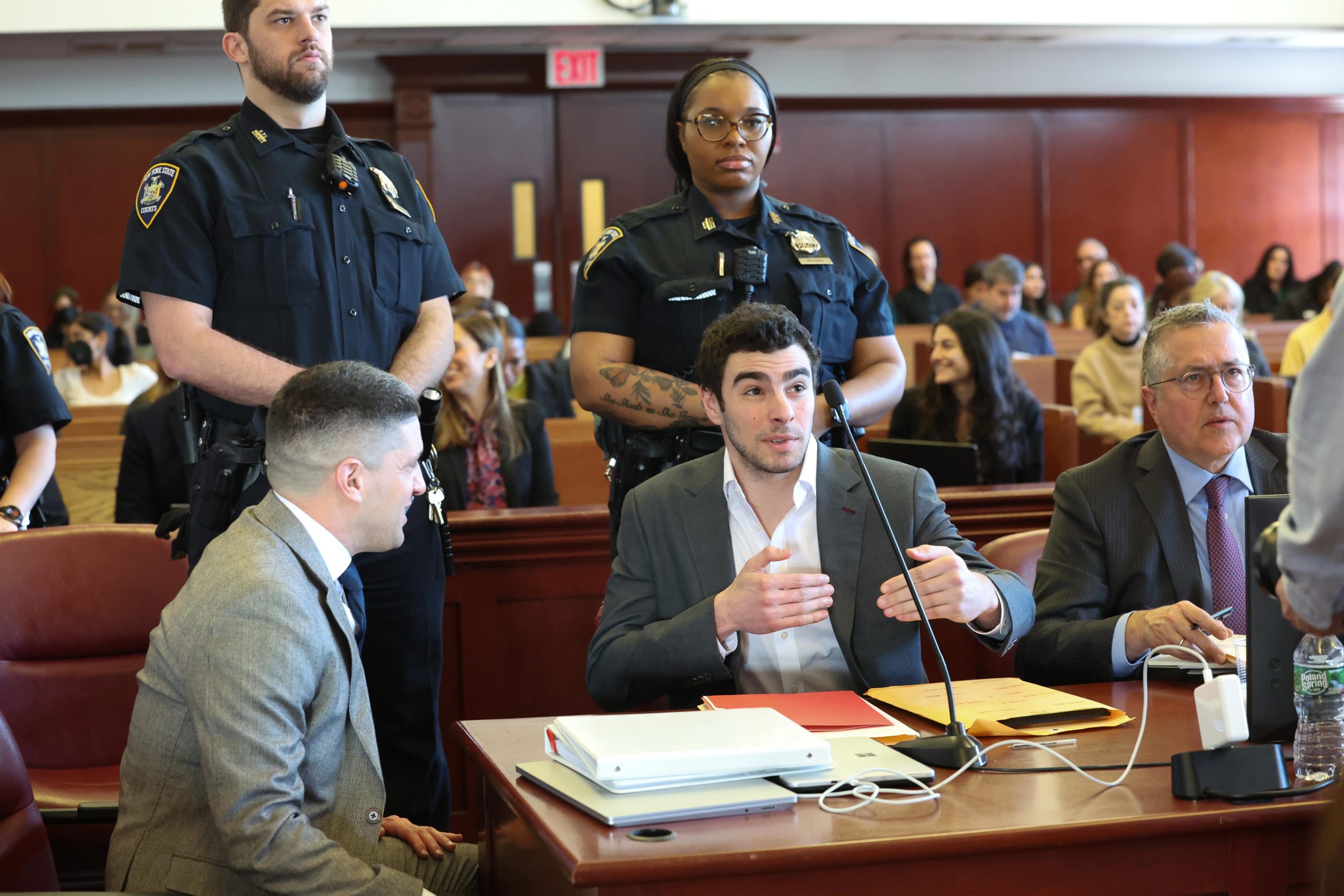
Luigi Mangione appeared in federal court as a judge ruled that prosecutors could not seek the death penalty, narrowing the penalties available before trial.
The ruling also creates near-term institutional pressure points that extend beyond this single case.
First, it reinforces judicial scrutiny over capital charging decisions at a time when federal executions have become politically charged. Courts are signalling that capital punishment remains an exceptional remedy, bounded by narrow statutory gates that cannot be stretched to accommodate enforcement priorities.
Second, it places reputational pressure on prosecutorial offices. Losing a death-penalty pathway on technical grounds invites questions about internal review, charging discipline, and the alignment between public statements and legal foundations. Even where the prosecution continues, credibility is affected.
Third, it shapes appellate posture. Prosecutors were given a defined window to decide whether to appeal the ruling. That decision itself carries institutional risk: appealing may preserve authority if successful, but it also prolongs scrutiny and delays finality. Declining to appeal, by contrast, cements the constraint and forces adaptation.
Fourth, the ruling clarifies that judicial oversight remains a live check on executive criminal policy. Even where administrations publicly commit to expanding or resuming capital punishment, implementation remains contingent on courts’ willingness to accept the legal mechanics used to get there.
Finally, the case illustrates how procedural rulings — often viewed as technical — can have consequences as significant as verdicts. By shaping what punishments are legally available, courts influence the entire trajectory of a prosecution long before jurors are empanelled.
For senior decision-makers, the lesson is not about the facts of the alleged killing. It is about institutional constraint.
Courts continue to act as the final arbiters of how far enforcement power can go, even in cases framed by prosecutors as uniquely serious or nationally significant. Legal authority does not expand to meet political appetite; it contracts to fit statutory boundaries.
This matters for anyone operating in environments subject to state power. Charging decisions, enforcement announcements, and public rhetoric may suggest maximum exposure, but actual risk is determined by whether the legal machinery is correctly assembled. When it is not, courts will intervene early, reshaping outcomes before trial.
The ruling also highlights the importance of understanding process over headlines. From the outside, the case still looks like a major federal murder prosecution. Inside the system, however, the removal of the death penalty fundamentally changes leverage, timelines, and strategic posture for all parties involved.
The broader takeaway is institutional rather than individual. Authority in the criminal justice system is not monolithic. It is fragmented, conditional, and subject to judicial veto. When courts exercise that veto, they do more than decide a motion — they recalibrate the balance of power between the state and the accused, with consequences that extend far beyond a single courtroom.
When a defendant is returned to the United States after months abroad and placed in custody without bail, the legal consequences begin immediately — long before any evidence is tested in court. That is the procedural position now facing Alyssa Marie Lira, who has been charged in California with murder and a related sentencing enhancement and is being held in Orange County custody pending arraignment.
At this stage, the case is not about verdicts or proof. It is about how the criminal justice system moves once a serious charge is filed, why some defendants are denied pre-trial release, and what legal rights and restrictions apply while a case is still taking shape. These early procedural decisions often shape outcomes more than the trial itself.
In California, courts may deny bail where prosecutors argue that a defendant presents a significant flight risk or a danger to the public. That decision is not a finding of guilt. It is a forward-looking assessment based on risk, not evidence tested at trial.
Where a defendant is alleged to have left the country after an incident, courts are more likely to view detention as a necessary safeguard rather than a punitive measure. The legal threshold at this stage is lower than that required for conviction, but the practical consequence is immediate: loss of liberty while proceedings continue.
Importantly, bail decisions are not fixed forever. They can be revisited if circumstances change, but the initial ruling often sets the tone for how the rest of the case unfolds.
Arraignment is the formal starting point of a criminal case. Charges are read into the record, constitutional rights are confirmed, and a plea is entered. This is also when the court addresses legal representation and determines whether a defendant qualifies for appointed counsel.
Arraignment does not assess the strength of the evidence or decide guilt. Its purpose is procedural, but it triggers timelines for everything that follows, including discovery obligations, motion deadlines, and future hearings. From this point forward, the case operates on a structured schedule governed by criminal procedure rules rather than press statements.
Prosecutors often reference potential maximum sentences at the outset of a case, particularly where enhancements are alleged. These figures represent statutory ceilings, not predictions. They outline what is legally possible, not what is likely.
At this stage, sentencing exposure functions as context rather than outcome. Whether any enhancement applies depends on what can be proven later, how charges are resolved, and whether the case proceeds to trial or plea. Early references to maximum penalties should be understood as legal boundaries, not conclusions.
Even while held in custody, a defendant retains core legal rights. These include the presumption of innocence, the right to counsel, the right to challenge detention, and the right to receive evidence disclosed by the prosecution.
What defendants do not control is timing. Serious felony cases often move slowly, with months of procedural steps before substantive hearings occur. Delays are not unusual and do not signal weakness or strength in a case. They reflect the complexity of pre-trial litigation, evidence review, and motion practice.
The pre-trial phase often determines the real leverage in a criminal case. Detention affects access to counsel, the ability to assist in defence preparation, and the pressure to resolve matters before trial. These factors exist regardless of guilt or innocence.
For many defendants, the most consequential decisions occur before a jury is ever empanelled. Bail rulings, scheduling orders, and early motions quietly shape what options remain available months later.
Although extreme cases attract attention, the same criminal procedures apply to ordinary defendants every day. Arrest, detention decisions, arraignment, and pre-trial rights are standard features of the justice system, not exceptional responses.
Understanding these early stages helps explain why criminal cases can feel unresolved for long periods and why outcomes are often influenced long before trial begins.
Following arraignment, the court will set a schedule for motions, hearings, and evidence disclosure. Challenges to detention may be raised, and prosecutors must begin meeting disclosure obligations. Only after these steps are complete does a case move toward resolution.
For now, the outcome remains undecided. What is clear is that once a defendant is charged and held without bail, the criminal process is fully engaged — operating on rules that prioritise procedure, rights, and risk management well before any verdict is reached.
In criminal cases, the most decisive phase often occurs before trial. Detention decisions, arraignment procedure, and early scheduling shape what follows long before evidence is tested in court.
A recent court filing in the United States involving Hunter Biden has sparked strong reactions, largely because of how starkly it lays out a legal position many people find uncomfortable. The argument made to the court was not about morality or personal conduct, but about what the law can — and cannot — compel.
Once the headlines are stripped away, the case highlights a misunderstanding that surfaces repeatedly in family disputes: the assumption that courts can force a parent to maintain contact, show emotional involvement, or behave in a particular way toward their child.
They generally can’t.
What matters here is not who the parties are, but the principle. And it is one that affects thousands of ordinary families navigating separation, child support, and court orders every year.
Many parents assume that parental responsibility automatically includes a legal obligation to stay in touch, communicate regularly, or play an active role in a child’s life. Emotionally, that expectation is understandable. Legally, it is far less certain.
If you are a parent who feels shut out — or one who has stepped back — this issue may already apply to you. It also matters if you are relying on an existing child support order or negotiating a settlement for the first time.
Most people don’t realise that family courts draw a sharp distinction between financial responsibility and personal involvement. The law is structured to enforce obligations it can clearly define and measure. Money falls into that category. Relationships usually do not.
That distinction often only becomes clear when a dispute reaches court.
In practice, family courts enforce what is written in an order — and little else.
If a parent fails to pay child support set out in a court order, enforcement options are well established. Payments can be recalculated, income can be attached, assets can be pursued, and in serious cases sanctions may follow.
But where an order is silent on communication or contact, a parent’s decision to disengage emotionally is rarely enforceable. Unless the order specifically requires phone calls, visits, or other forms of contact, there is usually no technical breach.
Put simply, if an order says “pay £X per month” and that payment is made, the legal obligation has been met. Courts do not infer additional duties based on what one parent expected or hoped would happen.
This is often a shock to parents who assume the court will intervene to correct what feels unfair. The problem is that disappointment is not the same as non-compliance.
The most important step is to look closely at the paperwork you already have.
Start by checking the wording of any existing order or agreement. Does it clearly require contact, communication, or involvement? Or does it deal only with financial support? What is not written is just as important as what is.
If your concern is unpaid child support, enforcement routes may be available and effective. If your concern is lack of contact, the options are more limited unless contact terms were formally agreed and recorded.
For parents negotiating a new settlement, specificity matters. Vague promises are rarely enforceable. If ongoing contact is important, it needs to be clearly defined, realistic, and recorded in the order itself.
Before escalating a dispute, it is also worth understanding what the court can realistically achieve. Applications based on perceived unfairness rather than a clear breach often add cost and stress without changing the outcome.
Family courts are designed to enforce legal obligations, not to police emotional behaviour.
Child support exists to ensure that a child’s financial needs are met. It is not intended to regulate the quality of a parent-child relationship. Courts generally avoid trying to compel emotional engagement because it cannot be objectively measured or supervised.
While courts can make orders about contact where it is in a child’s best interests, enforcement is cautious and fact-specific. Judges tend to enforce only what has been clearly ordered and avoid punishing parents for behaviour that falls outside the strict terms of an order.
This is why family law orders are interpreted narrowly. Courts enforce what is written, not what one party assumed it meant.
Family law draws a clear line between what feels right and what is legally enforceable.
A parent can be required to meet financial obligations. They usually cannot be forced to maintain a relationship unless the court order expressly says so.
The key takeaway is not to lower expectations, but to understand how the system works. If contact, communication, or involvement matters, it must be addressed clearly and formally. Without that, the law has very little to say about it at all.
A recent court ruling involving the former chief executive of London Capital & Finance has brought an obscure but powerful legal tool back into focus: the restraint order. The Serious Fraud Office confirmed that Michael Thomson and his wife had admitted to multiple breaches of such an order and were held in contempt of court.
The underlying investigation relates to the collapse of London Capital & Finance, which left thousands of investors out of pocket. But the wider significance of the case is not about that collapse itself. It is about how restraint orders work, what counts as a breach, and why courts treat even relatively small violations so seriously.
Most people have never heard of restraint orders until they are suddenly subject to one. Yet for anyone facing a financial crime investigation — or advising someone who is — understanding how they operate can make the difference between preserving legal options and compounding legal trouble.

The case has drawn attention to how restraint orders operate during ongoing financial crime investigations.
Restraint orders are not limited to high-profile fraud cases. They can be imposed early in an investigation, often before charges are brought, and they apply to ordinary people as well as executives.
If you are under investigation for fraud, money laundering, or similar offences — or if you are closely connected to someone who is — a restraint order can affect everyday financial decisions. That includes spending, selling personal property, receiving refunds, or moving money between family members.
What catches many people out is that restraint orders are not just about large transfers or hidden assets. Seemingly minor transactions can still amount to a breach.
In practical terms, a restraint order freezes assets to prevent them being dissipated before criminal proceedings conclude. Once in place, it typically restricts what you can spend, sell, or transfer without court approval.
That means:
selling personal items can be prohibited
receiving money, including refunds, may require disclosure
transferring funds to a spouse or family member can trigger scrutiny
even indirect benefits can count as a breach
In the recent case, breaches included the sale of personal items and the receipt of a holiday refund. The amounts involved were modest, but that did not matter. What mattered was that the transactions took place while a court order was active.
The law does not operate on a “common sense” threshold here. The question is not whether the transaction feels reasonable, but whether it was permitted.
If you are subject to a restraint order, or think one may be imposed, there are some immediate steps that matter:
Read the order carefully. Do not rely on assumptions or informal advice.
Do not move or sell assets without clearance. If in doubt, assume it is restricted.
Keep records of all financial activity. Transparency matters.
Seek legal advice before making changes. Even routine actions can have consequences.
If you live with or support someone under a restraint order, the same caution applies. Transactions between partners are closely scrutinised, particularly where funds might be seen as indirectly controlled.
Restraint orders are governed by the Proceeds of Crime Act 2002. Their purpose is to preserve assets so they remain available if a confiscation order is later made.
They are imposed on the basis of suspicion, not proof. The court does not need a conviction to grant one, only reasonable grounds to believe that a defendant has benefited from criminal conduct.
Breaching a restraint order is not a technical oversight. It can amount to contempt of court, which carries serious consequences, including imprisonment. Repeated breaches, or breaches while already under a suspended sentence, are treated particularly harshly.
Importantly, courts expect strict compliance. The burden is on the individual subject to the order to ensure they stay within its terms.
Restraint orders are not symbolic. They are one of the strongest tools available to prosecutors, and courts expect them to be taken seriously.
The recent SFO case is a reminder that even small transactions can escalate legal exposure if they breach a court order. Once an order is in place, caution is not optional — it is essential.
If you are affected, the safest approach is simple: assume nothing, check everything, and get advice before acting.
What is a restraint order?
A restraint order is a court order freezing assets during a criminal investigation to prevent them being moved or sold before proceedings conclude.
Can I still pay for everyday living expenses?
Often yes, but only within limits set by the court. Spending outside those limits can be a breach.
Do small amounts really matter?
Yes. Courts focus on compliance, not value. Small transactions can still amount to contempt.
Can family members be affected?
Yes. Transfers or shared assets involving spouses or partners are closely examined.
Across several U.S. states, immigration enforcement is no longer moving at its usual pace. Operations that once advanced quietly are now being paused, delayed, or approached with caution as new legal threats reshape the environment before any court has ruled on their legality.
The disruption is already being felt. Federal agents are operating in communities where personal legal exposure has become a live concern, not a hypothetical one. Local officials are hesitating to cooperate.
Advocacy groups are documenting encounters more aggressively. Decisions that once moved quickly are now subject to review, delay, or quiet recalibration.
At the center of this shift is a growing push by Democratic-led states to allow people to sue federal immigration agents in state courts for alleged civil rights violations. Illinois has already enacted such a law, and similar proposals are advancing elsewhere. None of the measures have been upheld or struck down yet, but their mere existence is changing behavior.
The federal government has responded by filing a lawsuit to block the Illinois law, arguing that states cannot expose federal agents to personal liability for actions taken while enforcing federal immigration policy. That case is unresolved, but the pressure it has created is already altering how enforcement unfolds.
For agents with U.S. Immigration and Customs Enforcement, the risk calculation has shifted. The question is no longer only whether an action aligns with federal guidance, but whether it could later become the basis for a personal lawsuit depending on where it occurs. For communities, the uncertainty cuts differently — enforcement may arrive late, change form, or not happen at all.
Legal clashes between states and the federal government rarely move fast. Challenges involving enforcement authority tend to stretch on, often climbing through multiple courts before clarity arrives. During that time, agencies must operate in a legal fog.
Institutions respond by adjusting internally. Guidance is refined. Approval chains lengthen. Coordination with local authorities becomes more selective. In high-visibility or sensitive situations, hesitation replaces speed.
Delay itself becomes a cost. Operations take longer to authorize. Planned actions are revisited. In some cases, timing becomes the deciding factor — not because the law has changed, but because the risk environment has.
On the ground, behavior is already shifting. Advocacy organizations are preparing legal challenges that may never be filed but still influence decisions. Communities are documenting encounters more carefully, assuming legal action could soon be possible. Federal agents are reported to be more selective about where and how they operate, particularly in states where similar laws are advancing.
No one is being told what the final rules are, because no one knows yet. Instead, everyone is adjusting to the possibility that the rules may change mid-stream.
Supporters of the state measures say they are addressing an accountability gap that has existed for decades. Opponents warn that exposing agents to personal liability will chill enforcement and fragment the application of federal law. The courts have not settled that debate, but the uncertainty alone is enough to slow the system.
The unresolved question hovering over all of this is simple and destabilising: can states really open their courts to lawsuits against federal immigration agents, or will federal authority shut those efforts down? Until that question is answered, enforcement exists in a grey zone.
What happens next follows only two paths. If legal pressure continues to expand across more states, enforcement decisions may slow further while challenges work their way through the courts. If courts move swiftly to block or narrow these laws, some of the hesitation may ease.
For now, neither outcome has arrived. What has arrived is delay — driven not by a ruling, but by unresolved legal risk.
Venezuelan families across the United States are already changing their lives, even after a federal appeals court ruled that the Trump administration unlawfully ended their legal protections.
Work plans are stalled, housing decisions are on hold, and some families have chosen to leave the country altogether rather than wait for clarity that has not arrived.
For many, the uncertainty is immediate. Temporary Protected Status, which allowed Venezuelans to live and work legally, remains ended despite the court ruling.
That means people who were authorised to work weeks ago are now unsure whether they can stay employed, renew leases, or remain with their families without risk of detention.
The ruling came from a three-judge panel of the Ninth U.S. Circuit Court of Appeals, which found that the Department of Homeland Security exceeded its authority when it terminated protections for Venezuelans. But the decision did not restore those protections.
Earlier orders from the U.S. Supreme Court allow the termination to remain in effect while appeals continue.
That gap between a legal finding and real-world relief is where pressure has intensified. Venezuelans affected by the decision number around 600,000, many of whom have lived and worked in the United States for years under the program. For them, the court’s conclusion does not change what happens at work sites, border checkpoints, or immigration offices today.
Some families have already acted. In Texas, ICE detentions prompted a Venezuelan family to self-deport to Mexico late last year, according to court filings cited in the case. Others have delayed major decisions, uncertain whether remaining in the country will expose them to detention or separation.
Government officials have taken a different view. The Department of Homeland Security said conditions in Venezuela have changed and argued that the temporary nature of the program allows it to be ended.
But the appeals court said federal law does not permit the government to terminate protections for an entire country while a designation remains in effect.
The ruling also affects Haitians, whose protections were terminated under a similar process. While the administration has not appealed that portion of the decision, separate plans are moving forward to end protections for Haitians as well, adding to the sense that the legal landscape is shifting faster than families can adapt.
What happens next is uncertain. The administration may continue to appeal, the Supreme Court may take up the case, or protections could remain suspended for months. In the meantime, Venezuelans remain in legal limbo — recognised by the courts as unlawfully stripped of status, but still treated as if that status no longer exists.
For those affected, the pressure is not abstract. It shows up in delayed paychecks, postponed moves, children leaving schools, and families weighing whether to leave before enforcement reaches them. The law has spoken, but daily life has not caught up.
Until the legal process fully resolves, Venezuelan migrants are living in the space between a ruling and its consequences — a place where nothing feels settled, and every decision carries risk.
A lawsuit can change the shape of a situation long before a judge ever weighs in, and that is the position Kenan Thompson now finds himself in. A Los Angeles landlord has filed a civil claim alleging the comedian breached a residential lease and now owes more than $34,000. There has been no ruling, no hearing on the merits, and no finding of fault. But the filing itself immediately introduces pressure, delay, and uncertainty.
According to the complaint, the dispute stems from a written lease for a three-bedroom rental property that was set to run for 12 months beginning in early October.
The landlord claims Thompson agreed to pay more than $10,000 a month and then failed to follow through, leaving November and December rent unpaid. The suit also alleges that re-renting the home took time and required accepting a lower monthly rate, creating additional losses. All of that, the landlord argues, is recoverable now, before any broader questions are resolved.
Thompson’s side tells a different story, and the distinction matters at this stage. Sources close to him describe the situation as a contractual disagreement, not a refusal to pay rent, saying he never received keys and never took possession of the property. That detail sits at the center of the conflict, because possession is often the moment when obligations truly begin. Until a court decides whose version carries legal weight, both narratives exist in tension.
This is the legal fault line where timing becomes more powerful than truth. Civil cases like this can impose consequences simply by existing on the docket. A filed complaint can freeze negotiations, complicate schedules, and shift leverage, even if it is later dismissed or settled quietly. The law here acts less like a verdict and more like a pause button.

Kenan Thompson appears at a public event as a lease dispute with a Los Angeles landlord remains unresolved.
Lease disputes are particularly procedural, and that is why they can feel so disruptive. Courts often focus first on whether a lease was properly executed, when it was triggered, and what each side did once problems arose. Did the landlord act quickly to find a replacement tenant? Was access actually provided?
Those questions can narrow or expand financial exposure before anyone debates intent. In the meantime, the claimed amount becomes a looming figure that shapes decisions.
For someone with a public career, that pressure carries practical consequences. A pending lawsuit can influence how and when statements are made, how projects are timed, and how aggressively lawyers advise restraint. Even when the underlying issue is a private contract, the visibility changes the calculus. Silence can be strategic, but it also leaves space for assumptions.
Situations like this are not unusual for high-profile renters, especially in expensive markets where leases are detailed and expectations high.
Similar disputes involving actors, musicians, and athletes have hinged on small procedural details that outsiders rarely notice. In many cases, the outcome turned not on whether rent was “owed” in a moral sense, but on whether a clause was activated or a condition precedent was met.
The pattern shows how quietly decisive paperwork can be.
That pattern also feeds a broader tension the law often creates. Contracts are meant to provide certainty, but they can become instruments of pressure when circumstances shift.
For landlords, filing suit is a way to protect against losses that feel immediate and tangible. For tenants, especially those who say the agreement never fully began, the process itself can feel like punishment before proof. Neither side needs to be proven right yet for the pressure to be real.
The controversy here is not about celebrity behavior or privilege. It sits in a safer, more familiar space: power versus accountability, and protection versus exposure. Is a lawsuit a fair tool to enforce expectations, or does it apply leverage too early, before facts are sorted? Reasonable people land on both sides, and the court process is designed to sort that out slowly.
For now, what matters most is what has not happened. There has been no ruling on whether the lease was breached, no finding on possession, and no decision on damages. What exists instead is an unresolved claim that places financial and reputational weight on everyone involved. That weight can influence choices long before anyone steps into a courtroom.
Until something moves — a settlement, a dismissal, or a hearing — the pressure stays exactly where it is: active, unresolved, and quietly shaping what happens next, a familiar example of how the law affects people before a case is decided.
For years, Costco’s $5 rotisserie chicken has been treated less like a grocery item and more like a promise. Cheap, convenient, and widely marketed as having “no preservatives,” it has become a staple for families trying to balance cost, health, and time.
That image is now under legal pressure after a proposed class-action lawsuit challenged how the product is advertised.
The lawsuit, filed in California, accuses Costco of misleading consumers by promoting its Kirkland Signature rotisserie chicken as preservative-free while allegedly using ingredients that function as preservatives. While no court has ruled on the claims, the filing itself has already shifted the conversation — and potentially Costco’s exposure — before any facts are tested at trial.
At the center of the dispute is how consumers interpret the words “no preservatives,” and how much responsibility retailers have to clarify what those claims really mean. For shoppers who say they relied on that language when making everyday food choices, the issue isn’t abstract. It’s about trust, labeling, and what happens when marketing and ingredient lists don’t align in the way people expect.
The plaintiffs argue that Costco’s in-store signage and website create what lawyers call an “overall net impression” that the chicken contains no added preservatives at all. According to the complaint, that impression conflicts with the inclusion of sodium phosphate and carrageenan — ingredients the lawsuit claims function as preservatives, even if they are disclosed elsewhere on the label.
That distinction matters more than it might seem. Consumer protection cases often hinge not on whether an ingredient appears somewhere on packaging, but on whether a reasonable shopper would understand its role. The lawsuit claims that listing ingredients in small print on the back of the label does not offset bold “no preservatives” messaging displayed prominently at the point of sale.

Shoppers enter and exit a Costco Wholesale warehouse. The retailer is facing a proposed class-action lawsuit related to labeling claims for its popular $5 rotisserie chicken.
From a legal standpoint, this type of case rarely turns on scientific debates alone. Instead, it focuses on timing and perception. What did consumers see first? What claims were emphasized? And did those claims influence purchasing decisions before shoppers had a realistic chance to examine ingredient details?
For Costco, the pressure isn’t limited to the courtroom. Class-action filings can force companies to rethink labeling, marketing language, or settlement strategy long before a judge weighs in. Even without admitting wrongdoing, retailers sometimes adjust claims early to reduce risk, avoid prolonged litigation, or protect brand trust.
That’s why cases like this often feel unresolved for a long time. A lawsuit can sit in procedural stages — motions, certifications, negotiations — while the product at issue remains on shelves.
During that period, companies must decide whether to hold the line or quietly change course, knowing that either move could carry implications.
For consumers, the case taps into a broader unease about food labeling and transparency. Many shoppers say they make quick decisions based on front-facing claims, especially when feeding families on a budget. When those claims are challenged, it raises uncomfortable questions about how much scrutiny is realistic in a grocery aisle.
Similar lawsuits against major brands have followed this same pattern: a widely used product, a simple claim, and a legal argument that the claim oversimplifies something more complex.
Some have ended in settlements or labeling changes without ever reaching trial. Others have been dismissed. The outcome is rarely immediate, and rarely as clear-cut as headlines suggest.
What makes this case particularly charged is the product itself. Costco’s rotisserie chicken is one of the retailer’s most iconic loss leaders, often cited as a reason customers maintain memberships. Any suggestion that its marketing could be misleading strikes at the heart of Costco’s reputation for value and transparency.
For now, nothing has been decided. Costco has not been found liable, and the allegations remain claims, not conclusions. But the filing alone has created a moment of uncertainty — one where legal definitions, consumer expectations, and corporate strategy collide before a judge or jury has said a word.
Whether the case moves forward, settles quietly, or is dismissed entirely, it highlights how quickly an everyday purchase can become a legal fault line. And for shoppers scanning signs in a busy warehouse aisle, it raises a lingering question that won’t be answered anytime soon: when a label says “no preservatives,” what does that really mean?
