
Understand Your Rights. Solve Your Legal Problems
Nigel Baker outside Snaresbrook Crown Court
Nigel Baker, 56, believed to be Britain’s most prolific romance fraudster, has been jailed for 17 years after conning five women out of more than £900,000. Posing as a successful businessman on dating apps, Baker targeted divorced women, convinced them he was in love, and persuaded them to drain savings, sell homes and take out loans of up to £200,000 for what he claimed was a “risk-free” betting business.
At Snaresbrook Crown Court, jurors heard how Baker promised financial security and a shared future while systematically stripping his victims of everything they had. Judge Charles Falk said the total loss exceeded £900,000 and described Baker as a “complete charlatan” who “mercilessly and cynically exploited” the trust placed in him. None of the money was ever repaid. Instead, it was lost to gambling.
The sentence is thought to be the longest ever imposed in the UK for romance fraud. But focusing only on the scale of the loss or the length of the jail term misses the most disturbing feature of the case. What unfolded in court was not just a financial scam, but a sustained pattern of emotional manipulation that closely resembles coercive control.
Baker’s fraud did not begin with money. It began with reassurance, attention and emotional availability. Prosecutors said he deliberately targeted divorced women, often single mothers, presenting himself as a reliable partner offering stability and commitment.
Only once emotional trust was established did the financial demands begin. Baker repeatedly fabricated crises to extract cash: claiming he could not afford to feed his children, that his father’s boiler urgently needed repair, or that his dog required emergency veterinary treatment. When sympathy alone failed, he escalated the pressure. He threatened to end relationships if money was not transferred and, in one case, claimed London gangsters would kill him unless a victim sent £50,000 immediately.
Victims told the court that once they were financially exhausted, Baker returned to dating apps to find new women. The behaviour was not impulsive. It was systematic.
Romance fraud is usually prosecuted as deception — lies told to obtain money. But Baker’s conduct reveals how these cases often blur into psychological and financial abuse.
Specialists in coercive control recognise the tactics: emotional grooming, manufactured emergencies, threats of abandonment, isolation from friends and family, and pressure to make irreversible financial decisions under fear. Victims are not simply misled; they are steered, cornered and emotionally conditioned to comply.
One victim, a divorced police officer who gave Baker nearly £80,000, described him as a “dangerous predator.” In her victim impact statement, she said what she believed was love “was manipulation and deceit for financial gain.”
Judge Falk echoed that assessment at sentencing. “You told the women everything they wanted or needed to hear,” he said, “each woman perceiving you as their second chance at life-long happiness, when you were merely seeking to exploit them.”
Romance scams rarely begin with obvious red flags. The first stage is emotional, not financial. Contact is often made through dating apps or social media, followed by a rapid push to move conversations off the platform into private messages or calls.
Fraudsters typically present themselves as emotionally open and serious about commitment. They may accelerate intimacy, talk about shared futures or long-term plans, and create a sense of exclusivity. Distance plays a key role. Many claim to live or work abroad, making repeated excuses for never meeting in person appear plausible.
Money is introduced gradually. Initial requests are framed as temporary problems or shared investments — travel costs, business opportunities, emergency bills. Reassurances are constant: the money is safe, it will be repaid, it benefits both partners.
As trust deepens, demands escalate. Victims may be encouraged to borrow, sell assets or keep transfers secret. Emotional pressure replaces persuasion. Threats of abandonment, guilt and invented danger are used to force quick decisions.
In severe cases, including Baker’s, the scam evolves into a closed emotional system where the victim’s judgement is overridden by fear of losing the relationship. At that point, the fraud functions less like a con and more like coercive control.
Central to Baker’s success was the persona he constructed. He claimed to be a successful businessman with insider knowledge of betting platforms and “zero-risk” trading strategies. In reality, investigators found no meaningful assets to recover.
This illusion is common in romance fraud. Offenders do not need to be wealthy; they only need to appear competent long enough to secure trust. The image of financial sophistication — confident language, supposed expertise, constant reassurance — often proves more persuasive than actual results.
By the time victims realise the truth, the money is gone and the relationship that justified the sacrifices never existed.
Despite the scale of romance fraud in the UK, lengthy prison sentences remain rare. Many cases are never reported at all. Victims frequently delay coming forward, embarrassed or fearful of being blamed for “falling for it.”
Even when prosecutions succeed, sentencing often focuses on financial loss rather than psychological harm. The emotional devastation, isolation and long-term financial instability victims experience are harder to quantify in court.
Baker’s case was different because of its pattern, scale and cruelty. Jurors convicted him unanimously on 18 counts of fraud by false representation, accepting that this was a sustained campaign of exploitation rather than isolated dishonesty.
For Baker’s victims, the sentence offers recognition but not restoration. Loans taken out under emotional pressure do not disappear when a fraudster is jailed. Credit ratings, housing security and financial independence can take years — if not decades — to rebuild.
The psychological impact is often longer-lasting. Victims report difficulty trusting others, anxiety about relationships and a lingering sense of shame that can prevent them seeking help.
Advocates argue that cases like Baker’s demonstrate why romance fraud should be treated not merely as a financial crime, but as a form of abuse that exploits intimacy itself.
Nigel Baker’s 17-year sentence may be unprecedented, but the tactics he used are not. Dating platforms, economic vulnerability and online anonymity continue to create opportunities for similar schemes.
What makes this case stand out is how clearly it exposes the mechanics of exploitation. Baker did not simply take money. He engineered dependence, applied pressure and moved on once his victims were depleted.
The challenge now is not just punishing the worst offenders, but recognising the warning signs earlier — and understanding that when love is weaponised, the harm goes far beyond the balance sheet.
What is a romance scam?
A romance scam is a form of fraud in which a criminal builds an emotional relationship with a victim in order to extract money. It relies on trust and psychological manipulation rather than technical deception.
How does romance fraud usually start?
Most cases begin on dating apps or social media. The fraudster establishes emotional closeness, moves communication off the platform, and delays meeting in person before introducing financial requests.
Why do victims give so much money?
Victims are often emotionally invested and believe they are protecting a shared future. Pressure tactics such as threats of abandonment, secrecy and urgent crises can override normal financial judgement.
Is romance fraud considered abuse?
While prosecuted as financial crime, serious romance fraud often shares features with coercive control and financial abuse, particularly where emotional dependency is deliberately engineered.
👉 What Is Teen Sextortion — and How These Online Scams Work
Britain has been labelled Europe’s top destination for immigrants after official figures suggested it recorded a higher inflow of foreign nationals in 2023 than any other European country. This is analysis, not breaking news. The deeper question is not whether the UK edged past Germany in a single year, but whether such rankings are genuinely comparable — and what they really tell the public about immigration policy, control, and outcomes.
The UK and EU do not currently publish migration data through a single, unified system, meaning cross-country rankings combine different statistical sources.
“Immigration,” “foreign nationals,” and “net migration” measure different things and are often conflated in public debate. The UK’s figures are based on Office for National Statistics estimates using administrative data, while EU figures come from Eurostat and national registers. Small differences between countries may reflect methodology as much as migration reality. Headlines about league tables often say less about policy success or failure than they appear to.
When readers see claims that Britain has become Europe’s “immigration capital,” they instinctively ask why. Is the UK unusually permissive? Has Brexit backfired? Or is something else going on beneath the surface of the numbers?
Those questions matter because migration statistics shape political trust. They influence whether voters believe governments are in control, whether policies are working, and whether promised reforms delivered what they claimed. But those judgments depend on one assumption that is rarely tested: that the numbers being compared across countries are measuring the same thing in the same way.
In reality, migration data is closer to a carefully constructed estimate than a headcount. Countries observe movement through different administrative lenses — border records, population registers, visa systems, tax and health data — all filtered through national legal frameworks. The result is that “who came” can mean subtly different things depending on where you look.
The headline comparison rests on a legitimate dataset, but it leaves out crucial context that determines how much weight readers should place on the ranking itself.
The UK no longer submits migration flow data directly to Eurostat, so comparisons combine EU 2023 figures with UK Office for National Statistics estimates produced under a separate system.
Eurostat commonly reports migration by citizenship, while the UK’s headline figures track long-term international migration based on residence intentions of 12 months or more.
Administrative data captures people differently across countries, depending on how and when residents are required to register, deregister, or update status.
Estimates are revised over time, meaning a country’s position in a single year can change retrospectively.
Both Eurostat and the House of Commons Library explicitly caution that small differences between countries should not be treated as statistically significant.
Without this context, a ranking risks being read as a verdict rather than what it really is: a snapshot produced under imperfect alignment.
European migration statistics are governed by shared definitions but not shared machinery. Since 2008, EU countries have used a common statistical definition of long-term migration based on usual residence for at least 12 months. That standard is set out in EU statistical regulations and overseen by Eurostat. However, how each country observes “usual residence” varies widely.
Germany relies heavily on population registration systems that require residents to formally register and deregister addresses. Spain and Italy combine municipal registers with permit data. France uses census-linked estimates. The UK, by contrast, has moved away from survey-based measurement toward a system that integrates administrative data from across government departments.
This shift matters. The Office for National Statistics now describes its migration figures as “official statistics in development,” reflecting ongoing refinement as new administrative sources mature. That makes UK data richer in some respects, but also means it cannot be dropped seamlessly into Eurostat tables without caveats.
Brexit further complicates the picture. Since leaving the EU, the UK is no longer part of the same reporting pipeline, so comparisons rely on aligning separate releases rather than reading from a single source. The House of Commons Library has been explicit about this limitation, noting that recent charts combine UK and EU data that were never designed to be ranked together.
Statistical analysts and migration scholars generally agree on two points. First, the UK experienced historically high levels of measured net migration in the early 2020s, driven largely by legal routes such as work, study, and family reunion. Second, international rankings should be treated as contextual signals, not precise scoreboards.
A consistent theme in official guidance is that migration is measured through intent and behaviour over time, not instantaneous arrival. Students who plan to stay for more than a year are counted as migrants even if they later leave earlier than expected. Workers may arrive on visas that are granted but never used. Emigration is harder to observe than immigration in many systems, which affects net figures.
Because of these complexities, experts tend to focus less on who ranks first in a given year and more on sustained trends, composition of flows, and economic or demographic impacts. Rankings attract attention, but trends explain outcomes.
Factually, the UK’s most recent estimates show immigration falling from its 2023 peak to under 900,000 in the year to June 2025. That suggests a moderation, though it remains historically high. Whether this represents a structural shift or a temporary adjustment will depend on policy enforcement, labour demand, international student numbers, and global mobility patterns.
Analytically, the debate is likely to sharpen around which numbers “count.” Governments may point to falling net migration, critics may cite visa issuance, and others may focus on population change or pressure on housing and services. Each metric tells a different story, and none is wrong — but none is complete on its own.
The risk is that public trust erodes if rankings are used as proof without explanation. The opportunity, by contrast, is to improve the quality of debate by being clear about what migration statistics can and cannot say. When definitions and limitations are understood, policy choices become easier to judge on their merits rather than on headlines alone.
Is the UK definitely Europe’s top destination for immigrants?
The UK recorded one of the highest inflows of foreign nationals in 2023 based on available estimates, but differences between countries are small and data systems are not fully comparable.
Why do UK and EU migration numbers differ in how they are reported?
The UK uses Office for National Statistics estimates based on administrative data, while EU countries report through Eurostat using national registration systems and shared definitions.
What is the difference between immigration and net migration?
Immigration counts arrivals intending to stay long term. Net migration subtracts long-term departures from arrivals, producing a balance figure.
Did Brexit reduce immigration to the UK?
Brexit changed who could come and on what terms, but it did not automatically reduce overall numbers. Legal non-EU routes expanded after 2021.
Why should small differences between countries be treated cautiously?
Because migration figures are estimates shaped by national administrative practices, small numerical gaps may reflect methodology rather than real-world differences.
What’s the most responsible way to read migration league tables?
As broad context rather than definitive rankings, with attention to trends, definitions, and composition rather than single-year positions.
Initial Report: Updated 12:26 GMT, December 14, 2025
Latest Update: 13:11 GMT, December 16, 2025
Bondi Beach terror attack leaves at least 16 dead during Hanukkah celebration in Sydney.
Australian authorities are urgently investigating the gunmen responsible for the mass shooting at Bondi Beach in Sydney, which has been declared a terrorist attack targeting Australia’s Jewish community.
As of Sunday morning, New South Wales Police have confirmed that at least 16 people were killed and 42 others injured, including two police officers, when gunfire erupted during a Hanukkah by the Sea celebration attended by more than 1,000 people.
The attack is the deadliest mass shooting in Australia in nearly 30 years and has prompted heightened security measures nationwide.
Australian authorities have confirmed additional details in the investigation into the Bondi Beach terror attack, including the identities and background of the two suspects believed to be responsible.
Police have identified the younger suspect as Naveed Akram, 24, from Bonnyrigg in Sydney’s southwest. He remains in hospital in critical condition under police guard. The second suspect, a 50-year-old man believed to be his father, was shot by police during the incident and died at the scene.
Officials have stressed that the investigation remains active and complex. Counter-terrorism units are continuing to examine the suspects’ backgrounds, any signs of radicalisation, and whether the attack was carried out entirely independently or involved outside influence.
Authorities have urged the public to avoid speculation as further verified information is released.
NSW police commissioner Mal Lanyon has identified a father and son, aged 50 and 24, in connection with the terror attack that left a 10-year-old girl dead after she later died in hospital. Mal Lanyon said at a press conference on Monday: “As part of the investigation, we conducted two search warrants last night, one at Bonnyrigg and a second at Campsie. The 50-year-old male is a licensed firearms holder. He has six firearms licensed to him.”
One of the alleged shooters in the deadly attack at Bondi Beach in Sydney has been identified as Naveed Akram, 24, from Bonnyrigg in Sydney’s southwest, according to a senior law enforcement official cited by ABC News.
According to The Daily Mail, video and photographs taken by its photographer appear to show a gunman opening fire from an elevated bridge overlooking Bondi Beach. The publication reported that the suspect was shot by police and taken to hospital, where he remains under police guard while receiving medical treatment.
NSW Police confirmed that officers searching a property in Bonnyrigg linked to the suspects located suspicious items near the bridge, including an improvised explosive device. The items were described as basic in structure and had been secured and remain under forensic examination.
Australian security agencies have confirmed that one of the suspects had previous contact with intelligence authorities, though officials emphasized that he was not considered an imminent threat at the time of that assessment.
Police have also confirmed that the older suspect was a licensed firearms holder, with several weapons registered in his name. Investigators are examining how the firearms were used and whether existing licensing and storage requirements were breached.
Officials are reviewing the suspects’ recent movements and associations, including any overseas travel, while cautioning that no evidence has yet been presented indicating a wider terror cell or direct operational control by a foreign organisation.
The Australian Security Intelligence Organisation (ASIO) said it is cooperating fully with state and federal police as inquiries continue.
Australian authorities are investigating overseas travel undertaken by the two suspects in the weeks before the Bondi Beach attack, amid growing scrutiny over potential ideological influences.
According to reporting from CNN, the father and son traveled together to the southern Philippines in November, visiting the island of Mindanao — a region long associated with Islamist insurgent activity. Philippine immigration officials confirmed that the pair entered the country on separate passports, with the father traveling on an Indian passport and the son on an Australian passport, before returning to Sydney late last month.
Prime Minister Anthony Albanese said authorities now believe the attack was motivated by Islamic State ideology, while emphasizing that the investigation remains ongoing and that conclusions are based on intelligence gathered after the attack.
Police Commissioner Mal Lanyon said no intelligence alerts were triggered at the time of the travel and rejected suggestions of a systemic intelligence failure, noting that investigators are piecing together information retrospectively.
Authorities also confirmed that items found in a vehicle linked to the suspects included homemade ISIS flags and improvised explosive devices, all of which remain under forensic examination.
While NSW Police have not yet publicly detailed the exact firearms used, investigators confirmed that the attackers were armed with long-gun style weapons.
Images and video footage from the scene showed what appeared to be a pump-action shotgun lying near a tree close to the beach. Several eyewitnesses also reported seeing rifle-style firearms, though police have cautioned that formal identification of the weapons is ongoing.
Specialist counter-terrorism officers continue to examine suspicious items recovered from the surrounding area, and an exclusion zone remains in place.
At 9.36pm on Sunday, the NSW Police Commissioner formally declared the shooting a terrorist incident, citing evidence that the attack was deliberately designed to target Sydney’s Jewish community.
The gunfire erupted during a “Hanukkah by the Sea” gathering marking the first day of the Jewish festival of lights — an event attended by families, children, and community leaders.
Prime Minister Anthony Albanese said the shooting was “an act of evil, antisemitism and terrorism”, calling it a direct attack on Jewish Australians and on the nation’s values.
Police and Australia’s counter-terrorism command are continuing to examine the suspects’ backgrounds and any potential ideological motivations.
As of Sunday afternoon, authorities have not confirmed whether the gunmen were known to security agencies prior to the attack, nor whether they had any formal links to extremist organisations.
Investigators are also assessing whether the attackers acted alone or received assistance, direction, or encouragement from others.
NSW Police have urged the public not to speculate as inquiries continue.
Verified video footage from the scene shows a member of the public tackling and disarming one of the attackers during the shooting.
The bystander wrestled the weapon away and forced the gunman to retreat, an intervention police believe prevented further loss of life.
Prime Minister Albanese praised the individual as a “genuine hero”, saying his actions saved “countless lives” amid the chaos.
Instead of running for safety, he disarmed the active shooter at Bondi Beach in Sydney.
Give him an award—he’s a true hero.
The following social media post reflects public reaction and has not been independently verified by authorities.
— Zach “🅂🄲🄷🅄🅉” Schumaker (@ZachSchumaker) December 14, 2025
The shooting has sent shockwaves across Australia and the international community, not only because of the high death toll, but because it occurred at one of the country’s most iconic public locations during a religious celebration.
Bondi Beach is typically crowded with locals and tourists, particularly on warm summer evenings. Authorities say the attack has triggered heightened security around Jewish community events nationwide as Australia confronts the growing threat of extremist violence.
As the investigation continues, authorities have begun confirming the identities of several victims killed during the Hanukkah celebration.
According to CNN and Australian media reports, those who died include children, elderly attendees, religious leaders, and bystanders who attempted to intervene during the attack. Among the victims were a 10-year-old girl attending the celebration with her family, a Holocaust survivor, and two rabbis associated with the Bondi Jewish community.
Officials have emphasized that formal identification and family notifications are ongoing, and have urged media outlets to treat victims’ families with care and respect.
Naveed Akram, 24, from Bonnyrigg in Sydney’s southwest, has been named by multiple media outlets as the surviving suspect in the Bondi Beach attack. He remains in hospital under police guard after being critically injured during the incident.
Police say Akram was one of two armed men who allegedly opened fire near Bondi Beach shortly after 6.40pm on Sunday, December 14, 2025, during a Hanukkah celebration attended by families and children.
Officers responding to reports of gunfire confronted the suspects and exchanged fire. The older man was killed at the scene, while Akram was transported to hospital where he remains in critical condition.
Authorities have not yet confirmed whether Akram will face terrorism or other criminal charges, citing his medical condition and the ongoing nature of the investigation. Police have also not publicly disclosed whether he held a firearms licence or the extent of his involvement relative to the second suspect.
🕕 Time: About 6.40pm, Sunday 14 December 2025
📍 Location: Bondi Beach, Sydney’s east
🔫 Suspects: Two men, aged 50 and 24
⚰️ Fatalities: 16 people, including a 10-year-old girl
🏥 Injured: More than 40 people, including children
👮 Police injured: Two officers (serious but stable)
🚔 Status: One alleged shooter dead, one in hospital under guard
🧪 Evidence: Three firearms seized
🕵️ Investigation: Joint Counter Terrorism Team
NSW Police have maintained a heavy presence around Bondi Beach as forensic teams continue their work. Authorities have asked for calm and warned against retaliatory actions while investigations continue.
Security has been increased around Jewish schools, synagogues, and Hanukkah events across Australia.
“This is a time for unity, not fear,” police said, adding that there is no current threat to the wider public.
Who were the Bondi Beach shooters?
NSW Police have confirmed the attack involved two men. One suspect was shot dead at the scene, while the second remains in critical condition in hospital under police guard.
ABC Australia reported late Sunday that the younger suspect is Naveed Akram, 24, from Bonnyrigg in Sydney’s southwest.
Was the Bondi Beach shooting a terrorist attack?
Yes. NSW Police formally declared the incident a terrorist attack targeting the Jewish community.
How many people were killed at Bondi Beach?
At least 16 people have been confirmed dead, with 42 others injured, including two police officers.
Is there still a threat to the public?
Police say there is no ongoing threat, but investigations continue, including inquiries into a possible third offender.
Despite significant developments, authorities say key questions remain unanswered, including:
Whether the suspects received any external encouragement or assistance
The full extent of any ideological motivation
Whether failures occurred in firearm licensing or monitoring systems
Whether any additional individuals had prior knowledge of the attack
Police and counter-terrorism officials have reiterated that no further threat to the public has been identified, but security remains heightened around Jewish community sites nationwide.
The Bondi Beach attack has reignited debate over firearms regulation in Australia.
New South Wales Premier Chris Minns said his government is determined to introduce what he described as “the toughest gun laws in Australia,” including potential limits on the number and type of firearms an individual can own.
Prime Minister Albanese echoed the call for reform, saying national gun laws are “only as strong as the weakest link,” and confirmed that proposed measures could include stricter licensing requirements, accelerated work on a national firearms register, and tighter controls on eligibility.
This is a developing story and will be updated as more information becomes available.
A confirmed mass shooting at Sydney’s Bondi Beach on Sunday, 14 December 2025, has killed at least 16 people, and injured at least 40 others including police officers, and triggered a continuing multi-agency emergency operation affecting public access and safety according to ABC Australia.
New South Wales Police said the shooting occurred near Bondi Park Playground along Campbell Parade. One man believed to be one of the shooters was confirmed dead, while a second alleged shooter was taken to hospital in a critical condition.
UPDATE (Late Sunday):
New South Wales Police have confirmed that the shooting occurred near a Jewish community gathering at Bondi Beach. Authorities said there is no ongoing threat to the public and stressed that investigations into motive are ongoing. Police have not formally classified the incident as terrorism.
At least 16 people have been confirmed dead following a shooting at Bondi Beach in Sydney, New South Wales Police said on Sunday evening, as officers continued a major operation in the area.
Emergency services were called to Campbell Parade at about 6:45 p.m. local time after reports of shots being fired near the northern end of the beach.
Police said one of the dead is a man believed to be one of the shooters, while a second alleged shooter was taken to hospital in a critical condition. A further 40 people were reported injured, including two police officers.
The incident has immediate public-interest significance because Bondi Beach is one of Australia’s most heavily visited public spaces and sits alongside dense housing, transport routes and scheduled community events. Police warned that casualty numbers could change as medical assessments continue and urged the public to avoid the area while specialist officers secure the scene and examine suspicious items.
👉👉 Bondi Beach shooter identified by UK media 👈👈
In a verified media release issued at 8:57 p.m. on Sunday, New South Wales Police said the shooting involved two men in a public place along Campbell Parade, near Bondi Park Playground. Officers from Eastern Suburbs Police Area Command responded, supported by specialist resources drawn from across Sydney.
Police confirmed that 16 people are dead, including one man believed to be one of the shooters. The second alleged shooter is in hospital in a critical condition. At least 40 other people were injured, among them two police officers who were responding to the incident.
An extensive exclusion zone remains in place as specialist officers examine a number of suspicious items located nearby. Police said there have been no reports of any other incidents in Sydney connected to the shooting.
Takeaway: Police have confirmed the deaths, injuries and custody status while maintaining strict scene control.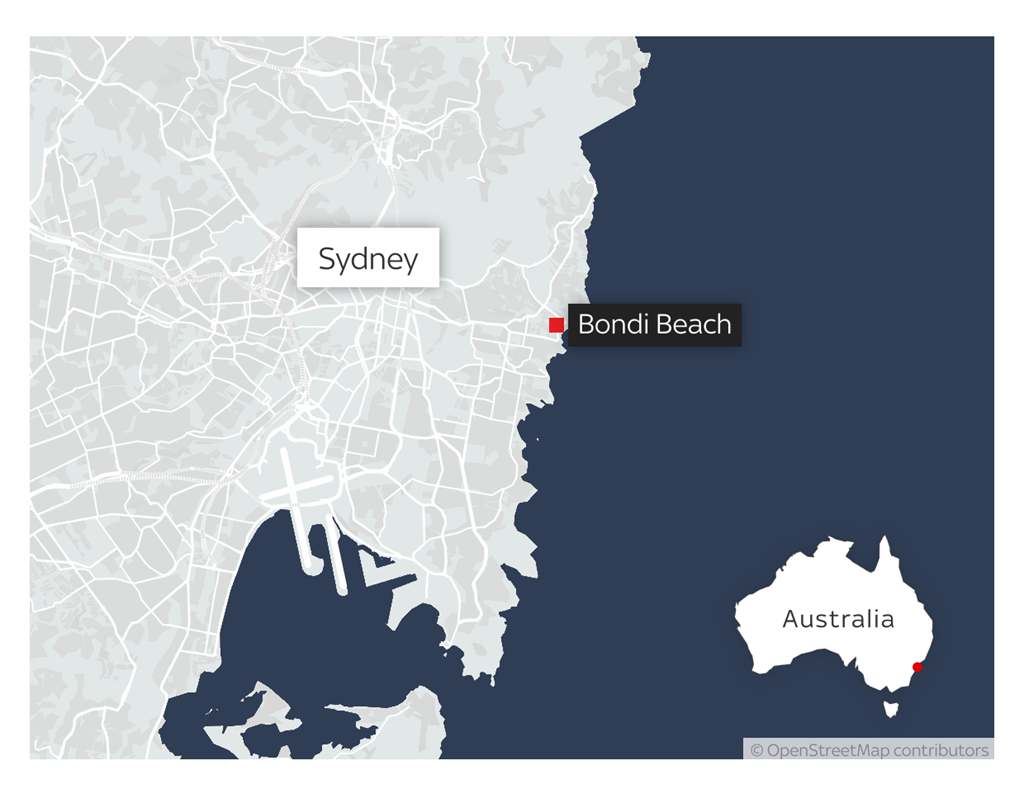
6:45 p.m. (Sunday): Emergency services called to Campbell Parade after reports of gunfire.
Shortly after: Officers from Eastern Suburbs Police Area Command arrive, supported by citywide specialist units.
Evening: Exclusion zones established around Bondi Beach and nearby streets as paramedics treat the injured.
8:57 p.m.: NSW Police issue a verified media release confirming 16 deaths, 40 injuries and no related incidents elsewhere in Sydney.
Later evening: Police confirm there is no longer an active threat but warn the operation remains ongoing.
Takeaway: Authorities have provided time-stamped updates as the response and investigation progress.
Police confirmed the shooting occurred in proximity to a Jewish community gathering marking the start of Chanukah. While several political figures have described the incident as terrorism, NSW Police said investigations into motive remain ongoing and no formal classification has been made.
Prime Minister Anthony Albanese said the scenes at Bondi Beach were “shocking and distressing” and confirmed he had spoken with the Australian Federal Police commissioner and the New South Wales premier. He urged people in the area to follow directions from NSW Police and rely on confirmed information.
Police repeatedly warned against sharing unverified reports, noting that misinformation during active incidents can interfere with emergency response and cause unnecessary alarm. Authorities also stressed that casualty figures may change as inquiries continue and medical conditions evolve.
— Anthony Albanese (@AlboMP) December 14, 2025
Bondi Beach and surrounding streets along Campbell Parade remain subject to police closures, affecting pedestrian access, traffic movement and nearby businesses. Residents and visitors were advised to avoid the area entirely until restrictions are lifted.
The northern end of Bondi Beach is frequently used for family activities and organised community gatherings, which can complicate evacuation and emergency medical access during incidents of this scale. Police exclusion zones are standard practice to protect the public and preserve evidence during investigations involving firearms.
Past major incidents in crowded public locations have led authorities to review crowd-management planning, patrol deployment and emergency response coordination once investigations conclude.
Takeaway: The shooting has disrupted a major public area and may influence future safety planning.
NSW Ambulance said injured patients were transported to multiple hospitals across Sydney, reflecting standard mass-casualty distribution protocols designed to prevent any single facility from being overwhelmed. Police said injury numbers may be updated as medical assessments continue.
Two police officers were among those injured while responding to the incident, underscoring the risks faced by first responders during active public-place shootings.
Takeaway: Emergency services remain engaged across multiple sites as patient care continues.
Australia’s firearms laws are governed by the National Firearms Agreement, introduced after the 1996 Port Arthur massacre. The framework requires firearm licensing and registration and restricts access to many weapon types.
Because mass-casualty shootings are rare under this system, each incident attracts heightened scrutiny from law enforcement and policymakers. Reviews typically focus on enforcement, intelligence sharing and early-intervention mechanisms rather than immediate legislative change.
Takeaway: The rarity of such incidents heightens national attention on prevention and response systems.
Police are appealing for anyone with mobile phone footage or dashcam vision relevant to the incident to contact Crime Stoppers. Information can be provided confidentially by calling 1800 333 000 or through the Crime Stoppers NSW website. Police asked the public not to submit information via social media.
People near Bondi Beach should continue to follow directions from officers on the ground and avoid all exclusion zones. Emergencies in Australia should be reported via Triple Zero (000).
Takeaway: Authorities are seeking public assistance while maintaining strict safety controls.
New South Wales Police said at least 16 people have been confirmed dead following the Bondi Beach shooting, including one man believed to be one of the shooters. Police cautioned that the death toll may change as the operation continues and medical assessments are finalised.
Police said 16 people were injured in the Bondi Beach shooting, including two police officers who were responding to the incident. Injured victims were transported to multiple hospitals across Sydney under standard mass-casualty protocols.
Police said there is no longer an active threat to the public at Bondi Beach, but stressed the scene remains active due to forensic examinations and safety checks. Authorities continue to enforce exclusion zones while the investigation proceeds.
New South Wales Police said there have been no reports of any other incidents in Sydney connected to the Bondi Beach shooting. Police urged the public to avoid sharing unverified information or rumours.
Authorities advised residents and visitors to avoid Bondi Beach and surrounding streets, follow all police directions, and remain clear of exclusion zones until restrictions are lifted. Police said official updates will be provided through verified channels as the operation continues.
Police said an extensive crime scene has been established and formal inquiries are underway. Specialist officers will continue forensic examinations and assess suspicious items located near the scene.
Further updates are expected once immediate operational steps and victim identification processes are completed. Any criminal proceedings would follow standard New South Wales legal processes once charges, if any, are laid.
Takeaway: Confirmed information will be released progressively as procedural steps are completed.
The Bondi Beach shooting has resulted in multiple deaths and injuries at one of Australia’s most recognisable public locations. It affects victims’ families, first responders, residents, businesses and visitors, while raising broader public-safety concerns. In a country where mass shootings are rare, the incident underscores the importance of emergency preparedness, verified information and public cooperation. Authorities say the public should continue to rely on official updates as the investigation continues.
New York seniors will see meaningful property tax relief in 2026 under new legislation signed by Governor Kathy Hochul. The law raises the maximum senior exemption from 50% to 65% of a home’s assessed value — the first increase in decades.
The change applies to eligible older homeowners who meet local income requirements. For many, the expanded exemption may reduce annual tax bills by up to $300, offering welcome relief at a time when property taxes continue rising due to higher home values and increased municipal service costs.
The new exemption is part of a broader affordability agenda aimed at helping longtime residents stay in their homes. With more than 1.8 million seniors owning property across the state, the measure is expected to ease financial pressure for those on fixed incomes.
Local governments will adopt and administer the exemption, meaning savings will vary by county and town. Seniors are encouraged to check updated assessment notices and confirm their income eligibility before the 2026 tax cycle begins.
New York’s new rules join other statewide affordability measures taking effect in 2026, including cash-acceptance protections and broader middle-class tax adjustments, which together reflect a growing focus on cost-of-living relief.
Many of these changes align with broader shifts in state and federal money laws taking effect nationwide, as detailed in our 2026 money law overview.
Millions of retirees are asking whether Social Security will be taxed differently in 2026 — and the answer is yes. New deductions and a higher standard deduction may reduce taxable income, especially for low- and middle-income seniors.
However, benefit increases triggered by the Social Security Fairness Act could make some retirees owe more, particularly those receiving new lump-sum payments or restored benefits.
The key document to watch is the SSA-1099 arriving after December 26. This form determines how much of a retiree’s Social Security becomes taxable for 2026 returns.
Many of these changes align with broader shifts in state and federal money laws taking effect nationwide, as detailed in our 2026 money law overview.
Nineteen states — including New York, California, Hawaii, Colorado and Washington — will raise their minimum wages on January 1, 2026. Nearly 50 cities and counties will follow suit with their own increases.
Several regions will cross the $15-per-hour threshold, and more states will adjust wages later in the year. These raises come as workers face ongoing cost-of-living pressure and as inflation continues to influence wages nationwide.
Workers are encouraged to check updated rate charts to ensure their 2026 pay reflects the new legal minimum.
Many of these changes align with broader shifts in state and federal money laws taking effect nationwide, as detailed in our 2026 money law overview.
Pet owners in parts of California will face new requirements in 2026. Selma is considering a law requiring owners of unneutered dogs and cats over four months old to obtain a paid breeding permit — potentially costing up to $500. Violations could lead to fines of $1,000.
California is also enforcing statewide rules banning cosmetic declawing, tightening health certificate rules for imported pets and adding protections preventing animals from being euthanized prematurely.
Owners should check local city rules carefully to avoid unexpected costs or penalties.
Many of these changes align with broader shifts in state and federal money laws taking effect nationwide, as detailed in our 2026 money law overview.
Georgia’s 2026 temporary tag law will transform how used-car dealers operate in the state. Starting January 1, 2026 dealers may only request the same number of temporary plates they issued in 2025 unless they prove legitimate sales. The law specifically targets “ghost dealers” — operations that issued hundreds or thousands of tags without selling real vehicles.
Online dealers must also lease physical office space and meet state requirements. The goal: reduce tax evasion, improve road safety and protect consumers from fraudulent sellers.
Car buyers should expect a more regulated process but fewer risks when purchasing used vehicles.
Many of these changes align with broader shifts in state and federal money laws taking effect nationwide, as detailed in our 2026 money law overview.
New York is rolling out two major consumer-friendly laws in 2026 that could change how residents pay at stores and how senior homeowners manage their property taxes.
Beginning March 20, every retailer in New York must accept cash for in-person purchases. Stores also cannot charge cash users more than those paying by card, nor can they use rounding practices that consistently push totals up. This comes as the U.S. stops minting pennies, raising concerns about fairness at the register.
At the same time, New York will expand its senior property-tax exemption. Qualifying older homeowners may receive up to a 65% exemption on assessed value, an increase from the previous 50% ceiling. For many households, this could mean savings of up to $300 annually, offering relief amid rising home values and local taxes.
Together, these rules aim to protect affordability and prevent older and unbanked New Yorkers from falling behind as the state modernizes its consumer policies.
Many of these changes align with broader shifts in state and federal money laws taking effect nationwide, as detailed in our 2026 money law overview.
