
Understand Your Rights. Solve Your Legal Problems
The twists and turns of this week's General Election may be enough to befuddle anyone - even TV journalists.
On Sunday, two of them managed to make the same big gaffe on air as they reported on Theresa May's reshuffle.
As Jeremy Hunt arrived at Downing Street to learn his fate this afternoon, BBC political journalist Ellie Price accidentally dropped the C bomb.
Meanwhile, over at Sky News, anchorwoman Claudia-Liza Armah was minutes away from falling into the same trap.
It wasn’t too long ago that hashtags didn’t even exist, but since the birth of Twitter they’ve grown to become so much more than a tool to identify messages on a particular topic. They’ve become stand-alone marketing tools, used in adverts and advertising campaigns to strengthen brand engagement and recognition.
This is reflected in new trademark research conducted by CompuMark, which found that the number of hashtag trademark applications globally in 2016 saw an increase of 64% compared to the previous year. Interestingly, since the first ever trademark application for a hashtag was filed in 2010, there have been well over 5,000 applications — 2,200 of those coming in 2016 alone.
The research also found that the US is far and away the global leader when it comes to the number hashtag trademark applications in 2016 — an impressive 608 in total — but its total percentage share for the year was actually down to 28% compared with 25% in 2015. Coming in second place was Brazil with a total of 226 registered trademarks, while India won the bronze medal with a respectable 141.
What these stats seem to tell us is that, even though organisations on a broad level are applying to trademark more hashtags than ever before, there are signs of a slowing down in growth within the US possibly due to the time and labour-intensive work that is required to successfully trademark these hashtags in an already ferociously competitive marketplace.
The results get even more interesting when you start looking at the hashtag trademarking efforts of individual companies. The Colombian broadcaster RCN Television S.A. applied for 50 different hashtag trademarks over the course of the year; all of them related to its Grita Gol football programming.
Of all the different trademark classes available, there were three that attracted the vast majority of them. 594 of these hashtags fell into Class 41 (education and entertainment services, shows, sporting events, training), closely followed by 587 in Class 35 (advertising and administration, business consultancy, marketing, online retail, recruitment) and 512 in Class 25 (clothing, footwear and headwear).
On the whole, these figures indicate that more brands across a broader spectrum of countries are realising the value of going through the proper trademarking procedures in all spheres, including social media, to ensure they are effectively protecting themselves from potential infringement and mitigating the associated risks.
Mark O’Halloran, Partner and trademark specialist at law firm Coffin Mew, said in response to this story:
“Hashtags have become something of a fad in trademark circles, and that’s no surprise given the advertising spend on social media these days. But I’ll make a prediction that when trademark laws are next updated, the ubiquitous # will cease to be relevant.
“The fad took off when brands realised that a catchy hashtag helped their adverts go viral. So, in addition to their own straplines, they began registering the tags with which they labelled their posts and videos. This meant that competitors could not get in on the act and hijack the media conversation using that same hashtag (in theory, anyway). All too often social media made its own mind up and hijacked the campaign itself for humorous or other reasons - #McDstories anyone?
“But, in the trademark world, fads quickly become generic and lose all value when it comes to registration. Once the public become used to seeing hashtags as registered trademarks, the difference between, say, ARAMA and #ARAMA ceases to be relevant. In other words, much as adding an S or slightly mis-spelling a word doesn’t count when distinguishing trademarks, the # itself will soon cease to be a distinctive element for registerability purposes.
“More to the point, a good hashtag is both catchy and descriptive; and descriptiveness is a problem when registering a trademark. But the biggest problem of all is this: if brands want to engage their customers on social media, trying to control the conversation rarely goes well. People see through it and are unlikely to be dissuaded from mockery just by that little ® symbol - #fail®.”
(Source: CompuMark + Coffin Mew)
The White House is on fire. Every day – almost every few hours – new scandals are breaking. From investigations about Russian collusion to alleged obstruction of justice, the blaze is white hot. But when it comes to the world of businesses and law, it's not the alleged criminal law bombshells that are causing the most panic. James Goodnow, talks to Finance Monthly.
On June 1st, US President Donald Trump formally announced what everyone knew was coming: the US is out of the Paris Climate Accord. The announcement and its build up set off another explosion the likes of which Trump and his Twitter account aren't as accustomed to fighting: a neck-snapping backlash from the business community and the lawyers who represent them.
Trump Thumbs His Nose at Business
“Global warming is an expensive hoax!” Donald Trump famously — or infamously — tweeted in January 2014. With that shot across the bow at the global scientific community, Trump started his war against climate change. His claim served as a rallying cry for his base supporters — many of whom believed that rejecting limits on carbon emissions would lead to a resurgence of US jobs in the coal industry. And the strategy was largely successful, catapulting Trump into the White House.
Despite Trump's bluster, the business community largely took a wait-and-see approach following Trump's election. The reason: Trump engaged in plenty of campaign hyperbole that was ultimately dialed back once he assumed office. Obamacare "repeal and replace" is stalled, construction has not started on Trump's border wall with Mexico, and his travel ban has been blocked by the courts. Perhaps the withdrawal from the Paris Accord would end with the same fate: a promise that would be delayed or not fulfilled.
The business world miscalculated. What business leaders monitoring the situation failed to account for is the fact Trump was backed into a corner. He needed a win with his base. And withdrawal from the Paris Accord is one of the only "successes" he could accomplish unilaterally.
The Business World's Reaction
The response from the business and legal community has been swift. On June 1, 25 major US companies, including juggernauts Apple, Facebook, Google and PG&E signed an open letter to the president that appeared in the New York Times and Wall Street Journal. The letter makes the business case for the Paris Accord: "Climate change presents both business risks and business opportunities."
The day before the announcement, Tesla and SpaceX CEO Elon Musk gave Trump an informal ultimatum on Twitter, saying he will have "no choice but to depart" from Trump advisory councils if Trump pulled the plug on the Paris Accord. Musk's comments are not isolated. Since the election, over 1000 businesses signed the Business Backs Low-Carbon USA statement.
The chorus of voices coming from the business community is united by a common theme: US withdrawal from the Paris Accord is not only ethically questionable, but leads to dangerous instability for business. Every day, business leaders make difficult decisions about where to allocate resources. A stable and uniform framework allows businesses to confidently invest in technology that will last into the future. According to the Business Backs Low-Carbon USA statement: "Investment in the low carbon economy ... give[s] financial decision-makers clarity and boost[s] the confidence of investors worldwide."
Legal Community Reaction
Trump's decision has also put lawyers into hyper-drive. Within Washington, there is widespread disagreement about the legal implications of Trump's move. Last week, a group of 22 US lawmakers, including Senate majority leader Mitch McConnell, warned Trump in a letter that his failure to withdraw from the Paris Accord could open the litigation floodgates: “Because of existing provisions within the Clean Air Act and others embedded in the Paris Agreement, remaining in it would subject the United States to significant litigation risk." But it's far from clear that US withdrawal from the Paris Accord will immunize the White House from the courts – with groups that favor the agreement already having vowed to sue.
In-house lawyers are no doubt sweating, as well. Lawyers at large corporations with operations in the United States are tasked with providing recommendations to business leadership on what they can and can't do from a regulatory perspective. With Trump pulling the US out the Paris Accord, lawyers now have to look to domestic regulations — a scheme that itself could be turned upside down — and try to reconcile those with international protocols. All of this uncertainty may translate into lawyers feeling like they are walking on quicksand.
Trump's Political Miscalculation?
Trump prides himself on operating on instinct. Prior to making his decision to pull out from the Paris Accord, he no doubt felt the rumblings of this business backlash coming. Why, then, did he move forward? Part of the answer may lie in his examining his base. Recent polls show that, for the first time, Trump's support among his core supporters is starting to erode. And that may spell danger for Trump, who relied on a mobilized and rock-solid base to ride into the White House. Trump thus decided that his need for a political victory and appeasing his base was worth the kickback from the business community.
But Trump may be missing something here. According to many reports, moderate conservatives and centrists who voted for Trump did so in part because they believed his rhetoric was nothing more than puffing that wouldn't ultimately be acted on. They were willing to throw their support behind him believing that he would revert to more traditional GOP, pro-business values.
But Trump's withdrawal from the Paris Accord demonstrates that Trump isn't all talk. When his back is against the wall, he is willing to act – even if it means acting against the interests of non-base voters who helped elect him. That realization may alienate the critical segment of the business electorate he needs to win again in 2020. More immediately, it may spell trouble for Republican members of Congress in 2018.
The White House is on fire. But it may not be heat from the blaze that stops Trump politically – but rather a cooling to Trump and his policies from moderate Republicans and the business world.
James Goodnow is an attorney and legal and political commentator based in the United States. He is a graduate of Harvard Law School and Santa Clara University. You can follow him on Twitter at @JamesGoodnow or email him directly at james@jamesgoodnow.com.
With the 4MLD coming into action on 26th June 2017 Aziz Rahman, Senior Partner at corporate fraud solicitors Rahman Ravelli has provided Lawyer Monthly with his comments on how businesses across the UK need to remain vigilant and inform themselves about the risks of a Money Laundering Investigation.
Corporate fraud legal firm Rahman Ravelli has advised businesses on how to spot money-laundering threats within an organisation and communicate concerns.
This comes after the 4MLD (Fourth Money Laundering Directive), which was agreed by the European Community in 2015 and is scheduled to be implemented on 26th June, looks to deliver on former PM David Cameron’s intentions to crack down on money laundering in the UK.
The directive will secure data handling and introduce radical measures to help UK banks identify money-laundering threats and prevent terrorist financing.
It will also provide comprehensive reports on owners of corporate entities in a wide range of countries, producing a register of ownership that will help firms understand who they are doing business with.
The UK government has already made progress, enacting the legislation to bring about the register of ‘persons with significant control’ (PSC). Companies will need to begin populating the register from April 2017.
Aziz Rahman, Senior Partner at corporate fraud solicitors Rahman Ravelli, says that businesses need to remain vigilant and inform themselves about the risks of an investigation: “It looks to be a positive move from the UK government, and one that will hopefully make a difference to the number of businesses affected by money laundering.
“Transparency is key if it is going to work. Business leaders need to be training employees to recognise the signs and make them aware of the risks.
“An investigation into your business by a governing body such as the SFO can have a devastating effect.
“As the government looks to combat money-laundering operations, there is no doubt that new technologies will rise in opposition.”
Anti-money-laundering techniques are due an overhaul, in the UK at least. The 4MLD has come at the right time.
It has been reported that the anti-money-laundering divisions of UK banks squander almost £3 billion a year chasing false leads with outdated technology, according to research by AML technology experts Fortytwo Data.
The research reveals a need for more intelligent systems to deal with mass information stores and money-laundering threats that are getting increasingly sophisticated.
Aziz Rahman comments: “On a large scale, the measures implicit in the 4MLD will have greater influence if businesses are compliant with its requirements and carry out customer due diligence. It needs to be a two-way effort.
“Businesses also need to be aware of the latest technologies available. Without this awareness it is easier for money-laundering operations to go on behind the scenes.”
Rahman Ravelli has recently published a guide providing advice for businesses on how to be vigilant in the face of money-laundering, which you can see here.
Leading the efforts in promoting global opportunities for its students is the O.P. Jindal Global University, whose graduates have pursued and continue to pursue study abroad programmes at leading world-class universities and institutions.
As many as 120 university students will be studying at some of the leading institutions across the globe this summer.
Over 30 students have enrolled for a programme on Human Rights in Development at the Harvard T. H. Chan School of Public Health. Another 30 students will be studying International Law and Global Governance at Somerville College, Oxford, while 15 students have enrolled to study business and corporate laws at Columbia University.
Over 17 students will be visiting Europe for a study tour of eleven Top East-European Universities and few others will be studying at the Law Schools Global League at ITAM, Mexico and the China University of Political Science and Law. Students have also enrolled to pursue language training at University of Granda and Instituto Superior de Derecho Economia, Madrid.
Describing the vision of the study abroad programmes at the university, JGU Founding Vice-Chancellor, Professor (Dr.) C Raj Kumar said, "We are committed to producing global citizens and are constantly exploring global opportunities for our students. Our exchange programmes not only introduce our students to multicultural and enriching environments but are aimed at equipping them with necessary qualifications and capabilities that set them apart in a globalized marketplace."
"Each of these programmes is specially curated and covers varied fields, such as law, business, global governance etc. for instance, the program at Somerville College, University of Oxford pertains to 'International Law and Global Governance' for over three weeks, the students will study under some of the best international law professors in the world and experience the unique tutorial system at Oxford," said, Aditya Swarup, Assistant Dean, International Collaborations, JGU.
Since its inception, JGU has fostered collaborations with over 175 universities and institutions in 45 countries across the world.
JGU students have also visited Brooklyn Law School, Bond University, East China University of Political Sciences and Law, ESADE Law School, SGV Sao Paolo, National Taiwan University, Queens Mary University, Singapore Management University, Stockholm University, Tel Aviv University, University of California, Temple University, Cornell Law School amongst many other leading universities and institutions for exchange and study abroad programmes.
(Source: JGU)
A three-judge panel of the United States Court of Appeals for the Sixth Circuit concluded Friday that a Michigan Township can forbid religious schools, specifically First Liberty Institute's client Livingston Christian School, from moving into its city. A copy of the opinion is available here.
"This precedent is very dangerous. It states that it is not a burden on religious exercise for a city to ban religious schools, churches, synagogues or mosques from moving into town. In fact, if a city wanted to ban a specific synagogue or mosque from moving into its city limits, the court held such a ban would not be a substantial burden on religious exercise. This is shocking and cannot be allowed to stand," says Hiram Sasser, Deputy Chief Counsel of First Liberty. "Towns who use their zoning laws to keep religious schools and organizations out of their backyard violate federal law and the First Amendment."
Livingston Christian School first brought a lawsuit in a federal court in Michigan in an effort to protect its right to exist as a ministry in Genoa Township. They sued the Township under the Religious Land Use and Institutionalized Persons Act (RLUIPA), arguing that the Township's actions substantially burdened the school's ability to operate as a religious ministry. After arguments at the US Court of Appeals for the Sixth Circuit in April of 2017, the three judges of the Sixth Circuit concluded that the Township's ban did not present a "substantial burden" on the free exercise of religion of Livingston Christian School.
(Source: First Liberty Institute)
This week, a leading Russian expert on countering terrorism, Joseph Linder said that following the attack on London Bridge, Britain should extradite thousands of people. With today’s general election, this is a sensitive matter to approach the public with.
According to The Sun, he said: “The political leadership of England must take radical measures. But ahead of the election, no-one will dare introduce tough total counter-terrorism measures that would mean extradition operations to send a huge number of people out.
“It is almost impossible to monitor migrants in the current situation, but the UK authorities do not want to take responsibility for extraditing thousands of people.”
Below Aleksandra Kowalik, British & Polish immigration and human rights lawyer, explains to Lawyer Monthly that extradition is not as simple as it sounds in these words, but in fact crosses intentions with deportation and leave this whole matter confusing in the eyes of the public, particular pre-election.
“You must not lose faith in humanity. Humanity is an ocean; if a few drops of the ocean are dirty, the ocean does not become dirty.” - (M. Gandhi).
Any act of terrorism is a painful hit to any society and its innocent members - it should always be strongly underlined that there is no justification for targeting any human’s life due to any form of extremism, and one must bear in mind that often it is not about the death itself, but to intimidate the nations in order for them to become more vulnerable, and to limit widely understood human rights as this kind of society, namely the threatened society, is much is easier to be governed.
Respectfully, the idea in terms of an extradition of “thousands of extremists” does not appear to be understandable as extradition itself means that those thousands must have been chased by other judicial authorities to bring them to justice in order to face the criminal proceedings (non- conviction warrant) or serve the custodial sentence (in terms of a conviction warrant). Which means that if no request is issued by the other jurisdiction, the United Kingdom is not legally entitled to extradite anybody without the formal request from the issuing state. My understanding is that Mr Joseph Linder meant a “deportation” not an “extradition”.
Deportation, legally, is far away from an extradition and is governed by different rules.
Nevertheless, the basic question which should be answered is about the effectiveness of that solution. Mr Linder’s approach does not establish whether the extremist is British born, namely if the extremist is a British citizen - following that idea, where should the extremist be deported to then? One can only be deported to his own country.
This week Canada's Environment and Climate Change Minister, the Honourable Catherine McKenna, released the following statement in response to the decision by the United States to withdraw from the Paris Agreement on climate change:
"While Canada is deeply disappointed that the United States has chosen to withdraw from the Paris Agreement, we remain steadfast in our commitment to work with our global partners to address climate change and promote clean growth. It is the right thing to do for future generations and will create good jobs as we grow a clean economy.
Canada will continue to take leadership on climate change.
In September, we will co-host a Ministerial meeting with China and the European Union in Canada to move forward on the Paris Agreement and clean growth.
The Paris Agreement, negotiated by 195 countries, sent an important signal to the market. In fact, it has opened up $23 trillion in clean innovation opportunities for climate-smart investments in emerging markets between now and 2030.
Not only are countries around the world acting on climate change, so are businesses. They understand that tackling climate change is the right thing to do. It is good for business. Provinces, states, cities and Indigenous and local communities are also acting to protect our planet.
With or without the United States, the momentum around the Paris Agreement and climate action is unstoppable.
We are proud that last year, we announced the Pan-Canadian Framework on Clean Growth and Climate Change that demonstrates the commitment of the federal government and the provinces to work with Indigenous peoples, business, environmentalists and all Canadians to grow the economy, reduce greenhouse gas emissions and help our communities adapt to the changing climate.
Canada will continue to take a leadership role to tackle climate change at home and abroad.
We understand the clear economic opportunity. We also understand that we need to leave a more sustainable planet to our children and granchildren."
(Source: Environment and Climate Change Canada)
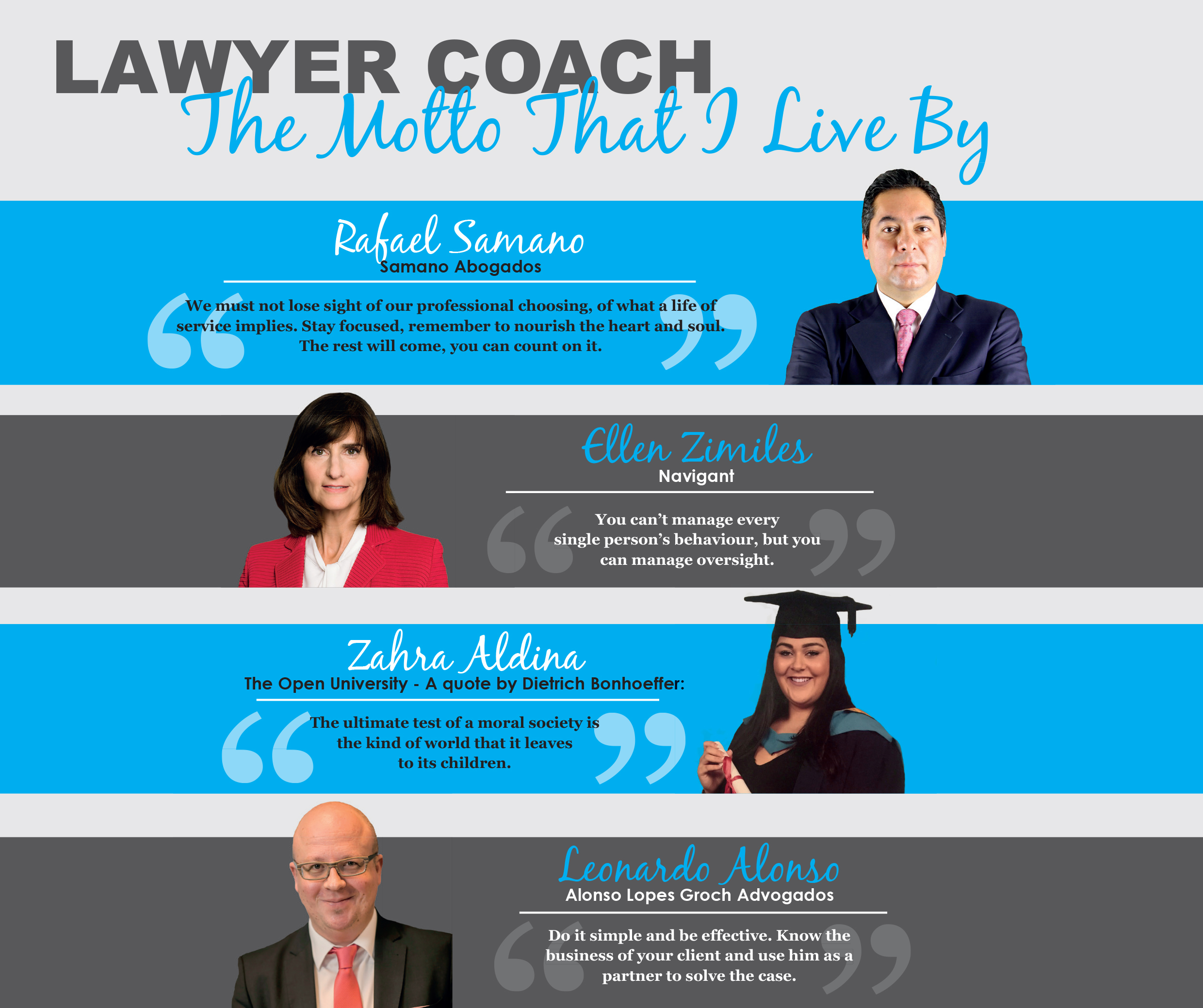
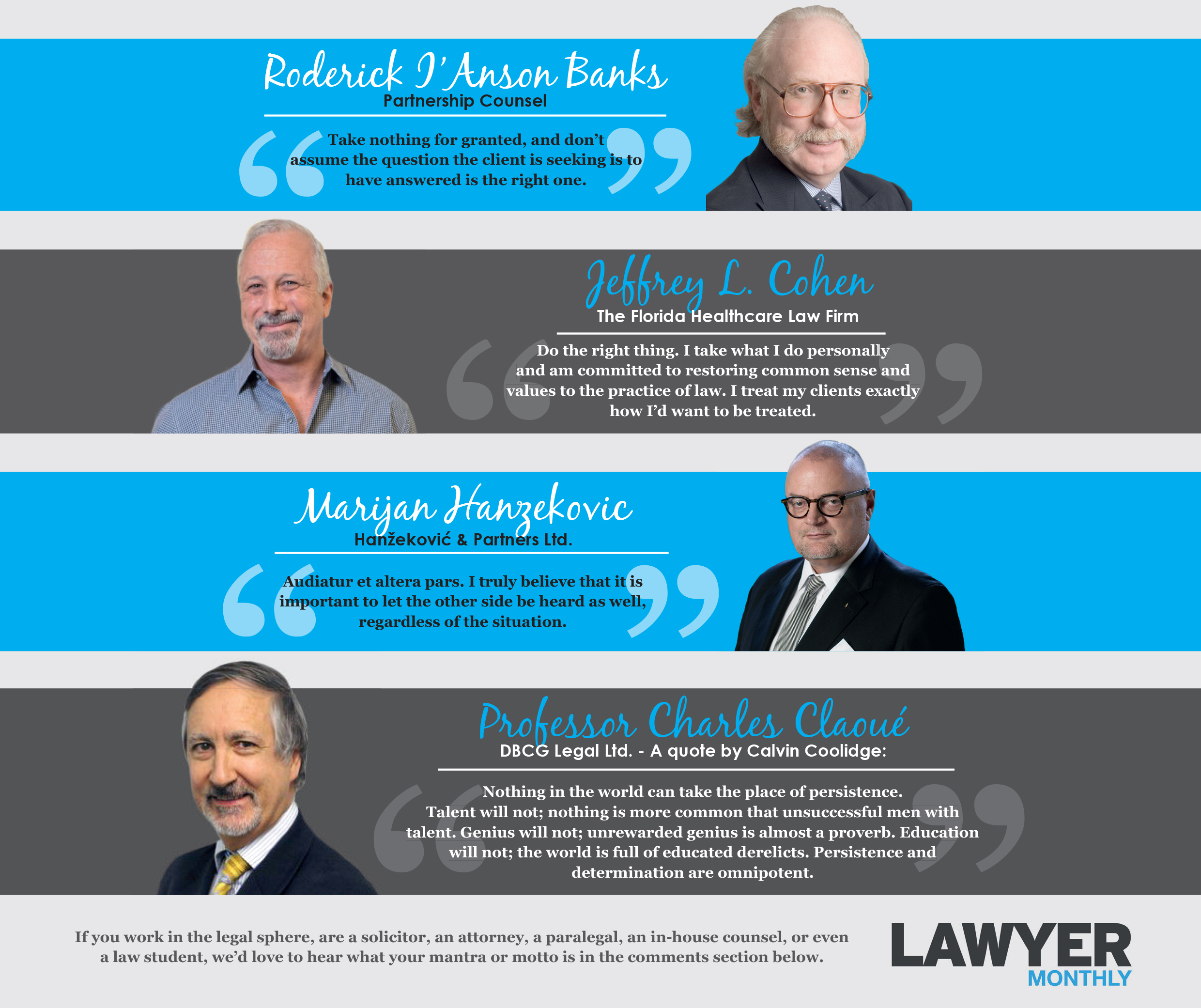
Here below Lawyer Monthly has collated a number of short responses from highly esteemed legal professionals, in answer to the question: What is the mantra or motto you live by in the legal sector? Whether it's a deep seeded life lesson or a matter of professionalism or integrity, we each have something we could say is our core value.
Recent diversity figures from the Judicial Appointments (JAC) show there is a serious problem with the appointment of black and minority ethnic lawyers to the bench and underline the need for targeted support and training, the Bar Council has said.
The figures reveal:
Chair of the Bar Council’s Equality and Diversity Committee, Robin Allen QC said: “We cannot go on having no BAME applications for senior judicial roles. The rule of law requires a fully diverse judiciary.
“Once again the figures reveal the urgent need for positive action to make BAME applicants more successful and to increase the number of eligible women applicants.
“These figures stress the importance of the Bar Council’s on-going training and coaching programmes for BAME and women lawyers who wish to serve as members of the judiciary.
“Despite the problems it highlights, the JAC’s reporting is meticulous and it deserves credit for not shying away from these issues.”
Speaking about proposals for a new education programme in development with the JAC, Ministry of Justice and other legal professional bodies, Robin Allen QC said: “The Bar Council is working in partnership to develop a programme of Pre-Application Judicial Education (PAJE), open to all who are thinking about applying to the bench, but with a high proportion of reserved places for BAME, women and disabled lawyers.”
The PAJE programme has support from across the legal profession and the judiciary. It would give potential candidates a vital insight into what being a judge entails with modules on judgecraft, jury handling, judicial ethics and dealing with families and the media.
He said: “We want to give all aspiring judges a better idea of what is expected of them. The aim is to level the playing-field so that all potential applicants have access to training, support and insights that will help them to decide if the judiciary is the right calling for them.
“If they chose to apply, the programme would help candidates to apply with confidence.”
(Source: The Bar Council)
