
Understand Your Rights. Solve Your Legal Problems
When a person is injured in an accident, they worry about their injuries and how long it will take to recover. As the bills start pouring in, they begin to panic. How will they pay these bills until a settlement has been reached? What if the settlement isn't enough to cover the bills? These questions and more may race through their minds.
Contact Gauthier & Maier Law Firm before panicking. The team helps victims obtain financial compensation for injuries and losses sustained due to the accident. The following guide provides answers about personal injury lawsuits, so people know what to expect when contacting an attorney.
A personal injury lawsuit is a civil action against those responsible for the accident. This legal action aims to secure compensation for the injury and losses. To win the lawsuit, the victim must show that the defendant is responsible for the injuries and subsequent losses. Once this has been proven, the court determines a fair settlement.
Most people associate personal injury lawsuits with car accidents. However, a person may file this type of civil suit if a dog attacks them, someone defames them, or they are a medical malpractice victim. Product liability, wrongful death, and workers' compensation claims also fall under the umbrella of personal injury lawsuits.
When a person is injured in an accident, they must see a doctor immediately. Take pictures of any injuries and the accident scene. Gather other pertinent information and preserve the evidence. It will be needed as the case moves forward. Finally, keep a record of how the injuries impact daily life and any expenses incurred because of the injuries. For example, a person with a broken leg may be unable to clean the home. They must pay someone to complete this task during their recovery. The victim may seek compensation for these added expenses. Record how the injuries also affect mental health.
Proving fault in a personal injury case can be challenging. The victim must show that the defendant breached the duty of care, which must have led to the injuries the victim is seeking compensation for, or the case will fail. Most victims find that showing the defendant was negligent in some manner provides the necessary proof.
At times, multiple parties may be at fault for an accident. An attorney works with clients to determine how they may be held accountable for their injuries. In these situations, the court assigns a percentage of fault to each negligent party. All parties will contribute to the settlement based on their percentage of fault. However, in some states, the victim may also be held accountable for their role in the accident, reducing the settlement they receive by their percentage.
Attorneys know which damages a person can seek. They work with victims to ensure that all expenses related to the accident are paid by those responsible. In addition to the medical bills and lost wages, a victim might request compensation for pain, suffering, and other expenses, as they deserve compensation for all losses related to the accident.
Contact an attorney immediately following an accident for help resolving the matter. The attorney will file the case before the statute of limitations runs out. While an attorney is not required, it takes the burden off the victim. They can focus on their recovery, knowing the legal aspects of the case are handled.
When dealing with criminal charges against you, it's all about your reputation, freedom, and future hanging in the balance. This is why you need an advocate who understands how to navigate the system in a way that will secure the best possible results for you. A criminal attorney offers strategy, protection, and confidence. Whether you are accused of an offense or a felony, the right lawyer can make a big difference. Here are five reasons why retaining a criminal defence lawyer is one of the best decisions you can make.
The law of crime is complex, and the translation of legal jargon, double-speak, procedure, and codes is opaque. A criminal attorney knows the ways of the courts in your jurisdiction and has a rapport with judges, prosecutors, and court procedures, which can help represent you.
You could misapply the law or miss essential filing deadlines without knowing it. An experienced lawyer ensures they represent you every step of the legal procedure. They know how to spot weaknesses in the case brought against you and can negotiate reduced charges or case dismissal when possible.
Most criminal offenses are not prosecuted; they can be resolved through a plea bargain. A seasoned criminal lawyer has mastered how to bargain with prosecutors to reduce the charges, punishment, or eliminate the prospect of incarceration. All these bargaining skills take talent, integrity, and an advanced understanding of the system's operation.
Seasoned attorneys will know when the plea deal is good or it's necessary to go to trial. A good Raleigh criminal defense lawyer, for instance, will guide you on key aspects of the case you'll leverage for better outcomes. Consult them first for specifics on everything from timelines to the number of sessions.
Every crime has its situation, and an experienced lawyer will develop a strategy specific to your case's circumstances. That may involve seeking evidence, interviewing witnesses, or negotiating a plea bargain.
A lawyer has access to resources and experience to make effective investigations. They can use the services of private investigators, forensic analysts, or other professionals to obtain evidence on your behalf. All these tactical considerations are impossible for a layperson to accomplish without legal acumen.
You might unintentionally make statements or judgments that hurt your case if you are undergoing a criminal investigation or on trial. During questioning, arrests, and trials, a defense attorney advocates for your constitutional rights.
They will also protect you from yourself by stopping you from doing something that can affect your case, like talking with the police in a way you shouldn't, or agreeing to a plea you don't desire. Your attorney is your voice, holding the police and prosecutor in check from wandering outside the law's bounds every step of the way.
Accusation of a crime is an emotionally overwhelming experience. Fear, worry, and confusion cloud the mind and nip logical thinking in the bud. Besides protecting you legally, a criminal attorney gives comfort and explanation at your most crucial moment.
Employing an expert who knows your goal and can gently and confidently lead you, restoring normalcy in your life, mentally and psychologically. They help you make the best possible choices to protect your rights.
Without an experienced lawyer to guide you through the criminal law system, your life hangs in the balance. An excellent criminal defence provides the expertise, strategy, and guidance necessary for your first time in court. From defending your rights to advocating for positive results, their work matters.
As intellectual property law struggles to keep up with the needs of an evolving world, music is one of the most dynamic and contentious fields. As legal systems around the globe have struggled for decades to define the boundaries of ownership, originality, and fair use in the music industry, the rise of artificial intelligence (AI) as a creative force has triggered a paradigmatic revolution in our understanding of authorship and rights.
Now, music is not only created by humans using instruments and intention; it's also created by algorithms trained on large datasets of other songs, sounds, and styles. That presents some complicated questions: Who owns the copyright on a song written by a machine? Can an algorithm be considered an author? And what's the consequence when such machine-generated content borrows too heavily from copyrighted works?
Classically, music copyright law has demanded two principles: fixation and originality. To qualify for protection, a musical composition must be an original work, at a minimum, and it must be fixed in a tangible medium of expression. Courts have uniformly held that originality demands some minimal amount of creativity, a standard that has stood firm since Feist Publications, Inc. v. Rural Telephone Service Co. in 1991.
But AI blurs this line. Can an output of a generative algorithm meet this threshold? And if so, who is the creator: the programmer, the person who inputted prompts into it, or perhaps the company that owns the AI platform?
AI-generated music is not a hypothetical concept—it's already transforming industries. Tools like OpenAI’s MuseNet, Google's MusicLM, and platforms like Soundful and Amper Music allow users to generate full-length tracks in seconds. These systems don’t merely remix existing songs; they synthesize entirely new compositions from patterns learned across millions of samples.
This democratization of creativity is exciting but extremely disruptive. For instance, if a company uses AI to create a background score for an ad, and the melody later becomes the subject of a copyright battle for resembling an already existing song, who is responsible? Further, can the company claim ownership of the AI-created music under current laws?
Here is where the controversy intensifies. While some argue that AI-generated works lack the "human touch" to qualify for copyright protection, others point to the creative effort involved in training, curating, and guiding the AI model.
From the legal point of view, AI music has the audacity to challenge the very definition of authorship. Most jurisdictions require a human author for a work to be eligible for copyright. In the US, the Copyright Office has routinely denied registration for works created without human authorship. But what if the "human" contribution lies in the design of the algorithm or the intentionality of the prompt? Such gray areas are becoming ever more relevant in courtrooms and boardrooms everywhere.
A leading case in this context is Thaler v. Perlmutter, where the U.S. District Court again insisted that copyright protection is for human-authored works and refused the registration of a Creativity Machine AI-generated artwork. The ruling set a precedent, but music, with its multi-layered and subjective nature, might be about to challenge that precedent with more sophistication in the near future.
The commercialization of AI-generated music introduces further legal challenges. Traditional music licensing systems are based on identifiable rights holders—producers, performers, composers, and publishers. Yet, when a song is created by an AI system, it is unclear who the rightful owner is. This renders licensing, royalty payments, and even moral rights more complicated, as they are inclined to be based on the reputation and intentions of the creator.
There is also the risk of unintentional infringement. Since AI algorithms are trained on existing copyrighted music, it is always a risk that generated music will reflect melodies, chord progressions, or rhythms from such works. Judges would have to determine, in such instances brought before the courts, if such similarities are the result of unlawful copying or coincidence.
Legal systems worldwide are catching up with varying degrees of urgency and coherence. The AI Act of the European Union and its proposed revisions to copyright law aim to introduce transparency and accountability into AI-generated content. The UK Intellectual Property Office has provided guidance stating that AI-generated works can be protected under a custom category of copyright—although only for 50 years, and only if the output is organized by a human.
Meanwhile, other countries like Japan and Singapore have adopted more lenient approaches, allowing broader use of AI-generated content without infringing on existing copyrights in a bid to foster innovation. These differences in regulation could lead to forum shopping, conflict of laws, and enforcement issues in cross-border music distribution.
For lawyers, the proliferation of AI music composition represents both a challenge and an opportunity. On the one hand, it calls for the reconceptualization of traditional doctrines in copyright law. On the other, it opens up the potential for new models of joint authorship, AI-compatible creativity, and novel types of licensing that reflect this hybrid reality.
The final outcome must not be to stifle innovation, but to guide it in a responsible manner. Courts, legislatures, and industry leaders must join forces to make sure that creators, whether human or machine, are acknowledged and compensated in a rational legal framework.
We are on the cusp of a new era of musical creativity in which ingenuity is no longer limited to the human imagination. As legal systems come up to speed with this cultural and technological development, the issue will not just be who owns the music, but what it will mean to create in the era of algorithms.
No one wants to deal with an injury that wasn’t their fault. But in the aftermath of a personal injury experience, it’s important to put aside the anger and stress and take action.
The right personal injury attorney can fight for fair compensation to cover everything from medical appointments to missed work hours. Choosing the right attorney, however, isn’t always easy.
What should clients really look for when choosing the right lawyer?
A variety of factors, including a solid track record and online reputation, can inform anyone’s choice.
Read on to learn about the top factors clients consider when weighing representation options.
Most people wouldn’t choose a plumber or electrician with poor online ratings or unprofessional websites. The same should hold for a personal injury attorney. Since more people are scrolling through websites from their phones, making a good digital first impression is imperative for attorneys trying to earn new clients.
Reviews on sites like Google, for instance, can make or break an attorney’s reputation in the online space. Comments that raise any red flags can deter potential clients from becoming actual clients.
In response, attorneys should be vigilant about managing their online reputation. That means responding to questions and politely handling poor reviews. Evidence of professionalism can go a long way, and a quality approach to marketing for personal injury law firms can help establish a trustworthy online presence.
Most clients suffering from a personal injury are tired, confused, and overwhelmed. On top of a potentially devastating injury, they also have to sift through intense legal jargon and procedures. Consequently, the best attorneys will be great communicators willing to demystify terms and guide clients through the legal landscape.
Clients want lawyers who are committed to responding quickly and through whatever means is most convenient. They don’t want to feel like they’re being pawned off on an assistant. Clients deserve to feel heard and respected, with regular case updates and interpretations of the outcomes.
While lawyers should demonstrate legal expertise during a consultation with the client, they also should demonstrate empathy and understanding.
Clients want to feel comfortable sharing all details of their story with their lawyer. But a lawyer without obvious compassion and good listening skills won’t help a client open up.
In short, quality communication can result in happier clients and the potential for referrals.
Clients want attorneys with a proven track record of success. And this is especially true with cases that are similar to the client’s particular situation. In other words, a client coming forward after a motorcycle accident would like an attorney with experience representing clients in similar scenarios.
That way, the client can feel confident that the lawyer knows the nuances involved.
Attorneys would be wise to include stats, details, and testimonials from successful cases on their websites. Clients shopping for an attorney will take notice if an attorney can cite several successful outcomes and financial settlement amounts.
Further, clients should ask prospective attorneys for examples of positive case outcomes to verify their experience.
Clients understand that legal fees are not cheap. Even so, they don’t want to be blindsided by big costs at the end of a personal injury settlement. Legal fees can be a source of stress, especially for clients already under financial strain.
As such, lawyers should be transparent about fee structures, including whether they work on contingency or charge hourly fees. Vague answers about fees could persuade potential clients to look elsewhere.
Lawyers should put together a written fee agreement that outlines expectations. They should be clear about repayment plans, too, to help clients know exactly what they’ll need to do.
Ultimately, being explicit about costs can help set the tone for a better client-lawyer relationship.
To earn business with a new client, a personal injury lawyer must be able to showcase legal knowledge while also building trust. This starts with a professional online presence and good communication skills that make a client feel heard.
Attorneys hoping to grow their business can’t rely on expertise alone to garner new clients. The right blend of soft and hard skills, plus a sharp approach to marketing, must be part of the package. The best lawyers are sincere in their efforts to help clients as they manage personal injury cases.
Losing your job is often a stressful and destabilizing experience. You might question your performance, the company’s financial health, or a simple change in business direction. However, sometimes a termination isn't just an unfortunate event; it's the culmination of a series of retaliatory actions, a final, decisive act of punishment for exercising your legal rights or engaging in protected activities. Recognizing when a seemingly straightforward firing is actually the endpoint of illegal retaliation is vital for employees seeking justice, and this is where the expertise of an employment lawyer NJ becomes indispensable. Understanding the nuances between wrongful termination and retaliatory discharge can be the first step toward protecting your career and your rights.
While wrongful termination and retaliation are often intertwined, they are distinct legal concepts. Wrongful termination generally refers to being fired for an illegal reason, such as discrimination based on race, religion, gender, age, disability, or for taking legally protected leave. Retaliation, on the other hand, involves an employer taking adverse action against an employee because the employee engaged in a protected activity. This could include complaining about discrimination or harassment, reporting safety violations, participating in workplace investigations, or filing a wage and hour claim.
Several employee actions are legally protected, meaning an employer cannot take adverse action against an employee for engaging in them. These protected activities form the bedrock of retaliation claims. Reporting discrimination or harassment to HR or a government agency is a prime example. Similarly, raising concerns about workplace safety to OSHA or refusing to participate in illegal activities are protected. Filing a workers' compensation claim after a work-related injury or taking legally mandated family or medical leave also falls under this umbrella.
Retaliation rarely manifests as a sudden, isolated act of termination. Instead, it often unfolds as a pattern of adverse actions designed to punish the employee and make their work life unbearable, ultimately leading to their resignation (constructive discharge) or outright firing. These actions can be subtle or overt, and recognizing them is crucial. Examples include unwarranted negative performance reviews, demotions, transfers to less desirable roles, increased scrutiny, exclusion from meetings, denial of training opportunities, or even hostile behavior from supervisors or colleagues orchestrated by management.
One of the key elements in proving retaliation is establishing a causal link between the employee's protected activity and the adverse action taken by the employer. While a close temporal proximity between the protected activity and the termination (for example, being fired shortly after reporting harassment) can be suggestive of retaliation, it is not always sufficient proof on its own. Employers may try to concoct legitimate-sounding reasons for the termination. Therefore, a retaliation lawyer will gather evidence to demonstrate that the employer's stated reasons are pretextual – a cover-up for the true retaliatory motive.
In cases of potential retaliation leading to wrongful termination, thorough documentation is your most powerful tool. Keep detailed records of any instances of perceived unfair treatment, including dates, times, specific actions, and the names of individuals involved. Save all relevant emails, memos, performance reviews, and any other written communication. If you reported discrimination or harassment, retain copies of your complaints and any responses from the company. This documentation can provide crucial evidence to support a claim of retaliation and help your employment lawyer build a strong case.
Many employers operate under the "at-will" employment doctrine, which generally allows them to terminate an employee for any reason, or no reason at all, as long as it's not an illegal reason. However, the at-will doctrine does not provide a shield for retaliatory actions. Even in an at-will employment scenario, an employer cannot fire an employee for engaging in legally protected activities. Understanding this limitation is essential for employees who might wrongly believe they have no recourse simply because they are at-will employees.
Sometimes, instead of outright firing an employee, an employer creates such a hostile or intolerable work environment that the employee feels compelled to resign. This is known as constructive discharge, and under the law, it can be considered a form of wrongful termination if it is the direct result of illegal retaliation. To prove constructive discharge, an employee typically needs to demonstrate that the employer's actions were so egregious that a reasonable person in the same situation would have felt compelled to quit.
Many companies have internal grievance procedures for employees to report concerns like discrimination or harassment. While utilizing these procedures is often a good first step, it's important to understand that filing an internal complaint is itself a protected activity. If an employer retaliates against an employee for raising concerns through internal channels, this can form the basis of a retaliation claim, even if the underlying complaint is not ultimately substantiated.
If you believe you have been wrongfully terminated as a result of retaliation, it is crucial to seek legal advice from a NJ wrongful termination lawyer as soon as possible. These attorneys specialize in employment law and have a deep understanding of the complexities of retaliation claims. They can assess the specific facts of your situation, advise you on your legal rights and options, help you gather and preserve evidence, and represent your interests in negotiations or litigation.
Like other legal claims, retaliation claims are subject to statutes of limitations, which are deadlines for filing a lawsuit. These deadlines can vary depending on the specific federal and state laws involved. Failing to file a claim within the applicable statute of limitations can bar you from pursuing legal action altogether. Therefore, prompt consultation with a retaliation lawyer is essential to protect your legal rights.
Proving that an employer's actions were motivated by retaliatory intent can be one of the most challenging aspects of these cases. Employers rarely admit to retaliating against an employee. Instead, they often provide seemingly legitimate, non-discriminatory reasons for their actions. A skilled employment lawyer will employ various strategies to uncover the true motive, such as examining the timing of events, inconsistencies in the employer's explanations, past disciplinary actions, and the treatment of similarly situated employees who did not engage in protected activities.
If an employee prevails in a wrongful termination or retaliation lawsuit, they may be entitled to various types of damages. These can include back pay (lost wages and benefits from the time of termination until the resolution of the case), front pay (future lost wages if reinstatement is not feasible), compensatory damages (to cover emotional distress, pain, and suffering), and in some cases, punitive damages (to punish the employer for egregious misconduct and deter future wrongdoing).
When a job loss feels like more than just a termination, when it follows closely after you’ve spoken up about discrimination, safety concerns, or other workplace violations, it may be a symptom of illegal retaliation. Understanding your rights, recognizing the patterns of retaliatory behavior, and acting promptly to seek legal counsel from an experienced retaliation lawyer NJ are essential steps in protecting yourself. Wrongful termination that stems from retaliation is a serious violation of employment law, and with the right legal guidance, employees can pursue justice and hold their employers accountable for their unlawful actions.
Facing overwhelming debt can feel like navigating a stormy sea without a compass. For many individuals, bankruptcy becomes a necessary lifeline, offering a chance to reset and reclaim financial stability. But how often can one file for bankruptcy? Understanding the different types of bankruptcy available is crucial in making informed decisions about your financial future.
When considering bankruptcy, it's essential to comprehend the differences between Chapter 7 and Chapter 13. Chapter 7 bankruptcy is often referred to as "liquidation bankruptcy." It allows individuals to discharge most of their unsecured debts, such as credit card bills and medical expenses, without repaying them. Conversely, Chapter 13 bankruptcy is known as "reorganization bankruptcy." It enables individuals to create a repayment plan to pay back a portion of their debts over three to five years, allowing them to keep their assets.
Understanding these differences can help you determine which option best suits your situation. It’s important to consult with a bankruptcy lawyer who can provide personalized guidance based on your unique financial circumstances.
Chapter 7 bankruptcy is designed for individuals who cannot repay their debts. It involves liquidating non-exempt assets to pay creditors, but many people find that they can keep most of their property due to exemptions. This process typically lasts around three to six months, giving individuals a fresh start.
Imagine the relief of being free from the burden of debt, allowing you to focus on rebuilding your financial life. However, it’s vital to understand that not everyone qualifies for Chapter 7. To be eligible, you must pass a means test that assesses your income and expenses.
You can file for Chapter 7 bankruptcy once every eight years. This waiting period is crucial to prevent individuals from abusing the system. If you find yourself in a situation where you’ve previously filed for Chapter 7, it’s essential to explore other options or seek advice from a bankruptcy attorney.
Navigating the complexities of bankruptcy can be overwhelming, and having a knowledgeable Chapter 7 bankruptcy attorney by your side can make all the difference. They can help you understand your rights, guide you through the filing process, and ensure that you make the best decisions for your financial future. An attorney can also assist in determining if you may qualify for exemptions that allow you to keep certain assets.
Chapter 13 bankruptcy allows individuals to keep their property while repaying their debts through a structured repayment plan. This plan typically lasts three to five years, during which you make monthly payments to a bankruptcy trustee, who then distributes the funds to your creditors.
This type of bankruptcy is often a good option for individuals who have a steady income and want to avoid foreclosure on their homes. It provides a way to catch up on missed mortgage payments while also addressing other debts.
You can file for Chapter 13 bankruptcy multiple times, but there are specific timeframes to consider. If you have previously filed for Chapter 13 and received a discharge, you must wait two years before filing again. This allows you to reorganize your finances and create a sustainable plan for the future.
While it is possible to file for Chapter 13 bankruptcy without an attorney, having a Chapter 13 bankruptcy lawyer can significantly enhance your chances of a successful outcome. They can help you navigate the complexities of the repayment plan, ensure that you meet all legal requirements, and represent you in court if necessary. The guidance of a professional can alleviate stress and provide clarity during a challenging time.
Navigating the world of bankruptcy can be daunting, but understanding your options is the first step toward reclaiming your financial future. Whether you choose Chapter 7 or Chapter 13, knowing how often you can file and seeking professional advice can empower you to make informed decisions. Remember, you are not alone in this journey, and with the right support, you can emerge stronger and more financially secure.
As healthcare becomes increasingly digital, the protection of sensitive medical data has never been more critical. From electronic health records and mobile apps to AI-driven analytics, the line between innovation and privacy grows thinner by the year. Few understand this evolving landscape better than Helen Oscislawski, a leading attorney and founder of Attorneys at Oscislawski LLC, who has spent more than two decades advising healthcare organizations on HIPAA, data sharing, and patient privacy compliance.
In this exclusive interview, Helen shares insights from her remarkable 23-year legal career, offering a rare look into how U.S. healthcare privacy law has evolved—and what lies ahead in an age dominated by open APIs, mobile health apps, and artificial intelligence.
Helen, thank you for speaking with us. For readers unfamiliar with your background, could you tell us about your journey into healthcare law?
It is hard for me to believe that I have been practicing law for over 23 years! Growing up, pursuing a career in law was not even on my radar. I was raised as an only child by two working parents who came to the United States as Ukrainian refugees shortly after World War II. Much of my early childhood was spent with my grandmother, who didn’t speak English—so Ukrainian was my first language. Not exactly the ideal start for someone whose career would eventually depend on strong English communication skills.
I graduated from Rutgers University with a degree in Psychology, Summa Cum Laude, and was named “Most Outstanding Student in Psychology.” My plan was to earn a PhD and become a clinical psychologist. But after relocating to Michigan for my husband’s emergency medicine residency, I put those plans on hold and began working as a social worker in a skilled nursing facility. Soon after, my husband encouraged me to try law school—and the rest, as they say, is history.
I graduated from Rutgers School of Law at the top of my class and was admitted to the New Jersey Bar in 1999. My early legal work exposed me to a new and rapidly emerging area—health data privacy law—which would ultimately define my career.
When I joined a large firm in Princeton, the federal HIPAA law had just been enacted. For two years straight, I worked almost exclusively on HIPAA-related matters, interpreting the law’s brand-new privacy and security regulations. I quickly became my firm’s “go-to” attorney for anything involving health information privacy.
Around 2005, the digital transformation of healthcare began in earnest. The push to move from paper to electronic health records, and later to connect providers and patients through online networks, placed me squarely at the forefront of this evolution.
In 2008, I was appointed by Governor Jon Corzine to the New Jersey Health Information Technology Commission, representing the legal community as an expert in health privacy. I was reappointed by Governor Chris Christie in 2010 and went on to chair the Commission’s Privacy Subcommittee.
That same year, I left my firm to establish Attorneys at Oscislawski LLC, a boutique healthcare law practice advising clients nationwide on privacy, compliance, and emerging health technologies. Since then, I’ve had the privilege of working with general counsels, CEOs, CIOs, privacy officers, and regulators on some of the most complex issues at the intersection of technology and healthcare.
Drawing on your expertise, can you give us a brief overview of healthcare privacy regulation in the United States?
Federal protection of health information began in the 1970s with the law known as “Part 2”, which safeguarded the confidentiality of records from substance use disorder treatment programs. But it wasn’t until 1996, with the passage of the Health Insurance Portability and Accountability Act (HIPAA), that the U.S. saw its first comprehensive healthcare privacy law.
The HIPAA Privacy Rule came into effect in 2003, followed by the Security Rule and Breach Notification Rule, forming the legal backbone for how health information must be protected. Together, HIPAA and Part 2 established the foundation of U.S. healthcare privacy law.
However, as technology evolved, these frameworks began to show their age. The 21st Century Cures Act introduced the Information Blocking Rule, designed to prevent electronic health record vendors from hoarding or restricting access to patient data. This fundamentally shifted the conversation—from how to protect information to how to make it accessible without compromising privacy.
What rights do individuals have under HIPAA and related privacy laws?
There are several, but three stand out:
Protection against unauthorized use or disclosure of Protected Health Information (PHI): Healthcare entities must obtain signed authorization before sharing PHI unless an exception applies (e.g., treatment, payment, or public health).
The right of access: Individuals have the right to view, download, and transmit their PHI electronically, often through patient portals or mobile apps.
Breach notification: Patients must be informed if their data has been compromised, allowing them to take protective steps against identity theft or fraud.
These rights, combined with the Information Blocking Rule, have given patients more control than ever—but also more responsibility.
How has the rise of health information technology affected patient privacy?
When records were on paper, privacy was simpler to manage. Today, electronic data can travel anywhere with a click. Health information is often stored on cloud servers, and interoperability—once a barrier—is now the goal. The trade-off is that data becomes inherently more vulnerable.
Data breaches are now the most common threat. These can result from cyberattacks, vendor errors, or even misconfigured technology upgrades. The push for open APIs and app-based connectivity means patients themselves must now vet the apps they use—many of which aren’t covered by HIPAA.
The Federal Trade Commission (FTC) has recently stepped in, targeting mobile health app vendors for “unfair or deceptive practices.” Meanwhile, lawsuits against hospitals accused of sharing data through online tracking tools like pixels and cookies underscore the new privacy risks of the digital era.
What happens when healthcare information is compromised?
For healthcare organizations, consequences can include major civil penalties, class-action lawsuits, and severe reputational damage. For individuals, compromised data can lead to identity theft, embarrassment, or even employment loss.
HIPAA itself doesn’t grant individuals a private right of action, meaning patients can’t directly sue under the statute. However, they may pursue claims under state laws such as invasion of privacy or breach of contract. Patients can also file complaints with the Office for Civil Rights (OCR) at the Department of Health and Human Services, though not all complaints trigger investigations.
What do you foresee for the future of health information privacy?
The next major frontier is the explosion of mobile health apps and the integration of AI technologies like ChatGPT into healthcare systems. These tools can empower patients but also raise unprecedented privacy challenges. The key will be balancing innovation with accountability—ensuring patients know where their data goes and how it’s used.
As technology continues to outpace regulation, my role as a privacy attorney is to help clients navigate that uncertainty while maintaining trust in a healthcare system built increasingly on digital transparency.
Helen Oscislawski, Esq. is the founder of Attorneys at Oscislawski LLC, a boutique healthcare law firm based in Princeton, New Jersey. A recognized authority in healthcare privacy, she was named Best Lawyers® 2022 “Lawyer of the Year” in Healthcare Law for Princeton and has been listed among Super Lawyers® for healthcare law since 2020. She is admitted to practice in New Jersey and Arizona and advises clients nationwide on HIPAA, data privacy, information blocking, and regulatory compliance.
📍 Attorneys at Oscislawski LLC
782 Alexander Road, 2nd Floor, Princeton, NJ 08540, USA
📞 Tel/Fax: +1 609-385-0833
📧 Email: helen@oscislaw.com
The Channel 4 series "Barristers" provides a rare insight into the world of courtroom advocacy but how well does it capture the true challenges of life at the Bar? Lawyer Monthly spoke with Saadiya Ahmad and Nurun Choudhury from the University of East London’s Legal Advice Centre who shared their perspectives on the show.
From the perspective of the UEL Legal Advice Centre the Channel 4 programme "Barristers" has the potential to shape public perception in both positive and challenging ways. Barristers are often viewed as detached, inaccessible and somewhat superior – a perception reinforced by the formal wigs and gowns they wear, which serve to distance the individual from their professional role, allowing them to focus on the pursuit of justice. While this traditional image is intentional, it can also contribute to misconceptions about the profession.
In the Channel 4 series barristers are presented as real people, each with their own motivations for practising law. The show captures the deep ethical conflicts and personal reflections that often accompany their work, offering a behind-the-scenes view of the intense preparation required for every courtroom appearance. This transparency helps challenge the common misconception that barristers are simply hired counsel or disconnected legal practitioners, instead highlighting the human side of the profession and the moral complexities they navigate.
Furthermore, the programme gives insight into the diversity of cases barristers handle, the misconception that barristers are extortionately paid for what they do and only deal with high-profile criminal trials is proved wrong. They represent clients in all legal matters including family disputes; immigration matters and social justice issues. The series is a good teaching tool for students at UEL and the Legal Advice Centre to understand what is involved personally and professionally in becoming a barrister. You could be involved in cases that directly affect ordinary people, including those from a vulnerable or marginalised background.

We would say that the series makes some effort in revealing the legal process for the public, though there is still room for further demystification.
The series provides an unprecedented behind-the-scenes look into the UK legal system, exploring real-life cases. However, a more complete picture would have included some of the additional challenges faced, such as delays, barriers to access, and declining funding – issues that, as some have warned, risk undermining faith in the justice system both externally and within.
The ongoing impacts of legal aid cuts have resulted in overworked and underpaid practitioners at the Bar, with many leaving to pursue different careers with greater stability resulting in challenges faced by both victims and defendants.
While the series has significantly contributed to public understanding of the legal system, it is essential for viewers to approach the portrayal with a critical eye. It has served as a valuable starting point for those interested in the workings of the law, but could be enhanced with additional resources. For a more thorough understanding, future episodes could delve deeper into how barristers manage their caseloads on a daily basis. It would also be particularly useful for our aspiring lawyers at UEL, to follow the personal story of one of the barristers. Such as highlighting how long it took them to qualify, the barriers they faced and what inspired them to pursue a career in law. This level of insight would not only inform viewers, but also motivate those considering a legal career.
Furthermore, a series focused on how barristers are instructed on matters would be useful, how they evaluate evidence, build arguments and prepare for hearings.
Understanding the emotional, practical and intellectual demands of the profession and whether it is truly a round-the-clock career, would give future legal professionals a more realistic and grounded perspective on what the role entails.

The series could have a significant impact on aspiring lawyers from underrepresented and marginalised backgrounds, particularly those studying at UEL who may not have established connections in the legal profession. By offering an upfront and honest behind the scenes look into the profession, the series helps to expose a career that could often appear as exclusive and inaccessible. It provides an insight into the daily realities of life in chambers, and the challenges of courtroom advocacy. These are experiences that many students may never otherwise witness. For those from marginalised communities, the visibility of diverse stories (when included) can be deeply validating, reinforcing the idea that they too can succeed in such spaces.
Beyond this, the series shines a light on systemic barriers such as the legal training and the dominance of elite institutions, whilst also humanising the role by portraying barristers as complex, often conflicted ‘normal’ individuals.
This balance of realism and inspiration can motivate students to pursue their legal goal, preparing them with a clearer understanding of the profession’s demands and encouraging them by giving them a strong sense of purpose, especially if they hope to use the law as a tool for social justice or community empowerment.
This article was written by:

Saadiya Ahmad
Associate Professor
Head of Health Partnerships - Projects of the Office of the Vice-Chancellor and President
Associate Dean for Careers and Enterprise.
Practising Solicitor & Director of Legal Advice Centre
University of East London

Nurun Choudhury
Supervising Solicitor & Lead for the Legal Advice Centre
Lecturer
University of East London
The legal industry has always been known for its traditional approach. However, it’s now experiencing a major transformation due to artificial intelligence (AI) technology. AI is making an impact by helping lawyers work faster, smarter, and more efficiently. From scanning legal documents in seconds to predicting case outcomes, AI is changing how law firms function. While it offers incredible possibilities, it also introduces ethical concerns that legal professionals must address carefully.
AI is no longer just a concept for the future, it’s already reshaping how law firms operate today. Many firms now use AI-driven tools to review contracts, organize legal documents, and predict judicial rulings based on previous cases. These technologies reduce the amount of time attorneys spend on routine tasks, allowing them to focus on strategic thinking and complex legal matters.
One of the most valuable applications of AI is predictive analytics. By analyzing historical case outcomes, artificial intelligence can provide legal teams with insights about possible rulings, which can be particularly useful in trial preparation. A trial consultant at The Trial Concierge can use AI-powered data to refine courtroom strategies, ensuring that every legal argument is backed by analytical evidence.
Artificial intelligence is also reshaping transactional law. Instead of spending hours reviewing contracts, attorneys can rely on AI tools to highlight important clauses, detect risks, and propose necessary revisions. This streamlines legal processes and reduces the likelihood of human errors.
AI isn’t just transforming how lawyers work, it’s also reshaping the client experience. Many law firms now rely on AI-powered chatbots to handle routine inquiries, giving clients quick access to basic legal information without long wait times. Legal research, traditionally a slow and tedious process, is now lightning-fast. AI scans vast databases, pulling up relevant cases in minutes rather than hours. This efficiency slashes costs and ensures legal teams can focus on strategy rather than manual searches.
But AI is more than just a research assistant. It’s revolutionizing trial preparation. Advanced e-discovery tools comb through massive amounts of data to pinpoint key evidence with incredible accuracy. Jury analysis software goes even further, helping lawyers anticipate reactions, refine arguments, and build stronger cases.
Legal research has always been one of the most time-consuming parts of a lawyer’s job. AI is changing that entirely. Instead of flipping through books or combing through endless case files, attorneys now have sophisticated AI tools that recognize patterns, extract relevant details, and present crucial insights in seconds.
With natural language processing, lawyers can input complex legal queries and receive precise results instantly. No more manually cross-referencing endless statutes. AI streamlines the process, making legal decision-making faster and more accurate. AI is also making waves in case analysis. Machine learning algorithms examine historical rulings, revealing trends in judicial decisions. That data gives lawyers an edge, helping them predict case outcomes with remarkable precision.
The use of AI in law firms is changing how legal professionals work, but it also comes with important ethical concerns. One major challenge is bias. AI relies on past legal data to make predictions and assist with cases. If this data contains unfair patterns, such as discrimination based on race or gender, the AI may continue those biases. This could lead to unjust outcomes, making it essential to regularly review and refine AI models to ensure fairness.
Privacy and data security are also crucial issues. Law firms handle highly sensitive client information, and AI systems must be designed to protect this data from breaches or unauthorized access. Strict security measures and compliance with legal regulations are necessary to maintain trust between lawyers and their clients.
Accountability is another challenge. AI can analyze legal cases and provide recommendations, but who is responsible if the AI makes an incorrect assessment? Legal professionals must remain in control of AI-driven decisions, ensuring that human oversight prevents errors that could impact a client’s case.
Transparency is equally important. AI can process vast amounts of legal information, but its reasoning may not always be clear. Lawyers need to understand how AI arrives at its conclusions to maintain confidence in legal proceedings. If AI decisions cannot be explained, they risk undermining trust in the justice system.
Legal regulations surrounding AI use in law are still evolving. Governments and regulatory bodies must establish clear guidelines to ensure AI operates within ethical and legal boundaries. As AI continues to reshape legal practice, law firms must carefully address these challenges to protect fairness, privacy, and justice.
Creators rely on CapCut Web as their primary choice when they seek fast and simple video creation. Since 2025, the power capabilities of CapCut Web have grown significantly with its introduction of AI-based features. Smart tools from CapCut Web now enable users from all backgrounds to generate intriguing social media content for various purposes, including business and school, and personal entertainment.
An AI caption generator stands out among the most practical new features available on Capcut Web. The automated system of this tool converts video and audio into written captions, which appear in a matter of seconds. Users can avoid hand typing their complete words through this tool without missing essential information.

Through its AI system, CapCut generates captions that properly reflect your video content without any accuracy or clarity issues. Using this tool will save lots of time in addition to reaching additional viewers who either watch silently or require caption support for better accessibility.
The AI video maker serves as an exciting new component that users are starting to discover extensively. Through its latest AI function, you can outline your video specifications, and the system will generate a finished product from your specifications.
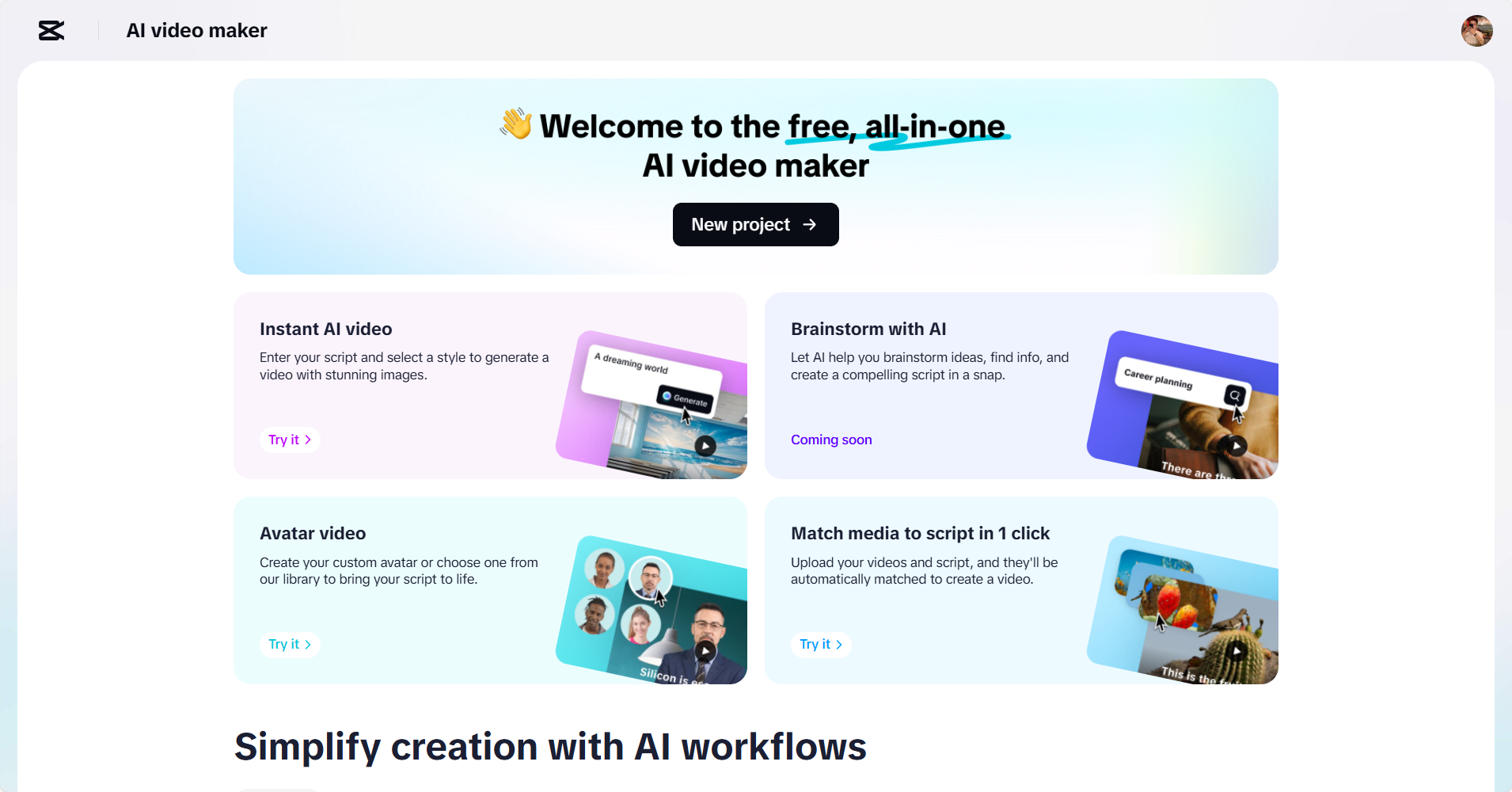
You would instruct the AI to make a birthday video with balloons and upbeat music, after which it will generate video elements that match your description.
CapCut allows users to skip long editing times and effect searches by generating professional products. You provide instructions to the AI system, which handles all the work until you receive a refined video in short order.
The text to speech free tool within CapCut Web enables voiceless narration, which suits users who want to add voiceover to their video projects.
You enter your content, then choose from many available voice options together with their corresponding languages for AI automated reading. Any user can find clear voices among the numerous options available.
CapCut Web makes it possible to create multilingual videos alongside professional enhancements through its automated features that require no additional expenses.
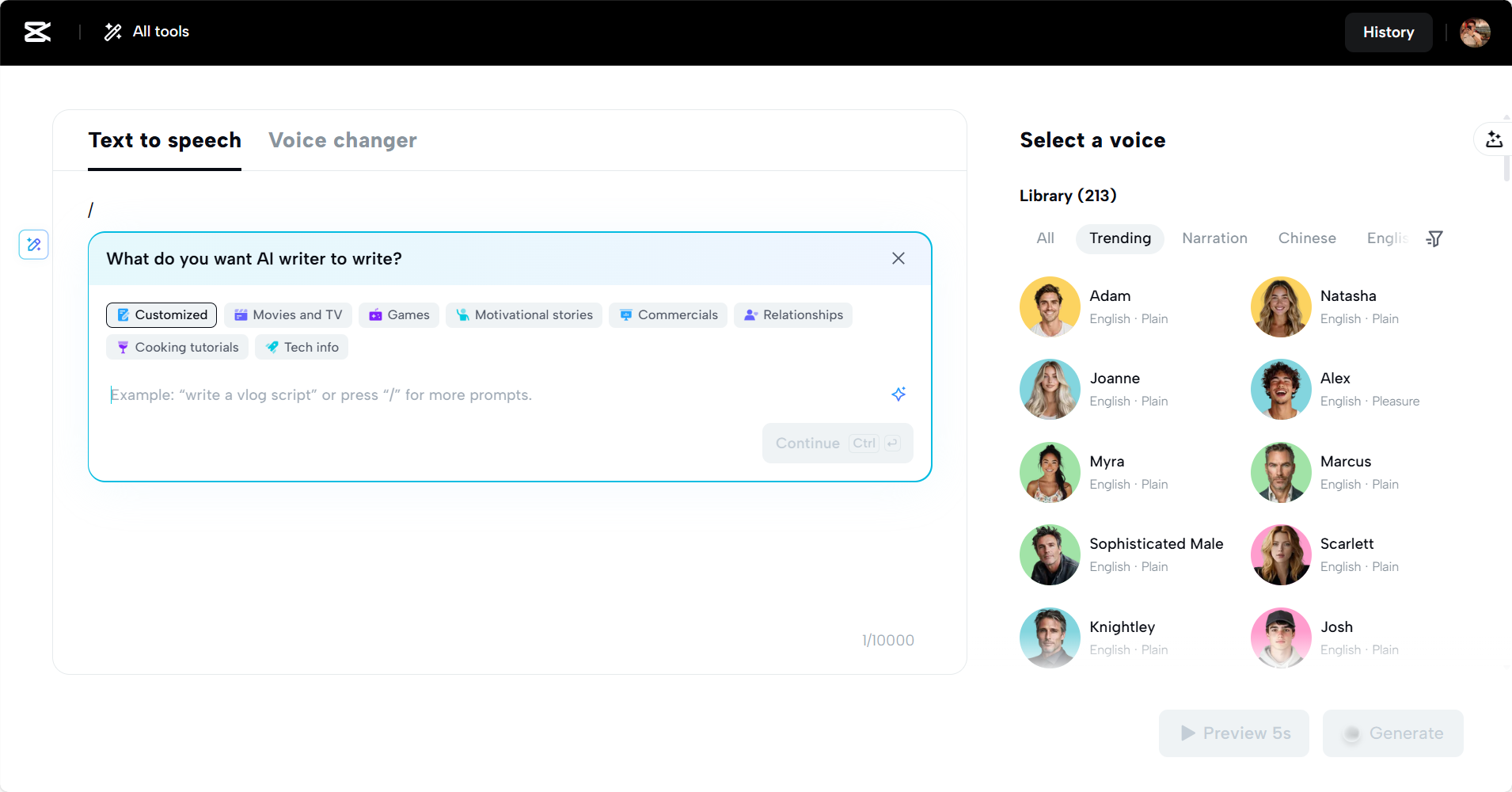
The AI capabilities of CapCut Web enable users to generate creative content without incurring any costs. The platform offers new features, including:
The easy-to-use interface of CapCut Web provides all these features at your disposal. Simple video editing is possible through the platform without any additional downloads or difficult commands. Now, your browser contains all the tools you need, which are instantly accessible to aid your creative ideas as they come to mind.
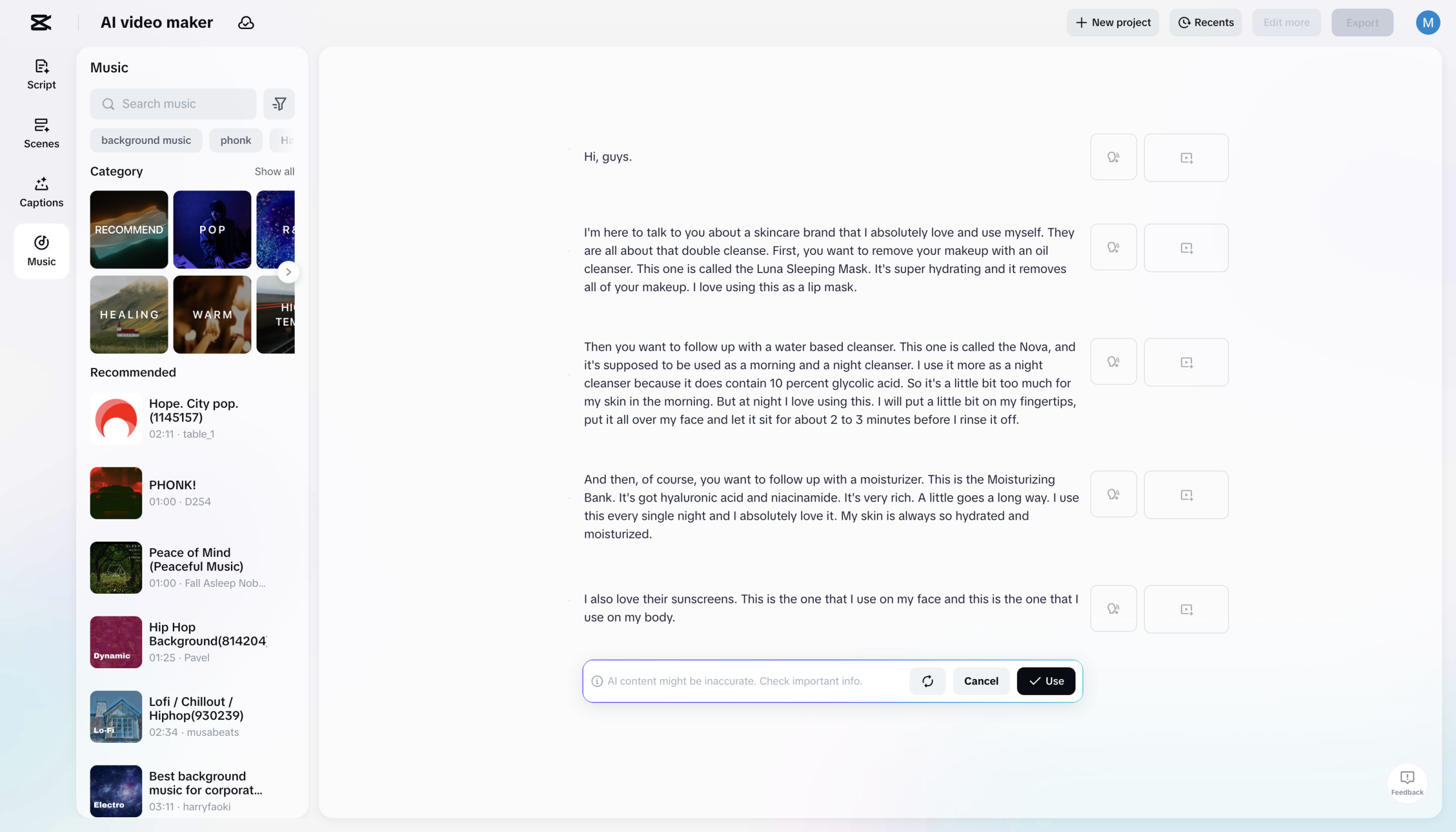
The 2025 update brings even more smart features to CapCut Web:
People love CapCut Web’s AI features because they:
CapCut Web in 2025 is all about unlocking creativity with the help of AI. With AI-driven tools, anyone can create videos that look and sound amazing. The platform’s easy interface, smart features, and constant updates mean you’ll always have the latest technology at your fingertips.
If you want to make videos that stand out and have fun doing it, CapCut Web is the perfect place to start.
