
Understand Your Rights. Solve Your Legal Problems
On 8 May 2025, we mark the historic 80th anniversary of VE Day as the citizens, families, and communities of our esteemed nation gather to celebrate eight decades of peace following the conclusion of World War II in Europe, a peace for which countless individuals made the ultimate sacrifice. The 80th anniversary of VE Day serves not only as a homage to those who fought for the freedoms we cherish today but also as a poignant reminder of the resilience and unity that have characterized our nation throughout the years.
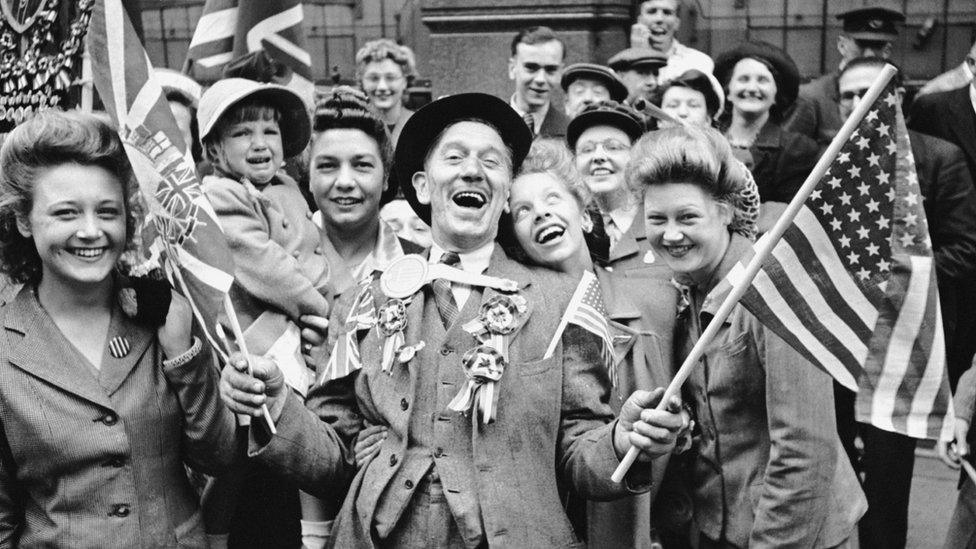
Flags of freedom: Crowds wave the Union Jack and Stars and Stripes in a shared moment of joy on VE Day, celebrating the Allied victory and the hard-won peace that followed years of war.
VE Day stands for Victory in Europe Day—marking the official end of World War II in Europe.
On May 8, 1945, Nazi Germany formally surrendered to the Allied forces, bringing nearly six years of brutal war across Europe to an end. The announcement triggered an outpouring of celebration across the world, especially in the United Kingdom, the United States, France, and other Allied nations.
While the war would continue in the Pacific for a few more months, VE Day symbolized hope, peace, and victory—and for millions, it meant their loved ones might finally come home.
Despite its massive significance at the time, VE Day doesn’t always get the attention it deserves today. Many people know D-Day, but far fewer understand what VE Day really meant.

The war ends with a signature: On May 7, 1945, General Alfred Jodl signs Nazi Germany’s unconditional surrender in Reims, France, flanked by Colonel Wilhelm Oxenius (left) and Admiral Hans-Georg von Friedeburg (right). Just a week earlier, Adolf Hitler had died by suicide in his Berlin bunker, leaving Admiral Karl Dönitz to lead the collapsing regime and authorize the surrender. Within hours, the world began to celebrate the end of the war in Europe.
On May 8, 1945, people all across the United Kingdom commemorated Victory in Europe Day (VE Day) following the announcement of the Nazis' unconditional surrender. At 3 PM, Prime Minister Winston Churchill announced this momentous news to the nation via radio, prompting large crowds to assemble in the streets in celebration.
When word got out that the war in Europe was finally over, people didn’t wait—they just ran outside. In London, Paris, New York, the streets filled up fast. Strangers hugged, people danced, some cried and didn’t even know why. There were flags and street parties everywhere. In London, Churchill spoke, steady as ever, and later that night King George VI addressed the nation. But it was the people who said it best—with cheers, tears, and just this huge wave of relief. The war had taken so much. But for that one day, the world let itself breathe.

Dancing in the streets: Strangers twirled, laughed, and embraced as joy spilled across Britain’s cities on VE Day—celebrating peace after six long years of war.
Because for so many people, it meant the nightmare was finally over. The news of Germany’s surrender was not surprising. It had been anticipated for some time and people across Britain were on standby to start celebrating the end of the war.
After years of fear, loss, and waiting for loved ones who might never come home, VE Day was the day people could finally exhale. No more blackouts, no more bombings, no more wondering if the next knock on the door was bad news.
It wasn’t just about beating the enemy—it was about what the world had to fight through to get there. The day stood for hope, for survival, and for the people who never made it back. It’s important because it reminds us how fragile peace really is—and how hard it was to earn.
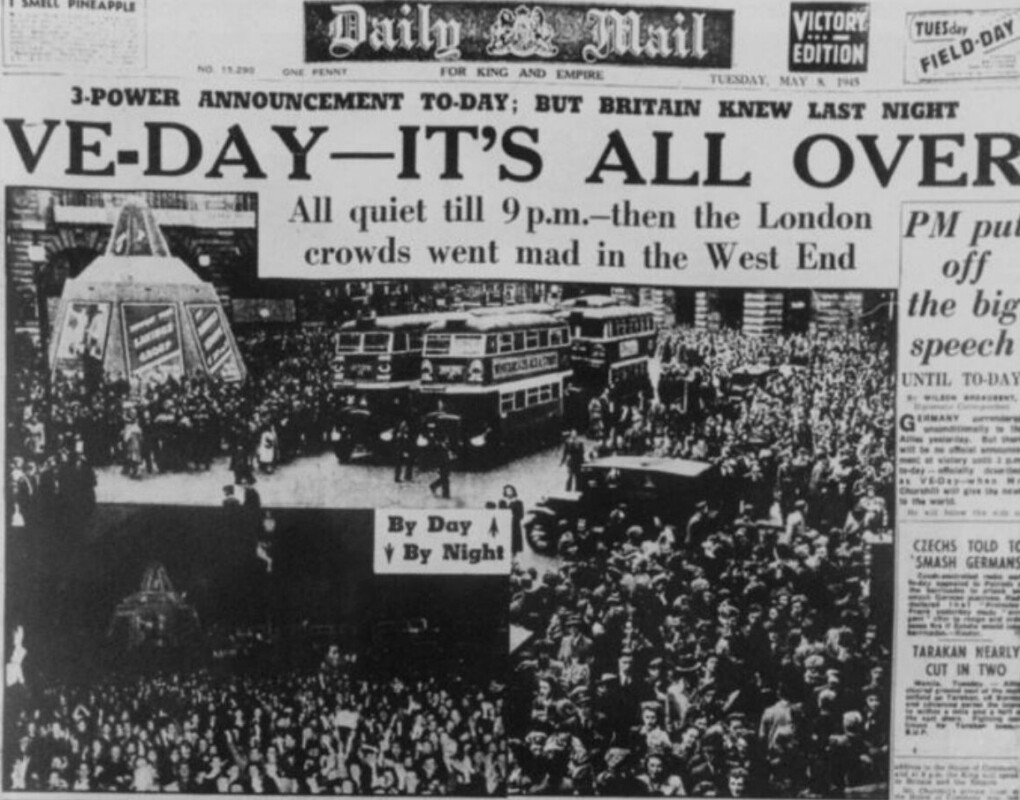
Victory at last: Jubilant Britons celebrate in the streets as the Daily Mail declares 'It’s All Over' on May 8, 1945—marking the end of six long years of war in Europe.
VE Day comes and goes quietly for most people. In places like the UK and parts of Europe, there are still small ceremonies—maybe a wreath laid at a local memorial, a moment of silence, or a few old veterans gathered to pay their respects. It’s not loud. It’s not big. But it means something.
Back in 2020, when the 75th anniversary came around, there was this brief moment where the world paused—people shared old family photos, lit candles, and told the stories their grandparents used to tell. But since then? It’s easy for it to slip by unnoticed.
It’s not about pageantry—it’s about remembering what was sacrificed, and holding on to that thread of gratitude before it fades too far from view.
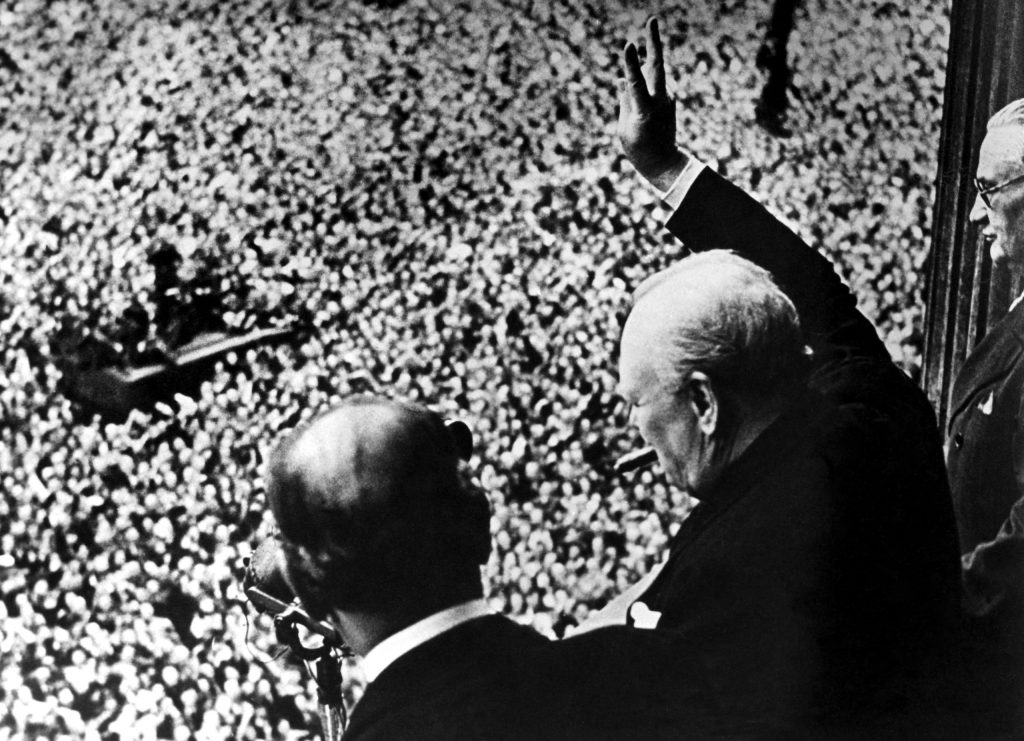
A nation’s hero: Winston Churchill waves to cheering crowds from the balcony of the Ministry of Health on VE Day, as Britain celebrates victory and the end of war in Europe.
Probably because life just moves on.
The people who lived through it—the ones who celebrated in the streets have aged and today many of them are gone. And as they go, so do the stories. If it’s not talked about at home, or taught in school, it just slips away.
Other days get more attention now. We’ve got Memorial Day, Veterans Day, and even D-Day tends to gain more attention.
But just because people forget, it doesn’t mean it stopped mattering. The end of the war marked the end of something massive. For a lot of people, it was the first day they felt safe again. That kind of moment deserves to be remembered—even if it's just in small ways.

A moment in history: Prime Minister Winston Churchill joins King George VI, Queen Elizabeth and Princess Margaret on the Buckingham Palace balcony as jubilant crowds cheer the end of war in Europe. Princess Elizabeth, then just 19, slipped out later that night to celebrate anonymously among the people.
What happened on VE Day?
On May 8, 1945, Germany officially surrendered to the Allied forces, ending World War II in Europe. People across the UK, U.S., and Europe flooded the streets to celebrate peace, while leaders like Winston Churchill and King George VI addressed the public.
Will VE Day 2025 be a bank holiday?
As of now, VE Day 2025 is not expected to be an additional bank holiday in the UK. It typically falls on May 8, but unless it aligns with an existing holiday or a special anniversary, it remains a regular weekday.
What is VE Day in the UK?
In the UK, VE Day—Victory in Europe Day—marks the end of WWII in Europe. It’s a day to remember both the joy of peace and the cost of war. Commemorations may include memorial services, flag displays, and veterans’ events.
What happened on May 9th, 1945?
In some countries, especially in the former Soviet Union, Victory Day is celebrated on May 9th due to time zone differences. It marks the same surrender of Nazi Germany, just observed a day later in places like Russia.
What’s the difference between VE Day and VJ Day?
VE Day (May 8) marks the end of the war in Europe.
VJ Day (Victory over Japan Day) marks the end of WWII entirely. Japan surrendered in August 1945, bringing the full conflict to a close.
Why is VE Day significant?
VE Day represents the defeat of Nazi Germany and the end of a brutal, years-long war in Europe. It’s a powerful symbol of freedom, sacrifice, and unity among the Allied nations.
When did VE Day start?
The first VE Day was celebrated on May 8, 1945, the day Germany's surrender was officially recognized by the Allies.
What happened on VE Day in 1945?
There were massive celebrations—street parties, church bells ringing, people dancing in the streets. But there was also mourning. Millions had died, and the war in the Pacific wasn’t over yet.
What are some facts about VE Day?
Germany surrendered on May 7, 1945; the news was announced May 8
Over 1 million people celebrated in London alone
Churchill gave a famous radio speech that day
The war in Asia continued until August 1945
What was the VE Day 75th anniversary like?
In 2020, the 75th anniversary of VE Day was marked with nationwide tributes in the UK and around the world—many virtual due to COVID-19. People shared family stories, lit candles, and held socially distanced ceremonies.
How will VE Day be celebrated in 2025?
While not a major anniversary year, VE Day 2025 may still be observed with local events, veterans' services, and school activities—especially in countries like the UK and France. Larger commemorations may be planned locally depending on community interest.
As Tax Day approaches, Joe Rogan sparked heated debate during a recent episode of The Joe Rogan Experience and Elon Musk quickly jumped into the conversation.
Rogan, chatting with comedian Ron White, questioned how tax dollars are spent. “What’s really crazy to me is when people say the rich should pay more taxes,” Rogan said. “OK, fine. But where’s that money going? Do you think the federal government is good at managing your money?”
He then referenced Musk directly, saying, “Have you paid attention to all the s*** Elon’s f****** uncovered?”
Just the tip of the iceberg so far
pic.twitter.com/BNYCbXk6sT— Elon Musk (@elonmusk) April 10, 2025
Elon Musk replied on X with a blunt comment: “Just the tip of the iceberg so far.” The post quickly went viral, racking up nearly 15 million views and over 70,000 likes.
Rogan didn’t hold back either. He pointed out that the highest tax bracket 37% kicks in at $609,000 a year. “That’s you, m*****f***er,” he joked to White.
White laughed, saying, “That’s me last month.”
Although Rogan said he’s not against paying taxes, he criticized how those funds are used. “You're being strong-armed into giving money to people that do a really s****y job of protecting your money and investing it in the country,” he said. “A lot of it is going to bureaucracy and bs.”
He even floated the idea of letting Americans choose where their tax dollars go: “What if the federal government’s budget was entirely based on the will of the people?”
The U.S. federal tax deadline for 2025 is April 15. It’s a time of year that often reignites national debate over income taxes, tax brackets, and how tax revenue is allocated.
The top federal income tax bracket currently sits at 37%, applying to individuals earning over $609,350 annually or $731,200 for married couples filing jointly (IRS, 2025 figures).
Elon Musk paid $11 billion in taxes in 2021, reportedly the largest single tax payment in U.S. history. Musk has frequently criticized government inefficiency and pushed for reduced bureaucratic spending.
Joe Rogan’s podcast regularly features high-profile guests and hot-button political topics. With an estimated 11 million listeners per episode, The Joe Rogan Experience has significant influence in shaping public opinion—particularly among younger, independent voters.
Public trust in the federal government's handling of taxpayer money remains low. According to Pew Research, only 20% of Americans say they trust the government to do what's right "just about always" or "most of the time."
DOGE’s Budget Cuts: 47 Social Security Offices to Close
The Department of Government Efficiency initiates sweeping closures, what this means for public access and support.
Behind the Scenes of the Upcoming Legal Reform Bill
A preview of the controversial legislative package shaking up legal frameworks nationwide.
Ballerina Ksenia Karelina Freed After Over a Year of Wrongful Detention in Russia
International pressure and human rights advocacy lead to a long-awaited release.
Ohio Enacts Foreign Property Ownership Ban
New state law restricts non-U.S. citizens from buying property, legal experts weigh in on its constitutionality.
Portugal MEP Urges EU Action After Viral Assault Video
Calls for justice intensify following a widely circulated incident involving a sitting MEP.
Portuguese MEP Urges EU Action After Shocking Video of Sexual Assault Goes Viral.
A Portuguese Member of the European Parliament (MEP) is calling on the European Commission to take urgent action to combat the spread of harmful content online, following the circulation of a video allegedly showing the rape of a 16-year-old girl.
The disturbing footage, believed to have been filmed in February in the Loures district of Lisbon, was viewed over 32,000 times on social media before the police were alerted, not by users, but by the hospital where the victim sought treatment.
Three suspects, aged between 17 and 19, were arrested but later released by a court. They now face restrictions, including a ban on contacting the victim and mandatory check-ins with authorities.
On Tuesday, Socialist MEP Ana Catarina Mendes addressed the European Commission in a letter co-signed by the Portuguese Socialist delegation.
Ms. Mendes described the video as part of a broader pattern of online abuse and cited additional cases, including allegations of upskirting at the University of Porto, where intimate images were reportedly shared in WhatsApp groups.
“These horrific acts violate fundamental rights and raise urgent concerns about online safety—especially for women,” Ana Catarina Mendes wrote. She urged the Commission to take concrete steps under the Digital Services Act to ensure social media platforms swiftly remove harmful content and prevent the spread of non-consensual material.
The call for stronger action comes after hundreds of people protested in front of the Portuguese Parliament on Saturday. Protesters demanded tougher laws and accountability from tech platforms. Many carried signs reading: “Rape is not filmed, it is condemned.”
An event organizer told Euronews that, at minimum, the suspects’ social media accounts should have been suspended while investigations are ongoing.
Political figures from several parties joined the protest, with Left Bloc leader Mariana Mortágua warning of a rise in misogyny online:
“Male chauvinists are becoming online prophets, contaminating a generation. We need rules for social networks and accountability for the platforms.”
Livre MP Isabel Mendes Lopes added that gender inequality is “structural” and worsened by unchecked harmful narratives online. She emphasized that many families remain unaware of the digital abuse their children face.
Inês Sousa Real, the sole MP for the PAN party, called for better victim protection systems, stronger crime reporting tools, and self-defense education in schools.
Inês Marinho, a victim of image-based abuse whose intimate video was shared without her consent on Telegram, founded the ‘Don’t Share’ movement - now an association supporting victims of online sexual violence.
A 2024 investigation by Portuguese magazine NiT exposed a Telegram group of 70,000 men who were sharing intimate images of women without their consent.
Image-based sexual abuse is rising across Europe. According to a 2023 report from the European Institute for Gender Equality (EIGE), 1 in 10 women in the EU has experienced some form of non-consensual image sharing, often referred to as “revenge porn.” Most cases go unreported due to fear, stigma, or lack of legal protections.
Portugal is not facing this crisis in isolation. Across Europe, similar incidents have raised alarm—most notably in Spain, where a 2022 investigation uncovered a Telegram group with over 100,000 members sharing explicit images of women and minors without their consent. These disturbing revelations point to a deeper, systemic issue: the persistent inability or unwillingness of major tech platforms to effectively monitor and remove abusive content.
Globally, the responsibility of social media companies is under increasing scrutiny. In response, the European Union introduced the Digital Services Act (DSA) in 2024, aiming to hold large platforms accountable for illegal content.
The law mandates faster removal of harmful material and the implementation of transparent reporting mechanisms. Still, enforcing these rules remains a major challenge, particularly on encrypted platforms like Telegram and WhatsApp, where moderation is limited by design. Experts call for digital literacy and platform responsibility.
Dr. Marta Santos, a cybercrime analyst at the University of Coimbra, said:
“We need stronger reporting mechanisms, more transparent moderation practices, and real consequences for platforms that allow this type of content to circulate.”
According to the NGO Women’s Digital Rights Watch, Portugal lacks dedicated support services for victims of online abuse. They are advocating for the creation of specialized cybercrime units and legal reform to categorize non-consensual image sharing as a standalone criminal offense. Digital abuse is becoming normalized.
As Inês Marinho, founder of the Don't Share movement, put it:
“When 70,000 men are casually swapping stolen images on Telegram, we are dealing with a cultural crisis, not just a digital one.”
Sextortion: A Growing Threat to Teen Mental Health and Safety
Ballerina Ksenia Karelina Freed After Over a Year of Wrongful Detention in Russia
Ohio lawmakers recently proposed legislation to limit property ownership by foreign entities from China, Russia, and other countries identified as adversaries by the U.S. government.
This effort is part of a broader national push, with similar proposals appearing in 37 states to protect local communities from potential security threats.
Rep. Angie King (R-Celina), a sponsor of Ohio’s House Bill 1, expressed concerns over security vulnerabilities, stating that federal efforts alone aren't enough to address growing cybersecurity and espionage threats.
The proposed law focuses specifically on areas within 25 miles of critical infrastructure like military bases, railroads, water plants, and communication systems.
Ohio officials are increasingly concerned about the risks posed by foreign espionage, particularly from countries such as China and Russia, following high-profile cybersecurity incidents nationwide.
Despite the emphasis on security, there are concerns about potential negative economic impacts. Gov. Mike DeWine previously vetoed similar legislation, expressing worry about discouraging beneficial economic investments and hurting job opportunities in Ohio.
Possible impacts include:
The Ohio Legislative Service Commission noted that, given Ohio’s extensive infrastructure network, this bill could broadly impact property ownership statewide.
County auditors would initiate investigations if suspicious transactions are reported, with enforcement responsibilities assigned to county sheriffs. Those buying property would need to submit statements verifying they comply with the proposed law.
Groups like State Armor Action and the America First Policy Institute advocate for these restrictions, emphasizing the need for state-level action against foreign influence. Harrison Siders from State Armor Action highlighted the importance of local responses to complement federal security efforts.
Chinese businesses operating in Ohio, such as Capchem, Fuyao Glass, and Triangle Tire USA, which collectively employ hundreds, could face uncertainty under stricter proposals, particularly the Senate bill.
JobsOhio, the state’s economic development organization, highlighted that national security is always a key factor in their investment considerations.
With more than 1,300 international companies employing approximately 323,000 residents in Ohio, industry representatives urge careful consideration of the law’s language.
Kelsey Johnson from the Global Business Alliance stressed that laws should specifically target genuine threats without unintentionally discouraging friendly foreign investment.
Advocates argue security is a fundamental priority. Rep. Roy Klopfenstein summarized the sentiment by saying, "Without security, we really have nothing."
Ohio residents and businesses now await the outcome as the legislature moves forward with discussions.
Ballerina Ksenia Karelina Freed After Over a Year of Wrongful Detention in Russia
Kirkland & Ellis Advises SVPGlobal on Blantyre Capital's Acquisition of OXEA
Mikal Mahdi’s Execution Sparks Legal Debate in South Carolina
Former UNM Football Player Sentenced on Meth Trafficking Conviction
More than $1 billion in federal funds designated for Cornell University and about $790 million for Northwestern University have been frozen by the Trump administration.
The freeze comes amid an investigation into alleged civil rights violations related to handling antisemitism accusations on campus. Both universities were caught off guard and stated they had not received official notification from the government about this funding pause.
According to the White House, the funds are on hold due to allegations that the universities failed to effectively address complaints of antisemitism during protests related to the Israel-Hamas conflict. Officials at both universities firmly deny these claims and are urgently seeking clarification from federal agencies.
Cornell University reported receiving more than 75 "stop work" orders from the Department of Defense. These orders disrupt critical research projects involving national defense, cybersecurity, and public health.
At Northwestern, spokesperson Jon Yates highlighted the importance of federal support for research breakthroughs, including life-saving medical devices and Alzheimer's studies. He warned that the current freeze threatens to disrupt ongoing scientific advancements significantly.
This freeze is part of a broader effort by the Trump administration to use federal funding as leverage, urging universities to align more closely with certain policy positions. Previously, the administration withheld $400 million from Columbia University until it adopted specific policy changes, including a new definition of antisemitism and increased diversity of thought.
Cornell President Michael I. Kotlikoff emphasized that the university is actively reaching out to federal officials to understand why these decisions were made. Northwestern University's leadership similarly expressed concern, noting the potential negative impacts on important research benefiting public health and technology.
Yes, similar funding pauses have occurred at Columbia University and the University of Pennsylvania. These actions show a consistent approach by the Trump administration to use federal funding as a means to influence campus policies.
Ted Mitchell, president of the American Council on Education, condemned the funding freezes, arguing they harm essential university research without effectively addressing the underlying concerns about campus antisemitism.
The high-profile case highlights growing concerns over extraterritorial application of foreign laws, human rights violations, and the legal complexities of international detentions.
Russian-American ballerina Ksenia Karelina, who had been wrongfully detained in Russia for over a year, is returning to the United States, according to Secretary of State Marco Rubio.
American Ksenia Karelina is on a plane back home to the United States.
She was wrongfully detained by Russia for over a year and President Trump secured her release. @POTUS will continue to work for the release of ALL Americans.
— Secretary Marco Rubio (@SecRubio) April 10, 2025
Karelina was sentenced to 12 years in a Russian penal colony after donating roughly $50 to a Ukrainian charity in early 2024. Russian authorities prosecuted her under wartime legislation that criminalizes perceived support for so-called “hostile entities.”
The case drew widespread condemnation from international legal observers, who cited violations of international human rights standards, including those enshrined in the Universal Declaration of Human Rights and the International Covenant on Civil and Political Rights.
Legal experts argue that her detention demonstrates a troubling pattern of politically motivated prosecutions in Russia, particularly targeting individuals with dual citizenship or perceived ties to Western governments.
Critics point to the opaque legal process and lack of due process guarantees, such as access to independent legal counsel and transparent judicial review.
Ksenia Karelina’s case adds to the growing number of "wrongful detentions" recognized under the Robert Levinson Hostage Recovery and Hostage-Taking Accountability Act, which guides the U.S. government’s response to Americans detained abroad under politically charged circumstances.
Ms. Karelina's release was reportedly part of quiet diplomatic negotiations, raising questions about the legal tools available to protect U.S. citizens from politically motivated arrests in authoritarian regimes.
“This is more than a humanitarian victory, it’s a wake-up call for international law,” said a senior fellow at the American Society of International Law. “When governments criminalize charitable donations under vague statutes, it erodes legal predictability and global norms.”
Mielle Organics Faces Lawsuit Over False Advertising & 'Made in USA' Claims
Justice for Sara Millerey: International Pressure Mounts After Colombia Arrest
Atlanta Veteran Sues VA for Medical Malpractice in Delayed Cancer Diagnosis
ND Mayor Tom Ross Entangled in Harassment Scandal, Investigation Ongoing
Kirkland & Ellis LLP has advised Strategic Value Partners (SVP) and Blantyre Capital on their successful acquisition of OQ Chemicals, a global name in the oxo chemicals industry.
With the deal now closed, the company is returning to its original name, OXEA, a move that reflects its deep-rooted heritage and long-standing reputation in the global chemicals market.
SVP is an international investment firm overseeing around $22 billion in assets. Blantyre, based in London, manages over €2.7 billion in committed capital.
The firms worked together through their managed funds to complete the purchase of the company, which will now operate under the OXEA name moving forward.
OXEA is known for producing a wide range of chemicals that serve as key ingredients in everything from paints and coatings to plastics, lubricants, and pharmaceuticals. Its products are used every day across industries like construction, automotive, and electronics.
With headquarters in both Germany and Texas, and a global workforce of more than 1,200 employees, OXEA supplies customers in over 60 countries.
HJ Woltery, Co-Head of the European Investment Team at SVP, shared his enthusiasm about the acquisition:
"OXEA's leading market positions, global reach, and innovation capabilities provide a solid foundation for long-term growth, we look forward to partnering with the OXEA team to build upon this strong foundation and continue delivering exceptional value to its customers and stakeholders across well-diversified markets."
Blantyre’s Chief Investment Officer, Mubashir Mukadam, echoed those sentiments:
“We are pleased to partner with OXEA, a market leader with strong production capabilities, OXEA's significant expertise in oxo chemicals, combined with its global footprint, presents ample opportunities for growth. We look forward to supporting the Company as it continues to expand its product offerings and enhance its strategic position in the industry."
Strategic Value Partners (SVP) is a global investment firm founded in 2001, managing approximately $21 billion in assets. Specializing in opportunistic credit and private equity, SVP focuses on complex, value-driven investments across North America and Europe. Headquartered in Greenwich, Connecticut, with offices worldwide, SVP has invested over $48 billion since inception.
Blantyre Capital is a London-based investment firm focused on special situations in the European middle market. Founded in 2016, the firm manages over €2.7 billion in committed capital and has completed more than 70 investments across 20+ countries. Blantyre partners with institutional investors to deliver strong, risk-adjusted returns through tailored capital solutions, guided by a core commitment to integrity, transparency, and disciplined value creation.
Kirkland & Ellis LLP is a leading global law firm with over 4,000 attorneys across 21 offices. Founded in 1909, the firm specializes in private equity, M&A, fund formation, restructuring, litigation, and IP. Known for its client-first approach and entrepreneurial culture, Kirkland is the first law firm to exceed $7 billion in annual revenue and is widely recognized for its leadership in high-stakes legal matters.
Dentons Appoints Jan-Willem de Tombe as COO in the Netherlands
DOJ Faces Silence Over Liz Oyer in Mel Gibson Gun Rights Case
Jet Set Nightclub Collapse in Dominican Republic Sparks Legal Scrutiny
Is Priyanka vegan?
I know it's better for us, but no, I'm not vegan. Neither is Liam Hemsworth—he is vegan, I know—and I'm just like, talking about like, I don't like eating in front of him.
Is Priyanka asthmatic?
Yes, I am. I do have my inhaler with me all the time. Good enough.
Is Priyanka Hindi?
Hindi is a language. I'm Hindu, which is the religion. It's a slight difference—do educate yourself.
Is Priyanka Chopra left-handed?
No, I'm not. I'm right-handed.
This transcript is from Wired’s Autocomplete Interview with Priyanka Chopra, originally published on Wired’s YouTube channel. All rights belong to Condé Nast/Wired.
Jim Bob Duggar’s $5M Land Deal with Walmart Raises Eyebrows
A deep dive into how a reality TV star turned real estate investor landed a multimillion-dollar deal.
Pastor Marvin Sapp Faces Backlash Over $40K Offering Incident
Allegations swirl around a controversial church service involving locked doors and fundraising demands.
Rubby Pérez and Dozens Killed in Jet Set Nightclub Collapse
A tragic incident that shook the Dominican Republic and the music world.
Hedge Funds Hit by Margin Calls Amid Tariff Market Chaos
Financial institutions are feeling the pressure as global markets react to aggressive tariffs.
Machine Gun Kelly Turns to Faith and Therapy to Win Back Megan Fox
A personal transformation in the spotlight as MGK tries to repair his relationship with Megan Fox.
The violent death of Sara Millerey González, a 32-year-old trans woman and activist, has shaken Colombia. Her murder in the city of Bello, Antioquia, during the first weekend of April has sparked widespread outrage, with many, including President Gustavo Petro, calling it a brutal act of hate.
Sara’s final moments were deeply disturbing. On April 4, she was reportedly raped, her arms and legs were broken, and her body was thrown into the La García stream.
Some witnesses not only watched, but allegedly recorded the scene as she struggled in the water. Those videos later surfaced on social media, adding another layer of heartbreak.
Rescue workers pulled her from the stream and rushed her to the hospital, but she died the next day, on April 5, from the extent of her injuries.
President Gustavo Petro addressed the tragedy directly, saying on X: “What happened in Bello is fascism. Fascism is the violent erasure of human difference—be it political, religious, ethnic, or sexual. There are Nazis in Colombia.”
Local leaders are demanding justice. Bello’s mayor, Lorena González Ospina, released an emotional message online condemning Sara’s murder as a hateful and horrifying act.
View this post on Instagram
“Sara was attacked with unimaginable cruelty. What’s just as painful is the silence of those who stood by,” she said.
“We have a responsibility to protect the LGBTQ+ community. We cannot keep letting transphobia destroy lives.”
The mayor has pledged full cooperation with authorities, and a 50 million peso reward (about $11,000 USD) is being offered for information leading to an arrest.
Ms. Ospina confirmed that evidence has been turned over to the Prosecutor’s Office and a special investigation is underway, adding the hashtag #JusticiaParaSaraMillerey to her Instagram posts about the murder.
Across the country, LGBTQ+ advocates are calling Sara’s death a symptom of something much deeper—a culture that often ignores, excludes, or mistreats trans people.
In a powerful statement, advocacy group Caribe Afirmativo wrote:
“Sara’s murder didn’t start that day. It started when she was denied a fair chance at work, when people mocked her on the street, when institutions refused to recognize her. She had to fight to exist, every single day. The violence she faced didn’t begin or end with her death.”
The group urged Colombians to move beyond passive grief.
“Let this anger move us. Let it push us to organize, to demand change. Sharing a hashtag once a year isn’t enough. We need action, real justice, and lasting respect for trans lives.”
Sara Millerey’s death is not an isolated tragedy. According to Colombia Diversa, a leading LGBTQ+ rights organization, at least 63 LGBTQ+ people were killed in Colombia in 2023, with trans women facing the highest levels of targeted violence.
Latin America remains one of the most dangerous regions in the world for trans people. A 2022 report by Transrespect vs Transphobia Worldwide ranked Colombia among the top 10 countries for reported murders of trans individuals.
Despite legal advances, such as the ability to change gender markers on IDs and anti-discrimination laws, trans Colombians often face barriers to employment, healthcare, and basic safety.
Many rely on informal economies to survive, leaving them especially vulnerable.
Hi I'm John Carlo Esposito and this is the Wired Autocomplete Interview.
I was in an anime—what was it? Go to Google, baby.
Google: What games is John Carlo Esposito in?
I am in Far Cry, which is a great game. I play Antón Castillo, the head of a small Latin American country—a dictator, a very interesting man. I'm also in—I play the dentist in... oh my gosh, my brain is going—Payday 2! Yes, I got it.
What is John Carlo Esposito most famous for?
He's most famous for playing Gustavo Fring, kingpin of the meth world in Breaking Bad. “You are done.” I got into an airplane, I wanted to go to the bathroom and a woman was standing there. She turned around and she just froze—she was totally in shock and she hit the wall. She's up against the wall and she’s like, “You—you—you can go, Gus.” And I was stunned. I said, “No no, please, you know—ladies first, you go.” “No no no no no no, you go.” And so I went inside the bathroom, did what I had to do, came back out, and she's still up against the wall—peeled, pinned to it. And I said, “Thank you very much.” And I walked away.
What languages does John Carlo Esposito speak?
English, baby. My first language was a bit of German, as my mother and father were working in Hamburg. My mother was singing at the Hamburg Staatsoper, and then Italian. My father is from Naples, Italy, and so my father and mother spoke Italian in the home. Then when we got to Germany, some German. And then my third language is gibberish, because my head was so full of languages that I really couldn’t process them all. And English was throwing me. And so the third language was gibberish. And then the fourth language—through the roles I play, I said, I'm part Italian and part African-American, but I couldn’t get those African-American roles, so I learned how to speak a little Spanish.
What is John Carlo Esposito’s accent?
Well, when I say my name—John Carlo Jeppe Alessandro Esposito—my accent is Italian. For many years I pronounced my name “Espazito,” and I grew up with, you know, the Espazito brothers who were hockey players, so I understood that to be the pronunciation. I went back to Italy and I could literally be riding a bicycle in the mountains outside Milan—Lake Como—and someone would roll down the window: “Giacarlo!” And I’m like, okay. And I had a buddy in Italy who said, “Why do you pronounce your name Espazito? It’s so American. It’s just not you. And everyone says that sounds Spanish.” Because there is an “Esposo.” I said, “No, I’m very—look at me—very Italian: Giancarlo Esposito.”
Where is Giancarlo Esposito from?
My mother was performing with Josephine Baker in Copenhagen, in a supper club, and so I was born there. However, I grew up in Rome, Italy, because my father was from Naples. He was working in the opera house, and my mother and father traveled around with each other as he became sort of her manager. And she sang in different supper clubs and opera houses, eventually winding up at La Scala in Milano. They met in the San Carlo Opera in Napoli. So I’m very proud of where I’m from, and I’m very proud to be raised in America—but I’m completely proud of my Italian heritage and my African-American heritage.
When did Giancarlo Esposito start acting?
I started acting at 8 years old. We were living in a basement apartment in Yonkers, New York, and we were really poor because my mother and father were getting divorced after 11 years of marriage. I was watching a TV show called Gigantor with my brother, and there was a commercial that came on—and it was the first time I ever saw a brown-skinned person on a commercial. It was a kid, like 15 or 16 years old. My brother came home and I said, “I can do this. We can do this. We’re eating franks and beans, we’re eating grits with ketchup—we can do this.” And she took us to an agent, Ernest McClendon, and I auditioned within two weeks for my first Broadway show called Maggie Flynn with Jack Cassidy and Shirley Jones. That was 58 years ago.
When Wednesday dances...
Oh yeah, that’s it, right? When Wednesday dances—this is a special one for me because I got a call—and I love Jenna Ortega—and I got a call to do this Netflix promo. And I love Netflix. I've had a number of shows on Netflix—you can look them up, many of them are on now. But I have to tell you, to be loosey-goosey and have fun—this was one of my most favorite things I ever did. So getting there, I’m doing my research, checking out Wednesday, checking out her moves, and figuring out how to just be that Castilian—very big and very wonderful—and I had a blast. A real blast doing this. And I want to do more. What fun that was.
Does Giancarlo Esposito like playing villains?
I am a dramatic actor, and I have always resisted this question. So when you ask me this question, I want to say to you—I will kill you. But I was thinking about this in the last 24 hours, and I thought to myself—you know what? You love playing villains. This is my favorite thing in life. I saw a picture with James Cagney—many of you will not know who James Cagney is—many years ago, Public Enemy, and at the end he is on top of a scaffold with a machine gun, and he’s like, “Top of the world, Ma! Top of the world!” And I saw that movie and I went—this dude is having so much fun. I went—the villain is complicated. The villain is interesting. The villain is someone that we don’t know—we wonder why he’s so villainous. And if you’re in for a penny, you’re in for a pound. If you’re going to do it, you gotta do it right. The villain is the antithesis of a hero. And some of them have good intentions. Many of them, not. But they’re interesting, and they drive the story, and they’re electric, and they’re exciting, and you can’t take your eyes off of them. So yes—I have just outed myself to say I love to scare the **** out of people.
Does Giancarlo Esposito like anime?
I love anime. I have no favorite anime, but I think anime is extremely interesting. I do go to Comic-Cons and I do see people dress up. I was in an anime called Cyberpunk, and it was a really interesting thing—it was a really great project for me to do, playing Faraday. To make that guy live and breathe in our American culture but have the influence of that Japanese anime.
How long did Giancarlo Esposito live in Denmark?
Okay, the answer is—I can’t remember. No, just kidding. The answer is one year. Again, my mother was performing with Josephine Baker, who years ago I eventually met in Toronto when I was nine years old, doing my first out-of-town tour for Maggie Flynn. But I lived in Denmark for one year and I loved it.
How did Giancarlo Esposito get famous?
You know—wow, what a question that is. How does anyone get famous? How did I get famous? If you love what you do, you never work a day in your life. So I commit—I commit myself to the reality of what I do. I realize that there are ups and downs in everyone’s careers. I never tried to be a celebrity or a star—I just try to be me and to understand what my connection is to the work I’m doing. And that’s probably how I got famous.
How did Giancarlo Esposito start acting?
Well, I told part of this story. It was through needing to have a better life economically, after my mother and father’s divorce. It was realizing that I loved performing. There were other things I loved too, but it was asking myself a question—after many years of ups and downs—is this what I was meant to do? Like, we’re meant to do a lot of things. I asked myself—is this what you were meant to do? And I was meant to be a storyteller. That’s what I do. I think my true calling was to tell a story and to move people from one place to another in their consciousness. After 15–20 years of acting in the theater, I decided I wanted to move to film and television. But I also knew that took work—that took a different acting style. That took becoming smaller, more compressed, having a thought in my head when you’re watching me that you can’t read and you’re wondering, “What is he thinking right now?” That is committing to doing something you love but also going to class, figuring yourself out. And I think we’re all on that journey. I know I am.
How do you pronounce Giancarlo Esposito?
Well, my name once again is Giancarlo Jeppe Alessandro Esposito.
Is Giancarlo Esposito Italian?
Yes. Completely Italian.
Is Giancarlo Esposito a nice guy?
Oh my gosh. I know these are not your questions, Wired—I know these are the fan questions. I am a nice guy. You know, I have a lot of integrity for who I am today—but I may not be that tomorrow, and that’s okay. But underneath it all, I believe people are intrinsically good. That’s certainly my life. So yeah, I’ve come to realize I’m not all the characters I play—but I really love life and I love people. I’ve done one comedy—Nothing to Lose—no one asked that, but I’m going to tell you. But I also want to do a romantic comedy, and it would be nice to figure out—how do you do a romantic comedy with someone who is maybe a little more mature than our young romantic comedies? And so we’re going to figure that out. But yeah, I’m a nice guy—most of the time.
Is Giancarlo Esposito a director?
Wow. Yeah—I am a director. That changed my life too. You make these turns in your life. I’ve directed two feature films. I love directing because I feel like you can tell more personal stories that are relatable to an audience that sometimes doesn’t get targeted with movies they can really understand—about everyday people. And so yes, I’ll direct more. Look out for that. You have to go see it—you gotta go to the theaters, people.
Does Giancarlo Esposito have children?
I have four daughters who I absolutely adore. And they’ve changed my life—Shane, Kale, Seir, and Ruby. And they’re all in their 20s. And they’ve changed the way I think about the habits that I’ve taken on from my father. My girls have grown me in the world of—you know what I say—my girls have really helped me be a real man.
Giancarlo Esposito, Do the Right Thing?
I love Ossie Davis’s line in that. He tells Spike Lee, “Young man, always do the right thing.” I love this movie. I love Spike Lee. It was really fun to do—creating the character of Buggin’ Out, that guy who is questioning how it all works—“Why don’t you have any... why you got no brothers on the wall?” It was a very, very special experience for me. The movie lives on. I saw it in the Netherlands about five years ago and it really still holds up. And it’s been great to have this friendship and love for Spike Lee and all that he stands for.
Giancarlo Esposito laughing meme
Oh my gosh. I get these laughing memes five times a day from people that I know. We are not the same. It’s a whole other world to get famous in. And I’m really happy that it came out of a really organic place that people know me.
Giancarlo Esposito The Residence
A show I really love—a show that’s on Netflix right now. It is Knives Out in the White House. I play AB Winter. I start out on the floor—you see my feet. AB Winter, Chief White House Usher, responsible for all the workings, comings and goings to have a smoothly working White House. And this role of Cordelia Cupp by Uzo Aduba is absolutely spectacular. It is a fantastic show. The White House is recreated within inches of exactly what it is. You get a tour of this place, but you get a chance to see the show through all the suspects’ eyes to figure out—who done it? You know I didn’t, because I’m dead on the floor. But who done it? You’re gonna love it, and I’m very proud to have been in it.
Giancarlo Esposito voice acting
You know, part of what I do requires a lot of it—a lot of imagination. And if I can encourage you guys to have anything and to cultivate anything, it would be your imagination. And so when I’m in the room, in the booth, voice acting—I really love it. I’m cultivating my imagination. Sometimes I close my eyes and I take the journey of the character. Because many times—whether you know it or not—I’m not looking at a screen, matching something. I’m creating the voice so they can match to me. I use my voice well from my Broadway acting days, and I love voice acting. And I’ll continue to do that till the day I die. I love it.
See you next time. Those are all the searches. I want to thank you for having me today—it’s been so much fun.
This transcript is from Wired’s Autocomplete Interview with Giancarlo Esposito, originally published on Wired’s YouTube channel. All rights belong to Condé Nast/Wired.
Jim Bob Duggar’s $5M Land Deal with Walmart Raises Eyebrows
A deep dive into how a reality TV star turned real estate investor landed a multimillion-dollar deal.
Pastor Marvin Sapp Faces Backlash Over $40K Offering Incident
Allegations swirl around a controversial church service involving locked doors and fundraising demands.
Rubby Pérez and Dozens Killed in Jet Set Nightclub Collapse
A tragic incident that shook the Dominican Republic and the music world.
Hedge Funds Hit by Margin Calls Amid Tariff Market Chaos
Financial institutions are feeling the pressure as global markets react to aggressive tariffs.
Machine Gun Kelly Turns to Faith and Therapy to Win Back Megan Fox
A personal transformation in the spotlight as MGK tries to repair his relationship with Megan Fox.
