A newly filed civil lawsuit against Sean ‘Diddy’ Combs introduces a form of legal pressure that doesn’t wait for a jury, a verdict, or even a hearing.
The complaint alleges that an accuser stayed silent for years after being threatened, with the threat tied to Combs’ purported power and reach.
No court has tested the claim, and no facts have been adjudicated. But the filing alone shifts control immediately, forcing consequences that arrive long before any trial.
According to the lawsuit, the plaintiff says he was assaulted in a New York hotel suite in 2012 and warned not to speak afterward.
The complaint claims the warning referenced violence and consequence, invoking the killing of rapper Tupac Shakur as a reminder of what could happen if he talked.
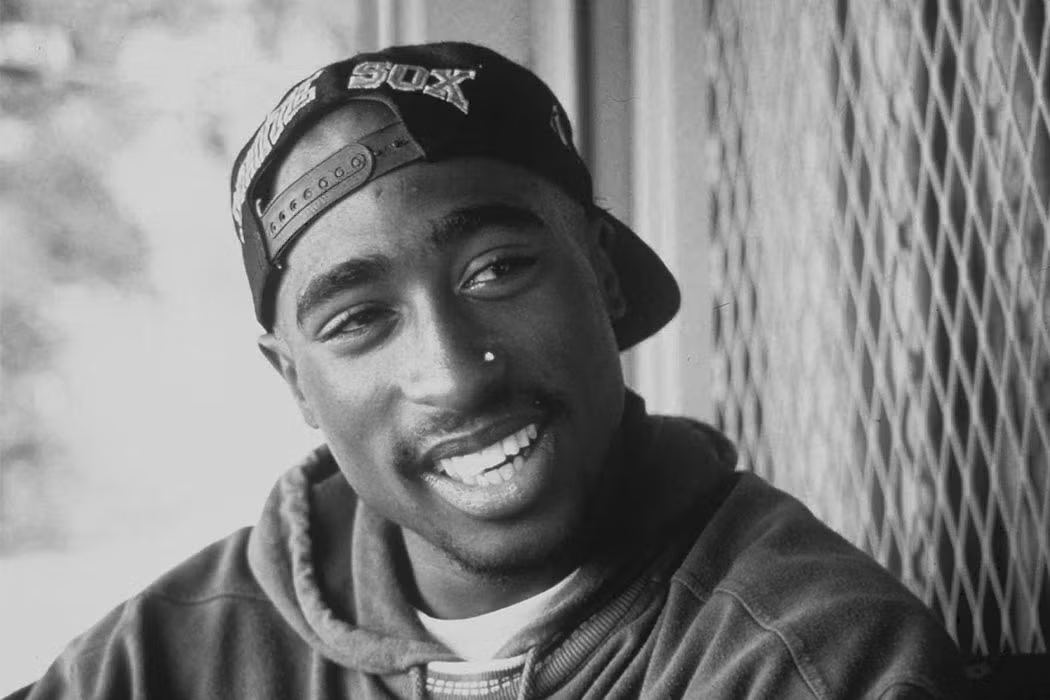
Rapper Tupac Shakur, whose 1996 killing is referenced in a newly filed lawsuit alleging threats made to silence an accuser.
Years later, the suit alleges, the threat was reinforced indirectly through others. The legal trigger is not what a judge decides later, but what the allegation explains now: delay.
That explanation is the fault line of the case. When a lawsuit claims silence was the product of fear rather than choice, the timeline itself becomes contested territory.
Courts may be asked to decide whether alleged intimidation justifies why a claim is arriving now, which can affect whether the case even proceeds. Those arguments happen early, often before discovery on the underlying facts begins.
This is where procedure matters more than proof, at least at this stage. Allegations of threats can complicate motions to dismiss, widen the scope of early discovery, and force arguments over communications that might otherwise remain irrelevant.
None of that requires a ruling on guilt or innocence. It simply means the case can become harder to contain, slower to resolve, and more public before anyone reaches the merits.
For a public figure, those mechanics translate quickly into real-world consequences. Decisions about whether to respond, stay silent, or fight publicly are no longer strategic abstractions; they affect reputation in real time.
Appearances, partnerships, and schedules can be impacted by the existence of the filing alone. Even without a court date, the pressure is active.
Financial exposure also enters earlier than many expect. Civil cases framed around alleged intimidation often bring settlement pressure long before evidence is tested, because uncertainty carries its own cost.
Legal teams must prepare for expanded document requests and prolonged motion practice while the narrative plays out in public.
Privacy narrows as past interactions and relationships become part of the procedural conversation, not because they have been proven, but because they have been alleged.
Situations like this follow a familiar pattern for high-profile defendants. Other public figures have faced cases where the earliest battles weren’t about what happened, but about why nothing was said sooner.
In those moments, procedure quietly decides leverage. The law doesn’t resolve the story; it stretches it.
That tension creates a broader question without forcing an answer. Does the legal system protect those who say fear delayed their claims, or does it risk turning unresolved accusations into years-long pressure campaigns?
Is publicity a tool of accountability, or does it become a form of punishment before judgment? The lawsuit raises those questions simply by existing.
The filing also arrives in the shadow of other litigation involving Combs. Since late 2023, he has faced a wave of civil claims following a lawsuit brought by his former partner Cassie Ventura, which settled quickly and preceded additional allegations.
Each new case adds procedural weight even before any court evaluates substance. The accumulation itself becomes part of the pressure landscape.
For now, nothing has been decided. There has been no ruling on credibility, no testing of evidence, and no judicial finding. What exists is a lawsuit that reframes years of silence as fear and delay as consequence.
The waiting begins not at trial, but here in the space where the law applies pressure without resolution.