Amelia and AI Nostalgia: When Synthetic Media Becomes a Legal Problem
In the first quarter of 2026, a viral phenomenon known as the “Amelia” trend has become the primary test case for digital speech in the age of generative AI.
While the trend, which uses an AI-generated character to depict a "lost" version of 1960's Britain is often framed as a cultural debate over immigration and national identity, its true significance is legal.
For the first time, creators are navigating the intersection of the UK Online Safety Act (OSA) and the EU AI Act, where the line between "fictional nostalgia" and "criminal misinformation" is being drawn.
The “Amelia” Case Study: Repurposed State-Backed AI
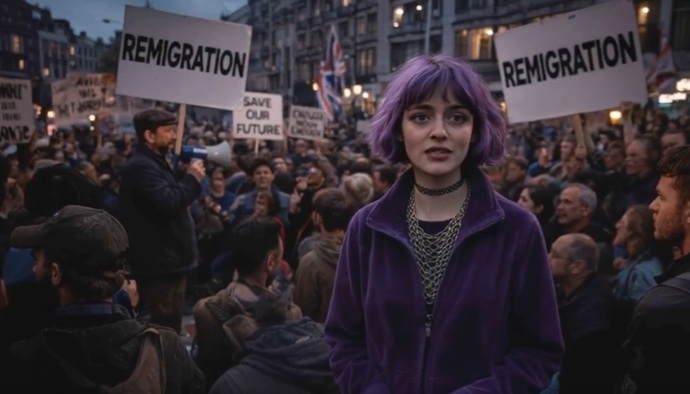
The irony of the "Amelia" controversy lies in the character's origins. Amelia was originally a purple-haired "goth girl" avatar created by Shout Out UK for the British Government’s Prevent counter-extremism programme.
In the original "Pathways" game, she was intended to serve as a cautionary tale—a character that might lure young users toward radicalization.
However, in early 2026, online "dissident" creators subverted this government-mandated character. By using advanced image-generation tools, users have placed Amelia into photorealistic 1960s settings, portraying her as a nostalgic observer of a pre-mass-migration era.
This transformation from a "negative archetype" to a "nostalgic symbol" has created a massive regulatory headache: at what point does a fictional character expressing a political viewpoint become a "False Communication" under the law?
The UK Online Safety Act: Section 179 and the Harm Threshold
The UK Online Safety Act (OSA), fully enforced in early 2026, significantly raised the legal stakes for viral online content. At the centre of that shift is Section 179, which creates the criminal offence of sending a false communication.
Under this provision, a person commits an offence if they knowingly send false information with the intent to cause non-trivial psychological or physical harm to a likely audience. The law is not aimed at mistakes or satire, but at content where falsity and harm are foreseeable.
This is where AI-generated nostalgia becomes legally risky. If a creator uses AI to fabricate “evidence” of historical events that never occurred, or presents a synthetic character’s account as an authentic historical document, the requirement of knowing falsity may be satisfied.
Intent is assessed contextually. Claims that the content was merely artistic or expressive carry less weight if the material is distributed in a way that fuels social tension or targets particular communities.
In such cases, prosecutors and regulators are entitled to infer an intent to cause harm from the surrounding circumstances.
UK law applies a “reasonable person” test. If an ordinary user scrolling social media would reasonably believe an AI-generated image or narrative to be genuine, the creator may be exposed to liability.
As generative tools become more photorealistic, courts are likely to expect clearer signals that content is artificial.
EU AI Act and Platform Liability: Why Unlabeled Synthetic Media Now Fails by Default
Across the EU, the regulatory response to synthetic media is far less discretionary than in the UK. The EU AI Act, in force in 2026, establishes a strict transparency regime for AI-generated content that resembles real people, places, or historical events.
Article 50 requires that synthetic media be clearly disclosed as artificially generated, with labels that are visible, distinguishable, and presented no later than the moment of first exposure.
For creators and influencers, this obligation applies regardless of scale, intent, or artistic framing.
While the Act contains a limited exception for works that are evidently artistic, fictional, or satirical, that carve-out narrows significantly where content touches on matters of public interest.
Guidance issued by the European Commission in 2026 makes clear that the exception does not apply if the presentation is likely to mislead the public.
In practice, political or socially charged themes, including immigration, national identity, or public safety are held to the highest transparency standard. In that context, unlabeled AI content is not treated as expressive speech but as a regulatory breach.
This regulatory pressure does not stop with creators. Under the EU’s Digital Services Act and parallel obligations imposed by the UK Online Safety Act, enforcement increasingly occurs at platform level.
Major platforms now face fines of up to six per cent of global turnover if they fail to identify and mitigate “priority harms,” including misleading synthetic media.
As a result, platforms have adopted proactive detection systems, using automated hashing and AI-based classifiers to flag unlabeled or photorealistic content at scale.
In practice, this has produced a form of shadow enforcement. When an unlabeled synthetic post gains traction, algorithms may reduce its visibility, restrict distribution, or remove it entirely, often without public explanation.
This approach has intensified following regulatory scrutiny of platform moderation practices in early 2026, leading to a risk-averse environment in which “nostalgic AI” content is frequently taken down before any public debate can occur.
In this framework, the legal risk no longer turns on whether content is persuasive or offensive. It turns on whether its artificial nature is clearly disclosed.
In the EU’s regulatory view, an unlabeled deepfake is not a meme, a provocation, or a stylistic choice. It is a compliance failure.
The Moral and Legal Grey Zone: Subversion vs. Disinformation
The Amelia controversy exposes a difficult legal grey zone involving the repurposing of government-funded digital assets.
Because Amelia originated as part of a publicly funded counter-extremism programme, her use in anti-immigration or extremist-adjacent messaging raises secondary questions around trademark control and Crown copyright, even where parody or commentary is claimed.
More significantly, the controversy illustrates the so-called “flood the zone” effect.
When thousands of AI-generated images and narratives featuring the same character circulate simultaneously, it becomes increasingly difficult for the public to distinguish between official messaging, private satire, and deliberate disinformation.
In that environment, regulators become less interested in what is being said and more concerned with where it came from.
Frequently Asked Questions (FAQ)
Is the “Amelia” character protected by trademark or copyright?
The Amelia character belongs to the creators of the Pathways game and was originally developed as part of a government-funded counter-extremism project. While parody and commentary are generally protected under UK and EU law, using the character for commercial gain or to falsely imply a government-endorsed message could expose creators to civil claims, including trademark or Crown copyright disputes.
Can I be arrested for sharing an AI-generated post rather than creating it?
Potentially, yes. Under the UK Online Safety Act, “sending” a communication can include reposting or sharing content. If a person knowingly shares false information with the intent to contribute to non-trivial harm, they could fall within the scope of Section 179. In practice, enforcement usually targets original creators, but sharing is not legally risk-free.
What is the safest legal approach for AI content creators?
Transparency. Clearly labelling content as AI-generated — through a visible watermark or an explicit “Generated by AI” disclaimer — is the most reliable way to reduce legal risk. This approach aligns with both the EU AI Act’s disclosure requirements and UK regulatory expectations.
Legal Takeaway: When Perception Becomes Legal Reality
In the digital ecosystem of 2026, the law has moved beyond simple questions of truth or falsity and toward a new metric: how content is perceived by a reasonable audience.
If AI-generated nostalgia is so high-fidelity that it convinces an ordinary observer they are seeing an authentic version of history, the law no longer treats the creator as an artist.
It treats them as the source of a false communication. Whether the intent is political, satirical, or purely creative, the legal risk follows the format. In the world of synthetic media, clarity is not a courtesy, it is the only reliable legal shield.