Understand Your Rights. Solve Your Legal Problems


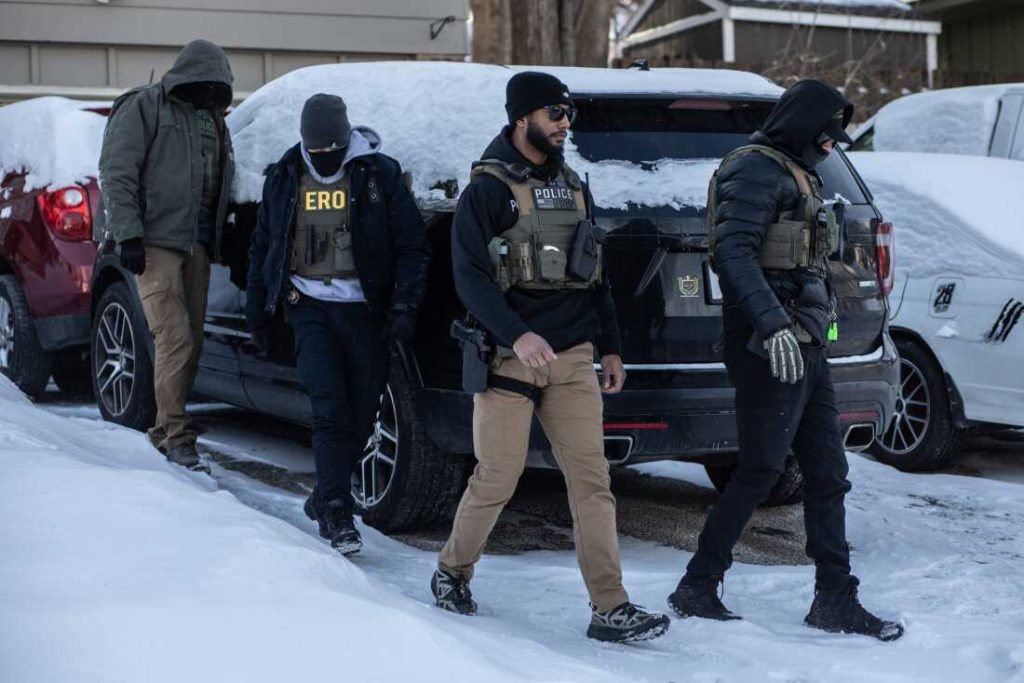
The fatal shooting of an “armed man” by federal agents in Minneapolis on Saturday marked the third such incident involving immigration authorities in the city in recent weeks. Video footage circulating online shows multiple agents wrestling the man to the ground before gunfire erupts. Officials have yet to identify the victim or publicly account for the sequence of events that led to the use of lethal force.
For the Trump administration, the incident has been framed as a necessary act of enforcement in a volatile environment. For critics, it has become the latest manifestation of a federal immigration campaign increasingly defined by opacity, escalating force, and disputed claims about who is being targeted.
What is emerging across court filings, public records, and international human rights warnings is a more complex — and legally unsettled — picture, one that stretches beyond immigration policy into fundamental questions about due process, accountability, and the limits of federal power.

Trump launches new ICE immigration crackdown in Maine
Federal officials say more than 100 people were detained in Maine during what Immigration and Customs Enforcement (ICE) branded “Operation Catch of the Day,” a name that itself drew criticism for trivialising the gravity of detention and removal. ICE described the operation as a focused effort to remove “the worst of the worst,” citing alleged child abusers, hostage takers, and violent criminals.
Yet court records examined by the Associated Press complicate that account. While some detainees had documented felony convictions, others had no criminal convictions at all, faced charges that were later dismissed, or were swept up while immigration proceedings remained unresolved.
Among the cases highlighted by ICE was that of Dominic Ali, a Sudanese national with serious assault convictions. His criminal history is not in dispute. But other individuals publicly cited by ICE as emblematic of the operation included people whose only recorded encounters with the justice system involved traffic-related offences or administrative violations.
Elmara Correia, an Angolan national singled out by ICE, was described by the agency as having been arrested for child endangerment. Maine court records instead show a dismissed charge related to learner’s permit regulations. Her attorney has said Correia entered the United States legally on a student visa and had never been subject to expedited removal.
“Was she found not guilty, or are we just going to be satisfied that she was arrested?” Portland’s mayor, Mark Dion, asked publicly — a question that goes to the heart of the legal distinction between allegation and conviction, and one that immigration enforcement does not erase.
Immigration attorneys say the Maine operation mirrors enforcement surges unfolding across the country. Boston-based attorney Caitlyn Burgess filed habeas petitions on behalf of detainees transferred from Maine to Massachusetts, noting that the most serious allegation faced by any of her clients was driving without a licence.
“Habeas petitions are often the only tool available to stop rapid transfers that sever access to counsel and disrupt pending immigration proceedings,” she said.
Attorney Samantha McHugh, representing eight Maine detainees, reported that none of her clients had criminal records. According to her filings, several were detained at workplaces or during lunch breaks by agents arriving in unmarked vehicles.
Federal court records confirm that immigration cases involving old convictions can remain unresolved for decades. In some instances, removal orders have been vacated and returned to immigration courts for reconsideration, creating legal limbo that resurfaces years later under new enforcement priorities.

Renée Good’s death at the hands of a federal immigration agent in Minneapolis on January 7, 2026, has become a focal point in national discussions about due process, lethal force standards, and civilian oversight of federal enforcement operations.
It is against this backdrop that Minneapolis has emerged as the epicentre of escalating confrontations between federal agents and civilians.
On January 7, U.S. citizen Renée Good was fatally shot by an ICE officer during an enforcement operation. On January 24, another man was killed following a physical struggle with agents near a neighbourhood business. The Department of Homeland Security said the man was armed and that a firearm was recovered from a nearby vehicle.
Minnesota’s governor, Tim Walz, described the shooting as “sickening” and urged President Donald Trump to end the operation, calling for the removal of what he characterised as “violent, untrained officers.” Senator Amy Klobuchar echoed that demand, accusing congressional Republicans of silence amid repeated lethal incidents.
The frequency of such encounters has intensified scrutiny not only of individual shootings, but of the broader enforcement framework in which they occur.
As federal enforcement has expanded, so too have civilian efforts to monitor it.
Following Good’s death, advocacy groups in Minnesota reported a sharp increase in volunteers registering as ICE observers — civilians trained to document arrests, record agents in public spaces, and alert communities to active enforcement. According to CNN, these observers include parents, teachers, clergy members, and retirees.
First Amendment specialists argue that filming agents in public is a protected act, not a criminal one. Physical obstruction is a crime; documentation is a right. Yet, federal rhetoric increasingly treats these civilian observers as targets rather than witnesses.
Federal officials, however, have increasingly portrayed such monitoring as dangerous or unlawful. The Trump administration has described some ICE observers as “domestic terrorists,” while the Department of Homeland Security has launched investigations into activists who publish information about agents online.
Law professors caution that while physically interfering with officers is illegal, observation and documentation are not — a distinction that has become increasingly blurred in public rhetoric and enforcement practice.
The math of federal enforcement is shifting. Since January 2025, immigration agents have been involved in at least 27 shootings across the United States. Six of these encounters proved fatal. This surge represents a departure from historical norms of civil immigration enforcement.
Most local police departments operate under strict restrictive policies regarding discharging firearms into moving vehicles. Federal agencies, however, maintain a more permissive "objective reasonableness" standard. This creates a legal gray zone where federal agents use lethal tactics that would trigger immediate local internal affairs investigations.
Federal records reveal a startling pattern of escalation. Of the 27 incidents recorded since the start of 2025, the following trends emerge:
Vehicle Discharges: 14 incidents involved agents firing into or at moving vehicles, a high-risk maneuver.
Bystander Risk: Three of these shootings occurred in crowded commercial zones during daylight hours.
Identity Error: In two cases, including the Renée Good shooting, the targets were confirmed U.S. citizens.
The friction is no longer just about who belongs in the country. It is about how the state behaves when it enters a neighborhood. We are witnessing the "criminalization of civil status" in real-time.
Federal officials argue that increased resistance justifies increased force. They point to a rise in verbal and physical interference from "ICE observers" and civilian monitors. Yet, the data suggests that force is often used as a first resort to maintain operational speed.
When speed replaces scrutiny, the constitutional "reasonableness" of an officer's actions becomes a moving target. These 27 shootings are not outliers; they are the new baseline for a system under extreme political pressure. Accountability now lags dangerously behind the trigger.

Federal agents at the scene of a Minneapolis shooting involving immigration authorities, amid growing public concern over lethal force used during federal enforcement operations.
Taken together, the Maine detentions, the Minneapolis shootings, and the criminalisation of civilian oversight suggest a federal immigration strategy operating at the outer edge of legal authority. In this environment, speed overtakes scrutiny, narrative outruns evidence, and accountability lags behind force.
As habeas petitions multiply, protests intensify, and international scrutiny grows, the legal question confronting the administration is no longer whether immigration enforcement has become aggressive.
It is whether the legal framework governing it — from due process to use-of-force standards — can withstand the pressure now being placed upon it.
At the heart of the enforcement surge lies a tension that cuts across immigration law, constitutional protections, and the lawful use of force.
Immigration enforcement is civil, not criminal. That distinction is foundational. An arrest by ICE does not require a criminal conviction, but it does not nullify due-process guarantees. Court records from Maine show that several detainees publicly branded as dangerous offenders had unresolved cases, dismissed charges, or no criminal record at all — yet were rapidly detained and transferred, often forcing attorneys to seek emergency judicial intervention simply to preserve access to counsel.
Use-of-force standards draw an even firmer boundary. Under international law, lethal force is lawful only as a last resort against an imminent threat to life. That principle applies regardless of immigration status. Recent shootings involving federal agents — including the killing of a US citizen — have raised acute questions about whether those standards are being met.
Oversight itself has become contested terrain. Legal scholars note that recording law enforcement and observing enforcement activity are constitutionally protected acts. Physical obstruction is illegal; documentation is not. Yet federal rhetoric has increasingly collapsed that distinction.
What is being tested, in real time, are the outer limits of federal authority — and the resilience of legal safeguards designed to restrain the state when enforcement accelerates beyond accountability.