When Foreign Conflicts Spill Onto British Streets, What Does Integration Really Mean?
The violence on Manchester’s Curry Mile this week did not begin with a dispute about Britain.
It began with Syria.
Fights between groups of people of Kurdish and Syrian heritage, smashed shop windows, damaged cars and a stabbing that sent a 23-year-old man to hospital were all sparked by events thousands of miles away — clashes between Syrian government forces and Kurdish-led groups in the Middle East. Yet the confrontation played out not in Damascus or Aleppo, but on Wilmslow Road, one of Manchester’s most recognisable commercial streets.
Police described the protests as “largely peaceful.” Local businesses boarded up.
The question raised by the disorder is uncomfortable but unavoidable: what happens when conflicts from abroad are imported wholesale into British public space — and is the UK prepared to manage the consequences?
Protest Is Legitimate. Imported Conflict Is Something Else.
Britain has long defended the right to protest, including protests rooted in international politics. Demonstrations over Gaza, Ukraine and Iran have all unfolded peacefully across the UK in recent years.
What unfolded in Manchester crossed a different line.
This was not simply an expression of solidarity or dissent. It involved confrontations between distinct diaspora groups, property damage, dispersal orders, mass police deployment, and a serious stabbing during what had been billed as a peaceful gathering at Exchange Quay.
Local business owners made clear they were not participants in any political dispute. One jeweller described “swarms of people” attempting to smash windows, forcing staff to barricade themselves inside. Another said there had been no prior community tension — until geopolitics arrived uninvited.
This distinction matters. Peaceful protest challenges power. Imported conflict destabilises neighbourhoods.
A Familiar Political Script, Replayed Again
As disorder spread, the political response followed a now-predictable pattern.
Senior figures condemned the violence. Some exaggerated it. Former Conservative minister Nadhim Zahawi circulated claims of multiple stabbings that later proved false, conflating events in Manchester with a separate incident in Antwerp. Others framed the unrest as proof that Britain has “lost control of its streets,” or that migration itself is the root cause.
In Parliament, MPs clashed over asylum hotels, criminality, deportations, tagging, and deterrence. The language escalated quickly: “national emergency,” “border security crisis,” “violent disorder,” “mindless thuggery.”
Yet amid the noise, one crucial distinction was repeatedly blurred: the difference between perception and evidence.
What the Data Actually Shows — and What It Doesn’t
Public debate often assumes that disorder involving migrants reflects a broader pattern of criminality. The available data does not support that assumption.
According to analysis from the Migration Observatory at the University of Oxford, foreign nationals account for roughly 12–13% of the prison population and criminal convictions in England and Wales — broadly in line with their estimated share of the adult population. When age and sex are taken into account, non-citizens are slightly under-represented in prison compared with British citizens.
That does not mean crime is evenly distributed. Non-citizens are over-represented in some offence categories, such as drug and fraud offences, and under-represented in others, including violent crime and robbery. Rates also vary significantly by nationality, though precise comparisons are difficult due to gaps in population data and the exclusion of people in communal accommodation, such as asylum hotels, from surveys.
Crucially, the Ministry of Justice does not record crime by immigration status. There is no comprehensive dataset showing whether asylum seekers are more or less likely to offend than the wider population.
What the data does show is this: headline-driven narratives routinely outpace the evidence.
The Real Fault Line: Identity Without Integration
If the Manchester clashes were not driven by a general rise in migrant criminality, what were they driven by?
The answer appears to lie less in crime statistics and more in identity fragmentation.
Kurdish and Syrian communities in the UK are shaped by recent trauma, displacement and unresolved conflict. Many arrived during or after Syria’s long civil war. Political loyalties, ethnic tensions and historical grievances did not dissolve at the border.
What Britain lacks is a clear framework for managing how those unresolved conflicts play out domestically.
Integration policy has focused heavily on employment, housing and legal status. Far less attention has been paid to civic cohesion when transnational identities collide — especially in moments of heightened geopolitical tension.
Manchester’s unrest suggests that the assumption “diversity equals harmony” is no longer sufficient on its own.
Policing the Aftermath, Not the Causes
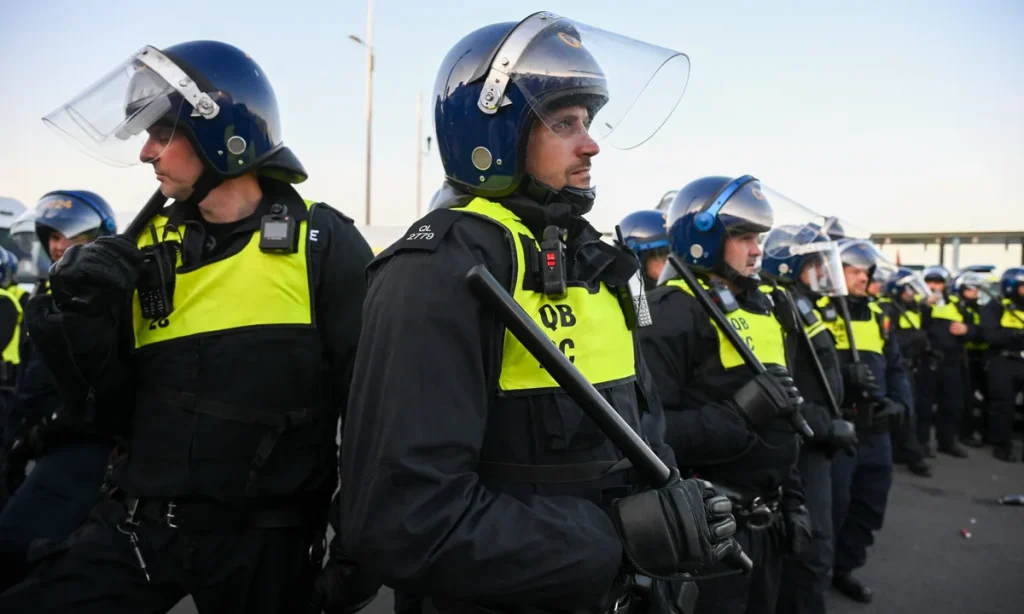
Greater Manchester Police responded with Section 34 dispersal orders, Section 60 stop-and-search powers and expanded patrols. Arrests were made. Calm was restored.
But policing can only manage symptoms.
The deeper issue is structural: Britain has become a host to multiple global conflicts without a strategy for insulating local communities from their fallout. Social media accelerates mobilisation. Rumours spread faster than corrections. Diaspora politics becomes street politics almost overnight.
As MPs across parties acknowledged during recent Commons exchanges, misinformation — particularly online — now plays a central role in turning isolated incidents into flashpoints.
The Risk Ahead
There is a danger in misreading Manchester.
Downplaying the disorder risks normalising street violence as an inevitable feature of multicultural society. Overstating it risks fuelling moral panic, racialised narratives and collective blame.
The greater risk lies elsewhere: allowing foreign conflicts to repeatedly erupt on British streets without a serious conversation about integration, identity and civic responsibility.
Integration is not just about who lives here. It is about which conflicts are allowed to be fought — and which are not.
A Test Britain Has Not Yet Faced
The Manchester clashes were not the largest protest Britain has seen, nor the most violent. But they may prove among the most revealing.
They exposed a gap between Britain’s self-image as a tolerant, plural society and its capacity to manage imported geopolitical tensions in real time. They showed how quickly legitimate protest can slide into communal confrontation. And they revealed how fragile public trust becomes when perception, politics and evidence pull in different directions.
The question now is not whether Britain should remain open or closed. It is whether integration can keep pace with global instability — or whether Britain will increasingly find itself hosting other people’s wars at home.
What Powers Did Police Actually Use — and How Far Do They Go?
When disorder broke out in Manchester, Greater Manchester Police relied on two rarely explained but powerful legal tools: Section 34 dispersal orders and Section 60 stop-and-search powers.
Section 34 of the Anti-social Behaviour, Crime and Policing Act allows police to order individuals to leave a designated area for up to 48 hours if their presence is believed to contribute to harassment, alarm or distress. Failure to comply is a criminal offence. The power is preventative, not punitive — officers do not need to prove wrongdoing, only reasonable belief.
Section 60 of the Criminal Justice and Public Order Act goes further. It temporarily removes the requirement for reasonable suspicion, allowing officers to stop and search individuals within a defined area if serious violence is anticipated. The threshold for authorisation is high, but once in place, civil liberties protections are significantly reduced.
Both powers are lawful, time-limited, and subject to review. But they are also blunt instruments. Civil liberties groups have long warned that frequent or prolonged use risks undermining public trust, particularly in diverse communities.
Manchester illustrates the legal dilemma clearly: the state has the authority to suppress disorder swiftly — but far less ability to prevent the conditions that trigger it.