Trump Threatens 100% Tariff on Canada — Treats Ally Like a Sanctioned State
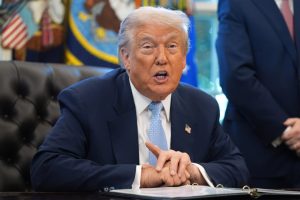
The threat issued this Saturday was blunt and unmistakable. President Donald Trump warned Prime Minister Mark Carney that Canada could face a 100% tariff on all imports if it moves forward with a trade deal with China. On social media, Trump accused Canada of becoming a potential “drop-off port” for Chinese goods entering the United States.
It was not framed as negotiation. It was framed as punishment.
This is no ordinary dispute over dairy quotas or auto parts. The threat marks a deeper shift in how the United States now wields economic power. Tariffs are no longer trade tools — they are instruments of coercion. Alliances, once treated as durable partnerships, are now transactional assets, vulnerable to sudden liquidation.
When Trump warned that China would “eat Canada alive,” he wasn’t merely attacking Beijing. He was signaling that sovereignty itself has become conditional.
A Year of Strategic Volatility
The pattern did not emerge overnight. Since returning to office, Trump has embraced volatility as leverage.
On January 20, 2025, he vowed to “tariff and tax foreign countries to enrich our citizens.” Within weeks, his administration declared a national emergency to justify 25% tariffs on Canada and Mexico, bypassing Congress.
What followed was a familiar cycle: threat, partial reprieve, then escalation.
In March 2025, U.S. automakers were granted a one-month exemption — only for the tariffs to land shortly afterward. In January, Colombia was pressured with 25% tariffs until it accepted migrant deportation flights. Each episode reinforced the same message to foreign capitals: relief is temporary, and compliance is expected.
This rhythm of uncertainty forces governments into constant defensive negotiation, never knowing when the next economic strike will land.
Allies on the Menu: Canada Put on Notice
Canada’s treatment marks a sharp break from precedent. Traditionally shielded by geography and treaty, Ottawa now finds itself spoken to like a sanctioned state.
By early 2025, aluminum tariffs had already been raised to 25%. By March, Justin Trudeau’s government retaliated with $100 billion in counter-tariffs. The political landscape shifted again with Mark Carney’s rise — but the tone from Washington hardened.
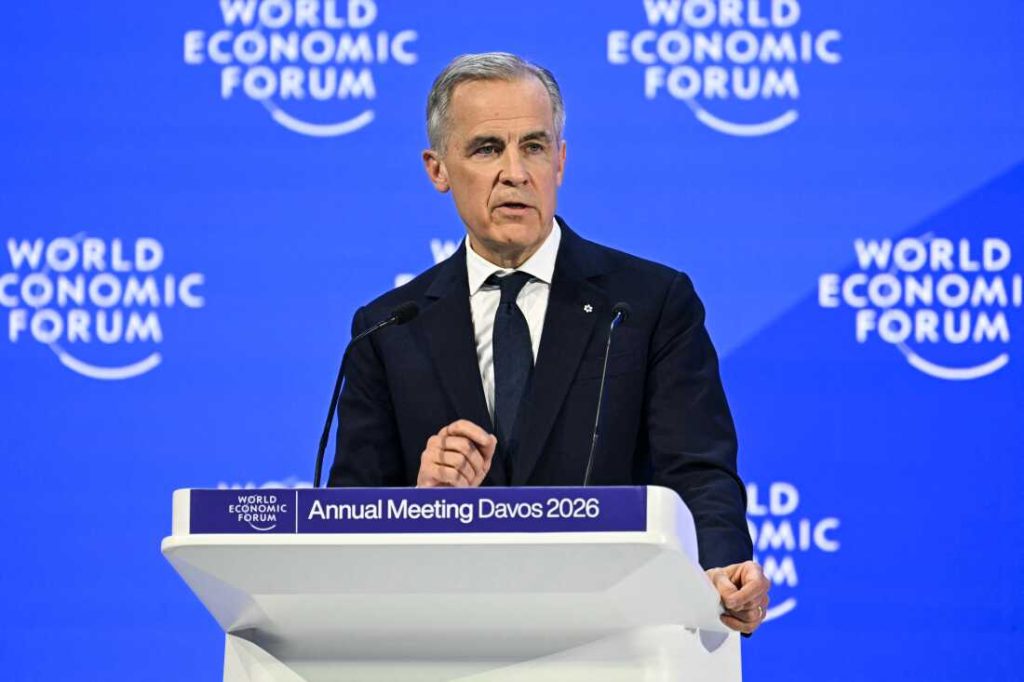
Trump’s rhetoric has grown openly predatory. After a tense Davos exchange, Carney’s invitation to Trump’s proposed “Board of Peace” was withdrawn. The message was unmistakable: follow the U.S. lead or face economic isolation.
For Canada, the threat is not theoretical. A 100% tariff would land immediately on supply chains, jobs, and consumer prices — with little room to maneuver.
How the White House Keeps the Tariff Weapon Loaded
The legal architecture behind this strategy allows the administration to move fast and unilaterally.
Two tools dominate:
-
Section 232 of the Trade Expansion Act, which frames imports like timber, steel, and copper as national security threats
-
The International Emergency Economic Powers Act (IEEPA), which allows sweeping economic penalties under declared emergencies
In January 2026, the White House quietly extended these emergency declarations for another year. The effect is simple: tariffs can be deployed at will, with minimal legislative oversight. The European Union has already initiated WTO action, calling the measures abusive and destabilizing.
“We Take the Oil”: When Coercion Turns Physical
Canada faces economic pressure. Venezuela has faced something more direct.
Following an overnight raid on January 3, 2026, the U.S. military detained President Nicolás Maduro. Days later, Trump announced that 50 million barrels of Venezuelan oil seized from tankers would be processed by U.S. refineries.
“Let’s put it this way,” Trump said. “They don’t have any oil. We take the oil.”
The operation reportedly involved a classified acoustic weapon — dubbed the “discombobulator” — used to incapacitate guards. White House officials described it as a “very intense sound wave.” The message was unmistakable: economic pressure and military force now operate on the same spectrum.
The administration’s $100 billion plan to “rebuild” Venezuela’s oil industry has been described by critics as less reconstruction than acquisition.
The Global Fallout Is Already Spreading
Trump’s “reciprocal tariff” policy, introduced in April 2025, upended decades of trade norms. By matching foreign tax rates, the U.S. imposed a 34% tariff on China, prompting Beijing to retaliate with 125% duties on American farm products.
A short-lived truce collapsed within months.
Even close allies have felt the squeeze. The United Kingdom secured a limited vehicle quota at a reduced tariff only after agreeing to import U.S. bioethanol. The deal underscored a new reality: access is conditional, and concessions are mandatory.
Britain offers a preview of what compliance looks like. A House of Commons briefing published in December acknowledged that the UK accepted a non-binding “Economic Prosperity Deal” under U.S. tariff pressure — agreeing to quotas, regulatory concessions, and large imports of U.S. bioethanol — yet still remains subject to a 10% baseline tariff on most goods.
Parliamentary committees warned the arrangement creates uncertainty for businesses and risks eroding the UK’s competitive position, underscoring a broader reality: even allies who concede do not escape Trump’s tariff regime — they merely soften its edge.
The Cost at Home
Trump has portrayed tariffs as a revenue bonanza. Economists see a different picture.
Auto-parts tariffs have disrupted supply chains at Ford and GM. Higher steel and timber prices are filtering directly to consumers. The removal of the $800 de minimis threshold in August 2025 has hit small businesses with new taxes and customs delays.
Retaliation has followed. European tariffs now target American whiskey and motorcycles, squeezing exporters already navigating rising costs.
For many households, “America First” has begun to look like consumer last.
Economists warn the cost of Trump’s tariff strategy will land fastest at home. According to analysis by the Tax Foundation, the current and threatened tariffs amount to an average tax increase of roughly $1,000 per U.S. household in 2025, rising to about $1,300 in 2026.
Even after accounting for reduced imports and behavioral shifts, the effective tariff rate would climb to its highest level since 1946, while eliminating the equivalent of nearly 450,000 full-time jobs. The projected revenue gains, analysts note, would be partially offset by slower growth, higher prices, and retaliatory tariffs abroad.
The economic stakes are substantial. Analysts at JPMorgan estimate the effective U.S. tariff rate is now climbing toward 18–20%, up from just 2.3% before Trump returned to office — a shift they describe as the largest tax increase since 1968. The bank warns the tariffs could lift consumer prices by as much as 1.5%, push real disposable income into negative territory, and materially raise the risk of recession, both in the U.S. and among close trading partners such as Canada.
A Rules-Based Order in Retreat
The threat of a 100% tariff on Canada is not an outlier. It is the clearest expression yet of a broader shift.
Trade agreements like the USMCA still exist on paper, but in practice they have been eclipsed by bilateral pressure and brinkmanship. Whether the target is Ottawa, Caracas, or Copenhagen, the logic is the same: compliance brings relief; resistance brings punishment.
As Mark Carney warned in Davos, this is not a transition — it is a rupture. In 2026, tariffs are no longer about trade balances. They have become the primary weapon of a new, coercive global order.