


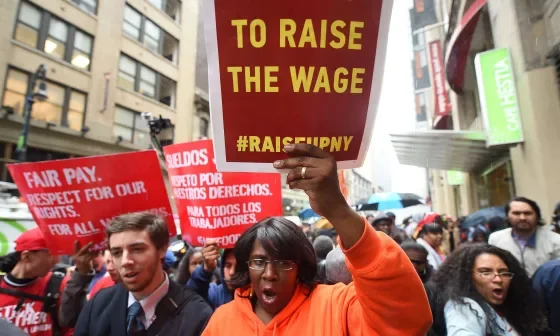
$15 Floor Is a Ceiling: How 2026 Wage Laws Trigger Triple-Penalty Risk
-
The Exposure: 22 states are implementing aggressive wage hikes in 2026, with Hawaii hitting a record $2.00 increase and California reaching new heights for healthcare-specific sectors.
-
The Trap: New "triple-penalty" statutes—like California’s refined SB 261—now trigger automatic 300% liquidated damages for unsatisfied wage judgments.
-
The Pivot: Elite defense strategy has shifted from "compliance audits" to "forensic payroll hashing" to survive the new proactive Fair Work Agency (FWA) enforcement regimes.
Why a $1 Wage Increase Triggers Human and Employer Risk
For the average retail or healthcare worker, a $1.00 bump is a tank of gas or a week of groceries. But for a mid-market employer operating across state lines, it is a ticking litigation clock.
In 2026, the story isn't just about inflation; it’s about reputational execution. When a multi-state operator fails to adjust for a localized "living wage" ordinance in a place like Seattle, Flagstaff, or Honolulu, they aren't just facing a back-pay claim.
They are facing a "naming and shaming" regime where government agencies publicly blacklist non-compliant entities. The stake isn't just the balance sheet—it’s the brand’s license to operate in a talent-starved market.
If you lose your "Fair Labor" certification in 2026, you lose your workforce.
The Hidden Law: The 2026 Triple-Penalty Chokepoint in Wage Claims
While the public follows the headline rates—noting that 60 jurisdictions have now cleared the $15.00 mark—the "legal lever" moving the story is the tightening of Liquidated Damages Statutes.
Under previous rules, an employer who lost a wage dispute paid the difference plus interest. In 2026, the law has been weaponized. Statutes like California’s SB 261 have created a "Triple-Threat" environment.
If a judgment remains unsatisfied for 180 days, the law mandates triple penalties. This turns a minor $10,000 payroll oversight into a $30,000 corporate artery-bleed.
The defense is boxed in. Their only move is to attack the "payroll hash"—the digital signature of when and how a payment was processed—before the Labor Commissioner's Office issues a final determination.
Once that determination is inked, the math becomes catastrophic.
The Forensic Pivot: How “Digital Exhaust” Redefines Timecards in Wage Claims
In 2026, the "smoking gun" is no longer a paper punch card or an Excel spreadsheet. It is the Portal-to-Portal signature. As states like New York and Illinois increase enforcement, plaintiffs' firms are using AI-driven discovery to find "walking time" gaps.
Consider a healthcare worker in a California facility, now governed by the complex healthcare-specific wage tiers. If they clock in at the front desk but spend seven minutes walking to their specific ward, those seven minutes are litigated as "unpaid integral work."
Elite defense teams at AmLaw litigation teams experienced in cross-border evidence are now deploying "time-latency forensics."
They analyze the metadata of badge swipes against Wi-Fi triangulation to prove that the "unpaid time" was actually a personal detour—effectively neutralizing the "off-the-clock" claim before it reaches a jury.
Can a Car’s “Digital Exhaust” Prove Intent in Wage and Travel-Time Claims?
The 2026 battleground has shifted heavily toward the mobile and remote workforce.
With Alaska, Florida, and Oregon raising their pay requirements later this year, the "travel time" and "reimbursement" loopholes have become goldmines for class-action litigants.
When an employer fails to reimburse for personal vehicle use at the new 2026 adjusted rates, it triggers a "wage theft" designation in many jurisdictions.
Defensive strategy now relies on GPS Hashing. By using cryptographically secure logs of vehicle movement, firms known for constitutional advocacy in media-heavy trials are successfully arguing that "uncompensated time" was actually "commute-to-primary-site" time—a distinction that saves millions in aggregate class settlements.
The Verification Gate: How 2026 Wage Enforcement Is Actually Applied
All analysis must be grounded in the hard reality of the Fair Work Act updates.
-
The $70,304 Wall: In California, the exempt salary threshold is legally tethered to 2x the minimum wage. As the rate hits $16.90, any manager earning less is legally "non-exempt," entitling them to mandatory overtime and meal breaks.
-
The 6-Month Rule: National litigation teams are prepping for the shift in tribunal time limits. In several jurisdictions, the window to file a wage claim has expanded, meaning an error made during a 2026 rate transition can haunt a company well into 2028.
The Strategic Pivot: The Old Way vs. The 2026 Reality
Penalty Structure
Before 2025, employers who lost a wage dispute typically paid backpay plus interest. In 2026, that exposure has expanded dramatically, with many jurisdictions now imposing “triple-threat” damages that can multiply liability overnight.
Enforcement Model
Historically, wage enforcement was complaint-driven and largely reactive. In 2026, Fair Work Agencies are running proactive, algorithm-based audits that flag payroll anomalies before a worker ever files a claim.
Evidence Standards
The old system relied heavily on paper records and PDF payroll logs. Today’s enforcement environment prioritizes biometric data and hashed digital signatures, turning metadata into primary legal evidence.
Exempt Salary Thresholds
Previously, exemption status was tied to federal standards or flat state rules. In 2026, exemption thresholds are dynamically linked to minimum wage rates—pushing required salaries above $70,000 in states like California.
The “Hawaii Ripple”: Why a $2.00 Wage Increase Changes Everything
Hawaii’s $2.00 jump is the largest single increase in the 2026 cycle. This creates a "wage compression" crisis. When the floor rises that sharply, the gap between an entry-level worker and a supervisor shrinks.
From a legal strategy perspective, this is the "Compression Trap." If a supervisor's pay isn't adjusted proportionally, they may fall below the "Exempt" salary threshold mentioned earlier.
National defense firms handling physician-defendant cases and high-level management disputes are seeing a surge in "misclassification" suits stemming exactly from this Hawaii-style jump.
The "hidden lever" here isn't the minimum wage; it’s the Salary Basis Test.
The Verification Gate: Non-Negotiable Wage Compliance Procedures in 2026
In 2026, a "good faith" defense is no longer a shield. Under the revised Department of Labor (DOL) guidelines, "unawareness of localized rate changes" is explicitly excluded as a mitigating factor.
Defense teams are now forced to adopt a "zero-trust" payroll architecture. This involves:
-
Automated Rate Injection: Using API-driven payroll software that pulls from the National Employment Law Project (NELP) databases in real-time.
-
Shadow Auditing: Running a parallel payroll "ghost" to identify discrepancies before the FWA algorithms flag the business.
Why 2026 Changes the Wage Enforcement Game
The 2026 wage hikes are not a routine adjustment; they are a structural overhaul of employer liability. With 30 states and D.C. now operating well above the federal $7.25 relic, the "Legal Chokepoint" is no longer the rate itself, but the velocity of enforcement.
If you aren't auditing your "digital exhaust"—the metadata of when, where, and how much you pay, you aren't just risking a fine. You are risking the "Triple-Penalty" death blow that 2026 law has designed specifically to catch the unprepared.
FAQ: The 2026 Wage & Hour Snippets
Does the federal minimum wage ($7.25) still have any legal standing?
Yes, but only as a floor for the 20 states that haven't enacted higher rates. For any employer with a multi-state footprint, the federal rate is practically irrelevant; the "compliance ceiling" is set by the most aggressive state in their network.
What is the biggest risk for healthcare employers during this 2026 cycle?
The "Tiered Compliance" trap. Laws like California’s SB 525 create different minimums for large hospital groups versus independent clinics. Misclassifying the type of facility can lead to immediate back-pay triggers.
How are firms fighting AI-generated "mass-action" wage claims?
Plaintiffs' firms are using AI to scrape public payroll data for anomalies. Defense teams at AmLaw firms are responding with "Counter-AI" that validates the "reasonableness" of clerical errors to prevent them from being labeled as "willful" violations.














