Understand Your Rights. Solve Your Legal Problems



A growing number of U.S. families are being affected by rapid-escalation sextortion schemes that pressure minors into harm within hours.
A 15-year-old student from Cross Lanes, West Virginia, died by suicide on Nov. 6 after being targeted in an online sextortion scheme that unfolded over roughly three hours, according to local authorities.
The teen, identified by his family as Bryce Tate, was contacted through text message shortly after returning home from school. Investigators say the exchange intensified rapidly, mirroring methods seen in recent cases involving coordinated groups operating across several countries.
The case has renewed concern among parents, schools and law-enforcement agencies because of the speed, scale and sophistication of these digital extortion schemes, which federal investigators have linked to organized networks abroad.
The FBI has warned of a rise in coercive tactics directed at boys, noting that the practice blends online impersonation, harassment and financial extortion. Sextortion is prosecutable under federal statutes that cover coercion, threats and exploitation of minors.
Authorities say stronger awareness is needed because many victims are pressured into silence during the short window in which the harm occurs.
Authorities say Bryce received a message from an unfamiliar number at about 4:37 p.m. on Nov. 6. The communication soon escalated into threats demanding money in exchange for not sharing sensitive images.
Similar extortion attempts have been documented by the National Center for Missing & Exploited Children (NCMEC), which reported more than 33,000 child sextortion cases in 2024 — a figure nearly matched in the first half of 2025.
NCMEC and the FBI have previously noted that perpetrators often gather personal details from public social-media accounts to impersonate a peer and build trust.
In recent years, cases have involved information sourced from platforms such as Instagram, Snapchat and TikTok.
Federal investigators have attributed many U.S. cases to groups operating from West Africa and Eastern Europe, including networks linked to the organized online group known as “764,” described by the FBI as an international exploitation enterprise.
Comparable rapid-escalation timelines have appeared in earlier cases in Michigan, Montana and California, where victims were contacted, threatened and overwhelmed within hours.
Local police in Kanawha County say they immediately referred the case to federal authorities because the tactics matched patterns documented in multi-state investigations.
The FBI has repeatedly warned that coercive sextortion involving minors is among the agency’s fastest-growing online crime reports.
In public advisories, the bureau emphasizes that threats to expose images even when no payment is made constitute a federal offense when minors are involved.
Families in several states have shared similar experiences after the deaths of their children, prompting renewed calls from schools and community groups for guidance on online safety.
Parents responding publicly to Bryce’s case have echoed concerns raised after the 2022 deaths of teenagers in Mississippi, Michigan and California, each involving sextortion attempts traced to overseas networks.
Federal and non-profit organizations report that sextortion targeting boys typically focuses on financial pressure, with demands for payment through digital wallets, gift cards or cryptocurrency.
The FBI says victims often receive dozens of messages in rapid succession, a tactic intended to create panic and limit opportunities to seek help.
For minors, the legal framework offers protections: threatening or coercing a child into producing or exchanging explicit images violates federal child-exploitation statutes, and distributing or attempting to distribute such images carries separate penalties.
However, families often face immediate emotional and practical challenges, including understanding how the extortion escalated and navigating the investigative process.
Parents and educators have noted that many teens are unfamiliar with how swiftly online threats can escalate.
Comparisons to earlier cases show that young people frequently believe they are communicating with a peer, especially when perpetrators use accurate personal details harvested from public profiles.
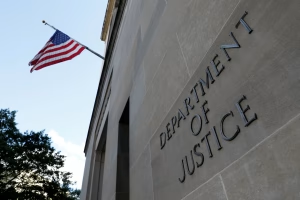
Federal cases tied to sextortion have increased steadily in recent years. In 2023, the Department of Justice reported a rise in cross-border online exploitation cases involving minors, citing more referrals from NCMEC and state agencies.
In 2024, sentencing records showed that perpetrators involved in a Michigan case were extradited from Nigeria and received 17-year federal sentences — a rare but notable outcome that underscored international cooperation.
On Dec. 3, the Justice Department announced indictments against five U.S.-based individuals allegedly associated with an offshoot of the 764 network.
The charges were filed in federal court and included offenses relating to the exploitation of minors and the transmission of threats. DOJ records confirm that one defendant was an active-duty Navy sailor, highlighting concerns about the group’s recruitment reach.
The FBI, NCMEC and state agencies advise families to set social-media profiles to private, limit visible personal information and ensure that minors understand that threats to share images are illegal attempts to coerce compliance.
Reporting routes include the NCMEC CyberTipline, local police departments and FBI field offices.
Digital-safety groups also recommend avoiding sending images to unknown contacts, using platform-level blocking features and saving evidence for investigators.
School districts in several states, including West Virginia, have added classroom guidance on online impersonation and rapid-escalation scams after reviewing state data on youth mental-health risks.
Sextortion occurs when someone threatens to share explicit images unless the victim provides money, more images, or other concessions. When minors are targeted, the conduct falls under federal child-exploitation laws. The FBI treats these cases as criminal offenses regardless of whether the images were voluntarily shared.
Law-enforcement agencies report that boys are targeted because scammers often seek rapid financial gain rather than long-term grooming. Publicly visible social-media information allows perpetrators to impersonate peers. NCMEC data shows that boys account for a substantial share of financially driven sextortion reports.
Investigators say some cases escalate within hours. Perpetrators may send dozens of messages in minutes, using threats to create panic. Published FBI advisories describe this as a deliberate effort to prevent victims from seeking help.
Arrests occur when investigators can identify suspects through financial transactions, device data or international cooperation. DOJ extradition records from 2023 and 2024 show several successful prosecutions, but many cases involve overseas actors who are difficult to identify.
Agencies advise stopping all communication, capturing screenshots, reporting through the NCMEC CyberTipline, and notifying local law enforcement. Officials emphasize that victims should not pay; extortion usually continues even when money is sent.
The FBI has an open investigation into Bryce’s case and has not released further details. Federal officials say ongoing cases tied to organized sextortion networks may involve additional indictments following digital-forensics analysis and financial tracing.
State lawmakers in West Virginia have indicated they are reviewing proposals to strengthen penalties for online coercion of minors, including amendments to existing cyberbullying provisions.
Nationally, federal agencies are continuing public-awareness campaigns with NCMEC, and several states have announced school-focused education initiatives for the 2025–26 academic year.
Bryce’s death reflects a broader rise in fast-moving online exploitation schemes targeting minors across the United States.
Families, schools and investigators say the short time frame between initial contact and serious harm underscores the need for early awareness.
The public-interest concern centers on child safety, digital-privacy risks and access to reliable reporting mechanisms.
👉 Sextortion: A Growing Threat to Teen Mental Health and Safety 👈