Paul Campo’s Cartel Conspiracy Charges Shake Federal Law Enforcement and Raise National-Security Concerns
Former DEA agent Paul Campo and associate Robert Sensi are charged in New York with conspiring to launder millions for the CJNG cartel and discussing potential access to military-grade weapons. Both men have pleaded not guilty and remain detained as federal proceedings unfold, intensifying scrutiny over law-enforcement integrity.
Former federal agent Paul Campo was charged in New York on Friday in a sweeping conspiracy case that prosecutors say reveals how a onetime DEA insider allegedly agreed to help what he believed was a representative of the Jalisco New Generation Cartel (CJNG).
The core search-intent question—why was Campo charged?—is answered plainly in the indictment: prosecutors accuse him and 75-year-old associate Robert Sensi of laundering millions in purported cartel proceeds, facilitating cash-to-crypto conversions and discussing routes to obtain military-grade firearms and explosives.
Campo, 61, who retired in 2016 after a 25-year DEA career, was arrested during a controlled undercover operation involving a government informant posing as a CJNG emissary.
Both defendants pleaded not guilty and were ordered detained without bail, a decision shaped by the severity of the narcoterrorism and money-laundering conspiracy counts now facing them.
The emotional stakes are equally stark: a decorated former agent standing accused of agreeing to assist a cartel that U.S. officials say has fueled violence on both sides of the border. With electronic recordings, surveillance evidence and financial tracking at the heart of the government’s case, this prosecution is poised to become one of the most consequential federal corruption cases of the year.
What we know so far
The indictment alleges that Campo and Sensi entered a year-long series of meetings with a confidential informant who claimed to represent CJNG. During these meetings, prosecutors say the defendants agreed to launder around $12 million in supposed drug proceeds and converted approximately $750,000 into cryptocurrency under the belief the funds belonged to the cartel.
According to court filings, the men also provided a payment tied to what they thought would be the sale of 220 kilograms of cocaine in the U.S., expecting a financial return. Discussions reportedly widened to potential access to AR-15-type rifles, M4 carbines, grenade launchers, drones and rocket-propelled grenades.
Campo allegedly referenced his DEA experience repeatedly, describing himself as a potential “strategist” for the cartel’s operations. Prosecutors say evidence includes hours of recorded conversations, emails, surveillance images and cellphone location data.
Both defendants remain in federal custody after a magistrate judge rejected defense efforts to secure release pending trial.
The legal issue at the centre
At its core, this is a federal conspiracy case, involving counts linked to narcoterrorism, terrorism, narcotics distribution and money laundering. In the federal system, prosecutors do not need to show that a criminal act was completed—only that:
-
An agreement existed to commit a federal offence.
-
The defendants knowingly participated in that agreement.
-
An overt act took place, such as a meeting, payment, or recorded communication.
Courts typically focus on documentary evidence, recorded conversations, financial transactions and surveillance data. The government must prove each element beyond a reasonable doubt, and each conspiracy count carries serious potential penalties.
Procedurally, the case will move through discovery, evidentiary hearings, pre-trial motions and ultimately trial unless resolved earlier through legal challenges or negotiations.
Key questions people are asking
Is Paul Campo facing jail time?
Campo faces federal conspiracy counts with significant statutory penalties. No outcome can be predicted, but similar narcoterrorism-related charges have historically carried long sentences upon conviction.
What charges are actually on the table?
The indictment lists four conspiracy counts: narcoterrorism, terrorism, narcotics distribution and money laundering. These counts relate to alleged agreements and overt actions rather than completed transactions.
Did any weapons or explosives actually change hands?
Court documents indicate that discussions about weapons occurred within a controlled undercover operation. The legal issue is the alleged agreement and actions taken toward that agreement—not the ultimate delivery of weapons.
Why is CJNG’s designation relevant?
Because CJNG was designated a foreign terrorist organisation earlier this year, prosecutors may apply terrorism-related statutes that expand jurisdiction, increase penalties and allow broader investigative tools.
How long could the federal process take?
Complex conspiracy cases routinely take many months before trial due to voluminous discovery, digital-evidence review and procedural motions.
What this means for ordinary people
This case illustrates how federal money-laundering stings and conspiracy charges operate. U.S. law permits charges even when funds come from government sources and when the alleged criminal plan exists largely in recorded conversations. What matters legally is the defendant’s intent and participation in the agreement.
It also shows why law-enforcement misconduct cases have outsized public impact. When a former agent is charged with aiding a cartel, the focus shifts to internal oversight, training, and mechanisms designed to prevent insider exploitation of government expertise.
Additionally, the case highlights how terrorism designations reshape legal frameworks, expanding the tools prosecutors can use to respond to threats involving transnational criminal groups.
Possible outcomes based on current facts
Best-case procedural scenario
The court could find legal deficiencies in certain counts or limit key pieces of evidence through pre-trial motions. In rare cases, charges may be narrowed or dismissed if procedural requirements are not met.
Worst-case procedural scenario
If the case proceeds to trial with the government’s evidence admitted in full, defendants could face convictions on multiple federal conspiracy counts, each with substantial statutory penalties, including terrorism-related enhancements.
Most common procedural pathway
Most federal conspiracy cases progress through extensive discovery, motion practice, evidentiary hearings and ultimately a jury trial unless the parties seek a negotiated resolution.
Frequently asked questions
Are Campo and Sensi the only individuals charged?
Yes. The indictment lists only the two defendants. No additional defendants have been publicly named.
Does Sensi’s health affect the charges?
Health concerns may influence detention arguments but do not alter the charges themselves. Courts weigh medical issues when evaluating risk, not when assessing the underlying allegations.
Is this part of a broader DEA misconduct trend?
U.S. media reports note past misconduct cases within the DEA, and agency leadership has acknowledged institutional failures. However, each federal case is adjudicated strictly on its own facts.
When will the next major step occur?
Upcoming procedural steps will likely include discovery deadlines and pre-trial motions challenging aspects of the indictment or evidence.
Who are the The Jalisco New Generation Cartel (CJNG)
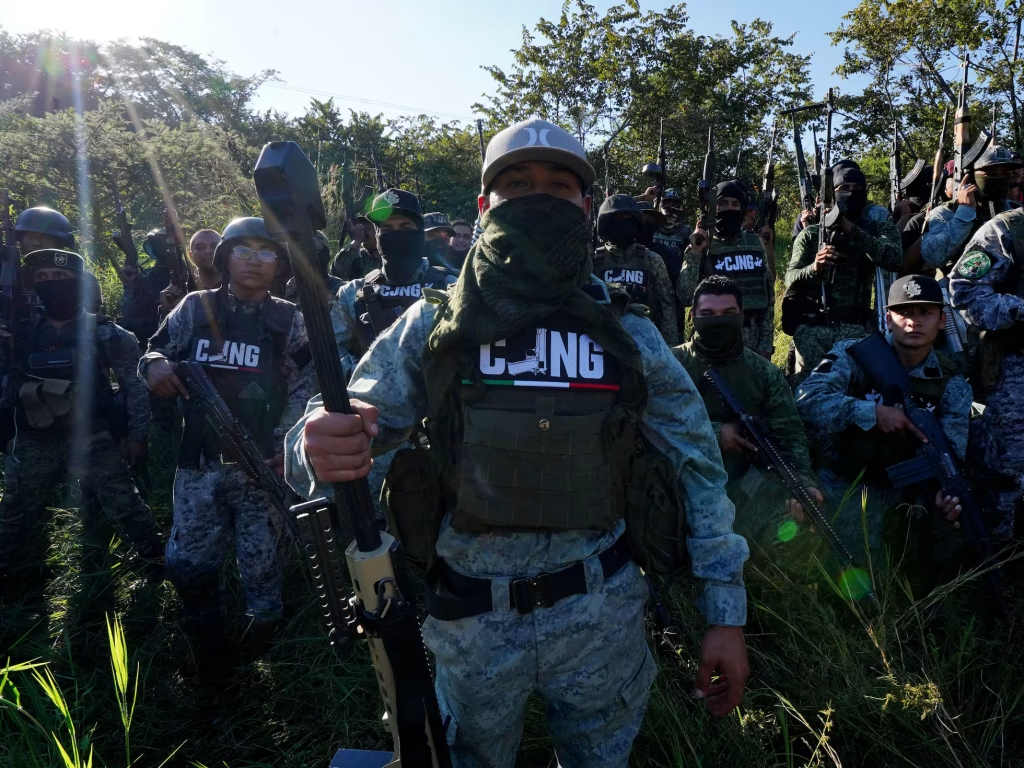
The Jalisco New Generation Cartel (CJNG) is one of Mexico’s most powerful and rapidly expanding criminal organisations, known for its aggressive tactics, global trafficking networks, and advanced military-style operations. Emerging in the early 2010s from a faction of the Sinaloa Cartel, CJNG quickly gained influence by combining rapid territorial expansion with sophisticated financial structures that move narcotics, weapons, and illicit funds across multiple continents.
U.S. and Mexican authorities describe CJNG as a vertically integrated organisation capable of producing and transporting synthetic drugs, including fentanyl and methamphetamine, at scale. Its structure blends hierarchical leadership with semi-autonomous regional cells, allowing it to adapt quickly to law-enforcement pressure.
The cartel’s public messaging—often through videos displaying heavily armed groups—serves both intimidation and recruitment functions. In 2025, the United States formally designated CJNG a foreign terrorist organisation, reflecting concerns over violence, corruption, and cross-border criminal activity. Despite sustained enforcement efforts, CJNG remains a dominant force in the Western Hemisphere’s criminal landscape.
Final legal takeaway
Campo and Sensi’s indictment confronts the justice system with a rare and deeply consequential allegation: that a former DEA agent and a longtime associate entered into an agreement they believed would support one of the most dangerous criminal organisations in the hemisphere.
Both men deny the allegations and remain detained as federal prosecutors prepare to present extensive surveillance and financial evidence. The next stage will determine how much of that evidence reaches a jury—and how this case shapes the ongoing national conversation about law-enforcement accountability and cartel-related prosecutions.