Understand Your Rights. Solve Your Legal Problems



Newly filed Los Angeles court documents reveal the exact pension split between Channing Tatum and Jenna Dewan, confirming each will receive 50% of the other’s SAG-Producers Pension Plan credits earned during their 2009–2018 marriage. The filings also clarify the long-debated financial dispute over Magic Mike profits, officially closing one of Hollywood’s most scrutinised divorce battles.
It took six years, thousands of pages of filings, and one franchise-sized money dispute — but the financial core of Channing Tatum and Jenna Dewan’s divorce has finally been exposed.
New documents filed in Los Angeles on Nov. 26 lay out, in precise legal terms, how the former Step Up co-stars divided retirement benefits after a bitter, years-long fight over what counted as marital property. The filings confirm that both actors — who married in 2009, built careers together, and separated in 2018 — will receive 50 percent of the other’s pension credits earned during their marriage under the Screen Actors Guild-Producers Pension Plan.
The revelation lands after Dewan argued that Tatum’s 2012 hit Magic Mike, which exploded into a global franchise, was developed using marital funds and should have been shared. Tatum’s team rejected the claim, insisting nothing was ever withheld. It was one of the most talked-about Hollywood divorce clashes of the decade, and the emotional weight of that fight lingers over today’s disclosures.
Why does this matter now? Because this filing quietly resolves the last major financial question in a divorce that shaped headlines, defined arguments about marital labour in Hollywood, and determined the future financial security of two high-earning stars co-parenting a child. And after years of tension, the case has finally reached its endgame.

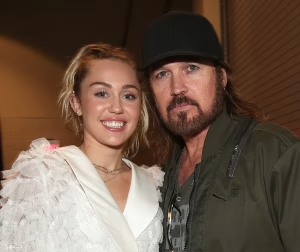
Channing Tatum and Jenna Dewan at a red carpet event years before new court documents detailed the final terms of their divorce settlement.
The newly filed documents confirm that the September 2024 divorce settlement includes a strict 50/50 division of pension credits earned during the marriage. This calculation applies only to the 2009–2018 period, mirroring California’s community property rules.
This follows Dewan’s long-standing claim that Magic Mike, and its later sequels, shows, and spin-offs, were partly funded by marital resources. Her legal team argued she was entitled to a share of franchise profits. Tatum maintained full financial transparency and denied any wrongdoing.
The couple continues to share joint custody of their daughter Everly, born in 2013, and both remain active producers across film and television projects.
This case hinges on how California courts divide community property — including union pensions. When two spouses earn retirement benefits during marriage, the law applies a “time rule” formula to determine the marital share. Only the pension credit earned during the marriage is divisible.
The SAG-Producers Pension Plan distributes payments according to Qualified Domestic Relations Orders (QDROs). Once the court issues a QDRO, administrators divide future payments accordingly. No damages, penalties, or retroactive claims are attached.
In this settlement, the pension split becomes the definitive legal resolution, rather than reopening the dispute over Magic Mike profits.
No. The settlement is procedural, not punitive. It finalises asset division; it does not impose penalties or findings of wrongdoing.
The new filings don’t change the past arguments. They simply confirm the pension division. The franchise-profit dispute resolved privately as part of the 2024 settlement.
Not based on current facts. Once a court-approved marital settlement is executed, reversals are rare unless evidence of fraud or nondisclosure emerges.
No. Their joint custody agreement remains intact.
From Dewan’s 2018 filing to the 2024 settlement — an unusually long timeline even for a high-asset Hollywood divorce.
This case highlights how retirement benefits are treated in divorce: pensions earned during a marriage are often split, even if only one spouse earned them. The key rule is marital timing — not total career value. It also shows how creative or intellectual property developed during marriage can trigger complex legal questions about contribution, investment, and marital benefit.
For many divorce cases, pensions end up being one of the largest assets, and their division can take years to calculate and finalise.
Best-case scenario:
Both stars’ pension divisions proceed smoothly through SAG’s administrators, with no delays or disputes.
Worst-case scenario:
Administrative timing issues arise, slowing payouts — a rare but possible bureaucratic hurdle.
Most common outcome in similar cases:
The QDRO is processed, and each spouse automatically receives their share upon eligibility, with no further court involvement.
The filings address pension credits, not franchise profits. There is no new ruling on Magic Mike income.
No. The documents suggest all financial matters are now resolved.
Yes. In community property states, this is the standard calculation when pension credits overlap with the marriage.
No. Pension division does not affect ongoing earnings or new production revenue.
The newly revealed pension split marks the true legal end of Channing Tatum and Jenna Dewan’s divorce, closing the door on years of financial negotiations and public scrutiny.
It confirms how California law treats retirement benefits, clarifies the final chapter of the Magic Mike dispute, and cements the framework of their post-marriage financial future. With joint custody in place and all major issues resolved, this case now stands as one of Hollywood’s clearest examples of how long, complex, and emotionally charged high-asset divorces can be — and how they finally conclude.
👉 What Is Domestic Violence in California? The 2025 Guide to Understanding the Law, Your Rights, and the Real Consequences 👈