Understand Your Rights. Solve Your Legal Problems


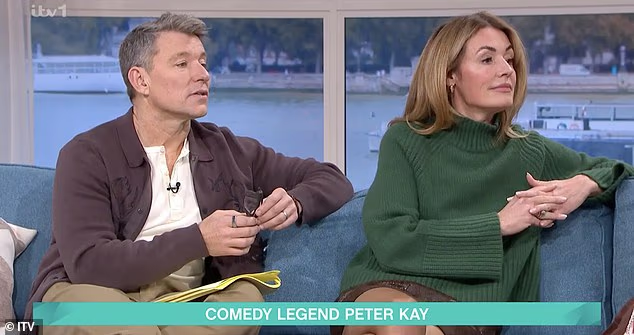
Cat Deeley was left visibly stunned on This Morning when Peter Kay paused mid-interview to call out her habit of repeatedly responding during guest segments, a moment that immediately thrilled viewers online. The exchange happened as Kay discussed donating all profits from his Better Late Than Never tour to 12 cancer charities, sparking a wave of social media reaction. Under Ofcom’s Broadcasting Code, presenter conduct and treatment of guests are closely watched, which is why moments like this can quickly draw public scrutiny.
Cat Deeley’s morning took an unexpected turn on Thursday when a light-hearted chat on ITV’s This Morning suddenly shifted into an uncomfortable live-TV moment. Peter Kay, appearing to promote the final run of his Better Late Than Never charity tour, stopped mid-sentence as he listed the 12 cancer charities receiving the tour’s profits.
Sitting alongside Ben Shephard in the London studio, the comedian paused, glanced over, and told viewers he wasn’t laughing at “bowel cancer” — but at Deeley’s repeated “yeah” responses after every charity name.
It happened just after 10 a.m., and the reaction was instant. Social media lit up with viewers saying a guest had “finally called her out,” reigniting months of criticism about Deeley speaking over contributors.
What matters now is that this clip has become a flashpoint in the ongoing conversation about presenter responsibility, tone, and respect on daytime television. While there is no complaint or investigation, this is the kind of moment that often snowballs into broader scrutiny of broadcasting standards — especially when health-related charities are involved and emotional sensitivity is expected on air.

The presenter, who co-hosts the ITV daytime series alongside Ben Shephard, was joined by comedian Peter Kay to discuss his Better Late Than Never tour.
Peter Kay, 52, appeared live on ITV to discuss the expansion of his charity-focused comedy tour. As he read from a list of cancer charities set to receive the profits, Cat Deeley responded “yes” after each name.
Kay briefly stopped, smiled, and clarified to viewers that he wasn’t laughing at any of the causes but at Deeley’s interjections. Deeley blushed and looked away as Ben Shephard stepped in, calling the habit “active listening.”
Viewers quickly posted the clip online, many arguing that Deeley has a pattern of interrupting guests. Past criticism has centred on interviews and cooking demonstrations where she has spoken over contributors.
No Ofcom complaint has been filed, and ITV has not issued a statement. The incident remains one of public debate, not regulatory action.
This is not a legal dispute, but it does sit squarely within the framework of UK broadcasting regulation. Under Ofcom’s Broadcasting Code, presenters must ensure guests are treated fairly and with due respect, particularly when discussing sensitive subjects such as cancer charities. Tone and conduct matter because viewers expect composure, accuracy, and calm handling of emotional content.
Regulators look at intention, impact, and context. Live TV naturally includes unpredictable moments, but broadcasters must still maintain editorial control. If viewer concerns escalate, Ofcom may review whether the programme upheld standards of fairness and audience expectation.
The process is straightforward: Ofcom reviews clips, evaluates audience harm or concern, and determines whether the code was breached. No such process has begun here.
No. There is no evidence of misconduct rising to a regulatory threshold, and no complaint has been lodged with Ofcom. Online commentary does not trigger official action on its own.
Ofcom requires presenters to treat interviewees respectfully and ensure sensitive topics are handled with care. The rules focus on fairness, accuracy, and preventing unjustified offence.
Based on available facts, it is unlikely. Kay’s comment was humorous, and the conversation continued without disruption. No audience harm has been identified.
There is none. Viewer frustration relates to Deeley’s style rather than any failure of compliance or procedure.
Only if significant numbers of viewers file formal complaints. Without that, the matter remains a public-opinion moment rather than a regulatory concern.
Incidents like this help clarify how broadcasting oversight actually works. A viral clip does not automatically lead to legal or regulatory action; what matters is whether the content causes harm, misleads viewers, or treats guests unfairly.
Anyone appearing on live television — whether a public figure or a member of the public — benefits from Ofcom’s protections. The code ensures people are treated with dignity, that sensitive subjects are handled responsibly, and that broadcasters maintain standards even during moments of unscripted tension.
This also demonstrates how audience trust plays a major role. Public perception can influence whether complaints emerge, shaping how broadcasters respond and how regulators prioritise reviews.
Best-case scenario:
The moment remains a viral clip, Deeley takes it in stride, and Kay’s charity message stays in focus. The incident passes without further attention.
Worst-case scenario:
If a wave of viewer complaints arrives, Ofcom could conduct a standards review into tone and presenter conduct. Even then, this would be a process-based assessment, not punitive.
Most common outcome in similar cases:
The moment becomes part of the show’s ongoing social-media conversation, receives no regulatory intervention, and fades as news cycles move on.
👉 Has Your Reputation Been Attacked? UK Defamation Law Explained for the Public 👈
Did Peter Kay intend to embarrass her?
Nothing indicates malice. His remark appeared spontaneous and humorous, and the segment continued smoothly.
Has Ofcom said anything?
No. There has been no comment or involvement from the regulator.
Does this affect Peter Kay’s charity tour?
Not at all. His announcement about donating profits to 12 cancer charities remains unchanged.
Has Cat Deeley been criticised before?
Yes. UK media reports say viewers have previously expressed frustration about interruptions, but this has never led to regulatory action.