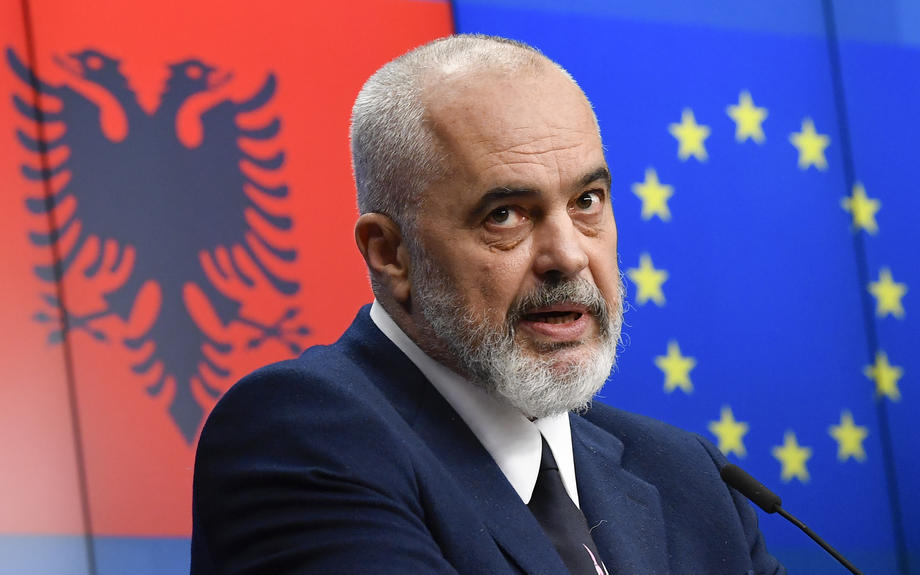
Albanian Prime Minister Edi Rama ignited fresh political tensions in Brussels today after forcefully defending his country’s push to join the European Union and rejecting criticism that crime and corruption threaten Albania’s membership prospects. Speaking during a high-profile enlargement forum attended by senior European officials, Rama insisted Albania has delivered a decade of tough reforms and argued that organised crime “is not an Albania-only problem,” pointing toward concerns inside EU capitals themselves.
The exchange comes as Brussels reassesses whether Albania has made enough progress to stay on track for a potential 2030 entry date. With EU leaders weighing the geopolitical risks of slowing down Western Balkan integration — especially after Russia’s invasion of Ukraine — today’s confrontation lifted Albania’s accession talks into renewed urgency. Officials monitoring the process will now decide whether the country’s latest reforms, combined with strong political backing from Italy, are enough to keep the bid moving forward.
What Sparked Today’s Tense Brussels Clash
Rama’s comments landed during a major EU enlargement gathering in the Belgian capital. The event was designed to review progress across Western Balkan candidates but quickly shifted focus after renewed questions surfaced about Albania’s record on corruption, money-laundering prevention, and judicial independence.
European officials have repeatedly flagged these areas in progress reports, and today’s session was no exception. What changed was Rama’s tone: he dismissed the idea that Albania uniquely struggles with organised crime and reframed the issue as one facing many European cities, not just Tirana. His stance injected unexpected tension into a meeting that had been expected to remain technical — not political.
Why Albania Says Its EU Moment Should Not Be Delayed
Support for Albania’s membership has grown in recent years, partly due to the sweeping institutional reforms that reshaped its justice system and policing structures. Government officials point out that Albania’s small population — around 2.3 million — means it can be absorbed into the EU far more easily than larger candidate states.
The geopolitical climate is equally influential. Russia’s invasion of Ukraine pushed the EU to strengthen relationships with pro-European neighbours, accelerating several Western Balkan files. In that environment, Albania has been repeatedly labelled a frontrunner. Rama’s message today was blunt: delaying enlargement risks weakening Europe’s unity at a time when stability matters most.
How Italy Became Albania’s Most Powerful EU Ally
A major factor behind Albania’s accelerated trajectory is its unusually close relationship with Italy. The two nations signed a controversial migration agreement in 2023 allowing Italy to operate processing centres on Albanian soil. The deal drew international attention but also showcased a strategic partnership stronger than most bilateral relationships in the region.
For Albania’s EU ambitions, Italy’s support is essential. Any new member must be approved unanimously by all 27 member states, and Italy has positioned itself as one of Albania’s most vocal backers. Rama reiterated today that the migration agreement was a response to Italy’s request for assistance — a decision that reinforced political goodwill at a key moment in the accession process.
The Legal Process: How EU Accession Decisions Are Really Made
EU membership follows a structured, rule-based pathway that applies to every candidate country. The key steps include:
Screening and Negotiation Chapters
The EU divides its laws into thematic chapters. Albania must demonstrate that its legislation, institutions, and enforcement systems meet the standards for each chapter before they can be closed.
Reform Monitoring and Enforcement
Progress on judicial reforms, anti-corruption measures, and crime prevention is tracked through regular EU assessments. The focus is on measurable, functional improvements — not perfection.
Unanimous Member-State Approval
Even after all negotiation chapters close, every EU country must vote in favour of admitting the candidate. This final stage is political and requires strong diplomatic relationships.
These mechanisms explain why Albania cannot be guaranteed a fixed date, even as it advances toward the end of negotiations.
What Happens Next for Albania’s EU Future
The outcome of today’s Brussels exchange will shape discussions across multiple EU capitals in the months ahead. Officials are evaluating whether Albania remains on schedule with its stated accession goals and whether reforms show consistent, credible progress.
The next stage hinges on demonstrating continued judicial improvements, reinforcing anti-crime systems, and maintaining close diplomatic ties — especially with Italy — before the decisive unanimous vote. As the EU reviews its future enlargement path, Albania’s position will depend on both its technical progress and the political dynamics shaping Europe’s broader security concerns.
FAQ's — Key Questions About Albania’s EU Accession
Is Albania currently a member of the European Union?
No. Albania is an official candidate country and remains in advanced negotiations.
What prevents Albania from joining the EU right now?
The EU requires sustained reforms in justice, corruption prevention, and crime-fighting systems before granting approval.
Is there an official date for Albania’s EU entry?
No confirmed date exists. Albanian leaders have floated 2030 as a target, but the final decision depends on reform benchmarks and unanimous approval from all EU member states.
Does the Italy migration agreement affect Albania’s EU bid?
The deal strengthened Albania’s political ties with Italy, one of its strongest EU supporters, though it also sparked debate among other member states.
👉 Latest: Donald Trump Orders Epstein Files Released: DOJ Given 30 Days as Survivors and MAGA World Collide 👈