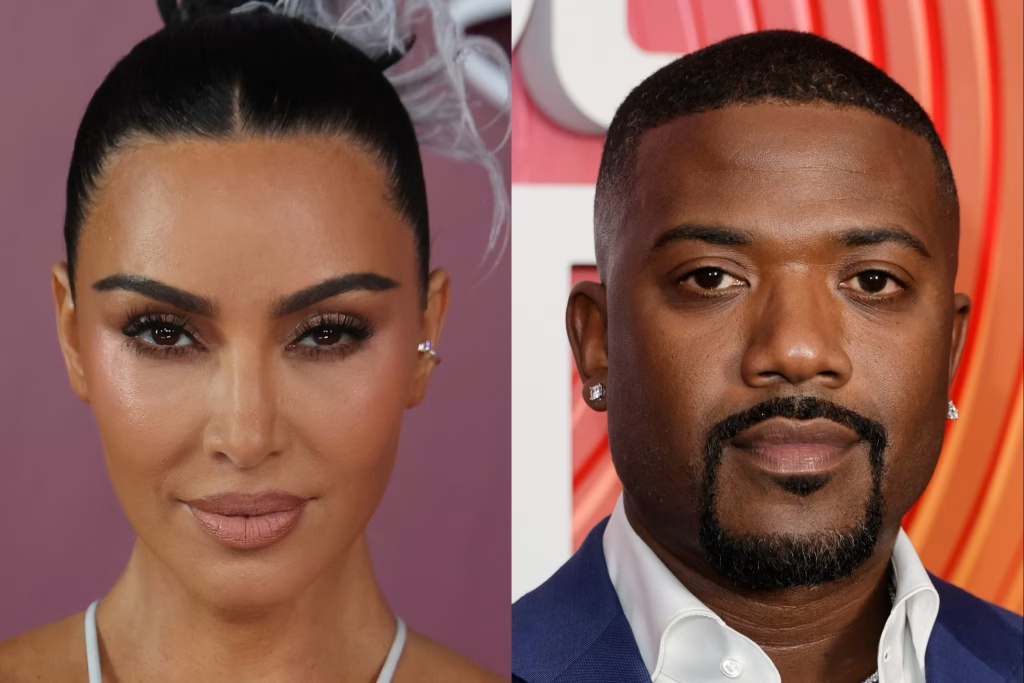
When Ray J filed a countersuit this week against Kim Kardashian and Kris Jenner, the headlines immediately shifted toward the drama. But behind the familiar names and years of pop-culture noise sits a remarkably intricate legal fight — one involving contract clauses, settlement terms, and the limits of what reality-TV stars can say on camera once they’ve signed an agreement promising not to.
This latest filing, submitted on November 13, doesn’t just reopen a long-public dispute. It raises fresh questions about how far confidentiality clauses can go, how courts evaluate liquidated damages, and what happens when the rhythms of reality television collide with the rigid language of a negotiated legal settlement.
It is, in many ways, a uniquely modern lawsuit — part entertainment, part contract law, and all wrapped around a moment from 2003 that still reverberates more than two decades later.
What Ray J Is Alleging — In Plain English
Ray J’s cross-complaint lays out the same basic storyline you may already know, but with sharpened legal edges.
He says that:
-
In 2023, he, Kardashian, and Jenner finalised a settlement worth $6 million.
-
Part of that deal, according to Ray J, required everyone involved to stop mentioning the sex tape in public — including on their Hulu series.
-
The agreement also included a $1 million penalty if anyone broke that promise.
Ray J argues that Season 3 of The Kardashians, released just a month after the settlement, violated that commitment. He says multiple cast members — including Kardashian, Jenner, Kendall Jenner, and Kanye West — referred to the tape in ways the settlement was supposed to prevent.
At the same time, he denies the claims in Kardashian and Jenner’s October defamation lawsuit against him. In his words, their accusations amount to a “public relations charade” that has little to do with actual defamation law.
Kardashian and Jenner, through attorney Alex Spiro, strongly dispute Ray J’s narrative. Spiro responded through PEOPLE:
“After realizing he is losing the case and losing his way, this disjointed rambling distraction is not intimidating anyone. Ray J will lose this frivolous case too.”
With both sides calling the other deeply wrong, the case now turns on what the 2023 agreement really said — and how courts interpret speech that exists in the world of reality TV.
Understanding the $6 Million Settlement — And Why It Matters Now
Because most settlement agreements are confidential, the public normally sees only fragments. But Ray J’s filing offers enough detail to understand why this dispute has escalated into a full-blown legal battle.
1. The “No More Talking About It” Clause
Ray J’s interpretation is straightforward:
After 2023, no one on the Kardashian side was supposed to publicly mention the sex tape — at all.
These types of speech-restriction clauses do exist, but courts look at them carefully. Judges generally want to see:
-
Clear language, not ambiguity
-
Mutual intent to stay silent
-
Reasonable scope, so the clause isn’t overly broad
If the court finds the clause too sweeping — for example, if it prohibits any mention under any circumstances — it might narrow or disregard it entirely.
2. The $1 Million Liquidated Damages Penalty
This is where things get legally thorny.
Liquidated damages clauses are allowed, but only if the amount is a reasonable estimate of actual harm. Courts routinely reject clauses that look more like punishment than compensation.
So the legal question becomes:
Was $1 million a fair projection of what Ray J might lose if the agreement was breached?
Or was it a deterrent designed to scare the other party into silence?
That distinction could decide the case.
3. What Counts as a “Public Reference”?
This may become the most interesting issue.
Is a comment on reality TV — a show filmed months before air — considered a fresh public statement?
Does timing matter?
Does intent?
Kardashian and Jenner reportedly attempted to revise the agreement after the show’s Season 3 rollout, which suggests they anticipated this argument years before it reached a courtroom.
Can Reality-TV Footage Break a Contract?
This case pulls reality TV into a courtroom in a very direct way.
Ray J claims The Kardashians misrepresented him by:
-
implying he had unreleased footage
-
suggesting he acted without consent
-
raising questions about sexual misconduct
-
presenting conversations that he says did not reflect the truth
And he’s blunt about the consequences: he sees those statements as breaches, both of the settlement and of basic fairness.
Reality TV, despite the name, isn’t documentary footage. It’s edited, produced, curated. Yet courts have repeatedly treated televised statements as public speech, especially when presented as factual.
If the judge concludes that Season 3 revived the controversy to fuel marketing or storyline development, Ray J’s claim may gain traction.
The Defamation Counter-Allegations
Meanwhile, Kardashian and Jenner have their own suit against Ray J, arguing that he made harmful false statements during appearances on TMZ and on a Twitch stream. Because both women are public figures, they must meet the heightened “actual malice” standard — proving he either knew the statements were false or acted with reckless disregard for whether they were true.
Ray J insists:
-
His remarks were opinions or offhand comments
-
Some remarks were never intended for public broadcast
-
His own comments, even if poorly worded, were overshadowed by the Kardashians’ earlier breaches
Courts tend to analyze defamation like a slow, methodical process. Every statement gets pulled apart for meaning, tone, and context. In this case, both sides will be asked to justify not only what they said, but why they said it and how viewers understood it.
Why This Case Matters — Beyond Celebrity Names
Strip away the celebrity factor, and you’re left with a genuinely significant legal dispute.
Three key issues stand out:
1. The enforceability of NDA-style clauses in settlement agreements
How far can a contract go in restricting speech?
This case may offer a new test.
2. The reasonableness of high-dollar liquidated damages
If $1 million is struck down here, it could influence future entertainment-industry settlements.
3. The legal status of reality-TV storytelling
As reality television continues blending personal lives with commercial content, courts are increasingly asked to distinguish narrative from fact.
This case brings all of those questions together in one courtroom.
What Happens Next
You can expect several early moves:
1. Motions to dismiss
Kardashian and Jenner’s legal team will try to strike portions of the countersuit quickly.
2. Discovery battles
If the case moves forward, this phase could become unusually intense. It may require:
-
internal production notes
-
raw, unedited Season 3 footage
-
communication between Hulu, producers, and cast
-
drafts of the 2023 agreement
-
messages between Ray J and Kardashian
Reality-TV producers rarely want editing logs made public. That alone could influence whether one side seeks an early settlement.
3. Potential settlement pressure
Despite the public tension, both sides understand the cost — financial and reputational — of letting a case like this reach trial.
But at this moment, neither camp seems close to compromise.
Ray J vs. Kardashian: FAQs
Did Kim Kardashian violate a contract by talking about the sex tape on Hulu?
That’s Ray J’s argument. A court will decide whether the statements fall within the agreement’s restricted speech clause.
Is a $1 million penalty enforceable?
Possibly — but only if a judge believes the amount reflects a fair estimate of actual harm and not punishment.
Why is defamation harder to prove for public figures?
Because they must prove “actual malice,” a much higher legal bar than private individuals face.
Can reality-TV editing be used in court?
Yes. Courts may look at both the aired footage and unaired material if it’s relevant to a case.