Understand Your Rights. Solve Your Legal Problems


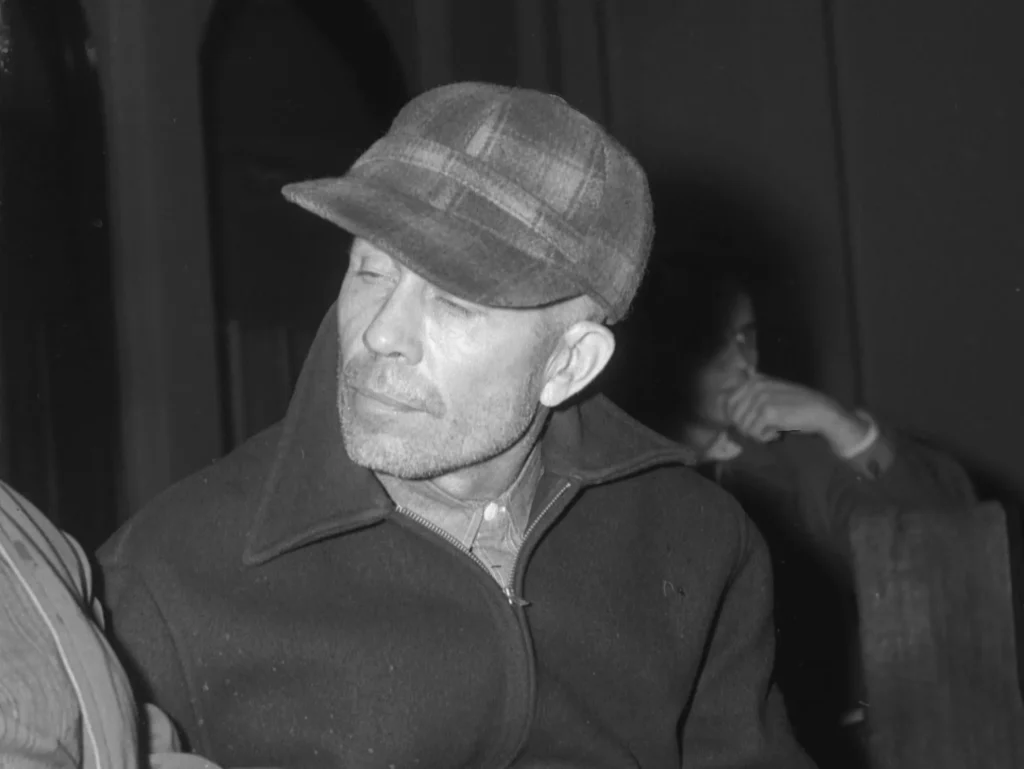
When police entered a remote farmhouse near Plainfield, Wisconsin, on November 16, 1957, they found a scene that would change both criminal law and popular culture. Human remains hung from rafters, skulls had been turned into bowls, and chairs were stitched from human skin. The quiet handyman responsible—Edward Theodore Gein—was about to redefine the American understanding of madness.
In this investigation, Lawyer Monthly reconstructs the full Ed Gein timeline, drawing from archived police records, psychiatric files, and Wisconsin court documents. Beyond the myth of the “Plainfield Ghoul,” this account explores the real chronology of one man’s descent into delusion—and how his case reshaped the law on criminal insanity.

A haunting moment from Monster: The Ed Gein Story, the Netflix dramatization exploring Ed Gein’s relationship with his mother and the origins of his madness.
Aug 27 1906 — Edward Theodore Gein is born in La Crosse, Wisconsin, to George Philip Gein and Augusta Wilhelmine Gein (Lehrke).
1915 — The family relocates to a 155-acre farm outside Plainfield. Augusta, a rigidly religious Lutheran, isolates her sons from the world, forbidding friendships and condemning women as sinful.
Teachers later describe Ed as “polite but emotionally stunted,” his worldview entirely shaped by his mother’s sermons (Wisconsin Historical Society Archive #WHS-P57).
Apr 1 1940 — George Gein dies of heart failure.
May 16 1944 — Ed’s brother Henry perishes in a brush-fire incident. The Waushara County Sheriff’s report notes bruising inconsistent with burns but rules the death accidental.
Dec 29 1945 — Augusta Gein dies following a stroke. Ed seals off her bedroom and lives in the kitchen and a single back room, preserving the rest of the house like a shrine.
Psychiatric evaluators later identify this period as the “onset of complete emotional collapse” (Central State Hospital Psychological Evaluation, 1958).
Working odd jobs as a handyman, Ed becomes known locally as quiet but reliable. Behind closed doors, he develops an obsession with anatomy books, pulp horror, and female obituaries.
Between 1947 and 1952, Gein exhumes bodies from at least nine local graves, selecting women who resembled his mother. He uses their remains to craft household items and a macabre “woman suit.” Evidence catalogues from the Wisconsin State Crime Laboratory list skull bowls, masks, corsets of human flesh, and boxes of preserved organs seized from the farmhouse in 1957.
During interviews, Gein claimed he entered “a trance-like state” when robbing graves and believed he could “bring mother back.” The FBI Behavioral Science Unit later classified his behavior as a ritualized grief response rather than sexual sadism (FBI BSU, Case Studies in Ritualistic Behavior, Vol. II, 1979).
Dec 8 1954 — Tavern owner Mary Hogan disappears from Pine Grove. Blood is found on the floor; the case goes cold.
Nov 16 1957 — Hardware-store owner Bernice Worden vanishes. Her son, Deputy Sheriff Frank Worden, finds a sales slip for antifreeze made out to Ed Gein.
That evening, officers enter Gein’s farmhouse and uncover a nightmare. Worden’s body hangs in the barn, and throughout the house are human remains repurposed into furniture and clothing.
District Attorney Earl Kileen’s 1958 report describes the scene as “beyond comprehension, a museum of psychosis.”
Gein calmly confesses to killing Hogan and Worden but insists he remembers little. He also admits to grave-robbing “night trips” guided by what he called “voices of Mother.”
Mar 1958 — Gein is found unfit for trial and committed to Central State Hospital for the Criminally Insane in Waupun.
Mar 20 1958 — His farmhouse burns to the ground the night before it was due to be auctioned. Investigators never determine the cause.
1968 — After a decade of psychiatric care, Gein is deemed competent. Tried for Bernice Worden’s murder, Judge Robert Gollmar finds him not guilty by reason of insanity under Wisconsin Stat. §971.15.
1974 – 1984 — He remains at Mendota State Hospital in Madison, engaging in occupational therapy and reading magazines. Nurses recall him as “quiet, courteous, almost childlike.”
Jul 26 1984 — Ed Gein dies of respiratory failure from lung cancer, aged 77. He is buried beside his mother in Plainfield Cemetery. His headstone, repeatedly stolen by souvenir hunters, was permanently removed in 2001.
Under Wisconsin law (Stat. §971.15), a defendant is not criminally responsible if, due to mental disease or defect, they lack substantial capacity to appreciate the wrongfulness of their conduct or to conform to the law.
Gein’s 1968 verdict cemented this principle nationally. Legal scholars—including Judge Robert H. Gollmar in Edward Gein: America’s Most Bizarre Murderer (1973)—noted that the ruling balanced justice with compassion and became a cornerstone reference for later cases such as Durham v. United States (1954) and United States v. Hinckley (1982).
The case also influenced Wisconsin’s mandatory periodic psychiatric reviews for institutionalized offenders, ensuring continuing evaluation of mental capacity.
Though convicted of only two murders, Ed Gein’s crimes helped shape the FBI’s early behavioral-profiling program and inspired some of the most enduring figures in horror fiction. His case became a cornerstone in the Bureau’s understanding of ritualistic and compulsive offenders, influencing the psychological frameworks later used to study killers like the Zodiac Killer in California and the Menendez brothers in Los Angeles.
The link between Gein and later cases wasn’t direct, but thematic: the intersection of family pathology, public fascination, and media sensationalism. Just as Gein’s obsession with his mother defined his crimes, the Menendez brothers’ parricide decades later forced juries to confront the role of abuse, trauma, and motive in acts of extreme violence. Likewise, the Zodiac case echoed Gein’s legacy of fear and mystery — crimes that blurred the line between confession, compulsion, and myth.
Gein’s story also forced courts, psychiatrists, and the public to confront an enduring question: when does delusion erase culpability, and how should society treat those who commit atrocities without comprehension of their acts?
More than sixty years later, the name Ed Gein still resonates through both criminal psychology and film history — a grim testament to the thin, shifting boundary between mental illness and monstrosity.