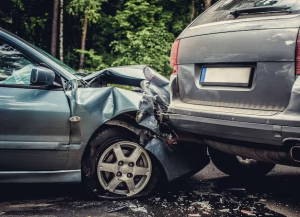
When an unexpected injury shatters the routine of a normal day, the first human response is often a search for meaning, which quickly becomes a question of fault. We feel, almost instinctively, that a broken bone from a fall on a wet floor or a serious injury from a faulty product should not have happened. The intricate challenge, however, is that a legal case requires far more than this intuitive sense of injustice; it demands a meticulous reconstruction of events to prove not just that harm occurred, but that it was fundamentally preventable.
Proving this requires demonstrating that:
- A responsible party had a duty to maintain a safe environment or product.
- This duty was breached through a specific act of carelessness or inaction.
- This specific failure was the direct cause of the injury.
- The injury resulted in measurable damages, such as medical bills, lost wages, and pain.
This process from personal certainty to legal proof is the crucible where every personal injury claim is tested. It involves a methodical process of gathering evidence and applying legal principles to demonstrate that the injury was not a random misfortune, but the direct result of a failure that could and should have been avoided.
The Anatomy of a Duty of Care
For harm to be considered legally preventable, the process begins with a simple but powerful concept: the "duty of care." This principle asserts that one party has a recognizable responsibility to act with a certain level of caution and prudence to protect the safety of another. This duty is the foundational pillar upon which any claim of negligence is built. It can be explicit, such as a doctor's formal responsibility to a patient, or it can be implied by circumstance, like a retail store's obligation to ensure its premises are safe for customers. A driver on a highway has a duty to operate their vehicle safely to protect other motorists and pedestrians. Without first establishing that this duty existed, the conversation about whether an injury could have been prevented is legally moot. The court must first agree that there was a responsibility to care before it can even begin to consider if that responsibility was neglected.
From Breach of Duty to Provable Negligence
Once a duty of care is established, the next critical step is to prove that it was breached. A breach occurs when an individual or entity fails to meet the reasonable standard of care required by their duty. This is the moment an abstract responsibility transforms into a concrete failure. To illustrate, consider a customer who is injured after falling in a grocery store. It is not enough to show that the floor was wet; the legal challenge is to prove that the store’s management knew, or reasonably should have known, about the hazardous condition and did not take appropriate action on time. Proving this negligence requires tangible evidence: security camera footage, maintenance logs, cleaning schedules, and witness testimony. This is where the specialized expertise of a slip and fall attorney Riverside becomes indispensable, as their work involves the painstaking investigation required to find the specific evidence that links a property owner’s failure directly to the victim’s harm.
The Crucial Link of Causation
Proving that a duty of care was breached is not enough to win a case; one must also forge an unbreakable link of causation between that failure and the resulting injury. This is a two-part challenge. First, there is "cause in fact," which asks a simple question: would the injury have occurred but for the defendant's negligence? If the answer is no, this first hurdle is cleared. The second, more nuanced test is "proximate cause," which examines foreseeability.
| Aspect to Analyze | Cause in Fact (Factual Causation) | Proximate Cause (Legal Causation) |
| Core Question | Would the harm have occurred "but for" the defendant's action? | Was the type of harm a reasonably foreseeable result of the action? |
| Focus of Analysis | The direct, factual chain of events. | The legal fairness of holding someone responsible for the outcome. |
| Nature of Link | Direct and physical. | Conceptual and based on predictability. |
It asks whether the harm that occurred was a reasonably predictable consequence of the negligent act. For instance, if a company improperly stores flammable chemicals (the breach), a fire is a foreseeable outcome. However, if the fire causes a helicopter to crash miles away, that may be deemed too remote. Defense teams often work diligently to sever this chain of causation, arguing that other factors intervened or that the outcome was simply unforeseeable, making this link a critical battleground in any claim.
The Ultimate Harm: Proving Wrongful Death
The challenge of proving preventable harm reaches its apex when a negligent act results in a fatality. In these cases, the central witness—the victim—is tragically absent, unable to recount the events or describe their experience. The burden of proof then shifts entirely to the surviving family, who must piece together the final moments of their loved one's life through a painstaking process of investigation. This requires a deep reliance on accident reconstruction experts, forensic evidence, and witness testimony to build a case that proves the death was not only a tragedy but a direct result of a preventable failure. Navigating this complex legal battle while enduring immense grief is an overwhelming task. This is why families depend on a Riverside negligence fatality lawyer, who not only takes on the immense burden of proving the case but also serves as a compassionate guide through the legal system, seeking accountability on behalf of those who can no longer speak for themselves.
Conclusion
The pursuit of justice after an injury is a demanding quest to transform a deeply felt sense of wrong into a legally irrefutable case of preventable harm. The process requires methodically establishing each pillar of the claim: the existence of a duty of care, a provable breach of that duty, a clear and direct chain of causation, and quantifiable damages. Behind every settlement or verdict lies this meticulous and often arduous process of investigation, evidence gathering, and strategic argument.
This legal framework, while challenging, serves a purpose that extends beyond financial compensation for an individual. By holding negligent parties accountable, the process of proving preventable harm reinforces the standards of care and responsibility that are essential for maintaining a safer and more just society for everyone.