Understand Your Rights. Solve Your Legal Problems


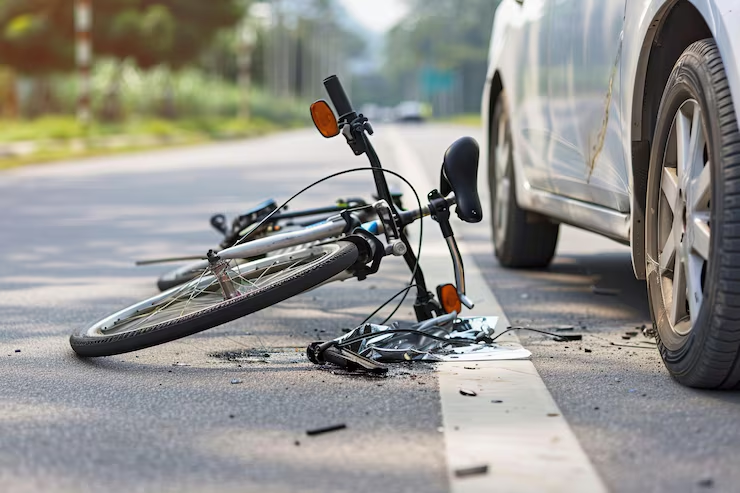
The rapid rise of electric bicycles, or e-bikes, represents not only a transformation in modern transportation but also a developing frontier in liability law. Once regarded as a recreational novelty, e-bikes have quickly become a global phenomenon, reshaping commuting patterns and urban infrastructure.
Yet the pace of this growth has outstripped both regulatory oversight and consumer protection frameworks. Courts are now seeing a surge of personal injury and wrongful death claims that test the boundaries of product liability, negligence, and marketplace responsibility.
These lawsuits are less about isolated defects and more about establishing accountability in a marketplace where innovation often moves faster than the law.
To understand the legal battles, one must first grasp the sheer scale of the e-bike market's expansion. Once a curiosity, e-bikes are now a mainstream mode of transportation.
According to industry reports, U.S. sales surged by over 240% between 2019 and 2021, far outpacing the growth of traditional bicycles. Projections indicate that the number of e-bikes sold annually in the U.S. could reach 6.4 million units by 2025.
This growth is driven by affordability, convenience, and a push for eco-friendly alternatives to cars, with a significant portion of riders using them for daily commutes and errands.
Yet, as more e-bikes hit the streets, so do the injury statistics. Data from the Consumer Product Safety Commission (CPSC) reveals a parallel rise in accidents, with e-bike-related emergency room visits increasing by 21% from 2021 to 2022.
While this data includes all ages, a concerning trend has emerged, particularly with pediatric injuries. Studies have found that children involved in e-bike accidents have a higher rate of hospitalization and more severe injuries, such as concussions and internal trauma, compared to those injured on pedal bikes.
This is often attributed to the higher speeds of e-bikes and the fact that young riders may not be wearing helmets. This confluence of rapid market growth and rising injury rates sets the stage for the pivotal legal cases now making headlines.
On January 31, 2021, a downhill ride on a RadRunner electric bike turned into a catastrophic tragedy for 12-year-old Molly Steinsapir. As the bike picked up speed, her 11-year-old friend, who was piloting the bike, struggled to brake.
The rear brake allegedly failed to slow the bike, while the front brake caused the wheel to wobble uncontrollably, throwing both girls to the pavement. Molly sustained a traumatic brain injury and died 16 days later.
Her parents, both attorneys, filed a wrongful death lawsuit against Rad Power Bikes, the manufacturer, and Giro Sport Design, the helmet maker. Their complaint outlines a series of allegations that strike at the heart of modern product liability law.
The legal battle in the Steinsapir case and others like it is not one-sided. Manufacturers and retailers have mounted robust defenses that reflect a complex web of liability.
In response to the Steinsapir family’s lawsuit, Rad Power Bikes filed a cross-complaint against the parents of the surviving rider, arguing that they were the ones actively and primarily responsible for the accident.
Just as the Steinsapir case made headlines, another catastrophic injury lawsuit emerged—this one targeting Amazon. On December 30, 2024, Robert Lewis was riding a foldable e-bike purchased from Amazon when the handlebar locking system failed, collapsing mid-ride. The incident left him paraplegic.
Lewis's family has sued both Actbest Technology Inc., the e-bike’s manufacturer, and Amazon.com Inc., arguing that Amazon is not merely a neutral platform but an integral part of the supply chain.
This lawsuit is a perfect example of a new and evolving area of law: retailer responsibility in the age of e-commerce.
These cases are not isolated incidents; they serve as test cases for how personal injury law adapts to new technologies. The legal strategies involved blend traditional negligence claims with modern arguments about online commerce and consumer protection.
A central legal question in both cases is the duty of care owed by manufacturers. This principle dictates that a company must exercise a reasonable level of care to prevent foreseeable harm to its consumers. In the context of e-bikes, this raises pressing questions:
In both the Steinsapir and Lewis cases, the plaintiffs are seeking significant damages to account for their immeasurable losses. The legal framework for calculating these damages is complex and multi-faceted.
The current wave of e-bike litigation serves as a bellwether for the future of consumer protection. These cases underscore the complex legal and ethical questions that emerge when technological innovation advances more quickly than the regulatory framework meant to safeguard the public.
Their outcomes may help define the contours of liability in a digital-first economy, compelling both manufacturers and online platforms to place safety and accountability at the forefront of their business models.
As e-bikes become further integrated into daily life, the demands on the legal system to keep pace will intensify.
For practitioners and policymakers alike, these lawsuits are a reminder that the law must continually evolve to balance innovation with responsibility, ensuring that progress in transportation does not come at the expense of public safety.
Q: What is the difference between a wrongful death claim and a personal injury claim?
A: A personal injury claim is filed by an individual who has been injured due to another party's negligence. A wrongful death claim is a specific type of personal injury claim filed by the family or estate of a person who has died as a result of a negligent act. While both seek compensation, a wrongful death claim includes damages for the loss of a loved one, such as funeral expenses, emotional distress, and loss of companionship.
Q: Can I sue if I was injured on an e-bike I bought from Amazon?
A: Yes, you can sue both the e-bike manufacturer and the retailer, such as Amazon. While Amazon often claims to be a neutral marketplace, recent legal trends show that courts are increasingly willing to hold large e-commerce platforms liable for defective and dangerous products sold through their sites, particularly if they are involved in the fulfillment or have received prior complaints about the product.
Q: What kind of evidence is needed for an e-bike accident lawsuit?
A: Successful lawsuits rely on a range of evidence. This can include police reports, medical records, photographs of the accident scene and the e-bike, testimony from witnesses, expert analysis of the e-bike's design and mechanical systems, and evidence of the manufacturer's or retailer's awareness of prior issues or complaints.
Q: How are damages calculated in these types of cases?
A: Damages are generally divided into two categories: economic and non-economic. Economic damages are quantifiable costs like medical bills, lost wages, and future care. Non-economic damages are harder to quantify and include pain and suffering, emotional distress, and loss of enjoyment of life. In some cases, courts may also award punitive damages to punish particularly egregious conduct.