Understand Your Rights. Solve Your Legal Problems


In a stinging rebuke to former President Donald Trump’s immigration crackdown, a federal judge has dismissed a lawsuit challenging Illinois’ sanctuary city policies—declaring them constitutionally protected under the 10th Amendment.
In a major legal setback for the Trump-aligned Justice Department, U.S. District Judge Lindsay C. Jenkins ruled Friday that Illinois and its local jurisdictions—including Chicago and Cook County—acted within their constitutional rights when they refused to assist federal authorities in civil immigration enforcement. The 64-page ruling dismissed the federal government's lawsuit, marking a pivotal moment in the ongoing battle over the limits of federal power and state autonomy.
States cannot be forced to enforce federal immigration laws—a principle reaffirmed by the Tenth Amendment.
Judge Jenkins, appointed by President Joe Biden, wrote that the U.S. government lacked legal standing and that its claim would effectively allow Washington to “commandeer” local governments—a direct violation of constitutional federalism.
“The Sanctuary Policies reflect Defendants’ decision to not participate in enforcing civil immigration law — a decision protected by the Tenth Amendment,” Jenkins wrote.
“It would allow the federal government to commandeer States under the guise of intergovernmental immunity — the exact type of direct regulation of states barred by the Tenth Amendment.”
Her ruling emphasized that immigration enforcement, while a federal domain, does not grant the federal government power to force state or local authorities to act as immigration agents.
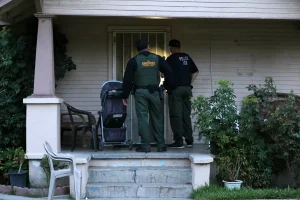
The now-dismissed lawsuit was part of a wider Trump administration campaign to punish sanctuary jurisdictions—cities and states that refuse to cooperate with U.S. Immigration and Customs Enforcement (ICE) unless a judicial warrant is presented. The lawsuit targeted several Illinois laws and ordinances enacted by the state, Chicago, and Cook County that prohibited local police from detaining individuals based solely on ICE detainers.
Filed in February—just days after the Senate confirmed Attorney General Pam Bondi—the lawsuit alleged Illinois was intentionally obstructing federal law.
“These laws impede consultation and communication between federal, state, and local law enforcement officials,” the Trump-era complaint argued.
“They reflect an intentional effort to obstruct the Federal Government’s enforcement of federal immigration law.”
Illinois Governor JB Pritzker praised the dismissal, calling it a decisive victory for civil liberties and constitutional order.
“What Illinois will not do is participate in the Trump administration’s violations of the law and abuses of power,” Pritzker said. “We will work with federal officials—when they follow the law.”
Pritzker reiterated the state's position: unless a federal warrant is presented, local police will not detain individuals solely on ICE's request. He emphasized this policy does not protect violent criminals, but prevents unlawful cooperation without due process.
White House spokeswoman Abigail Jackson pushed back against the ruling, calling sanctuary policies a danger to public safety.
“Sanctuary cities like Chicago interfere with federal immigration enforcement at the expense of Americans' safety and security,” she said. “We look forward to ultimate vindication.”
While the case was dismissed without prejudice—meaning the Justice Department could file an amended complaint—the judge's strong language casts doubt on the likelihood of success.
Illinois is not the only battleground. The Trump administration has pursued similar lawsuits against New York City, Los Angeles, and the state of New York over its “Green Light Law,” which permits undocumented immigrants to apply for driver’s licenses while protecting their information from federal access.
In California, tensions escalated after federal raids led to protests and the deployment of National Guard troops. Trump responded by signing a sweeping executive order in January aimed at stripping federal funding from any jurisdiction labeled as a sanctuary, and even hinted at pursuing criminal penalties.
But in April, another federal judge blocked that funding order—calling it a violation of the Constitution’s separation of powers.
“The federal government may not unilaterally withhold congressionally approved funding to coerce states into compliance,” the court found—echoing previous decisions from 2017.
Legal scholars say the Illinois case may become a reference point in future disputes about the boundaries of federal authority.
Professor Elaine Martínez, a constitutional law expert at Northwestern University, explained:
“This ruling reinforces that states are not subsidiaries of the federal government. Immigration may be federal law, but cooperation cannot be compelled. It’s a textbook Tenth Amendment case.”
She noted that courts have historically rejected efforts to conscript local authorities into federal law enforcement—including in landmark cases like Printz v. United States (1997), which found it unconstitutional to require local officers to conduct background checks for gun purchases.
The ruling comes as Donald Trump intensifies his campaign rhetoric ahead of the 2026 midterms, vowing to “eliminate every last sanctuary city” if Republicans retake the Senate. His platform includes proposals to criminalize non-cooperation and expand ICE authority.
Meanwhile, Democrats have embraced the ruling as a vindication of local autonomy, with Illinois Attorney General Kwame Raoul calling it “a blueprint for safeguarding civil rights in the face of authoritarian overreach.”
Expect this issue to resurface prominently in campaign debates, particularly in key swing states with large immigrant populations.
Although the court dismissed the federal complaint, the political and legal struggle over sanctuary policies is far from over.
The DOJ may appeal or file a revised suit, but constitutional scholars predict a steep uphill battle.
Other sanctuary cases are still active, including litigation in New York, California, and Washington.
State and city leaders may now feel emboldened to pass stronger sanctuary protections—knowing courts are largely on their side.
What is a sanctuary city?
A sanctuary city is a local jurisdiction that limits cooperation with federal immigration enforcement, typically refusing to detain individuals solely based on ICE detainers without a criminal warrant.
Can the federal government force local police to enforce immigration law?
No. Under the Tenth Amendment, the federal government cannot compel states or cities to enforce federal laws—a principle confirmed in multiple Supreme Court rulings.
Why did the judge dismiss the lawsuit against Illinois?
The court found that the federal government lacked standing and that the state's policies were protected by the Tenth Amendment, which guards state sovereignty.
What happens next for federal immigration enforcement?
Federal authorities must continue operating independently of local agencies in sanctuary jurisdictions unless a valid criminal warrant is issued.
Sources:
U.S. District Court, Northern District of Illinois – Jenkins ruling, July 2025
U.S. Department of Justice complaint against Illinois, February 2025
Printz v. United States, 521 U.S. 898 (1997)
Interviews with Prof. Elaine Martínez, Northwestern University, July 2025
Executive Order on Sanctuary Jurisdictions, White House Archive, January 2025
Governor JB Pritzker Press Office