Understand Your Rights. Solve Your Legal Problems


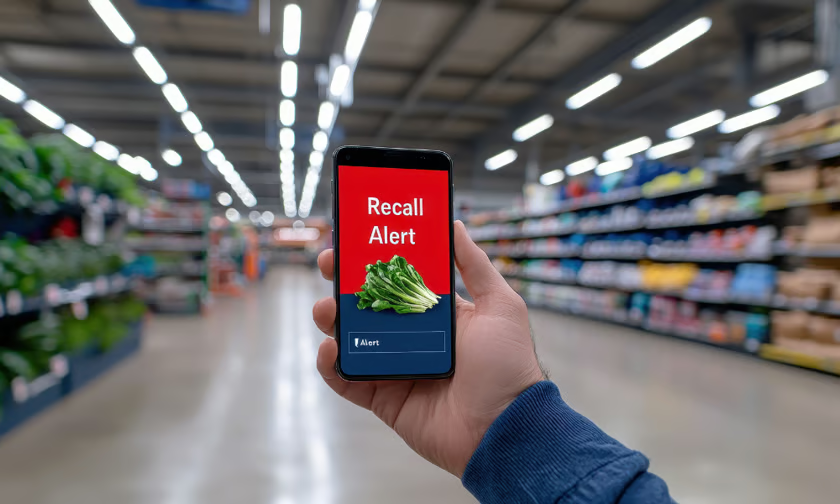
Imagine this: you unwrap a chocolate bar after a long day, expecting something sweet, only to bite down on something so unexpected it jolts you. Not an almond, not a caramelised crunch—something entirely out of place. That’s the sort of experience a handful of customers reported when small stones were found in certain Tony’s Chocolonely bars. The company acted quickly, issued a recall, and removed the affected batches from shelves.
But even in a situation like that—where no serious injuries occurred—it raises a question many people don’t realise they need to ask:
If a company recalls a product, does that protect them from being sued?
It feels like the recall should resolve the issue. After all, the company acknowledged a problem and offered refunds. But legally, that’s not how things work. A recall may reduce future risk, but it doesn’t erase responsibility for harm that has already happened. And in some situations, it doesn’t shield a company from harm that happens afterward either.
This belief that “recall equals immunity” is surprisingly common. And it’s almost entirely incorrect.
Recalls might sound dramatic, but in the regulatory world they are routine safety tools. When companies discover a defect—anything from contamination to a part that’s likely to snap under normal use—they often work with agencies like:
the Consumer Product Safety Commission (CPSC)
the Food and Drug Administration (FDA)
the Food Standards Agency (FSA)
the Office for Product Safety and Standards (OPSS)
The goal is straightforward: remove the unsafe product from circulation and warn the public.
Recall notices usually follow a formula: stop using the product, return it, and request a replacement or refund. They are written with clarity, not legal nuance. And importantly, they are not statements about liability or fault. In fact, many recall notices specifically avoid discussing legal responsibility at all.
A recall is a safety measure—not a legal settlement, not an admission of guilt, and certainly not a shield against future claims.
It’s easy to see why people fall into this line of thinking. Recalls feel official. They come from regulators, include batch numbers, and sometimes even look like legal notices. But from a legal perspective, they operate in a different lane entirely.
Courts do not treat a recall as the final word. Instead, they often treat it as evidence—a piece of the larger puzzle.
When someone is injured by a defective product, judges and juries focus on questions like:
Was the product defective, unsafe, or misleading?
Did that defect directly cause the injury or damage?
Did the manufacturer know—or should they reasonably have known—about the issue?
Could earlier testing, inspections, or design changes have prevented the harm?
Did the recall come after reports of injuries or complaints?
Notice what’s not on the list:
“Did the company issue a recall?”
That fact alone doesn’t erase liability. If anything, it sometimes suggests the company recognised the problem.
Although product liability law varies slightly by region, its core structure remains the same across most English-speaking jurisdictions. Courts tend to evaluate claims through three major lenses.
Negligence looks at conduct.
Did the manufacturer, distributor, or retailer do something careless or fail to do something reasonable?
Examples include:
inadequate product testing
poor quality control
ignoring early warning signs
failing to provide proper instructions or warnings
If an injury could have been prevented through ordinary care, negligence may be in play.
Strict liability removes the question of intent.
If the product was defective—whether in design, construction, or labelling—and that defect caused harm, liability may follow regardless of how careful the company was.
This framework was shaped by decades of court decisions, including foundational rulings like Greenman v. Yuba Power Products, which reinforced that consumers should not bear the cost of defective goods placed into the marketplace.
Strict liability is why many product cases move forward even when a company claims it followed industry standards.
Every product carries an implicit guarantee that it will function safely under normal use. When a blender blade detaches, a toy breaks in a hazardous way, or food contains foreign materials, that promise is broken.
Even without complex legal arguments, courts often recognise this failure as a breach of warranty.
A recall typically offers a simple remedy: return the product and get your money back. That might seem sufficient if the defect caused inconvenience. But if the defect caused harm, a refund doesn’t come close to addressing the full picture.
Replacing a faulty product does not:
repair a cracked tooth
cover medical bills
address lost wages
recognise long-term pain or complications
compensate for damaged property
Refunds and replacements are consumer remedies.
Injury claims are legal remedies.
The two are not interchangeable.
This part surprises many people.
If an injury occurred before the recall was announced, the recall has no effect on your right to pursue a claim. Courts simply examine the defect, the harm, and the company’s actions leading up to the incident.
This is where things become more nuanced. Courts recognise that recall notices don’t reach everyone. Some go unread, some get buried in email inboxes, and many consumers never even know a recall exists unless it’s widely publicised.
Courts may look at:
how the recall was communicated
whether consumers realistically could have known about it
whether the defect remained dangerous even after the notice
whether the recall instructions were clear or practical
A recall doesn’t automatically shift responsibility onto consumers. Safety information only works if people can reasonably access it.
Agencies like the CPSC, FDA, and FSA don’t decide compensation. They are not courts, and they don’t determine who is financially responsible for harm. Instead, they:
collect incident reports
investigate safety issues
require companies to disclose hazards
monitor compliance
maintain public recall databases
Their findings often appear in court records because they establish timelines, reveal when complaints first surfaced, and shed light on whether a company responded responsibly.
For example:
If the FDA documented earlier contamination complaints, that may show the company had notice.
If the CPSC issued hazard warnings before a recall, that can influence how courts view a manufacturer’s actions.
Regulatory data provides context—something courts rely on heavily when assessing whether harm was preventable.
Sometimes defects impact only a handful of people. Other times, they ripple across thousands of households. When injuries or financial losses are shared across a broad group, legal systems often allow cases to be combined.
These collective actions serve practical and social purposes:
They streamline complicated evidence.
They allow individuals with smaller injuries to be heard.
They push companies to reveal what they knew and when.
They often lead to stronger future safety standards.
Class actions are not responses to recalls; they are responses to harm. Recalls may appear in the background, but they rarely determine whether a collective case is possible.
A recall is essentially a warning—a public message that something went wrong and needs to be corrected. It is not a declaration that the company is off the hook. Injuries linked to a defective product are evaluated on the facts: the defect, the harm, and the connection between the two.
Whether it involves a chocolate bar containing a stone or a household tool with an unstable part, the core principle remains unchanged:
Your rights do not disappear because a recall notice exists.
No. A recall is a safety action, not a legal defence. Courts examine the defect and the injury—not whether a company later removed the product from sale.
Courts recognise that recall notices aren’t always widely seen. The focus remains on whether the product was defective and whether that defect caused harm.
Yes. Refunds or replacements address the faulty product itself, not the consequences of an injury. They do not replace the possibility of compensation for harm.
Not exactly. Courts look at the type of defect, the circumstances of the injury, and how closely the defect and harm are linked. Evidence such as medical records and product documentation often supports this analysis.
Yes. Class actions may arise when many people suffer similar harm. A recall does not prevent consumers from joining together to seek accountability.
If you’ve ever wondered whether something someone said about you counts as defamation, or why some statements are protected while others can lead to serious legal consequences, this quick explainer breaks it down in plain English. It’s a simple, myth-busting guide to what defamation really is — and what the law doesn’t cover.