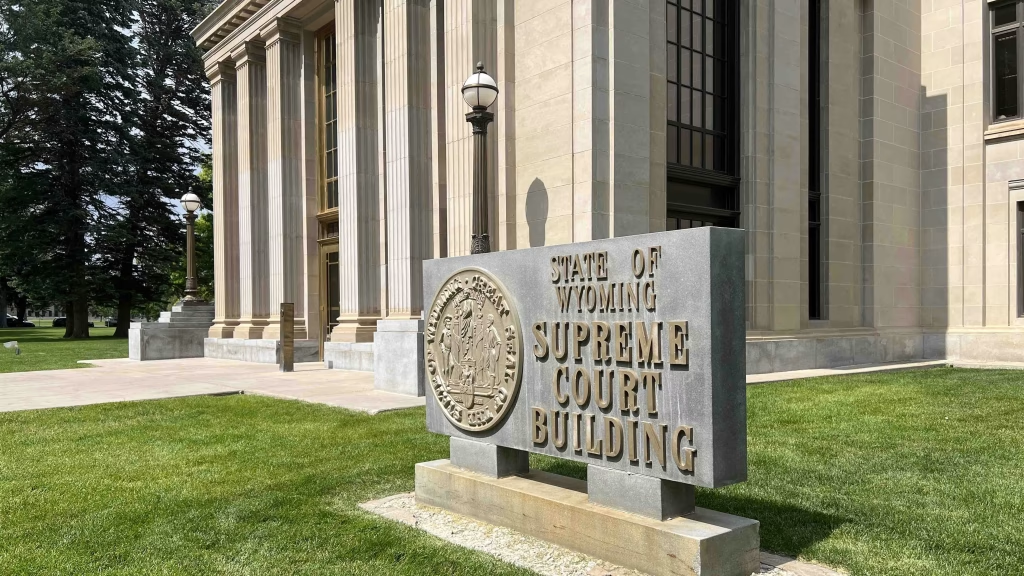
The 2012 Policy Backfire: How GOP Health Safeguards Shielded Wyoming Abortion Access
The Wyoming Supreme Court’s January 6 ruling in State v. Johnson serves as a masterclass in unintended legal consequences for legislative drafters nationwide. By striking down the "Life Is a Human Right Act," the state’s highest justices utilized a conservative-led constitutional amendment to protect individual reproductive autonomy.
This decision is a direct hit to the Wyoming Legislature’s attempt to criminalize medical procedures through statutory definitions. For partners at firms like Gibson Dunn, the case marks a pivotal moment where a shield against federal mandates became a sword for medical liberty.
Liability for healthcare providers across the state has been recalibrated following this definitive rejection of the 2023 abortion bans.
The court held that the state failed to meet its burden of justifying a total prohibition on surgical and medication-based care. This ruling provides an immediate safety zone for clinics that were previously operating under the shadow of potential felony indictments. The legal trigger here is the judicial enforcement of Article 1, Section 38, a provision once intended to block the Affordable Care Act.
The Medical Malpractice Shield: Invalidating Criminal Liability for Wyoming Physicians
Professional indemnity for Wyoming’s 4,000 licensed physicians has stabilized now that the high court has invalidated the "Life Is a Human Right Act." For over a year, medical practitioners faced the impossible choice between providing standard care and risking a lifetime of incarceration.
The court’s decision removes this administrative paralysis by affirming that the state cannot arbitrarily redefine "health care" to suit a partisan agenda. This restoration of the patient-physician relationship is the primary commercial fallout of the January 6 opinion.
Regulatory chokepoints that previously hampered hospital board decisions have effectively evaporated under the Strict Scrutiny applied by Chief Justice Lynne J. Boomgaarden. The ruling ensures that the Wyoming Board of Medicine cannot pursue disciplinary actions against doctors for procedures that are now constitutionally protected. This shift allows for a restoration of labor market stability, preventing a "brain drain" of specialized OB-GYNs from the region.
Senior partners must now advise healthcare clients to update their internal compliance protocols to reflect this new operational freedom.
The Insurance Pivot: Recalibrating Professional Liability and Indemnity Limits
The commercial tension within Wyoming’s medical market has moved from total prohibition to a state of constitutionally protected autonomy. This change has profound implications for insurance carriers, hospital administrators, and the long-term funding of local health clinics.
| Former Status Quo | Strategic Trigger | 2026 Reality |
|---|---|---|
| Near-total prohibition under the Life Is a Human Right Act (Wyo. Stat. 35-6-122). | Wyoming Supreme Court ruling in State v. Johnson (Jan 6). | Restoration of abortion access up to the point of fetal viability. |
| Strict criminal ban on all medication-induced abortions (SF109). | Invalidation of the pill ban under Article 1, Section 38. | Legalization of medication termination services for state providers. |
| Legislative dominance over the definition of “health care” services. | Judicial enforcement of the voter-enacted Health Care Freedom amendment. | Constitutional protection for physician-led medical decision-making. |
This matrix illustrates the total loss of legislative leverage when a voter-enacted amendment is used as a primary defense. The strategic trigger—the high court's final ruling—has neutralized the primary policy goals of the 2023 legislative session.
For corporate boards overseeing rural health networks, this necessitates an immediate pivot in risk assessment regarding the provision of reproductive services. Funding that was previously withheld due to the threat of state prosecution can now be released to stabilize clinical operations.
ERISA Preemption and the Employer-Sponsored Healthcare Exposure
Employer-sponsored health plans are now caught in a jurisdictional friction between Wyoming’s constitutional protections and federal ERISA preemption rules. While the state cannot criminalize abortion, self-funded plans remain largely exempt from state insurance mandates under the "deemer clause" of federal law.
This creates a split-market reality where fully-insured plans in Wyoming must cover the procedure as "health care," while self-funded plans retain discretion. General Counsel must audit their Summary Plan Descriptions (SPDs) to ensure they do not inadvertently violate fiduciary duties by excluding protected care.
Institutional liability is further complicated by the dissenting voice of Justice Kari Gray, which highlights the specific areas where future litigation may focus. While the majority has established a fortress for reproductive rights, the dissent signals the arguments that a future court might use to challenge this precedent. Stakeholders must build governance structures that are resilient to the possibility of a legislative "counter-amendment" aimed at Article 1, Section 38. For now, the "Health Care Freedom" amendment serves as the final arbiter of patient privacy and medical professional judgment.
Regulatory Chokepoints: How Article 1 Section 38 Redefines Health Care Compliance
The densest mapping of legal risk now sits at the intersection of state constitutional law and federal pharmaceutical regulations. These entities must reconcile their guidelines with the State v. Johnson mandate to ensure that no practitioner is penalized for constitutional acts. The following chokepoints define the current exposure for 2026:
-
Wyoming Board of Medicine: Must issue updated guidance to all licensed physicians regarding the legality of surgical and medication procedures.
-
Wyoming Department of Health: Faces the task of revising data collection protocols to reflect the legal resumption of reproductive health services.
-
Gibson Dunn & Crutcher LLP: Maintains the primary role in monitoring state compliance with the permanent injunction issued by the high court.
-
Wyoming Attorney General’s Office: Tasked with evaluating the "reasonable and necessary" clause for any potential future legislative restrictions.
-
Wellspring Health Access: Faces the commercial pressure of scaling operations as Wyoming becomes a regional hub for reproductive care.
-
Teton County District Court: Remains the primary trial-level venue for lingering procedural challenges related to the initial lawsuits.
-
Alliance Defending Freedom (ADF): Likely to consult on future legislative efforts to draft an amendment that bypasses the court's scrutiny.
-
Robinson Bramlet LLC: Vital for navigating Wyoming-specific procedural hurdles during the implementation phase of the court's order.
Second-order risk is concentrated in the realm of medication abortion, where the invalidation of SF109 puts Wyoming in direct conflict with certain federal pressures. This creates a "double-shield" effect where providers are protected by the state constitution while operating within a complex national regulatory environment.
Insurers must now decide if their policies cover medication-induced abortions in Wyoming, given the court’s clear ruling on medical autonomy. The involvement of the Wyoming Medical Society remains critical as they advocate for the professional autonomy of their members.
The historical stance of the Wyoming Medical Society—supporting the "Health Care Freedom" amendment—has been validated by the court’s decision. This institutional alignment strengthens the framing of abortion not as a social issue, but as a technical medical procedure. T
his framing is essential for senior partners and hospital executives who require a depoliticized, risk-management approach to the ruling's aftermath. By treating the procedure as "health care," the court has provided a commercial pathway for clinics to resume business as usual.
Jurisdictional Arbitrage: Wyoming’s New Role as a Mountain West Safe Haven
The decision in State v. Johnson serves as the final authority on the limits of state power over medical professionals in Wyoming. For senior commercial leaders, the impact is clear: medical autonomy is now a fundamental, constitutionally anchored right that supersedes legislative bans. Founders of healthcare startups and executives of rural health networks must recognize that the Life Act is functionally dead. Any attempts to enforce its provisions would constitute a direct violation of the constitutional due process established by the justices.
Governance pillars for the coming year must focus on the "Shield-to-Sword" transition to avoid future liability traps. First, institutions must confirm their "Health Care" status under Article 1, Section 38 to maximize their defense in civil litigation. Second, legal teams should monitor the Wyoming Legislature for any "counter-amendment" filings that would require a public vote. Finally, practitioners must ensure that their medical judgment is documented as the primary driver of patient care to maintain constitutional protection.
People Also Ask:
-
Q: What did the Wyoming Supreme Court rule on abortion?
-
A: On January 6, 2026, the Wyoming Supreme Court ruled that state bans on surgical and medication abortion are unconstitutional under the 2012 "Health Care Freedom" amendment, restoring access up to fetal viability.
-
-
Q: Is abortion legal in Wyoming in 2026?
-
A: Yes, abortion is currently legal in Wyoming up to the point of fetal viability, following the high court's decision to strike down the Life Is a Human Right Act.
-
-
Q: What is the Wyoming Health Care Freedom amendment?
-
A: Article 1, Section 38 is a 2012 voter-enacted amendment that guarantees adults the right to make their own healthcare decisions, a provision now used to protect reproductive autonomy.
-
-
Q: Who wrote the Wyoming Supreme Court abortion opinion?
-
A: Chief Justice Lynne J. Boomgaarden wrote the majority opinion in State v. Johnson, which was joined by Justices Fenn, Jarosh, and Fox.
-
-
Q: Can Wyoming pass a new abortion ban after this ruling?
-
A: While the legislature can propose new laws, they would likely be found unconstitutional unless voters pass a new constitutional amendment explicitly excluding abortion from healthcare protections.
-
Legal Insight:👉 Columbus Double Homicide: Institutional Liability and the 48-Hour Investigative Window 👈
Wyoming Supreme Court, State v. Johnson, Abortion Rights, Article 1 Section 38, Health Care Freedom Amendment, Medication Abortion, Wyoming Constitution, Reproductive Rights 2026, ERISA Preemption, Chief Justice Boomgaarden