Understand Your Rights. Solve Your Legal Problems


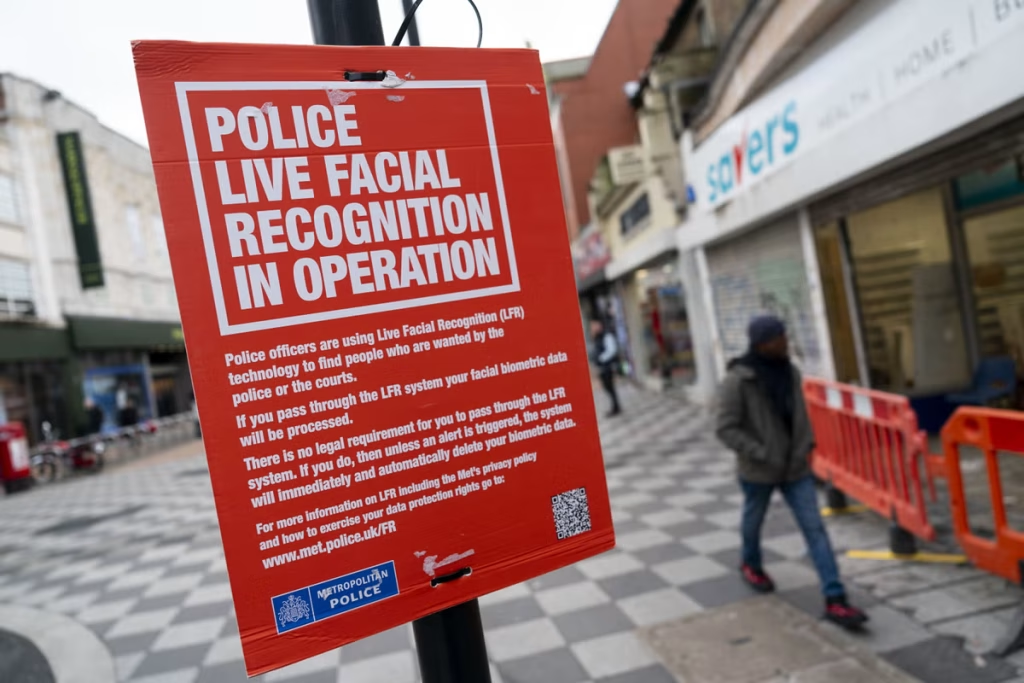
More than 100 wanted suspects were arrested in Croydon during a three-month police trial using fixed live facial recognition cameras.
More than 100 people wanted for serious criminal offences have been arrested in Croydon following a three-month pilot using live facial recognition cameras, according to figures released by the Metropolitan Police Service.
The trial, which began in October, marked the first time the technology was mounted on existing street infrastructure such as lampposts rather than mobile police vans. Deployments took place at two locations on Croydon High Street and were monitored remotely by specialist officers.
The development matters as police forces across the UK expand the use of biometric surveillance while facing ongoing scrutiny over privacy, proportionality, and safeguards.
Live facial recognition remains lawful in England and Wales when used under strict operational policies, including targeted watchlists and human oversight.
The Croydon pilot is being closely watched because it tests whether fixed cameras can improve efficiency without expanding surveillance beyond existing legal limits.
The pilot involved 13 deployments using live facial recognition cameras attached to lampposts at the north and south ends of Croydon High Street.
Unlike previous van-based operations, the camera feeds were monitored remotely, allowing police vehicles to be redeployed elsewhere. Officers were present on the ground during every activation to respond to alerts and speak with members of the public.
According to the Met, arrests were made on average every 34 minutes while the system was active. Police said the average time taken to locate wanted individuals was reduced by more than half compared with mobile van deployments.
Each operation relied on a bespoke watchlist created no more than 24 hours in advance and deleted immediately after the deployment ended, in line with existing policy.
Live facial recognition deployments in London are governed by internal Met policy and national data protection law, including the UK GDPR and the Data Protection Act 2018.
Police said a third of those arrested during the pilot were wanted for offences linked to violence against women and girls, including sexual assault and strangulation. Other arrests related to burglary, possession of offensive weapons, recall to prison, and suspected kidnapping.
Among those detained was a 36-year-old woman who had been unlawfully at large for more than two decades after failing to appear in court over a 2004 assault charge.
Officers also arrested a 37-year-old registered sex offender for breaching a Sexual Harm Prevention Order by possessing an unregistered phone and accessing social media. A 27-year-old man was detained on suspicion of kidnap.
The Met said around three-quarters of those arrested lived in Croydon, supporting its view that the deployments targeted locally active offenders.
Lindsey Chiswick, the Metropolitan Police’s national lead for live facial recognition, said the Croydon pilot builds on more than 1,700 arrests made across London using the technology since the start of 2024.
She said mounting cameras on existing street infrastructure allowed officers to deploy the system more efficiently while operating under the same safeguards as van-based deployments.
Alongside enforcement activity, the Metropolitan Police Service said it has held ongoing engagement sessions with Croydon residents and local councillors to explain how live facial recognition works, how short-term watchlists are created, and what protections apply to members of the public who are not on those lists.
The force has previously cited polling showing high public support for the technology, while acknowledging continued scrutiny from civil liberties groups over oversight and long-term use.
During the pilot period, police reported a 12% reduction in recorded crime in Fairfield Ward, which includes part of Croydon town centre where deployments took place.
The figures cover categories such as retail crime, violent offences, and sexual offences.
The Met said crime trends can be influenced by multiple factors, including seasonal patterns and wider policing activity, but added that the results are consistent with outcomes from earlier live facial recognition deployments using mobile units.
Since January 2024, deployments in Croydon overall have resulted in 249 arrests, with 193 leading to charges or cautions.
Court records show that arrests triggered by live facial recognition in Croydon have progressed through the justice system in the same way as any other police-led detention.
In one October case, a 25-year-old man was identified by the system and arrested for breaching electronic tag conditions linked to an intentional strangulation offence and assaults on emergency workers.
He was later sentenced to 18 months’ imprisonment at Croydon Crown Court. In a separate November deployment, officers arrested a 35-year-old man suspected of breaching conditions as a registered sex offender; he later appeared before Wood Green Crown Court.
Police stress that live facial recognition is used solely to locate wanted individuals, with charging decisions and convictions dependent on standard evidential and judicial scrutiny.
For residents, commuters, and shoppers, the pilot has meant a visible police presence during deployments and the temporary activation of facial recognition cameras in clearly defined areas of Croydon town centre.
The Metropolitan Police says cameras are not in constant operation and are only switched on when officers are physically present.
Under current policy, biometric data relating to people who are not matched to a watchlist is deleted immediately, and individuals who believe they have been incorrectly stopped can pursue complaints through existing police oversight and accountability routes.
The pilot underscores the ongoing balance between crime prevention and privacy as UK policing expands its use of digital identification tools in public spaces.
Live facial recognition scans faces in real time and compares them with a pre-approved watchlist of people wanted by police. Any alert is reviewed by trained officers before action is taken. If there is no match, biometric data is automatically deleted immediately.
No. The Metropolitan Police says the cameras are only switched on during specific, time-limited deployments when officers are present. They are not used for continuous or permanent surveillance.
Yes. UK courts have ruled that live facial recognition can be lawful when used with clear policies, human oversight, and strict data protection safeguards. Police forces must comply with the Data Protection Act 2018 and UK GDPR.
Yes. Any police stop or arrest can be challenged through the courts, and complaints about police conduct can be raised through existing oversight bodies. Live facial recognition is used to help locate suspects, not as evidence of guilt.
The Metropolitan Police has confirmed the Croydon live facial recognition trial will now be formally reviewed to assess accuracy, arrest outcomes, operational efficiency, and compliance with existing legal safeguards.
There are currently no plans to extend the fixed-camera approach beyond Croydon, and any wider use would require further internal approval and continued adherence to data protection and policing frameworks already in place.
The pilot has broader significance because it highlights how police are adapting surveillance technology in busy public spaces.
More than 100 arrests in three months point to its potential impact on crime detection, while the use of fixed cameras raises important questions around visibility, oversight, and public confidence.
The review’s findings are likely to influence future decisions by police leaders and policymakers on how live facial recognition is used across London.