Understand Your Rights. Solve Your Legal Problems


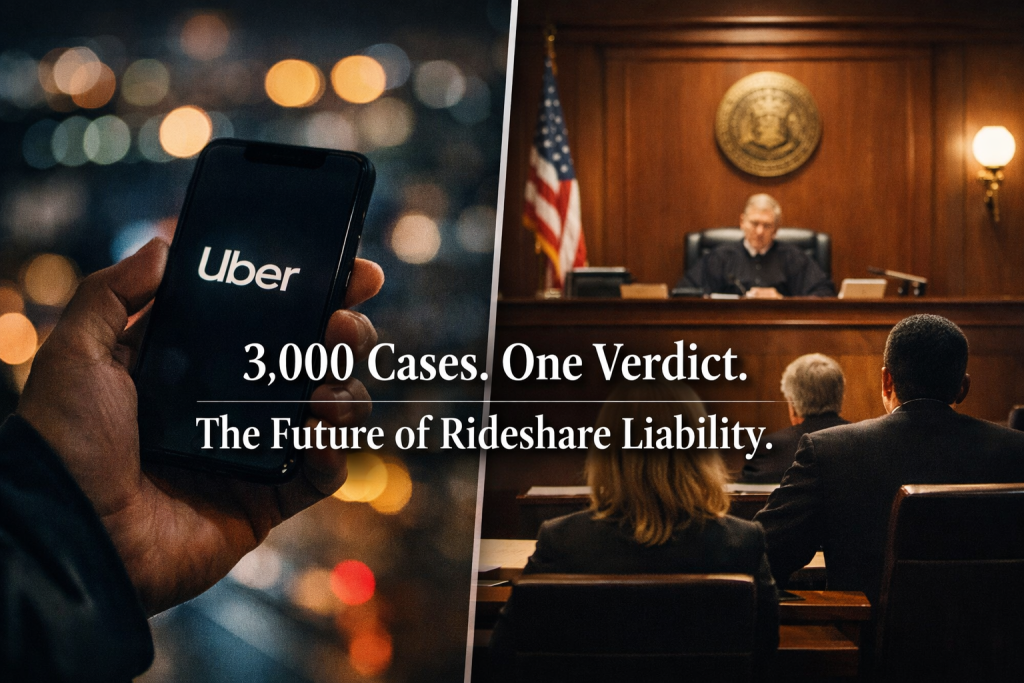
The Phoenix federal bellwether trial represents the most significant test yet of Uber’s institutional liability exposure in mass sexual-assault litigation. Senior U.S. District Judge Charles Breyer has now cleared the runway for the first federal bellwether in MDL No. 3084, a consolidated docket in the Northern District of California that centralizes nearly 3,000 claims.
The first plaintiff to face a federal jury is Jaylynn Dean, who alleges she was raped by an Uber driver in Tempe, Arizona. Uber’s previous attempts to stay or delay proceedings were rejected, reinforcing that the judiciary now favors resolution over procedural stalling.
For Uber, the courtroom is no longer a place to argue abstract legal theories—it has become an institutional audit of corporate oversight, platform safety, and commercial consequence.
Uber has historically relied on the independent-contractor model to shield itself from driver-related tort liability, arguing that criminal conduct by drivers is personal and unpredictable. That defense posture is now colliding head-on with the plaintiff narrative that Uber exerts extensive control over its platform, enabling the company to monitor, regulate, restrict, and remove drivers at will.
Plaintiffs contend that this level of control should also trigger a duty of care, and that Uber knowingly prioritized speed and growth over safety mechanisms that could have protected riders.
The strategic irony of this moment is unmistakable: the more Uber insists on its ability to govern drivers through platform architecture, the more plaintiffs argue that the platform itself constitutes the proximate cause of foreseeable harm.
Institutional investors, insurance carriers, and commercial partners are tracking this case not for the criminal facts alone, but for its potential to reshape Uber’s balance sheet liabilities, settlement reserves, and regulatory future.
Uber sought to argue that public advocacy ads—most notably the "Every 8 Minutes" campaign, which references the frequency of alleged sexual-assault incidents tied to rideshare platforms—created coordinated prejudice that could taint the Phoenix jury pool.
The company moved to subpoena the groups behind the campaign to demonstrate orchestration, an effort designed to frame the advertising strategy as an impermissible attempt to buy narrative control and sway verdicts. Judge Breyer rejected this motion, signaling that the right to trial outweighs corporate reputation management, even when public messaging is aggressive.
The court’s refusal to let Uber weaponize discovery to fight PR strategy sets a precedent that plaintiffs’ attorneys may shape public narrative without crossing a legal red line, provided they avoid defamation and fabrication.
The message to corporations is now clear: brand campaigns built to counteract litigation momentum will not override the judiciary’s priority to move cases toward verdicts.
Uber’s primary insurance partners are now quantifying intentional-act exclusions against corporate-negligence claims.
This distinction is critical. Most policies limit coverage for intentional criminal acts by drivers, but plaintiffs are not targeting driver intent—they are targeting Uber’s oversight, background-check sufficiency, complaint-tracking systems, reporting friction, and systemic failure to implement reasonable safety features at scale.
If the Phoenix jury awards substantial damages, insurers may be forced to treat rideshare platforms as institutional risk vectors rather than neutral marketplaces.
Actuarial teams are already modeling how a plaintiff victory could increase premiums across North America, trigger mandatory safety technology requirements, and expand the scope of common-carrier duties in digital transportation platforms. This repricing risk extends beyond Uber. The rideshare insurance ecosystem, the gig-economy labor model, and platform moderation standards may all be shaped by a single federal verdict.
Uber previously escaped liability in a September 2025 state-court trial in San Francisco, where the jury was asked to weigh individual driver misconduct against platform responsibility.
Uber treated that defense win as evidence that institutional liability theories would fail before juries. However, federal MDLs are built differently. They operate under unified pretrial orders, coordinated discovery, centralized evidence frameworks, and judges empowered to address systemic design rather than isolated tort facts.
The Judicial Panel on Multidistrict Litigation is also reviewing whether Lyft may face similar consolidation pressure. Institutional alignment is forming around a new judicial theory: that platforms which can monitor safety signals at scale may hold liability for failing to act on those signals when risks are foreseeable, repeated, and measurable.
Federal consumer-protection agencies, including the Federal Trade Commission, could take interest depending on what emerges in testimony.
The risk vector here is not criminal conduct—it is institutional knowledge. If pretrial evidence or witness testimony reveals that Uber internally tracked assault complaints without implementing proportionate rider safety protections, the company could face:
Federal investigations into unfair or deceptive safety marketing.
Legislative mandates tightening rideshare safety protocols in Arizona and California.
Mandatory in-car video monitoring, biometric driver verification, or enhanced background-check obligations.
Disclosure pressure from mass-tort law firms seeking executive testimony.
Commercial fallout affecting investor confidence, affiliate partners, and insurance underwriting.
The Phoenix courtroom has become a jurisdictional chokepoint for all these second-order consequences. Arizona regulators are also monitoring jury selection. Their interest is simple: does Uber’s screening and safety system meet the standard of care expected of a company that markets itself as a tech-enabled transportation safety innovator?
Bellwether trials are not chosen because they are average. They are chosen because they contain clear liability tension and replicable fact patterns that can forecast the gravitational pull of future settlements. For Uber, this bellwether is acting as a settlement accelerant. A plaintiff victory would:
Increase settlement values for thousands of federal claims.
Push Uber toward a multi-billion-dollar global settlement conversation.
Increase commercial insurance premiums and underwriting scrutiny.
Strengthen plaintiffs’ leverage in state courts nationwide.
Undermine Uber’s ability to argue that safety failures were isolated.
Trigger new institutional liability models for platform-based gig services.
| Former Status Quo | Strategic Trigger | 2026 Legal Reality |
|---|---|---|
| Independent-contractor defense shielding Uber from most driver-related torts | Judge Breyer denies stay, orders federal bellwether to proceed | Liability framed as platform defect, negligence, and failure to monitor safety at scale |
| Scattered state lawsuits, inconsistent rulings, limited coordination | Claims consolidated into Northern District of California MDL 3084 | Unified federal pressure shifting settlement reserves into multi-billion exposure models |
| Marketing campaigns reinforcing safety innovation | "Every 8 Minutes" advocacy campaign reframing narrative around safety gaps | Public and judicial skepticism about Uber’s safety claims and oversight |
| Discovery used to contest criminal unpredictability | Uber attempts to subpoena safety-advocacy groups, motion denied | Judiciary signals that corporate reputation arguments cannot block trial rights |
Uber and Gupta Wessler LLP are locked in a second-layer battle for narrative legitimacy. Uber attempted to frame advocacy advertising as coordinated jury tampering, a tactic designed to reassert corporate narrative dominance.
The judiciary declined that framing, moving the litigation needle from advertising optics to platform conscience and commercial consequence. The tension now favors plaintiffs because the harm pattern is statistically repeated, commercially measurable, and institutionally foreseeable.
The litigation battlefield has changed shape. The question is no longer “Did a driver commit a crime?” The question is “Did Uber create a platform defect by ignoring repeated safety signals it had the power to monitor?”
Here are the refined strategic insights as they now read in narrative form:
Uber’s ability to remove drivers based on safety complaints is being reframed as evidence that assault risk was foreseeable, measurable, and preventable.
The judiciary is signaling that platform governance power may create platform governance duty. Insurance carriers are modeling increased North American exposure if juries adopt systemic liability theories. Federal MDL proceedings prioritize unified consequence over scattered state outcomes. The Phoenix bellwether may influence how digital transportation platforms price safety oversight in commercial underwriting.
The Phoenix bellwether is Uber’s point of no return. If the jury finds Uber’s safety systems commercially negligent, settlement becomes inevitable, insurance premiums rise, and regulatory mandates tighten. If Uber wins, it gains leverage to negotiate from strength.
But even a defense verdict won’t erase the institutional question now etched into the litigation record: whether platform efficiency without human oversight crosses into punishable negligence.
The strategic irony remains that Uber’s pursuit of seamless user friction may have created the safety gap. By automating oversight in favor of growth, the company may have built not just a platform—but a defect. The federal jury will now decide whether that defect is commercially and legally punishable.
What is the Uber sexual-assault bellwether trial in Phoenix?
It is the first federal jury test in a consolidated multidistrict litigation assessing Uber’s systemic safety negligence.
Who is the plaintiff in the first federal Uber rape trial?
Jaylynn Dean, who alleges an Uber driver raped her in Tempe, Arizona.
Can Uber be held liable for driver sexual assaults?
The bellwether jury will decide whether repeated assault complaints created a foreseeable institutional duty of care.
What court is handling the Uber sexual-assault MDL?
The U.S. District Court for the Northern District of California under MDL No. 3084, with the federal bellwether hosted in the District of Arizona.
Legal Feature Analysis: 👉👉 Amazon Faces Renewed Liability Risk as Price-Gouging Litigation Clears Judicial Threshold