“Now I Finally Feel Like No One Will Call Me a Liar”
The sentence appears again and again online, usually without context: “Now I finally feel like no one’s going to call me a liar, because I’m not the only one.”
It was first spoken in a sterile police interview room by a woman identified in court papers as S.M. She was describing a 2017 encounter in a Miami apartment that she said had haunted her for nearly a decade.
Online, however, the line quickly broke free of its original setting. It was clipped, subtitled, and paired with high-definition screenshots of luxury yachts and Manhattan penthouses.
The quote became a digital shorthand for the case against Oren, Tal, and Alon Alexander. It tapped into a familiar American true-crime archetype: the "hidden monster" lurking behind a gilded life.
But as the brothers prepare for a federal trial in New York, the story is moving out of the realm of viral certainty and into the friction of the legal system—a place where "feeling" like a liar is secondary to the cold, often missing, corroboration of evidence.
The Architecture of an Empire
Before the indictments, the Alexander name was synonymous with an aggressive brand of the American Dream.
Oren and Tal didn’t just sell houses; they sold the idea that they were the gatekeepers to a life most people only see through a filtered lens.
They were the "rock stars" of real estate, frequently pictured in slim-cut suits on the decks of yachts or courtside at NBA games.

Alon Alexander, Tal Alexander, and Oren Alexander are pictured on a boat in the Bahamas in 2019. (Photo: Facebook)
Their portfolio included the most exclusive zip codes on earth: $100 million Hamptons estates and "Billionaire’s Bunker" in Miami. This wasn't just business; it was a carefully curated aesthetic of invincibility.
When the "brand" is built on being young, wealthy, and untouchable, the public’s fascination with its collapse becomes a form of "schadenfreude" journalism. The internet didn't just see criminal defendants; it saw the fall of titans.
Federal prosecutors allege that the very tools of this success -the private jets, the luxury rentals, the promise of "access"were actually the mechanisms of a sex trafficking conspiracy.
In the government's narrative, "luxury" was a weapon used to "lure and entice."
When One Account Became Many
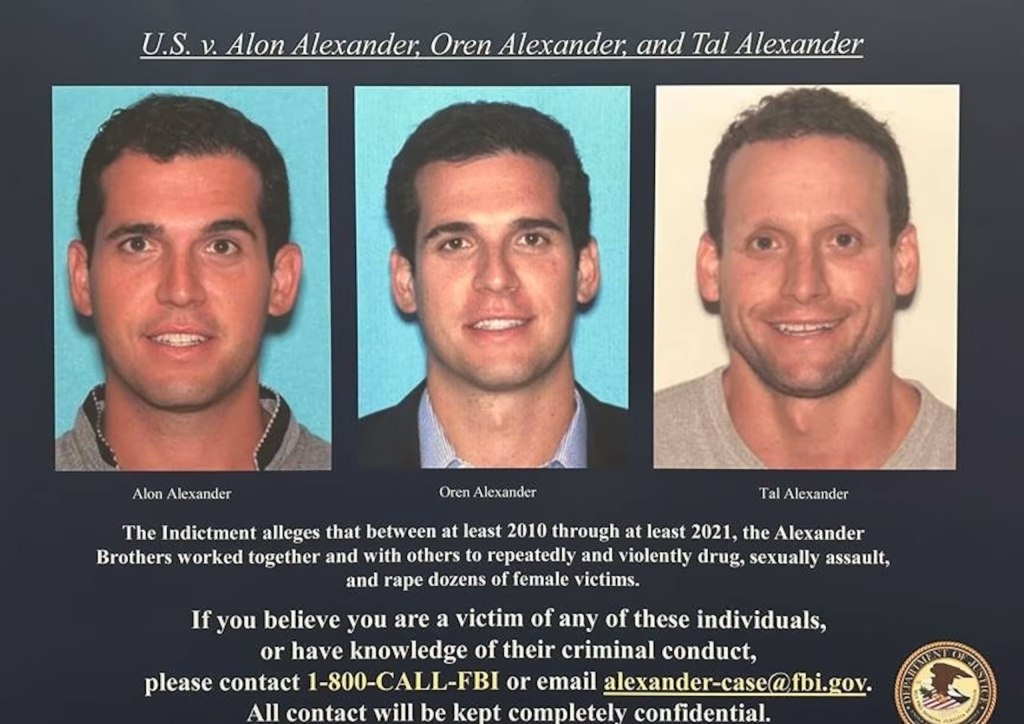
The scale of the case is extraordinary. In a 16-page indictment, the US Attorney’s Office in Manhattan alleges that for well over a decade, the brothers conspired to "repeatedly and violently drug, sexually assault and rape dozens of women."
The alleged locations span the globe: the Hamptons, Aspen, Las Vegas, and the Bahamas. Online, the figure often cited is "more than 60 victims." In true-crime circles, magnitude equals credibility. A single allegation invites doubt; dozens suggest a system.
However, in the quiet of a courtroom, magnitude presents a different challenge: The Jurisdictional Labyrinth. Many of the most viral allegations took place outside U.S. borders.
When an incident is alleged to have occurred on a cruise ship in the Bahamas or a villa in a foreign territory, the investigation enters a "no man’s land." To the public, a crime is a crime.
To investigators, it means navigating the Mutual Legal Assistance Treaty (MLAT) process—requesting records from foreign police who may not have preserved them, or searching for CCTV footage from a decade ago that has long since been overwritten.
The Problem of "Digital Archeology"
Because many of these allegations date back to the late 2000s, investigators are forced to engage in a form of digital archeology.
They are looking for "ghosts" in the machine: deleted Blackberry messages, deactivated social media interactions, and hotel logs from obsolete software.
One of the most contentious points involving "temporal distance" is a foreign birth certificate intended to prove the age of an alleged victim from 2009.
The defense has pointed out a sobering reality: the document originates from a city currently in an active war zone.
While the internet sees a "smoking gun," the judge sees a complex argument about international document verification. If the records office no longer exists, the "fact" of a victim's age becomes a point of evidentiary instability.
This is the procedural detail that deflates the drama. It is where the narrator’s certainty meets the investigator’s restraint.
The Contradictions: Memory Under Pressure
The critical linchpin in the Alexander cases is the fragility of narrative when subjected to federal cross-examination.
In court, "post-incident" behaviors continued contact, friendly texts, or active civil lawsuits, are rarely viewed through the lens of trauma. Instead, they are framed as fatal flaws in credibility.
Defense attorneys have pivoted sharply toward these "misaligned memories."
The harrowing account from "M.G." regarding locked doors and torn clothing hit a procedural wall when her own friend—the primary witness—testified the doors were unlocked and the clothing appeared intact.
The result is Narrative Exhaustion. An audience initially hooked by the clarity of an accusation quickly fatigues when the "perfect victim" archetype is complicated by the mess of human reality.
While the internet demands a cinematic, unblemished survivor, the legal system is designed to dwell in the gray. When the two collide, the friction often produces more doubt than clarity.
Case Breakdown: Narrative vs. Procedural Defense
| Subject | The Viral Allegation (Prosecution) | The Defense Counter-Argument |
|---|---|---|
| Methods | Coordinated “lure and entice” schemes using travel, luxury housing, and party promoters to trap victims. | Consensual participation in a high-status “jet-set” lifestyle where social climbing was the primary motive. |
| Evidence | Recovered communications referencing GHB, ketamine, and cocaine; surreptitious drugging of victims. | “Idle chatter” or locker-room talk among young men; lack of contemporary medical or toxicology reports. |
| Timeline | A 15-year pattern of behavior involving “dozens” of victims, framed as a continuous criminal conspiracy. | “Temporal erosion” of memory; claims that civil lawsuits and viral media created a “contagion” of false memories. |
| Consent | Victims described as “physically incapacitated” or “forcibly restrained” while being filmed without consent. | Willing participation in sexual acts; evidence of friendly post-event text messages and continued social contact. |
The “Denial” Defense and the Bikini Snapshot
Nowhere is this ethical tension more visible than in the deposition of "S.M." The defense focused on a bikini photo she posted the day after her alleged assault with a cheerful caption.
When S.M. explained, "I was hoping that it didn't happen," she was describing a psychological state of post-traumatic denial.
It is a concept well-understood by experts but deeply mistrusted by a "common sense" public. By extracting these fragments, the photo, the friendly text sent weeks later, the defense is playing to the "court of public opinion," betting that the audience’s belief in a "rational" victim is stronger than their understanding of trauma.
The Spectacle and the Ethics of the "Chorus"
The prosecution’s strategy relies on an "ensemble" of voices - a chorus of women intended to prove a pattern. But there is an ethical cost to this volume.
When allegations are consumed in bulk, the specificities of each case begin to blur; the individuals become "The Alexanders' Victims" a brand name as flattened and commodified as the real estate empire that preceded it.
Standing against this collective narrative are the defendants themselves, who have pleaded not guilty.
Their parents, Orly and Shlomy, maintain their sons’ innocence, stating: "We ask only for a fair process, grounded in facts, where their voices can finally be heard."
Their statements, however, rarely achieve the same velocity as the accusations. In the economy of viral attention, the presumption of innocence lacks the emotional immediacy of a "hook."
No Easy Ending
As the trial begins, the public story is already fixed in multiple, incompatible forms. For some, the allegations are an unquestionable truth. For others, they are a cautionary tale of collective misremembering and financial incentive.
The legal system will proceed deliberately. Evidence will be tested. Credibility will be evaluated under rules that do not reward virality. When a verdict arrives, it may not satisfy an audience that has already consumed this story as entertainment.
Because this was never only about what may have happened behind closed doors. It is about what happens when allegations become content, when belief outruns proof, and when justice is expected to compete with engagement metrics.
The most unsettling possibility is not that the story is false or even that it is true, but that the version most people believe is simply the one that felt right, not the one that could be proven.