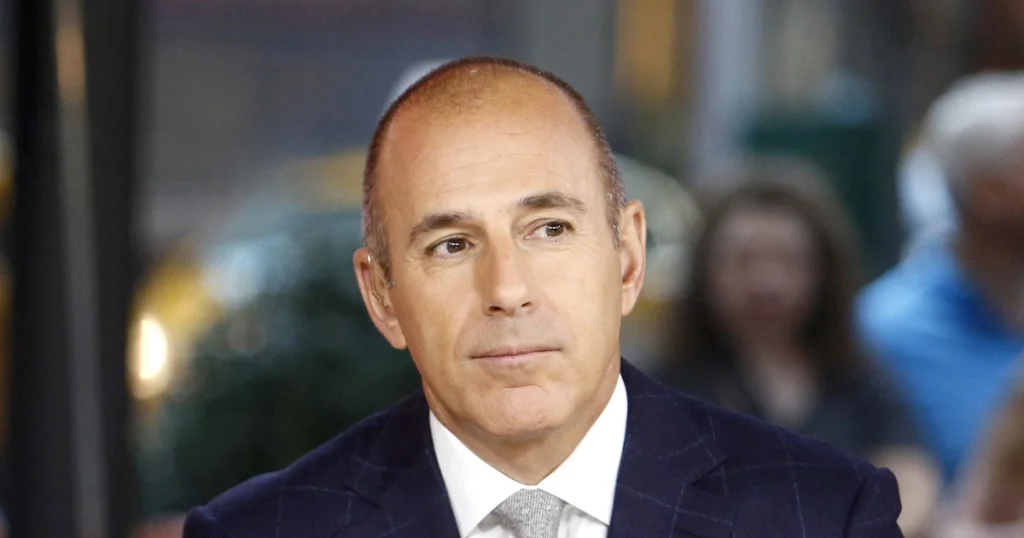
For years, the legal reckoning surrounding Matt Lauer appeared to have stalled. No criminal charges followed his 2017 firing from NBC. No courtroom proceeding ever weighed the allegations against him.
But the release of a new memoir by his former colleague Brooke Nevils has quietly shifted the balance again, reintroducing pressure that takes effect long before any judge or jury becomes involved.
The trigger is not a new lawsuit or an indictment. It is narrative revival. Nevils’ forthcoming book revisits her allegation that Lauer assaulted her during the 2014 Winter Olympics, an accusation he has consistently denied.

Brooke Nevils is seen outdoors in New York amid reporting on her memoir and its renewed legal and reputational impact.
What matters now is not the truth of the claim, but the procedural reality that renewed allegations can reshape exposure years later, even when formal legal action is absent.
This is where modern legal pressure lives, not in verdicts, but in timing.
In situations like this, the legal fault line is defined less by guilt or innocence and more by consequence. Criminal statutes may have expired. Civil claims may be difficult or impossible to pursue.
Yet none of that prevents reputational harm, financial risk, or professional isolation from resurfacing when allegations re-enter public circulation. The law may be dormant, but its shadow is not.
For Lauer, the consequences arrive in the present tense. Attempts at professional rehabilitation remain constrained. Media institutions and business partners are forced to reassess proximity.
Silence becomes a choice with reputational cost, while response carries its own risks. The absence of a courtroom does not insulate against impact — it simply shifts where that impact lands.
Nevils’ account also highlights how timing redistributes power. When allegations surface alongside broader cultural shifts, procedural context can outweigh factual resolution.
Internal investigations, employment decisions, and negotiated exits often carry consequences that are more immediate than litigation itself. In these moments, the law operates as leverage rather than judgment.
This pattern is not unique. Across entertainment, media, and sports, public figures have seen careers stall or collapse without a single day in court. In many cases, the decisive moment is not a trial date but a publication date.
Once allegations are reintroduced through books or renewed reporting, the pressure resets, regardless of how much time has passed.
The personal consequences are asymmetric. For the accused, exposure brings renewed uncertainty, reputational damage without a clear mechanism for rebuttal, financial implications tied to stalled opportunities, and ongoing privacy erosion.
For accusers, going public again can reopen scrutiny and personal strain, even when legal pathways are no longer active.
What remains unresolved is not a legal question but a structural one. How long can allegations exert force in the absence of formal adjudication? And how does someone navigate a landscape where the most consequential moments arrive outside the courtroom?
For now, there is no ruling, no timeline, and no finality. Only renewed attention, constrained options, and the quiet reality that in public life, legal consequences often begin long before and sometimes without a trial.