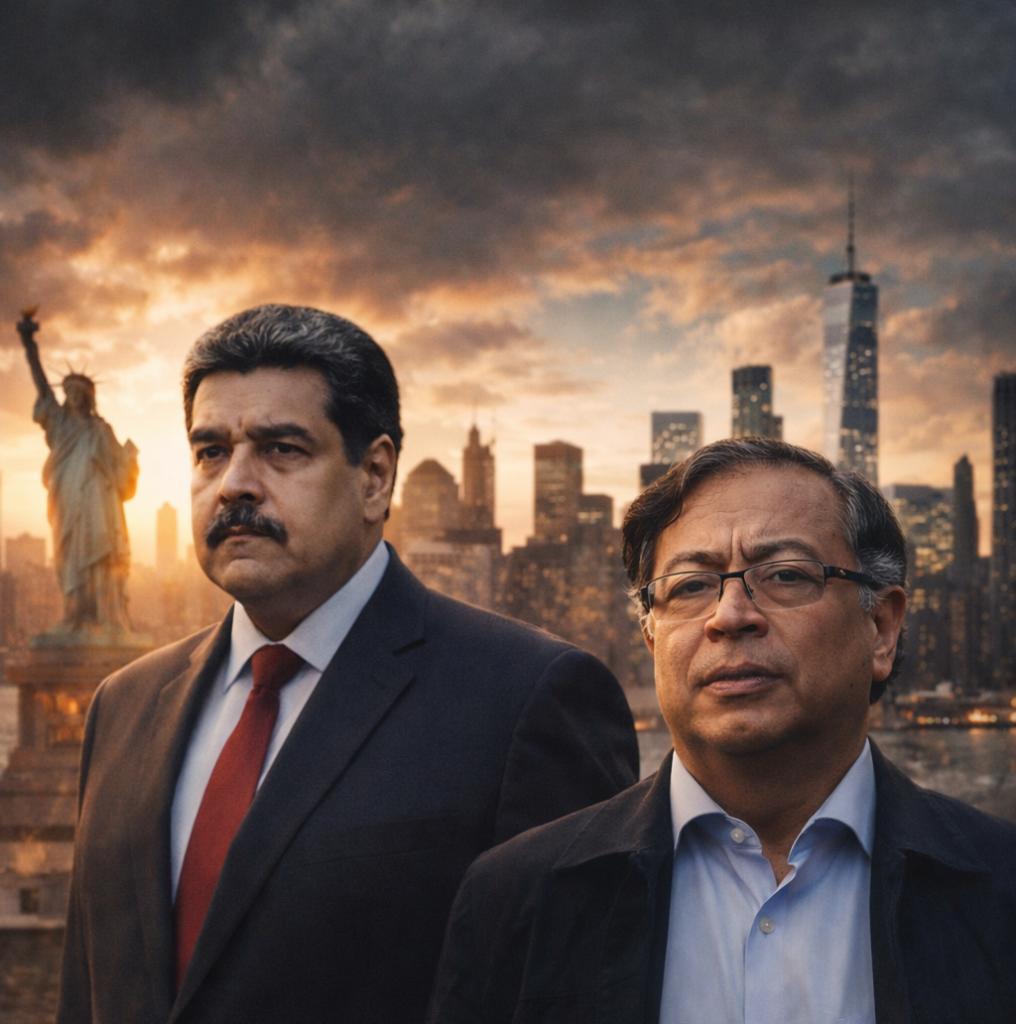
Maduro in Manhattan, Petro Sanctioned: Colombia at the New Legal Front in the Americas
The detention of a sitting head of state on foreign soil represents the most significant challenge to sovereign immunity in the post-Westphalian era.
On January 3, 2026, the United States executed Operation Absolute Resolve, a high-kinetic military intervention in Caracas that resulted in the apprehension of Venezuelan President Nicolás Maduro and his wife, Cilia Flores.
By January 5, the pair were arraigned in a Manhattan federal court, facing a litany of charges including narco-terrorism and cocaine importation conspiracy.
This maneuver has effectively collapsed the distinction between international military engagement and domestic criminal prosecution, creating an immediate legal crisis for neighboring Colombia.
The legal fallout centers on the "Trump Corollary" to the Monroe Doctrine, which asserts that the United States maintains inherent constitutional authority to conduct law enforcement operations within its regional sphere of influence.
For Colombia, the threat is no longer theoretical. President Donald Trump’s public characterization of Colombian President Gustavo Petro as a "sick man" involved in cocaine production has signaled that the Manhattan indictment of Maduro may serve as a procedural blueprint for future actions against Bogotá.
The legal trigger here is the unilateral expansion of extraterritorial jurisdiction, where the U.S. Executive Branch bypasses extradition treaties in favor of direct military apprehension.
Insurance Risk and Sovereign Default Metrics
The U.S. Treasury’s designation of President Petro under Executive Order 14059 has triggered a "de-risking" epidemic within the global financial system.
By targeting the Colombian executive branch, the Office of Foreign Assets Control (OFAC) has effectively turned the Colombian sovereign into a high-risk counterparty for Tier-1 clearing banks.
For commercial entities, the legal risk is no longer limited to direct transactions with sanctioned individuals; it extends to the ancillary liability of facilitating any trade that might be construed as supporting a "narco-terrorist" regime.
This institutional exposure has sent shockwaves through the maritime and aviation insurance markets. Underwriters at Lloyd’s of London and other major syndicates have begun invoking "War and Sanctions" clauses to cancel or re-rate hull and cargo coverage for shipments transiting the port of Buenaventura.
The legal tension lies in the overcompliance of financial institutions—a phenomenon where banks freeze Colombian assets to avoid the "strict liability" penalties enforced by U.S. regulators.
This fiscal strangulation is designed to catalyze domestic political instability, framing the Petro administration as an economic liability that outweighs its democratic mandate.
The Liability of Maritime Interdiction and "Southern Spear"
The U.S. Navy’s deployment of the USS Gerald R. Ford carrier strike group to the Caribbean—rechristened as Operation Southern Spear—represents a shift from surveillance to active interdiction. Legally, the Trump administration has reclassified the Caribbean Sea as a "Contested Law Enforcement Zone."
This allows the U.S. Coast Guard and the Department of War to board vessels without the traditional flag-state consent usually required under the 1988 UN Convention Against Illicit Traffic.
For the Petro administration, this is a direct challenge to the United Nations Convention on the Law of the Sea (UNCLOS).
The legal defense mounted by the Colombian Ministry of Defense argues that the U.S. is practicing a form of "maritime vigilantism" that ignores the sovereign rights of coastal states.
However, the commercial reality is that shipping conglomerates, fearing the seizure of their fleets by the U.S. Department of Justice, are increasingly adhering to U.S. directives over Colombian sovereign law.
Outcome Matrix: The Shift in Regional Legal Doctrine
| Former Status Quo | Strategic Trigger | 2026 Reality |
|---|---|---|
| Bilateral Extradition: High-value targets were processed via formal judicial treaties and domestic courts. | Operation Absolute Resolve: The pre-dawn military capture of Maduro in Caracas and flight to Manhattan. | Executive Apprehension: Military force replaces the legal process for leaders labeled "narco-terrorists." |
| Diplomatic Immunity: Sitting presidents enjoyed absolute immunity from foreign criminal prosecution. | Petro Sanctions: OFAC designation of a sitting president and revocation of his U.S. diplomatic visa. | Qualified Sovereignty: Immunity is conditional upon alignment with U.S. counternarcotics mandates. |
| Multilateral Governance: The OAS and UN Security Council served as the primary venues for conflict. | "Donroe Doctrine": Trump’s assertion of the Western Hemisphere as a proprietary U.S. "sphere of influence." | Unilateral Hegemony: U.S. domestic law (E.O. 14059) supersedes international treaties in regional disputes. |
The Manhattan Nexus: Adjudicating Foreign Executive Conduct
The indictment of Nicolás Maduro and Cilia Flores in the U.S. District Court for the Southern District of New York (SDNY) has transformed a diplomatic dispute into a procedural battleground.
By presenting evidence of the "Cartel of the Suns" and its alleged coordination with Colombian insurgent groups, U.S. Attorney General Pam Bondi has created a legal bridge to Bogotá.
The SDNY now functions as a jurisdictional chokepoint where the conduct of South American sovereigns is scrutinized under U.S. criminal statutes, specifically 21 U.S.C. § 960a, which criminalizes narco-terrorism with extraterritorial reach.
This judicial expansion forces the Colombian Ministry of Justice and the Attorney General’s Office (Fiscalía General de la Nación) into a defensive posture.
If the SDNY issues sealed indictments against Colombian officials, it creates an immediate conflict with the Colombian Supreme Court of Justice, which holds final authority over domestic extradition approvals.
The U.S. strategy appears to be the bypass of these institutional safeguards by labeling the Petro administration as a "hostile non-state actor," thereby invoking the Authorization for Use of Military Force (AUMF) as a substitute for traditional judicial cooperation.
Institutional Infrastructure of the Regional Conflict
The legal architecture of the current crisis is maintained by a dense network of regulatory and investigative bodies.
These entities are currently engaged in a high-stakes "lawfare" exercise, where administrative actions—such as visa revocations and asset freezes—preface kinetic military operations.
-
U.S. Department of Justice (DOJ): Leading the criminal prosecution of the Maduro administration and drafting potential complaints against Colombian executive leaders.
-
Office of Foreign Assets Control (OFAC): Implementing primary and secondary sanctions that isolate the Colombian financial sector from the SWIFT payment network.
-
Colombian Ministry of Foreign Affairs (Cancillería): Lodging formal protests with the UN Security Council and seeking an advisory opinion from the International Court of Justice (ICJ).
-
U.S. Southern Command (SOUTHCOM): Providing the operational logistics for maritime interdictions under the guise of "enhanced counter-narcotics missions."
-
Special Jurisdiction for Peace (JEP): Navigating the legal complexities of former FARC and ELN members who are now targets of U.S. narco-terrorism indictments.
-
Inter-American Commission on Human Rights (IACHR): Monitoring the displacement of civilians as Colombia prepares for a massive refugee influx from a destabilized Venezuela.
-
Drug Enforcement Administration (DEA): Utilizing confidential sources and intercepted communications to build the "narcotic state" narrative against the Petro government.
Constitutional Mandates and Prosecutorial Discretion
The terminal legal conflict rests in the hands of the Colombian Senate and the Constitutional Court, which must balance the executive’s right to self-defense against the risk of total institutional collapse.
If the Petro administration executes its "military response," the legal burden of proof for the "imminence" of an attack will fall upon the Minister of National Defense, Iván Velásquez. Domestically, the Procuraduría General de la Nación (Inspector General’s Office) is already monitoring whether the use of public force for political defense constitutes an overreach of executive power.
The paradox is clear: while the Trump administration uses the Southern District of New York as its primary tool for regime change, Colombia’s own courts remain the final gatekeepers of the country’s sovereign dignity.
For senior commercial readers and legal strategists, the 2026 reality is one of jurisdictional volatility.
The standard protections of international law are currently being stress-tested by a U.S. executive branch that views domestic criminal code as a global mandate. As the Maduro trial progresses in Manhattan, every procedural ruling will serve as a legal harbinger for Bogotá.
The commercial sector must prepare for a landscape where sovereign risk is no longer a metric of debt, but a metric of a leader's standing in a U.S. federal court.
Legal Insight: 👉 Maduro Arraignment 2026: Can U.S. Courts Break Presidential Immunity? 👈
People Also Ask (PAA)
Is the U.S. military operation in Venezuela legal under international law?
Most international legal scholars contend the operation conflicts with the UN Charter’s prohibition on the use of force. Current norms only permit military intervention under UN Security Council authorization or legitimate self-defense. Drug trafficking alone is not a recognized legal justification for detaining or extracting a sitting head of state.
What are the narco-terrorism charges against Nicolás Maduro?
The Southern District of New York indictment includes conspiracy to commit narco-terrorism and cocaine importation offenses. U.S. prosecutors allege Maduro coordinated with the FARC and ELN, using cocaine distribution as a strategic threat to U.S. national security interests.
Can a U.S. President order the arrest of a foreign head of state?
U.S. courts apply the Ker-Frisbie doctrine, allowing criminal jurisdiction regardless of how a defendant was apprehended. While international law grants immunity to sitting presidents, U.S. legal posture shifts when a leader is classified as illegitimate or linked to designated narcotics or terror networks.
Who is Rosa Yolanda Villavicencio, Colombia’s Foreign Minister?
Rosa Yolanda Villavicencio assumed office in 2025 and leads Colombia’s diplomatic legal strategy against expanding U.S. regional jurisdiction. She represents Colombia’s interests in seeking review and advisory support through the International Court of Justice (ICJ).
How does the Trump Corollary affect Latin American sovereignty?
It reframes the Western Hemisphere as a U.S.-led security sphere where sovereign protections—including immunity from prosecution—become conditional on alignment with U.S. counternarcotics and regional security mandates, signaling a historic shift from multilateral norms.
Will Colombia face sanctions similar to Venezuela?
Colombia moved into a heightened sovereign-risk category in 2025 when the U.S. Treasury sanctioned President Petro under the IEEPA, increasing global over-compliance pressure from clearing banks and insurers wary of U.S. regulatory penalties.
What is the status of the U.S.–Colombia extradition treaty?
Extradition cooperation is currently non-operational. Colombia suspended intelligence sharing and opposed extraditions connected to U.S. Caribbean counternarcotics strikes, creating a de facto freeze in treaty execution.
How is Colombia defending its territory in 2026?
The Colombian Ministry of National Defense has reinforced land and maritime borders as a deterrence strategy. Public rhetoric around “popular resistance” remains political, while state defense agencies prioritize territorial integrity, risk mitigation, and strategic deterrence rather than unilateral escalation.
Colombia-US Relations 2026, Operation Absolute Resolve, Narco-terrorism Indictments, Sovereign Immunity Law, Gustavo Petro vs Donald Trump, Latin America Security Crisis, Extraterritorial Jurisdiction, SDNY Maduro Trial.