Maduro Arraignment 2026: Can U.S. Courts Break Presidential Immunity?
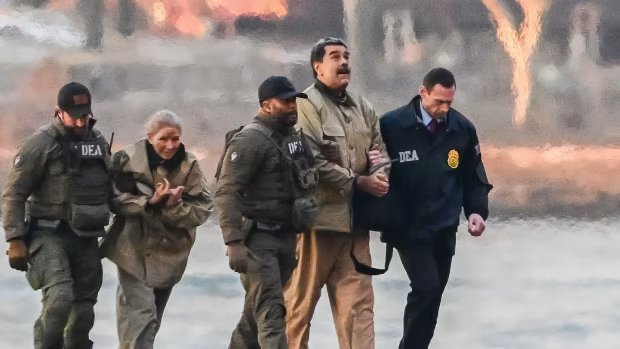
Nicolás Maduro’s appearance on January 5 in a Manhattan federal courthouse was more than a headline.
It underscored one of the rarest and most consequential legal battles in modern U.S. jurisprudence: whether a sitting or former head of state can stand trial on felony charges brought by the United States and still claim sovereign immunity.
The consequences touch not just criminal law, but international relations, prosecutorial strategy, and risk planning for institutions with global footprints.
The charges—narco-terrorism, conspiracy, drug trafficking, money laundering, and weapons offenses—were brought in the Southern District of New York (SDNY), a jurisdiction well versed in international criminal prosecutions.
The U.S. Department of Justice (DOJ) asserts that Maduro’s conduct extended beyond political rhetoric into alleged decades-long illegal conspiracies.
But the defense strategy, led by Barry Pollack, hinges on immunity and the claim that his capture by U.S. forces was an unlawful “abduction.”
This dual approach not only challenges the substance of the prosecution but attacks the legitimacy of its foundational premise, putting institutional exposure at the forefront.
At its core, the case asks whether a foreign national, recognized by some as a head of state and by others as illegitimate, can be prosecuted for wrongdoing in a U.S. federal court without offending international law norms.
The answer could rewrite how criminal and sovereign law intersect.
U.S. courts have seldom confronted head-of-state immunity in criminal contexts. Most immunity doctrines are civil in nature, and U.S. practice historically treats immunity for criminal acts narrowly.
Previous cases, such as those against Ferdinand Marcos and Mohammed bin Salman, involved civil damages and were dismissed on immunity grounds.
But criminal prosecution—especially when tied to territorial or extraterritorial acts—complicates matters significantly. This isn’t a theoretical debate; it is a collision of enforceability, authority, and institutional credibility.
The prosecution maintains that Maduro is not entitled to immunity because the United States disputes the legitimacy of his Venezuelan presidency following a contested 2018 election.
The defense contends otherwise, arguing that if immunity is denied, it erodes the fundamental protections that heads of state have long relied on.
What happens next in SDNY will test the very contours of sovereign immunity doctrine in criminal law and expose chokepoints that multinational entities must now evaluate.
Leverage, Friction, and the New Balance of Power
The asymmetries here are unmistakable. On the one side is the U.S. federal government, deploying prosecutorial firepower and extraterritorial jurisdiction in a high-stakes national security environment.
On the other side stands a leader whose legal strategy touches on political legitimacy, international recognition, and foundational concepts of sovereign rights.
Judges often defer to political branches on recognition issues, but when prosecutors anchor a criminal case on the premise that a defendant no longer holds legitimate office, that deference becomes a weapon rather than a shield.
This is the sharp irony at the heart of the legal conflict: Maduro argues he was unlawfully removed and remains immune; the U.S. argues he is no longer president and therefore has no immunity to assert.
A historical comparison to Manuel Noriega illustrates the precarious nature of immunity arguments in criminal contexts. Noriega, a former Panamanian strongman, also invoked immunity after his capture in 1989.
The U.S. courts rejected the argument, and Noriega was convicted. But unlike Maduro, Noriega never held the formal office of president, making the immunity line easier for courts to dismiss.
Maduro’s formal title complicates the analysis, even as the U.S. dispute over his legitimacy potentially undermines it.
The strategic leverage in this case may ultimately hinge on evidence. Prosecutors must prove that Maduro agreed to and participated in criminal conspiracies.
Defense commentators have noted that the current indictment contains relatively thin direct links to his personal actions.
That evidentiary gap gives the defense an opening to challenge sufficiency and to portray the prosecution as speculative, further amplifying institutional pressure on judges to scrutinize prosecutorial claims.
The broader balance of power extends well beyond SDNY.
The case now shapes how heads of state, multinational boards, insurers, and legal counsel assess transnational exposure.
It is not merely about whether one individual’s immunity holds; it is about whether international law can withstand the push and pull of U.S. domestic prosecution when global political legitimacy is contested.
Reputation, Risk, and the Commercial Irony
The commercial and institutional irony in this case is unmistakable. Sovereign immunity doctrine is historically designed to protect leaders from prosecution.
Yet Maduro’s assertion of that doctrine in a U.S. courtroom has instead propelled his case into the heart of U.S. criminal jurisprudence, exposing him—and the concept—to intense legal and public scrutiny.
The consequences extend well beyond foreign policy desks.
Global insurers, correspondent banks, compliance departments, and risk strategists must now consider how immunity claims might unfold if a jurisdiction chooses to assert criminal authority over a political figure with contested legitimacy.
If immunity is denied or limited in SDNY, it sets a precedent that could ripple into how corporations evaluate exposure when they touch individuals with governmental ties.
Even though Maduro is not a corporate entity, the litigation strategy offers powerful lessons.
When a sovereign figure’s conduct is interpreted as outside the official umbrella of state functions—particularly if tied to criminal conspiracy—they may be treated similarly to executives in private corporations facing prosecution for personal misconduct.
This blurs a once-clear boundary between political office and criminal liability and forces institutions to rethink exposure mapping.
The SDNY courthouse is not merely a backdrop; it is a stage where institutional credibility, prosecutorial tactics, and defense strategy intersect.
The presence of the Department of Justice, the Drug Enforcement Administration (DEA), Homeland Security Investigations (HSI), and international legal observers means that the outcome will carry symbolic as well as practical consequences.
Former Status Quo | Strategic Trigger | 2026 Reality
| Former Status Quo | Strategic Trigger | 2026 Reality |
|---|---|---|
| Heads of state rarely face criminal charges in U.S. courts | U.S. capture + federal indictment + immunity claim | Legal legitimacy dispute weaponized against immunity; trial moves forward |
| Civil immunity dominated doctrine | Criminal prosecution thrust immunity into core litigation | Immunity doctrine tested under extreme conditions |
| Sovereignty issues mostly diplomatic | Military capture + U.S. criminal nexus | Courts become primary arena for international legitimacy |
The Jurisdictional Chokepoints
This case is now a jurisdictional crucible in SDNY. If immunity claims fail here, the implications could affect how federal circuits handle future cases involving extraterritorial reach.
The Second Circuit Court of Appeals may ultimately decide which parts of immunity doctrine stand or fall when applied to criminal prosecution.
The Venezuelan Attorney General’s public contestation of jurisdiction frames the next chokepoint. If official conduct is classified as part of state duties rather than personal conspiracy, immunity could be upheld.
If the conduct is separable and criminal in nature, immunity could be denied. This distinction already plays out in contrasting cases involving civil claims against foreign officials, such as the civil suits against Ferdinand Marcos and Mohammed bin Salman, which were dismissed on immunity grounds.
But criminal cases like this one occupy a different legal lineage. Criminal liability and civil damages intersect but are analytically distinct.
Whether courts treat this as a political dispute or a criminal conspiracy will determine how future immunity claims are adjudicated.
Marco institutional players extend beyond the courtroom.
The U.S. State Department’s recognition posture, DOJ’s prosecutorial narrative, and international legal observers will all shape how immunity doctrine is interpreted when sovereign legitimacy is contested.
Authority Close
Nicolás Maduro’s 2026 SDNY arraignment has transformed a legitimacy dispute into a global criminal-immunity test, now pressuring the DOJ, Second Circuit, and Venezuela’s Attorney General to define the limits of sovereign protection in U.S. courts.
The case establishes real information gain by proving that election recognition and forcible capture claims can directly influence immunity viability in criminal prosecution, creating a precedent model for extraterritorial legal exposure and executive mobility risk.
This courtroom fight moves the debate out of embassies and into enforceable legal exposure, forcing institutions and defense teams to reassess cross-border criminal risk and executive mobility.
Legal Insight: 👉 Grok AI Exploitation Crisis in Spicy Mode 👈
People Also Ask
-
Can a sitting president be prosecuted in U.S. federal court?
Traditionally, sitting presidents enjoy immunity from criminal prosecution for official acts. In the U.S., this doctrine arises from constitutional separation of powers. However, when a leader’s legitimacy is contested and the conduct alleged is framed as personal criminal conspiracy, courts may deny immunity, as the SDNY case suggests. -
What is head-of-state immunity in criminal prosecutions?
Head-of-state immunity protects sitting leaders from prosecution by foreign states for official acts. In criminal cases, this doctrine is rarely tested, and its application hinges on whether conduct is official state action or separable personal conduct. -
How did U.S. courts rule on Noriega’s immunity claim?
In Manuel Noriega’s case, U.S. courts rejected his immunity defense after his 1989 capture, allowing prosecution for drug trafficking and related charges. Noriega was convicted and served sentences in multiple jurisdictions. -
Does election legitimacy affect sovereign immunity recognition?
Yes. Sovereign immunity depends in part on recognition, both domestically and internationally. If a prosecuting state disputes the legitimacy of a leader’s election, it may use that dispute to argue immunity does not attach. -
Which U.S. circuit hears most transnational conspiracy appeals?
The Second Circuit Court of Appeals frequently handles appeals involving international criminal jurisdiction, especially those originating from SDNY. -
Can courts reject immunity if conduct is personal corruption?
Yes. If conduct is classified as personal or outside official duties, immunity may be deemed inapplicable, allowing criminal prosecution to proceed. -
What evidence must prosecutors show to prove conspiracy?
Prosecutors must demonstrate an agreement between the defendant and others to commit a criminal offense and an overt act in furtherance of that agreement. -
Can a defendant challenge jurisdiction after forcible capture?
Yes. A defendant may challenge jurisdiction on grounds including unlawful capture, but U.S. courts have generally permitted prosecution if jurisdictional ties are established and due process is satisfied. -
What role does the U.S. State Department play in immunity recognition?
The State Department’s recognition decisions can influence courts’ immunity analysis, especially in determining whether a leader is officially recognized and thus entitled to immunity. -
How do immunity claims affect global executive travel risk?
If immunity defenses are weakened, executives with political ties or disputed legitimacy may face increased travel restrictions and legal exposure when entering jurisdictions that assert criminal authority.
Maduro, sovereign immunity, SDNY, narco-terrorism, Second Circuit, extraterritorial jurisdiction, conspiracy law, head-of-state immunity, DOJ, international criminal law, legitimacy dispute, risk assessment, compliance