
Judge Bars Death Penalty, Narrowing Federal Prosecutors’ Power Before Trial
A federal judge’s decision to bar prosecutors from seeking the death penalty against Luigi Mangione does not end the government’s case.
It does, however, materially change the balance of power inside the prosecution, the limits of punishment now available, and the institutional constraints shaping how federal criminal authority can be exercised.
The ruling removes the most severe sanction from the table before a jury ever hears evidence, narrowing the state’s leverage and clarifying how tightly capital punishment is bounded by technical legal thresholds.
For decision-makers watching federal enforcement — whether in criminal justice, regulated industries, or risk governance — the significance lies less in the alleged crime and more in what the ruling shows about judicial control over prosecutorial ambition.
When courts determine that charging structures are defective, even politically backed enforcement strategies can be curtailed at an early stage, with consequences that reverberate through trial strategy, plea dynamics, and institutional credibility.
This is a liberty-based exposure case. The immediate consequence is not acquittal, but the removal of execution as a lawful outcome. What follows is a prosecution constrained by statute, precedent, and judicial oversight rather than executive intent.
Authority in Play
The authority exercised here rests squarely with the federal judiciary. The judge dismissed the specific federal murder charge that enabled prosecutors to pursue capital punishment, finding that it failed to meet the statutory requirement that the killing occur during another qualifying “crime of violence.” Without that predicate offence, the death penalty could not lawfully be submitted to a jury.
This matters because capital punishment in the federal system is not discretionary rhetoric. It is a tightly conditioned power that depends on precise charging architecture. Prosecutors may believe conduct warrants the ultimate penalty, but courts act as gatekeepers, ensuring that punishment options track statutory design rather than prosecutorial preference or political signalling.
At the same time, the court upheld prosecutors’ ability to use evidence seized at the time of arrest, rejecting defence arguments that the search was unlawful. That ruling preserves the government’s evidentiary foundation even as it loses its most severe sentencing option. Authority, in other words, is being redistributed — constrained in punishment, but sustained in proof.
Liability and Responsibility Shift
The removal of the death penalty shifts liability exposure in several directions at once.
For the defendant, the maximum federal consequence narrows from execution to life imprisonment. Liberty remains severely constrained, but the irreversible sanction has been taken off the table. That change alone alters defence incentives, plea considerations, and long-term litigation posture.
For prosecutors, the ruling limits leverage. Capital exposure often exerts pressure well before trial, shaping negotiations and resource deployment. With that pressure removed, prosecutors must proceed knowing that the ceiling of punishment is lower, even if the underlying allegations remain grave.
For the Department of Justice more broadly, the decision underscores institutional vulnerability when enforcement strategy relies on aggressive interpretations of charging statutes. Political directives to pursue capital punishment do not override the requirement that indictments satisfy exacting legal definitions. When they do not, courts will intervene — publicly and decisively.
Second-Order Institutional Pressure
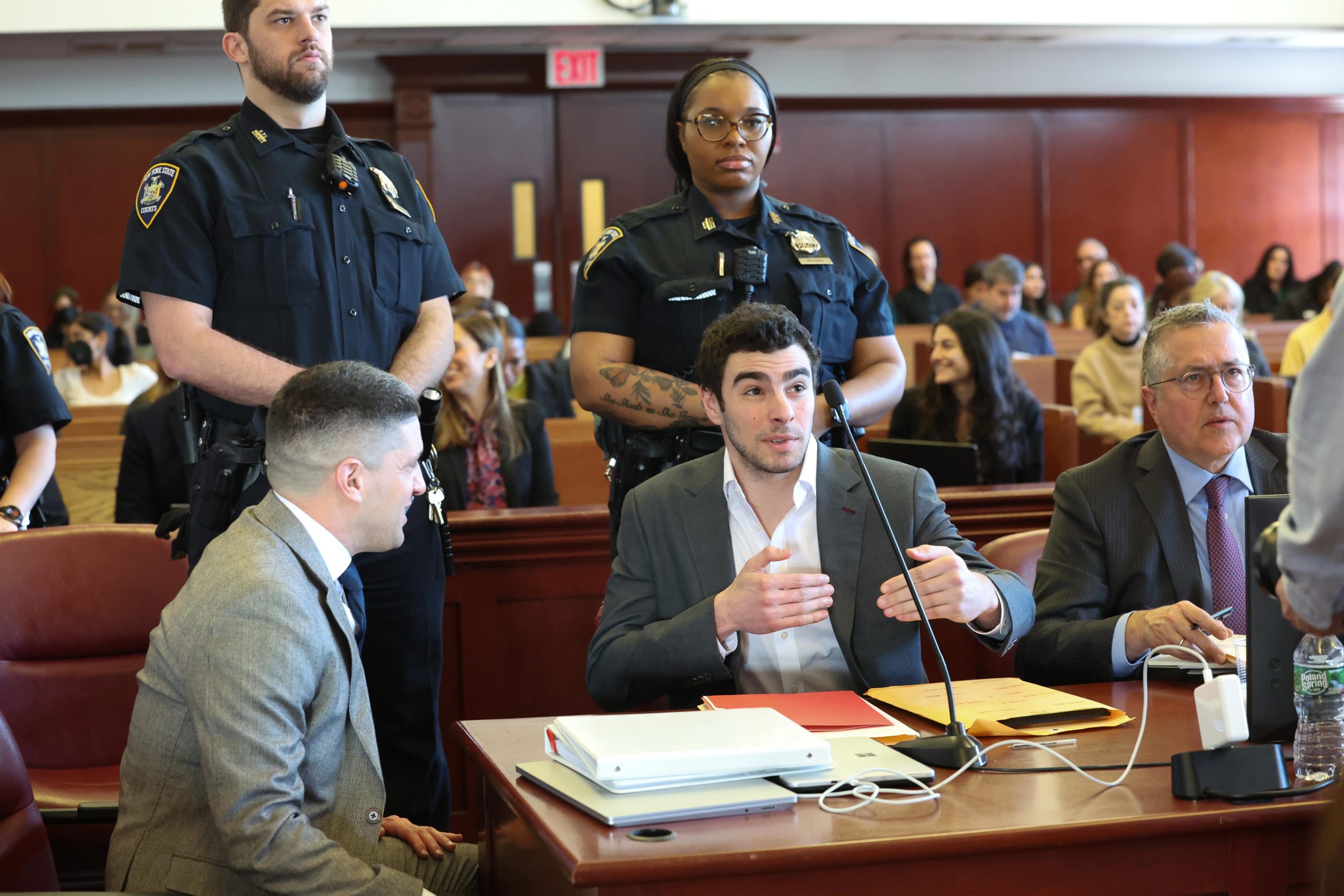
Luigi Mangione appeared in federal court as a judge ruled that prosecutors could not seek the death penalty, narrowing the penalties available before trial.
The ruling also creates near-term institutional pressure points that extend beyond this single case.
First, it reinforces judicial scrutiny over capital charging decisions at a time when federal executions have become politically charged. Courts are signalling that capital punishment remains an exceptional remedy, bounded by narrow statutory gates that cannot be stretched to accommodate enforcement priorities.
Second, it places reputational pressure on prosecutorial offices. Losing a death-penalty pathway on technical grounds invites questions about internal review, charging discipline, and the alignment between public statements and legal foundations. Even where the prosecution continues, credibility is affected.
Third, it shapes appellate posture. Prosecutors were given a defined window to decide whether to appeal the ruling. That decision itself carries institutional risk: appealing may preserve authority if successful, but it also prolongs scrutiny and delays finality. Declining to appeal, by contrast, cements the constraint and forces adaptation.
Fourth, the ruling clarifies that judicial oversight remains a live check on executive criminal policy. Even where administrations publicly commit to expanding or resuming capital punishment, implementation remains contingent on courts’ willingness to accept the legal mechanics used to get there.
Finally, the case illustrates how procedural rulings — often viewed as technical — can have consequences as significant as verdicts. By shaping what punishments are legally available, courts influence the entire trajectory of a prosecution long before jurors are empanelled.
What This Changes for Decision-Makers
For senior decision-makers, the lesson is not about the facts of the alleged killing. It is about institutional constraint.
Courts continue to act as the final arbiters of how far enforcement power can go, even in cases framed by prosecutors as uniquely serious or nationally significant. Legal authority does not expand to meet political appetite; it contracts to fit statutory boundaries.
This matters for anyone operating in environments subject to state power. Charging decisions, enforcement announcements, and public rhetoric may suggest maximum exposure, but actual risk is determined by whether the legal machinery is correctly assembled. When it is not, courts will intervene early, reshaping outcomes before trial.
The ruling also highlights the importance of understanding process over headlines. From the outside, the case still looks like a major federal murder prosecution. Inside the system, however, the removal of the death penalty fundamentally changes leverage, timelines, and strategic posture for all parties involved.
The broader takeaway is institutional rather than individual. Authority in the criminal justice system is not monolithic. It is fragmented, conditional, and subject to judicial veto. When courts exercise that veto, they do more than decide a motion — they recalibrate the balance of power between the state and the accused, with consequences that extend far beyond a single courtroom.