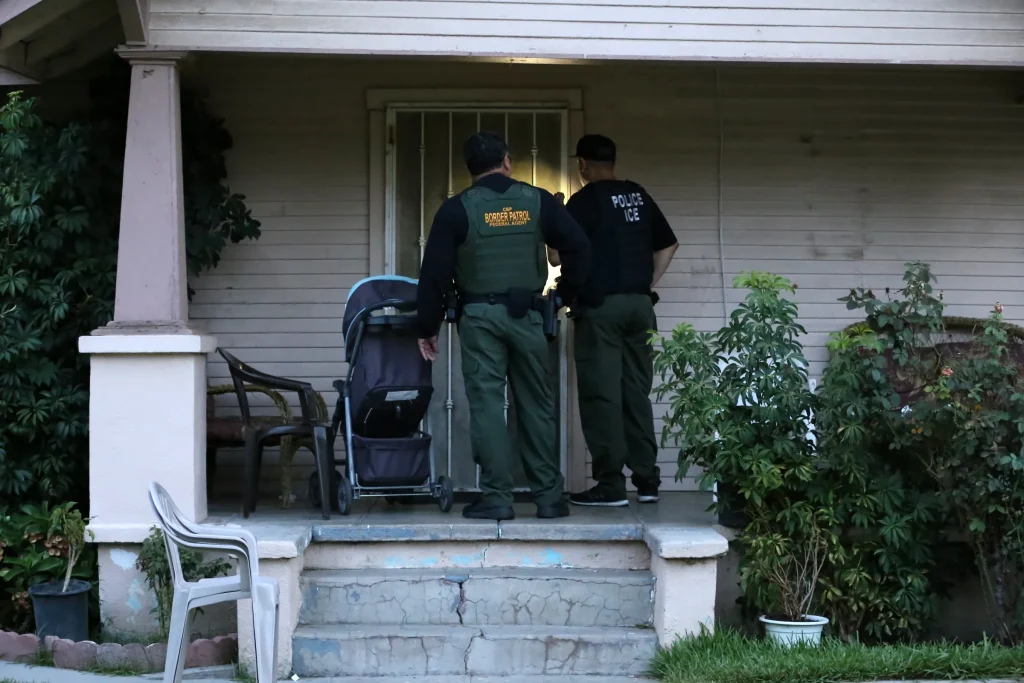
ICE claims power to enter homes without a judge’s warrant, sparking constitutional alarm
US immigration authorities are facing mounting scrutiny after asserting that federal agents can forcibly enter private homes without a judge’s approval – a claim constitutional scholars, immigration lawyers and a federal judge have described as a clear violation of the Fourth Amendment.
An internal Immigration and Customs Enforcement (ICE) memo issued in May instructs agents that they may use force to enter residences armed only with an administrative warrant, according to a whistleblower disclosure reviewed by USA Today and first reported by the Associated Press. Unlike judicial warrants, administrative warrants are signed internally by ICE officials and are not reviewed or approved by a judge.
The directive represents a sharp break from longstanding legal precedent and established policy across the Department of Homeland Security, which has historically required a warrant issued by an independent judge before agents could enter a home to make an arrest.
The memo emerged amid an aggressive expansion of the Trump administration’s deportation campaign, marked by large-scale enforcement operations and a rapid hiring push that has more than doubled ICE’s workforce. How often the policy has been used remains unclear.
What is clear, however, is the growing public fallout.
On 18 January, federal agents with guns drawn forced their way into a home in St Paul, Minnesota, detaining ChongLy Thao, a naturalized US citizen. Family members and local officials said agents never produced a judicial warrant. Images of Thao being led outside shirtless in freezing weather quickly spread online, prompting outrage and calls for an independent investigation. ICE later said agents had been searching for a different person.
Federal officials have sought to downplay constitutional concerns. Marcos Charles, a senior ICE official, said in January that agents do not “break into” homes, insisting entry is made either during “hot pursuit” or with an administrative arrest warrant – documents he claimed courts have deemed sufficient for immigration enforcement.
During a visit to Minneapolis, Vice-president JD Vance echoed that position, saying agents would not enter homes “without some kind of warrant”, while acknowledging that could include administrative paperwork rather than a judge’s order. He conceded the policy would likely face legal challenges.
Civil liberties experts say the distinction is fundamental – and dangerous.
Administrative warrants, including Form I-205, authorize the arrest of individuals with final orders of removal but are not reviewed by the judiciary. They can be signed by ICE officials, sometimes by the very agents carrying out the arrest. Judicial warrants, by contrast, require an independent judge to assess evidence and determine whether forced entry into a home is justified.
“This goes to the heart of the Fourth Amendment,” said Ric Simmons, a constitutional law professor at Ohio State University. “The entire point is to require law enforcement to justify invading someone’s home to a neutral decision-maker outside the executive branch.”
Legal scholars warn that conflating administrative paperwork with judicial warrants strips away one of the most basic safeguards against state overreach.
In 2024, a federal judge in California reached the same conclusion, ruling that ICE agents may not enter homes without a judicial warrant and declaring that such actions violate the Constitution. The new memo explicitly carves out an exception for that jurisdiction.
The Supreme Court has recognized only narrow circumstances in which officers may enter a home without a warrant – typically emergencies involving imminent danger or the risk of evidence being destroyed. Immigration enforcement, experts note, is a civil process, not an emergency.
“There’s no emergency here,” Simmons said. “They’re not claiming one. It’s a civil law violation, and the courts have been very clear about that.”
The memo also appears to contradict ICE’s own training materials. A 2021 ICE guide states explicitly that a warrant of removal “does NOT alone authorize a Fourth Amendment search of any kind”.
Despite this, the May memo – signed by the acting ICE director – claims government lawyers have recently determined that administrative warrants are sufficient under the Constitution and immigration law. No detailed legal justification has been publicly released.
Whistleblowers allege the policy was quietly rolled out, shared verbally with supervisors and new recruits rather than formally circulated. According to a disclosure submitted to members of Congress, agents were instructed to read the memo briefly and return it, limiting documentation.
The whistleblowers warn that many newly hired agents lack prior law enforcement experience and are being encouraged to rely on administrative warrants to enter homes without consent – including homes belonging to US citizens.
“That raises the risk of widespread, unlawful intrusions into private residences,” the disclosure states.
For legal experts, the secrecy surrounding the policy is itself revealing.
“This is not how an agency behaves when it’s confident its actions will withstand judicial scrutiny,” said Lindsay Nash, a law professor at Yeshiva University’s Cardozo School of Law. “ICE has long acknowledged that administrative warrants do not authorize forced home entry. Trying to reverse that quietly will be extraordinarily difficult to defend in court.”
As legal challenges loom, the directive has intensified fears among immigrant communities and civil rights advocates that constitutional protections long considered settled are being deliberately tested – or ignored – in the name of enforcement.
What this means legally – and what people need to know now
The central legal question raised by ICE’s directive is not abstract. It is immediate, personal and constitutional: can federal immigration agents legally force their way into your home without a judge’s warrant?
Short answer: No – and courts have been clear about that.
Under the Fourth Amendment, law enforcement officers may not enter a private home without either voluntary consent or a warrant issued by an independent judge, except in rare emergency circumstances. Immigration enforcement, which is civil rather than criminal, does not create a blanket exception.
Administrative warrants – the documents ICE says it relies on – do not meet that standard.
They are signed internally by ICE officials, not reviewed by a judge, and do not authorize forced entry into a home. Courts have repeatedly drawn that line, and ICE itself acknowledged it in its own training materials until recently.
So how is ICE claiming it can do this?
ICE is leaning on a legal theory that immigration enforcement falls under “civil” authority and therefore does not require the same constitutional safeguards as criminal policing. Some government lawyers argue this places immigration arrests closer to regulatory actions than criminal searches.
But constitutional scholars say that argument collapses at the front door.
The Supreme Court has consistently ruled that the home is afforded the highest level of Fourth Amendment protection, regardless of whether the government action is civil or criminal. The “special needs” and emergency exceptions ICE may try to invoke are narrow and do not apply to routine immigration arrests.
Does the public have to accept this policy?
No. Policies do not override the Constitution.
ICE can issue internal directives, but they do not become lawful simply because the agency says so. If agents enter homes without judicial warrants, those actions are vulnerable to legal challenge, suppression of evidence, civil liability and court injunctions.
In fact, a federal judge in California already barred ICE from doing exactly this in 2024, ruling that warrantless home entry violates the Fourth Amendment. That ruling remains binding in that jurisdiction and signals how other courts are likely to respond.
What happens if agents show up at your door?
Legal experts are clear on this point:
-
You are not required to open the door unless agents present a judicial warrant signed by a judge
-
An administrative ICE warrant does not authorize forced entry
-
You have the right to ask officers to slide the warrant under the door or hold it up to a window
-
Silence or refusal to open the door is not consent
If agents enter anyway without a judicial warrant or exigent circumstances, that entry may later be ruled unlawful.
Why is this likely to end up in court?
Because ICE’s position conflicts with:
-
Supreme Court precedent
-
Existing federal court rulings
-
DHS’s own historical policy
-
ICE’s own training manuals
That combination makes the directive legally fragile. Courts are especially skeptical when agencies quietly reverse long-standing constitutional interpretations without public explanation or legislative change.
Legal experts expect lawsuits challenging unlawful entries, requests for nationwide injunctions, and potential damages claims — particularly in cases involving US citizens or lawful residents.
The bottom line
ICE can say it has this authority.
That does not mean the courts will agree.
And if history is any guide, they likely won’t.