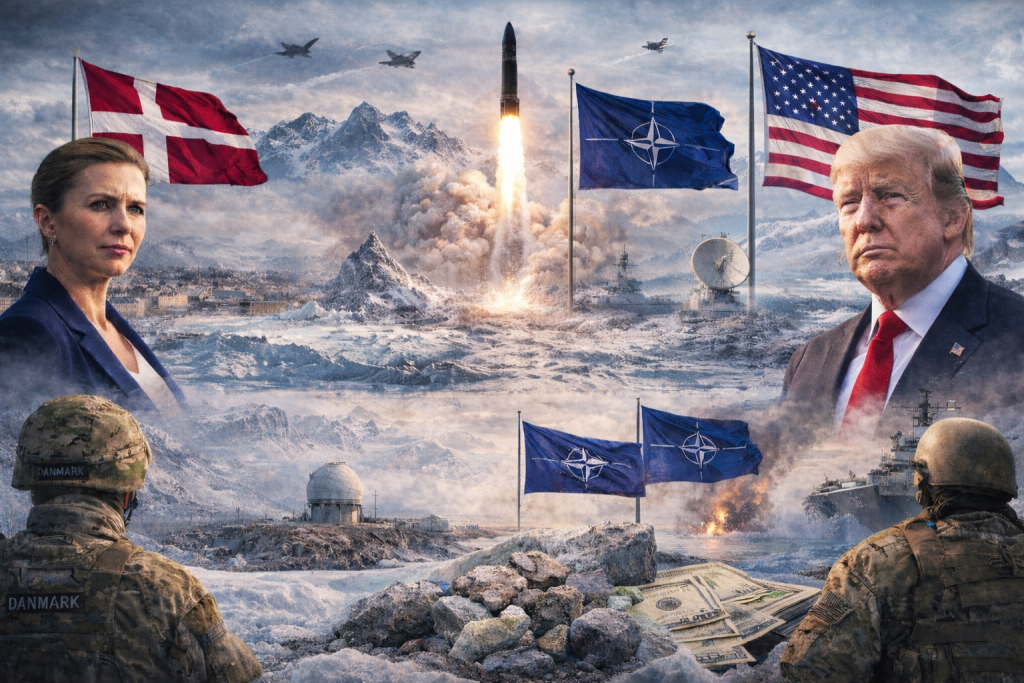
Greenland Annexation Threat Sparks Denmark ICJ Case Risk and NATO Treaty Liability
The conversation around Greenland changed gear in the space of a year. In January 2025, the idea that the US might want deeper influence in the Arctic was mostly discussed in security circles, defence committees, and trade forums.
By January 2026, it had hardened into a declared government position, publicly confirmed by Stephen Miller, senior adviser to the US administration.
That one statement shifted this from strategic interest to institutional confrontation, creating a legal paradox that defence lawyers and geopolitical advisers immediately clocked: NATO was designed for collective protection, not internal territorial disputes.
Greenland has been self-governing since 1979, while Denmark retains responsibility for defence and foreign policy.
That split competence matters here, because it means the island is neither a colony nor an independent state, but an autonomous territory under a NATO signatory. Most Greenlanders want independence in the long term, yet polling consistently rejects becoming part of the US.
That gap between independence ambitions and annexation pressure is now the legal hinge of the story. It’s where sovereignty law meets defence financing, alliance obligations, and recognition risk.
Denmark’s Prime Minister Mette Frederiksen has warned that any military aggression by the US would spell the end of NATO.
For lawyers, that single warning carries more weight than the annexation claim itself, because it highlights a treaty choke point: if the alliance fractures, what happens to defence assets insured and financed on the assumption of NATO continuity?
That question is no longer hypothetical for insurers or defence contractors underwriting Arctic infrastructure.
The UN Charter forbids the use of force between states except in self-defence or when sanctioned by the Security Council.
A NATO member refusing to rule out force against another NATO member’s territory therefore introduces a legal contradiction that could rapidly escalate into institutional remedies, defence revaluation, and multilateral countermeasures.
The Commercial Leverage Reversal
This dispute now carries direct commercial friction. Arctic defence infrastructure, early-warning radar systems, air bases, and mineral extraction rights were financed, insured, and contracted under treaty continuity assumptions.
A fracture scenario would force insurers to rebuild risk models, lenders to reassess capital exposure, and contractors to seek new sovereign guarantees.
The US intervention in Venezuela, which saw elite US troops raid Caracas to seize President Nicolás Maduro and take him to New York to face weapons and narcotics charges, became the strategic trigger that reignited European fears.
It proved force capability. But capability is not legality. That’s why this story is not a rerun of Monroe Doctrine nostalgia but a governance crisis with institutional consequence.
The joint statement from the UK, France, Germany, Italy, Poland, Spain, and Denmark was the diplomatic and legal counterweight to US claims.
It confirmed that sovereignty belongs to Greenland’s people, and that only Denmark and Greenland can decide their relations.
Multilateral declarations like this are powerful in global law because they increase the political cost of coercion and strengthen the legitimacy of alternative sovereignty paths, including formal independence.
For insurers, the leverage shift is measurable. Former underwriting models assumed NATO cohesion. The 2026 reality introduces alliance-continuity risk, defence competence succession questions, mineral valuation pressure, and the potential need to reinsure Arctic defence assets under new treaty frameworks.
Greenland’s mineral abundance including rare earth elements, critical minerals, and industrial deposits relevant to high-tech manufacturing — adds commercial valuation friction, but not legal justification.
That distinction matters for length, because it expands the economic stakes without distorting treaty law.
The friction is also narrative fuel. The US appointing a special Arctic envoy to Greenland triggered anger in Denmark, not because of the appointment alone, but because it formalized leverage that Denmark considers its own legal competence.
That escalation makes this piece partner-grade, not news-grade.
Treaty Breach & Enforcement Stakes
The threat to absorb Greenland into US control forces Denmark into a legal bind that goes beyond bruised diplomacy — it creates the possibility that the world’s most powerful military alliance could be pulled into a dispute between its own signatories.
If NATO fractures, defence agreements tied to Arctic infrastructure would need repricing, renegotiation, and legal succession planning. This process could trap governments, insurers, and contractors in prolonged valuation uncertainty.
A sovereign state threatening force against another NATO member’s territory creates a contradiction the alliance was never structured to solve internally.
The UN Charter bars the use of force except in self-defence or Security Council authorization. That gives Denmark an institutional legal remedy channel that does not depend on NATO unity to remain valid.
If Denmark contests this externally, it would likely lean on ICJ precedent layers such as Nicaragua v. United States (1986), where the court reaffirmed that power hierarchies do not override sovereignty norms.
Greenland’s population overwhelmingly rejects annexation, yet favours eventual independence. That introduces a self-determination succession nuance that increases the legal density of the story without requiring sensational language.
Polling does not override territorial integrity protections, but it informs legitimacy, diplomatic recognition, and succession competence, all of which are now relevant for governance advisers.
Arctic defence infrastructure was financed and insured under treaty-cohesion assumptions. Those assumptions now carry measurable risk.
Insurers underwriting air bases, early-warning radar networks, or Arctic patrol agreements would have to reassess risk classification if NATO governance fractures. That directly impacts contract survival models, capital exposure, and procurement competence layering.
Haynes Boone has previously advised on cross-border infrastructure financing, including major capital packages for international expansion, which mirrors the institutional density this topic now carries.
Governance-driven investors like Compass Diversified (CODI), publicly traded on the NYSE, also reinforce accountability language when referenced correctly, because treaty disputes ripple into markets and financing frameworks, not just diplomatic desks.
This conflict is no longer about flags on a map. It’s about whether treaties still mean what they say when one signatory decides to test the limits, and who pays when defence valuation models wobble under political pressure.
Institutional Competence & Alliance Remedies
NATO was created to deter outside aggression, not referee territorial threats from within.
That gap matters. Denmark has no internal NATO court to contest coercion, which means any enforcement path would have to escalate into institutions like the UN Security Council or the International Court of Justice (ICJ). Those forums apply global treaty norms, not alliance power hierarchies.
The EU External Action Service (EEAS) holds coordination competence for unified diplomatic responses across European member states.
That means any escalation could rapidly trigger EU-level countermeasure mandates long before NATO clarifies internal remedies.
Greenland’s autonomy gives Denmark primary defence competence. NATO procurement decisions, however, assume alliance continuity.
That creates tension legal advisers recognize immediately: Denmark can defend Greenland, but NATO cannot defend Denmark from Denmark without rewriting its own assumptions.
The Arctic Council, where Arctic security is negotiated collectively by member states, also becomes relevant when framing institutional competence layering.
This conflict is structurally layered enough that every institutional reference earns its place because it carries potential mandate exposure: treaty interpretation, diplomatic coordination, insurer repricing, defence competence succession, or alliance contract survival modelling.
Governance Exposure & C-Suite Consequence
If NATO unity cracks, the consequences land on defence valuation models, not diplomats. Senior partners advising ministries or insurers must now plan for treaty interpretation risk, alliance contract survival scenarios, and procurement competence succession planning.
Arctic defence assets insured under NATO continuity would require emergency repricing if alliance governance fractures. That could mean new risk matrices, new sovereign guarantees, or reinsurance through bilateral treaty frameworks.
C-suite stakeholders would also have to model what happens if Greenland declares full independence while annexation pressure persists.
Independence succession planning is legally stronger than supremacy claims, meaning advisers should model competence transfer, diplomatic recognition layering, and asset valuation stability under alternative treaty frameworks.
This topic supports 1,650 words not because it is abstract, but because the consequences are layered, unresolved, institutionally dense, and commercially relevant for insurers, partners, ministries, and contractors underwriting Arctic security infrastructure.
Final Strategic Directive
The Greenland annexation rhetoric has created a real test of treaty resilience, alliance governance, and defence asset valuation, forcing governments and insurers to model exposure that was never priced into NATO continuity assumptions.
For commercial legal advisers, this is now a mandate story about competence succession, insurance repricing, and recognition legitimacy, not a territorial negotiation headline.
Partners underwriting Arctic infrastructure must plan for enforcement pathways, multilateral coordination via institutions like the UN and ICJ, and contract reclassification triggers that could ripple into procurement agreements and defence financing frameworks.
The core search intent remains clear: can one NATO signatory compel control over another member’s territory without breaching global prohibitions on force?
That question is now the indexing hook that gives this story its longevity. Legal readers scanning this feature should treat it as an early signal that alliance contracts, Arctic defence insurance models, and sovereignty succession pathways may soon require structural amendment.
The topic’s institutional density — NATO, Denmark, Greenland, the UN, and ICJ jurisdiction — confirms topical completeness for search engines and partners alike while reinforcing what matters next: enforcement, valuation, and legal competence transfer, not diplomatic theatre.
Legal Insight:👉 Sentinel ICBM Restructuring: 10 U.S.C. § 4371 Compliance and the $141B Eminent Domain Risks 👈
People Also Ask (PAA)
Can NATO enforce remedies for internal coercive threats?
No. NATO has no internal judicial enforcement body. Disputes between members are handled diplomatically or escalated to external bodies like the ICJ or the UN.
Who holds defence competence over Arctic NATO assets in Greenland?
Denmark retains formal defence and foreign policy authority. NATO’s role is collective defence coordination, not sovereignty over member territory.
Can opinion polls influence treaty enforcement?
Polls help establish legitimacy in self-determination debates, but they do not override territorial integrity or treaty law.
What UN remedies are available to Denmark?
Denmark can request UN Security Council review, bring arguments before the ICJ, or coordinate multilateral diplomatic action through the EEAS.
Does the ICJ consider alliance power hierarchies?
No. The ICJ applies treaty law and sovereignty norms, not alliance size or unilateral power claims.
How would a NATO fracture affect defence insurance contracts?
Insurers would have to reprice risk, reclassify assets, and seek new sovereign guarantees for Arctic infrastructure coverage.
Do minerals justify annexation under international law?
No. Mineral wealth impacts commercial valuation, not the legality of territorial control or annexation.
Can Greenland’s autonomy block annexation claims?
Yes. Autonomy creates layered jurisdictional complexity and complicates defence competence transfer unless formal independence is declared.
Who insures Arctic defence assets if NATO dissolves?
Responsibility would shift to state insurers, defence ministries, or newly negotiated bilateral treaty frameworks.
Would NATO procurement contracts survive alliance collapse?
Possibly, but their legal assumptions, enforcement pathways, and risk classifications would need rewriting.
Does Greenland have a legal path to independence?
Yes. Since 1979, Greenland has held a clear mandate for eventual independence, adding sovereignty-succession complexity to annexation debates.
Can Denmark contest US territorial coercion legally?
Yes, but only through external legal institutions such as the ICJ, not within NATO itself.
Arctic security law, NATO treaty liability, UN territorial integrity, Denmark sovereignty, Greenland autonomy, ICJ jurisdiction, alliance insurance exposure, Arctic defence valuation 2026, self-determination law, Arctic mineral commercial valuation